Coordinated optimization of departure sequencing and section-track allocation in railway short-term concentrated departure scenarios based on qubo and hybrid quantum algorithms
Pith reviewed 2026-06-28 01:25 UTC · model grok-4.3
The pith
A QUBO model paired with simulation evaluation lets hybrid quantum algorithms reduce railway departure costs and delays.
A machine-rendered reading of the paper's core claim, the machinery that carries it, and where it could break.
Core claim
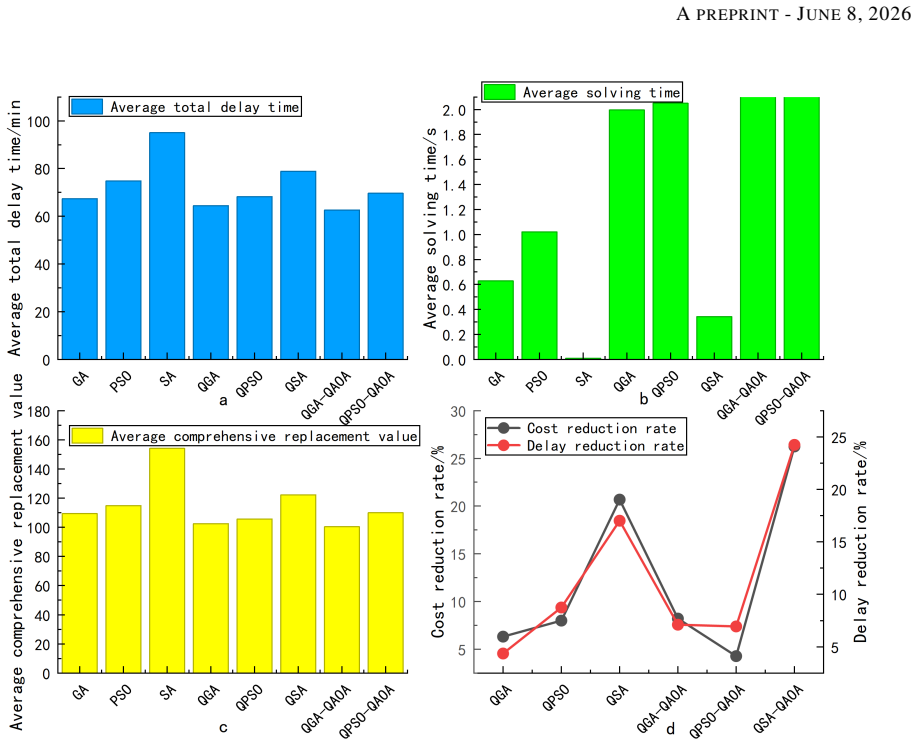
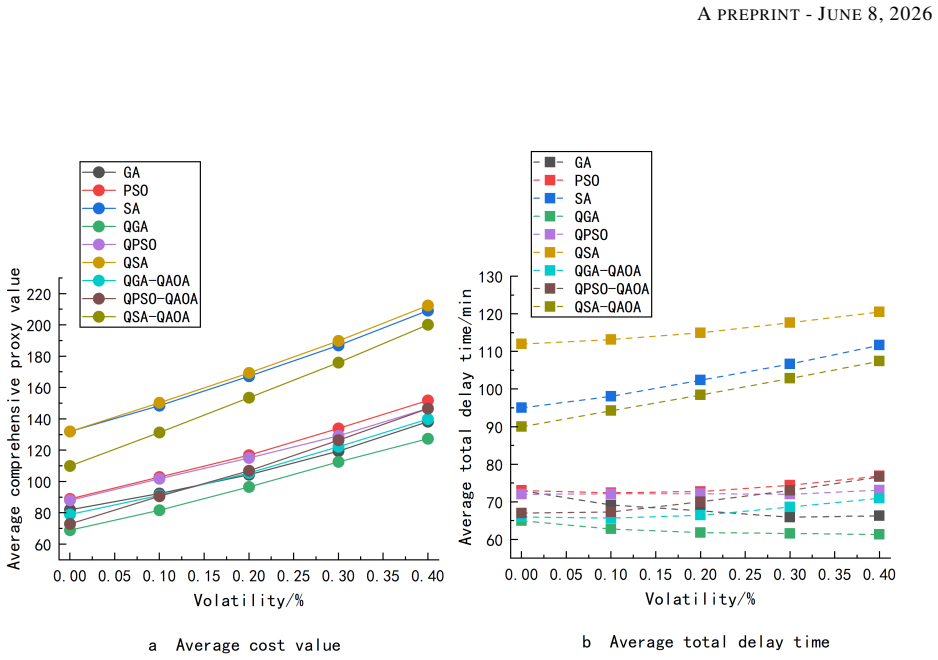
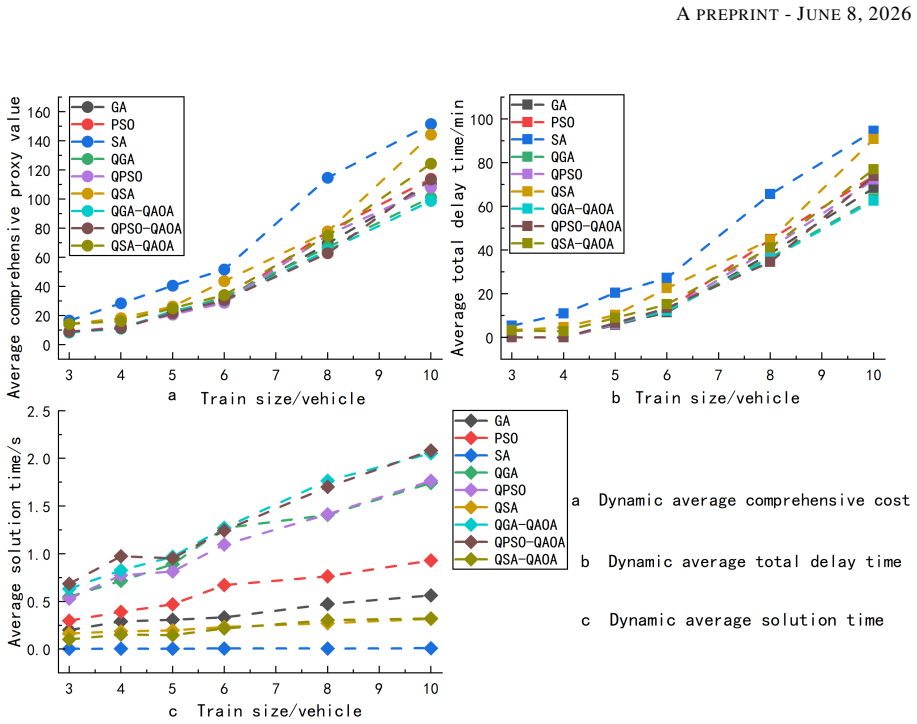
The QUBO model generates feasible departure and track assignments after decoding, while the added simulation layer distinguishes operational performance; in the tested cases the hybrid QPSO-QAOA variant performs best under normal conditions and the quantum-enhanced solvers cut comprehensive cost by 4.28–26.26 percent and total delay by 4.37–24.25 percent on average under dynamic conditions relative to conventional counterparts.
What carries the argument
A unified QUBO that represents departure-position assignment and section-track selection together as binary variables, evaluated by a separate simulation layer that tracks time-dependent effects.
If this is right
- Feasible candidate schemes are produced directly from the decoded QUBO solutions.
- The simulation step separates algorithm performance under both normal and disturbed operating conditions.
- Quantum-enhanced solvers deliver measurable average reductions in cost and delay on the tested instances.
Where Pith is reading between the lines
- The same layered structure could be applied to other dense scheduling problems where binary assignment decisions interact with continuous time flows.
- Scaling the QUBO size or replacing the simulator with live data feeds would test whether the reported gains persist at larger stations.
- If the simulation proves accurate, the framework supplies a practical route to embed quantum solvers inside existing railway dispatch software.
Load-bearing premise
The simulation layer correctly reproduces the real time-dependent interactions between trains that the static QUBO cannot capture.
What would settle it
Compare the simulated cost and delay values against measured outcomes from an actual railway control system running the same departure sequences.
Figures

read the original abstract
This study examines the coordinated optimization of departure sequencing and section-track allocation in railway short-term concentrated departure scenarios. A quadratic unconstrained binary optimization (QUBO) model is formulated to represent departure-position assignment and section-track selection within a unified binary framework. Because the quality of a dispatching scheme depends on time-dependent operational interactions that cannot be fully captured by a static combinatorial model, a simulation-based evaluation layer is introduced to assess section occupation, intermediate-station waiting, platform-capacity pressure, running-time fluctuations, and delay propagation. Within this layered framework, conventional heuristics, quantum-inspired algorithms, and hybrid algorithms are compared on the same decision structure. The results show that the QUBO model can generate feasible candidate schemes after decoding, while the simulation layer clearly differentiates the operational performance of the competing algorithms under both normal and disturbed conditions. In the tested scenarios, QPSO-QAOA performs best under normal conditions, and the quantum-enhanced methods reduce comprehensive cost by 4.28\%--26.26\% and total delay by 4.37\%--24.25\% on average under dynamic conditions relative to their conventional counterparts. These findings suggest that the integration of QUBO-based modeling and simulation-based evaluation provides a useful methodological framework for railway short-term concentrated departure scheduling, although validation with real operational data remains necessary.
Editorial analysis
A structured set of objections, weighed in public.
Referee Report
Summary. The manuscript formulates a QUBO model unifying departure-position assignment and section-track selection for railway short-term concentrated departure scenarios. Because the static QUBO cannot capture time-dependent interactions, a simulation layer is added to evaluate section occupation, waiting times, platform pressure, running-time fluctuations, and delay propagation. Conventional heuristics are compared against quantum-inspired and hybrid algorithms (including QPSO-QAOA) on the same decision structure; the results claim that QPSO-QAOA performs best under normal conditions and that quantum-enhanced methods reduce comprehensive cost by 4.28%--26.26% and total delay by 4.37%--24.25% on average under dynamic conditions. The authors conclude that the QUBO-plus-simulation framework is methodologically useful, while noting that validation against real operational data remains necessary.
Significance. If the simulation layer were shown to be calibrated and validated against real railway data, the work would supply a concrete layered framework for applying QUBO and hybrid quantum algorithms to a practical scheduling problem, with explicit handling of both combinatorial decisions and dynamic operational metrics. The explicit statement that real-data validation is still required is a constructive acknowledgment, but the current numerical performance claims rest entirely on an internal, unvalidated simulation.
major comments (2)
- [Abstract and Results] Abstract and Results section: the reported average reductions (4.28%--26.26% comprehensive cost, 4.37%--24.25% total delay) are generated exclusively inside the authors' simulation layer that models section occupation, waiting, platform pressure, and delay propagation. No parameter fitting, comparison to historical railway logs, or sensitivity analysis is described, so the ranking of QPSO-QAOA and the quantum-enhanced methods over conventional heuristics is not demonstrably independent of the chosen disturbance and propagation rules.
- [Simulation-based evaluation layer] Simulation-based evaluation layer (described in Abstract): the manuscript states that the static QUBO cannot capture time-dependent interactions and therefore introduces the simulation layer, yet the layer itself receives no calibration against external data and no external benchmarks. This makes the cross-algorithm performance claims under dynamic conditions circular with respect to the simulation rules chosen by the same team.
Simulated Author's Rebuttal
We thank the referee for the detailed and constructive report. The comments correctly identify that all reported performance metrics originate from our internal simulation layer and that external calibration against real railway data is absent. We address each point below, agree that the absolute numerical gains are model-dependent, and will make targeted revisions to strengthen the description of the simulation assumptions and limitations while preserving the paper's core methodological contribution.
read point-by-point responses
-
Referee: [Abstract and Results] Abstract and Results section: the reported average reductions (4.28%--26.26% comprehensive cost, 4.37%--24.25% total delay) are generated exclusively inside the authors' simulation layer that models section occupation, waiting, platform pressure, and delay propagation. No parameter fitting, comparison to historical railway logs, or sensitivity analysis is described, so the ranking of QPSO-QAOA and the quantum-enhanced methods over conventional heuristics is not demonstrably independent of the chosen disturbance and propagation rules.
Authors: We agree that the quantitative improvements are obtained solely within the simulation layer and that no external fitting or historical-log comparison is performed. The simulation is constructed from standard railway engineering parameters (section capacities, running-time distributions, platform dwell constraints) to create a controlled testbed that applies identical disturbance and propagation rules to every algorithm. This ensures that observed differences reflect the quality of the QUBO-derived solutions rather than differences in evaluation rules. Nevertheless, the referee is correct that the specific percentage ranges depend on the chosen parameter values. We will add an explicit sensitivity analysis subsection and a dedicated paragraph stating that the reported gains are relative and conditional on the simulation assumptions. revision: partial
-
Referee: [Simulation-based evaluation layer] Simulation-based evaluation layer (described in Abstract): the manuscript states that the static QUBO cannot capture time-dependent interactions and therefore introduces the simulation layer, yet the layer itself receives no calibration against external data and no external benchmarks. This makes the cross-algorithm performance claims under dynamic conditions circular with respect to the simulation rules chosen by the same team.
Authors: The simulation layer is introduced precisely because the static QUBO cannot encode time-dependent dynamics; its role is evaluative rather than predictive. All algorithms are decoded into the same set of departure sequences and track allocations and then fed into an identical simulation engine, so the ranking among them is internally consistent. We acknowledge, however, that the absence of external calibration means the absolute performance numbers cannot be claimed to generalize beyond the model. We will revise the manuscript to (i) provide a more detailed derivation of the simulation parameters from railway standards, (ii) include a limitations paragraph that reiterates the need for real-data validation, and (iii) avoid any language suggesting the simulation constitutes a calibrated operational model. revision: yes
- We currently lack access to proprietary real-time railway operational logs required for external calibration and validation of the simulation layer.
Circularity Check
No significant circularity; performance claims are simulation-internal comparisons, not reductions by construction
full rationale
The paper formulates a QUBO model for assignment, then introduces a separate simulation layer to evaluate time-dependent effects (section occupation, delay propagation) that the static model omits. Algorithm comparisons and reported percentage reductions (4.28%–26.26% cost, 4.37%–24.25% delay) are produced by executing the same decoded schemes inside that simulation; no equation, parameter, or result is defined in terms of itself or obtained by fitting a subset and relabeling the output as a prediction. The simulation rules are chosen by the authors, but this is an unvalidated modeling choice (correctness risk) rather than a self-definitional or fitted-input reduction. No self-citation chain, uniqueness theorem, or ansatz smuggling is present in the provided text. The derivation chain therefore remains self-contained against external benchmarks.
Axiom & Free-Parameter Ledger
axioms (1)
- standard math A QUBO formulation can encode departure-position and section-track decisions as binary variables whose quadratic objective captures conflicts and costs.
Reference graph
Works this paper leans on
-
[1]
A survey of optimization models for train routing and scheduling.Transportation Science, 32(4):380–404, 1998
Jean-François Cordeau, Paolo Toth, and Daniele Vigo. A survey of optimization models for train routing and scheduling.Transportation Science, 32(4):380–404, 1998
1998
-
[2]
Railway track allocation: Models and methods.OR Spectrum, 33(4):843–883, 2011
Richard Martin Lusby, Jesper Larsen, Matthias Ehrgott, and David Ryan. Railway track allocation: Models and methods.OR Spectrum, 33(4):843–883, 2011
2011
-
[3]
An overview of recovery models and algorithms for real-time railway rescheduling.Transportation Research Part B: Methodological, 63:15–37, 2014
Valentina Cacchiani, Dennis Huisman, Michael Kidd, Leo Kroon, Paolo Toth, Leo Veelenturf, and Jens Wagenaar. An overview of recovery models and algorithms for real-time railway rescheduling.Transportation Research Part B: Methodological, 63:15–37, 2014
2014
-
[4]
Sharma, P
B. Sharma, P. Pellegrini, J. Rodriguez, and N. Chaudhary. A review of passenger-oriented railway rescheduling approaches.European Transport Research Review, 15:14, 2023
2023
-
[5]
Zwaneveld, Leo G
Peter J. Zwaneveld, Leo G. Kroon, and Stan P. M. van Hoesel. Routing trains through a railway station based on a node packing model.European Journal of Operational Research, 128(1):14–33, 2001
2001
-
[6]
Solution of the train platforming problem.Transportation Science, 45(2):246–257, 2011
Alberto Caprara, Luca Galli, and Paolo Toth. Solution of the train platforming problem.Transportation Science, 45(2):246–257, 2011
2011
-
[7]
Reordering and local rerouting strategies to manage train traffic in real time.Transportation Science, 42(4):405–419, 2008
Andrea D’Ariano, Francesco Corman, Dario Pacciarelli, and Michele Pranzo. Reordering and local rerouting strategies to manage train traffic in real time.Transportation Science, 42(4):405–419, 2008
2008
-
[8]
Törnquist and Jan A
Johan A. Törnquist and Jan A. Persson. N-tracked railway traffic re-scheduling during disturbances.Transportation Research Part B: Methodological, 41(3):342–362, 2007
2007
-
[9]
Improving the robustness in railway station areas.European Journal of Operational Research, 235(1):276–286, 2014
Thomas Dewilde, Pieter Sels, Dirk Cattrysse, and Pieter Vansteenwegen. Improving the robustness in railway station areas.European Journal of Operational Research, 235(1):276–286, 2014
2014
-
[10]
Kroon, Gábor Maróti, Mark J
Leo G. Kroon, Gábor Maróti, Mark J. Retel Helmrich, Michiel J. C. M. Vromans, and Rommert Dekker. Stochastic improvement of cyclic railway timetables.Transportation Research Part B: Methodological, 42(6):553–570, 2008
2008
-
[11]
A branch and bound algorithm for scheduling trains in a railway network.European Journal of Operational Research, 183(2):643–657, 2007
Andrea D’Ariano, Dario Pacciarelli, and Michele Pranzo. A branch and bound algorithm for scheduling trains in a railway network.European Journal of Operational Research, 183(2):643–657, 2007
2007
-
[12]
Integrating train scheduling and delay management in real-time railway traffic control.Transportation Research Part E: Logistics and Transportation Review, 105:213–239, 2017
Francesco Corman, Andrea D’Ariano, Antonio Marra, Dario Pacciarelli, and Marcella Samà. Integrating train scheduling and delay management in real-time railway traffic control.Transportation Research Part E: Logistics and Transportation Review, 105:213–239, 2017
2017
-
[13]
Ising formulations of many np problems.Frontiers in Physics, 2:5, 2014
Andrew Lucas. Ising formulations of many np problems.Frontiers in Physics, 2:5, 2014
2014
-
[14]
Quantum bridge analytics i: A tutorial on formulating and using qubo models.Annals of Operations Research, 314(1):141–183, 2022
Fred Glover, Gary Kochenberger, Richard Hennig, and Yu Du. Quantum bridge analytics i: A tutorial on formulating and using qubo models.Annals of Operations Research, 314(1):141–183, 2022
2022
-
[15]
The unconstrained binary quadratic programming problem: A survey.Journal of Combinatorial Optimization, 28:58–81, 2014
Gary Kochenberger, Jin-Kao Hao, Fred Glover, Mark Lewis, Zhipeng Lü, Haibo Wang, and Yong Wang. The unconstrained binary quadratic programming problem: A survey.Journal of Combinatorial Optimization, 28:58–81, 2014
2014
-
[16]
Quadratic and higher-order unconstrained binary optimization of railway rescheduling for quantum computing.Quantum Information Processing, 21:337, 2022
Krzysztof Domino, Arijit Kundu, Ozgür Salehi, and Krzysztof Krawiec. Quadratic and higher-order unconstrained binary optimization of railway rescheduling for quantum computing.Quantum Information Processing, 21:337, 2022
2022
-
[17]
Xu, J.-H
H.-Z. Xu, J.-H. Chen, X.-C. Zhang, T.-E. Lu, T.-Z. Gao, K. Wen, and Y . Ma. High-speed train timetable optimization based on space-time network model and quantum simulator.Quantum Information Processing, 22:418, 2023
2023
-
[18]
Strategic portfolio optimization using simulated, digital, and quantum annealing.Applied Sciences, 12(23):12288, 2022
Jonas Lang, Sebastian Zielinski, and Sebastian Feld. Strategic portfolio optimization using simulated, digital, and quantum annealing.Applied Sciences, 12(23):12288, 2022. 18 APREPRINT- JUNE8, 2026
2022
-
[19]
Oberreuter, Riccardo Aiolfi, Luca Asproni, Branislav Roman, and Jürgen Schiefer
Wolfgang Sakuler, Johannes M. Oberreuter, Riccardo Aiolfi, Luca Asproni, Branislav Roman, and Jürgen Schiefer. A real-world test of portfolio optimization with quantum annealing.Quantum Machine Intelligence, 7:43, 2025
2025
-
[20]
Multi-objective portfolio optimization using a quantum annealer.Mathematics, 12(9):1291, 2024
Esteban Aguilera, Jins de Jong, Frank Phillipson, Skander Taamallah, and Mischa V os. Multi-objective portfolio optimization using a quantum annealer.Mathematics, 12(9):1291, 2024
2024
-
[21]
Dixit and Chence Niu
Vinayak V . Dixit and Chence Niu. Quantum computing for transport network design problems.Scientific Reports, 13(1):12267, 2023
2023
-
[22]
Modeling routing problems in qubo with application to ride-hailing.Scientific Reports, 14:19768, 2024
Michele Cattelan and Sheir Yarkoni. Modeling routing problems in qubo with application to ride-hailing.Scientific Reports, 14:19768, 2024
2024
-
[23]
Solving a real-world package delivery routing problem using quantum annealers.Scientific Reports, 14:24791, 2024
Eneko Osaba, Esther Villar-Rodriguez, and Anton Asla. Solving a real-world package delivery routing problem using quantum annealers.Scientific Reports, 14:24791, 2024
2024
-
[24]
Weinberg, Fabio Sanches, Takanori Ide, Kazumitsu Kamiya, and Randall Correll
Sean J. Weinberg, Fabio Sanches, Takanori Ide, Kazumitsu Kamiya, and Randall Correll. Supply chain logistics with quantum and classical annealing algorithms.Scientific Reports, 13:4770, 2023
2023
-
[25]
Moncayo-Martinez and Naihui He
Luis A. Moncayo-Martinez and Naihui He. Quantum optimisation for supply chain: Qubo formulations and qaoa solutions for facility location and load balancing.Results in Engineering, 29:108373, 2026
2026
-
[26]
Quantum annealing-based route optimization for commercial agv operating systems in large-scale logistics warehouses.Scientific Reports, 15:44047, 2025
Thinh Nguyen Quang, Kosuke Matsuyama, Keisuke Shimizu, Hiroki Sugano, Eiji Kurimoto, Masahiro Miki, Jumpei Suzuki, Ziyi Chen, Hasitha Muthumala Waidyasooriya, Masanori Hariyama, Masaru Hitomi, Kenta Sawamura, and Masayuki Ohzeki. Quantum annealing-based route optimization for commercial agv operating systems in large-scale logistics warehouses.Scientific ...
2025
-
[27]
Quantum computing in the nisq era and beyond.Quantum, 2:79, 2018
John Preskill. Quantum computing in the nisq era and beyond.Quantum, 2:79, 2018
2018
-
[28]
Bardin, Rami Barends, Rupak Biswas, Ser- gio Boixo, Fernando G
Frank Arute, Kunal Arya, Ryan Babbush, Dave Bacon, Joseph C. Bardin, Rami Barends, Rupak Biswas, Ser- gio Boixo, Fernando G. S. L. Brandao, David A. Buell, et al. Quantum supremacy using a programmable superconducting processor.Nature, 574(7779):505–510, 2019
2019
-
[29]
A review on quantum approximate optimization algorithm and its variants.Physics Reports, 1068:1–66, 2024
Kostas Blekos, Dean Brand, Andrea Ceschini, Chiao-Hui Chou, Rui-Hao Li, Komal Pandya, and Alessandro Summer. A review on quantum approximate optimization algorithm and its variants.Physics Reports, 1068:1–66, 2024
2024
-
[30]
A quantum approximate optimization algorithm, 2014
Edward Farhi, Jeffrey Goldstone, and Sam Gutmann. A quantum approximate optimization algorithm, 2014. 19
2014
discussion (0)
Sign in with ORCID, Apple, or X to comment. Anyone can read and Pith papers without signing in.