Entanglement behavior and localization properties in monitored fermion systems
Pith reviewed 2026-05-23 03:16 UTC · model grok-4.3
The pith
An interpolating fit between linear and power-law growth characterizes entanglement phases in monitored integrable fermions.
A machine-rendered reading of the paper's core claim, the machinery that carries it, and where it could break.
Core claim
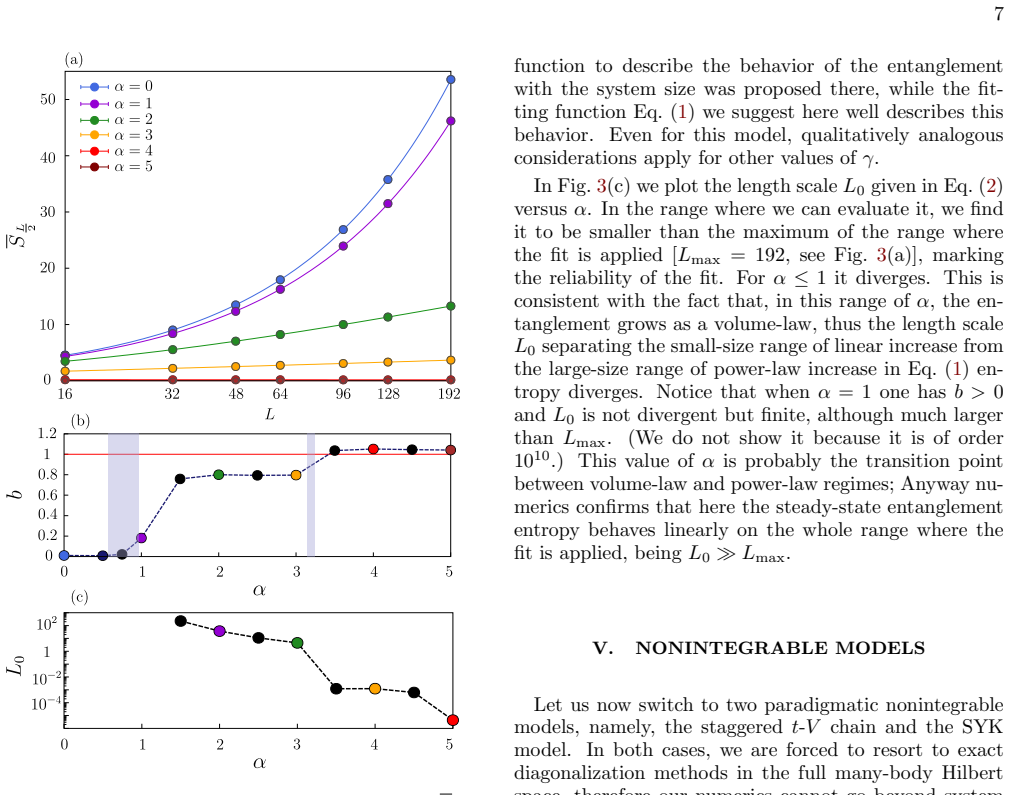
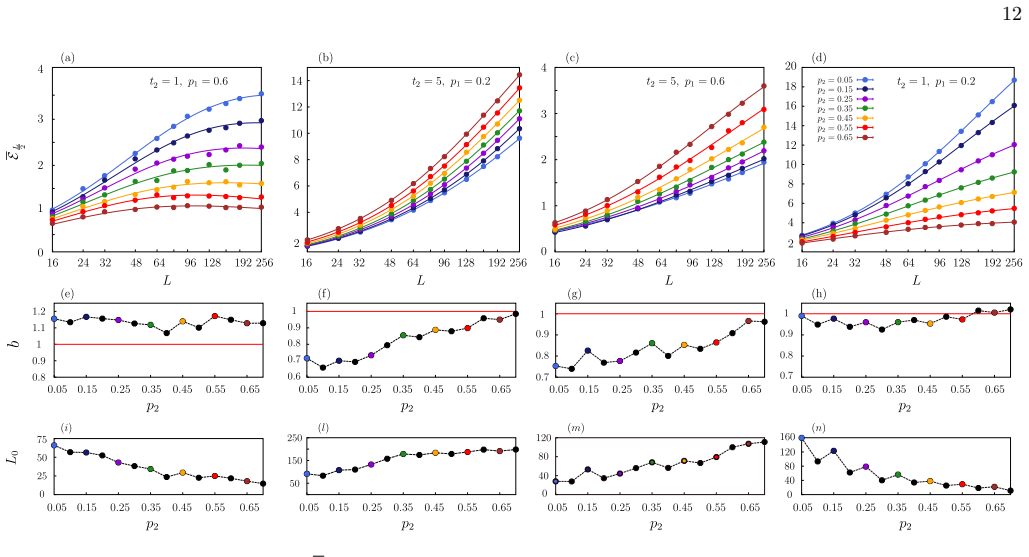
In integrable monitored fermion models the bipartite entanglement versus system size is well fitted over more than one order of magnitude by a function that interpolates between linear and power-law behavior; the same fit also accommodates logarithmic growth with a very small power-law exponent, so that entanglement phases can be characterized directly by the resulting fitting parameters.
What carries the argument
The interpolating fitting function between linear and power-law forms applied to entanglement entropy versus system size.
If this is right
- Entanglement phases in integrable monitored fermions are labeled by the parameters of the interpolating fit rather than by separate scaling regimes.
- In the SYK model the asymptotic entanglement follows a volume law when scaled against measurement strength.
- In the staggered t-V model traces of an entanglement transition appear when the same scaling is performed.
- Hilbert-space localization measured by inverse participation ratio shows anomalous delocalization with no direct link to the observed entanglement scaling.
- The same interpolating function also describes fermionic logarithmic negativity in a quadratic ladder model with stroboscopic measurements.
Where Pith is reading between the lines
- The fitting procedure could be tested on other classes of monitored systems to see whether the same parameter-based classification emerges.
- The reported independence of localization and entanglement scaling suggests they may be controlled by distinct mechanisms that can be varied separately.
- If the fit remains accurate at larger sizes, it supplies a practical diagnostic that avoids needing to resolve tiny logarithmic corrections directly.
Load-bearing premise
That the chosen interpolating function continues to describe the true asymptotic large-size behavior rather than serving only as an effective description inside the numerically accessible range.
What would settle it
A direct computation of entanglement on system sizes several times larger than those already studied that systematically deviates from the proposed interpolating function.
Figures





read the original abstract
We study the asymptotic bipartite entanglement in various integrable and nonintegrable models of monitored fermions. We find that, for the integrable cases, the entanglement versus the system size is well fitted, over more than one order of magnitude, by a function interpolating between a linear and a power-law behavior. Up to the sizes we are able to reach, a logarithmic growth of the entanglement can be also captured by the same fit with a very small power-law exponent. We thus propose a characterization of the various entanglement phases using the fitting parameters. For the nonintegrable cases, as the staggered t-V and the Sachdev-Ye-Kitaev (SYK) models, the numerics prevents us from spanning different orders of magnitude in the size, therefore we fit the asymptotic entanglement versus the measurement strength and then look at the scaling with the size of the fitting parameters. We find two different behaviors: for the SYK we observe a volume-law growth, while for the t-V model some traces of an entanglement transition emerge. In the latter models, we study the localization properties in the Hilbert space through the inverse participation ratio, finding an anomalous delocalization with no relation with the entanglement properties. Finally, we show that our function fits very well the fermionic logarithmic negativity of a quadratic model in ladder geometry with stroboscopic projective measurements.
Editorial analysis
A structured set of objections, weighed in public.
Referee Report
Summary. The manuscript numerically studies asymptotic bipartite entanglement in monitored integrable and non-integrable fermion models. For integrable cases it reports that entanglement versus system size is well fitted over more than one decade by an interpolating function between linear and power-law forms; the same fit can capture logarithmic growth with a small power-law exponent, and the authors propose to characterize entanglement phases via the extracted parameters. For non-integrable models (staggered t-V and SYK) the accessible size range is smaller, so they fit entanglement versus measurement strength and examine the size scaling of the fit parameters, finding volume-law behavior in SYK and possible traces of an entanglement transition in t-V. They additionally compute the inverse participation ratio in Hilbert space, report anomalous delocalization unrelated to the entanglement scaling, and show that the same interpolating function fits the fermionic logarithmic negativity of a quadratic ladder model under stroboscopic projective measurements.
Significance. If the proposed interpolating fit remains stable and physically meaningful beyond the numerically accessible window, the work supplies a concrete, practical protocol for classifying entanglement phases in monitored integrable systems from finite-size data. The reported decoupling between Hilbert-space localization (IPR) and entanglement scaling, together with the extension to logarithmic negativity, would be of interest to the monitored-dynamics community. The absence of an analytic derivation of the interpolant and the lack of systematic validation against larger sizes or alternative functional forms limit the strength of the phase-characterization claim.
major comments (2)
- [Abstract, §3] Abstract and §3 (integrable models): the central proposal to characterize entanglement phases via the parameters of the interpolating fit is load-bearing on the assumption that the functional form and extracted exponents remain stable for L→∞. The text acknowledges the limited size window but provides no extrapolation tests, no AIC/BIC comparison against pure logarithmic or other candidate forms, and no derivation of the interpolant from the monitored dynamics; if the true scaling is logarithmic with a slow crossover, the reported parameters would be effective descriptors only inside the accessible window.
- [§4] §4 (non-integrable models): the claim of 'traces of an entanglement transition' in the t-V model rests on the size scaling of fit parameters extracted from entanglement versus measurement strength. The accessible size range is stated to be too small to span orders of magnitude, yet no quantitative assessment of finite-size drift or sensitivity to the fitting window is supplied; this weakens the distinction drawn between SYK (volume-law) and t-V behaviors.
minor comments (2)
- [§2, figures] Figure captions and §2 should explicitly state the range of system sizes used for each model and the precise definition of the interpolating function (including any free parameters and their initialization).
- [§4] The IPR analysis in §4 would benefit from a brief statement of the Hilbert-space dimension and the precise definition of the participation ratio employed.
Simulated Author's Rebuttal
We thank the referee for their careful reading and constructive comments on our manuscript. We address the major concerns point by point below, providing the strongest honest defense of our numerical observations while acknowledging limitations.
read point-by-point responses
-
Referee: [Abstract, §3] Abstract and §3 (integrable models): the central proposal to characterize entanglement phases via the parameters of the interpolating fit is load-bearing on the assumption that the functional form and extracted exponents remain stable for L→∞. The text acknowledges the limited size window but provides no extrapolation tests, no AIC/BIC comparison against pure logarithmic or other candidate forms, and no derivation of the interpolant from the monitored dynamics; if the true scaling is logarithmic with a slow crossover, the reported parameters would be effective descriptors only inside the accessible window.
Authors: We agree that an analytic derivation of the interpolant is absent, as the work is a numerical study identifying an empirical functional form that fits the data over more than one decade in L. We have added an AIC comparison in the revised manuscript demonstrating that the interpolating form outperforms a pure logarithmic fit across the accessible sizes. Additional finite-size stability checks for the extracted parameters have also been included. However, computational constraints prevent access to sizes sufficient for definitive L→∞ extrapolation or to rule out a very slow crossover; we therefore present the characterization as a practical protocol for the numerically reachable regime rather than a proven asymptotic classifier. revision: partial
-
Referee: [§4] §4 (non-integrable models): the claim of 'traces of an entanglement transition' in the t-V model rests on the size scaling of fit parameters extracted from entanglement versus measurement strength. The accessible size range is stated to be too small to span orders of magnitude, yet no quantitative assessment of finite-size drift or sensitivity to the fitting window is supplied; this weakens the distinction drawn between SYK (volume-law) and t-V behaviors.
Authors: We acknowledge the limited size range for non-integrable models. In the revision we have added explicit checks of fit-parameter sensitivity to the measurement-strength fitting window together with quantitative estimates of finite-size drift. These show that the volume-law signature in SYK remains robust while the t-V parameters exhibit a distinct trend consistent with an emerging transition, even within the accessible window. The language has been softened to describe these as preliminary indications rather than definitive evidence. revision: yes
- Analytic derivation of the interpolating function from the underlying monitored dynamics
- Numerical access to system sizes large enough to perform controlled extrapolations to L→∞ or to fully exclude slow crossovers
Circularity Check
Numerical fitting of entanglement scaling shows no circular derivation chain
full rationale
The paper is a numerical study that simulates monitored fermion models and empirically fits an interpolating function to entanglement-versus-size data in integrable cases, then extracts parameters for phase characterization. No derivation from first principles is presented that reduces by construction to the fitted quantities themselves; the fit is applied to observed data rather than used to predict the same data. No self-citations, uniqueness theorems, or smuggled ansatzes appear as load-bearing steps. The analysis remains self-contained as an empirical characterization within numerically accessible windows.
Axiom & Free-Parameter Ledger
Reference graph
Works this paper leans on
-
[1]
Ifz l,µ ≤p µ, the mea- surement is performed
For each sitelbelonging to chainµ, extract a ran- dom numberz l,µ ∈(0,1]. Ifz l,µ ≤p µ, the mea- surement is performed
-
[2]
If the measurement must be performed, extract a second random numberq l,µ ∈(0,1]
-
[3]
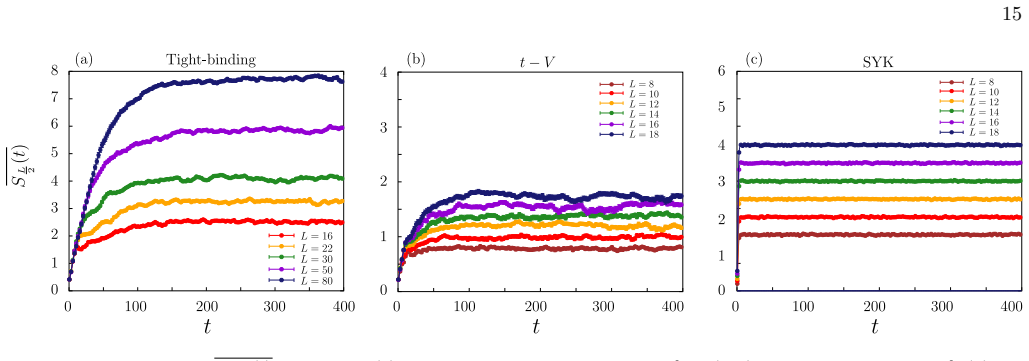
Ifq l,µ ≤p nl,µ=1(τ), then the operator ˆn l,µ is ap- plied to the state: |Ψ(τ)⟩ 7→ ˆnl,µ |Ψ(τ)⟩ ∥ˆnl,µ |Ψ(τ)⟩ ∥ ,(C5) 15 FIG. 12. The behavior of SL/2(t) versustfor (a) the staggered tight-binding chain [Eq. (22a), withW= 1 andV= 0], (b) the staggeredt-Vchain [Eq. (22a), withW=V= 1], and (c) the SYK model [Eq. (23)]. We chooseγ= 0.04 and report data for ...
-
[4]
Ifq l,µ > p nl,µ=1(τ), then the operator 1−ˆn l,µ is applied to the state: |Ψ(τ)⟩ 7→ (1−ˆnl,µ)|Ψ(τ)⟩ ∥(1−ˆnl,µ)|Ψ(τ)⟩ ∥ ,(C7) which results into Dij,σσ′(τ)→ D ij,σσ′(τ)−δ ilδjlδσµδσ′µ + (δil,σµ − Dil,σµ(τ))(δ lj,µσ′ − Dlj,µσ′(τ)) 1− D ll,µµ(τ) . (C8) The FLN can be obtained through the spectrum of the correlation matrixD(τ), reduced to the degrees of free...
-
[5]
M. A. Nielsen and I. L. Chuang,Quantum Computation and Quantum Information: 10th Anniversary Edition (Cambridge University Press, Cambridge, UK, 2011)
work page 2011
-
[6]
R. Horodecki, P. Horodecki, M. Horodecki, and K. Horodecki, Quantum entanglement, Rev. Mod. Phys. 81, 865 (2009)
work page 2009
- [7]
- [8]
-
[9]
P. Fromholz, G. Magnifico, V. Vitale, T. Mendes- Santos, and M. Dalmonte, Entanglement topological in- variants for one-dimensional topological superconduc- tors, Phys. Rev. B101, 085136 (2020)
work page 2020
- [10]
-
[11]
T. Micallo, V. Vitale, M. Dalmonte, and P. Fromholz, Topological entanglement properties of disconnected partitions in the Su-Schrieffer-Heeger model, SciPost Phys. Core3, 012 (2020)
work page 2020
-
[12]
V. Alba and P. Calabrese, Entanglement and thermody- namics after a quantum quench in integrable systems, Proc. Natl. Acad. Sci. U.S.A.114, 7947 (2017)
work page 2017
-
[13]
V. Alba and P. Calabrese, Entanglement dynamics after quantum quenches in generic integrable systems, Sci- Post Phys.4, 017 (2018)
work page 2018
- [14]
-
[15]
A. Russomanno, M. Fava, and R. Fazio, Nonergodic be- havior of the clean Bose-Hubbard chain, Phys. Rev. B 102, 144302 (2020)
work page 2020
-
[16]
X. Yu, D. J. Luitz, and B. K. Clark, Bimodal entangle- ment entropy distribution in the many-body localization transition, Phys. Rev. B94, 184202 (2016)
work page 2016
-
[17]
D. J. Luitz, Long tail distributions near the many-body localization transition, Phys. Rev. B93, 134201 (2016)
work page 2016
-
[18]
G. De Chiara, S. Montangero, P. Calabrese, and R. Fazio, Entanglement entropy dynamics of Heisenberg chains, J. Stat. Mech.2006, P03001 (2006)
work page 2006
-
[19]
M. ˇZnidariˇ c, T. Prosen, and P. Prelovˇ sek, Many-body localization in the Heisenberg XXZ magnet in a random field, Phys. Rev. B77, 064426 (2008)
work page 2008
-
[20]
J. H. Bardarson, F. Pollmann, and J. E. Moore, Un- bounded growth of entanglement in models of many- body localization, Phys. Rev. Lett.109, 017202 (2012)
work page 2012
-
[21]
M. Fava, R. Fazio, and A. Russomanno, Many-body dy- namical localization in the kicked Bose-Hubbard chain, Phys. Rev. B101, 064302 (2020)
work page 2020
-
[22]
M. J. Gullans and D. A. Huse, Dynamical purification phase transition induced by quantum measurements, Phys. Rev. X10, 041020 (2020)
work page 2020
-
[23]
Y. Li, X. Chen, and M. P. A. Fisher, Quantum Zeno ef- fect and the many-body entanglement transition, Phys. Rev. B98, 205136 (2018)
work page 2018
-
[24]
A. Chan, R. M. Nandkishore, M. Pretko, and G. Smith, Unitary-projective entanglement dynamics, Phys. Rev. B99, 224307 (2019)
work page 2019
-
[25]
B. Skinner, J. Ruhman, and A. Nahum, Measurement- induced phase transitions in the dynamics of entangle- ment, Phys. Rev. X9, 031009 (2019)
work page 2019
-
[26]
M. Szyniszewski, A. Romito, and H. Schomerus, En- tanglement transition from variable-strength weak mea- surements, Phys. Rev. B100, 064204 (2019)
work page 2019
-
[27]
A. C. Potter and R. Vasseur, Entanglement dynamics in hybrid quantum circuits, inQuantum Science and Technology(Springer International Publishing, Cham,
-
[28]
Y. Bao, S. Choi, and E. Altman, Symmetry enriched phases of quantum circuits, Ann. Phys.435, 168618 (2021)
work page 2021
-
[29]
A. Nahum and B. Skinner, Entanglement and dynam- ics of diffusion-annihilation processes with Majorana de- fects, Phys. Rev. Res.2, 023288 (2020)
work page 2020
-
[30]
X. Chen, Y. Li, M. P. A. Fisher, and A. Lucas, Emergent conformal symmetry in nonunitary random dynamics of free fermions, Phys. Rev. Res.2, 033017 (2020)
work page 2020
-
[31]
Y. Li, X. Chen, and M. P. A. Fisher, Measurement- driven entanglement transition in hybrid quantum cir- cuits, Phys. Rev. B100, 134306 (2019)
work page 2019
-
[32]
C.-M. Jian, Y.-Z. You, R. Vasseur, and A. W. W. Lud- wig, Measurement-induced criticality in random quan- tum circuits, Phys. Rev. B101, 104302 (2020)
work page 2020
-
[33]
Y. Li, R. Vasseur, M. P. A. Fisher, and A. W. W. Lud- wig, Statistical mechanics model for Clifford random tensor networks and monitored quantum circuits, Phys. Rev. B109, 174307 (2024)
work page 2024
-
[34]
M. Szyniszewski, A. Romito, and H. Schomerus, Univer- sality of entanglement transitions from stroboscopic to continuous measurements, Phys. Rev. Lett.125, 210602 (2020)
work page 2020
-
[35]
X. Turkeshi, R. Fazio, and M. Dalmonte, Measurement- induced criticality in (2 + 1)-dimensional hybrid quan- tum circuits, Phys. Rev. B102, 014315 (2020)
work page 2020
-
[36]
O. Lunt, M. Szyniszewski, and A. Pal, Measurement- induced criticality and entanglement clusters: A study of one-dimensional and two-dimensional Clifford cir- cuits, Phys. Rev. B104, 155111 (2021)
work page 2021
-
[37]
P. Sierant, M. Schir` o, M. Lewenstein, and X. Turkeshi, Measurement-induced phase transitions in (d+ 1)- dimensional stabilizer circuits, Phys. Rev. B106, 214316 (2022)
work page 2022
- [38]
- [39]
-
[40]
P. Sierant and X. Turkeshi, Universal behavior be- yond multifractality of wave functions at measurement- induced phase transitions, Phys. Rev. Lett.128, 130605 (2022)
work page 2022
-
[41]
G. Chiriac` o, M. Tsitsishvili, D. Poletti, R. Fazio, and M. Dalmonte, Diagrammatic method for many-body non-Markovian dynamics: Memory effects and entan- glement transitions, Phys. Rev. B108, 075151 (2023)
work page 2023
-
[42]
K. Klocke and M. Buchhold, Majorana loop models for measurement-only quantum circuits, Phys. Rev. X13, 041028 (2023)
work page 2023
-
[43]
A. Lira-Solanilla, X. Turkeshi, and S. Pappalardi, Mul- tipartite entanglement structure of monitored quantum circuits, Phys. Rev. Lett.135, 080401 (2025)
work page 2025
- [44]
-
[45]
A. C. C. de Albornoz, D. C. Rose, and A. Pal, En- tanglement transition and heterogeneity in long-range quadratic lindbladians, Phys. Rev. B109, 214204 (2024)
work page 2024
-
[46]
M. Fava, L. Piroli, D. Bernard, and A. Nahum, Moni- tored fermions with conservedU(1) charge, Phys. Rev. 17 Res.6, 043246 (2024)
work page 2024
-
[47]
K. Chahine and M. Buchhold, Entanglement phases, localization, and multifractality of monitored free fermions in two dimensions, Phys. Rev. B110, 054313 (2024)
work page 2024
-
[48]
A. Delmonte, Z. Li, G. Passarelli, E. Y. Song, D. Bar- berena, A. M. Rey, and R. Fazio, Measurement-induced phase transitions in monitored infinite-range interacting systems, Phys. Rev. Res.7, 023082 (2025)
work page 2025
-
[49]
G. Passarelli, X. Turkeshi, A. Russomanno, P. Lucig- nano, M. Schir` o, and R. Fazio, Many-body dynamics in monitored atomic gases without postselection barrier, Phys. Rev. Lett.132, 163401 (2024)
work page 2024
-
[50]
X. Cao, A. Tilloy, and A. De Luca, Entanglement in a fermion chain under continuous monitoring, SciPost Phys.7, 24 (2019)
work page 2019
-
[51]
M. Buchhold, Y. Minoguchi, A. Altland, and S. Diehl, Effective theory for the measurement-induced phase transition of Dirac fermions, Phys. Rev. X11, 041004 (2021)
work page 2021
-
[52]
C.-M. Jian, B. Bauer, A. Keselman, and A. W. W. Ludwig, Criticality and entanglement in nonunitary quantum circuits and tensor networks of noninteracting fermions, Phys. Rev. B106, 134206 (2022)
work page 2022
-
[53]
M. Coppola, E. Tirrito, D. Karevski, and M. Collura, Growth of entanglement entropy under local projective measurements, Phys. Rev. B105, 094303 (2022)
work page 2022
-
[54]
M. Fava, L. Piroli, T. Swann, D. Bernard, and A. Nahum, Nonlinear sigma models for monitored dy- namics of free fermions, Phys. Rev. X13, 041045 (2023)
work page 2023
-
[55]
I. Poboiko, P. P¨ opperl, I. V. Gornyi, and A. D. Mirlin, Theory of free fermions under random projective mea- surements, Phys. Rev. X13, 041046 (2023)
work page 2023
- [56]
-
[57]
J. Merritt and L. Fidkowski, Entanglement transitions with free fermions, Phys. Rev. B107, 064303 (2023)
work page 2023
-
[58]
O. Alberton, M. Buchhold, and S. Diehl, Entanglement transition in a monitored free-fermion chain: From ex- tended criticality to area law, Phys. Rev. Lett.126, 170602 (2021)
work page 2021
-
[59]
X. Turkeshi, A. Biella, R. Fazio, M. Dalmonte, and M. Schir` o, Measurement-induced entanglement transi- tions in the quantum Ising chain: From infinite to zero clicks, Phys. Rev. B103, 224210 (2021)
work page 2021
-
[60]
M. Szyniszewski, O. Lunt, and A. Pal, Disordered mon- itored free fermions, Phys. Rev. B108, 165126 (2023)
work page 2023
-
[61]
X. Turkeshi, M. Dalmonte, R. Fazio, and M. Schir` o, En- tanglement transitions from stochastic resetting of non- hermitian quasiparticles, Phys. Rev. B105, L241114 (2021)
work page 2021
-
[62]
G. Piccitto, A. Russomanno, and D. Rossini, Entangle- ment transitions in the quantum Ising chain: A com- parison between different unravelings of the same Lind- bladian, Phys. Rev. B105, 064305 (2022)
work page 2022
-
[63]
G. Piccitto, A. Russomanno, and D. Rossini, Erratum: Entanglement transitions in the quantum Ising chain: A comparison between different unravelings of the same Lindbladian, Phys. Rev. B106, 219901(E) (2022)
work page 2022
-
[64]
E. Tirrito, A. Santini, R. Fazio, and M. Collura, Full counting statistics as probe of measurement-induced transitions in the quantum Ising chain, SciPost Phys. 15, 096 (2023)
work page 2023
-
[65]
A. Paviglianiti and A. Silva, Multipartite entanglement in the measurement-induced phase transition of the quantum Ising chain, Phys. Rev. B108, 184302 (2023)
work page 2023
-
[66]
N. Lang and H. P. B¨ uchler, Entanglement transition in the projective transverse field Ising model, Phys. Rev. B102, 094204 (2020)
work page 2020
- [67]
-
[68]
C. Zerba and A. Silva, Measurement phase transitions in the no-click limit as quantum phase transitions of a non- hermitean vacuum, SciPost Phys. Core6, 051 (2023)
work page 2023
-
[69]
A. Paviglianiti, X. Turkeshi, M. Schir` o, and A. Silva, Enhanced entanglement in the measurement-altered quantum Ising chain, Quantum8, 1576 (2024)
work page 2024
-
[70]
P. Chatterjee and R. Modak, Measurement-induced phase transition in periodically driven free-fermionic systems, Phys. Rev. B112, 024304 (2025)
work page 2025
-
[71]
G. Piccitto, D. Rossini, and A. Russomanno, The im- pact of different unravelings in a monitored system of free fermions, Eur. Phys. J. B97, 90 (2024)
work page 2024
- [72]
-
[73]
O. Lunt and A. Pal, Measurement-induced entangle- ment transitions in many-body localized systems, Phys. Rev. Res.2, 043072 (2020)
work page 2020
-
[74]
D. Rossini and E. Vicari, Measurement-induced dynam- ics of many-body systems at quantum criticality, Phys. Rev. B102, 035119 (2020)
work page 2020
-
[75]
Q. Tang and W. Zhu, Measurement-induced phase transition: A case study in the nonintegrable model by density-matrix renormalization group calculations, Phys. Rev. Res.2, 013022 (2020)
work page 2020
-
[76]
Y. Fuji and Y. Ashida, Measurement-induced quantum criticality under continuous monitoring, Phys. Rev. B 102, 054302 (2020)
work page 2020
-
[77]
P. Sierant, G. Chiriac` o, F. M. Surace, S. Sharma, X. Turkeshi, M. Dalmonte, R. Fazio, and G. Pagano, Dissipative Floquet dynamics: from steady state to measurement induced criticality in trapped-ion chains, Quantum6, 638 (2022)
work page 2022
-
[78]
E. V. H. Doggen, Y. Gefen, I. V. Gornyi, A. D. Mir- lin, and D. G. Polyakov, Generalized quantum measure- ments with matrix product states: Entanglement phase transition and clusterization, Phys. Rev. Res.4, 023146 (2022)
work page 2022
-
[79]
A. Altland, M. Buchhold, S. Diehl, and T. Micklitz, Dy- namics of measured many-body quantum chaotic sys- tems, Phys. Rev. Res.4, L022066 (2022)
work page 2022
-
[80]
Z. Li, A. Delmonte, X. Turkeshi, and R. Fazio, Mon- itored long-range interacting systems: spin-wave the- ory for quantum trajectories, Nat. Commun.16, 4329 (2025)
work page 2025
discussion (0)
Sign in with ORCID, Apple, or X to comment. Anyone can read and Pith papers without signing in.