REVIEW 3 major objections 6 minor 12 references
MMAG: A Multi-Control Mixed Audio Generation Benchmark
T0 review · 3 major / 6 minor · reviewed 2026-08-10 · deepseek-v4-flash
Pith's one-line read MMAG is the first benchmark for compositional evaluation of mixed audio generation, and its results show that no existing model balances acoustic fidelity, speech quality, semantic consistency, and temporal control.
desk verdict A genuinely useful mixed-audio benchmark with a self-referential evaluation loop that needs breaking before the rankings are taken at face value. read the letter →
The pith
A machine-rendered reading of the paper's core claim, the machinery that carries it, and where it could break.
The reading
What carries the argument
The load-bearing machinery is the annotation pipeline paired with a four-axis evaluation protocol. Expert models extract fine-grained attributes, Whisper for transcripts, WhisperX and PE-A-Frame for timestamps, Audeering and Emotion2Vec for speaker age, gender, and emotion, CED for sound events, and musical descriptor models for instruments and genre, and an LLM aggregates them into two caption types: an overall caption with coarse temporal ordering and a timestamped caption with precise boundaries for speech segments and foreground events; human annotators then verify captions and select voice prompts. On the evaluation side, the protocol measures acoustic fidelity (FD, KL, IS, production quality and complexity), speech quality (WER, UTMOSv2, speaker similarity), semantic consistency (CLAP plus the rubric-based AnyAudio-Judge), and temporal accuracy (segment-level Speech F1 and Sound F1 computed from WhisperX and PE-A-Frame predictions). A diagnostic Proportion metric isolates caption-confusion errors, where models speak caption text that is not part of the transcript, and the paper shows this error grows sharply on timestamped inputs.
What would settle it
Have independent annotators re-label a stratified sample of the main set without seeing the machine-generated captions and compare the results; if agreement with MMAG's labels falls well below the claimed ~90%, or if mismatches concentrate in specific categories such as rare accents, music genres, or event boundaries, the reported model rankings should be recomputed. A second check: rebuild the voice-cloning and timestamp subsets with a different automatic annotator suite and test whether the ordering of models on SPK-SIM, Speech F1, and Sound F1 stays the same.
Extended reading notes
Core claim
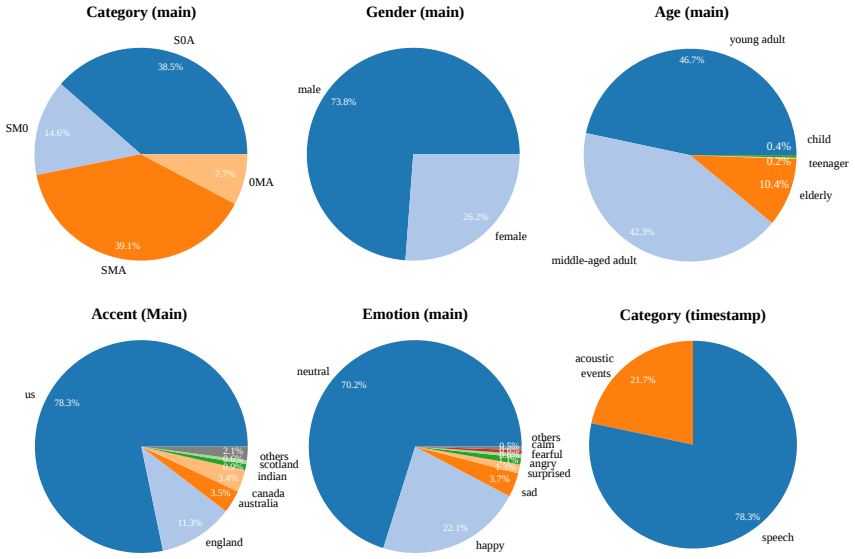
The paper's central claim is that compositional evaluation of mixed audio generation is both necessary and now possible, and that current models fail it. Concretely, the authors build MMAG by selecting cross-domain clips from the AudioCaps, VGGSound, and MECAT test sets, filtering for modality content and quality, then running a multi-expert annotation pipeline that produces overall captions and timestamped captions with LLM aggregation and human verification. Under the proposed protocol, Dasheng-AudioGen achieves the best acoustic fidelity (FD 1.78, KL 0.87) and strong semantic scores, Ming-Omni-TTS achieves the best speech intelligibility (WER 0.03) and naturalness, LTX-2 is the most balanced overall, and AuDirector, an agentic orchestrator, has the best temporal control (Speech F1 0.72, Sound F1 0.57) while paying a fidelity cost. No model occupies the top of all four dimensions, and the paper documents systematic trade-offs: voice cloning prompts degrade quality across models, timestamps amplify caption-confusion errors, and speech-centric systems omit music and sound effects, which inflates their speech metrics while failing the scene-level ones.
Load-bearing premise
The benchmark's ground-truth captions and timestamps come from automatic speech, emotion, and event-detection systems that were only spot-checked by humans at about 90% agreement, so errors hidden in the unchecked 10% of the data could change the model rankings and the paper's conclusion that no model performs well.
Editorial extensions
If this is right
- Temporal control is the largest unsolved gap: the best system reaches Speech F1 0.72 and Sound F1 0.57, several models are barely above chance, and timestamp-conditioned generation will need new training data and objectives.
- Conditioning degrades quality: introducing voice prompts or timestamps lowers acoustic and speech metrics for most models, so controllability and fidelity currently trade against each other.
- Caption confusion is a distinct failure mode: models speak, quote, or recite non-transcript caption content, with Dasheng-AudioGen-Base reaching a Proportion of 56.48% on timestamped inputs, and structured or LLM-normalized inputs substantially reduce it.
- No single architecture family wins: speech-specialized, audio-visual, and agentic systems each hold some metric records and trail on others, so progress likely requires combining strengths rather than scaling one family.
- Evaluator models need improvement too: the timestamp-aware AnyAudio-Judge rubrics show limited discriminative power across models, indicating the metric, not just the generators, is a bottleneck.
Reading between the lines
- The ~90% spot-check pass rate implies the labels inherit whatever systematic biases Whisper and the other expert annotators carry; if the unchecked 10% concentrates in specific categories, per-category model rankings could shift on re-annotation.
- The 10-second, single-speaker, English-only scope bounds the paper's claim: 'no model performs consistently well' is established for short, one-speaker scenes, and longer, multi-speaker, or multilingual scenes could reward different model designs.
- The Proportion diagnostic points to a cheap testable extension: normalizing raw captions into structured input sharply cut caption-confusion in AuDirector and Dasheng-AudioGen-Fine, so input formatting may matter as much as architecture for mixed-audio generation.
- Because the timestamp subset drops clips dominated by speech or background audio, the temporal-control results apply to foreground-event-rich scenes; extending the subset to continuous background transitions could reveal whether models track relative rather than absolute timing.
Signed reviews
Editorial analysis
A structured set of objections, weighed in public.
Referee Report
Summary. The paper introduces MMAG, a benchmark for multi-control mixed audio generation, comprising approximately 4,000 audio clips with annotations for speech content, speaker attributes, music, sound events, and temporal relationships, plus dedicated voice cloning and timestamp subsets. It also proposes an evaluation protocol covering acoustic fidelity, speech quality, semantic consistency, and temporal control, and benchmarks agentic orchestrators, audio-visual and native mixed-audio generators. The central empirical claim is that no existing model performs consistently well, with substantial trade-offs across capabilities.
Significance. If validated, MMAG would be a valuable community resource: it is arguably the first benchmark explicitly designed for compositional evaluation of mixed audio generation, with richer annotations than AudioCaps or MECAT, including timestamps and voice prompts. The paper ships an evaluation protocol and a detailed comparison; the 'no model dominates' finding is plausible and useful. However, the strength of the empirical conclusions is currently bounded by the self-referential nature of some metrics and the lack of a formal definition for Seg-F1, so the significance is conditional on those being addressed.
major comments (3)
- [Section 4.2 / Table 6] The evaluation of speech and temporal control uses the same automatic models that generated the reference annotations. Specifically, Whisper-Large-V3 produces the reference transcripts in the annotation pipeline (Table 6) and is also used to compute WER (Section 4.2); WhisperX and PE-A-Frame-Large produce the ground-truth timestamps in Section 3.2 and are the same systems used to extract predictions for Speech-F1 and Sound-F1. This closed loop means that a generated clip whose audio happens to be recognized or detected in the same way as the source clip by these particular models will score higher, independent of human-perceived correctness. The rankings in Tables 2-4 and the trade-off conclusions may therefore partly measure annotator-model agreement rather than model capability. I recommend that the authors provide human-transcribed references for at least a subset, use different ASR and event detectors for scoring than for annotation, and report the agreement between automatic and human references.
- [Section 4.2] Seg-F1 is not formally defined. The text states that predictions are aligned with ground truth and Speech-F1 and Sound-F1 are reported, but it does not specify the matching rule, the temporal tolerance, the alignment algorithm, or the unit of matching (token, segment, or event). Without such a definition, Table 4 is not reproducible and the temporal-control claim cannot be audited. The authors should give a precise algorithm and pseudocode, and ideally release the evaluation code.
- [Section 3.2 / Abstract] The abstract and introduction describe MMAG as 'manually verified,' but Section 3.2 describes a three-round inspection whose final round is a spot-check with approximately 90% pass rate. The paper does not specify whether every clip was manually corrected in the earlier rounds or only a sample, what the sample size and selection procedure were, or how the 90% pass rate is computed. This ambiguity is load-bearing because the validity of the benchmark's ground truth, and thus of every model ranking, depends on the actual extent of human verification. Please clarify the procedure and report inter-annotator agreement or per-category pass rates.
minor comments (6)
- [Figure 2] In the timestamped caption, 'a bell rings from 5.3 to 3.5s' has the start and end times reversed; it should read '3.5 to 5.3s'.
- [Section 2] The dataset name 'ACA V100M' appears to be a typo for 'ACAV100M' (the reference is Lee et al., 2021).
- [Section 4.2] The definition of FD in the PANNs CNN14 feature space is not explicitly linked to the FDCNN14 reported in Appendix D; please unify the notation.
- [Section 5.4 and Appendix D] The Proportion metric is used in Table 5 but defined only in Appendix D; please define it in the main text or provide a clear forward reference when it is first used.
- [Table 2] JavisDiT++ has '–' for WER; please explain in a footnote whether this means no intelligible speech was detected or the model does not support transcript input, and how the WER calculation handles such cases.
- [Table 4] Dasheng-AudioGen-Base shows a dramatic drop in PQ (3.48) on the timestamp subset compared to the main set (6.67), which is not discussed; please comment on this outlier.
Circularity Check
WER and temporal F1 are scored with the same ASR/event detectors that generated MMAG's ground-truth labels, creating a partial self-referential loop in two of the four evaluation axes; the benchmark retains independent content through external acoustic/semantic metrics and human-verified captions.
-
self definitional
[Table 6 and Sec. 4.2, Speech Quality]
"transcript Whisper-Large-V3 (Radford et al., 2023) | WER is computed from Whisper-Large-v3 (Radford et al., 2023) transcriptions and capped at 1.0 for robustness."
Table 6 identifies Whisper-Large-V3 as the model that produced the benchmark's speech transcripts. Section 4.2 computes WER by transcribing generated audio with the same Whisper-Large-v3 and comparing against that reference. WER is therefore an edit distance between two outputs of the same ASR (source vs. generated), not a comparison against an independently human-verified transcript. Generated audio that triggers the same systematic Whisper errors as the source receives a low WER, so the speech-quality axis of the reported trade-offs partly measures annotator self-agreement. The human check is only a spot-check ('The final spot-check pass rate reaches approximately 90%'), so it does not replace the model-generated reference.
-
self definitional
[Table 6 and Sec. 4.2, Temporal Control]
"Table 6: 'timestamp WhisperX (Bain et al., 2023)' and 'timestamp PE-A-Frame-Large (Vyas et al., 2025)'; Sec. 4.2: 'The ground-truth timestamps for speech segments and foreground acoustic events are obtained from timestamped captions using an LLM. For predictions, we apply WhisperX (Bain et al., 2023) to extract speech timestamps and PE-A-Frame-Large (Vyas et al., 2025) to extract foreground event timestamps, both on the generated audio.'"
The timestamped captions that define the temporal ground truth were constructed with WhisperX speech timestamps and PE-A-Frame-Large event timestamps (Table 6). The predictions are extracted from generated audio with exactly the same two detectors. Speech-F1 and Sound-F1 therefore measure whether WhisperX and PE-A-Frame-Large localize events in the generated clip the same way they localize events in the source clip, rather than measuring alignment to human-labeled boundaries. A detector that consistently misses or shifts an event class in both source and generated audio will inflate F1. The alignment rule for Seg-F1 is never specified, which makes the closed loop impossible to audit.
full rationale
The paper is primarily a benchmark-construction paper, not a formal derivation, so the central resource has independent content: the captions are human-spot-checked, and the acoustic (FD/KL/IS/PQ) and semantic (CLAP/AAJ) metric families come from separately trained predictors rather than from the annotation models. The main circularity is the reference/scorer identity loop: Whisper-Large-V3 creates the speech transcripts and also computes WER; WhisperX and PE-A-Frame-Large create the timestamp ground truth and also extract predicted timestamps. That loop affects two of the four evaluation axes and plausibly biases the trade-off rankings, so the strongest empirical conclusions should be read as conditional on ASR/event-detector agreement rather than as a purely human-verified measurement. A weaker version of the same pattern may affect SPK-SIM: voice prompts are pre-selected with a speaker-verification model from the WeSpeaker family and then scored with WeSpeaker-ResNet-221, though manual prompt selection and shared prompts across models reduce its impact on model rankings. There are self-citations to the authors' AuDirector and Dasheng-AudioGen systems, but these appear as benchmarked systems only and are not used to justify the benchmark's correctness, so they are not load-bearing. The paper also omits a formal definition of Seg-F1 (no matching rule or tolerance), a reproducibility gap that compounds but is distinct from the circularity.
Assumptions & free parameters
free parameters (5)
- CED cross-domain detection threshold =
not reported
- Production quality (PQ) filter threshold =
not reported
- Voice prompt duration range =
2-5 seconds
- Top-K candidate prompts for manual selection =
5
- Spot-check pass rate =
approximately 90%
assumptions (4)
- domain assumption Expert model annotations are accurate enough to serve as ground truth after spot-checking.
- domain assumption Automatic metrics are valid proxies for the named qualities.
- domain assumption Speakers and timestamps detected on reference audio can serve as reliable ground truth for evaluating generated audio.
- domain assumption Blank image conditioning is a fair baseline for audio-visual models.
Cite this review
Pith. "Pith review of MMAG: A Multi-Control Mixed Audio Generation Benchmark." pith.science (2026). https://pith.science/paper/OY2RJFU4
@misc{pith2026260806900,
  author       = {Pith},
  title        = {Pith review of: MMAG: A Multi-Control Mixed Audio Generation Benchmark},
  year         = {2026},
  howpublished = {\url{https://pith.science/paper/OY2RJFU4}},
  note         = {Machine review of arXiv:2608.06900}
}
read the original abstract
Recent audio generation systems have progressed from single-modality synthesis to generating complex acoustic scenes containing speech, music, and sound effects. Therefore, evaluating these models requires assessing multiple interacting capabilities, including semantic fidelity, speaker consistency, and temporal control, yet existing benchmarks focus on isolated domains or coarse-grained descriptions. To address this gap, we introduce the Multi-control Mixed Audio Generation (MMAG) benchmark. MMAG contains approximately 4,000 manually verified audio clips with rich annotations covering speech content, speaker identity, music attributes, sound events, and temporal relationships, together with dedicated subsets for voice cloning and timestamp-conditioned generation. We further propose a systematic evaluation protocol that measures acoustic fidelity, speech quality, semantic alignment, and temporal accuracy. Benchmarking representative agentic orchestrators, unified audio-visual generation models, and native mixed-audio generators reveals substantial performance trade-offs across these capabilities, with no existing model performing consistently well. Our results highlight the remaining challenges of controllable mixed audio generation and establish MMAG as a comprehensive benchmark for future research.
Figures


Figures from the paper (3 more)


Reference graph
Works this paper leans on
-
[1]
Speech: - Incorporate transcription content and speaker attributes (age, gender, language, accent, emotion, etc.). - Infer speaker identity only when sufficient evidence exists. - The complete transcription must be included verbatim, enclosed in quotation marks, without omission or summarization. - Example: "A middle-aged male captain aged 40-50 calmly st...
-
[2]
Slow-tempo electronic music with dark melodic elements and synthesized bass
Music: - Synthesize music descriptions based on the provided information (instrument, genre, moods). - Key, instrument, and genre are given as label-probability pairs. Integrate all relevant information to make informed judgments. - The existing music labels have limited credibility and should only serve as auxiliary references for resolving ambiguous cas...
-
[3]
Sound: - Generate a complete description of sound events based on the "event_segments" field. - Sound events exclude content from major categories such as speech or music (e.g., " man talking", "guitar"). - Include coarse-grained temporal information, such as event sequences and approximate ranges, but avoid precise timestamps. - Example: "After a barking...
-
[4]
Indoor/outdoor hybrid environment with significant engine interference
Environment: - Infer environmental context from the existing speech, sound, and music information, and provide a refined environment caption when evidence is sufficient. - Example: "Indoor/outdoor hybrid environment with significant engine interference." B. Systematic Caption ---------------------------------------- Generate holistic captions that integra...
-
[5]
Picoaudio: Enabling precise temporal con- trollability in text-to-audio generation. InICASSP 2025-2025 IEEE International Conference on Acous- tics, Speech and Signal Processing (ICASSP), pages 1–5. IEEE. An Yang, Anfeng Li, Baosong Yang, Beichen Zhang, Binyuan Hui, Bo Zheng, Bowen Yu, Chang Gao, Chengen Huang, Chenxu Lv, and 1 others
work page 2025
-
[6]
Qwen3 technical report.arXiv preprint arXiv:2505.09388. Guozhen Zhang, Zixiang Zhou, Teng Hu, Ziqiao Peng, Youliang Zhang, Yi Chen, Yuan Zhou, Qinglin Lu, and Limin Wang. 2025. UniA VGen: Unified audio and video generation with asymmetric cross-modal interactions.arXiv preprint arXiv:2511.03334. Siyi Zhou, Yiquan Zhou, Yi He, Xun Zhou, Jinchao Wang, Wei D...
arXiv 2025
-
[11]
- If transcription exists, include the complete transcription verbatim, enclosed in quotation marks
Overall Caption (several sentences): - Include as much information as possible, covering speech, music, sound, environment, and other relevant dimensions. - If transcription exists, include the complete transcription verbatim, enclosed in quotation marks. The speech content may be summarized at the beginning, but the complete transcription must appear sub...
work page 2023
-
[12]
Timestamped Caption (several sentences): - Include as much information as possible, covering speech, music, sound, environment, and other relevant dimensions. - If transcription exists, include the complete transcription verbatim, enclosed in quotation marks. - Provide specific timestamps for each sentence and foreground event by integrating transcription...
Show all 12 references
-
[2021]
In2021 IEEE/CVF International Conference on Computer Vision (ICCV), pages 10254–10264
Acav100m: Automatic curation of large-scale datasets for audio-visual video representation learn- ing. In2021 IEEE/CVF International Conference on Computer Vision (ICCV), pages 10254–10264. IEEE. Haitao Li, Tian Tan, Yuguang Yang, Shan Yang, and Xie Chen. 2026. Anyaudio-judge:...
2026 arXiv
-
[2024]
InInter- national Conference on Learning Representations, volume 2024, pages 12181–12204
Mert: Acoustic music understanding model with large-scale self-supervised training. InInter- national Conference on Learning Representations, volume 2024, pages 12181–12204. Kai Liu, Yanhao Zheng, Kai Wang, Shengqiong Wu, Rongjunchen Zhang, Jiebo Luo, Dimitrios Hatzi- nakos, Z...
2024 arXiv
-
[2025]
Jaeyong Kang and Dorien Herremans
Ming-Omni: A unified multimodal model for perception and generation.arXiv preprint arXiv:2506.09344. Jaeyong Kang and Dorien Herremans. 2025. To- wards unified music emotion recognition across di- mensional and categorical models.arXiv preprint arXiv:2502.03979. Kevin Kilgour,...
2025 arXiv
-
[2026]
Shawn Hershey, Sourish Chaudhuri, Daniel P
LTX-2: Efficient joint audio-visual foundation model.arXiv preprint arXiv:2601.03233. Shawn Hershey, Sourish Chaudhuri, Daniel P. W. Ellis, Jort F. Gemmeke, Aren Jansen, R. Channing Moore, Manoj Plakal, Devin Platt, Rif A. Saurous, Bryan Seybold, Malcolm Slaney, Ron J. Weiss, ...
2017 arXiv
Reviewed August 10, 2026 · model on record in the stance chip above.
Discussion (0). Continue with ORCID to comment.