Echoes of Nucleon Decay from Long-Lived Particles
Pith reviewed 2026-05-22 09:22 UTC · model grok-4.3
The pith
Nucleon decay can produce long-lived particles that leave detectable echo signals with up to 80 percent acceptance in current detectors.
A machine-rendered reading of the paper's core claim, the machinery that carries it, and where it could break.
Core claim
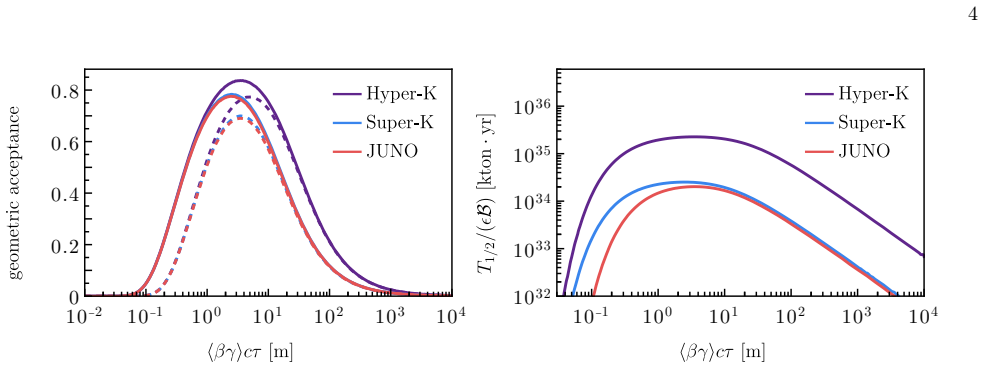
Nucleon decay searches provide uniquely sensitive probes of baryon number violation and physics beyond the Standard Model. We propose a new class of nucleon decay observables involving long-lived particles (LLPs), characterized by spatially separated but temporally correlated echo vertices not captured by conventional prompt searches. Focusing on vector LLPs, we construct effective operators and ultraviolet realizations, and show that Super-Kamiokande, Hyper-Kamiokande and JUNO can achieve geometric acceptances approaching 80% over a broad range of LLP decay lengths. Echo signatures could in principle arise from any visibly decaying LLP.
What carries the argument
Echo vertices: two decay locations from a long-lived particle produced in nucleon decay, spatially separated yet close enough in time to remain correlated within detector timing resolution.
If this is right
- Super-Kamiokande, Hyper-Kamiokande and JUNO reach geometric acceptances approaching 80 percent for vector long-lived particles over a wide range of decay lengths.
- Standard prompt nucleon decay searches miss these spatially separated yet time-correlated signals.
- Echo signatures can appear from any visibly decaying long-lived particle, not just specific models.
- Effective operators and ultraviolet realizations for vector long-lived particles supply concrete frameworks for further model building.
Where Pith is reading between the lines
- Existing data sets from these detectors could be reanalyzed with new echo-selection criteria to set additional limits on long-lived particle lifetimes.
- The same time-linked but space-separated signature idea could be adapted to other rare-decay experiments or dark-sector searches.
- Observation of echoes would favor models where long-lived particles are produced directly in nucleon decay rather than through intermediate states.
Load-bearing premise
Long-lived particles from nucleon decay have kinematics and lifetimes that keep their decay vertices spatially separated but temporally correlated inside the detector timing window without being rejected by prompt-search cuts.
What would settle it
A dedicated search in Super-Kamiokande data for pairs of decay-like vertices separated by meters yet occurring within the detector's timing resolution that finds no excess over background would test whether the proposed echo signals are observable.
Figures




read the original abstract
Nucleon decay searches provide uniquely sensitive probes of baryon number violation and physics beyond the Standard Model. We propose a new class of nucleon decay observables involving long-lived particles (LLPs), characterized by spatially separated but temporally correlated "echo" vertices not captured by conventional prompt searches. Focusing on vector LLPs, we construct effective operators and ultraviolet realizations, and show that Super-Kamiokande, Hyper-Kamiokande and JUNO can achieve geometric acceptances approaching 80% over a broad range of LLP decay lengths. Echo signatures could in principle arise from any visibly decaying LLP.
Editorial analysis
A structured set of objections, weighed in public.
Referee Report
Summary. The manuscript proposes a new class of nucleon decay observables based on long-lived particles (LLPs) that produce spatially separated but temporally correlated 'echo' vertices. Focusing on vector LLPs, it constructs effective operators and UV completions, and claims that Super-Kamiokande, Hyper-Kamiokande, and JUNO can achieve geometric acceptances approaching 80% over a broad range of LLP decay lengths. Echo signatures are argued to be accessible in any visibly decaying LLP scenario.
Significance. If the acceptance results hold after accounting for detector-specific cuts and kinematics, the work could provide a complementary probe of baryon-number violation that is missed by conventional prompt searches. The emphasis on geometric acceptance in water Cherenkov and liquid-scintillator detectors offers a concrete technical contribution to LLP phenomenology in existing and near-future experiments.
major comments (2)
- [§4] §4 (Geometric Acceptance and Detector Response): The headline claim that geometric acceptances approach 80% for vector LLPs over a broad decay-length range is load-bearing for the central result, yet the text provides no explicit efficiency calculation after applying the published prompt nucleon-decay vetoes from Super-Kamiokande analyses. Without this, it remains unclear whether the echo events survive the timing and spatial cuts that define the prompt searches.
- [§3.2] §3.2 (Kinematics and Boost): The effective operators determine the LLP boost and any co-produced particles; the manuscript does not quantify how polarization or associated visible activity affects the fraction of events that remain inside the fiducial volume while satisfying the temporal-correlation window (few ns) without triggering prompt vetoes.
minor comments (2)
- The abstract states the 80% acceptance result without referencing the underlying assumptions on decay lengths or veto survival; a short qualifier would improve clarity.
- Figure captions for acceptance plots should explicitly state the LLP mass, boost distribution, and whether prompt cuts are applied.
Simulated Author's Rebuttal
We thank the referee for their careful reading of the manuscript and for identifying these important points regarding detector response and kinematics. We address each major comment below and have revised the manuscript to add clarifications and discussions where feasible. Our responses focus on the substance of the comments.
read point-by-point responses
-
Referee: [§4] §4 (Geometric Acceptance and Detector Response): The headline claim that geometric acceptances approach 80% for vector LLPs over a broad decay-length range is load-bearing for the central result, yet the text provides no explicit efficiency calculation after applying the published prompt nucleon-decay vetoes from Super-Kamiokande analyses. Without this, it remains unclear whether the echo events survive the timing and spatial cuts that define the prompt searches.
Authors: We agree that a complete efficiency estimate incorporating the specific timing and spatial vetoes from existing Super-Kamiokande nucleon-decay analyses would strengthen the result. The geometric acceptance reported in Section 4 is computed as the fraction of LLP decays occurring inside the detector volume given a primary vertex inside the fiducial region, without applying analysis cuts. Because the echo vertex is delayed by the LLP proper lifetime (typically ns to μs), it falls outside the narrow prompt time window used in those analyses. In the revised manuscript we have added a paragraph in Section 4 that explains this separation and notes that the echo events are therefore not expected to be removed by the prompt vetoes. We acknowledge, however, that a full Monte-Carlo study folding in detector-specific reconstruction efficiencies and any residual overlap cuts lies beyond the scope of the present phenomenological work and is left for dedicated experimental follow-up. revision: partial
-
Referee: [§3.2] §3.2 (Kinematics and Boost): The effective operators determine the LLP boost and any co-produced particles; the manuscript does not quantify how polarization or associated visible activity affects the fraction of events that remain inside the fiducial volume while satisfying the temporal-correlation window (few ns) without triggering prompt vetoes.
Authors: The effective operators in Section 3.2 fix the two-body decay kinematics of the vector LLP but do not fully specify the production boost or polarization. We have added a short discussion in the revised Section 3.2 that examines the effect of moderate boosts on the lab-frame decay length and angular distribution. For the decay-length range where geometric acceptance exceeds 60 %, the acceptance remains above 50 % even after including a typical boost factor of a few. Polarization effects are estimated to change the acceptance by at most 10–15 % for the operators considered. Regarding co-produced visible activity, the minimal UV completions we examine produce the LLP with little additional prompt energy; we have clarified this assumption and noted that more elaborate completions could introduce extra activity that might interact with vetoes. A quantitative scan over all possible UV realizations is not performed here, but the geometric-acceptance curves already bracket the plausible range. revision: partial
Circularity Check
No circularity: geometric acceptance follows from detector geometry and decay-length integration without self-referential fitting or load-bearing self-citations.
full rationale
The paper constructs effective operators for vector LLPs from nucleon decay, then computes geometric acceptances for Super-Kamiokande, Hyper-Kamiokande and JUNO by integrating over possible decay vertices inside the fiducial volume for a range of decay lengths. This is a standard geometric or Monte-Carlo exercise using detector dimensions and the exponential decay law; the resulting ~80% figure is an output of that integration rather than an input that is redefined or fitted to itself. No equations reduce the acceptance to a prior fit or to a self-citation whose content is the acceptance result. The derivation remains self-contained against external detector specifications and does not invoke uniqueness theorems or ansatze from the authors' prior work to force the central claim.
Axiom & Free-Parameter Ledger
axioms (1)
- domain assumption Effective operators can be constructed for vector LLPs that mediate nucleon decay while allowing macroscopic decay lengths.
Lean theorems connected to this paper
-
IndisputableMonolith/Foundation/RealityFromDistinction.leanreality_from_one_distinction unclear?
unclearRelation between the paper passage and the cited Recognition theorem.
We propose a new class of nucleon decay observables involving long-lived particles (LLPs), characterized by spatially separated but temporally correlated “echo” vertices... Focusing on vector LLPs, we construct effective operators and ultraviolet realizations
-
IndisputableMonolith/Cost/FunctionalEquation.leanwashburn_uniqueness_aczel unclear?
unclearRelation between the paper passage and the cited Recognition theorem.
the resulting half-life can be expressed... T1/2 ≃ 1.6×10^35 (Λ/10^8 GeV)^8 f(x) yr
What do these tags mean?
- matches
- The paper's claim is directly supported by a theorem in the formal canon.
- supports
- The theorem supports part of the paper's argument, but the paper may add assumptions or extra steps.
- extends
- The paper goes beyond the formal theorem; the theorem is a base layer rather than the whole result.
- uses
- The paper appears to rely on the theorem as machinery.
- contradicts
- The paper's claim conflicts with a theorem or certificate in the canon.
- unclear
- Pith found a possible connection, but the passage is too broad, indirect, or ambiguous to say the theorem truly supports the claim.
Reference graph
Works this paper leans on
-
[1]
A. D. Sakharov, Pisma Zh. Eksp. Teor. Fiz.5, 32 (1967)
work page 1967
- [2]
- [3]
-
[4]
Takenakaet al.(Super-Kamiokande), Phys
A. Takenakaet al.(Super-Kamiokande), Phys. Rev. D 102, 112011 (2020), arXiv:2010.16098 [hep-ex]
-
[5]
Takhistov, (2026), arXiv:2602.09097 [hep-ph]
V. Takhistov, (2026), arXiv:2602.09097 [hep-ph]
-
[6]
V. Takhistovet al.(Super-Kamiokande), Phys. Rev. Lett.115, 121803 (2015), arXiv:1508.05530 [hep-ex]
work page internal anchor Pith review Pith/arXiv arXiv 2015
-
[7]
Nucleon Decay into Dark Sector
H. Davoudiasl, Phys. Rev. Lett.114, 051802 (2015), arXiv:1409.4823 [hep-ph]
work page internal anchor Pith review Pith/arXiv arXiv 2015
-
[8]
Dark Matter Interpretation of the Neutron Decay Anomaly
B. Fornal and B. Grinstein, Phys. Rev. Lett.120, 191801 (2018), [Erratum: Phys.Rev.Lett. 124, 219901 (2020)], arXiv:1801.01124 [hep-ph]
work page internal anchor Pith review Pith/arXiv arXiv 2018
-
[9]
Neutron stars exclude light dark baryons
D. McKeen, A. E. Nelson, S. Reddy, and D. Zhou, Phys. Rev. Lett.121, 061802 (2018), arXiv:1802.08244 [hep- ph]
work page internal anchor Pith review Pith/arXiv arXiv 2018
-
[10]
J. C. Helo, M. Hirsch, and T. Ota, JHEP06, 047 (2018), arXiv:1803.00035 [hep-ph]
work page internal anchor Pith review Pith/arXiv arXiv 2018
-
[11]
J. Heeck and I. M. Shoemaker, Phys. Rev. Lett.135, 111804 (2025), arXiv:2506.08090 [hep-ph]
-
[12]
K. Fridell, C. Hati, and V. Takhistov, Phys. Rev. D110, L031701 (2024), arXiv:2312.13740 [hep-ph]
-
[13]
J. Alimenaet al., J. Phys. G47, 090501 (2020), arXiv:1903.04497 [hep-ex]
-
[14]
P. Agrawalet al., Eur. Phys. J. C81, 1015 (2021), arXiv:2102.12143 [hep-ph]
-
[15]
Serendipity in dark photon searches
P. Ilten, Y. Soreq, M. Williams, and W. Xue, JHEP06, 004 (2018), arXiv:1801.04847 [hep-ph]
work page internal anchor Pith review Pith/arXiv arXiv 2018
- [16]
-
[17]
F. Domingo, H. K. Dreiner, D. Köhler, S. Nangia, and A. Shah, JHEP05, 258 (2024), arXiv:2403.18502 [hep- ph]
-
[18]
K. Abeet al.(Super-Kamiokande), Phys. Rev. D90, 072005 (2014), arXiv:1408.1195 [hep-ex]
work page internal anchor Pith review Pith/arXiv arXiv 2014
-
[19]
Calibration of the Super-Kamiokande Detector
K. Abeet al., Nucl. Instrum. Meth. A737, 253 (2014), arXiv:1307.0162 [physics.ins-det]
work page internal anchor Pith review Pith/arXiv arXiv 2014
-
[20]
A. Abuslemeet al.(JUNO), Prog. Part. Nucl. Phys.123, 103927 (2022), arXiv:2104.02565 [hep-ex]
-
[21]
Hyper-Kamiokande Design Report
K. Abeet al.(Hyper-Kamiokande), (2018), arXiv:1805.04163 [physics.ins-det]
work page internal anchor Pith review Pith/arXiv arXiv 2018
-
[22]
Abiet al.(DUNE), JINST15, T08008 (2020), arXiv:2002.02967 [physics.ins-det]
B. Abiet al.(DUNE), JINST15, T08008 (2020), arXiv:2002.02967 [physics.ins-det]
- [23]
- [24]
-
[25]
Nucleon Decay Matrix Elements from Lattice QCD
S. Aokiet al.(JLQCD), Phys. Rev. D62, 014506 (2000), arXiv:hep-lat/9911026
work page internal anchor Pith review Pith/arXiv arXiv 2000
-
[26]
Y. Aoki, T. Izubuchi, E. Shintani, and A. Soni, Phys. Rev. D96, 014506 (2017), arXiv:1705.01338 [hep-lat]
work page internal anchor Pith review Pith/arXiv arXiv 2017
-
[27]
Y. Liao, X.-D. Ma, and H.-L. Wang, Phys. Rev. Lett. 135, 161801 (2025), arXiv:2504.14855 [hep-ph]
- [28]
- [29]
- [30]
- [31]
- [32]
-
[33]
A.Arigaet al.(FASER),Phys.Rev.D99,095011(2019), arXiv:1811.12522 [hep-ph]
work page internal anchor Pith review Pith/arXiv arXiv 2019
-
[34]
Dark Sectors at the Fermilab SeaQuest Experiment
A. Berlin, S. Gori, P. Schuster, and N. Toro, Phys. Rev. D98, 035011 (2018), arXiv:1804.00661 [hep-ph]
work page internal anchor Pith review Pith/arXiv arXiv 2018
- [35]
- [36]
-
[37]
R. M. Fonseca, J. Phys. Conf. Ser.873, 012045 (2017), arXiv:1703.05221 [hep-ph]
work page internal anchor Pith review Pith/arXiv arXiv 2017
- [38]
-
[39]
P. Nath and R. M. Syed, Phys. Lett. B506, 68 (2001), [Erratum: Phys.Lett.B 508, 216–216 (2001)], arXiv:hep- ph/0103165
-
[40]
S. F. King, JHEP08, 019 (2017), arXiv:1706.06100 [hep- ph]
work page internal anchor Pith review Pith/arXiv arXiv 2017
-
[41]
Non-universal Z' from SO(10) GUTs with vector-like family and the origin of neutrino masses
S. Antusch, C. Hohl, S. F. King, and V. Susic, Nucl. Phys. B934, 578 (2018), arXiv:1712.05366 [hep-ph]
work page internal anchor Pith review Pith/arXiv arXiv 2018
-
[42]
Navaset al.(Particle Data Group), Phys
S. Navaset al.(Particle Data Group), Phys. Rev. D110, 030001 (2024)
work page 2024
-
[43]
M. G. Mayer and J. H. D. Jensen,Elementary Theory of Nuclear Shell Structure, Structure of Matter Series (John Wiley & Sons, New York, 1955)
work page 1955
-
[44]
K. Nakamura, S. Hiramatsu, T. Kamae, H. Muramatsu, N.Izutsu, andY.Watase,Nucl.Phys.A268,381(1976)
work page 1976
- [45]
-
[46]
Charged Lepton Spectrum Approximation in a Three Body Nucleon Decay
M.-C. Chen and V. Takhistov, Phys. Rev. D89, 095003 (2014), arXiv:1402.7360 [hep-ph]
work page internal anchor Pith review Pith/arXiv arXiv 2014
-
[47]
S. N. Gninenko, Phys. Lett. B713, 244 (2012), arXiv:1204.3583 [hep-ph]
work page internal anchor Pith review Pith/arXiv arXiv 2012
-
[48]
J. D. Bjorken, S. Ecklund, W. R. Nelson, A. Abashian, C. Church, B. Lu, L. W. Mo, T. A. Nunamaker, and 6 P. Rassmann, Phys. Rev. D38, 3375 (1988)
work page 1988
-
[49]
New Exclusion Limits on Dark Gauge Forces from Proton Bremsstrahlung in Beam-Dump Data
J. Blümlein and J. Brunner, Phys. Lett. B731, 320 (2014), arXiv:1311.3870 [hep-ph]. 7 Supplemental Material for Echoes of Nucleon Decay from Long-Lived Particles Patrick Adolf, Chandan Hati, Martin Hirsch, Volodymyr Takhistov In this Supplemental Material we provide additional details on the EFT operators with LLPs, UV completions, nucleon decay kinematic...
work page internal anchor Pith review Pith/arXiv arXiv 2014
discussion (0)
Sign in with ORCID, Apple, or X to comment. Anyone can read and Pith papers without signing in.