REVIEW 4 major objections 5 minor 1 cited by
GREAT: Geometry-Intention Collaborative Inference for Open-Vocabulary 3D Object Affordance Grounding
T0 review · 4 major / 5 minor · reviewed 2026-08-12 · deepseek-v4-flash
Pith's one-line read Mining invariant geometry and interaction intentions lets a model ground 3D object affordances for categories never seen in training.
desk verdict A solid method-and-dataset contribution whose open-vocabulary claim is plausible but needs external benchmarks and direct checks of the MLLM's reasoning outputs before the SOTA claim carries weight. read the letter →
The pith
A machine-rendered reading of the paper's core claim, the machinery that carries it, and where it could break.
The reading
What carries the argument
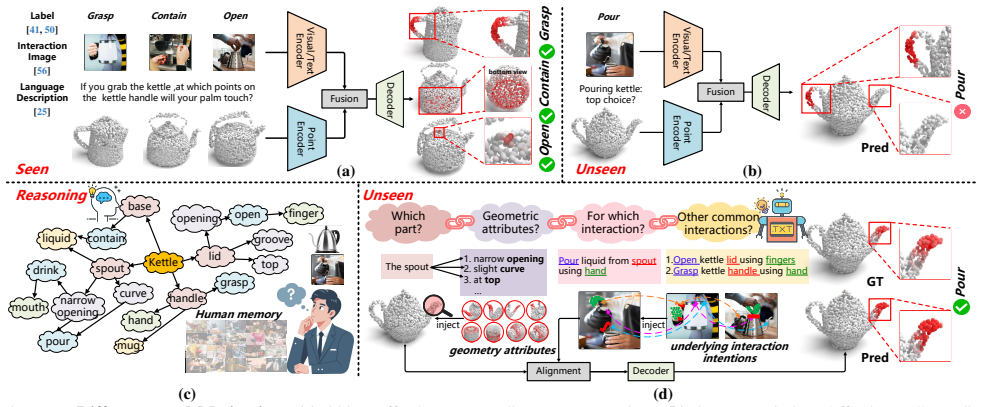
The load-bearing component is the Multi-Head Affordance Chain-of-Thought (MHACoT): a fine-tuned multimodal large language model prompted through four steps: object interaction perception, geometric structure reasoning, interaction detailed description, and interactive analogical reasoning. The object head's first two prompts extract which part interacts and why its geometry permits the interaction; the affordance head's last two prompts extract the shown interaction and brainstorm two additional interactions. These outputs are encoded, cross-attended to align geometry with intention, and compressed into two knowledge dictionaries. The Cross-Modal Adaptive Fusion Module (CMAFM) then injects the geometric dictionary into the deepest point cloud encoder layer and fuses the intention dictionary with image features, so the decoder sees point geometry and interaction context together. The mechanism's job is to make unseen affordances reachable through known geometric primitives and analogical interaction intentions instead of through memorized label mappings.
What would settle it
Run GREAT on unseen-affordance test images and compare the MLLM's four chain-of-thought answers against human annotations of the interaction part, its geometry, the shown action, and the alternative interactions. If the generated text is frequently wrong or generic for unseen affordances while grounding accuracy stays high, the chain-of-thought is not the mechanism carrying the gain; alternatively, if substituting fixed random text for the chain-of-thought answers preserves unseen-affordance AUC, then the chain-of-thought content is not the active ingredient.
Extended reading notes
Core claim
The discovery GREAT argues for is that explicitly separating geometric-structure reasoning from interaction-intention reasoning, and letting the two heads cross-reference each other, transfers to affordances whose categories were absent from training. The object head identifies the interacting part and explains its geometry; the affordance head describes the shown interaction and brainstorms two additional plausible interactions. After encoding these descriptions and aligning them via cross- and self-attention into two knowledge features, GREAT injects the geometric knowledge into point cloud features and the intention knowledge into image features, then decodes the fused features into a point-wise affordance map. On the unseen-affordance partition this design reaches an AUC of 69.81 and an aIOU of 12.05, outperforming the strongest baseline by 5.74 AUC and 3.68 aIOU. The authors present this as evidence that invariant geometry plus analogical intention reasoning, rather than a wider vocabulary of labels, is what enables open-vocabulary affordance grounding.
Load-bearing premise
The MLLM's chain-of-thought, fine-tuned on PIADv2 training images, produces accurate geometric attributes and interaction intentions for affordance categories never seen in training; if that reasoning is unreliable or hallucinated, the open-vocabulary gain the paper reports would not transfer.
Editorial extensions
If this is right
- A robot controller using this pipeline could hypothesize an interaction part and a manipulation strategy for an object category it has never seen, as long as the object's geometry resembles shapes whose affordances were described during training.
- Reasoning output is not tied to a fixed label vocabulary: the same framework can accept open-ended instructions and produce heatmaps for interactions beyond the 24 affordance categories in PIADv2.
- The dataset's three partitions turn open-vocabulary affordance grounding into a measurable benchmark, so future methods can be compared on generalization rather than only on seen-category accuracy.
- Removing either chain-of-thought head degrades performance, with the larger drop coming from removing the affordance head on unseen affordances, so both geometry and intention reasoning contribute to the open-vocabulary gain.
Reading between the lines
- An untested implication is that the four-step reasoning text itself is the active ingredient: one could replace the MLLM's answers with the same template filled with random or generic text while keeping fusion fixed, and check whether unseen-affordance accuracy drops.
- The geometry-intention decomposition could transfer to robotic grasping-point selection or tool-use planning, where the geometric step names the contact region and the intention step filters candidate actions; that application is outside the paper's experiments.
- Because the authors identify multi-step inference cost as the bottleneck, distilling the MLLM's chain-of-thought into a small text encoder or a lightweight reasoning head is the most direct path toward real-time use, and PIADv2's scale would support such distillation.
- The multi-to-multi relation between affordances and object categories in PIADv2 suggests the dataset could support compositional or few-shot splits beyond the three partitions explored here.
Editorial analysis
A structured set of objections, weighed in public.
Referee Report
Summary. The paper proposes GREAT, a framework for open-vocabulary 3D object affordance grounding. Given a point cloud and an interaction image, GREAT first fine-tunes an MLLM (InternVL) with a Multi-Head Affordance Chain-of-Thought (MHACoT) procedure to produce object geometric attributes and underlying interaction intentions. These textual outputs are encoded with RoBERTa and aggregated into two knowledge dictionaries, which are then fused into point-cloud features and image features through a Cross-Modal Adaptive Fusion Module. The final fused features are decoded into a point-wise affordance heatmap. The paper also introduces PIADv2, a large dataset of paired interaction images and 3D point clouds, and reports experiments on three partitions (Seen, Unseen Object, Unseen Affordance) showing substantial gains over reimplemented baselines. Ablations demonstrate the contribution of each component, and qualitative visualizations support the method's behavior.
Significance. If the reported results are sound, the paper makes a useful contribution to 3D affordance grounding by showing that MLLM-based chain-of-thought reasoning can provide transferable knowledge for unseen affordances. The proposed dataset, PIADv2, is substantially larger than prior benchmarks and could benefit future research. The paper also provides code and dataset release, and the ablations are fairly comprehensive. However, the significance is currently bounded by three limitations: all quantitative evaluation is on the authors' own dataset, the MLLM reasoning outputs are never directly validated for correctness or hallucination, and the fine-tuning data for the MLLM is not described in sufficient detail. These gaps make the central open-vocabulary claim less certain than the paper's wording suggests.
major comments (4)
- [Sec. 3.2] The fine-tuning of InternVL is described only in terms of adapters, epochs, learning rate, and LoRA rank; the paper does not state what data the MHACoT prompt-answer pairs come from, whether the answers are human-annotated or MLLM-generated, or whether any of those training pairs involve affordance categories or object categories that appear in the Unseen Affordance or Unseen Object test partitions. This matters because the method's open-vocabulary capability is attributed to this fine-tuned MLLM, and any overlap between the fine-tuning set and the evaluation partitions would be a form of leakage. Please specify the construction, size, and partition membership of the fine-tuning data, and verify that it is disjoint from the evaluation splits.
- [Sec. 5.2 and Table 2] All quantitative comparisons are carried out exclusively on PIADv2, a dataset introduced in the same paper, and the baselines are reimplemented with 'the same feature extractor and settings' rather than taken from official reported results. The claim of state-of-the-art performance therefore lacks external anchoring: a reader cannot tell whether the gains reflect the method's superiority or favorable properties of the new dataset and splits. Please add at least one external benchmark (for example, evaluation on the original PIAD or on 3D AffordanceNet) or, at minimum, report official baseline numbers and cross-dataset transfer experiments. Without such evidence, the SOTA claim is not fully supported.
- [Sec. 3.2, Sec. 5.3, Table 3] The paper states that the multi-step chain-of-thought strategy 'eliminates the hallucination and ambiguities raised by MLLMs when reasoning interactions,' but no direct measurement of MLLM output quality is reported. There is no hallucination rate, no accuracy metric for the predicted geometric attributes or interaction intentions, and no failure-case analysis, especially for affordance categories unseen in training. The Table 3 ablations show that removing the affordance head lowers Unseen Affordance AUC from 69.81 to 67.18 and removing the object head lowers it to 64.69; these deltas are modest and could stem from changes in the text-feature distribution or from reduced auxiliary supervision rather than from the factual correctness of the extracted knowledge. Please report direct evaluations of the MLLM-generated knowledge (e.g., human-rated accuracy or automatic comparison against annotations) and show representative successes and failures for the unseen-affordance setting.
- [Sec. 4, Data Partitions] The definition of the Unseen Affordance partition is under-specified. The paper says only that 'affordances in the test set are not present in the training set, and so does certain objects,' but it does not clarify whether the interaction images and the fine-tuned MLLM training data also exclude those affordances, nor how object categories and image sources are controlled across partitions. If, for example, images depicting 'pour' are present in the MLLM fine-tuning set even though the affordance is absent from the main training set, the open-vocabulary evaluation would be confounded. Please provide the exact partition construction rules and a per-category overlap analysis between training, fine-tuning, and test sets.
minor comments (5)
- [Sec. 4] The annotation description says 'each affordance category possesses such annotation of an instance,' which is ambiguous. Please clarify whether each point-cloud instance is annotated with one affordance heatmap per affordance category or only with the affordance category depicted in the paired image.
- [Sec. 5.3 and Table 3] The ablation labeled '✗ CMAFM' is not described in detail; please specify what replaces the Cross-Modal Adaptive Fusion Module when it is removed (e.g., simple concatenation or a fixed cross-attention layer).
- [Sec. 5.2 and Table 2] The phrase 'significantly outperforms' is used without statistical support. Reporting standard deviations across multiple seeds or a significance test would make the comparison more convincing.
- [Sec. 3.2] The full MHACoT prompts are said to be in the appendix, but the appendix is not included in the reviewed manuscript. Please ensure the full prompts are part of the submission or provide them in the main text.
- [Sec. 3.2, Eq. (1)] The cross-attention operation fm and the self-attention operation fδ are not defined in terms of their inputs and output shapes. In particular, when To and Ta have different sequence lengths, the implementation of Eq. (1) should be clarified so that the output dimensions of ¯To and ¯Ta are unambiguous.
Circularity Check
No circular derivation: the pipeline is a standard supervised image-point-cloud fusion; the only adjacent issues are a self-constructed benchmark and unmeasured MLLM hallucination claims, neither of which reduces a prediction to its inputs.
full rationale
The claimed derivation chain is explicit and non-circular. Inputs P and I are processed by PointNet++/ResNet into Fp, Fi; MHACoT fine-tunes InternVL on training interaction images to produce textual geometry and intention knowledge, encoded by RoBERTa as To, Ta; Eq. 1 aligns them via cross-attention; Eqs. 2-4 fuse these knowledge features into point and image features; Eq. 5 decodes the fused features into affordance heatmaps; Eq. 6 supervises with ground-truth point heatmaps. No equation uses test labels as an input or defines a predicted quantity as a fitted parameter renamed as a result. The MLLM's CoT outputs at test time are not the PIADv2 affordance annotations; they are derived from an externally pretrained model and from prompts, so the open-vocabulary claim rests on transfer rather than on an identity with the benchmark. The main caveats are benchmark-level, not derivation-level: PIADv2 and its Seen/Unseen partitions are constructed and partitioned by the same authors, and the assertion that multi-step reasoning 'eliminates the hallucination and ambiguities raised by MLLMs' (Sec. 3.2) is not supported by any hallucination-rate or failure-case measurement. These are evidence-quality concerns, and the self-citations to the authors' own PIAD/IAGNet work are not load-bearing for the mathematical derivation. Under the stated rules, an unsupported but non-circular assumption should be scored as low circularity, not as a definitional reduction.
Assumptions & free parameters
free parameters (4)
- LoRA rank for MLLM fine-tuning =
16
- MLLM fine-tuning learning rate =
4e-5
- Main model learning rate =
1e-4
- Training epochs =
65 (GREAT), 10 (MLLM)
assumptions (4)
- domain assumption InternVL with LoRA fine-tuning produces accurate and generalizable geometric attributes and interaction intentions from interaction images.
- domain assumption RoBERTa text embeddings preserve the affordance-relevant semantics of the MHACoT outputs.
- domain assumption PIADv2 affordance annotations and the three data partitions are clean and correctly constructed, with no category leakage between splits.
- domain assumption PointNet++ and ResNet18 provide sufficient 3D geometry and 2D image representations for affordance grounding.
Cite this review
Pith. "Pith review of GREAT: Geometry-Intention Collaborative Inference for Open-Vocabulary 3D Object Affordance Grounding." pith.science (2026). https://pith.science/paper/P2NOY5PS
@misc{pith2026241119626,
  author       = {Pith},
  title        = {Pith review of: GREAT: Geometry-Intention Collaborative Inference for Open-Vocabulary 3D Object Affordance Grounding},
  year         = {2026},
  howpublished = {\url{https://pith.science/paper/P2NOY5PS}},
  note         = {Machine review of arXiv:2411.19626}
}
read the original abstract
Open-Vocabulary 3D object affordance grounding aims to anticipate ``action possibilities'' regions on 3D objects with arbitrary instructions, which is crucial for robots to generically perceive real scenarios and respond to operational changes. Existing methods focus on combining images or languages that depict interactions with 3D geometries to introduce external interaction priors. However, they are still vulnerable to a limited semantic space by failing to leverage implied invariant geometries and potential interaction intentions. Normally, humans address complex tasks through multi-step reasoning and respond to diverse situations by leveraging associative and analogical thinking. In light of this, we propose GREAT (GeometRy-intEntion collAboraTive inference) for Open-Vocabulary 3D Object Affordance Grounding, a novel framework that mines the object invariant geometry attributes and performs analogically reason in potential interaction scenarios to form affordance knowledge, fully combining the knowledge with both geometries and visual contents to ground 3D object affordance. Besides, we introduce the Point Image Affordance Dataset v2 (PIADv2), the largest 3D object affordance dataset at present to support the task. Extensive experiments demonstrate the effectiveness and superiority of GREAT. The code and dataset are available at https://yawen-shao.github.io/GREAT/.
Figures


Figures from the paper (3 more)


Forward citations
Cited by 1 Pith paper
-
SeqAfford: Sequential 3D Affordance Reasoning via Multimodal Large Language Model
SeqAfford combines a 3D multimodal large language model with special segmentation tokens to decompose complex instructions into ordered affordance masks, and the authors present a 180K-pair benchmark for this task.
Reference graph
Works this paper leans on
-
[1]
Cross- modal learning for image-guided point cloud shape comple- tion
Emanuele Aiello, Diego Valsesia, and Enrico Magli. Cross- modal learning for image-guided point cloud shape comple- tion. In Advances in Neural Information Processing Systems,
-
[2]
Partafford: Part-level affordance discov- ery from 3d objects
Xu Chao, Yixin Chen, He Wang, songchun Zhu, Yixin Zhu, and Siyuan Huang. Partafford: Part-level affordance discov- ery from 3d objects. arXiv preprint arXiv:2202.13519, 2022. 1
arXiv 2022
-
[3]
Worldaf- ford: Affordance grounding based on natural language in- structions
Changmao Chen, Yuren Cong, and Zhen Kan. Worldaf- ford: Affordance grounding based on natural language in- structions. arXiv preprint arXiv:2405.12461, 2024. 3
arXiv 2024
-
[4]
How far are we to gpt-4v? closing the gap to commercial multimodal models with open-source suites
Zhe Chen, Weiyun Wang, Hao Tian, Shenglong Ye, Zhang- wei Gao, Erfei Cui, Wenwen Tong, Kongzhi Hu, Jiapeng Luo, Zheng Ma, et al. How far are we to gpt-4v? closing the gap to commercial multimodal models with open-source suites. arXiv preprint arXiv:2404.16821, 2024. 1, 3
arXiv 2024
-
[5]
Obja- verse: A universe of annotated 3d objects
Matt Deitke, Dustin Schwenk, Jordi Salvador, Luca Weihs, Oscar Michel, Eli VanderBilt, Ludwig Schmidt, Kiana Ehsani, Aniruddha Kembhavi, and Ali Farhadi. Obja- verse: A universe of annotated 3d objects. arXiv preprint arXiv:2212.08051, 2022. 3, 5
arXiv 2022
-
[6]
3d affordancenet: A benchmark for visual object affordance understanding
Shengheng Deng, Xun Xu, Chaozheng Wu, Ke Chen, and Kui Jia. 3d affordancenet: A benchmark for visual object affordance understanding. In Proceedings of the IEEE Con- ference on Computer Vision and Pattern Recognition , 2021. 1, 2, 3, 5
work page 2021
-
[7]
Mary L. Gick and Keith J. Holyoak. Analogical problem solving. Cognitive Psychology, 12(3):306–355, 1980. 1
work page 1980
-
[8]
Vi- sual affordance and function understanding
Mohammed Hassanin, Salman Khan, and Murat Tahtali. Vi- sual affordance and function understanding. ACM Comput- ing Surveys (CSUR), 54:1 – 35, 2018. 1
work page 2018
Show all 68 references
-
[9]
Deep residual learning for image recognition
Kaiming He, Xiangyu Zhang, Shaoqing Ren, and Jian Sun. Deep residual learning for image recognition. In 2016 IEEE Conference on Computer Vision and Pattern Recognition (CVPR), pages 770–778, 2016. 3, 6
2016
-
[10]
LoRA: Low-rank adaptation of large language models
Edward J Hu, Yelong Shen, Phillip Wallis, Zeyuan Allen- Zhu, Yuanzhi Li, Shean Wang, Lu Wang, and Weizhu Chen. LoRA: Low-rank adaptation of large language models. InIn- ternational Conference on Learning Representations , 2022. 3
2022
-
[11]
Diffusion- based generation, optimization, and planning in 3d scenes
Siyuan Huang, Zan Wang, Puhao Li, Baoxiong Jia, Tengyu Liu, Yixin Zhu, Wei Liang, and Song-Chun Zhu. Diffusion- based generation, optimization, and planning in 3d scenes. In Proceedings of the IEEE/CVF Conference on Computer Vision and Pattern Recognition (CVPR), 2023. 1
2023
-
[12]
Rekep: Spatio-temporal reasoning of rela- tional keypoint constraints for robotic manipulation
Wenlong Huang, Chen Wang, Yunzhu Li, Ruohan Zhang, and Li Fei-Fei. Rekep: Spatio-temporal reasoning of rela- tional keypoint constraints for robotic manipulation. arXiv preprint arXiv:2409.01652, 2024. 1
2024 arXiv
-
[13]
Imitation learning: A survey of learning methods
Ahmed Hussein, Mohamed Medhat Gaber, Eyad Elyan, and Chrisina Jayne. Imitation learning: A survey of learning methods. ACM Comput. Surv., 50(2), 2017. 1
2017
-
[14]
The ecological approach to visual percep- tion: classic edition
James J Gibson. The ecological approach to visual percep- tion: classic edition. Psychology press, 2014. 1
2014
-
[15]
Visionllm v2: An end-to-end generalist multimodal large language model for hundreds of vision-language tasks
Wu Jiannan, Zhong Muyan, Xing Sen, Lai Zeqiang, Liu Zhaoyang, Chen Zhe, Wang Wenhai, Zhu Xizhou, Lu Lewei, Lu Tong, Luo Ping, Qiao Yu, and Dai Jifeng. Visionllm v2: An end-to-end generalist multimodal large language model for hundreds of vision-language tasks. arXiv preprint a...
2024 arXiv
-
[16]
How We Reason
Philip Johnson-Laird. How We Reason . Oxford University Press, 2008. 1
2008
-
[17]
Sukhatme
David Inkyu Kim and Gaurav S. Sukhatme. Semantic la- beling of 3d point clouds with object affordance for robot manipulation. In 2014 IEEE International Conference on Robotics and Automation (ICRA) , pages 5578–5584, 2014. 1
2014
-
[18]
Openimages: A public dataset for large-scale multi- label and multi-class image classification
Ivan Krasin, Tom Duerig, Neil Alldrin, Vittorio Ferrari, Sami Abu-El-Haija, Alina Kuznetsova, Hassan Rom, Jasper Ui- jlings, Stefan Popov, Andreas Veit, Serge Belongie, Vic- tor Gomes, Abhinav Gupta, Chen Sun, Gal Chechik, David Cai, Zheyun Feng, Dhyanesh Narayanan, and Kevin ...
2017
-
[19]
Ram: Retrieval-based affordance transfer for generalizable zero-shot robotic manipulation, 2024
Yuxuan Kuang, Junjie Ye, Haoran Geng, Jiageng Mao, Con- gyue Deng, Leonidas Guibas, He Wang, and Yue Wang. Ram: Retrieval-based affordance transfer for generalizable zero-shot robotic manipulation, 2024. 1
2024
-
[20]
Boosting logical reasoning in large language models through a new framework: The graph of thought, 2023
Bin Lei, pei Hung Lin, Chunhua Liao, and Caiwen Ding. Boosting logical reasoning in large language models through a new framework: The graph of thought, 2023. 3
2023
-
[21]
One-shot open affordance learning with foundation models
Gen Li, Deqing Sun, Laura Sevilla-Lara, and Varun Jampani. One-shot open affordance learning with foundation models. In Proceedings of the IEEE/CVF Conference on Computer Vision and Pattern Recognition, 2024. 3
2024
-
[22]
Blip: Bootstrapping language-image pre-training for unified vision-language understanding and generation, 2022
Junnan Li, Dongxu Li, Caiming Xiong, and Steven Hoi. Blip: Bootstrapping language-image pre-training for unified vision-language understanding and generation, 2022. 1
2022
-
[23]
Ag2manip: Learning novel manipulation skills with agent- agnostic visual and action representations
Puhao Li, Tengyu Liu, Yuyang Li, Muzhi Han, Haoran Geng, Shu Wang, Yixin Zhu, Song-Chun Zhu, and Siyuan Huang. Ag2manip: Learning novel manipulation skills with agent- agnostic visual and action representations. arXiv preprint arXiv:2404.17521, 2024. 1
2024 arXiv
-
[24]
Manipllm: Embodied multimodal large language model for object-centric robotic manipulation
Xiaoqi Li, Mingxu Zhang, Yiran Geng, Haoran Geng, Yux- ing Long, Yan Shen, Renrui Zhang, Jiaming Liu, and Hao Dong. Manipllm: Embodied multimodal large language model for object-centric robotic manipulation. In CVPR,
-
[25]
Y . Li, N. Zhao, J. Xiao, C. Feng, X. Wang, and T. Chua. Laso: Language-guided affordance segmentation on 3d ob- ject. In 2024 IEEE/CVF Conference on Computer Vision and Pattern Recognition (CVPR), 2024. 1, 2, 3, 6, 7
2024
-
[26]
Focal loss for dense object detection
Tsung-Yi Lin, Priya Goyal, Ross Girshick, Kaiming He, and Piotr Dollár. Focal loss for dense object detection. IEEE Transactions on Pattern Analysis and Machine Intelligence , 42(2):318–327, 2020. 5
2020
-
[27]
Grounding 3d scene affordance from egocentric interactions
Cuiyu Liu, Wei Zhai, Yuhang Yang, Hongchen Luo, Sen Liang, Yang Cao, and Zheng-Jun Zha. Grounding 3d scene affordance from egocentric interactions. arXiv preprint arXiv:2409.19650, 2024. 1
2024 arXiv
-
[28]
Roberta: A robustly optimized bert pretraining approach, 2019
Yinhan Liu, Myle Ott, Naman Goyal, Jingfei Du, Mandar Joshi, Danqi Chen, Omer Levy, Mike Lewis, Luke Zettle- moyer, and Veselin Stoyanov. Roberta: A robustly optimized bert pretraining approach, 2019. 3, 4
2019
-
[29]
Lobo, Alberto Jiménez-Valverde, and Raimundo Real
Jorge M. Lobo, Alberto Jiménez-Valverde, and Raimundo Real. Auc: a misleading measure of the performance of pre- dictive distribution models. Global Ecology and Biogeogra- phy, 17:145–151, 2008. 6
2008
-
[30]
Phrase-based affordance detection via cyclic bilateral inter- action
Liangsheng Lu, Wei Zhai, Hongchen Luo, and Yang Cao. Phrase-based affordance detection via cyclic bilateral inter- action. 2022. 3
2022
-
[31]
One-shot affordance detection
Hongchen Luo, Wei Zhai, Jing Zhang, Yang Cao, and Dacheng Tao. One-shot affordance detection. In IJCAI,
-
[32]
Learning affordance grounding from exocen- tric images
Hongchen Luo, Wei Zhai, Jing Zhang, Yang Cao, and Dacheng Tao. Learning affordance grounding from exocen- tric images. In CVPR, 2022. 5
2022
-
[33]
Leverage interactive affinity for affordance learning
Hongchen Luo, Wei Zhai, Jing Zhang, Yang Cao, and Dacheng Tao. Leverage interactive affinity for affordance learning. In Proceedings of the IEEE/CVF Conference on Computer Vision and Pattern Recognition (CVPR) , pages 6809–6819, 2023. 3
2023
-
[34]
Learning visual affordance grounding from demonstration videos
Hongchen Luo, Wei Zhai, Jing Zhang, Yang Cao, and Dacheng Tao. Learning visual affordance grounding from demonstration videos. IEEE Transactions on Neural Net- works and Learning Systems , 35(11):16857–16871, 2024. 3
2024
-
[35]
Madiff: Motion-aware mamba diffusion models for hand trajectory prediction on egocentric videos, 2024
Junyi Ma, Xieyuanli Chen, Wentao Bao, Jingyi Xu, and Hes- heng Wang. Madiff: Motion-aware mamba diffusion models for hand trajectory prediction on egocentric videos, 2024. 1
2024
-
[36]
Gpt-driver: Learning to drive with gpt, 2023
Jiageng Mao, Yuxi Qian, Junjie Ye, Hang Zhao, and Yue Wang. Gpt-driver: Learning to drive with gpt, 2023. 1
2023
-
[37]
V-net: Fully convolutional neural networks for volumetric medical image segmentation
Fausto Milletari, Nassir Navab, and Seyed-Ahmad Ahmadi. V-net: Fully convolutional neural networks for volumetric medical image segmentation. In 2016 F ourth International Conference on 3D Vision (3DV), pages 565–571, 2016. 5
2016
-
[38]
Chang, Li Yi, Subarna Tripathi, Leonidas J
Kaichun Mo, Shilin Zhu, Angel X. Chang, Li Yi, Subarna Tripathi, Leonidas J. Guibas, and Hao Su. PartNet: A large- scale benchmark for fine-grained and hierarchical part-level 3D object understanding. In The IEEE Conference on Com- puter Vision and Pattern Recognition (CVPR), 2019. 3
2019
-
[39]
O2O-Afford: Annotation-free large-scale object-object affordance learning
Kaichun Mo, Yuzhe Qin, Fanbo Xiang, Hao Su, and Leonidas Guibas. O2O-Afford: Annotation-free large-scale object-object affordance learning. In Conference on Robot Learning (CoRL), 2021. 3
2021
-
[40]
Learning relational affor- dance models for robots in multi-object manipulation tasks
Bogdan Moldovan, Plinio Moreno, Martijn van Otterlo, José Santos-Victor, and Luc De Raedt. Learning relational affor- dance models for robots in multi-object manipulation tasks. In 2012 IEEE International Conference on Robotics and Au- tomation, pages 4373–4378, 2012. 1
2012
-
[41]
Open-vocabulary af- fordance detection in 3d point clouds
Toan Nguyen, Minh Nhat Vu, An Vuong, Dzung Nguyen, Thieu V o, Ngan Le, and Anh Nguyen. Open-vocabulary af- fordance detection in 3d point clouds. 2023. 1, 2, 3
2023
-
[42]
Global-local collab- orative inference with llm for lidar-based open-vocabulary detection, 2024
Xingyu Peng, Yan Bai, Chen Gao, Lirong Yang, Fei Xia, Beipeng Mu, Xiaofei Wang, and Si Liu. Global-local collab- orative inference with llm for lidar-based open-vocabulary detection, 2024. 1, 3
2024
-
[43]
Point- net++: Deep hierarchical feature learning on point sets in a metric space
Charles R Qi, Li Yi, Hao Su, and Leonidas J Guibas. Point- net++: Deep hierarchical feature learning on point sets in a metric space. arXiv preprint arXiv:1706.02413, 2017. 3, 4, 5, 6
2017 arXiv
-
[44]
Affordancellm: Grounding affordance from vision language models
Shengyi Qian, Weifeng Chen, Min Bai, Xiong Zhou, Zhuowen Tu, and Li Erran Li. Affordancellm: Grounding affordance from vision language models. In Proceedings of the IEEE/CVF Conference on Computer Vision and Pattern Recognition, pages 7587–7597, 2024. 3
2024
-
[45]
Optimizing intersection-over-union in deep neural networks for image segmentation
Md.Atiqur Rahman and Yang Wang. Optimizing intersection-over-union in deep neural networks for image segmentation. In International Symposium on Visual Com- puting, 2016. 6
2016
-
[46]
Morley Mao
Jiachen Sun, Qingzhao Zhang, Bhavya Kailkhura, Zhiding Yu, Chaowei Xiao, and Z. Morley Mao. Benchmarking ro- bustness of 3d point cloud recognition against common cor- ruptions. arXiv preprint arXiv:2201.12296, 2022. 3
2022 arXiv
-
[47]
Swain and Dana H
Michael J. Swain and Dana H. Ballard. Color indexing. In- ternational Journal of Computer Vision, 7:11–32, 1991. 6
1991
-
[48]
Cot- det: Affordance knowledge prompting for task driven object detection
Jiajin Tang, Ge Zheng, Jingyi Yu, and Sibei Yang. Cot- det: Affordance knowledge prompting for task driven object detection. In Proceedings of the IEEE/CVF International Conference on Computer Vision (ICCV) , pages 3068–3078,
-
[49]
Llama: Open and efficient foundation lan- guage models, 2023
Hugo Touvron, Thibaut Lavril, Gautier Izacard, Xavier Martinet, Marie-Anne Lachaux, Timothée Lacroix, Baptiste Rozière, Naman Goyal, Eric Hambro, Faisal Azhar, Aure- lien Rodriguez, Armand Joulin, Edouard Grave, and Guil- laume Lample. Llama: Open and efficient foundation lan-...
2023
-
[50]
Open-vocabulary affordance detection using knowledge distillation and text- point correlation
Tuan Van V o, Minh Nhat Vu, Baoru Huang, Toan Nguyen, Ngan Le, Thieu V o, and Anh Nguyen. Open-vocabulary affordance detection using knowledge distillation and text- point correlation. 2024. 1, 2, 3
2024
-
[51]
Chi, Quoc Le, and Denny Zhou
Jason Wei, Xuezhi Wang, Dale Schuurmans, Maarten Bosma, Ed H. Chi, Quoc Le, and Denny Zhou. Chain of thought prompting elicits reasoning in large language mod- els. CoRR, abs/2201.11903, 2022. 3
2022 arXiv
-
[52]
Willmott and Kenji Matsuura
Cort J. Willmott and Kenji Matsuura. Advantages of the mean absolute error (mae) over the root mean square error (rmse) in assessing average model performance.Climate Re- search, 30:79–82, 2005. 6
2005
-
[53]
Det- toolchain: A new prompting paradigm to unleash detection ability of mllm, 2024
Yixuan Wu, Yizhou Wang, Shixiang Tang, Wenhao Wu, Tong He, Wanli Ouyang, Philip Torr, and Jian Wu. Det- toolchain: A new prompting paradigm to unleash detection ability of mllm, 2024. 3
2024
-
[54]
Fusionrcnn: Lidar- camera fusion for two-stage 3d object detection
Xinli Xu, Shaocong Dong, Tingfa Xu, Lihe Ding, Jie Wang, Peng Jiang, Liqiang Song, and Jianan Li. Fusionrcnn: Lidar- camera fusion for two-stage 3d object detection. arXiv preprint arXiv:2209.10733, 2022. 6
2022 arXiv
-
[55]
Kptllm: Unveiling the power of large language model for keypoint comprehension,
Jie Yang, Wang Zeng, Sheng Jin, Lumin Xu, Wentao Liu, Chen Qian, and Ruimao Zhang. Kptllm: Unveiling the power of large language model for keypoint comprehension,
-
[56]
Grounding 3d object affordance from 2d interactions in images
Yuhang Yang, Wei Zhai, Hongchen Luo, Yang Cao, Jiebo Luo, and Zheng-Jun Zha. Grounding 3d object affordance from 2d interactions in images. In Proceedings of the IEEE/CVF International Conference on Computer Vision (ICCV), pages 10905–10915, 2023. 1, 2, 3, 6, 7
2023
-
[57]
Lemon: Learning 3d human-object in- teraction relation from 2d images
Yuhang Yang, Wei Zhai, Hongchen Luo, Yang Cao, and Zheng-Jun Zha. Lemon: Learning 3d human-object in- teraction relation from 2d images. In Proceedings of the IEEE/CVF Conference on Computer Vision and Pattern Recognition, pages 16284–16295, 2024. 5
2024
-
[58]
Egochoir: Capturing 3d human-object interaction regions from egocentric views
Yuhang Yang, Wei Zhai, Chengfeng Wang, Chengjun Yu, Yang Cao, and Zheng-Jun Zha. Egochoir: Capturing 3d human-object interaction regions from egocentric views. arXiv preprint arXiv:2405.13659, 2024. 1
2024 arXiv
-
[59]
Griffiths, Yuan Cao, and Karthik Narasimhan
Shunyu Yao, Dian Yu, Jeffrey Zhao, Izhak Shafran, Thomas L. Griffiths, Yuan Cao, and Karthik Narasimhan. Tree of thoughts: Deliberate problem solving with large lan- guage models, 2023. 3
2023
-
[60]
Beyond chain-of- thought, effective graph-of-thought reasoning in language models, 2024
Yao Yao, Zuchao Li, and Hai Zhao. Beyond chain-of- thought, effective graph-of-thought reasoning in language models, 2024. 3
2024
-
[61]
One-shot object affordance detection in the wild
Wei Zhai, Hongchen Luo, Jing Zhang, Yang Cao, and Dacheng Tao. One-shot object affordance detection in the wild. arXiv preprint arXiv:2108.03658, 2021. 3
2021 arXiv
-
[62]
Ex- ploring figure-ground assignment mechanism in perceptual organization
Wei Zhai, Yang Cao, Jing Zhang, and Zheng-Jun Zha. Ex- ploring figure-ground assignment mechanism in perceptual organization. Advances in Neural Information Processing Systems, 35:17030–17042, 2022. 1
2022
-
[63]
Background activation suppression for weakly supervised object localization and semantic segmen- tation
Wei Zhai, Pingyu Wu, Kai Zhu, Yang Cao, Feng Wu, and Zheng-Jun Zha. Background activation suppression for weakly supervised object localization and semantic segmen- tation. International Journal of Computer Vision , pages 1– 26, 2023. 3
2023
-
[64]
On exploring multiplicity of prim- itives and attributes for texture recognition in the wild
Wei Zhai, Yang Cao, Jing Zhang, Haiyong Xie, Dacheng Tao, and Zheng-Jun Zha. On exploring multiplicity of prim- itives and attributes for texture recognition in the wild. IEEE Transactions on Pattern Analysis and Machine Intelligence , 46(1):403–420, 2024. 1
2024
-
[65]
Automatic chain of thought prompting in large language models, 2022
Zhuosheng Zhang, Aston Zhang, Mu Li, and Alex Smola. Automatic chain of thought prompting in large language models, 2022. 3
2022
-
[66]
Bidirectional progressive transformer for interac- tion intention anticipation
Zichen Zhang, Hongchen Luo, Wei Zhai, Yang Cao, and Yu Kang. Bidirectional progressive transformer for interac- tion intention anticipation. arXiv preprint arXiv:2405.05552,
-
[67]
Pear: Phrase-based hand-object interaction anticipa- tion
Zichen Zhang, Hongchen Luo, Wei Zhai, Yang Cao, and Yu Kang. Pear: Phrase-based hand-object interaction anticipa- tion. arXiv preprint arXiv:2407.21510, 2024. 1
2024 arXiv
-
[68]
Minigpt-4: Enhancing vision-language understanding with advanced large language models
Deyao Zhu, Jun Chen, Xiaoqian Shen, Xiang Li, and Mo- hamed Elhoseiny. Minigpt-4: Enhancing vision-language understanding with advanced large language models. arXiv preprint arXiv:2304.10592, 2023. 3
2023 arXiv
Reviewed August 12, 2026 · model on record in the stance chip above.
Discussion (0). Continue with ORCID to comment.