A fidelity metric for quantum annealing benchmarked by extreme scaling quantum Monte-Carlo simulations
Pith reviewed 2026-06-26 01:44 UTC · model grok-4.3
The pith
A fidelity metric based on equation-of-state accuracy benchmarks quantum annealing to 10^{-4} at 100,000 atoms.
A machine-rendered reading of the paper's core claim, the machinery that carries it, and where it could break.
Core claim
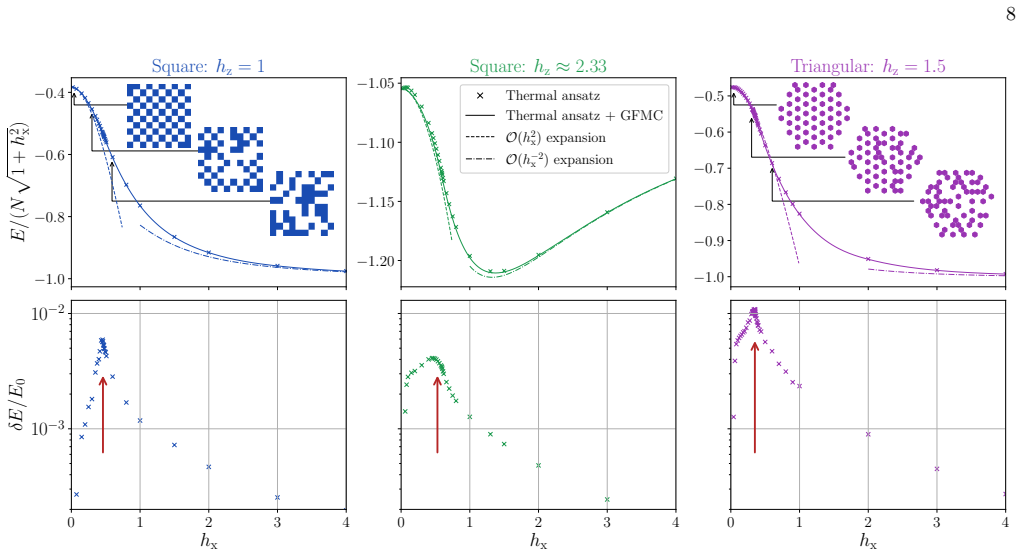
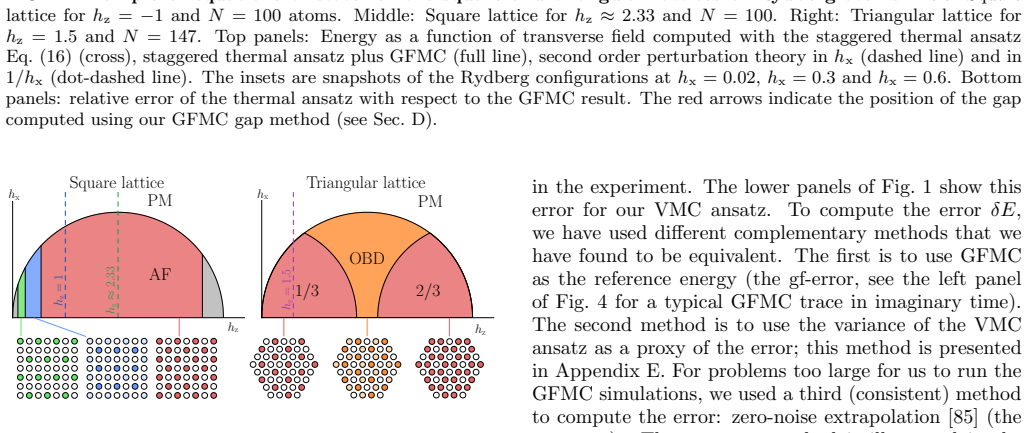
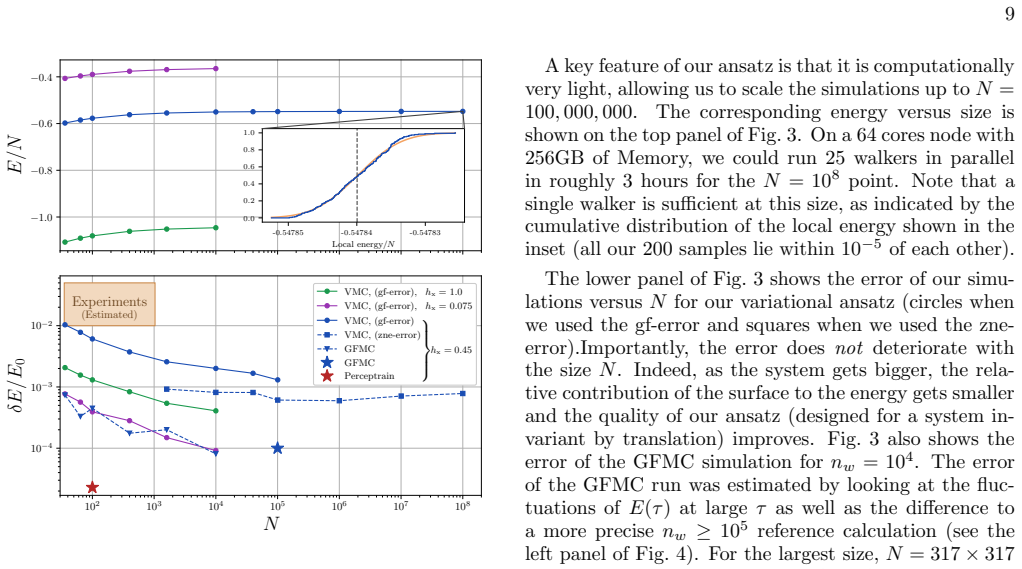
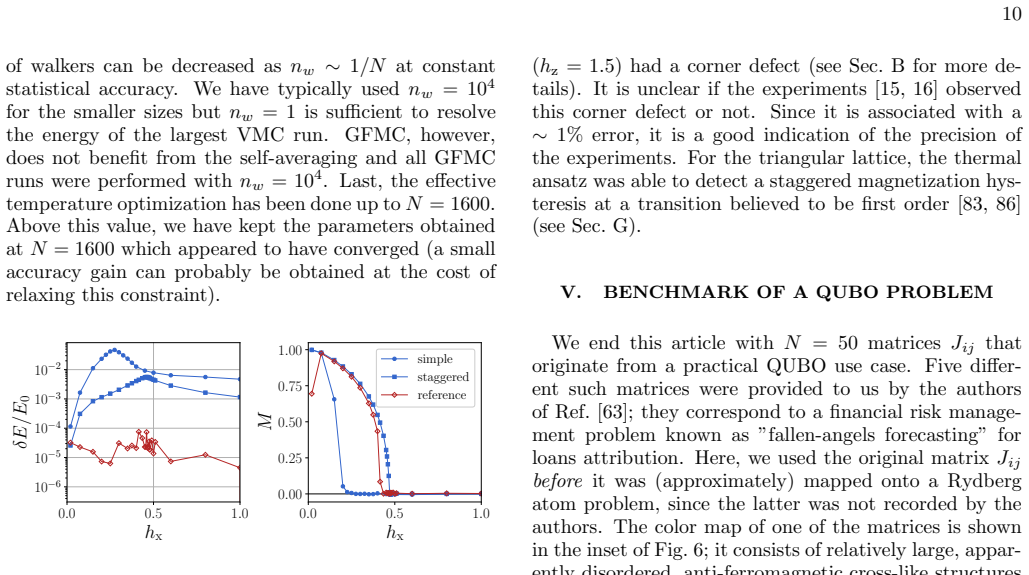
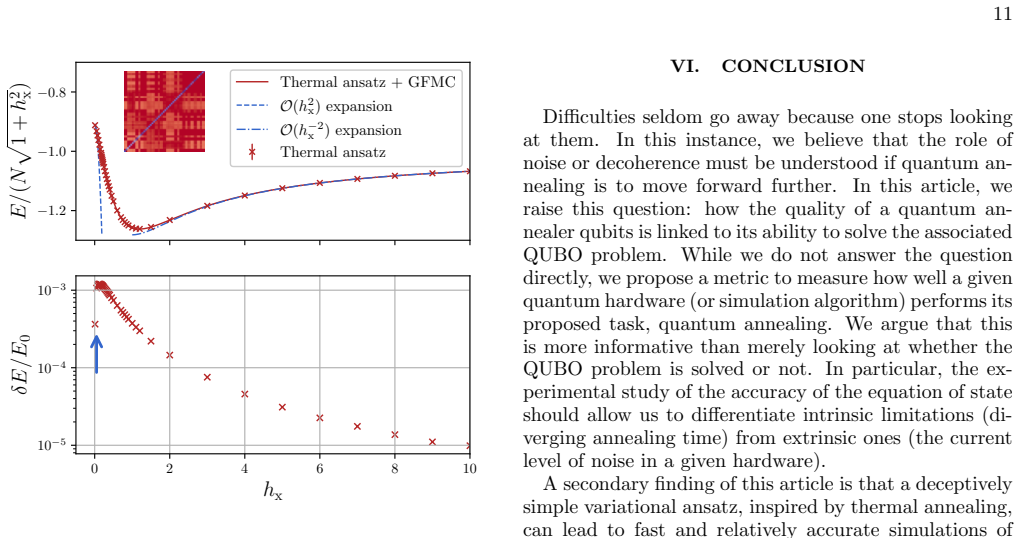
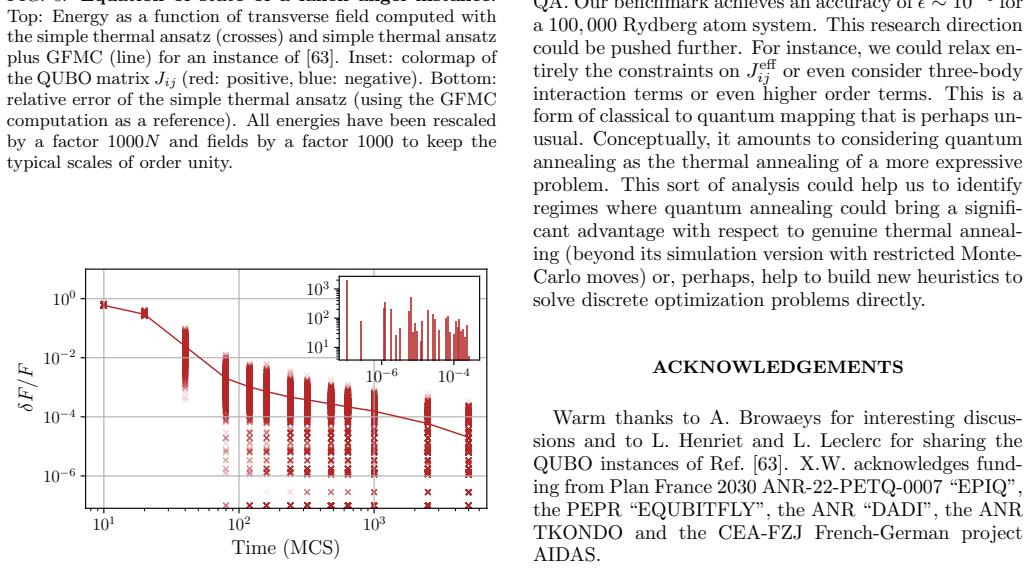
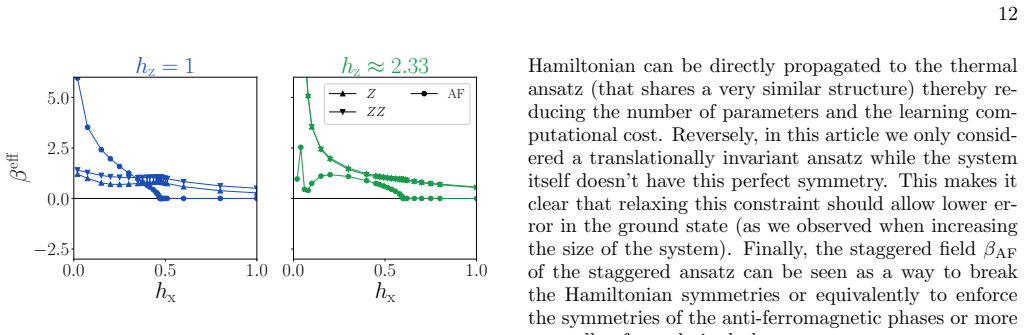
The authors define ε as the accuracy with which the annealer reproduces the equation of state of the system as the Hamiltonian interpolates from trivial to non-trivial. Variational quantum Monte-Carlo simulations with a thermal-annealing ansatz establish that ε ∼ 10^{-2}−10^{-3} suffices to make the quantum process indistinguishable from classical thermal annealing, with this precision attained at system sizes of 100,000,000 atoms on a single CPU. Green-function quantum Monte-Carlo improves the accuracy to ε ∼ 10^{-4} at 100,000 atoms. The resulting values serve as reference benchmarks that current experimental Rydberg platforms do not yet reach.
What carries the argument
The fidelity metric ε, defined as the accuracy of the annealer's equation of state during Hamiltonian interpolation.
If this is right
- The metric evaluates the annealing process quality rather than final optimization success and remains independent of the chosen problem instance or classical reference algorithm.
- Variational quantum Monte-Carlo reaches ε of order 10^{-2} to 10^{-3} at 100 million atoms on one CPU.
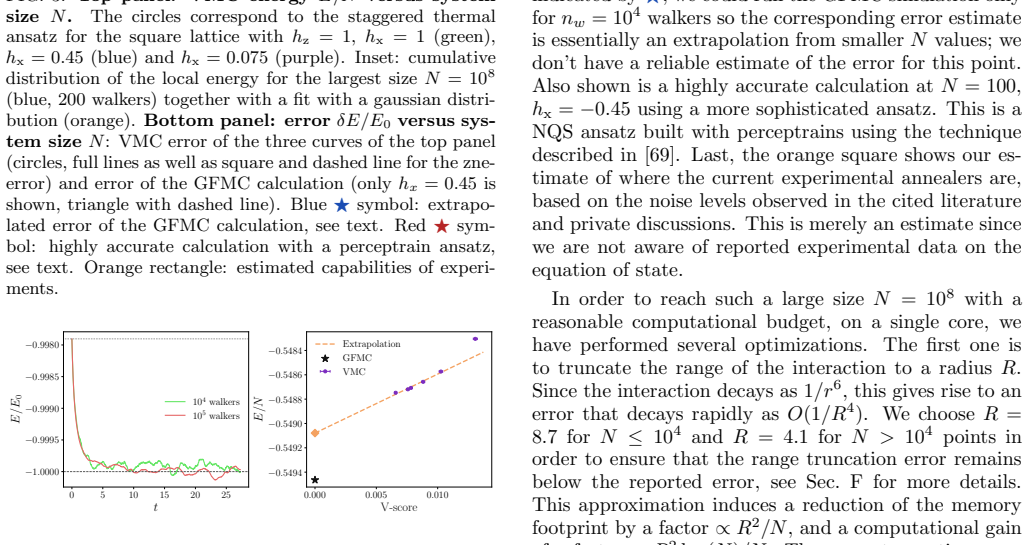
- Green-function quantum Monte-Carlo reaches ε around 10^{-4} at 100 thousand atoms.
- The benchmark values impose concrete precision and size targets that future quantum annealing hardware must meet or surpass.
- Existing Rydberg-atom experimental platforms are outperformed by the simulated benchmarks in both precision and system size by orders of magnitude.
Where Pith is reading between the lines
- Adoption of ε would allow direct numerical comparison of fidelity across different quantum annealing hardware platforms.
- The same simulation methods could be used to predict the minimal hardware improvements needed to exceed classical thermal performance at a chosen ε.
- The metric opens a route to unify benchmarking language between quantum annealing and gate-based quantum computing by treating ε as an analogue of fidelity per gate.
- If real devices match the Monte Carlo predictions at the reported precisions, it would confirm that current experimental limitations are mainly technical rather than fundamental.
Load-bearing premise
The two quantum Monte Carlo techniques faithfully reproduce the dynamics and equation of state that would occur in a real experimental quantum annealer.
What would settle it
An experimental Rydberg-atom device that measures its own equation of state during annealing and finds a systematic deviation from the Monte Carlo predictions larger than the reported ε at comparable system sizes.
Figures

read the original abstract
Quantum annealers are supposed to follow adiabatically the ground state of a system as its Hamiltonian slowly interpolates between a trivial phase and a non-trivial one; the non-trivial ground state being the solution to an optimization problem. Overwhelmingly, their performances are measured in terms of how well or fast the optimization problem is solved. While pragmatic, this approach is inherently brittle as it strongly depends on the problem considered and the classical algorithm used as the reference benchmark. Here, we propose a quantity that not only measures the end result but also the quality of the actual quantum annealing process itself. Our metric is the quantum annealing counterpart of the fidelity-per gate of gate-based quantum computers. It takes the form of an accuracy $\epsilon$ for the equation of state of the annealer. We calculate benchmark values of $\epsilon$ using two variants of the simulated quantum annealing technique for Rydberg atoms systems. Our first approach uses variational quantum Monte-Carlo with an ansatz inspired by thermal annealing. It suggests that within $\epsilon \sim 10^{-2}-10^{-3}$, a quantum annealer is indistinguishable from its thermal classical counterpart. Critically, we could reach this precision up to $100,000,000$ atoms on a single CPU. Our second approach (based on Green function quantum Monte-Carlo) reaches accuracies around $\epsilon \sim 10^{-4}$ and we have run it up to $100,000$ atoms. These results outperform current Rydberg atom quantum annealing experimental platforms in both precision and size by orders of magnitude and put severe constraints for future hardware.
Editorial analysis
A structured set of objections, weighed in public.
Referee Report
Summary. The paper introduces a fidelity metric ε for quantum annealing, defined as the accuracy with which the annealer reproduces the equation of state during the annealing process (analogous to fidelity per gate in gate-based QC). It benchmarks ε for Rydberg-atom systems using two simulated quantum annealing methods: variational quantum Monte Carlo with a thermal-annealing ansatz (reaching ε ∼ 10^{-2}–10^{-3} up to 10^8 atoms) and Green-function QMC (reaching ε ∼ 10^{-4} up to 10^5 atoms). The central claim is that these benchmark values already outperform current Rydberg experimental platforms by orders of magnitude in both precision and size, thereby imposing severe constraints on future hardware.
Significance. If the QMC simulations are shown to faithfully reproduce the relevant observables of actual quantum annealing dynamics, the proposed ε metric would offer a problem-independent figure of merit that directly quantifies annealing quality rather than end-point success. The reported extreme scaling (single-CPU runs to 10^8 atoms) demonstrates a clear computational advantage over direct experimental characterization and could serve as a useful reference once the proxy assumption is validated.
major comments (2)
- [Abstract] Abstract: the claim that the computed ε values 'outperform current Rydberg atom quantum annealing experimental platforms … and put severe constraints for future hardware' rests on the unverified assumption that the variational thermal-annealing QMC and Green-function QMC produce the same instantaneous or time-averaged observables that an ideal experimental device would produce under the same schedule. No small-system validation against exact time-dependent Schrödinger evolution or against published Rydberg annealing data is referenced, rendering the hardware-constraint conclusion unsupported.
- [Abstract] Abstract: the variational ansatz is explicitly constructed from a classical thermal distribution, yet the paper asserts it benchmarks quantum annealing; without a demonstration that it reproduces coherent or non-adiabatic quantum evolution (as opposed to classical thermal sampling), the reported ε ∼ 10^{-3} cannot be interpreted as a quantum-fidelity benchmark.
minor comments (1)
- [Abstract] The abstract does not define the precise functional form of ε or the equation of state being matched; a short explicit definition would improve clarity.
Simulated Author's Rebuttal
We thank the referee for their careful reading and constructive comments on the manuscript. We address each major comment below, clarifying the scope of our QMC benchmarks and proposing targeted revisions to the abstract and main text.
read point-by-point responses
-
Referee: [Abstract] Abstract: the claim that the computed ε values 'outperform current Rydberg atom quantum annealing experimental platforms … and put severe constraints for future hardware' rests on the unverified assumption that the variational thermal-annealing QMC and Green-function QMC produce the same instantaneous or time-averaged observables that an ideal experimental device would produce under the same schedule. No small-system validation against exact time-dependent Schrödinger evolution or against published Rydberg annealing data is referenced, rendering the hardware-constraint conclusion unsupported.
Authors: We acknowledge that the manuscript does not include explicit small-system benchmarks against exact time-dependent Schrödinger evolution or direct comparison to published Rydberg annealing experiments. The Green-function QMC is a standard projector method capable of simulating quantum dynamics under a time-dependent schedule, while the variational thermal-annealing ansatz is introduced specifically to establish a classical reference. The hardware-constraint statement is therefore framed relative to these simulated proxies rather than a fully validated ideal quantum annealer. We will revise the abstract to qualify the claim as applying to the simulated ideal case and add a brief discussion of the proxy assumptions together with relevant literature on QMC validation for Rydberg systems. revision: partial
-
Referee: [Abstract] Abstract: the variational ansatz is explicitly constructed from a classical thermal distribution, yet the paper asserts it benchmarks quantum annealing; without a demonstration that it reproduces coherent or non-adiabatic quantum evolution (as opposed to classical thermal sampling), the reported ε ∼ 10^{-3} cannot be interpreted as a quantum-fidelity benchmark.
Authors: The manuscript text already states that the variational QMC results indicate a quantum annealer would be 'indistinguishable from its thermal classical counterpart' within ε ∼ 10^{-2}–10^{-3}. This method is presented as one of two variants to furnish a classical thermal baseline, while the Green-function QMC supplies the higher-accuracy quantum benchmark (ε ∼ 10^{-4}). We will revise the abstract and relevant sections to make this distinction explicit and to avoid any implication that the variational ε value constitutes a quantum-fidelity benchmark. revision: yes
Circularity Check
No circularity; metric defined independently and benchmarks computed via external Monte Carlo methods
full rationale
The paper defines the fidelity metric ε directly as an accuracy measure on the equation of state of the annealing process, independent of any simulation output. Benchmark values of ε are then obtained by running two separate QMC algorithms (variational with thermal ansatz, and Green-function) on the target Rydberg systems. No equation or result is shown to be equivalent to its inputs by construction, no parameter is fitted to a subset and relabeled as a prediction, and no load-bearing claim reduces to a self-citation. The derivation chain therefore remains self-contained against the supplied simulation procedures.
Axiom & Free-Parameter Ledger
Reference graph
Works this paper leans on
-
[1]
This route is becoming increasingly popular with, e.g., demonstra- tions of up to 2000 artificial spins in photonic systems [34] with all-to-all connectivity
Thermal annealing The most natural counterpart to QA is to build a clas- sical machine tailored to solve QUBO problems using thermal fluctuations instead of quantum ones. This route is becoming increasingly popular with, e.g., demonstra- tions of up to 2000 artificial spins in photonic systems [34] with all-to-all connectivity. A large number of different...
2000
-
[2]
Simulated thermal annealing The baseline to which many QA articles compare themselves is a simulated version of thermal annealing, often simply referred as simulated annealing (SA). In SA, one uses a Markov Chain to sample a thermal distribu- tionP(n) = (1/Z) exp[−β effF(n)] and then gradually in- crease the inverse temperatureβ eff until one has reached ...
-
[3]
Importantly, the QA Hamilto- nian is sign-problemfreeso that these techniques are in principle exact
Simulated quantum annealing Simulated quantum annealing (SQA) is a generic ter- minology that encompasses various quantum Monte- Carlo techniques that aim at simulating the ground state of the QA problem itself. Importantly, the QA Hamilto- nian is sign-problemfreeso that these techniques are in principle exact. However, SQA potentially suffers from the s...
-
[4]
Classical heuristics Many QA applications originate from groups that had a history in solving discrete optimization problems, long before QA became fashionable. While the worst case so- lution of many of these problems is provably NP hard, hence almost certainly exponentially hard, practical in- stances have a lot of extra structure that specialized al- g...
-
[5]
As the importance of discrete optimization prob- lems spreads, new classes of classical algorithms are likely to emerge
Other classical baselines The examples above do not exhaust the classical ap- proaches against which quantum annealing can be com- pared. As the importance of discrete optimization prob- lems spreads, new classes of classical algorithms are likely to emerge. Examples include a combination of belief propagation with a tensor network [49] (Ref. [49] also co...
-
[6]
It developed into roughly three stages
Superconducting circuits The first implementation of QA with superconducting circuits is now already fifteen years old [53]. It developed into roughly three stages. Initially, the focus was to demonstrate that there actu- ally was some quantumness involved in the experiments. Ref. [54] prepared a superposition of the two ferromag- netic states of a small ...
-
[7]
EPIQ”, the PEPR “EQUBITFLY
Rydberg atoms Rydberg atoms QA platforms are more recent than superconducting circuits and the corpus of studied appli- cations is much smaller. Each qubitiis an atom that can be placed at positionr i with optical tweezers resulting in an interaction matrix Jij = (1−δ ij) 2|ri −r j|6 −δ ijhz,(6) whereδ ij is the Kronecker symbol. The off-diagonal part res...
2030
-
[8]
It is typically the antiferromagnetic state (possibly with a corner defect, see Fig
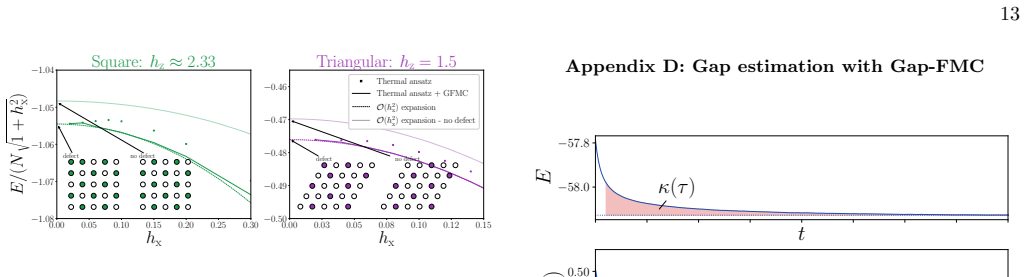
Weak field expansion (h x ≪J ij) Let| ˜n⟩be the ground state of ˆHz. It is typically the antiferromagnetic state (possibly with a corner defect, see Fig. 9). Perturbation theory inh x for ˆH= ˆHz −h x ˆHx gives E0 =F( ˜n)−h 2 x X i 1 δi +O(h 3 x),(C1) withδ i defined as δi =J ii + 2(1−2˜ni) X j Jij ˜nj.(C2)
-
[9]
Apply perturbation theory to ˆH/hx = ˆHx − 1 hx ˆHz
Strong field expansion (h x ≫J ij) At large field, the reference state is the ground state of ˆHx, i.e.,|+⟩ ⊗N. Apply perturbation theory to ˆH/hx = ˆHx − 1 hx ˆHz. The perturbation ˆHz contains terms acting on either one site ˆni or two sites ˆniˆnj. This results in the ground state energy E0 =−h xN+ 1 2 X i≤j Jij (C3) − 1 hx 1 8 X i X j Jij 2...
-
[10]
Kochenberger, J.-K
G. Kochenberger, J.-K. Hao, F. Glover, M. Lewis, Z. L¨ u, H. Wang, and Y. Wang, The unconstrained binary quadratic programming problem: a survey, J. Comb. Op- tim.28, 58 (2014)
2014
-
[11]
Kadowaki and H
T. Kadowaki and H. Nishimori, Quantum annealing in the transverse Ising model, Phys. Rev. E58, 5355 (1998). 17
1998
-
[12]
Morita and H
S. Morita and H. Nishimori, Mathematical foundation of quantum annealing, J. Math. Phys.49, 125210 (2008)
2008
-
[13]
Quantum annealing: An introduction and new developments
M. Ohzeki and H. Nishimori, Quantum anneal- ing: An introduction and new developments, arXiv 10.48550/arXiv.1006.1696 (2010), 1006.1696
work page internal anchor Pith review Pith/arXiv arXiv doi:10.48550/arxiv.1006.1696 2010
-
[14]
F. Phillipson, Quantum computing in logistics and supply chain management an overview (2025), arXiv:2402.17520 [quant-ph]
arXiv 2025
-
[15]
T. Stollenwerket al., Quantum annealing applied to de- conflicting optimal trajectories for air traffic manage- ment, IEEE Transactions on Intelligent Transportation Systems23, 16750 (2021)
2021
-
[16]
Venturelli and A
D. Venturelli and A. Kondratyev, Reverse quantum an- nealing approach to portfolio optimization problems, Quantum Mach. Intell.1, 17 (2019)
2019
-
[17]
Benedetti, J
M. Benedetti, J. Realpe-G´ omez, R. Biswas, and A. Perdomo-Ortiz, Quantum-assisted learning of hardware-embedded probabilistic graphical models, Phys. Rev. X7, 041052 (2017)
2017
-
[18]
Or´ us, S
R. Or´ us, S. Mugel, and E. Lizaso, Forecasting finan- cial crashes with quantum computing, Phys. Rev. A99, 060301 (2019)
2019
-
[19]
Yarkoni, E
S. Yarkoni, E. Raponi, T. B¨ ack, and S. Schmitt, Quan- tum annealing for industry applications: introduction and review, Reports on Progress in Physics85, 104001 (2022)
2022
-
[20]
K. A. Smith-Miles, H. H. Hoos, H. Wang, T. B¨ ack, and T. J. Osborne, The travelling salesperson problem and the challenges of near-term quantum advantage, Quan- tum Science and Technology10, 033001 (2025)
2025
-
[21]
A. D. King, J. Carrasquilla, J. Raymond, I. Ozfidan, E. Andriyash, A. Berkley, M. Reis, T. Lanting, R. Har- ris, F. Altomare, K. Boothby, P. I. Bunyk, C. En- derud, A. Fr´ echette, E. Hoskinson, N. Ladizinsky, T. Oh, G. Poulin-Lamarre, C. Rich, Y. Sato, A. Yu. Smirnov, L. J. Swenson, M. H. Volkmann, J. Whittaker, J. Yao, E. Ladizinsky, M. W. Johnson, J. H...
2018
-
[22]
A. D. King, J. Raymond, T. Lanting, S. V. Isakov, M. Mohseni, G. Poulin-Lamarre, S. Ejtemaee, W. Bernoudy, I. Ozfidan, A. Yu. Smirnov, M. Reis, F. Altomare, M. Babcock, C. Baron, A. J. Berkley, K. Boothby, P. I. Bunyk, H. Christiani, C. Enderud, B. Evert, R. Harris, E. Hoskinson, S. Huang, K. Jooya, A. Khodabandelou, N. Ladizinsky, R. Li, P. A. Lott, A. J...
2021
-
[23]
A. D. King, S. Suzuki, J. Raymond, A. Zucca, T. Lant- ing, F. Altomare, A. J. Berkley, S. Ejtemaee, E. Hoskin- son, S. Huang, E. Ladizinsky, A. J. R. MacDonald, G. Marsden, T. Oh, G. Poulin-Lamarre, M. Reis, C. Rich, Y. Sato, J. D. Whittaker, J. Yao, R. Harris, D. A. Lidar, H. Nishimori, and M. H. Amin, Coherent quantum an- nealing in a programmable 2,000...
2022
-
[24]
Scholl, M
P. Scholl, M. Schuler, H. J. Williams, A. A. Eberharter, D. Barredo, K.-N. Schymik, V. Lienhard, L.-P. Henry, T. C. Lang, T. Lahaye, A. M. L¨ auchli, and A. Browaeys, Quantum simulation of 2D antiferromagnets with hun- dreds of Rydberg atoms, Nature595, 233 (2021)
2021
-
[25]
Ebadi, T
S. Ebadi, T. T. Wang, H. Levine, A. Keesling, G. Se- meghini, A. Omran, D. Bluvstein, R. Samajdar, H. Pich- ler, W. W. Ho, S. Choi, S. Sachdev, M. Greiner, V. Vuleti´ c, and M. D. Lukin, Quantum phases of matter on a 256-atom programmable quantum simulator, Nature 595, 227 (2021)
2021
-
[26]
Ebadi, A
S. Ebadi, A. Keesling, M. Cain, T. T. Wang, H. Levine, D. Bluvstein, G. Semeghini, A. Omran, J.-G. Liu, R. Samajdar, X.-Z. Luo, B. Nash, X. Gao, B. Barak, E. Farhi, S. Sachdev, N. Gemelke, L. Zhou, S. Choi, H. Pichler, S.-T. Wang, M. Greiner, V. Vuleti´ c, and M. D. Lukin, Quantum optimization of maximum independent set using Rydberg atom arrays, Science3...
2022
- [27]
-
[28]
Zener, Non-adiabatic crossing of energy levels, Proc
C. Zener, Non-adiabatic crossing of energy levels, Proc. R. Soc. London A137, 696 (1932)
1932
-
[29]
S. R. White, Density matrix formulation for quantum renormalization groups, Phys. Rev. Lett.69, 2863 (1992)
1992
-
[30]
M. M. Wolf, F. Verstraete, M. B. Hastings, and J. I. Cirac, Area laws in quantum systems: Mutual infor- mation and correlations, Phys. Rev. Lett.100, 070502 (2008)
2008
-
[31]
Miller and D
J. Miller and D. A. Huse, Zero-temperature critical be- havior of the infinite-range quantum Ising spin glass, Phys. Rev. Lett.70, 3147 (1993)
1993
-
[32]
How powerful is adiabatic quantum compu- tation?
W. van Dam, M. Mosca, and U. Vazirani, How Powerful is Adiabatic Quantum Computation?, arXiv 10.1109/SFCS.2001.959902 (2002), quant-ph/0206003
-
[33]
B. W. Reichardt, The quantum adiabatic optimization algorithm and local minima, inProceedings of the Thirty- Sixth Annual ACM Symposium on Theory of Computing, STOC ’04 (Association for Computing Machinery, New York, NY, USA, 2004) p. 502–510
2004
-
[34]
J¨ org, F
T. J¨ org, F. Krzakala, J. Kurchan, and A. C. Maggs, Sim- ple Glass Models and Their Quantum Annealing, Phys. Rev. Lett.101, 147204 (2008)
2008
-
[35]
M. H. S. Amin and V. Choi, First-order quantum phase transition in adiabatic quantum computation, Phys. Rev. A80, 062326 (2009)
2009
-
[36]
Proceedings of the National Academy of Sciences , volume =
B. Altshuler, H. Krovi, and J. Roland, An- derson localization makes adiabatic quan- tum optimization fail, Proceedings of the Na- tional Academy of Sciences107, 12446 (2010), https://www.pnas.org/doi/pdf/10.1073/pnas.1002116107
-
[37]
A. P. Young, S. Knysh, and V. N. Smelyanskiy, First- order phase transition in the quantum adiabatic algo- rithm, Phys. Rev. Lett.104, 020502 (2010)
2010
-
[38]
J¨ org, F
T. J¨ org, F. Krzakala, G. Semerjian, and F. Zamponi, First-order transitions and the performance of quantum algorithms in random optimization problems, Phys. Rev. Lett.104, 207206 (2010)
2010
-
[39]
Quantum Adiabatic Algorithms, Small Gaps, and Different Paths
E. Farhi, J. Goldstone, D. Gosset, S. Gutmann, H. B. Meyer, and P. Shor, Quantum Adiabatic Al- gorithms, Small Gaps, and Different Paths, arXiv 10.48550/arXiv.0909.4766 (2009), 0909.4766. 18
work page internal anchor Pith review Pith/arXiv arXiv doi:10.48550/arxiv.0909.4766 2009
-
[40]
Miyazaki and H
R. Miyazaki and H. Nishimori, Real-space renormalization-group approach to the random transverse-field Ising model in finite dimensions, Phys. Rev. E87, 032154 (2013)
2013
-
[41]
Bapst, L
V. Bapst, L. Foini, F. Krzakala, G. Semerjian, and F. Zamponi, The quantum adiabatic algorithm applied to random optimization problems: The quantum spin glass perspective, Phys. Rep.523, 127 (2013)
2013
-
[42]
C. R. Laumann, R. Moessner, A. Scardicchio, and S. L. Sondhi, Quantum Adiabatic Algorithm and Scaling of Gaps at First-Order Quantum Phase Transitions, Phys. Rev. Lett.109, 030502 (2012)
2012
-
[43]
Inagaki, Y
T. Inagaki, Y. Haribara, K. Igarashi, T. Sonobe, S. Ta- mate, T. Honjo, A. Marandi, P. L. McMahon, T. Umeki, K. Enbutsu, O. Tadanaga, H. Takenouchi, K. Aihara, K.- i. Kawarabayashi, K. Inoue, S. Utsunomiya, and H. Take- sue, A coherent Ising machine for 2000-node optimization problems, Science354, 603 (2016)
2000
-
[44]
Mohseni, P
N. Mohseni, P. L. McMahon, and T. Byrnes, Ising ma- chines as hardware solvers of combinatorial optimization problems, Nature Reviews Physics4, 363 (2022)
2022
-
[45]
Kirkpatrick, C
S. Kirkpatrick, C. J. Gelatt, and M. Vecchi, Optimization by simulated annealing, Science220, 671 (1983)
1983
-
[46]
ˇCern´ y, Thermodynamical approach to the traveling salesman problem: An efficient simulation algorithm, J
V. ˇCern´ y, Thermodynamical approach to the traveling salesman problem: An efficient simulation algorithm, J. Optim. Theory Appl.45, 41 (1985)
1985
-
[47]
Hajek, Cooling schedules for optimal annealing, Math- ematics of Operations Research13, 311 (1988)
B. Hajek, Cooling schedules for optimal annealing, Math- ematics of Operations Research13, 311 (1988)
1988
-
[48]
A. W. Sandvik, Stochastic series expansion method for quantum ising models with arbitrary interactions, Phys. Rev. E68, 056701 (2003)
2003
-
[49]
D. M. Ceperley, Path integrals in the theory of condensed helium, Rev. Mod. Phys.67, 279 (1995)
1995
-
[50]
G. E. Santoro, R. Martoˇ n´ ak, E. Tosatti, and R. Car, Theory of Quantum Annealing of an Ising Spin Glass, Science295, 2427 (2002)
2002
-
[51]
B. Heim, T. F. Rønnow, S. V. Isakov, and M. Troyer, Quantum versus classical annealing of Ising spin glasses, Science348, 215 (2015)
2015
-
[52]
Martoˇ n´ ak, G
R. Martoˇ n´ ak, G. E. Santoro, and E. Tosatti, Quantum annealing of the traveling-salesman problem, Phys. Rev. E70, 057701 (2004)
2004
-
[53]
Seki and H
Y. Seki and H. Nishimori, Quantum annealing with an- tiferromagnetic fluctuations, Phys. Rev. E85, 051112 (2012)
2012
-
[54]
F. A. Quinton, P. A. S. Myhr, M. Barani, P. Crespo del Granado, and H. Zhang, Quantum annealing applica- tions, challenges and limitations for optimisation prob- lems compared to classical solvers, Scientific Reports15, 12733 (2025)
2025
-
[55]
Carugno, M
C. Carugno, M. Ferrari Dacrema, and P. Cremonesi, Evaluating the job shop scheduling problem on a D-wave quantum annealer, Sci. Rep.12, 6539 (2022)
2022
-
[56]
M. F. Serret, B. Marchand, and T. Ayral, Solving op- timization problems with rydberg analog quantum com- puters: Realistic requirements for quantum advantage using noisy simulation and classical benchmarks, Phys. Rev. A102, 052617 (2020)
2020
-
[57]
Cazals, A
P. Cazals, A. Fran¸ cois, L. Henriet, L. Leclerc, M. Marin, Y. Naghmouchi, W. d. S. Coelho, F. Sikora, V. Vitale, R. Watrigant, M. W. Garzillo, and C. Dalyac, Identify- ing hard native instances for the maximum-independent- set problem on neutral-atom quantum processors, Phys. Rev. Appl.25, 034085 (2026)
2026
-
[58]
I. A. Luchnikov, E. S. Tiunov, T. Haug, and L. Aolita, Large-scale quantum annealing simulation with tensor networks and belief propagation, arXiv 10.48550/arXiv.2409.12240 (2024), 2409.12240
-
[59]
T. Qian, G. Qi, Z. Y. Wu, R. Gu, X. Liu, and C. Lyu, Large language model for discrete optimization prob- lems: Evaluation and step-by-step reasoning (2026), arXiv:2603.07733 [cs.AI]
arXiv 2026
-
[60]
L. Mauron and G. Carleo, Challenging the Quan- tum Advantage Frontier with Large-Scale Clas- sical Simulations of Annealing Dynamics, arXiv 10.48550/arXiv.2503.08247 (2025), 2503.08247
-
[61]
S. W. Shin, G. Smith, J. A. Smolin, and U. Vazi- rani, How ”Quantum” is the D-Wave Machine?, arXiv 10.48550/arXiv.1401.7087 (2014), 1401.7087
work page internal anchor Pith review Pith/arXiv arXiv doi:10.48550/arxiv.1401.7087 2014
-
[62]
M. W. Johnson, M. H. S. Amin, S. Gildert, T. Lant- ing, F. Hamze, N. Dickson, R. Harris, A. J. Berkley, J. Johansson, P. Bunyk, E. M. Chapple, C. Enderud, J. P. Hilton, K. Karimi, E. Ladizinsky, N. Ladizinsky, T. Oh, I. Perminov, C. Rich, M. C. Thom, E. Tolkacheva, C. J. S. Truncik, S. Uchaikin, J. Wang, B. Wilson, and G. Rose, Quantum annealing with manu...
2011
-
[63]
Lanting, A
T. Lanting, A. J. Przybysz, A. Yu. Smirnov, F. M. Spedalieri, M. H. Amin, A. J. Berkley, R. Harris, F. Al- tomare, S. Boixo, P. Bunyk, N. Dickson, C. Enderud, J. P. Hilton, E. Hoskinson, M. W. Johnson, E. Ladizin- sky, N. Ladizinsky, R. Neufeld, T. Oh, I. Perminov, C. Rich, M. C. Thom, E. Tolkacheva, S. Uchaikin, A. B. Wilson, and G. Rose, Entanglement in...
2014
-
[64]
Boixo, T
S. Boixo, T. F. Rønnow, S. V. Isakov, Z. Wang, D. Wecker, D. A. Lidar, J. M. Martinis, and M. Troyer, Evidence for quantum annealing with more than one hun- dred qubits, Nature Physics10, 218 (2014)
2014
-
[65]
A. D. King, J. Raymond, T. Lanting, R. Harris, A. Zucca, F. Altomare, A. J. Berkley, K. Boothby, S. Ejtemaee, C. Enderud, E. Hoskinson, S. Huang, E. Ladizinsky, A. J. R. MacDonald, G. Marsden, R. Molavi, T. Oh, G. Poulin-Lamarre, M. Reis, C. Rich, Y. Sato, N. Tsai, M. Volkmann, J. D. Whittaker, J. Yao, A. W. Sandvik, and M. H. Amin, Quantum critical dynam...
2023
-
[66]
A. D. King, A. Nocera, M. M. Rams, J. Dziarmaga, R. Wiersema, W. Bernoudy, J. Raymond, N. Kaushal, N. Heinsdorf, R. Harris, K. Boothby, F. Altomare, M. Asad, A. J. Berkley, M. Boschnak, K. Chern, H. Christiani, S. Cibere, J. Connor, M. H. Dehn, R. Desh- pande, S. Ejtemaee, P. Farre, K. Hamer, E. Hoskinson, S. Huang, M. W. Johnson, S. Kortas, E. Ladizinsky...
2025
-
[67]
V. S. Denchev, S. Boixo, S. V. Isakov, N. Ding, R. Bab- bush, V. Smelyanskiy, J. Martinis, and H. Neven, What is the Computational Value of Finite-Range Tunneling?, Phys. Rev. X6, 031015 (2016). 19
2016
-
[68]
R. Saket, A ptas for the classical ising spin glass problem on the chimera graph structure (2013), arXiv:1306.6943 [cs.DS]
Pith/arXiv arXiv 2013
-
[69]
Albash and D
T. Albash and D. A. Lidar, Demonstration of a scaling advantage for a quantum annealer over simulated anneal- ing, Phys. Rev. X8, 031016 (2018)
2018
-
[70]
M. S. K¨ onz, W. Lechner, H. G. Katzgraber, and M. Troyer, Embedding Overhead Scaling of Optimiza- tion Problems in Quantum Annealing, PRX Quantum2, 040322 (2021)
2021
-
[71]
D. Vert, R. Sirdey, and S. Louise, Benchmarking Quan- tum Annealing Against “Hard” Instances of the Bipartite Matching Problem, SN Comput. Sci.2, 106 (2021)
2021
-
[72]
Leclerc, L
L. Leclerc, L. Ortiz-Guti´ errez, S. Grijalva, B. Albrecht, J. R. K. Cline, V. E. Elfving, A. Signoles, L. Henriet, G. Del Bimbo, U. A. Sheikh, M. Shah, L. Andrea, F. Ish- tiaq, A. Duarte, S. Mugel, I. C´ aceres, M. Kurek, R. Or´ us, A. Seddik, O. Hammami, H. Isselnane, and D. M’tamon, Financial risk management on a neutral atom quantum processor, Phys. R...
2023
-
[73]
H. Nishimori and Y. Nonomura, Quantum effects in neu- ral networks, Journal of the Physical Society of Japan 65, 3780 (1996), https://doi.org/10.1143/JPSJ.65.3780
-
[74]
Raymond, S
J. Raymond, S. Yarkoni, and E. Andriyash, Global Warming: Temperature Estimation in Annealers, Front. ICT3, 214379 (2016)
2016
-
[75]
Becca and S
F. Becca and S. Sorella,Quantum Monte Carlo ap- proaches for correlated systems(Cambridge University Press, 2017)
2017
-
[76]
Sprague and S
K. Sprague and S. Czischek, Variational Monte Carlo with large patched transformers, Communications Physics7, 90 (2024)
2024
-
[77]
Naumann, E
J. Naumann, E. L. Weerda, M. Rizzi, J. Eisert, and P. Schmoll, An introduction to infinite projected entangled-pair state methods for variational ground state simulations using automatic differentiation, SciPost Phys. Lect. Notes , 86 (2024)
2024
-
[78]
Srdinˇ sek and X
M. Srdinˇ sek and X. Waintal, Hybrid between biologically and quantum-inspired many-body states, Phys. Rev. B 113, 125107 (2026)
2026
-
[79]
Louvet, T
T. Louvet, T. Ayral, and X. Waintal, Feasibility of per- forming quantum chemistry calculations on quantum computers, Phys. Rev. B113, 125112 (2026)
2026
-
[80]
Ardonne, P
E. Ardonne, P. Fendley, and E. Fradkin, Topological or- der and conformal quantum critical points, Annals of Physics310, 493 (2004)
2004
discussion (0)
Sign in with ORCID, Apple, or X to comment. Anyone can read and Pith papers without signing in.