Axion-like particles solve the Bto Kνbarν and Bto π K puzzles
Pith reviewed 2026-06-30 12:49 UTC · model grok-4.3
The pith
A short-lived axion-like particle near the pion mass resolves both the B to K invisible excess and the B to pi K decay discrepancies.
A machine-rendered reading of the paper's core claim, the machinery that carries it, and where it could break.
Core claim
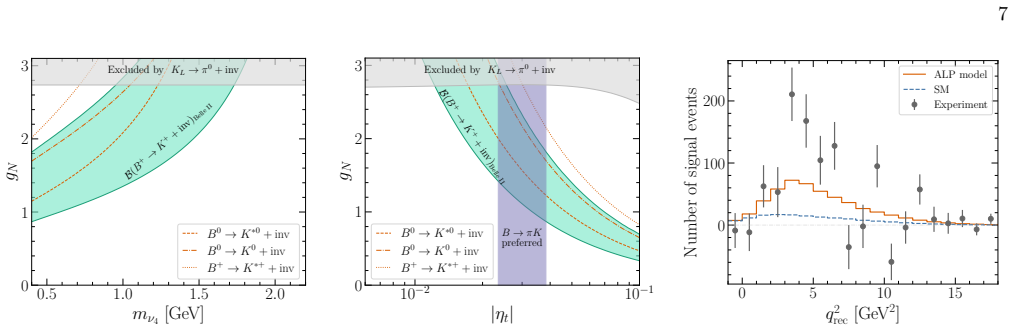
In the minimal ALP model, the particle mixes with the pi0 to alter B to pi0 K decays and couples off-shell to pairs of heavy sterile neutrinos to enhance B+ to K+ plus invisible, thereby addressing both anomalies simultaneously while producing specific, testable rates in related B and K channels and a contribution to the muon magnetic moment.
What carries the argument
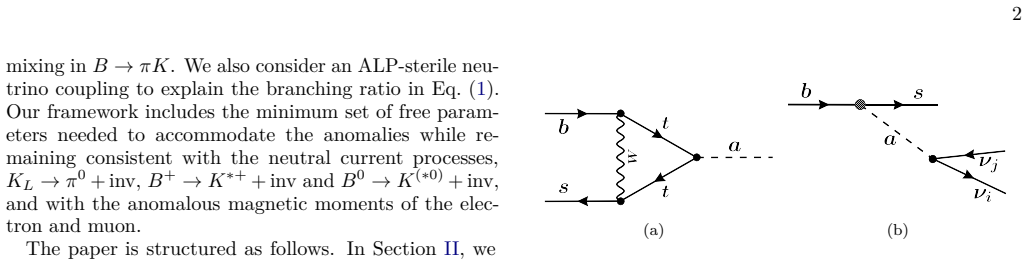
ALP mixing with the pi0 together with its off-shell coupling to heavy sterile neutrino pairs, driven by tuned couplings to the photon and top quark.
If this is right
- All B to K(*) plus invisible branching ratios receive specific ALP-induced enhancements.
- The decays K+ to pi+ plus invisible and KL to pi0 plus invisible receive appreciable ALP contributions.
- The muon magnetic moment receives an appreciable ALP contribution while the electron moment and b to s e+ e- remain essentially unaffected.
Where Pith is reading between the lines
- Future precision data on the full set of B to K(*) invisible modes at Belle II could overconstrain the ALP parameters.
- The required sterile neutrino mass and mixing could produce detectable signals in dedicated neutrino or beam-dump searches.
- If the ALP mixing mechanism holds, similar effects might appear in other neutral-meson systems where pion mixing is possible.
Load-bearing premise
The ALP mass sits close to the pi0 mass and its couplings to the photon, top quark, and sterile neutrino are tuned to fit the anomalies without violating other bounds.
What would settle it
A measurement of the KL to pi0 plus invisible branching ratio that shows no enhancement or deviates from the value predicted by the ALP mixing and sterile neutrino coupling would rule out the explanation.
Figures
read the original abstract
The recent measurement of the branching ratio of $B^+ \to K^+ + \mathrm{inv}$ (where "inv" denotes invisible states) by the Belle~II collaboration is enhanced relative to the standard model expectation by 2.7$\sigma$. An older puzzle persists in measurements of the branching ratios and CP asymmetries of $B \to \pi K $ decays. We address these two anomalies in flavor-changing neutral current $B$ decays, with a short-lived axion-like particle (ALP) with mass close to that of the $\pi^0$. In the minimal model, the ALP has couplings to the photon, top quark and a heavy sterile neutrino $\nu_N$. The ALP contributes to the $B \to \pi^0 K$ decays by mixing with the $\pi^0$. It contributes to $B^+ \to K^+ + \mathrm{inv}$ by its off-shell coupling to sterile neutrino pairs. We make predictions for all $B \to K^{(*)} + \mathrm{inv}$ modes and for the rare kaon decays $K^+ \to \pi^+ + \mathrm{inv}$ and $K_L \to \pi^0 + \mathrm{inv}$. We find an appreciable contribution to the magnetic moment of the muon, and negligible contributions to the magnetic moment of the electron and $b \to s e^+ e^-$.
Editorial analysis
A structured set of objections, weighed in public.
Referee Report
Summary. The manuscript proposes that a short-lived axion-like particle (ALP) with mass near m_π⁰, coupled to photons, the top quark, and a heavy sterile neutrino ν_N, simultaneously resolves the 2.7σ Belle II excess in B⁺ → K⁺ + inv and the B → πK branching-ratio and CP-asymmetry puzzles. The ALP mixes with the π⁰ to modify B → π⁰K modes and contributes to invisible B decays via off-shell exchange into ν_N pairs; predictions are given for all B → K(*) + inv channels, the rare kaon decays K⁺ → π⁺ + inv and K_L → π⁰ + inv, and (g-2)_μ (with negligible effects on (g-2)_e and b → s e⁺e⁻).
Significance. If the chosen parameter space is shown to be consistent with all existing limits, the work would supply a single-particle explanation for two independent B-physics anomalies together with concrete, falsifiable predictions in kaon decays and the muon magnetic moment. The approach is economical and directly testable at current and near-future experiments.
major comments (2)
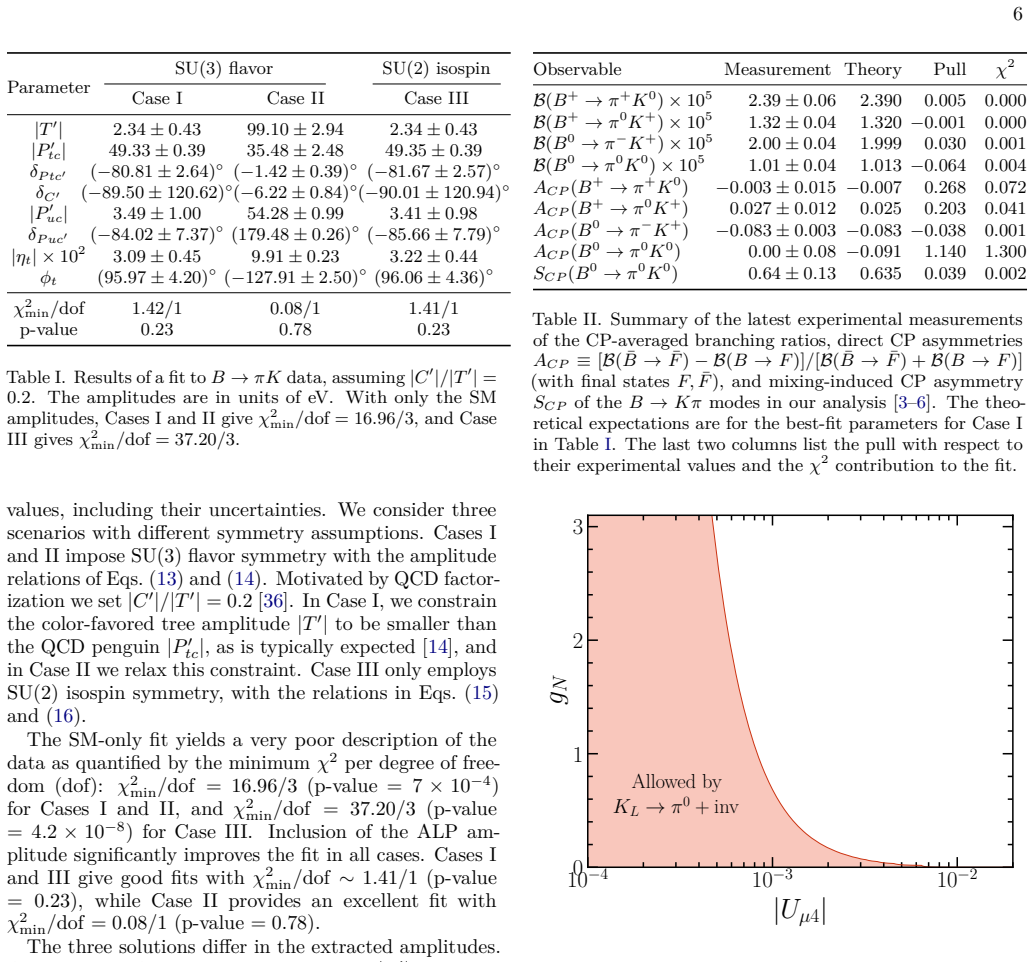
- [kaon-decay predictions section] The central viability claim rests on the assertion that the same three couplings (to photon, top, and ν_N) can be chosen to reproduce the observed B anomalies while keeping the predicted rates for K⁺ → π⁺ + inv and K_L → π⁰ + inv below experimental bounds. The manuscript must demonstrate this explicitly with the numerical values used for the B fits (e.g., the section presenting the kaon predictions and the table of branching ratios).
- [Eq. for ALP propagator and mixing] The off-shell contribution to B⁺ → K⁺ + inv relies on the propagator 1/(q² − m_ALP²) with m_ALP ≈ m_π⁰. The same mixing and couplings necessarily generate contributions to the kaon modes; the paper should quantify the degree of cancellation or suppression that keeps the kaon rates acceptable (reference the relevant equation for the effective b → s ALP vertex and the mixing angle).
minor comments (2)
- [model Lagrangian section] Clarify the precise definition of the ALP–top coupling (e.g., whether it is flavor-diagonal or includes a specific texture) and its relation to the b → s FCNC operator.
- [model section] Add a brief statement on the lifetime of the ALP and why it is short-lived enough to be treated as off-shell in the B decays but still mixes with the π⁰.
Simulated Author's Rebuttal
We thank the referee for their careful reading of the manuscript and for the positive assessment of its significance. We address each of the two major comments below and commit to revisions that will strengthen the presentation of our results.
read point-by-point responses
-
Referee: [kaon-decay predictions section] The central viability claim rests on the assertion that the same three couplings (to photon, top, and ν_N) can be chosen to reproduce the observed B anomalies while keeping the predicted rates for K⁺ → π⁺ + inv and K_L → π⁰ + inv below experimental bounds. The manuscript must demonstrate this explicitly with the numerical values used for the B fits (e.g., the section presenting the kaon predictions and the table of branching ratios).
Authors: We agree that an explicit demonstration with the specific numerical values from the B-anomaly fits is necessary to fully establish viability. Although the manuscript already computes and presents predictions for the kaon modes, the revised version will add a dedicated table (or subsection) that inserts the exact best-fit values of the three couplings obtained from the B → K + inv and B → πK analyses and reports the resulting K⁺ → π⁺ + inv and K_L → π⁰ + inv branching ratios, confirming they remain below the experimental limits. This addition will make the consistency transparent without changing any conclusions. revision: yes
-
Referee: [Eq. for ALP propagator and mixing] The off-shell contribution to B⁺ → K⁺ + inv relies on the propagator 1/(q² − m_ALP²) with m_ALP ≈ m_π⁰. The same mixing and couplings necessarily generate contributions to the kaon modes; the paper should quantify the degree of cancellation or suppression that keeps the kaon rates acceptable (reference the relevant equation for the effective b → s ALP vertex and the mixing angle).
Authors: The propagator is written exactly as stated, and the effective b → s ALP vertex is generated by the top-quark loop (with the sterile-neutrino coupling entering the invisible width). The π⁰ mixing, controlled by the photon coupling, produces a kinematic suppression in the kaon amplitudes. In the revision we will (i) explicitly cite the equation defining the effective b → s ALP vertex and the equation for the mixing angle, and (ii) add a short quantitative paragraph that evaluates the suppression factor (or the ratio of ALP-induced amplitudes in the kaon versus B channels) for the benchmark parameter point, thereby showing how the kaon rates remain acceptable. This will directly address the request for explicit referencing and quantification. revision: yes
Circularity Check
No significant circularity; model parameters fitted to anomalies then used for independent predictions
full rationale
The paper introduces an ALP with m_ALP ≈ m_π0 and couplings to photons, top quarks, and sterile neutrinos chosen to explain the two B-decay anomalies via mixing and off-shell exchange. It then derives contributions to additional modes (B → K(*) + inv, K → π + inv) from the same parameters. No quoted equations or self-citations show any 'prediction' reducing to the input anomalies by construction, nor any load-bearing self-citation chain. The derivation remains self-contained as a standard BSM construction with external experimental inputs and outputs.
Axiom & Free-Parameter Ledger
free parameters (2)
- ALP mass
- ALP couplings to photon, top, and nu_N
axioms (2)
- domain assumption ALP mixes with the neutral pion
- domain assumption ALP couples off-shell to sterile neutrino pairs
invented entities (2)
-
short-lived ALP
no independent evidence
-
heavy sterile neutrino nu_N
no independent evidence
Reference graph
Works this paper leans on
-
[1]
Adachiet al.(Belle-II), Evidence forB+→K+ν¯νde- cays, Phys
I. Adachiet al.(Belle-II), Evidence forB+→K+ν¯νde- cays, Phys. Rev. D109, 112006(2024), arXiv:2311.14647 [hep-ex]
-
[2]
Romano (NA62), New measurement ofK +→π+ν¯ν branching ratio at the NA62 experiment, PoSEPS- HEP2025, 299 (2026)
A. Romano (NA62), New measurement ofK +→π+ν¯ν branching ratio at the NA62 experiment, PoSEPS- HEP2025, 299 (2026)
2026
-
[3]
Navaset al.(Particle Data Group), Review of particle physics, Phys
S. Navaset al.(Particle Data Group), Review of particle physics, Phys. Rev. D110, 030001 (2024)
2024
-
[4]
R. Aaijet al.(LHCb), Observation of CP violation in two-body B0 (s)-meson decays to charged pions and kaons, JHEP03, 075, arXiv:2012.05319 [hep-ex]
-
[5]
I. Adachiet al.(Belle-II), Measurement of branching frac- tions and direct CP asymmetries for B→Kπand B→ππ decays at Belle II, Phys. Rev. D109, 012001 (2024), arXiv:2310.06381 [hep-ex]
-
[6]
Adachiet al.(Belle-II), Measurement of CP Violation in B0→KS0π0 Decays at Belle II, Phys
I. Adachiet al.(Belle-II), Measurement of CP Violation in B0→KS0π0 Decays at Belle II, Phys. Rev. Lett.131, 111803 (2023), arXiv:2305.07555 [hep-ex]
-
[7]
B. Bhattacharya, A. Datta, D. Marfatia, S. Nandi, and J. Waite, Axion-like particles resolve theB→πKand g−2anomalies, Phys. Rev. D104, L051701 (2021), arXiv:2104.03947 [hep-ph]
-
[8]
W. Altmannshofer and S. Roy, Joint explanation of the B→πKpuzzle and theB→Kν¯νexcess, Phys. Rev. D 111, 075029 (2025), arXiv:2411.06592 [hep-ph]
- [9]
- [10]
-
[11]
G. D’Ambrosio, A. M. Iyer, F. Mahmoudi, and S. Ne- shatpour, Anatomy of kaon decays and prospects for lepton flavour universality violation, JHEP09, 148, arXiv:2206.14748 [hep-ph]
- [12]
-
[13]
W. Altmannshofer, A. Crivellin, H. Haigh, G. In- guglia, and J. Martin Camalich, Light new physics in B→K (∗)ν¯ν?, Phys. Rev. D109, 075008 (2024), arXiv:2311.14629 [hep-ph]
-
[14]
S. Baek, P. Hamel, D. London, A. Datta, and D. A. Suprun, The B→πKpuzzle and new physics, Phys. Rev. D71, 057502 (2005), arXiv:hep-ph/0412086
work page internal anchor Pith review Pith/arXiv arXiv 2005
-
[15]
Weak Decays Beyond Leading Logarithms
G. Buchalla, A. J. Buras, and M. E. Lautenbacher, Weak Decays beyond Leading Logarithms, Rev. Mod. Phys. 68, 1125 (1996), arXiv:hep-ph/9512380. 9
work page internal anchor Pith review Pith/arXiv arXiv 1996
-
[16]
Isospin-based EWP-tree Relations
B. Bhattacharya, M. Bouchard, A. Jean, D. London, and I. Ray, Isospin-based EWP-tree Relations, (2025), arXiv:2510.13969 [hep-ph]
work page internal anchor Pith review Pith/arXiv arXiv 2025
-
[17]
A precise sum rule among four B -> Kpi CP asymmetries
M. Gronau, A Precise sum rule among four B —> K pi CP asymmetries, Phys. Lett. B627, 82 (2005), arXiv:hep-ph/0508047
work page internal anchor Pith review Pith/arXiv arXiv 2005
-
[18]
Collider Probes of Axion-Like Particles
M. Bauer, M. Neubert, and A. Thamm, Collider Probes of Axion-Like Particles, JHEP12, 044, arXiv:1708.00443 [hep-ph]
work page internal anchor Pith review Pith/arXiv arXiv
-
[19]
N. Gubernari, M. Reboud, D. van Dyk, and J. Virto, Dispersive analysis ofB→K(∗)andBs→ϕform factors, JHEP12, 153, arXiv:2305.06301 [hep-ph]
- [20]
-
[21]
$B\to V\ell^+\ell^-$ in the Standard Model from Light-Cone Sum Rules
A. Bharucha, D. M. Straub, and R. Zwicky,B→Vℓ+ℓ− in the Standard Model from light-cone sum rules, JHEP 08, 098, arXiv:1503.05534 [hep-ph]
work page internal anchor Pith review Pith/arXiv arXiv
-
[22]
G. Alonso-Álvarez and M. Escudero Abenza, The first limit on invisible decays ofBs mesons comes from LEP, Eur. Phys. J. C84, 553 (2024), arXiv:2310.13043 [hep- ph]
-
[23]
R. Barateet al.(ALEPH), Measurements of BR( b→ τ−¯ντX)and BR(b→τ−¯ντD∗±X)and upper limits on BR(B−→τ−¯ντ)and BR(b→sν¯ν), Eur. Phys. J. C19, 213 (2001), arXiv:hep-ex/0010022
work page internal anchor Pith review Pith/arXiv arXiv 2001
-
[24]
Invisible widths of heavy mesons
B. Bhattacharya, C. M. Grant, and A. A. Petrov, Invis- ible widths of heavy mesons, Phys. Rev. D99, 093010 (2019), arXiv:1809.04606 [hep-ph]
work page internal anchor Pith review Pith/arXiv arXiv 2019
-
[25]
Redeker (KOTO), The search forKL→π0ννin the KOTO experiment, PoSICHEP2024, 467 (2025)
J. Redeker (KOTO), The search forKL→π0ννin the KOTO experiment, PoSICHEP2024, 467 (2025)
2025
-
[26]
E. Cortina Gilet al.(NA62), Measurement of the very rare K+→π+ννdecay, JHEP06, 093, arXiv:2103.15389 [hep-ex]
- [27]
-
[28]
Dispersive representation and shape of the Kl3 form factors: robustness
V. Bernard, M. Oertel, E. Passemar, and J. Stern, Dis- persive representation and shape of the K(l3) form fac- tors: Robustness, Phys. Rev. D80, 034034 (2009), arXiv:0903.1654 [hep-ph]
work page internal anchor Pith review Pith/arXiv arXiv 2009
- [29]
-
[30]
Standard-model prediction for direct CP violation in $K\to\pi\pi$ decay
Z. Baiet al.(RBC, UKQCD), Standard Model Prediction forDirectCPViolation in K→ππDecay, Phys. Rev. Lett. 115, 212001 (2015), arXiv:1505.07863 [hep-lat]
work page internal anchor Pith review Pith/arXiv arXiv 2015
-
[31]
R. Abbottet al.(RBC, UKQCD), Direct CP violation and the∆ I = 1/2rule in K→ππdecay from the standard model, Phys. Rev. D102, 054509 (2020), arXiv:2004.09440 [hep-lat]
- [32]
- [33]
-
[34]
H. Dembinski and P. O. et al., scikit-hep/iminuit 10.5281/zenodo.3949207 (2020)
-
[35]
James and M
F. James and M. Roos, Minuit: A System for Function Minimization and Analysis of the Parameter Errors and Correlations, Comput. Phys. Commun.10, 343 (1975)
1975
-
[36]
NNLO vertex corrections to non-leptonic B decays: Tree amplitudes
M. Beneke, T. Huber, and X.-Q. Li, NNLO vertex cor- rections to non-leptonic B decays: Tree amplitudes, Nucl. Phys. B832, 109 (2010), arXiv:0911.3655 [hep-ph]
work page internal anchor Pith review Pith/arXiv arXiv 2010
-
[37]
D. M. Straub, flavio: a Python package for flavour and precision phenomenology in the Standard Model and be- yond, (2018), arXiv:1810.08132 [hep-ph]
work page internal anchor Pith review Pith/arXiv arXiv 2018
- [38]
-
[39]
Praz,Search for B→Kvvdecays with a machine learning method at the Belle II experiment, Ph.D
C. Praz,Search for B→Kvvdecays with a machine learning method at the Belle II experiment, Ph.D. thesis, U. Hamburg (main), Hamburg U., Hamburg U., Dept. Math., Hamburg (2022)
2022
-
[40]
Search for B -> h(*) nu nubar with the full Belle Y(4S) data sample
O. Lutzet al.(Belle), Search for B→h(∗)ν¯νwith the full BelleΥ(4 S)data sample, Phys. Rev. D87, 111103 (2013), arXiv:1303.3719 [hep-ex]
work page internal anchor Pith review Pith/arXiv arXiv 2013
-
[41]
Search for $\boldsymbol{B\to h\nu\bar{\nu}}$ decays with semileptonic tagging at Belle
J. Grygieret al.(Belle), Search for B→hν¯νdecays with semileptonic tagging at Belle, Phys. Rev. D 96, 091101 (2017), [Addendum: Phys.Rev.D 97, 099902 (2018)], arXiv:1702.03224 [hep-ex]
work page internal anchor Pith review Pith/arXiv arXiv 2017
- [42]
-
[43]
The anomalous magnetic moment of the muon in the Standard Model: an update
R. Alibertiet al., The anomalous magnetic moment of the muon in the Standard Model: an update, Phys. Rept. 1143, 1 (2025), arXiv:2505.21476 [hep-ph]
work page internal anchor Pith review Pith/arXiv arXiv 2025
-
[44]
Morel, Z
L. Morel, Z. Yao, P. Cladé, and S. Guellati-Khélifa, Deter- mination of the fine-structure constant with an accuracy of 81 parts per trillion, Nature588, 61 (2020)
2020
-
[45]
R. H. Parker, C. Yu, W. Zhong, B. Estey, and H. Müller, Measurement of the fine-structure constant as a test of the Standard Model, Science360, 191 (2018), arXiv:1812.04130 [physics.atom-ph]
work page internal anchor Pith review Pith/arXiv arXiv 2018
discussion (0)
Sign in with ORCID, Apple, or X to comment. Anyone can read and Pith papers without signing in.