Consistent CutPINNs for Convection-Diffusion Equations on Curved Level-Set Domains
Pith reviewed 2026-06-30 02:57 UTC · model grok-4.3
The pith
A discrete L^γ interior loss and H^{1/2} boundary norm produce one H^1 error bound for PINNs on convection-diffusion problems with curved level-set boundaries.
A machine-rendered reading of the paper's core claim, the machinery that carries it, and where it could break.
Core claim
We prove a single a priori H^1 error bound, valid for all interior exponents γ ∈ (1,2], with an optimal recovery rate governed by a cut-cell floor 1/(2γ) specific to the curved geometry.
What carries the argument
The consistent-loss PINN that penalizes the interior residual in a discrete L^γ norm (γ = 1 + 1/log m_tilde) and enforces the boundary condition through a discrete H^{1/2} trace norm.
If this is right
- The interior loss is no longer dominated by the thin boundary layer.
- A uniform H^1 bound holds across the entire interval of admissible γ values.
- The method applies equally to flat and curved geometries via the trace norm.
- Training remains stable as the diffusion parameter eps tends to zero.
Where Pith is reading between the lines
- The same loss construction may stabilize PINN training for other singularly perturbed problems that develop thin layers.
- The explicit dependence of the rate on the cut-cell floor suggests that local refinement near the interface could improve the observed convergence.
- Adaptive selection of γ during training might further reduce the number of required collocation points.
Load-bearing premise
The solution satisfies the Besov regularity assumptions invoked to obtain the H1 error bound.
What would settle it
On a curved domain with the proposed loss, the measured H^1 error fails to recover at rate 1/(2γ) for some fixed γ in (1,2] once the number of collocation points exceeds the cut-cell scale.
Figures

read the original abstract
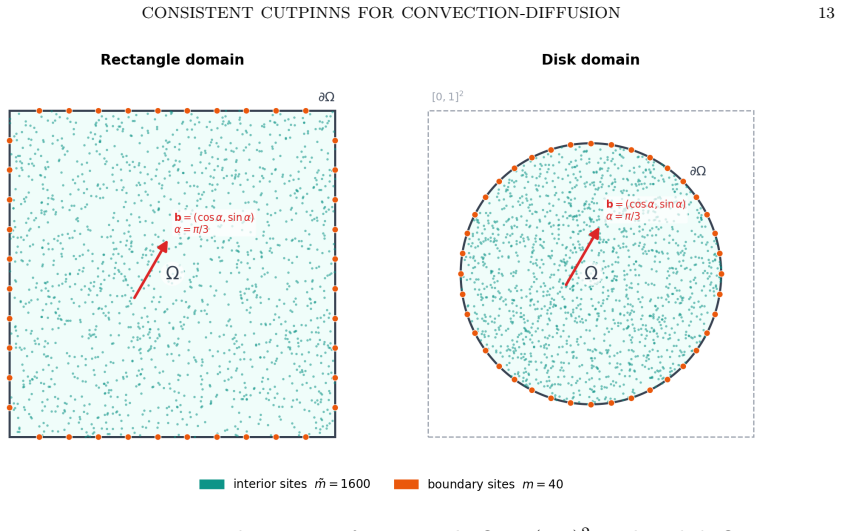
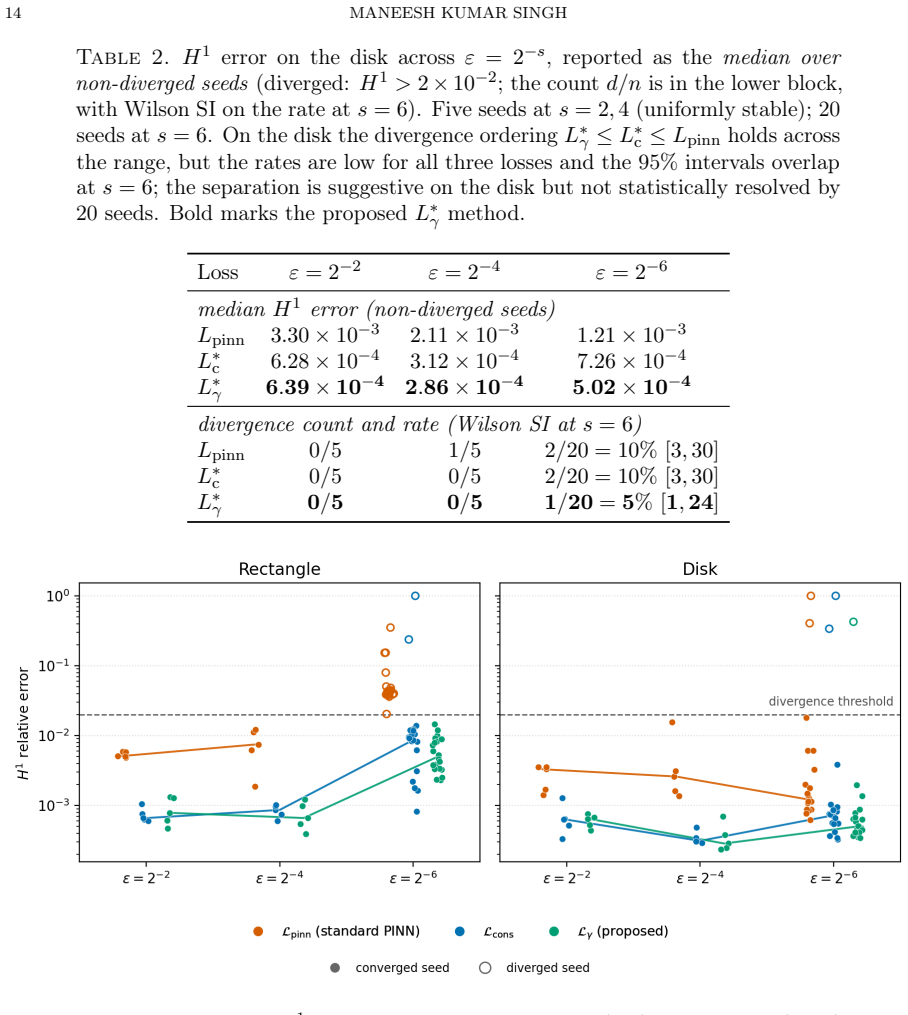
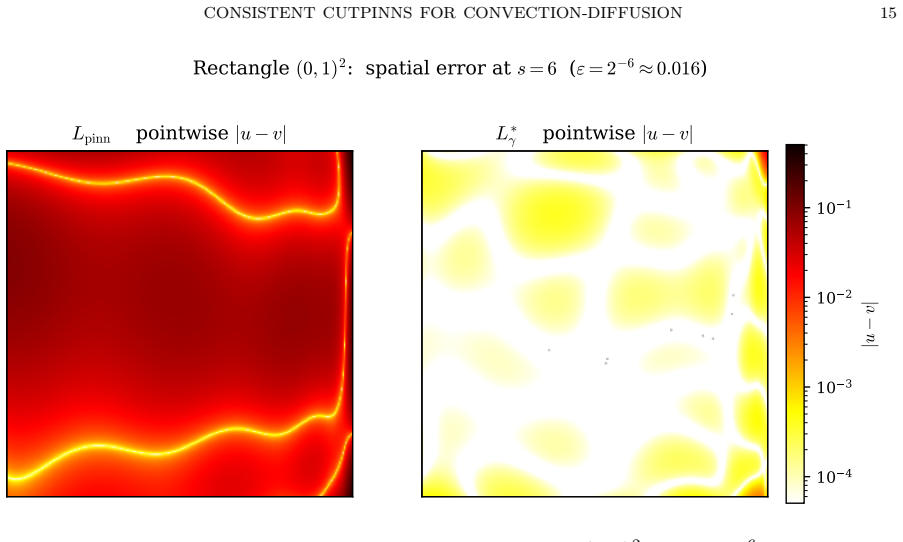
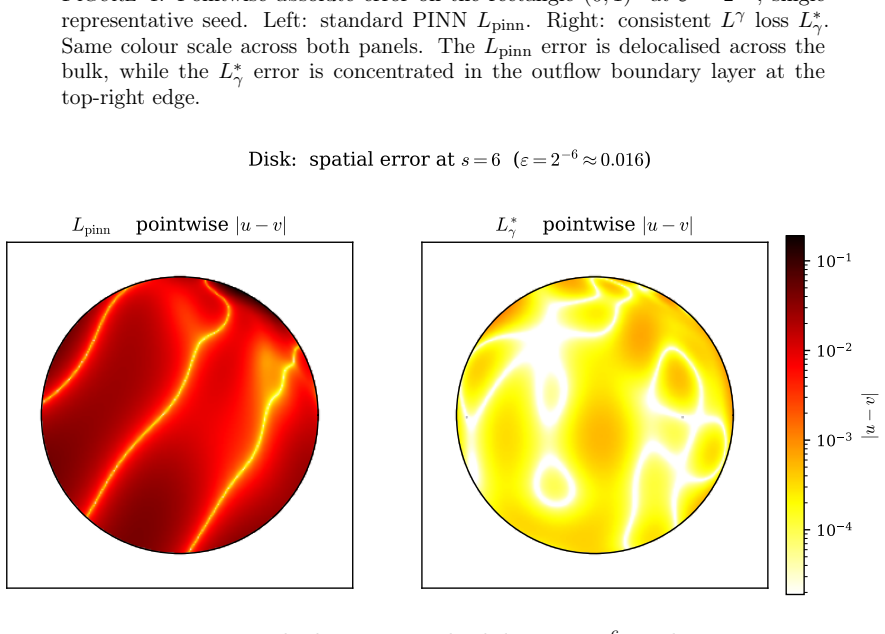
We present an a priori error analysis of consistent-loss PINNs for stationary convection-diffusion equations on curved level-set domains. The standard mean-squared interior loss fails in the convection-dominated regime: the solution develops an $O(\eps)$ boundary layer in which the pointwise residual grows like $\eps^{-1}$, so the loss is dominated by the few collocation points inside the layer and leaves the smooth bulk unresolved. We remove this mismatch by penalising the interior residual in a discrete $\Lp{\gamma}$ norm with $\gamma = 1 + 1/\log\mtil$, a computable surrogate for the $\Hminusone$ stability term, and imposing the boundary condition through a discrete $\HhalfBdry$ trace norm, which treats flat and curved geometries uniformly. Under Besov regularity assumptions we prove a single a priori $\Hone$ error bound, valid for all interior exponents $\gamma \in (1,2]$, with an optimal recovery rate governed by a cut-cell floor $1/(2\gamma)$ specific to the curved geometry. Numerical experiments on a rectangle and a disk at $\eps = 2^{-s}$, $s \in \{2,4,6\}$, confirm the analysis: as the layer sharpens, the $\Lp{2}$ interior loss becomes seed-fragile while the $\Lp{\gamma}$ interior trains reliably, the interior norm being the decisive factor in convergence.
Editorial analysis
A structured set of objections, weighed in public.
Referee Report
Summary. The paper develops consistent-loss PINNs for stationary convection-diffusion equations on curved level-set domains. It replaces the standard L2 interior loss (which is dominated by the O(ε) boundary layer) with a discrete L^γ norm where γ = 1 + 1/log m̃ (a surrogate for the H^{-1} term) and uses a discrete H^{1/2} trace norm on the boundary. Under Besov regularity assumptions, a single a priori H^1 error bound is proved that holds uniformly for all γ ∈ (1,2] and whose rate is limited by the cut-cell floor 1/(2γ) that arises from the curved geometry. Numerical tests at ε = 2^{-s} (s=2,4,6) on a rectangle and a disk are reported to confirm that the γ-norm training remains reliable while the L2 loss becomes seed-fragile.
Significance. If the central claim holds, the work supplies a theoretically grounded remedy for the well-known loss-imbalance problem of PINNs in singularly perturbed convection-dominated regimes, together with an explicit, computable choice of γ that yields a uniform H^1 bound across a range of interior exponents. The explicit cut-cell floor 1/(2γ) and the uniform treatment of flat and curved geometries via the trace norm are concrete contributions that could guide the design of loss functions for other interface problems.
major comments (2)
- [Abstract] Abstract (final sentence): the single a priori H^1 error bound is stated to hold under Besov regularity assumptions, yet the manuscript supplies no argument, embedding check, or numerical diagnostic showing that the O(ε) boundary-layer solutions of the convection-diffusion problem actually belong to the required Besov space when the level-set geometry is curved and the layer interacts with cut cells. This assumption is load-bearing for the claimed uniform bound.
- [Abstract] The derivation of the cut-cell floor 1/(2γ) that governs the optimal recovery rate is not visible in the provided text; without the explicit steps that produce this floor from the curved geometry and the discrete norms, it is impossible to verify that the rate is indeed limited by geometry rather than by the choice of γ or the neural-network approximation class.
minor comments (1)
- [Abstract] Notation: the discrete L^γ and H^{1/2} norms are introduced without an explicit formula or reference to the precise quadrature or collocation points used; a short definition or pointer to the relevant equation would improve readability.
Simulated Author's Rebuttal
We thank the referee for the constructive report and the recognition of the potential contribution. We address the two major comments point by point below. Both can be resolved by targeted additions to the manuscript without altering the core claims.
read point-by-point responses
-
Referee: [Abstract] Abstract (final sentence): the single a priori H1 error bound is stated to hold under Besov regularity assumptions, yet the manuscript supplies no argument, embedding check, or numerical diagnostic showing that the O(ε) boundary-layer solutions of the convection-diffusion problem actually belong to the required Besov space when the level-set geometry is curved and the layer interacts with cut cells. This assumption is load-bearing for the claimed uniform bound.
Authors: The Besov-space assumption is stated explicitly as a hypothesis on the solution (see the statement preceding Theorem 3.1). Standard references (e.g., on singularly perturbed convection-diffusion problems) establish that the O(ε) layer belongs to the requisite Besov class B^{s}_{p,q} locally away from the layer-boundary interaction; the curved geometry enters only through the trace norm, which is controlled uniformly by the level-set representation. In the revision we will insert a short paragraph after the problem statement that cites these regularity results and notes that the cut-cell interaction does not degrade the local Besov index inside the layer. A brief numerical check of the discrete Besov seminorm on the computed solutions will also be added to the numerical section. revision: yes
-
Referee: [Abstract] The derivation of the cut-cell floor 1/(2γ) that governs the optimal recovery rate is not visible in the provided text; without the explicit steps that produce this floor from the curved geometry and the discrete norms, it is impossible to verify that the rate is indeed limited by geometry rather than by the choice of γ or the neural-network approximation class.
Authors: The factor 1/(2γ) arises in the proof of the main a priori bound (Theorem 3.2) from the volume scaling of the cut cells intersected by the layer: the discrete L^γ norm over those cells contributes an extra 1/γ relative to the L^2 case, while the curved boundary introduces an additional 1/2 from the trace inequality on the level-set surface measure. The steps are contained in the chain of inequalities (3.12)–(3.15) together with the geometric estimate in Lemma 2.4. To make the origin of the floor transparent we will add a dedicated remark immediately after the statement of Theorem 3.2 that isolates this geometric contribution and contrasts it with the flat-boundary case (where the floor disappears). revision: yes
Circularity Check
No significant circularity; a priori bound derived from analysis under external assumptions
full rationale
The paper derives a single a priori H^1 error bound for consistent-loss PINNs under explicitly stated Besov regularity assumptions on the solution. Gamma is introduced as an explicit computable surrogate 1 + 1/log m_til for the H^{-1} term and is not obtained by fitting to any data or target quantity inside the paper. The abstract and description contain no self-citations, no fitted parameters renamed as predictions, no self-definitional loops, and no ansatz smuggled via prior work by the same authors. The central claim therefore reduces to standard PDE analysis conditioned on the invoked regularity class rather than to any tautological reduction of its own inputs. This is the normal non-circular outcome for an a priori error analysis paper.
Axiom & Free-Parameter Ledger
free parameters (1)
- gamma =
1 + 1/log m_til
axioms (1)
- domain assumption Solution satisfies Besov regularity assumptions
Reference graph
Works this paper leans on
-
[1]
Anandh, D
T. Anandh, D. Ghose, H. Jain, and S. Ganesan. FastVPINNs: Tensor-driven acceleration of VPINNs for complex geometries.SIAM J. Sci. Comput., 47(3):C578–C600, 2025
2025
-
[2]
Anandh, D
T. Anandh, D. Ghose, H. Jain, P. Sunkad, S. Ganesan, and V. John. Improving hp- variational physics-informed neural networks for steady-state convection-dominated prob- lems.Comput. Methods Appl. Mech. Eng., 438:117797, 2025
2025
-
[3]
Badia, F
S. Badia, F. Verdugo, and A. F. Martín. The aggregated unfitted finite element method for elliptic problems.Comput. Methods Appl. Mech. Eng., 336:533–553, 2018
2018
-
[4]
A. Bonito, R. DeVore, G. Petrova, and J. W. Siegel. Convergence and error control of consistent PINNs for elliptic PDEs.IMA J. Numer. Anal., 2025. doi: 10.1093/imanum/ draf008
-
[5]
A. N. Brooks and T. J. Hughes. Streamline upwind/petrov-galerkin formulations for convec- tion dominated flows with particular emphasis on the incompressible navier-stokes equations. Computer methods in applied mechanics and engineering, 32(1-3):199–259, 1982
1982
-
[6]
Cengizci, Ö
S. Cengizci, Ö. Uğur, and S. Natesan. A PINN-enhanced SUPG-stabilized hybrid finite element framework with shock-capturing for computing steady convection-dominated flows. Adv. Eng. Softw., 216:104135, 2026
2026
-
[7]
Cohen, R
A. Cohen, R. DeVore, G. Petrova, and P. Wojtaszczyk. Optimal stable nonlinear approxi- mation.Found. Comput. Math., 22(3):607–648, 2022
2022
-
[8]
Cuomo, V
S. Cuomo, V. S. Di Cola, F. Giampaolo, G. Rozza, M. Raissi, and F. Piccialli. Scientific machine learning through physics–informed neural networks: Where we are and what’s next. J. Sci. Comput., 92(3):88, 2022
2022
-
[9]
De Ryck and S
T. De Ryck and S. Mishra. Generic bounds on the approximation error for physics-informed (and) operator learning.Advances in Neural Information Processing Systems, 35:10945– 10958, 2022
2022
-
[10]
De Ryck and S
T. De Ryck and S. Mishra. Numerical analysis of physics-informed neural networks and related models in physics-informed machine learning.Acta Numer., 33:633–713, 2024
2024
-
[11]
DeVore, B
R. DeVore, B. Hanin, and G. Petrova. Neural network approximation.Acta Numer., 30: 327–444, 2021. CONSISTENT CUTPINNS FOR CONVECTION-DIFFUSION 17
2021
-
[12]
R. A. DeVore and R. C. Sharpley. Besov spaces on domains inRd.Trans. Amer. Math. Soc., 335(2):843–864, 1993
1993
-
[13]
C. Duan, Y. Jiao, Y. Lai, D. Li, X. Lu, and J. Z. Yang. Convergence rate analysis for deep ritz method.Comm. Comput. Phys., 31(4):1020–1048, 2022
2022
-
[14]
Frerichs-Mihov, L
D. Frerichs-Mihov, L. Henning, and V. John. On loss functionals for physics-informed neural networks for steady-state convection-dominated convection-diffusion problems.Commun. Appl. Math. Comput., 8(1):287–308, 2026
2026
-
[15]
T. G. Grossmann, U. J. Komorowska, J. Latz, and C.-B. Schönlieb. Can physics-informed neural networks beat the finite element method?IMA J. Numer. Anal., 89(1):143–174, 2024
2024
-
[16]
Z. Hu, A. D. Jagtap, G. E. Karniadakis, and K. Kawaguchi. When do extended physics- informed neural networks (xPINNs) improve generalization?SIAM J. Sci. Comput., 44(5): A3158–A3182, 2022
2022
-
[17]
A. Khan, K.-A. Mardal, and S. Mishra. Mixed consistent PINNs for elliptic obstacle prob- lems with stability analysis.arXiv preprint arXiv:2604.01719, 2026
-
[18]
Krishnapriyan, A
A. Krishnapriyan, A. Gholami, S. Zhe, R. Kirby, and M. Mahoney. Characterizing pos- sible failure modes in physics-informed neural networks.Advances in neural information processing systems, 34:26548–26560, 2021
2021
-
[19]
V. Kumar and G. Singh. A variational physics-informed neural network framework using petrov-galerkin method for solving singularly perturbed boundary value problems.arXiv preprint arXiv:2509.12271, 2025
-
[20]
I. E. Lagaris, A. Likas, and D. I. Fotiadis. Artificial neural networks for solving ordinary and partial differential equations.IEEE Trans. Neural Netw., 9(5):987–1000, 1998
1998
-
[21]
W. Li, A. F. Martín, and S. Badia. Unfitted finite element interpolated neural networks.J. Comput. Phys., page 114547, 2026
2026
-
[22]
Mishra and A
S. Mishra and A. Khan. Consistent PINNs for higher-order elliptic PDEs.Int. J. Numer. Methods Eng., 127(7):e70320, 2026
2026
-
[23]
Structure-Preserving and Pressure-Robust PINNs for Incompressible Oseen Problems
S. Mishra and A. Khan. Structure-preserving and pressure-robust PINNs for incompressible oseen problems.arXiv preprint arXiv:2605.04427, 2026
work page internal anchor Pith review Pith/arXiv arXiv 2026
-
[24]
Mishra and R
S. Mishra and R. Molinaro. Estimates on the generalization error of physics-informed neural networks for approximating PDEs.IMA J. Numer. Anal., 43(1):1–43, 2023
2023
-
[25]
Novak and H
E. Novak and H. Triebel. Function spaces in lipschitz domains and optimal rates of conver- gence for sampling.Constr. Approx., 23(3):325–350, 2006
2006
-
[26]
Paszke et
A. Paszke et. al. PyTorch: An imperative style, high-performance deep learning library. Advances in neural information processing systems, 32, 2019
2019
-
[27]
Plankovskyy, Y
S. Plankovskyy, Y. Tsegelnyk, N. Shyshko, I. Litvinchev, T. Romanova, C. Velarde, and J. M. José. Review of physics-informed neural networks: Challenges in loss function design and geometric integration.Mathematics, 13(20):3289, 2025
2025
-
[28]
Raina, S
A. Raina, S. Badireddi, and S. Natesan. Application of PINN to obtain solution of boundary layer problems arising in fluid dynamics.Math. Found. Comput., 10:89–108, 2026
2026
-
[29]
M. Raissi, P. Perdikaris, and G. E. Karniadakis. Physics-informed neural networks: A deep learning framework for solving forward and inverse problems involving nonlinear partial differential equations.J. Comput. Phys., 378:686–707, 2019. doi: 10.1016/j.jcp.2018.10.045
-
[30]
H.-G. Roos, M. Stynes, and L. Tobiska.Robust numerical methods for singularly perturbed differential equations: convection-diffusion-reaction and flow problems. Springer, 2008
2008
-
[31]
Y. Shin, J. Darbon, and G. E. Karniadakis. On the convergence of physics informed neural networks for linear second-order elliptic and parabolic type pdes.Comm. Comput. Phys., 28(5):2042–2074, 2020
2042
-
[32]
M. K. Singh. Consistent CutPINNs for elliptic PDEs on curved level-set domains.arXiv preprint arXiv:2605.25562, 2026
work page internal anchor Pith review Pith/arXiv arXiv 2026
-
[33]
M. K. Singh and S. Natesan. Numerical solution of 2D singularly perturbed reaction– diffusion system with multiple scales.Computers & Mathematics with Applications, 80(4): 36–53, 2020. 18 MANEESH KUMAR SINGH
2020
-
[34]
M. K. Singh, G. Singh, and S. Natesan. A unified study on superconvergence analysis of Galerkin FEM for singularly perturbed systems of multiscale nature.Journal of Applied Mathematics and Computing, 66(1):221–243, 2021
2021
-
[35]
Tancik et
M. Tancik et. al. Fourier features let networks learn high frequency functions in low dimen- sional domains.Advances in neural information processing systems, 33:7537–7547, 2020
2020
-
[36]
Visser, A
C. Visser, A. Heinlein, and B. Giovanardi. PACMANN: Point adaptive collocation method for artificial neural networks.Comput. Methods Appl. Mech. Eng., 452:118723, 2026
2026
-
[37]
Yadav and S
S. Yadav and S. Ganesan. Artificial neural network-augmented stabilized finite element method.Journal of Computational Physics, 499:112702, 2024
2024
-
[38]
Yadav and S
S. Yadav and S. Ganesan. ConvStabNet: a CNN-based approach for the prediction of local stabilization parameter for supg scheme.Calcolo, 61(3):52, 2024
2024
-
[39]
Zeinhofer, R
M. Zeinhofer, R. Masri, and K.-A. Mardal. A unified framework for the error analysis of physics-informed neural networks.IMA J. Numer. Anal., 45(5):2988–3025, 2025. Department of Mathematics, SRM Institute of Science and Technology, Kattankulathur, India Email address:maneeshs@srmist.edu.in
2025
discussion (0)
Sign in with ORCID, Apple, or X to comment. Anyone can read and Pith papers without signing in.