REVIEW 4 major objections 6 minor 2 cited by
Generative recommenders can use long-term user histories by turning the first semantic code into a retrieval key, and the paper shows this lifts top-1 prediction by up to 21.6% on a large e-commerce dataset.
Reviewed by Pith at T0; open to challenge. T0 means a machine referee read the full paper against a public rubric. the ladder, T0–T4 →
T0 review · deepseek-v4-flash
2026-08-03 04:09 UTC pith:P5VLGYMK
load-bearing objection A plausible, incremental advance in generative retrieval with consistent empirical wins, but the semantic-search story is under-supported: the key is wrong most of the time and the gate's behavior is barely analyzed. the 4 major comments →
Coarse-to-Fine Long-term Interest Modeling for Generative Recommendation
The pith
A machine-rendered reading of the paper's core claim, the machinery that carries it, and where it could break.
Core claim
The central claim is that the hierarchical structure of Semantic IDs carries two properties that make long-term interest modeling feasible in generative retrieval. First, the first-level codebook is compact, so the model can afford to compute cross features between every candidate coarse code and the user's entire long-term history—something impossible over raw item IDs; this is SID-Tier, which produces a unified interest vector that improves prediction of the initial code. Second, once the initial code is generated, it is a coarse but meaningful semantic trigger, so it can be used as a hard-search key over the long-term history, retrieving only items in the same coarse bucket; these retriev
What carries the argument
The load-bearing object is the hierarchical Semantic ID (SID): each item is quantized by a residual-quantization VAE into a three-level code, where level one is a coarse semantic bucket and levels two and three refine it toward the item. The paper treats level one as a natural retrieval key and as the only place where the item space is small enough for target-aware cross features. Three mechanisms carry the argument: SID-Tier builds a per-user histogram of cosine similarities between long-term history and each coarse prototype code, producing a heatmap-like interest vector that is appended to the encoder input; semantic hard search retrieves all long-term items whose first code matches the g
Load-bearing premise
Semantic hard search assumes the first predicted semantic code lands in the right coarse cluster often enough that retrieving historical items from that predicted cluster is informative; because the paper reports first-code precision around 0.16, the benefit in most cases rests on the learned gate correctly recognizing and handling a wrong retrieval key.
What would settle it
Re-run GLASS with the ground-truth first semantic code as the retrieval key instead of the predicted one. If using the true key does not improve (or worsens) the fine-code ranking relative to using the predicted key, the claim that the retrieved context is what drives the gains would be falsified. Conversely, inspect the gate: if average gate values are the same whether the first code was correct or wrong, the proposed self-verification mechanism is not making the claimed decision.
If this is right
- If the gains are real, generative retrieval systems can include long-term histories at item granularity without paying quadratic attention cost, removing a central obstacle to industrial deployment.
- The first-code prediction accuracy (P1) becomes a controllable lever: improvements from SID-Tier at P1 translate into better final ranking, so systems should invest in coarse-code prediction quality.
- The conditional rank progression (CRP) metric gives a concrete diagnostic for error accumulation in hierarchical decoding; it can be used to identify where generation drifts even when top-1 accuracy looks stable.
- Codebook design is a substantive modeling choice in generative retrieval: shrinking the first-level codebook buys context density, pushing precision to later levels, and this trade-off should be tuned jointly with history length.
- The smaller gains on the second dataset suggest that the benefit of this retrieval mechanism depends on the semantic quality of the item embeddings; improving multimodal alignment should widen the advantage.
Where Pith is reading between the lines
- The paper's own P1 numbers are low (about 0.16 after improvement), meaning the retrieval key is wrong in most inference cases; the fact that the system still gains suggests the learned gate may be doing more work than the search itself. A testable consequence: forcing the gate to ignore retrieval whenever the first code is confident-but-wrong should reproduce most of the benefit, while deleting th
- If the gate really learns to suppress wrong-cluster retrieval, the same 'coarse prefix as retrieval key plus gated fusion' pattern could transfer to other autoregressive structured-output tasks (code generation, hierarchical classification) where a coarse prefix is available before fine tokens.
- A practical design rule implied by the sparsity analysis: choose the first-level codebook size proportional to expected history length so that the average semantic bucket contains enough items for hard search; this could be tested by varying codebook size and history length systematically.
- The paper leaves open whether semantic hard search helps because of the personalization of retrieved items or simply because the retrieved context acts as additional similar-item negatives; an ablation that retrieves random same-bucket items versus user-specific same-bucket items would separate these.
Editorial analysis
A structured set of objections, weighed in public.
Referee Report
Summary. The paper proposes GLASS, a generative recommender system for long-sequence modeling. It augments a Tiger-style RQ-VAE SID generator with three components: (i) SID-Tier, which summarizes long-term history into a tiered similarity histogram over first-level codes to improve first-token prediction; (ii) semantic hard search, which retrieves historical items whose first SID equals the generated first SID and fuses them through an adaptive gate; and (iii) sparsity-aware augmentation via semantic neighbor expansion and codebook resizing. Experiments on TAOBAO-MM and KuaiRec report consistent improvements over ID-based and SID-based baselines, and ablations indicate each component contributes. The paper also introduces a Conditional Rank Progression (CRP) metric to study rank degradation during autoregressive decoding.
Significance. If the reported results are reliable, GLASS offers a practical way to inject long-term user behavior into generative retrieval without quadratic attention, and the idea of using a generated coarse SID as a retrieval key is a plausible and potentially reusable mechanism. The paper is also honest in trying to open the black box with the CRP analysis and gate-value visualization. However, the current evidence is not yet sufficient: the central mechanism is evaluated only indirectly, key CRP numbers are reported in prose without a table, and the headline 'significant gains' lacks statistical support. The availability of code is claimed but no URL is provided. These issues make the contribution more a promising direction than a fully established result.
major comments (4)
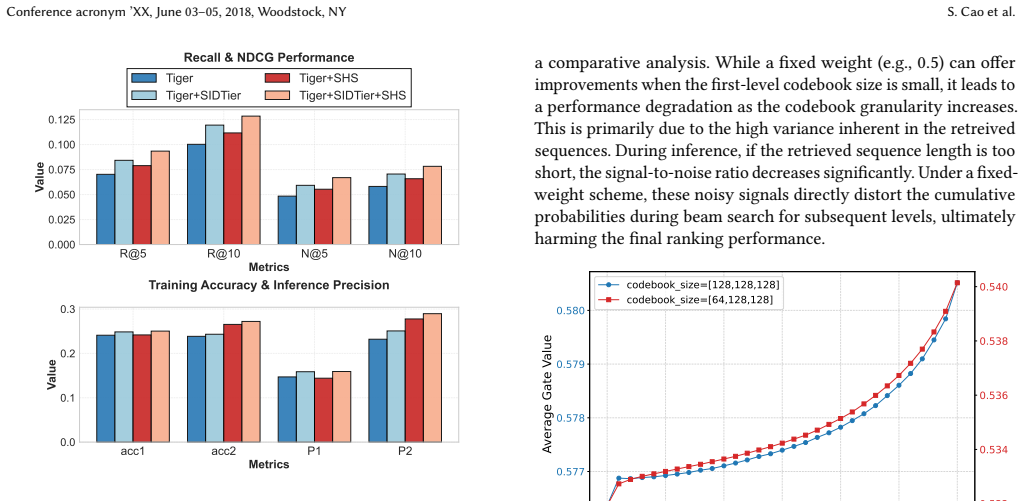
- [§4.2, §5.3, Fig. 4] Semantic hard search uses the generated first SID as the retrieval key (Eq. 7). Section 5.3 reports P1 = 0.1587 for the full model, so the key is incorrect in roughly 84% of test instances. In those cases H_ret cannot contain the ground-truth item, and the only mechanism that could prevent noise injection is the gate (Eqs. 12–13). The paper does not analyze gate behavior conditioned on whether the key is correct. Figure 4 only shows average gate value versus retrieved sequence length, with very small ranges (≈0.577–0.580 and ≈0.532–0.540), and therefore does not demonstrate that the gate responds to retrieval quality. This is load-bearing because the paper's core novelty is SID-as-key retrieval and gated fusion. Please add conditional gate statistics and end-task performance for correct vs. incorrect first-SID cases, a version using ground-truth keys, and a random-key baseline.
- [§5.5, Eqs. (14)–(18)] The CRP results underpinning RQ4 appear only as scattered prose ('1.25 vs 0.98', 'from 0.19 to 0.13', '22%', '31%') without a supporting table or figure, without specifying the exact model configuration(s) used, and without any uncertainty estimates. As written, the empirical justification for 'Rank Degradation' and its mitigation by Semantic Hard Search cannot be checked. Add a CRP-by-depth table for Tiger, +SIDTier, +SHS, and the full model, with beam size and standard errors or per-run values.
- [Table 3 / Abstract] The abstract claims 'significant gains', but Table 3 appears to report a single run per configuration: no seeds, no error bars, and no significance tests. Given that relative gains range from about 3.8% to 29.9% depending on metric and dataset, the central comparative claim is not statistically supported. Please report multiple seeds with means and confidence intervals, or at least paired significance tests over the test set.
- [§4.3, Table 2] The sparsity-augmentation hyperparameters are under-specified: the retrieval-length threshold tau, the neighbor count top-k, and the number of similarity tiers N in Eq. (3) are not listed in Table 2, and no sensitivity analysis is provided. Figure 3 reports divergent behavior for Semantic Neighbor Augmentation without exact values. Since this module is part of the proposed framework, its contribution is not fully quantified.
minor comments (6)
- [Front matter] The paper contains template artifacts: the CCS Concepts line says 'Do Not Use This Code', the ACM Reference Format lists '2018', and the venue is a placeholder. These must be corrected before submission.
- [Abstract / Contributions] There is a typo in the contributions list: 'recomemender'. In §5.5, 'injects injects' is duplicated.
- [Code availability] The abstract states 'Our codes are made publicly available', but no repository URL or link is given anywhere in the manuscript.
- [§4.2, Eq. (9)] The definition of t_bos is garbled: 't_bos = H_dec_q is the initial token' conflates a sequence with a token. Please clarify.
- [Figure 4] The caption says the two curves represent [128,128,128] (left) and [64,128,128] (right), but the figure text appears to place both curves in a single panel. The layout and axis assignment should be made explicit.
- [§5.5] The CRP definition is given twice, once formally and once in prose. Please unify and use consistent notation (B_d vs. B_k).
Circularity Check
No load-bearing circularity: the main results are empirical, trained and evaluated on held-out splits; self-citations appear only in background and baseline discussion.
full rationale
The paper's derivation chain does not reduce to its own inputs by construction. SID-Tier (Eqs. 1-5) builds histogram features from the long-term history and the first-level codebook and is trained with the same next-SID objective; it is not defined in terms of the target prediction. Semantic hard search (Eq. 7) retrieves historical items by the first decoded SID, which is a generated prefix rather than the ground-truth item, and the gate (Eqs. 12-13) is a learned fusion parameter trained on the same objective and tested on held-out data. There is no fitted-to-test curve, no parameter estimated from the reported metric, and no equation that is identical to the claimed improvement by construction. The self-citations, including MISS [9], OneRec [6], and DualGR [33], are used in related work or as baselines; none is invoked as a uniqueness theorem or as the sole justification for the central claim. The skeptical concern that P1 is only 0.1587, so the retrieval key is wrong in most inference cases, concerns robustness and generalization rather than circularity: the paper does not assume the key is correct, and the gate is trained rather than set to force the reported result. The closest thematic overlap is that DualGR already uses SID as a hard search key, but the paper explicitly acknowledges this and claims additional structure (SID-Tier, adaptive gated fusion, sparsity augmentation), so this is a novelty/prior-art matter, not a circular derivation. Overall, the central empirical claims are self-contained against external benchmarks; no circular step was found that would justify a score above 2.
Axiom & Free-Parameter Ledger
free parameters (4)
- Number of similarity tiers N (SID-Tier) =
not reported
- Neighbor top-k (semantic neighbor augmentation) =
not reported
- Retrieval-length threshold tau =
not reported
- First-level codebook size |C0| =
64 (vs 128 for non-resized)
axioms (4)
- domain assumption RQ-VAE and the pretrained multimodal item embeddings produce semantically coherent first-level SID clusters.
- domain assumption Matching first-level SID is a sufficient key for relevance in long-term history.
- domain assumption The positive-only adaptation of TAOBAO-MM and KuaiRec gives valid long-sequence retrieval evaluation.
- domain assumption Conditional rank progression under beam search is a faithful proxy for final ranking quality.
read the original abstract
Leveraging long-term user behavioral patterns is a key trajectory for enhancing the accuracy of modern recommender systems. While generative recommender systems have emerged as a transformative paradigm, they face hurdles in effectively modeling extensive historical sequences. To address this challenge, we propose GLASS, a novel framework that integrates long-term user interests into the generative process via SID-Tier and Semantic Search. We first introduce SID-Tier, a module that maps long-term interactions into a unified interest vector to enhance the prediction of the initial SID token. Unlike traditional retrieval models that struggle with massive item spaces, SID-Tier leverages the compact nature of the semantic codebook to incorporate cross features between the user's long-term history and candidate semantic codes. Furthermore, we present semantic hard search, which utilizes generated coarse-grained semantic ID as dynamic keys to extract relevant historical behaviors, which are then fused via an adaptive gated fusion module to recalibrate the trajectory of subsequent fine-grained tokens. To address the inherent data sparsity in semantic hard search, we propose two strategies: semantic neighbor augmentation and codebook resizing. Extensive experiments on two large-scale real-world datasets, TAOBAO-MM and KuaiRec, demonstrate that GLASS outperforms state-of-the-art baselines, achieving significant gains in recommendation quality. Our codes are made publicly available to facilitate further research in generative recommendation.
Figures



Forward citations
Cited by 2 Pith papers
-
PaletteID: Prototype-Composed Semantic Identifiers for Multimodal CTR Prediction
PaletteID represents each item by a weighted composition of top-ranked prototype items selected by a quality-aware DPP, improving multimodal CTR prediction and long-tail performance.
-
CapsID: Soft-Routed Variable-Length Semantic IDs for Generative Recommendation
CapsID uses probabilistic capsule routing and confidence-based termination to generate variable-length semantic IDs, improving recall by 9.6% over strong baselines with half the latency of dual-representation systems.
Reference graph
Works this paper leans on
-
[1]
Yue Cao, Xiaojiang Zhou, Jiaqi Feng, Peihao Huang, Yao Xiao, Dayao Chen, and Sheng Chen. 2022. Sampling is all you need on modeling long-term user behaviors for CTR prediction. InProceedings of the 31st ACM International Conference on Information & Knowledge Management. 2974–2983
2022
-
[2]
Zheng Chai, Qin Ren, Xijun Xiao, Huizhi Yang, Bo Han, Sijun Zhang, Di Chen, Hui Lu, Wenlin Zhao, Lele Yu, et al . 2025. Longer: Scaling up long sequence modeling in industrial recommenders. InProceedings of the Nineteenth ACM Conference on Recommender Systems. 247–256
2025
-
[3]
Jianxin Chang, Chenbin Zhang, Zhiyi Fu, Xiaoxue Zang, Lin Guan, Jing Lu, Yiqun Hui, Dewei Leng, Yanan Niu, Yang Song, et al. 2023. TWIN: TWo-stage interest network for lifelong user behavior modeling in CTR prediction at kuaishou. In Proceedings of the 29th ACM SIGKDD Conference on Knowledge Discovery and Data Mining. 3785–3794
2023
-
[4]
Ben Chen, Xian Guo, Siyuan Wang, Zihan Liang, Yue Lv, Yufei Ma, Xinlong Xiao, Bowen Xue, Xuxin Zhang, Ying Yang, Huangyu Dai, Xing Xu, Tong Zhao, Mingcan Peng, Xiaoyang Zheng, Chao Wang, Qihang Zhao, Zhixin Zhai, Yang Zhao, Bochao Liu, Jingshan Lv, Xiao Liang, Yuqing Ding, Jing Chen, Chenyi Lei, Wenwu Ou, Han Li, and Kun Gai. 2025. OneSearch: A Preliminar...
arXiv 2025
-
[5]
Qiwei Chen, Changhua Pei, Shanshan Lv, Chao Li, Junfeng Ge, and Wenwu Ou
-
[6]
Jiaxin Deng, Shiyao Wang, Kuo Cai, Lejian Ren, Qigen Hu, Weifeng Ding, Qiang Luo, and Guorui Zhou. 2025. Onerec: Unifying retrieve and rank with generative recommender and iterative preference alignment.arXiv preprint arXiv:2502.18965 (2025)
Pith/arXiv arXiv 2025
-
[7]
Kairui Fu, Tao Zhang, Shuwen Xiao, Ziyang Wang, Xinming Zhang, Chenchi Zhang, Yuliang Yan, Junjun Zheng, Yu Li, Zhihong Chen, Jian Wu, Xiangheng Kong, Shengyu Zhang, Kun Kuang, Yuning Jiang, and Bo Zheng. 2025. FORGE: Forming Semantic Identifiers for Generative Retrieval in Industrial Datasets. arXiv:2509.20904 [cs.IR] https://arxiv.org/abs/2509.20904
Pith/arXiv arXiv 2025
-
[8]
Chongming Gao, Shijun Li, Wenqiang Lei, Jiawei Chen, Biao Li, Peng Jiang, Xiangnan He, Jiaxin Mao, and Tat-Seng Chua. 2022. KuaiRec: A Fully-observed Dataset and Insights for Evaluating Recommender Systems. InProceedings of the 31st ACM International Conference on Information & Knowledge Management (CIKM ’22). ACM, 540–550. doi:10.1145/3511808.3557220
arXiv 2022
-
[9]
Chengcheng Guo, Junda She, Kuo Cai, Shiyao Wang, Qigen Hu, Qiang Luo, Guorui Zhou, and Kun Gai. 2025. MISS: Multi-Modal Tree Indexing and Searching with Lifelong Sequential Behavior for Retrieval Recommendation. InProceedings of the 34th ACM International Conference on Information and Knowledge Management. 5683–5690
2025
-
[10]
Ruidong Han, Bin Yin, Shangyu Chen, He Jiang, Fei Jiang, Xiang Li, Chi Ma, Mincong Huang, Xiaoguang Li, Chunzhen Jing, et al. 2025. MTGR: Industrial- Scale Generative Recommendation Framework in Meituan.arXiv preprint arXiv:2505.18654(2025). Conference acronym ’XX, June 03–05, 2018, Woodstock, NY S. Cao et al
Pith/arXiv arXiv 2025
-
[11]
Zhicheng He, Weiwen Liu, Wei Guo, Jiarui Qin, Yingxue Zhang, Yaochen Hu, and Ruiming Tang. 2023. A survey on user behavior modeling in recommender systems.arXiv preprint arXiv:2302.11087(2023)
Pith/arXiv arXiv 2023
-
[12]
Balázs Hidasi, Alexandros Karatzoglou, Linas Baltrunas, and Domonkos Tikk
-
[13]
Yupeng Hou, Jianmo Ni, Zhankui He, Noveen Sachdeva, Wang-Cheng Kang, Ed H Chi, Julian McAuley, and Derek Zhiyuan Cheng. 2025. ActionPiece: Contextually Tokenizing Action Sequences for Generative Recommendation.arXiv preprint arXiv:2502.13581(2025)
Pith/arXiv arXiv 2025
-
[14]
Junjie Huang, Jizheng Chen, Jianghao Lin, Jiarui Qin, Ziming Feng, Weinan Zhang, and Yong Yu. 2024. A Comprehensive Survey on Retrieval Methods in Recommender Systems.arXiv preprint arXiv:2407.21022(2024)
arXiv 2024
-
[15]
Kalervo Järvelin and Jaana Kekäläinen. 2002. Cumulated gain-based evaluation of IR techniques.ACM Transactions on Information Systems (TOIS)20, 4 (2002), 422–446
2002
-
[16]
Wang-Cheng Kang and Julian McAuley. 2018. Self-Attentive Sequential Recom- mendation. arXiv:1808.09781 [cs.IR] https://arxiv.org/abs/1808.09781
Pith/arXiv arXiv 2018
-
[17]
Xiaopeng Li, Bo Chen, Junda She, Shiteng Cao, You Wang, Qinlin Jia, Haiying He, Zheli Zhou, Zhao Liu, Ji Liu, et al. 2025. A Survey of Generative Recommendation from a Tri-Decoupled Perspective: Tokenization, Architecture, and Optimization. (2025)
2025
-
[18]
Zida Liang, Changfa Wu, Dunxian Huang, Weiqiang Sun, Ziyang Wang, Yuliang Yan, Jian Wu, Yuning Jiang, Bo Zheng, Ke Chen, Silu Zhou, and Yu Zhang. 2025. TBGRecall: A Generative Retrieval Model for E-commerce Recommendation Scenarios. arXiv:2508.11977 [cs.IR] https://arxiv.org/abs/2508.11977
arXiv 2025
-
[19]
Qijiong Liu, Jieming Zhu, Yanting Yang, Quanyu Dai, Zhaocheng Du, Xiao-Ming Wu, Zhou Zhao, Rui Zhang, and Zhenhua Dong. 2024. Multimodal pretraining, adaptation, and generation for recommendation: A survey. InProceedings of the 30th ACM SIGKDD Conference on Knowledge Discovery and Data Mining. 6566–6576
2024
-
[20]
Zhanyu Liu, Shiyao Wang, Xingmei Wang, Rongzhou Zhang, Jiaxin Deng, Honghui Bao, Jinghao Zhang, Wuchao Li, Pengfei Zheng, Xiangyu Wu, et al
-
[21]
Xinchen Luo, Jiangxia Cao, Tianyu Sun, Jinkai Yu, Rui Huang, Wei Yuan, Hezheng Lin, Yichen Zheng, Shiyao Wang, Qigen Hu, et al . 2025. Qarm: Quantitative alignment multi-modal recommendation at kuaishou. InProceedings of the 34th ACM International Conference on Information and Knowledge Management. 5915– 5922
2025
-
[22]
Chen Ma, Peng Kang, and Xue Liu. 2019. Hierarchical Gating Networks for Sequential Recommendation. arXiv:1906.09217 [cs.IR] https://arxiv.org/abs/1906. 09217
Pith/arXiv arXiv 2019
-
[23]
Yue Meng, Cheng Guo, Xiaohui Hu, Honghu Deng, Yi Cao, Tong Liu, and Bo Zheng. 2025. User Long-Term Multi-Interest Retrieval Model for Recommenda- tion. arXiv:2507.10097 [cs.IR] https://arxiv.org/abs/2507.10097
Pith/arXiv arXiv 2025
-
[24]
Qi Pi, Weijie Bian, Guorui Zhou, Xiaoqiang Zhu, and Kun Gai. 2019. Practice on long sequential user behavior modeling for click-through rate prediction. InProceedings of the 25th ACM SIGKDD international conference on knowledge discovery & data mining. 2671–2679
2019
-
[25]
Qi Pi, Guorui Zhou, Yujing Zhang, Zhe Wang, Lejian Ren, Ying Fan, Xiaoqiang Zhu, and Kun Gai. 2020. Search-based user interest modeling with lifelong sequential behavior data for click-through rate prediction. InProceedings of the 29th ACM International Conference on Information & Knowledge Management. 2685–2692
2020
-
[26]
Shashank Rajput, Nikhil Mehta, Anima Singh, Raghunandan Hulikal Keshavan, Trung Vu, Lukasz Heldt, Lichan Hong, Yi Tay, Vinh Tran, Jonah Samost, et al
-
[27]
Qin Ren, Zheng Chai, Xijun Xiao, Yuchao Zheng, and Di Wu. 2025. LongRetriever: Towards Ultra-Long Sequence based Candidate Retrieval for Recommendation. arXiv:2508.15486 [cs.IR] https://arxiv.org/abs/2508.15486
Pith/arXiv arXiv 2025
-
[28]
Zihua Si, Lin Guan, ZhongXiang Sun, Xiaoxue Zang, Jing Lu, Yiqun Hui, Xingchao Cao, Zeyu Yang, Yichen Zheng, Dewei Leng, et al. 2024. Twin v2: Scaling ultra- long user behavior sequence modeling for enhanced ctr prediction at kuaishou. InProceedings of the 33rd ACM International Conference on Information and Knowledge Management. 4890–4897
2024
-
[29]
Fei Sun, Jun Liu, Jian Wu, Changhua Pei, Xiao Lin, Wenwu Ou, and Peng Jiang
-
[30]
Jiaxi Tang and Ke Wang. 2018. Personalized Top-N Sequential Recommendation via Convolutional Sequence Embedding. arXiv:1809.07426 [cs.IR] https://arxiv. org/abs/1809.07426
Pith/arXiv arXiv 2018
-
[31]
Zhipeng Wei, Kuo Cai, Junda She, Jie Chen, Minghao Chen, Yang Zeng, Qiang Luo, Wencong Zeng, Ruiming Tang, Kun Gai, and Guorui Zhou. 2025. One- Loc: Geo-Aware Generative Recommender Systems for Local Life Service. arXiv:2508.14646 [cs.IR] https://arxiv.org/abs/2508.14646
Pith/arXiv arXiv 2025
-
[32]
Bin Wu, Feifan Yang, Zhangming Chan, Yu-Ran Gu, Jiawei Feng, Chao Yi, Xiang- Rong Sheng, Han Zhu, Jian Xu, Mang Ye, et al. 2025. MUSE: A Simple Yet Effective Multimodal Search-Based Framework for Lifelong User Interest Modeling.arXiv preprint arXiv:2512.07216(2025)
arXiv 2025
-
[33]
Zhongchao Yi, Kai Feng, Xiaojian Ma, Yalong Wang, Yongqi Liu, Han Li, Zhengyang Zhou, and Yang Wang. 2025. DualGR: Generative Retrieval with Long and Short-Term Interests Modeling.arXiv preprint arXiv:2511.12518(2025)
arXiv 2025
-
[34]
Jiaqi Zhai, Lucy Liao, Xing Liu, Yueming Wang, Rui Li, Xuan Cao, Leon Gao, Zhao- jie Gong, Fangda Gu, Michael He, et al. 2024. Actions speak louder than words: Trillion-parameter sequential transducers for generative recommendations.arXiv preprint arXiv:2402.17152(2024)
Pith/arXiv arXiv 2024
-
[35]
Jun Zhang, Yi Li, Yue Liu, Changping Wang, Yuan Wang, Yuling Xiong, Xun Liu, Haiyang Wu, Qian Li, Enming Zhang, Jiawei Sun, Xin Xu, Zishuai Zhang, Ruoran Liu, Suyuan Huang, Zhaoxin Zhang, Zhengkai Guo, Shuojin Yang, Meng-Hao Guo, Huan Yu, Jie Jiang, and Shi-Min Hu. 2025. GPR: Towards a Generative Pre-trained One-Model Paradigm for Large-Scale Advertising ...
arXiv 2025
-
[36]
Zuowu Zheng, Ze Wang, Fan Yang, Jiangke Fan, Teng Zhang, Yongkang Wang, and Xingxing Wang. 2025. EGA-V2: An End-to-end Generative Framework for Industrial Advertising. arXiv:2505.17549 [cs.IR] https://arxiv.org/abs/2505.17549
Pith/arXiv arXiv 2025
-
[37]
Guorui Zhou, Jiaxin Deng, Jinghao Zhang, Kuo Cai, Lejian Ren, Qiang Luo, Qian- qian Wang, Qigen Hu, Rui Huang, Shiyao Wang, et al. 2025. OneRec Technical Report.arXiv preprint arXiv:2506.13695(2025)
arXiv 2025
-
[38]
Guorui Zhou, Hengrui Hu, Hongtao Cheng, Huanjie Wang, Jiaxin Deng, Jinghao Zhang, Kuo Cai, Lejian Ren, Lu Ren, Liao Yu, et al. 2025. Onerec-v2 technical report.arXiv preprint arXiv:2508.20900(2025)
Pith/arXiv arXiv 2025
-
[39]
Guorui Zhou, Xiaoqiang Zhu, Chenru Song, Ying Fan, Han Zhu, Xiao Ma, Yanghui Yan, Junqi Jin, Han Li, and Kun Gai. 2018. Deep interest network for click-through rate prediction. InProceedings of the 24th ACM SIGKDD international conference on knowledge discovery & data mining. 1059–1068
2018
-
[40]
Kun Zhou, Hui Wang, Wayne Xin Zhao, Yutao Zhu, Sirui Wang, Fuzheng Zhang, Zhongyuan Wang, and Ji-Rong Wen. 2020. S3-Rec: Self-Supervised Learning for Sequential Recommendation with Mutual Information Maximization. InProceed- ings of the 29th ACM International Conference on Information & Knowledge Management (CIKM ’20). ACM, 1893–1902. doi:10.1145/3340...
arXiv 2020
-
[2016]
arXiv:1511.06939 [cs.LG] https://arxiv.org/abs/1511.06939
Session-based Recommendations with Recurrent Neural Networks. arXiv:1511.06939 [cs.LG] https://arxiv.org/abs/1511.06939
-
[2019]
arXiv:1904.06690 [cs.IR] https://arxiv.org/abs/ 1904.06690
BERT4Rec: Sequential Recommendation with Bidirectional Encoder Rep- resentations from Transformer. arXiv:1904.06690 [cs.IR] https://arxiv.org/abs/ 1904.06690
Pith/arXiv arXiv 1904
-
[2021]
arXiv preprint arXiv:2108.04468(2021)
End-to-end user behavior retrieval in click-through rateprediction model. arXiv preprint arXiv:2108.04468(2021)
Pith/arXiv arXiv 2021
-
[2023]
Recommender systems with generative retrieval.Advances in Neural Information Processing Systems36 (2023), 10299–10315
2023
-
[2025]
OneRec-Think: In-Text Reasoning for Generative Recommendation.arXiv preprint arXiv:2510.11639(2025)
arXiv 2025
discussion (0)
Sign in with ORCID, Apple, or X to comment. Anyone can read and Pith papers without signing in.