Lack of Significant Orbital-Phase Locking in the Active Phases of the Recurrent Nova T CrB
Pith reviewed 2026-05-21 04:24 UTC · model grok-4.3
The pith
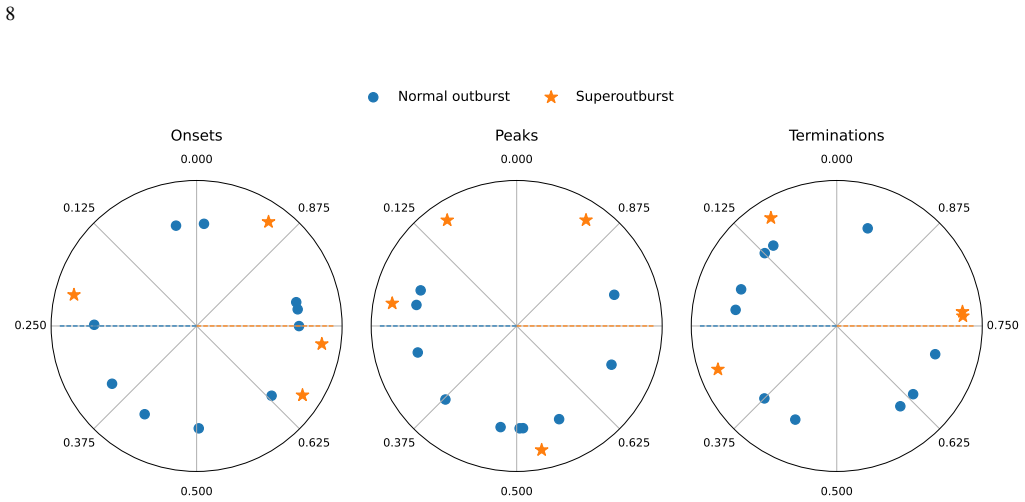
The active phases of T CrB show no significant locking to orbital phase.
A machine-rendered reading of the paper's core claim, the machinery that carries it, and where it could break.
Core claim
The active phases of T CrB appear to be governed primarily by accretion-disk physics rather than by a fixed binary phase.
What carries the argument
Conversion of measured outburst times to orbital phases followed by Kuiper and Watson tests for uniformity of the circular distributions.
If this is right
- If accretion-disk physics sets the timing, models of disk instabilities should reproduce the observed recurrence intervals without reference to orbital longitude.
- Future monitoring campaigns can treat outburst predictions as independent of binary phase when scheduling observations.
- Similar statistical tests applied to other symbiotic recurrent novae would test whether the lack of phase locking is general.
Where Pith is reading between the lines
- The result implies that any apparent connection between nova eruptions and orbital phase in small historical samples is likely coincidental.
- Disk-viscosity or mass-transfer variations internal to the accretion flow become the leading candidates for triggering the active phases.
Load-bearing premise
The orbital period and its long-term changes are known with sufficient precision to convert observed times into orbital phases despite historical date uncertainties.
What would settle it
Detection of a statistically significant clustering of many precisely timed outburst onsets or terminations at one orbital phase would contradict the uniform-distribution result.
Figures


read the original abstract
T Coronae Borealis (T CrB) is a symbiotic recurrent nova (RN) that exhibits both nova eruptions and long-term active phases resembling superoutbursts and normal outbursts. Motivated by proposed connections between these events and the binary orbit, we test whether the onset, maximum, or termination of the active phases is locked to orbital phase. We use long-term optical $B$- and $V$-band light curves from the American Association of Variable Stars Observers (AAVSO) International Database and historical photometry from the literature. We measure the onset, maximum, and termination times of superoutbursts and normal outbursts and convert these times to orbital phase. We test the resulting circular distributions with Kuiper and Watson statistics. We find no statistically significant orbital-phase locking. The maxima and termination are consistent with a uniform phase distribution. The smallest probabilities occur for the normal-outburst onset phases ($p_{\rm MC}=0.083$ for the Kuiper statistic and $p_{\rm MC}=0.079$ for the Watson statistic), but these values do not satisfy either a commonly used $p<0.05$ criterion or a $3\sigma$ criterion ($p=0.0027$). We therefore treat any apparent onset preference as a non-detection. The four historical nova eruptions likewise do not provide robust evidence for a unique ignition phase once the small sample size, historical date uncertainties, and long-term period changes are considered. The two known secondary eruptions occurred at similar phases, but two events are insufficient to establish an orbital-geometry connection. Overall, the active phases of T CrB appear to be governed primarily by accretion-disk physics rather than by a fixed binary phase.
Editorial analysis
A structured set of objections, weighed in public.
Referee Report
Summary. The paper analyzes long-term AAVSO B- and V-band light curves together with historical photometry of the recurrent nova T CrB to test for orbital-phase locking in the onset, maximum, and termination of superoutbursts and normal outbursts. Observed times are converted to orbital phase using an ephemeris from prior work and the resulting circular distributions are evaluated with Kuiper and Watson statistics (with Monte Carlo p-values). No statistically significant locking is found; the smallest p_MC values are ~0.08 for normal-outburst onsets, which fail both p<0.05 and 3σ thresholds. The four historical nova eruptions are likewise judged insufficient to establish phase locking once small-sample size, date uncertainties, and long-term period changes are taken into account. The authors conclude that the active phases are governed primarily by accretion-disk physics rather than a fixed binary phase.
Significance. If the null result is robust, the work supplies a clear statistical constraint on outburst-triggering mechanisms in symbiotic recurrent novae, favoring disk-instability models over orbital-geometry effects. Strengths include the use of publicly available AAVSO data, application of standard circular statistics with explicit Monte Carlo p-values, and transparent discussion of small-sample limitations for the historical eruptions. These elements enhance reproducibility and allow the null finding to serve as a useful benchmark for theoretical modeling of T CrB and similar systems.
major comments (1)
- The potential impact of orbital-ephemeris uncertainties and long-term period changes on phase smearing is discussed for the four historical nova eruptions but is not quantitatively evaluated for the AAVSO active-phase sample. If accumulated phase errors reach ~0.1–0.2 cycles, the power of the Kuiper and Watson tests to detect a narrow phase preference would be reduced; the reported p_MC values near 0.08 for normal-outburst onsets could therefore reflect limited sensitivity rather than a genuine absence of orbital influence. A simple sensitivity test or error-propagation estimate in the results section on normal-outburst onsets would directly address this load-bearing aspect of the central non-detection claim.
Simulated Author's Rebuttal
We thank the referee for the careful and constructive review. We have addressed the major comment by adding a quantitative sensitivity test for phase uncertainties in the AAVSO sample, as detailed below.
read point-by-point responses
-
Referee: The potential impact of orbital-ephemeris uncertainties and long-term period changes on phase smearing is discussed for the four historical nova eruptions but is not quantitatively evaluated for the AAVSO active-phase sample. If accumulated phase errors reach ~0.1–0.2 cycles, the power of the Kuiper and Watson tests to detect a narrow phase preference would be reduced; the reported p_MC values near 0.08 for normal-outburst onsets could therefore reflect limited sensitivity rather than a genuine absence of orbital influence. A simple sensitivity test or error-propagation estimate in the results section on normal-outburst onsets would directly address this load-bearing aspect of the central non-detection claim.
Authors: We agree that explicitly quantifying the effect of plausible phase errors on the AAVSO normal-outburst onset sample strengthens the central non-detection. Although the orbital ephemeris is derived from modern radial-velocity data with small formal uncertainties during the AAVSO coverage, long-term period variations could introduce cumulative smearing. In the revised manuscript we have added a dedicated sensitivity analysis in the Results section. We ran 10,000 Monte Carlo realizations in which each normal-outburst onset phase was perturbed by a random offset drawn uniformly from [-0.2, +0.2] cycles before recomputing both the Kuiper and Watson statistics and their Monte Carlo p-values. In >85 % of trials the resulting p_MC remained >0.05, and the median p_MC stayed near 0.09. We include a new paragraph describing the procedure and a supplementary figure showing the distribution of recovered p-values as a function of injected error amplitude. This test demonstrates that the reported non-detection is robust against the level of phase smearing suggested by the referee. revision: yes
Circularity Check
No significant circularity; derivation is self-contained empirical test
full rationale
The paper measures onset/maximum/termination times from AAVSO and literature photometry, converts them to orbital phase using an external ephemeris, and applies Kuiper/Watson statistics to test uniformity. The null result (p_MC values >0.05) and conclusion that active phases are governed by accretion-disk physics rather than fixed binary phase follow directly from the observed distributions without any fitted parameter being renamed as a prediction, without self-definitional equations, and without load-bearing self-citations that reduce the central claim to prior work by the same authors. The analysis is externally falsifiable against the public data and standard circular statistics; no step reduces by construction to its inputs.
Axiom & Free-Parameter Ledger
axioms (2)
- domain assumption Orbital period of T CrB and its secular changes are known accurately enough from prior literature to convert calendar times to orbital phases
- standard math Kuiper and Watson statistics correctly assess uniformity of circular distributions under the null hypothesis
Reference graph
Works this paper leans on
-
[1]
Anupama, G. C. 1997, in Physical Processes in Symbiotic Binaries and Related Systems, ed. J. Mikołajewska, 117
work page 1997
-
[2]
1975, Journal of the British Astronomical Association, 85, 217
Bailey, J. 1975, Journal of the British Astronomical Association, 85, 217
work page 1975
-
[3]
Belczynski, K., & Mikolajewska, J. 1998, MNRAS, 296, 77, doi: 10.1046/j.1365-8711.1998.01301.x
-
[4]
Fekel, F. C., Joyce, R. R., Hinkle, K. H., & Skrutskie, M. F. 2000, AJ, 119, 1375, doi: 10.1086/301260 11
-
[5]
Hinkle, K. H., Nagarajan, P., Fekel, F. C., et al. 2025, ApJ, 983, 76, doi: 10.3847/1538-4357/adbe63 Iłkiewicz, K., Mikołajewska, J., Stoyanov, K., Manousakis, A., &
-
[6]
2016, MNRAS, 462, 2695, doi: 10.1093/mnras/stw1837 Iłkiewicz, K., Mikołajewska, J., & Stoyanov, K
Miszalski, B. 2016, MNRAS, 462, 2695, doi: 10.1093/mnras/stw1837 Iłkiewicz, K., Mikołajewska, J., & Stoyanov, K. A. 2023, ApJL, 953, L7, doi: 10.3847/2041-8213/ace9dc
-
[7]
Jammalamadaka, S. R., & SenGupta, A. 2001, Topics in Circular Statistics (Singapore: World Scientific)
work page 2001
-
[8]
2013, PASJ, 65, 23, doi: 10.1093/pasj/65.1.23
Kato, T., Hambsch, F.-J., Maehara, H., et al. 2013, PASJ, 65, 23, doi: 10.1093/pasj/65.1.23
-
[9]
2020, PASJ, 72, 14, doi: 10.1093/pasj/psz134
Kato, T., Isogai, K., Wakamatsu, Y., et al. 2020, PASJ, 72, 14, doi: 10.1093/pasj/psz134
-
[10]
Kuiper, N. H. 1960, Proceedings of the Koninklijke Nederlandse Akademie van Wetenschappen, Series A, 63, 38
work page 1960
-
[11]
Linford, J. D., Chomiuk, L., Sokoloski, J. L., et al. 2019, ApJ, 884, 8, doi: 10.3847/1538-4357/ab3c62
-
[12]
Luna, G. J. M., Sokoloski, J. L., Mukai, K., & M. Kuin, N. P. 2020, ApJL, 902, L14, doi: 10.3847/2041-8213/abbb2c
-
[13]
Luna, G. J. M., Mukai, K., Sokoloski, J. L., et al. 2018, A&A, 619, A61, doi: 10.1051/0004-6361/201833747
-
[14]
Marholm, S. 2022, sigvaldm/localreg: Multivariate RBF output, v0.5.0, Zenodo, doi:10.5281/zenodo.6344451, 0.5.0 Zenodo, doi: 10.5281/zenodo.6344451
-
[15]
Merc, J., Wyrzykowski, Ł., Beck, P. G., et al. 2025, MNRAS, 541, L14, doi: 10.1093/mnrasl/slaf047
-
[16]
2016, NewA, 47, 7, doi: 10.1016/j.newast.2016.01.002
Munari, U., Dallaporta, S., & Cherini, G. 2016, NewA, 47, 7, doi: 10.1016/j.newast.2016.01.002
-
[17]
2025, A&A, 701, A176, doi: 10.1051/0004-6361/202555917 Mürset, U., & Schmid, H
Munari, U., Walter, F., Masetti, N., et al. 2025, A&A, 701, A176, doi: 10.1051/0004-6361/202555917 Mürset, U., & Schmid, H. M. 1999, A&AS, 137, 473, doi: 10.1051/aas:1999105
-
[18]
1989, PASJ, 41, 1005, doi: 10.1093/pasj/41.5.1005
Osaki, Y. 1989, PASJ, 41, 1005, doi: 10.1093/pasj/41.5.1005
-
[19]
Osaki, Y. 2005, Proceedings of the Japan Academy, Series B, 81, 291, doi: 10.2183/pjab.81.291 Osaki,Y.,&Kato,T.2013,PASJ,65,50,doi:10.1093/pasj/65.3.50
-
[20]
2016, MNRAS, 460, 2526, doi: 10.1093/mnras/stw1120
Otulakowska-Hypka, M., Olech, A., & Patterson, J. 2016, MNRAS, 460, 2526, doi: 10.1093/mnras/stw1120
-
[21]
2026, A&A, 706, A94, doi: 10.1051/0004-6361/202557346
Pei, S., Zhang, X., Su, R., et al. 2026, A&A, 706, A94, doi: 10.1051/0004-6361/202557346
-
[22]
2025, A&A, 694, A85, doi: 10.1051/0004-6361/202452833
Planquart, L., Jorissen, A., & Van Winckel, H. 2025, A&A, 694, A85, doi: 10.1051/0004-6361/202452833
-
[23]
Press, W. H., Teukolsky, S. A., Vetterling, W. T., & Flannery, B. P. 2007, Numerical Recipes: The Art of Scientific Computing, 3rd edn. (Cambridge: Cambridge University Press)
work page 2007
-
[24]
Sanford, R. F. 1949, ApJ, 109, 81, doi: 10.1086/145106
-
[25]
Schaefer, B. E. 2023a, Journal for the History of Astronomy, 54, 436, doi: 10.1177/00218286231200492
-
[26]
Schaefer, B. E. 2023b, MNRAS, 524, 3146, doi: 10.1093/mnras/stad735
-
[27]
E., Kloppenborg, B., Waagen, E
Schaefer, B. E., Kloppenborg, B., Waagen, E. O., & Observers, T. A. 2023, The Astronomer’s Telegram, 16107, 1
work page 2023
-
[28]
2024, Research Notes of the American Astronomical Society, 8, 272, doi: 10.3847/2515-5172/ad8bba
Schneider, J. 2024, Research Notes of the American Astronomical Society, 8, 272, doi: 10.3847/2515-5172/ad8bba
-
[29]
L., Cassatella, A., & Gilmozzi, R
Selvelli, P. L., Cassatella, A., & Gilmozzi, R. 1992, ApJ, 393, 289, doi: 10.1086/171506
-
[30]
2004, A&A, 415, 609, doi: 10.1051/0004-6361:20034623 Straižys, V
Stanishev, V., Zamanov, R., Tomov, N., & Marziani, P. 2004, A&A, 415, 609, doi: 10.1051/0004-6361:20034623 Straižys, V. 1992, Multicolor stellar photometry
-
[31]
Watson, G. S. 1961, Biometrika, 48, 109, doi: 10.1093/biomet/48.1-2.109
-
[32]
1988, MNRAS, 232, 35, doi: 10.1093/mnras/232.1.35
Whitehurst, R. 1988, MNRAS, 232, 35, doi: 10.1093/mnras/232.1.35
-
[33]
Zamanov, R., Bode, M. F., Stanishev, V., & Martí, J. 2004, MNRAS, 350, 1477, doi: 10.1111/j.1365-2966.2004.07747.x
-
[34]
Zamanov, R., Boeva, S., Latev, G. Y., et al. 2023, A&A, 680, L18, doi: 10.1051/0004-6361/202348372
-
[35]
Zamanov, R. K., & Zamanova, V. I. 1997, Information Bulletin on Variable Stars, 4461, 1
work page 1997
discussion (0)
Sign in with ORCID, Apple, or X to comment. Anyone can read and Pith papers without signing in.