REVIEW 4 major objections 5 minor 35 references
Prot2Chat: Protein LLM with Early-Fusion of Text, Sequence and Structure
T0 review · 4 major / 5 minor · reviewed 2026-08-08 · deepseek-v4-flash
Pith's one-line read Prot2Chat claims that fusing protein sequence, structure, and the question text before the LLM generates an answer—early fusion—outperforms sequence-only, ESM-based, multi-encoder, and late-fusion protein Q&A models.
desk verdict A plausible early-fusion architecture for protein Q&A, but the headline numbers rest on an unverified split; the authors must show protein-level disjointness before the margins are credible. read the letter →
The pith
A machine-rendered reading of the paper's core claim, the machinery that carries it, and where it could break.
The reading
What carries the argument
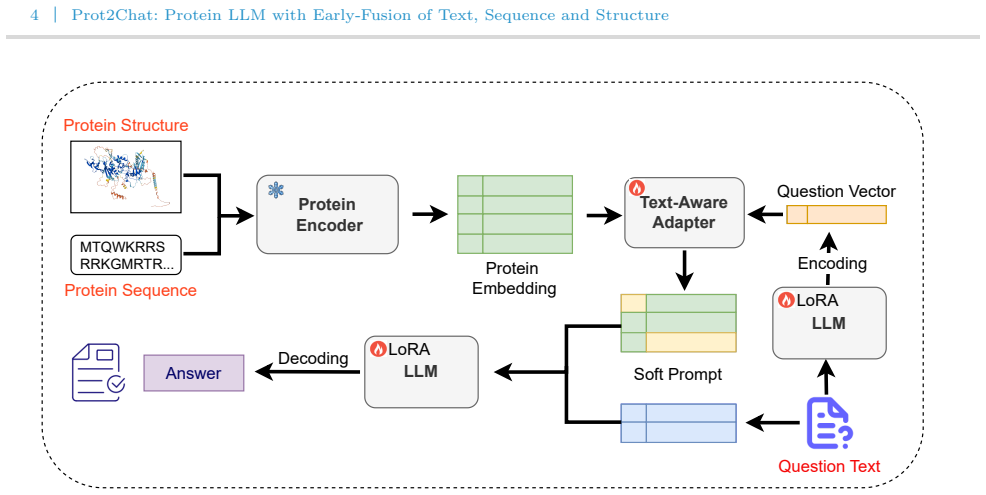
The central mechanism is the text-aware protein-text adapter with learnable queries. It takes the concatenated embeddings from nine frozen ProteinMPNN models (sequence-initialized node features, dimension 1152), projects them, and runs multi-head cross-attention where the queries are learnable vectors plus the LLM's question vector and positional encoding. Keys and values come from the projected protein embedding. This compresses the long protein representation into a fixed number of virtual tokens (256 queries) that already carry question information, producing the soft prompt for the LLM. The early fusion of text happens because the question vector is injected into the queries before cross-attention, so protein features are selected and compressed in a question-aware way.
What would settle it
Re-run the comparison with protein-level train/test splits and a late-fusion variant that injects the question only at the decoder (with the same frozen encoder and adapter size); if that variant matches Prot2Chat's BLEU/ROUGE on both datasets, the early-fusion claim collapses.
Extended reading notes
Core claim
Prot2Chat's central discovery is that question-conditioned early fusion of protein structure, sequence, and text is the decisive factor in protein Q&A quality. The paper shows that initializing ProteinMPNN's node features with sequence embeddings (a no-training modification) and then compressing the resulting protein embedding through learnable queries infused with the question vector yields a soft prompt that a LoRA-tuned LLM can answer from. Ablations show that removing the sequence initialization, removing early text fusion, or skipping LLM fine-tuning each degrades BLEU/ROUGE, with late fusion (text only at generation) far below early fusion. The same architecture also transfers zero-shot to a different dataset, UniProtQA, supporting the generalization claim.
Load-bearing premise
The evaluation relies on every test protein having an available structure file and on train/test splits that keep the same protein out of both sides; the paper does not report how many proteins lacked structures, whether predicted structures were substituted, or how the splits were constructed.
Editorial extensions
If this is right
- With only 109 million trainable parameters, the architecture is cheap enough to fine-tune on a single modern GPU, making protein Q&A accessible outside large compute centers.
- Because the adapter compresses protein information into a fixed number of soft tokens (256), prompt length stays bounded regardless of protein size, so long proteins can be handled in a fixed context window.
- The reported zero-shot transfer from Mol-Instructions to UniProtQA suggests that the learned text-conditioned compression generalizes across datasets with different text styles.
- The ablation showing late fusion far below early fusion implies that question information must shape protein representation selection, not just answer generation.
Reading between the lines
- If the early-fusion benefit is general, the same adapter pattern could transfer to other structured biomolecules (RNA, small molecules) where a frozen encoder plus question-conditioned queries should compress 3D information for a language model.
- The reported 'late fusion' baseline may not have been optimized to the same degree as the early-fusion model; a controlled experiment that varies only the fusion timing while holding encoder, adapter size, and training budget fixed would isolate the claimed advantage.
- The test-set construction—which proteins had structures and how splits were made—is not described; if the held-out proteins all have high-quality experimental structures, the zero-shot numbers could be optimistic for proteins without known folds.
- Because the question vector is the hidden state of the last text token from the same LLM, the design effectively reuses the generation model as a question encoder; an ablation with a smaller or frozen question encoder would test how much of the gain comes from this reuse.
Editorial analysis
A structured set of objections, weighed in public.
Referee Report
Summary. The paper proposes Prot2Chat, a protein Q&A model that integrates sequence, structure, and question text before generation. It modifies ProteinMPNN by initializing node embeddings with sequence embeddings, introduces a text-aware cross-attention adapter with learnable queries conditioned on a question vector, and LoRA-tunes LLaMA3-8B while keeping the protein encoder frozen. The model is evaluated on Mol-Instructions and UniProtQA using BLEU/ROUGE, online KIMI rankings, and expert manual rankings. The main claim is that early fusion of structure, sequence, and text outperforms sequence-only pretraining, multi-encoder baselines, and late-fusion alternatives at a much smaller trainable-parameter budget.
Significance. If the evaluation is sound, Prot2Chat would be a significant result: it would demonstrate a lightweight architecture (about 109M trainable parameters) that can beat much larger specialist models on protein Q&A, and it would provide a clean ablation supporting question-aware early fusion. Strengths of the paper include the explicit architectural equations, the frozen-encoder design, the availability of code and models, and the combination of automatic, LLM-based, and human evaluation. However, the central quantitative claims rest on evaluation details that are not reported, including split construction, PDB coverage, and statistical uncertainty. The reported zero-shot result also appears to contradict the abstract's generalization claim. The significance is therefore conditional on resolving these issues.
major comments (4)
- [Section 'Datasets' (Table 2)] The manuscript never describes how the train/valid/test splits of Table 2 were constructed or whether they are protein-disjoint. Because Mol-Instructions is derived from Swiss-Prot entries and each protein can appear in many instruction-output pairs, an example-level split would place the same ProteinMPNN embedding in both training and test, allowing the text-aware adapter to memorize per-protein answer patterns. The statement in Section 'Datasets' that 'we retrieved the corresponding PDB files for proteins listed in Swiss-Prot' reports neither the number of proteins with available structures, whether AlphaFold predictions were substituted, nor the overlap statistics between splits. This is load-bearing for the central early-fusion claim, since the large margins in Table 3 (e.g., BLEU-2 35.85 vs. Evola 8.69) could otherwise be explained by identity memorization or by testing only well-structured proteins. Please report unique-protein counts per split, cross-split protein overlap, and PDB coverage statistics.
- [Abstract and Section 'Main Results' (Table 5)] The zero-shot result in Table 5 is below the sequence-only BioMedGPT baseline (BLEU-2 2.23 vs. 5.80; ROUGE-L 10.10 vs. 14.68), yet the abstract states that 'zero-shot prediction results highlight its generalization ability.' As written, the paper's own data contradict that claim on the primary quantitative metrics. Either the generalization claim should be restricted to what the data support (for example, competitive or better behavior on some subsets, if any), or the analysis should explain why zero-shot performance is lower on UniProtQA while fine-tuned performance is higher. This is a central claim and must be fixed.
- [Section 'Evaluation Metrics' and Tables 3-5] All reported BLEU/ROUGE numbers are single point estimates. The paper gives no standard deviations, confidence intervals, or significance tests for any comparison. While the Mol-Instructions margins in Table 3 are large, the ablation margins in Table 4 (e.g., BLEU-2 33.25 vs. 35.85; ROUGE-L 47.90 vs. 50.51) and the UniProtQA fine-tuned comparison are small enough that the conclusions could change under reasonable run-to-run variation. Please provide at least three training runs (or bootstrap resampling over test instances) with standard deviations for all tables, and state the significance of the key comparisons.
- [Section 'Evaluation Metrics' (KIMI and expert prompts) and Tables 6-7] The KIMI and expert evaluations ask evaluators to rank outputs by closeness in meaning to the target sentence, i.e., by reference-based similarity. This measures how closely the generated text mirrors the ground-truth wording, not factual correctness or biological validity; a factually correct paraphrase would be penalized. The claim that 'the high consistency between expert evaluations and online KIMI assessments confirms the robustness of Prot2Chat' should be qualified accordingly. If the authors intend the rankings as evidence of quality, they should add an expert protocol that scores factual correctness independent of ground-truth wording, or at minimum report inter-annotator agreement.
minor comments (5)
- [Section 'Model Setting'] The word 'adpot' is a typo for 'adopt' in the sentence about CrossEntropyLoss.
- [References] Reference [20] is cited for the online KIMI model, but the reference is to Mooncake, a KV-cache serving system; this citation does not identify the KIMI chatbot or its version and should be corrected.
- [Figures] Figure 2 contains the placeholder label 'Assets' in multiple places; these should be replaced with the intended terms (e.g., 'Protein Embedding', 'Question Vector', 'Soft Prompt').
- [Table 8] The case study is a single example and should not be used to support the general claim of superiority; it can be retained as an illustration, but the text should say so.
- [Section 'Model Setting' and 'LLM Decoder'] The stated total of 109M trainable parameters is inconsistent with the sum of the adapter (106,483,712) and LoRA (3,407,872) parameters, which is about 109.9M; please reconcile the rounding.
Circularity Check
No significant circularity: Prot2Chat's claims are empirical evaluations on held-out/test data; no fitted value or self-citation is repackaged as a derivation.
full rationale
The paper's derivation chain is architectural, not formal: it modifies ProteinMPNN by initializing node features with sequence embeddings (Eq. 6), builds a BLIP-2-style cross-attention adapter whose learnable queries are augmented with the LLM's question vector (Eqs. 7-10), and generates answers with a LoRA-fine-tuned LLM (Eq. 11). None of these steps defines a target quantity in terms of itself, and no parameter fitted to an evaluation set is later called a prediction. The adapter and LoRA weights are trained on the Mol-Instructions training split and evaluated on held-out test examples of Mol-Instructions and on UniProtQA including a zero-shot setting; the zero-shot result is therefore not forced by construction. Comparisons to ESM-based, sequence-only, multi-encoder, and late-fusion baselines are external empirical benchmarks rather than outputs of the model's own equations. No load-bearing claim is justified solely by a self-citation; the cited ProteinMPNN, BLIP-2, InstructPLM, and LoRA works are external prior art and are used as components or inspirations, not as proofs of this paper's superiority. The manuscript's lack of detail on protein-level train/test disjointness and PDB coverage is a legitimate evaluation-validity risk, but it is not a circularity: no equation or fitted value reduces to itself, and the paper does not rename a fit as a first-principles result. Hence the appropriate finding is no significant circularity (0).
Assumptions & free parameters
free parameters (4)
- Text-aware adapter weights =
106,483,712 trainable parameters
- LoRA weights on LLaMA3 =
3,407,872 trainable parameters
- Learnable query count nq =
256
- LoRA hyperparameters =
r=8, alpha=16, dropout=0.1
assumptions (4)
- domain assumption Frozen ProteinMPNN weights, with only node initialization changed, provide useful fused sequence/structural embeddings for function Q&A without any encoder training.
- domain assumption A corresponding PDB structure file exists and can be retrieved for every Swiss-Prot protein used in the experiments.
- domain assumption The train/test partitions in Mol-Instructions and UniProtQA do not place the same protein or near duplicates in both training and test, so BLEU/ROUGE gains reflect generalization.
- domain assumption Concatenating nine released ProteinMPNN models yields a coherent 1152-dimensional representation.
Cite this review
Pith. "Pith review of Prot2Chat: Protein LLM with Early-Fusion of Text, Sequence and Structure." pith.science (2026). https://pith.science/paper/PEWSSTG7
@misc{pith2026250206846,
  author       = {Pith},
  title        = {Pith review of: Prot2Chat: Protein LLM with Early-Fusion of Text, Sequence and Structure},
  year         = {2026},
  howpublished = {\url{https://pith.science/paper/PEWSSTG7}},
  note         = {Machine review of arXiv:2502.06846}
}
read the original abstract
Motivation: Proteins are of great significance in living organisms. However, understanding their functions encounters numerous challenges, such as insufficient integration of multimodal information, a large number of training parameters, limited flexibility of classification-based methods, and the lack of systematic evaluation metrics for protein Q&A systems. To tackle these issues, we propose the Prot2Chat framework. Results: We modified ProteinMPNN to encode protein sequence and structural information in a unified way. We used a large language model (LLM) to encode questions into vectors and developed a protein-text adapter to compress protein information into virtual tokens based on these vectors, achieving the early fusion of text and protein information. Finally, the same LLM reads the virtual tokens and the questions to generate answers. To optimize training efficiency, we froze the encoder and employed Low-Rank Adaptation (LoRA) techniques for the LLM. Experiments on two datasets show that both automated metrics and expert evaluations demonstrate the superior performance of our model, and zero-shot prediction results highlight its generalization ability. The models and codes are available at https://github.com/ wangzc1233/Prot2Chat. Contact: zqcao@suda.edu.cn or wangzc025@163.com Key words: Protein Q&A, Early-Fusion, LLM
Figures


Reference graph
Works this paper leans on
-
[1]
Prot2text: Multimodal protein’s function generation with gnns and transformers
Hadi Abdine, Michail Chatzianastasis, Costas Bouyioukos, and Michalis Vazirgiannis. Prot2text: Multimodal protein’s function generation with gnns and transformers. In Proceedings of the AAAI Conference on Artificial Intelligence, volume 38, pages 10757–10765, 2024
work page 2024
-
[2]
Accurate structure prediction of biomolecular interactions with alphafold 3
Josh Abramson, Jonas Adler, Jack Dunger, Richard Evans, Tim Green, Alexander Pritzel, Olaf Ronneberger, Lindsay Willmore, Andrew J Ballard, Joshua Bambrick, et al. Accurate structure prediction of biomolecular interactions with alphafold 3. Nature, pages 1–3, 2024
2024
-
[3]
Protnote: a multimodal method for protein-function annotation
Samir Char, Nathaniel Corley, Sarah Alamdari, Kevin K Yang, and Ava P Amini. Protnote: a multimodal method for protein-function annotation. bioRxiv, pages 2024–10, 2024
work page 2024
-
[4]
Robust deep learning–based protein sequence design using proteinmpnn
Justas Dauparas, Ivan Anishchenko, Nathaniel Bennett, Hua Bai, Robert J Ragotte, Lukas F Milles, Basile IM Wicky, Alexis Courbet, Rob J de Haas, Neville Bethel, et al. Robust deep learning–based protein sequence design using proteinmpnn. Science, 378(6615):49–56, 2022
2022
-
[5]
Palm-e: An embodied multimodal language model
Danny Driess, Fei Xia, Mehdi SM Sajjadi, Corey Lynch, Aakanksha Chowdhery, Brian Ichter, Ayzaan Wahid, Jonathan Tompson, Quan Vuong, Tianhe Yu, et al. Palm-e: An embodied multimodal language model. arXiv preprint arXiv:2303.03378, 2023
arXiv 2023
-
[6]
Abhimanyu Dubey, Abhinav Jauhri, Abhinav Pandey, Abhishek Kadian, Ahmad Al-Dahle, Aiesha Letman, Akhil Mathur, Alan Schelten, Amy Yang, Angela Fan, et al. The llama 3 herd of models. arXiv preprint arXiv:2407.21783 , 2024. 8 Prot2Chat: Protein LLM with Early-Fusion of Text, Sequence and Structure
arXiv 2024
-
[7]
Moltc: Towards molecular relational modeling in language models
Junfeng Fang, Shuai Zhang, Chang Wu, Zhengyi Yang, Zhiyuan Liu, Sihang Li, Kun Wang, Wenjie Du, and Xiang Wang. Moltc: Towards molecular relational modeling in language models. arXiv preprint arXiv:2402.03781 , 2024
arXiv 2024
-
[8]
Mol-instructions: A large-scale biomolecular instruction dataset for large language models
Yin Fang, Xiaozhuan Liang, Ningyu Zhang, Kangwei Liu, Rui Huang, Zhuo Chen, Xiaohui Fan, and Huajun Chen. Mol-instructions: A large-scale biomolecular instruction dataset for large language models. arXiv preprint arXiv:2306.08018, 2023
arXiv 2023
Show all 35 references
-
[9]
Structure-based protein function prediction using graph convolutional networks
Vladimir Gligorijevi´ c, P Douglas Renfrew, Tomasz Kosciolek, Julia Koehler Leman, Daniel Berenberg, Tommi Vatanen, Chris Chandler, Bryn C Taylor, Ian M Fisk, Hera Vlamakis, et al. Structure-based protein function prediction using graph convolutional networks. Nature communica...
2021
-
[10]
LoRA: Low-rank adaptation of large language models
Edward J Hu, Yelong Shen, Phillip Wallis, Zeyuan Allen- Zhu, Yuanzhi Li, Shean Wang, Lu Wang, and Weizhu Chen. LoRA: Low-rank adaptation of large language models. In International Conference on Learning Representations , 2022
2022
-
[11]
Deepgoplus: improved protein function prediction from sequence
Maxat Kulmanov and Robert Hoehndorf. Deepgoplus: improved protein function prediction from sequence. Bioinformatics, 36(2):422–429, 2020
2020
-
[12]
Blip-2: Bootstrapping language-image pre-training with frozen image encoders and large language models
Junnan Li, Dongxu Li, Silvio Savarese, and Steven Hoi. Blip-2: Bootstrapping language-image pre-training with frozen image encoders and large language models. In International conference on machine learning , pages 19730–19742. PMLR, 2023
2023
-
[13]
ROUGE: A package for automatic evaluation of summaries
Chin-Yew Lin. ROUGE: A package for automatic evaluation of summaries. In Text Summarization Branches Out, pages 74–81, Barcelona, Spain, July 2004. Association for Computational Linguistics
2004
-
[14]
Language models of protein sequences at the scale of evolution enable accurate structure prediction
Zeming Lin, Halil Akin, Roshan Rao, Brian Hie, Zhongkai Zhu, Wenting Lu, Allan dos Santos Costa, Maryam Fazel- Zarandi, Tom Sercu, Sal Candido, et al. Language models of protein sequences at the scale of evolution enable accurate structure prediction. BioRxiv, 2022:500902, 2022
2022
-
[15]
Evolutionary-scale prediction of atomic-level protein structure with a language model
Zeming Lin, Halil Akin, Roshan Rao, Brian Hie, Zhongkai Zhu, Wenting Lu, Nikita Smetanin, Robert Verkuil, Ori Kabeli, Yaniv Shmueli, et al. Evolutionary-scale prediction of atomic-level protein structure with a language model. Science, 379(6637):1123–1130, 2023
2023
-
[16]
Biomedgpt: Open multimodal generative pre-trained transformer for biomedicine
Yizhen Luo, Jiahuan Zhang, Siqi Fan, Kai Yang, Yushuai Wu, Mu Qiao, and Zaiqing Nie. Biomedgpt: Open multimodal generative pre-trained transformer for biomedicine. arXiv preprint arXiv:2308.09442 , 2023
2023 arXiv
-
[17]
Macaw-llm: Multi-modal language modeling with image, audio, video, and text integration
Chenyang Lyu, Minghao Wu, Longyue Wang, Xinting Huang, Bingshuai Liu, Zefeng Du, Shuming Shi, and Zhaopeng Tu. Macaw-llm: Multi-modal language modeling with image, audio, video, and text integration. arXiv preprint arXiv:2306.09093, 2023
2023 arXiv
-
[18]
Tranception: protein fitness prediction with autoregressive transformers and inference-time retrieval
Pascal Notin, Mafalda Dias, Jonathan Frazer, Javier Marchena-Hurtado, Aidan N Gomez, Debora Marks, and Yarin Gal. Tranception: protein fitness prediction with autoregressive transformers and inference-time retrieval. In International Conference on Machine Learning , pages 1699...
2022
-
[19]
Bleu: a method for automatic evaluation of machine translation
Kishore Papineni, Salim Roukos, Todd Ward, and Wei- Jing Zhu. Bleu: a method for automatic evaluation of machine translation. In Pierre Isabelle, Eugene Charniak, and Dekang Lin, editors, Proceedings of the 40th Annual Meeting of the Association for Computational Linguistics, ...
-
[20]
Mooncake: A kvcache-centric disaggregated architecture for llm serving
Ruoyu Qin, Zheming Li, Weiran He, Mingxing Zhang, Yongwei Wu, Weimin Zheng, and Xinran Xu. Mooncake: A kvcache-centric disaggregated architecture for llm serving. arXiv preprint arXiv:2407.00079 , 2024
2024 arXiv
-
[21]
Instructplm: Aligning protein language models to follow protein structure instructions
Jiezhong Qiu, Junde Xu, Jie Hu, Hanqun Cao, Liya Hou, Zijun Gao, Xinyi Zhou, Anni Li, Xiujuan Li, Bin Cui, et al. Instructplm: Aligning protein language models to follow protein structure instructions. bioRxiv, pages 2024–04, 2024
2024
-
[22]
Funcfetch: an llm-assisted workflow enables mining thousands of enzyme–substrate interactions from published manuscripts
Nathaniel Smith, Xinyu Yuan, Chesney Melissinos, and Gaurav Moghe. Funcfetch: an llm-assisted workflow enables mining thousands of enzyme–substrate interactions from published manuscripts. Bioinformatics, 41(1):btae756, 2025
2025
-
[23]
Saprot: Protein language modeling with structure-aware vocabulary
Jin Su, Chenchen Han, Yuyang Zhou, Junjie Shan, Xibin Zhou, and Fajie Yuan. Saprot: Protein language modeling with structure-aware vocabulary. bioRxiv, pages 2023–10, 2023
2023
-
[24]
Galactica: A large language model for science
Ross Taylor, Marcin Kardas, Guillem Cucurull, Thomas Scialom, Anthony Hartshorn, Elvis Saravia, Andrew Poulton, Viktor Kerkez, and Robert Stojnic. Galactica: A large language model for science. arXiv preprint arXiv:2211.09085, 2022
2022 arXiv
-
[25]
Uniprot: the universal protein knowledgebase
The UniProt Consortium. Uniprot: the universal protein knowledgebase. Nucleic acids research , 46(5):2699–2699, 2018
2018
-
[26]
Foldseek: fast and accurate protein structure search
Michel van Kempen, Stephanie S Kim, Charlotte Tumescheit, Milot Mirdita, Cameron LM Gilchrist, Johannes S¨ oding, and Martin Steinegger. Foldseek: fast and accurate protein structure search. Biorxiv, pages 2022–02, 2022
2022
-
[27]
Attention is all you need
A Vaswani. Attention is all you need. Advances in Neural Information Processing Systems, 2017
2017
-
[28]
Protchatgpt: Towards understanding proteins with large language models
Chao Wang, Hehe Fan, Ruijie Quan, and Yi Yang. Protchatgpt: Towards understanding proteins with large language models. arXiv preprint arXiv:2402.09649 , 2024
2024 arXiv
-
[29]
Instructprotein: Aligning human and protein language via knowledge instruction
Zeyuan Wang, Qiang Zhang, Keyan Ding, Ming Qin, Xiang Zhuang, Xiaotong Li, and Huajun Chen. Instructprotein: Aligning human and protein language via knowledge instruction. arXiv preprint arXiv:2310.03269 , 2023
2023 arXiv
-
[30]
Predicting multiple conformations via sequence clustering and alphafold2
Hannah K Wayment-Steele, Adedolapo Ojoawo, Renee Otten, Julia M Apitz, Warintra Pitsawong, Marc H¨ omberger, Sergey Ovchinnikov, Lucy Colwell, and Dorothee Kern. Predicting multiple conformations via sequence clustering and alphafold2. Nature, 625(7996):832– 839, 2024
2024
-
[31]
Fapm: Functional annotation of proteins using multi-modal models beyond structural modeling
Wenkai Xiang, Zhaoping Xiong, Huan Chen, Jiacheng Xiong, Wei Zhang, Zunyun Fu, Mingyue Zheng, Bing Liu, and Qian Shi. Fapm: Functional annotation of proteins using multi-modal models beyond structural modeling. Bioinformatics, page btae680, 2024
2024
-
[32]
Video-llama: An instruction-tuned audio-visual language model for video understanding
Hang Zhang, Xin Li, and Lidong Bing. Video-llama: An instruction-tuned audio-visual language model for video understanding. arXiv preprint arXiv:2306.02858 , 2023
2023 arXiv
-
[33]
A survey of large language models in medicine: Progress, application, and challenge
Hongjian Zhou, Fenglin Liu, Boyang Gu, Xinyu Zou, Jinfa Huang, Jinge Wu, Yiru Li, Sam S Chen, Peilin Zhou, Junling Liu, et al. A survey of large language models in medicine: Progress, application, and challenge. arXiv preprint arXiv:2311.05112, 2023
2023 arXiv
-
[34]
Decoding the molecular language of proteins with evola
Xibin Zhou, Chenchen Han, Yingqi Zhang, Jin Su, Kai Zhuang, Shiyu Jiang, Zichen Yuan, Wei Zheng, Fengyuan Dai, Yuyang Zhou, et al. Decoding the molecular language of proteins with evola. bioRxiv, pages 2025–01, 2025
2025
-
[2002]
Association for Computational Linguistics
Reviewed August 8, 2026 · model on record in the stance chip above.
Discussion (0). Continue with ORCID to comment.