Selection of the angular speed of rotating waves in segregated reaction-diffusion systems with asymmetric competition
Pith reviewed 2026-06-29 03:19 UTC · model grok-4.3
The pith
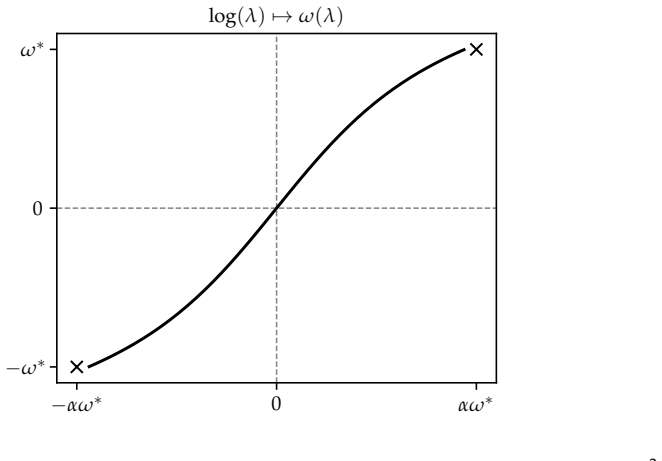
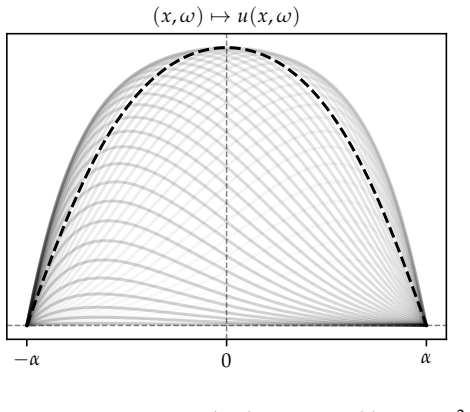
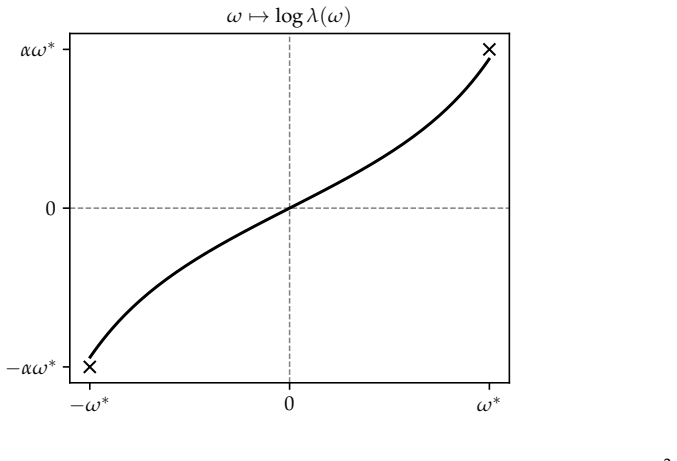
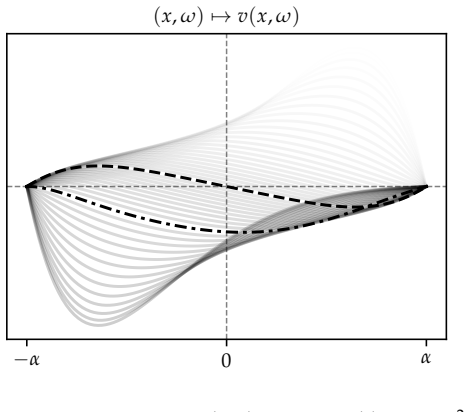
In systems with constant asymmetry ratio λ, equivariant rotating waves on the circle exist precisely when λ lies in an explicit range, uniquely fixing the angular speed ω(λ) and the wave profile.
A machine-rendered reading of the paper's core claim, the machinery that carries it, and where it could break.
Core claim
Assuming that a_{i+1,i}/a_{i,i+1} = λ > 0 holds for every consecutive pair, the equivariant segregated rotating waves exist if and only if λ belongs to an explicit range; whenever they exist, the angular velocity ω = ω(λ) is uniquely determined, as is the rotating profile. In particular, stationary solutions with ω = 0 exist only when λ = 1.
What carries the argument
The equivariant structure ansatz in which each density is obtained from the others by a fixed rotation on the circle, combined with the uniform ratio λ across consecutive competition coefficients.
If this is right
- Stationary segregated equilibria exist only when competition is symmetric (λ = 1).
- The angular speed is selected uniquely by the value of the asymmetry parameter λ.
- No equivariant rotating waves exist for λ outside the identified interval.
- The periodic geometry of the circle permits time-periodic segregated states that are ruled out on intervals with standard boundary conditions.
Where Pith is reading between the lines
- Cyclic asymmetry may systematically select a preferred rotation direction in multi-species systems on closed loops.
- The same ratio condition could determine speeds in other singular-limit models on periodic domains.
- Long-time dynamics on the circle may therefore differ qualitatively from those on the line even when the local reaction terms are identical.
Load-bearing premise
The competition coefficients maintain the same constant ratio λ between every consecutive pair of species, and the solutions are assumed to obey the equivariant rotation structure.
What would settle it
An explicit construction or numerical evidence of an equivariant rotating wave for some λ outside the claimed range, or of two distinct angular velocities supporting such waves for the same λ.
Figures

read the original abstract
We investigate the existence of segregated rotating waves, arising in the singular limit of competition-diffusion systems of the type \[ \partial_t u_i -\partial_{xx} u_i = f(u_i)-\beta u_i \sum_{j \neq i} a_{ij} u_j,\qquad x\in\mathbb{S}^1,\ t>0, 1\le i,j\le k, \] as $\beta\to+\infty$. Here $k\ge3$, the reaction $f$ is of Fisher-KPP (logistic) type, and the competition coefficients $a_{ij}>0$ are not necessarily symmetric. Assuming that, for every $i$, \[ \dfrac{a_{i+1,i}}{a_{i,i+1}}=\lambda>0, \] we provide a complete characterization of the rotating waves enjoying an equivariant structure, where each density is a suitable rotation of any other one: such waves exist if and only if $\lambda$ belongs to an explicit range, in which case the angular velocity $\omega=\omega(\lambda)$ is uniquely prescribed, as is the rotating profile. In particular, stationary solutions (with $\omega=0$) exist only in the symmetric case $\lambda=1$. This marks a strong difference with the same problem with either Dirichlet or Neumann boundary conditions, where it is known that no periodic in time solution exists, also in the asymmetric case, sheding more light on some conjectures and open problems concerning the long time behavior of competition-diffusion systems.
Editorial analysis
A structured set of objections, weighed in public.
Referee Report
Summary. The manuscript investigates segregated rotating waves in the singular limit β→∞ of a k≥3 system of Fisher-KPP competition-diffusion equations on the circle with asymmetric coefficients a_ij. Under the standing assumption that the ratio a_{i+1,i}/a_{i,i+1}=λ is constant across consecutive pairs and for solutions possessing an equivariant cyclic rotation structure, the authors give a complete characterization: such waves exist if and only if λ lies in an explicit range; when they exist, the angular velocity ω=ω(λ) and the rotating profile are uniquely determined. In particular, stationary solutions (ω=0) exist only for the symmetric case λ=1. This is contrasted with the Dirichlet and Neumann settings, where no time-periodic solutions are known to exist even in the asymmetric case.
Significance. If the analysis is correct, the result supplies an explicit selection mechanism for the speed of rotating waves under the stated structural hypotheses, thereby distinguishing the circle geometry from other boundary conditions and offering concrete information relevant to conjectures on long-time behavior of competition-diffusion systems. The uniqueness of ω(λ) and the profile, together with the explicit range for λ, constitute the main technical contribution.
minor comments (1)
- Abstract, last sentence: 'sheding' is a typographical error and should read 'shedding'.
Simulated Author's Rebuttal
We thank the referee for the positive summary of our work and the recommendation of minor revision. No specific major comments were provided in the report.
Circularity Check
No significant circularity
full rationale
The derivation is self-contained. The paper explicitly states the standing assumptions (constant ratio λ across consecutive pairs and the equivariant cyclic rotation ansatz) upfront, then characterizes existence/uniqueness of rotating waves and ω(λ) conditionally on those hypotheses. No step reduces the claimed result to a fitted parameter, self-citation chain, or definitional tautology; the output is an if-and-only-if statement derived from the PDE system under the given constraints, with no indication that the profile or speed is presupposed by the inputs.
Axiom & Free-Parameter Ledger
axioms (2)
- domain assumption The reaction f is of Fisher-KPP (logistic) type
- domain assumption Segregated rotating waves arise in the singular limit β→+∞
Reference graph
Works this paper leans on
-
[1]
Ambrosetti and G
A. Ambrosetti and G. Prodi.A primer of nonlinear analysis, volume 34 ofCambridge Studies in Advanced Mathematics. Cambridge University Press, Cambridge, 1995. Corrected reprint of the 1993 original
1995
-
[2]
D. G. Aronson and H. F. Weinberger. Multidimensional nonlinear diffusion arising in population genetics.Adv. in Math., 30(1):33–76, 1978
1978
-
[3]
Berestycki, F
H. Berestycki, F. Hamel, and L. Roques. Analysis of the periodically fragmented environ- ment model. I. Species persistence.J. Math. Biol., 51(1):75–113, 2005
2005
-
[4]
Berestycki, L
H. Berestycki, L. Nirenberg, and S. R. S. Varadhan. The principal eigenvalue and maxi- mum principle for second-order elliptic operators in general domains.Comm. Pure Appl. Math., 47(1):47–92, 1994
1994
-
[5]
Berestycki and A
H. Berestycki and A. Zilio. Predators-prey models with competition, Part I: Existence, bifurcation and qualitative properties.Commun. Contemp. Math., 20(7):1850010, 53, 2018
2018
-
[6]
Berestycki and A
H. Berestycki and A. Zilio. Predator-prey models with competition, Part III: Classification of stationary solutions.Discrete Contin. Dyn. Syst., 39(12):7141–7162, 2019
2019
-
[7]
Boselli and G
P . Boselli and G. Verzini. In preparation
-
[8]
Caffarelli, S
L. Caffarelli, S. Patrizi, and V . Quitalo. On a long range segregation model.J. Eur. Math. Soc. (JEMS), 19(12):3575–3628, 2017. 24
2017
-
[9]
L. A. Caffarelli, A. L. Karakhanyan, and F.-H. Lin. The geometry of solutions to a seg- regation problem for nondivergence systems.J. Fixed Point Theory Appl., 5(2):319–351, 2009
2009
-
[10]
Chuah, S
H. Chuah, S. Patrizi, and M. Torres. A nonlinear model for long-range segregation.Matem- atica, 5(1):Paper No. 20, 26, 2026
2026
-
[11]
Conti, S
M. Conti, S. Terracini, and G. Verzini. Asymptotic estimates for the spatial segregation of competitive systems.Adv. Math., 195(2):524–560, 2005
2005
-
[12]
Conti, S
M. Conti, S. Terracini, and G. Verzini. A variational problem for the spatial segregation of reaction-diffusion systems.Indiana Univ. Math. J., 54(3):779–815, 2005
2005
-
[13]
Conti, S
M. Conti, S. Terracini, and G. Verzini. Uniqueness and least energy property for solutions to strongly competing systems.Interfaces Free Bound., 8(4):437–446, 2006
2006
-
[14]
M. G. Crandall and P . H. Rabinowitz. Bifurcation from simple eigenvalues.J. Functional Analysis, 8:321–340, 1971
1971
-
[15]
E. N. Dancer and Y. H. Du. Competing species equations with diffusion, large interactions, and jumping nonlinearities.J. Differential Equations, 114(2):434–475, 1994
1994
-
[16]
E. N. Dancer and Y. H. Du. Positive solutions for a three-species competition system with diffusion. I. General existence results.Nonlinear Anal., 24(3):337–357, 1995
1995
-
[17]
E. N. Dancer and Y. H. Du. Positive solutions for a three-species competition system with diffusion. II. The case of equal birth rates.Nonlinear Anal., 24(3):359–373, 1995
1995
-
[18]
E. N. Dancer, K. Wang, and Z. Zhang. Uniform H ¨older estimate for singularly perturbed parabolic systems of Bose-Einstein condensates and competing species.J. Differential Equa- tions, 251(10):2737–2769, 2011
2011
-
[19]
E. N. Dancer, K. Wang, and Z. Zhang. Dynamics of strongly competing systems with many species.Trans. Amer. Math. Soc., 364(2):961–1005, 2012
2012
-
[20]
E. N. Dancer, K. Wang, and Z. Zhang. The limit equation for the Gross-Pitaevskii equa- tions and S. Terracini’s conjecture.J. Funct. Anal., 262(3):1087–1131, 2012
2012
-
[21]
E. N. Dancer and Z. Zhang. Dynamics of Lotka-Volterra competition systems with large interaction.J. Differential Equations, 182(2):470–489, 2002
2002
-
[22]
Girardin and A
L. Girardin and A. Zilio. Competition in periodic media: III—existence and stability of segregated periodic coexistence states.J. Dynam. Differential Equations, 32(1):257–279, 2020
2020
-
[23]
A. N. Kolmogorov, I. G. Petrovsky, and N. S. Piskunov. A study of the equation of diffu- sion with increase in the quantity of matter, and its application to a biological problem. Bulletin of Moscow State University Series A: Mathematics and Mechanics, 1:1–25, 1937
1937
-
[24]
Lanzara and E
F. Lanzara and E. Montefusco. On the limit configuration of four species strongly com- peting systems.NoDEA Nonlinear Differential Equations Appl., 26(3):Paper No. 19, 17, 2019
2019
-
[25]
Lanzara and E
F. Lanzara and E. Montefusco. Some remarks on segregation ofkspecies in strongly competing systems.Interfaces Free Bound., 23(3):403–419, 2021
2021
-
[26]
F. Lanzara, E. Montefusco, V . Nesi, and E. Spadaro. Generic configurations in 2d strongly competing systems, 2024. arXiv:2411.19867. 25
arXiv 2024
-
[27]
Li and S
Z. Li and S. Terracini. Rotating spirals for three-component competition systems.J. Differential Equations, 426:853–875, 2025
2025
-
[28]
Li and S
Z. Li and S. Terracini. Bifurcation for a three-component competition system.Matematica, 5(2):Paper No. 25, 31, 2026
2026
-
[29]
H. Matano. Asymptotic behavior of solutions of semilinear heat equations onS 1. In Nonlinear diffusion equations and their equilibrium states, II (Berkeley, CA, 1986), volume 13 of Math. Sci. Res. Inst. Publ., pages 139–162. Springer, New York, 1988
1986
-
[30]
Murakawa and H
H. Murakawa and H. Ninomiya. Fast reaction limit of a three-component reaction- diffusion system.J. Math. Anal. Appl., 379(1):150–170, 2011
2011
-
[31]
P . H. Rabinowitz. Some global results for nonlinear eigenvalue problems.J. Functional Analysis, 7:487–513, 1971
1971
-
[32]
Salort, S
A. Salort, S. Terracini, G. Verzini, and A. Zilio. Rotating spirals in segregated reaction- diffusion systems.Anal. PDE, 18(3):549–590, 2025
2025
-
[33]
Terracini, G
S. Terracini, G. Verzini, and A. Zilio. Spiraling asymptotic profiles of competition- diffusion systems.Comm. Pure Appl. Math., 72(12):2578–2620, 2019
2019
-
[34]
Verzini and A
G. Verzini and A. Zilio. Strong competition versus fractional diffusion: the case of Lotka- Volterra interaction.Comm. Partial Differential Equations, 39(12):2284–2313, 2014
2014
-
[35]
Wang and Z
K. Wang and Z. Zhang. Some new results in competing systems with many species.Ann. Inst. H. Poincar´ e C Anal. Non Lin´ eaire, 27(2):739–761, 2010
2010
-
[36]
Wei and T
J. Wei and T. Weth. Asymptotic behaviour of solutions of planar elliptic systems with strong competition.Nonlinearity, 21(2):305–317, 2008. giuseppe.spadaro@unical.it Dipartimento di Matematica e Informatica, Universit `a della Calabria Ponte Pietro Bucci 31B, 87036 Arcavacata di Rende, Cosenza (Italy) gianmaria.verzini@polimi.it Dipartimento di Matematic...
2008
discussion (0)
Sign in with ORCID, Apple, or X to comment. Anyone can read and Pith papers without signing in.