Trust Functions: Near-Lossless Weak-to-Strong Generalization by Learning When to Trust the Weak Teacher
Pith reviewed 2026-06-28 17:33 UTC · model grok-4.3
The pith
Trust functions score weak labels to filter supervision and achieve near-lossless weak-to-strong generalization.
A machine-rendered reading of the paper's core claim, the machinery that carries it, and where it could break.
Core claim
By learning or constructing trust functions that assign scalar trust scores to weak labels and filtering supervision according to these scores, models achieve near-lossless weak-to-strong generalization. Students trained on the filtered weak labels match and sometimes surpass the performance of models trained directly on ground-truth supervision. This approach further enables iterative weak-to-strong chains that amplify performance gains by reusing improved students as subsequent teachers.
What carries the argument
trust functions, which assign a scalar trust score to each weak label and enable filtering of unreliable supervision signals
If this is right
- Students trained with trust-filtered weak labels match or surpass ground-truth supervised students.
- Trust filtering supports iterative weak-to-strong chains that compound performance improvements.
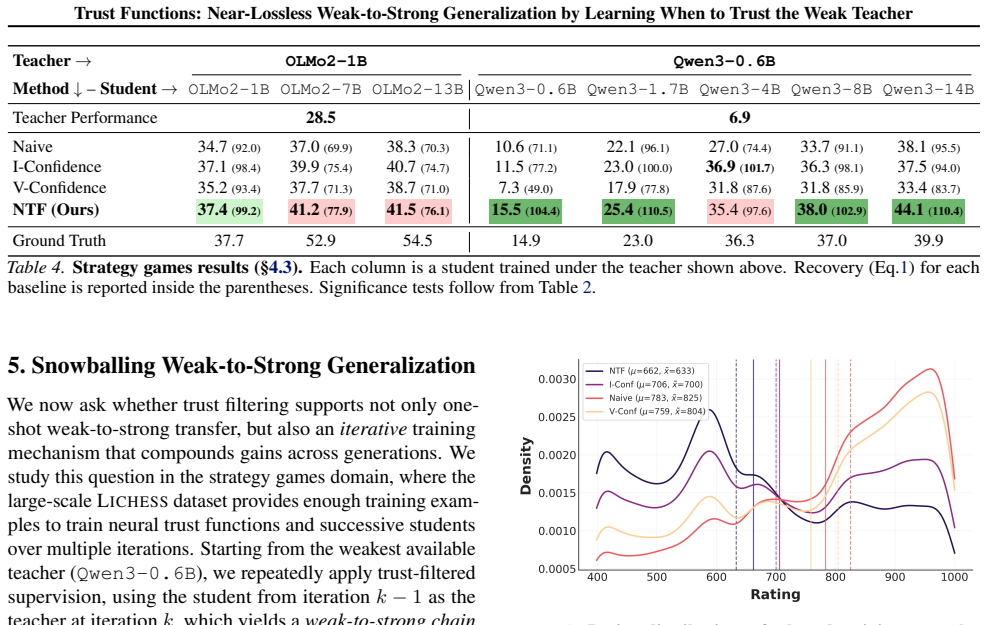
- The method applies across multiple domains including knowledge, reasoning, and games.
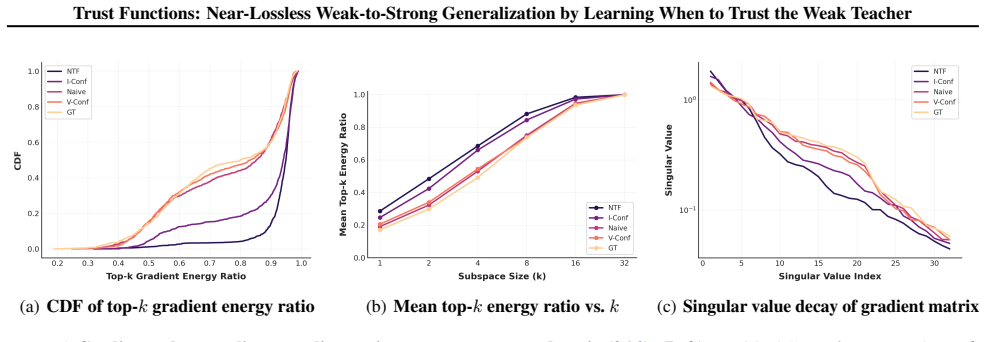
- Several mechanisms contribute to the advantage of using trust functions.
Where Pith is reading between the lines
- Trust functions could reduce reliance on expensive ground-truth labeling by making weak supervision nearly equivalent.
- This filtering approach might combine with other weak supervision techniques to further improve efficiency.
- Testing the method on larger scale models could reveal if the near-lossless property scales.
Load-bearing premise
Trust functions can be learned or constructed to accurately identify reliable weak labels without needing ground-truth labels for the filtering step itself.
What would settle it
Training a student on randomly filtered weak labels instead of trust-filtered ones and checking if performance falls significantly below ground-truth levels would falsify the claim that trust scores are necessary for the near-lossless result.
Figures


read the original abstract
Weak-to-strong generalization studies how to improve a strong student using supervision from a weaker teacher when reliable labels are scarce. We view this primarily as a data selection problem, where the key challenge is to identify which weak labels are reliable enough to serve as a training signal. To address this, we introduce trust functions that assign each weak label a scalar trust score and use these scores to filter weak supervision. Across several domains, including world knowledge, quantitative reasoning, and strategy games, trust filtering yields students that match and sometimes surpass ground-truth supervision, achieving near-lossless weak-to-strong generalization. Moreover, trust functions enable an iterative weak-to-strong chain that compounds gains by training a student and reusing it as the next teacher, amplifying the gains. There are several mechanisms to which advantage of trust functions can be attributed.
Editorial analysis
A structured set of objections, weighed in public.
Referee Report
Summary. The paper introduces trust functions that assign scalar trust scores to weak labels and filter them for training a strong student from a weak teacher. It claims this yields near-lossless weak-to-strong generalization, with students matching or surpassing ground-truth supervision across domains such as world knowledge, quantitative reasoning, and strategy games, while also enabling iterative chains that compound gains by reusing students as teachers.
Significance. If the empirical results hold and the trust functions can be learned without ground-truth access, the work would advance weak-to-strong generalization by reframing it as a data-selection problem, with potential impact on scalable oversight and training under label scarcity. The iterative chaining mechanism, if reproducible without GT leakage, would be a notable strength.
major comments (2)
- [Abstract] Abstract: the central claim that trust filtering achieves near-lossless generalization 'without access to ground-truth labels during filtering' cannot be evaluated because no training procedure, objective, or architecture for the trust functions is described; any supervised component in their learning would make the reported gains non-replicable under the stated constraints.
- [Methods (implied)] The manuscript provides no mechanism, equation, or algorithm for constructing or optimizing the trust functions (e.g., no loss, no data split, no hyper-parameters), which is load-bearing for the claim that filtering separates reliable from unreliable weak labels without GT.
minor comments (1)
- [Abstract] The abstract states there are 'several mechanisms to which advantage of trust functions can be attributed' but does not enumerate them; this should be expanded with concrete attribution analysis in the main text.
Simulated Author's Rebuttal
We thank the referee for the constructive comments. We agree that the current manuscript lacks sufficient detail on the trust function training procedure, which prevents full evaluation of the central claims. We will revise the paper to include explicit descriptions of the architecture, objective, data handling, and optimization process.
read point-by-point responses
-
Referee: [Abstract] Abstract: the central claim that trust filtering achieves near-lossless generalization 'without access to ground-truth labels during filtering' cannot be evaluated because no training procedure, objective, or architecture for the trust functions is described; any supervised component in their learning would make the reported gains non-replicable under the stated constraints.
Authors: We acknowledge this limitation in the current draft. The trust functions are designed to be learned without ground-truth labels via a self-supervised consistency objective on weak label agreement across model variants or augmentations. We will add a dedicated Methods subsection with the precise architecture (a lightweight MLP), loss function (binary cross-entropy on predicted trust vs. consistency targets), train/validation split on weak labels only, and all hyperparameters. This will make the no-GT claim directly verifiable and replicable. revision: yes
-
Referee: [Methods (implied)] The manuscript provides no mechanism, equation, or algorithm for constructing or optimizing the trust functions (e.g., no loss, no data split, no hyper-parameters), which is load-bearing for the claim that filtering separates reliable from unreliable weak labels without GT.
Authors: The referee is correct that these details are missing from the submitted version. We will insert the full algorithmic description, including the trust score equation, the optimization procedure (gradient descent on the self-supervised loss), data partitioning (no GT used), and hyperparameter table. Pseudocode for the end-to-end filtering and training pipeline will also be added to ensure the separation of reliable vs. unreliable labels can be reproduced without ground truth. revision: yes
Circularity Check
No significant circularity detected
full rationale
The provided abstract and context introduce trust functions as a data-selection mechanism for weak-to-strong generalization but contain no equations, training procedures, self-citations, or derivation steps that reduce the claimed near-lossless performance to fitted inputs or prior results by construction. No load-bearing premise is justified solely via overlapping-author citations, no ansatz is smuggled, and no prediction is shown to be a renaming or tautological fit of the same data. The empirical claims across domains are presented as experimental outcomes rather than a closed mathematical chain, satisfying the criteria for an independent result.
Axiom & Free-Parameter Ledger
Reference graph
Works this paper leans on
-
[1]
Langley , title =
P. Langley , title =. Proceedings of the 17th International Conference on Machine Learning (ICML 2000) , address =. 2000 , pages =
2000
-
[2]
T. M. Mitchell. The Need for Biases in Learning Generalizations. 1980
1980
-
[3]
M. J. Kearns , title =
-
[4]
Machine Learning: An Artificial Intelligence Approach, Vol. I. 1983
1983
-
[5]
R. O. Duda and P. E. Hart and D. G. Stork. Pattern Classification. 2000
2000
-
[6]
Suppressed for Anonymity , author=
-
[7]
Newell and P
A. Newell and P. S. Rosenbloom. Mechanisms of Skill Acquisition and the Law of Practice. Cognitive Skills and Their Acquisition. 1981
1981
-
[8]
A. L. Samuel. Some Studies in Machine Learning Using the Game of Checkers. IBM Journal of Research and Development. 1959
1959
-
[9]
2024 , eprint=
Reward Modeling with Weak Supervision for Language Models , author=. 2024 , eprint=
2024
-
[10]
2025 , eprint=
Learning to Reason without External Rewards , author=. 2025 , eprint=
2025
-
[11]
2025 , eprint=
The Unreasonable Effectiveness of Entropy Minimization in LLM Reasoning , author=. 2025 , eprint=
2025
-
[12]
2019 , eprint=
Self-training with Noisy Student improves ImageNet classification , author=. 2019 , eprint=
2019
-
[13]
2020 , eprint=
Fine-Tuning Pre-trained Language Model with Weak Supervision: A Contrastive-Regularized Self-Training Approach , author=. 2020 , eprint=
2020
-
[14]
2025 , eprint=
Debate Helps Weak-to-Strong Generalization , author=. 2025 , eprint=
2025
-
[15]
2024 , eprint=
EnsemW2S: Enhancing Weak-to-Strong Generalization with Large Language Model Ensembles , author=. 2024 , eprint=
2024
-
[16]
2024 , eprint=
I-SHEEP: Self-Alignment of LLM from Scratch through an Iterative Self-Enhancement Paradigm , author=. 2024 , eprint=
2024
-
[17]
2024 , eprint=
Quantifying the Gain in Weak-to-Strong Generalization , author=. 2024 , eprint=
2024
-
[18]
2025 , eprint=
Weak-to-Strong Generalization Even in Random Feature Networks, Provably , author=. 2025 , eprint=
2025
-
[19]
2024 , eprint=
Provable Weak-to-Strong Generalization via Benign Overfitting , author=. 2024 , eprint=
2024
-
[20]
2023 , eprint=
Just Ask for Calibration: Strategies for Eliciting Calibrated Confidence Scores from Language Models Fine-Tuned with Human Feedback , author=. 2023 , eprint=
2023
-
[21]
2023 , eprint=
LM-Polygraph: Uncertainty Estimation for Language Models , author=. 2023 , eprint=
2023
-
[22]
2025 , eprint=
Lexical Hints of Accuracy in LLM Reasoning Chains , author=. 2025 , eprint=
2025
-
[23]
2025 , eprint=
TokUR: Token-Level Uncertainty Estimation for Large Language Model Reasoning , author=. 2025 , eprint=
2025
-
[24]
2025 , eprint=
Rethinking Reflection in Pre-Training , author=. 2025 , eprint=
2025
-
[25]
2025 , eprint=
Inductive Moment Matching , author=. 2025 , eprint=
2025
-
[26]
2025 , eprint=
Unveiling the Mechanisms of Explicit CoT Training: How Chain-of-Thought Enhances Reasoning Generalization , author=. 2025 , eprint=
2025
-
[27]
2023 , eprint=
Weak-to-Strong Generalization: Eliciting Strong Capabilities With Weak Supervision , author=. 2023 , eprint=
2023
-
[28]
2021 , eprint=
Fine-Tuning Pre-trained Language Model with Weak Supervision: A Contrastive-Regularized Self-Training Approach , author=. 2021 , eprint=
2021
-
[29]
2022 , eprint=
Language Models (Mostly) Know What They Know , author=. 2022 , eprint=
2022
-
[30]
2023 , eprint=
Semantic Uncertainty: Linguistic Invariances for Uncertainty Estimation in Natural Language Generation , author=. 2023 , eprint=
2023
-
[31]
2024 , eprint=
Theoretical Analysis of Weak-to-Strong Generalization , author=. 2024 , eprint=
2024
-
[32]
2025 , eprint=
Representations Shape Weak-to-Strong Generalization: Theoretical Insights and Empirical Predictions , author=. 2025 , eprint=
2025
-
[33]
2025 , eprint=
Superhuman performance of a large language model on the reasoning tasks of a physician , author=. 2025 , eprint=
2025
-
[34]
A transfer learning framework for weak-to-strong generalization , author=. 2024 , publisher=. doi:10.48550/arXiv.2405.16236 , note=
-
[35]
2024 , eprint=
Weak-to-Strong Reasoning , author=. 2024 , eprint=
2024
-
[36]
Advances in Neural Information Processing Systems (NeurIPS) , year=
Easy-to-Hard Generalization: Scalable Alignment Beyond Human Supervision , author=. Advances in Neural Information Processing Systems (NeurIPS) , year=. doi:arXiv.2403.09472 , note=
-
[37]
2025 , eprint=
Your Weak LLM is Secretly a Strong Teacher for Alignment , author=. 2025 , eprint=
2025
-
[38]
Annual Meeting of the Association for Computational Linguistics (ACL) , year=
Superfiltering: Weak-to-Strong Data Filtering for Fast Instruction-Tuning , author=. Annual Meeting of the Association for Computational Linguistics (ACL) , year=. doi:10.48550/arXiv.2402.00530 , note=
-
[39]
Advances in Neural Information Processing Systems (NeurIPS) , year=
Weak-to-Strong Search: Align Large Language Models via Searching over Small Language Models , author=. Advances in Neural Information Processing Systems (NeurIPS) , year=. doi:10.48550/arXiv.2405.19262 , note=
-
[40]
2024 , eprint=
Improving Weak-to-Strong Generalization with Reliability-Aware Alignment , author=. 2024 , eprint=
2024
-
[41]
2026 , eprint=
Weak-to-Strong Generalization with Failure Trajectories: A Tree-based Approach to Elicit Optimal Policy in Strong Models , author=. 2026 , eprint=
2026
-
[42]
2024 , eprint=
Co-Supervised Learning: Improving Weak-to-Strong Generalization with Hierarchical Mixture of Experts , author=. 2024 , eprint=
2024
-
[43]
2026 , eprint=
Incentivizing Strong Reasoning from Weak Supervision , author=. 2026 , eprint=
2026
-
[44]
The Delta Learning Hypothesis: Preference Tuning on Weak Data , author=. 2025 , publisher=. doi:10.48550/arXiv.2507.06187 , note=
-
[45]
2026 , eprint=
W2S-AlignTree: Weak-to-Strong Inference-Time Alignment for Large Language Models via Monte Carlo Tree Search , author=. 2026 , eprint=
2026
-
[46]
Vision Superalignment: Weak-to-Strong Generalization for Vision Foundation Models , author=. 2024 , publisher=. doi:10.48550/arXiv.2402.03749 , note=
-
[47]
Generalizing Trust: Weak-to-Strong Trustworthiness in Language Models , author=. 2025 , publisher=. doi:10.48550/arXiv.2501.00418 , note=
-
[48]
2024 , eprint=
Optimizing Language Model's Reasoning Abilities with Weak Supervision , author=. 2024 , eprint=
2024
-
[49]
2025 , eprint=
Towards Robust Mathematical Reasoning , author=. 2025 , eprint=
2025
-
[50]
2025 , eprint=
Gold-medalist Performance in Solving Olympiad Geometry with AlphaGeometry2 , author=. 2025 , eprint=
2025
-
[51]
2025 , eprint=
Reasoning Models Know When They're Right: Probing Hidden States for Self-Verification , author=. 2025 , eprint=
2025
-
[52]
2025 , eprint=
Qwen3 Technical Report , author=. 2025 , eprint=
2025
-
[53]
2025 , eprint=
2 OLMo 2 Furious , author=. 2025 , eprint=
2025
-
[54]
2025 , eprint=
Gemma 3 Technical Report , author=. 2025 , eprint=
2025
-
[55]
2024 , eprint=
The Llama 3 Herd of Models , author=. 2024 , eprint=
2024
-
[56]
2021 , eprint=
Measuring Massive Multitask Language Understanding , author=. 2021 , eprint=
2021
-
[57]
2018 , eprint=
Think you have Solved Question Answering? Try ARC, the AI2 Reasoning Challenge , author=. 2018 , eprint=
2018
-
[58]
2018 , eprint=
Can a Suit of Armor Conduct Electricity? A New Dataset for Open Book Question Answering , author=. 2018 , eprint=
2018
-
[59]
2017 , eprint=
Crowdsourcing Multiple Choice Science Questions , author=. 2017 , eprint=
2017
-
[60]
2019 , eprint=
SocialIQA: Commonsense Reasoning about Social Interactions , author=. 2019 , eprint=
2019
-
[61]
2021 , eprint=
Measuring Mathematical Problem Solving With the MATH Dataset , author=. 2021 , eprint=
2021
-
[62]
2024 , eprint=
Omni-MATH: A Universal Olympiad Level Mathematic Benchmark For Large Language Models , author=. 2024 , eprint=
2024
-
[63]
2023 , publisher =
Hemish Veeraboina , title =. 2023 , publisher =
2023
-
[64]
chess-puzzles , year =
-
[65]
2021 , eprint=
LoRA: Low-Rank Adaptation of Large Language Models , author=. 2021 , eprint=
2021
-
[66]
2024 , eprint=
DeepSeekMath: Pushing the Limits of Mathematical Reasoning in Open Language Models , author=. 2024 , eprint=
2024
-
[67]
HybridFlow: A flexible and efficient RLHF framework
Sheng, Guangming and Zhang, Chi and Ye, Zilingfeng and Wu, Xibin and Zhang, Wang and Zhang, Ru and Peng, Yanghua and Lin, Haibin and Wu, Chuan , year=. HybridFlow: A Flexible and Efficient RLHF Framework , url=. doi:10.1145/3689031.3696075 , booktitle=
-
[68]
2023 , eprint=
FlashAttention-2: Faster Attention with Better Parallelism and Work Partitioning , author=. 2023 , eprint=
2023
-
[69]
2017 , eprint=
SGDR: Stochastic Gradient Descent with Warm Restarts , author=. 2017 , eprint=
2017
-
[70]
2015 , eprint=
Deep Residual Learning for Image Recognition , author=. 2015 , eprint=
2015
-
[71]
2019 , eprint=
Root Mean Square Layer Normalization , author=. 2019 , eprint=
2019
-
[72]
2020 , eprint=
GLU Variants Improve Transformer , author=. 2020 , eprint=
2020
-
[73]
Journal of Machine Learning Research , year =
Nitish Srivastava and Geoffrey Hinton and Alex Krizhevsky and Ilya Sutskever and Ruslan Salakhutdinov , title =. Journal of Machine Learning Research , year =
-
[74]
2016 , eprint=
Deep Networks with Stochastic Depth , author=. 2016 , eprint=
2016
-
[75]
2019 , eprint=
Decoupled Weight Decay Regularization , author=. 2019 , eprint=
2019
-
[76]
2023 , eprint=
Attention Is All You Need , author=. 2023 , eprint=
2023
-
[77]
2017 , eprint=
On Calibration of Modern Neural Networks , author=. 2017 , eprint=
2017
-
[78]
Monthly Weather Review , year=
VERIFICATION OF FORECASTS EXPRESSED IN TERMS OF PROBABILITY , author=. Monthly Weather Review , year=
-
[79]
, author=
The meaning and use of the area under a receiver operating characteristic (ROC) curve. , author=. Radiology , year=
-
[80]
2021 , eprint=
Training Verifiers to Solve Math Word Problems , author=. 2021 , eprint=
2021
discussion (0)
Sign in with ORCID, Apple, or X to comment. Anyone can read and Pith papers without signing in.