Computing resonant modes of circular cylindrical resonators by vertical mode expansions
Pith reviewed 2026-05-25 12:55 UTC · model grok-4.3
The pith
Resonant modes of circular cylindrical resonators are computed by expanding fields in one-dimensional vertical modes to reduce the three-dimensional problem to one dimension.
A machine-rendered reading of the paper's core claim, the machinery that carries it, and where it could break.
Core claim
The method uses field expansions in one-dimensional vertical modes to reduce the original three-dimensional eigenvalue problem to one-dimensional problems, and uses the Chebyshev pseudospectral method to compute the one-dimensional modes and set up the discretized eigenvalue problem. In addition, a new iterative scheme is developed so that the one-dimensional nonlinear eigenvalue problems can be reliably solved. For metallic cylinders, the resonant modes are calculated based on analytic models for the dielectric functions of metals.
What carries the argument
Vertical mode expansions: expansions of the electromagnetic fields in terms of one-dimensional vertical modes that reduce the three-dimensional Maxwell eigenvalue problem to one-dimensional nonlinear eigenvalue problems, discretized by the Chebyshev pseudospectral method and solved with a new iterative scheme.
If this is right
- The method allows computation of resonant modes for circular cylinders with a few layers embedded in a layered background.
- High-Q resonances in subwavelength dielectric cylinders can be explored using this approach.
- Resonant modes of gold nanocylinders can be analyzed with analytic models for metal dielectric functions.
- The approach is efficient and robust for computing complex-frequency outgoing solutions of Maxwell's equations.
Where Pith is reading between the lines
- This reduction to one dimension could enable faster design iterations for photonic devices based on cylindrical resonators.
- The iterative scheme for nonlinear eigenvalues might be applicable to other problems in computational electromagnetics involving frequency-dependent materials.
- Validation against existing results suggests the method could serve as a benchmark for other numerical techniques in nanophotonics.
Load-bearing premise
The new iterative scheme can reliably solve the one-dimensional nonlinear eigenvalue problems without failing to converge or generating spurious modes when material responses depend on frequency.
What would settle it
Compute the resonant frequencies for a specific multi-layer gold nanocylinder using both this method and an independent three-dimensional finite-difference time-domain simulation and check for agreement within numerical tolerance.
Figures
read the original abstract
Open subwavelength cylindrical resonators of finite height are widely used in various photonics applications. Circular cylindrical resonators are particularly important in nanophotonics, since they are relatively easy to fabricate and can be designed to exhibit different resonance effects. In this paper, an efficient and robust numerical method is developed for computing resonant modes of circular cylinders which may have a few layers and may be embedded in a layered background. The resonant modes are complex-frequency outgoing solutions of the Maxwell's equations with no sources or incident waves. The method uses field expansions in one-dimensional (1D) ``vertical'' modes to reduce the original three-dimensional eigenvalue problem to 1D problems, and uses Chebyshev pseudospectral method to compute the 1D modes and set up the discretized eigenvalue problem. In addition, a new iterative scheme is developed so that the 1D nonlinear eigenvalue problems can be reliably solved. For metallic cylinders, the resonant modes are calculated based on analytic models for the dielectric functions of metals. The method is validated by comparisons with existing numerical results, and it is also used to explore subwavelength dielectric cylinders with high-$Q$ resonances and analyze gold nanocylinders.
Editorial analysis
A structured set of objections, weighed in public.
Referee Report
Summary. The manuscript develops an efficient numerical method for computing resonant modes (complex-frequency outgoing solutions) of circular cylindrical resonators that may have a few layers and be embedded in a layered background. It reduces the 3D Maxwell eigenvalue problem via expansions in 1D vertical modes, computes those modes with the Chebyshev pseudospectral method, discretizes the resulting 1D problems, and introduces a new iterative scheme to solve the nonlinear eigenvalue problems that arise (especially for frequency-dependent metal permittivities). The method is validated by comparisons with existing results and applied to high-Q dielectric cylinders and gold nanocylinders.
Significance. If the iterative scheme is shown to be reliable, the vertical-mode reduction offers a computationally attractive route from 3D to 1D for resonator problems in nanophotonics, with the self-contained Chebyshev discretization and analytic metal models providing a parameter-free framework for dispersive cases.
major comments (2)
- [Abstract / iterative scheme description] Abstract (paragraph on method development) and the section describing the iterative scheme: the central claim that the 3D-to-1D reduction yields correct resonant modes rests on the new iterative solver reliably finding all physically relevant complex-frequency roots without spurious modes or missed branches for frequency-dependent permittivities. No convergence analysis, tests with varied initial guesses, layer counts, or dispersion models (e.g., gold Drude-Lorentz), or checks against known spurious-mode artifacts are provided, so the reduction's correctness cannot be verified from the given information.
- [Validation / results] Validation paragraph and any accompanying tables/figures: the abstract states validation by comparisons with existing numerical results and applications to dielectric/gold cylinders, yet supplies no quantitative data, error bars, convergence studies with respect to vertical-mode truncation or Chebyshev points, or tabulated resonant frequencies, undermining the claim that the method is robust.
minor comments (1)
- Notation for the vertical modes and the nonlinear eigenvalue problem should be introduced with explicit definitions of the expansion coefficients and the resulting matrix pencil to improve readability.
Simulated Author's Rebuttal
We thank the referee for the careful reading of the manuscript and the constructive comments. We respond to each major comment below.
read point-by-point responses
-
Referee: [Abstract / iterative scheme description] Abstract (paragraph on method development) and the section describing the iterative scheme: the central claim that the 3D-to-1D reduction yields correct resonant modes rests on the new iterative solver reliably finding all physically relevant complex-frequency roots without spurious modes or missed branches for frequency-dependent permittivities. No convergence analysis, tests with varied initial guesses, layer counts, or dispersion models (e.g., gold Drude-Lorentz), or checks against known spurious-mode artifacts are provided, so the reduction's correctness cannot be verified from the given information.
Authors: We agree that the manuscript would benefit from additional documentation of the iterative scheme's behavior. The scheme iterates on the complex frequency while solving linear problems at each step using the vertical-mode expansion; it is initialized from the real-frequency resonances of the corresponding lossless structure. The manuscript demonstrates reliability through agreement with published results for both dielectric and dispersive metallic cases, but does not contain explicit convergence tests or checks against spurious roots. In revision we will add a subsection presenting convergence of the iteration for different initial guesses, layer counts, and the Drude-Lorentz model, together with a brief discussion of how the vertical-mode truncation controls the appearance of non-physical modes. revision: yes
-
Referee: [Validation / results] Validation paragraph and any accompanying tables/figures: the abstract states validation by comparisons with existing numerical results and applications to dielectric/gold cylinders, yet supplies no quantitative data, error bars, convergence studies with respect to vertical-mode truncation or Chebyshev points, or tabulated resonant frequencies, undermining the claim that the method is robust.
Authors: The results section of the manuscript does contain direct numerical comparisons with literature values for both dielectric and gold nanocylinders, but we acknowledge that these are presented only graphically without tabulated frequencies, error metrics, or systematic convergence studies. We will revise the validation section to include tables of computed resonant frequencies versus reference values, relative errors, and plots demonstrating convergence with respect to the number of retained vertical modes and the number of Chebyshev points. revision: yes
Circularity Check
No circularity: standard numerical discretization and solver development
full rationale
The paper describes a vertical-mode expansion that reduces the 3D Maxwell eigenvalue problem to 1D nonlinear problems, discretized via Chebyshev pseudospectral method, plus a new iterative solver for the resulting nonlinear eigenproblems. No quoted step reduces a claimed prediction or uniqueness result to a fitted parameter, self-citation, or ansatz by construction. The method is presented as a self-contained discretization technique validated against external results, with no load-bearing self-citations or renaming of known patterns. This is the normal case of an independent numerical algorithm.
Axiom & Free-Parameter Ledger
axioms (2)
- domain assumption Resonant modes are complex-frequency outgoing solutions of Maxwell's equations with no sources or incident waves.
- domain assumption Field expansions in 1D vertical modes accurately reduce the 3D problem for cylindrical geometries with layers.
Lean theorems connected to this paper
-
IndisputableMonolith/Foundation/RealityFromDistinction.leanreality_from_one_distinction unclear?
unclearRelation between the paper passage and the cited Recognition theorem.
The method uses field expansions in one-dimensional (1D) 'vertical' modes to reduce the original three-dimensional eigenvalue problem to 1D problems, and uses Chebyshev pseudospectral method to compute the 1D modes and set up the discretized eigenvalue problem.
-
IndisputableMonolith/Cost/FunctionalEquation.leanwashburn_uniqueness_aczel unclear?
unclearRelation between the paper passage and the cited Recognition theorem.
In addition, a new iterative scheme is developed so that the 1D nonlinear eigenvalue problems can be reliably solved.
What do these tags mean?
- matches
- The paper's claim is directly supported by a theorem in the formal canon.
- supports
- The theorem supports part of the paper's argument, but the paper may add assumptions or extra steps.
- extends
- The paper goes beyond the formal theorem; the theorem is a base layer rather than the whole result.
- uses
- The paper appears to rely on the theorem as machinery.
- contradicts
- The paper's claim conflicts with a theorem or certificate in the canon.
- unclear
- Pith found a possible connection, but the passage is too broad, indirect, or ambiguous to say the theorem truly supports the claim.
Reference graph
Works this paper leans on
-
[1]
[26] using special FMMs with 1D vertical and radial modes, respectively
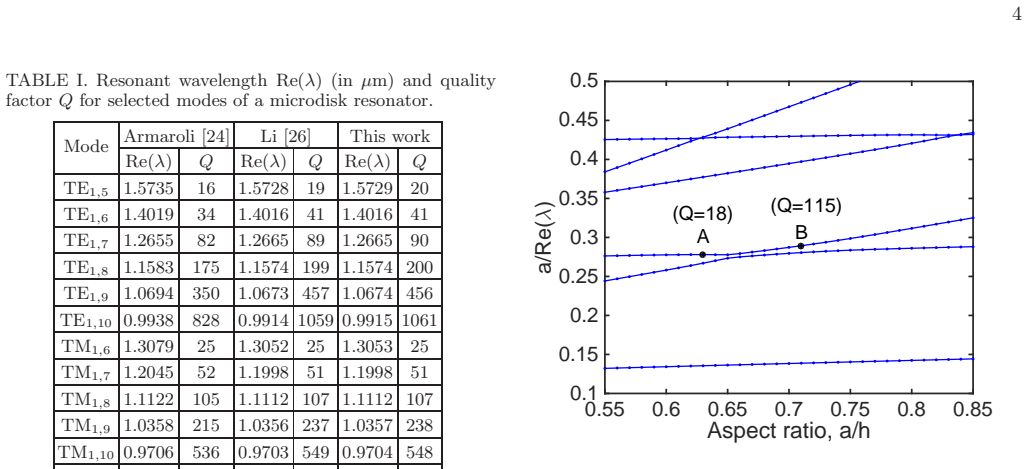
and Li et al. [26] using special FMMs with 1D vertical and radial modes, respectively. PMLs are used in these works to periodize the z or r directions. In our method, the z variable is truncated to an interval of 1. 92 µ m with a total of five layers. The top and bottom layers are PMLs with a thickness of 0 . 6 µ m. The middle layer corresponds to the micr...
work page 2045
-
[2]
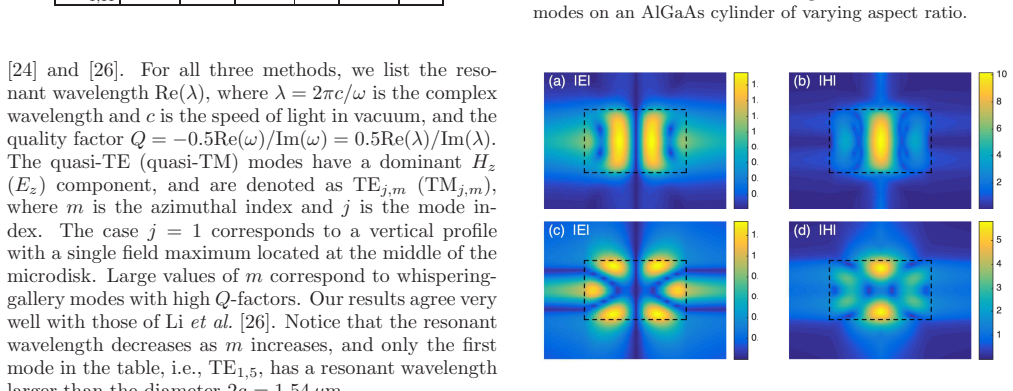
and [26]. For all three methods, we list the reso- nant wavelength Re( λ), where λ = 2πc/ω is the complex wavelength and c is the speed of light in vacuum, and the quality factor Q = −0. 5Re(ω )/ Im(ω ) = 0 . 5Re(λ)/ Im(λ). The quasi-TE (quasi-TM) modes have a dominant Hz (Ez) component, and are denoted as TE j,m (TMj,m), where m is the azimuthal index an...
-
[3]
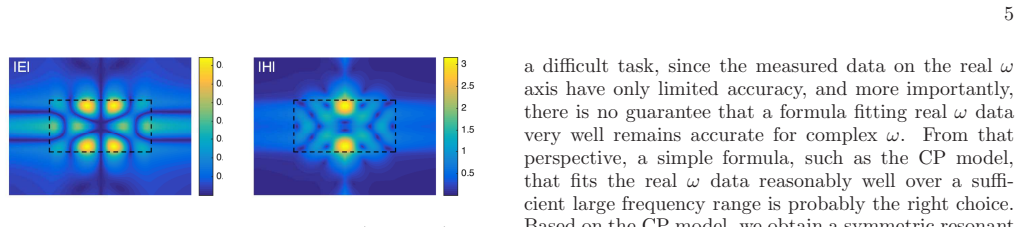
4256205 − 0. 001186053i. Its electromagnetic field pat- terns are shown in Fig. 3. Notice that the diameter and height of the cylinder are still smaller than the resonant wavelength. 5 FIG. 3. Magnitudes of the electric field E (left panel) and scaled magnetic field H (right panel) on the xz plane of a resonant mode for a silicon cylinder with aspect ratio a...
-
[4]
This example was previously analyzed using a finite element method [36] and a FMM [23, 25]
25. This example was previously analyzed using a finite element method [36] and a FMM [23, 25]. In these works, a particular resonant mode with azimuthal order m = 0 was carefully studied, while the dielectric function of gold is approximated by a Drude model ε(ω ) = ε∞ − ω 2 p ω 2 + iΓω , with parameters ε∞ = 1, ω p = 1. 26 × 1016 rad/ s and Γ =
-
[5]
These parameters are chosen to fit the measured data of [37]
41 × 1014 rad/ s. These parameters are chosen to fit the measured data of [37]. The complex wavelength of that mode is approximately 0 . 9177210 +i0. 0469092 µ m [36] or
-
[6]
9173666 + i0. 0468896 µ m [25]. Using the same Drude model, we calculate the resonant mode with our method, and obtain the complex wavelength λ = 0 . 9176863 + i0. 0469084 µ m. Our result has an excellent agreement with the FEM result [36] and a good agreement with FMM result [25]. Due to field singularity along the sharp edges and the large field gradient ...
-
[7]
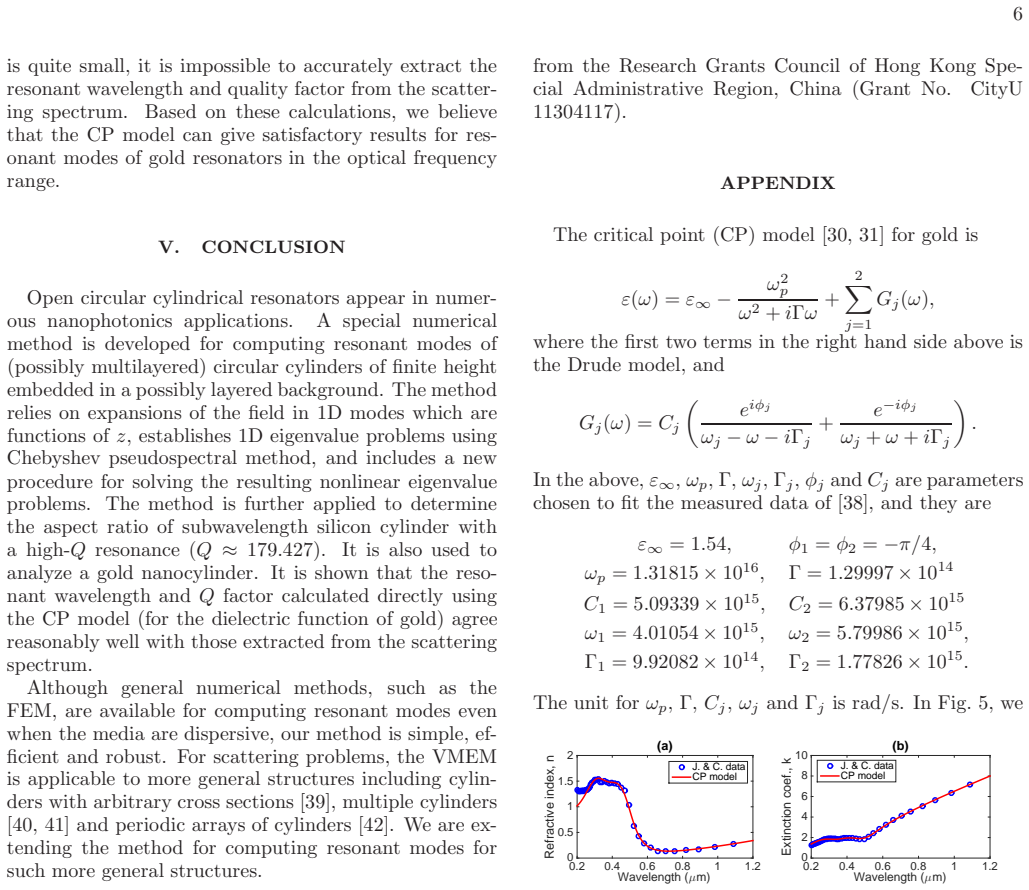
Panels (a) and (b) show real and imaginary parts of √ ε = n + ik
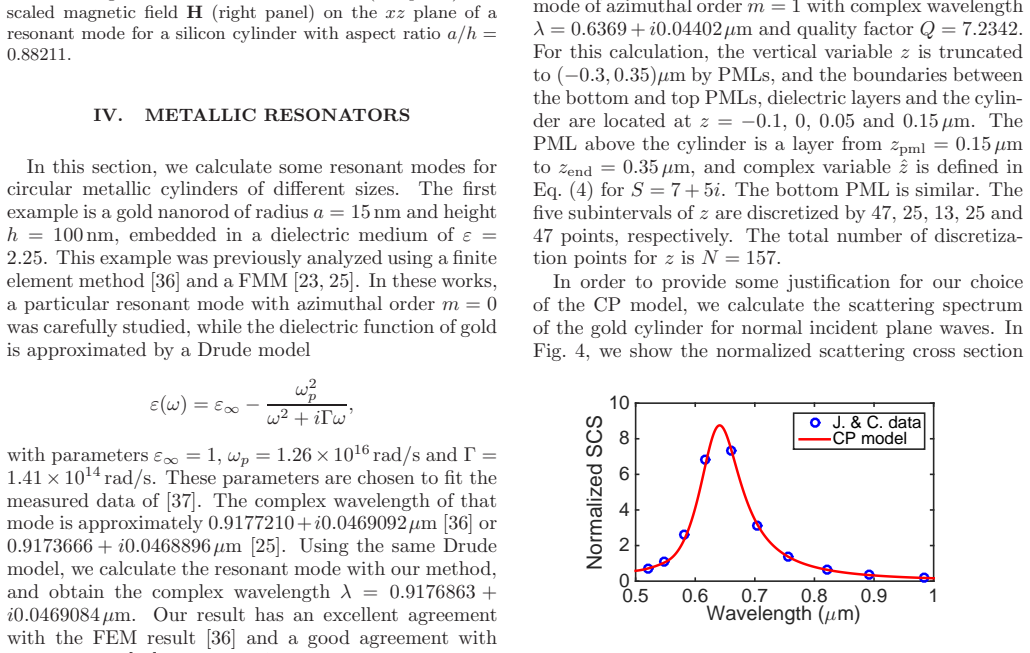
for gold. Panels (a) and (b) show real and imaginary parts of √ ε = n + ik. compare the CP model for gold with the data of [38] for the real and imaginary parts of √ ε = n + ik
-
[8]
P. Lalanne, W. Yan, K. Vynck, C. Sauvan, and J.-P. Hugonin, Light interaction with photonic and plasmonic resonances, Laser Photon. Rev. 12, 1700113 (2018)
work page 2018
-
[9]
M. Soltani, S. Yegnanarayanan, and A. Adibi, Ultra-high Q planar silicon microdisk resonators for chip-scale sili- con photonics, Opt. Express 15, 4694-4704 (2007)
work page 2007
-
[10]
P. Genevet, F. Capasso, F. Aieta, M. Khorasaninejad, and R. Devlin, Recent advances in planar optics: from plasmonic to dielectric metasurfaces, Optica 4(1), 139– 152 (2017)
work page 2017
-
[11]
M. Khorasaninejad and F. Capasso, Metalenses: Versa- tile multifunctional photonic components, Science 358, 8100 (2017)
work page 2017
-
[12]
V.-C. Su, C. H. Chu, G. Sun, and D. P. Tsai, Advances in optical metasurfaces: fabrication and applications, Opt. Express 26(10), 13148-13182 (2018)
work page 2018
-
[13]
S. Shrestha, A. C. Overvig, M. Lu, A. Stein, and N. Yu, Broadband achromatic dielectric metalenses, Light: Science & Applications 7, 85 (2018)
work page 2018
-
[14]
M. V. Rybin, K. L. Koshelev, Z. F. Sadrieva, K. B. Samu- sev, A. A. Bogdanov, M. F. Limonov, and Y. S. Kivshar, High-Q supercavity modes in subwavelength dielectric resonators, Phys. Rev. Lett. 119, 243901 (2017). 7
work page 2017
-
[15]
L. Carletti, K. Koshelev, C. De Angelis, and Y. Kivshar, Giant nonlinear response at the nanoscale driven by bound states in the continuum, Phys. Rev. Lett. 121, 033903 (2018)
work page 2018
- [16]
-
[17]
A. W. Glisson, D. Kajfez, and J. James, Evaluation of modes in dielectric resonators using a surface integral equation formulation, IEEE Transactions on Microwave Theory and Techniques 31, 1023-1029 (1983)
work page 1983
-
[18]
S. Hyun, J. Hwang, Y. Lee, and S. Kim, Computation of resonant modes of open resonators using the FEM and the anisotropic perfectly matched layer boundary condi- tion, Microwave Opt. Technol. Lett. 16, 352–356 (1997)
work page 1997
-
[19]
J.-K. Hwang, S.-B. Hyun, H.-Y. Ryu, and Y.-H. Lee, Resonant modes of two-dimensional photonic bandgap cavities determined by the finite-element method and by use of the anisotropic perfectly matched layer boundary condition, J. Opt. Soc. Am. B 15, 2316–2324 (1998)
work page 1998
- [20]
-
[21]
G. Bao Z. Chen, and H. Wu, Adaptive finite-element method for diffraction gratings, J. Opt. Soc. Am. A 22, 1106 (2005)
work page 2005
-
[22]
J. P. Berenger, A perfectly matched layer for the absorp - tion of electromagnetic waves, J. Comput. Phys. 114, 185–200 (1994)
work page 1994
-
[23]
A. Raman and S. Fan, Photonic band structure of disper- sive metamaterials formulated as a Hermitian eigenvalue problem, Phys. Rev. Lett. 104, 087401 (2010)
work page 2010
-
[24]
W. Yan, R. Feggiani, and P. Lalanne, Rigorous modal analysis of plasmonic nanoresonators, Phys. Rev. B 97, 205422 (2018)
work page 2018
-
[25]
D. A. Powell, Resonant dynamics of arbitrarily shaped meta-atoms, Phys. Rev. B 90, 075108 (2014)
work page 2014
-
[26]
Li, New formulation of the Fourier modal method for crossed surface-relief gratings, J
L. Li, New formulation of the Fourier modal method for crossed surface-relief gratings, J. Opt. Soc. Am. A 14, 2758–2767 (1997)
work page 1997
-
[27]
E. Silberstein, P. Lalanne, J.-P. Hugonin, and Q. Cao, Use of grating theories in integrated optics, J. Opt. Soc. Am. A 18, 2865–2875 (2001)
work page 2001
-
[28]
G. Granet and J. P. Plumey, Parametric formulation of the Fourier modal method for crossed surface-relief grat- ings, J. Opt. A 4, S145–S149 (2002)
work page 2002
-
[29]
P. Lalanne, J. P. Hugonin, and J. S. Gerard, Electromag- netic study of the quality factor of pillar microcavities in the small diameter limit, Appl. Phys. Lett. 84, 4726-4728 (2004)
work page 2004
- [30]
-
[31]
A. Armaroli, A. Morand, P. Benech, G. Bellanca, and S. Trillo, Three-dimensional analysis of cylindrical mi- croresonators based on the aperiodic Fourier modal method, J. Opt. Soc. Am. A 25(3), 667-675 (2008)
work page 2008
-
[32]
F. Bigourdan, J.-P. Hugonin, and P. Lalanne, Aperiodic - Fourier modal method for analysis of body-of-revolution photonic structures, J. Opt. Soc. Am. A 31(6), 1303-1311 (2014)
work page 2014
-
[33]
Y. Li, H. Liu, H. Jia, F. Bo, G. Zhang, and J. Xu, Fully vectorial modeling of cylindrical microresonators with aperiodic Fourier modal method, J. Opt. Soc. Am. A 31(11), 2459-2466 (2014)
work page 2014
-
[34]
L. N. Trefethen, Spectral Methods in MATLAB (Society for Industrial and Applied Mathematics, 2000)
work page 2000
-
[35]
D. Song, L. Yuan, and Y. Y. Lu, Fourier-matching pseu- dospectral modal method for diffraction gratings, J. Opt. Soc. Am. A 28, 613-620 (2011)
work page 2011
-
[36]
Granet, Fourier-matching pseudospectral modal method for dif- fraction gratings: Comment, J
G. Granet, Fourier-matching pseudospectral modal method for dif- fraction gratings: Comment, J. Opt. Soc. Am. A 29, 1843-1845 (2012)
work page 2012
-
[37]
P. G. Etchegoin, E. C. Le Ru, and M. Meyer, An analytic model for the optical properties of gold, The Journal of Chemical Physics 125, 164705 (2006)
work page 2006
-
[38]
An analytic model for the optical properties of gold
P. G. Etchegoin, E. C. Le Ru, and M. Meyer, Erratum: “An analytic model for the optical properties of gold”, The Journal of Chemical Physics 127, 189901 (2007)
work page 2007
- [39]
-
[40]
J. Asakura, T. Sakurai, H. Tadano, T. Ikegami, and K. Kimura, A numerical method for nonlinear eigenvalue problems using contour integrals, JSIAM Lett. 1, 52-55 (2009)
work page 2009
-
[41]
Beyn, An integral method for solving nonlinear eigenvalue problems, Linear Algebra Appl
W.-J. Beyn, An integral method for solving nonlinear eigenvalue problems, Linear Algebra Appl. 436, 3839- 3863 (2012)
work page 2012
- [42]
-
[43]
Q. Bai, M. Perrin, C. Sauvan, J.-P. Hugonin, and P. Lalanne, Efficient and intuitive method for the analy- sis of light scattering by a resonant nanostructure, Opt. Express 21(22), 27371-27382 (2013)
work page 2013
-
[44]
E. D. Palik, Handbook of Optical Constants of Solids (Academic, New York, 1985)
work page 1985
-
[45]
P. B. Johnson and R. W. Christy, Optical constants of the noble metals, Phys. Rev. B 6, 4370-4379 (1972)
work page 1972
- [46]
- [47]
-
[48]
H. Shi, Y. Y. Lu, and Q. Du, Analyzing bowtie structures with sharp tips by a vertical mode expansion method, Opt. Express 26, 32346–32352 (2018)
work page 2018
-
[49]
H. Shi, X. Lu, and Y. Y. Lu, Vertical mode expansion method for numerical modeling of biperiodic structures, J. Opt. Soc. Am. A 33, 836–844 (2016)
work page 2016
discussion (0)
Sign in with ORCID, Apple, or X to comment. Anyone can read and Pith papers without signing in.