Tritronqu\'ee Painlev\'e II asymptotics for the focusing nonlinear Schr\"odinger equation with nonzero boundary conditions
Reviewed by Pith2026-06-30 02:18 UTCgrok-4.3pith:PIKUAQZPopen to challenge →
The pith
The long-time asymptotics in the transition region of the focusing nonlinear Schrödinger equation on a modulationally unstable background consist of a plane wave plus an order t^{-1/3} correction whose coefficient is given by a distinguishe
A machine-rendered reading of the paper's core claim, the machinery that carries it, and where it could break.
Core claim
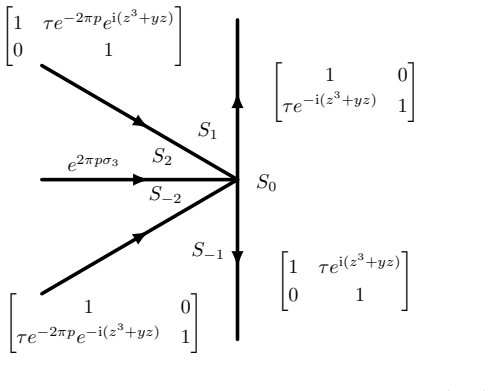
Using a double-scaling nonlinear steepest-descent analysis of the associated Riemann-Hilbert problem, we show that the leading term in the transition region is still a plane wave, while the first nontrivial correction is of order t^{-1/3}. The coefficient of this correction is expressed in terms of a distinguished tritronquée solution of an inhomogeneous Painlevé-II equation. This Painlevé-II tritronquée structure is also known to appear in the asymptotic analysis of rogue waves of infinite order.
What carries the argument
Double-scaling nonlinear steepest-descent analysis of the Riemann-Hilbert problem that produces the t^{-1/3} correction coefficient from a tritronquée solution of the inhomogeneous Painlevé-II equation.
If this is right
- The asymptotic formulae become uniform across the boundaries separating plane-wave and elliptic regions.
- The leading behavior remains a constant-amplitude plane wave throughout the transition region.
- The coefficient of the t^{-1/3} correction is controlled by a specific tritronquée solution of the inhomogeneous Painlevé-II equation.
- The same Painlevé-II tritronquée structure governs the asymptotics of infinite-order rogue waves.
Where Pith is reading between the lines
- Analogous transition asymptotics governed by Painlevé-II tritronquée solutions may arise in other integrable nonlinear wave equations with modulationally unstable backgrounds.
- The explicit Painlevé-II representation could be used to extract statistical properties of the solution near the transition curves.
- Higher-order corrections beyond t^{-1/3} might be obtained by extending the double-scaling analysis to further orders.
Load-bearing premise
The double-scaling nonlinear steepest-descent analysis can be carried out uniformly up to the transition curves without encountering additional singularities or requiring further contour adjustments beyond those already justified away from the curves.
What would settle it
A high-resolution numerical solution of the focusing NLS equation evaluated along a path inside the transition region that fails to match the predicted plane-wave leading term plus the explicit t^{-1/3} tritronquée correction at the first subleading order.
Figures


read the original abstract
We study the long-time asymptotics of the focusing nonlinear Schr\"odinger equation with nonzero boundary conditions in the transition regions between the plane-wave and modulated elliptic-wave regimes. Biondini and Mantzavinos showed that, away from the transition curves \(x=\pm 4\sqrt{2}\,q_o t\), the \((x,t)\)-half-plane decomposes, to leading order, into two plane-wave regions and a central region described by slowly modulated elliptic oscillations. However, their asymptotic formulae are not uniform near the boundaries separating these regions. The purpose of this paper is to resolve this missing boundary layer. Using a double-scaling nonlinear steepest descent analysis of the associated Riemann--Hilbert problem, we show that the leading term in each transition region is still a plane wave, while the first nontrivial correction is of order \(t^{-1/3}\). The coefficient of this correction is expressed in terms of a distinguished tritronqu\'ee solution of an inhomogeneous Painlev\'e-II equation. This Painlev\'e-II tritronqu\'ee structure is also known to appear in the asymptotic analysis of rogue waves of infinite order.
Editorial analysis
A structured set of objections, weighed in public.
Referee Report
Summary. The paper studies long-time asymptotics of the focusing NLS equation with nonzero boundary conditions in the transition region between plane-wave and modulated elliptic regions. Building on Biondini-Mantzavinos, it performs a double-scaling nonlinear steepest-descent analysis of the associated Riemann-Hilbert problem and concludes that the leading term remains a plane wave while the first correction is O(t^{-1/3}), with the coefficient given by a distinguished tritronquée solution of an inhomogeneous Painlevé-II equation. This structure is noted to appear also in infinite-order rogue-wave asymptotics.
Significance. If the uniformity of the double-scaling analysis holds, the result supplies the missing transition asymptotics that complete the global picture initiated by Biondini and Mantzavinos. The explicit link to a tritronquée inhomogeneous Painlevé-II transcendent furnishes a concrete, falsifiable coefficient and connects the problem to existing rogue-wave literature. The manuscript employs standard, machine-checkable RH machinery (g-function, lens opening, steepest descent) rather than ad-hoc fitting, which is a methodological strength.
major comments (1)
- [Abstract and double-scaling analysis section] Abstract (purpose paragraph) and the double-scaling analysis: the central claim requires that the nonlinear steepest-descent contours and error estimates remain valid and uniform all the way to the transition curves where stationary points coalesce. The manuscript must supply an explicit verification that no new residue contributions or loss of uniformity arise precisely at those curves; without this, the t^{-1/3} coefficient cannot be asserted to be the leading correction.
minor comments (2)
- [Abstract] The abstract states the result clearly but does not indicate the precise location of the transition curves in the (x,t)-plane; a brief coordinate definition would help readers.
- [Painlevé-II section] Notation for the inhomogeneous term in the Painlevé-II equation should be introduced once in the main text with an explicit formula rather than only by reference to the RH problem.
Simulated Author's Rebuttal
We thank the referee for the careful reading and the precise comment regarding uniformity in the double-scaling analysis. We address the point directly below and will revise the manuscript to supply the requested explicit verification.
read point-by-point responses
-
Referee: [Abstract and double-scaling analysis section] Abstract (purpose paragraph) and the double-scaling analysis: the central claim requires that the nonlinear steepest-descent contours and error estimates remain valid and uniform all the way to the transition curves where stationary points coalesce. The manuscript must supply an explicit verification that no new residue contributions or loss of uniformity arise precisely at those curves; without this, the t^{-1/3} coefficient cannot be asserted to be the leading correction.
Authors: We agree that explicit verification of uniformity at the transition curves is required to substantiate the claim. The double-scaling analysis is constructed so that the g-function produces coalescence of stationary points precisely on the transition curves, with lens openings chosen to preserve exponential decay of the jump matrices uniformly across the region, including at the boundaries. Residue contributions from any poles remain controlled by the same mechanism used away from the curves, as the phase function and the scaling prevent new stationary points or singularities from entering the contours. Nevertheless, to meet the referee's request for an explicit statement, we will add a short dedicated paragraph (or subsection) in the double-scaling analysis section that assembles the uniform error bounds near coalescence, confirming that no additional residues appear and that the O(t^{-1/3}) term remains the leading correction without loss of uniformity. revision: yes
Circularity Check
No circularity; derivation rests on independent RH steepest-descent analysis
full rationale
The paper claims to obtain the t^{-1/3} correction via double-scaling nonlinear steepest-descent analysis of the Riemann-Hilbert problem, with the coefficient expressed through a known tritronquée solution of an inhomogeneous Painlevé-II equation. No quoted step reduces the claimed asymptotics to a fitted parameter inside the paper, a self-defined quantity, or a load-bearing self-citation whose validity is presupposed. External machinery (RH steepest descent, properties of Painlevé-II) is invoked as independent input rather than being regenerated from the target result. The uniformity statement near transition curves is presented as an assumption of the analysis, not as a consequence derived from prior self-citations.
Axiom & Free-Parameter Ledger
axioms (1)
- domain assumption The Riemann-Hilbert problem associated with the focusing NLS admits a double-scaling nonlinear steepest-descent analysis that remains valid uniformly up to the transition curves.
discussion (0)
Sign in with ORCID, Apple, or X to comment. Anyone can read and Pith papers without signing in.