Cascades in transport and optical conductivity of Twisted Bilayer Graphene
Pith reviewed 2026-05-23 06:55 UTC · model grok-4.3
The pith
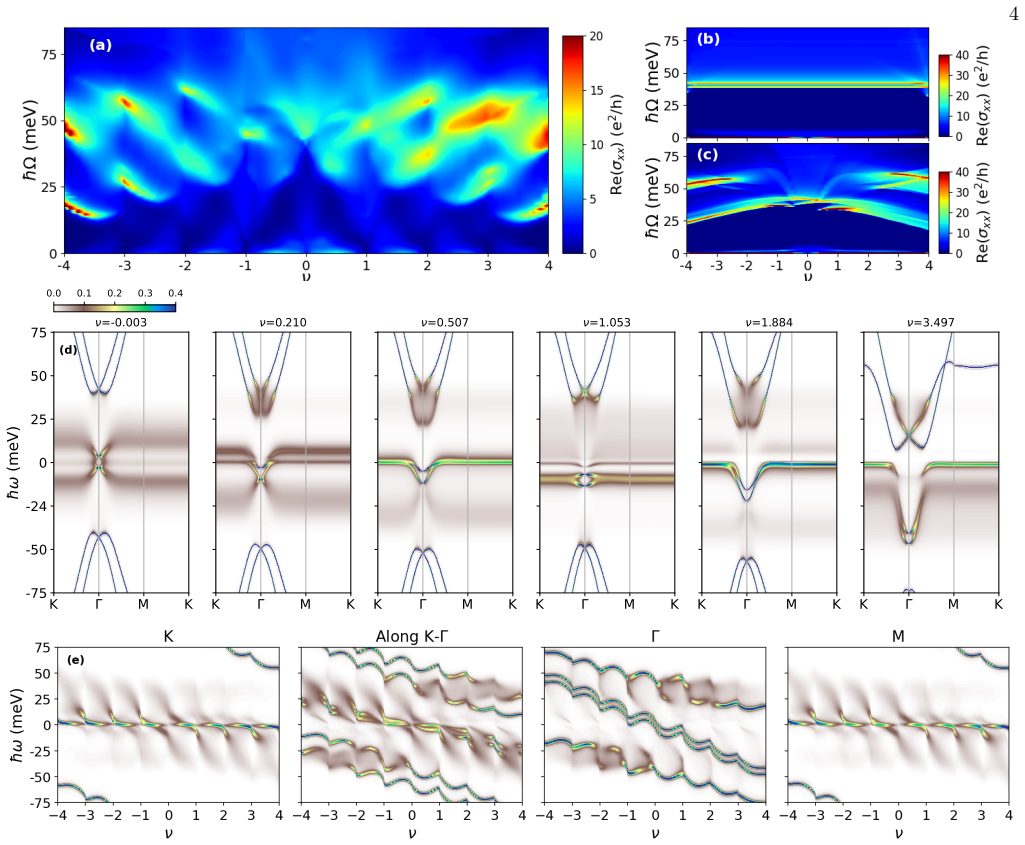
Transport and far-infrared optical conductivity in twisted bilayer graphene show doping-dependent Drude resets and cascades at integer fillings.
A machine-rendered reading of the paper's core claim, the machinery that carries it, and where it could break.
Core claim
Using DMFT+H on the 8-band heavy fermion model for twisted bilayer graphene in the normal state, resistive states appear around integer fillings. Drude analysis of the low-frequency optical conductivity extracts a strongly doping-dependent Drude weight and scattering rate that reset at the integers; for most dopings, especially above integers, the Drude scattering rate remains high yet smaller than the local-electron rate. This points to an important role for itinerant electrons in transport despite their limited weight on the flat bands. At far-infrared frequencies the optical conductivity displays cascades with highly asymmetric resets of intensity and oscillations in interband peak freq
What carries the argument
8-band heavy fermion model treated with Dynamical Mean Field Theory plus Hartree approximation
If this is right
- Resistive states form around integer fillings in dc transport.
- Drude weight and scattering rate reset at each integer filling.
- Itinerant electrons dominate transport even when their spectral weight on the flat bands is small.
- Far-infrared optical conductivity develops cascades with asymmetric intensity resets and shifting interband peaks.
Where Pith is reading between the lines
- Models that omit itinerant bands may systematically underestimate the doping dependence of scattering in moiré systems.
- The observed resetting behavior could be tested by gate-dependent microwave conductivity measurements that isolate the Drude component.
- Similar cascades may appear in other correlated flat-band platforms once an itinerant-local decomposition is applied.
Load-bearing premise
The 8-band heavy fermion model plus DMFT+H approximation captures enough of the normal-state physics of twisted bilayer graphene to produce quantitatively relevant transport and optical features.
What would settle it
Absence of resets in the extracted Drude weight and scattering rate exactly at integer fillings, or lack of asymmetric intensity resets and oscillating interband peaks in measured far-infrared conductivity, would falsify the reported cascades and doping dependence.
Figures


read the original abstract
Using a combined Dynamical Mean Field Theory and Hartree (DMFT+H) calculation we study the transport and optical properties of the 8-band heavy fermion model for Twisted Bilayer Graphene (TBG) in the normal state. We find resistive states around integer fillings which resemble the ones observed in transport experiments. From a Drude fitting of the low frequency optical conductivity, we extract a very strongly doping-dependent Drude weight and scattering rate, resetting at the integers. For most dopings, particularly above the integers, the Drude scattering rate is high but notably smaller than that of the local electrons. This highlights the important role of itinerant electrons in the transport properties, despite their limited spectral weight on the flat bands. At far infrared frequencies, the optical conductivity exhibits cascades characterized by highly asymmetric resets of the intensity and oscillations in the interband peak frequencies.
Editorial analysis
A structured set of objections, weighed in public.
Referee Report
Summary. The manuscript uses a combined DMFT+H approach on the 8-band heavy-fermion model for TBG to compute transport and optical conductivity in the normal state. It reports resistive states around integer fillings resembling experiments, extracts strongly doping-dependent Drude weight and scattering rate (with resets at integers) via Drude fits to low-frequency optical conductivity, notes that the scattering rate is smaller than that of local electrons for most dopings, and identifies cascades in far-infrared conductivity with asymmetric intensity resets and oscillations in interband peaks.
Significance. If the quantitative features hold, the work would underscore the contribution of itinerant electrons to transport despite their small spectral weight on flat bands and offer a microscopic account of doping-dependent cascades and resistive states seen in TBG experiments.
major comments (2)
- [Abstract] Abstract: the central extraction of doping-dependent Drude weight and scattering rate (and the claim that the latter is 'notably smaller than that of the local electrons') rests on the accuracy of the DMFT+H spectral functions, yet no convergence checks, error estimates, or comparisons to independent methods (cluster DMFT, GW, or experimental optical weight) are described.
- [Abstract] Abstract: the assertion that the 8-band heavy-fermion model plus DMFT+H 'sufficiently captures' the normal-state physics for quantitative transport features is load-bearing for all reported Drude parameters and cascade behavior, but the local nature of DMFT is known to be limited for momentum-structured flat bands near integers; no test of this assumption is supplied.
minor comments (1)
- The abstract would be clearer if it specified the doping range, the precise frequency window used for the Drude fit, and how 'resistive states' are quantified (e.g., resistivity threshold or temperature dependence).
Simulated Author's Rebuttal
We thank the referee for the careful reading of our manuscript and the constructive comments. We address each major comment below and indicate revisions planned for the next version.
read point-by-point responses
-
Referee: [Abstract] Abstract: the central extraction of doping-dependent Drude weight and scattering rate (and the claim that the latter is 'notably smaller than that of the local electrons') rests on the accuracy of the DMFT+H spectral functions, yet no convergence checks, error estimates, or comparisons to independent methods (cluster DMFT, GW, or experimental optical weight) are described.
Authors: We agree that explicit documentation of numerical convergence and uncertainties would strengthen the manuscript. In the revised version we will add a dedicated subsection (and supplementary figures) showing the dependence of the self-energy and spectral functions on the Matsubara frequency cutoff and DMFT mixing parameter, together with estimated uncertainties on the fitted Drude weight and scattering rate obtained from the self-consistency residual. Direct comparisons with cluster DMFT or GW calculations remain outside the scope of the present computational resources; we will nevertheless insert a brief reference to earlier benchmarks of the DMFT+H scheme on the same 8-band model. A short comparison of the integrated optical weight with available experimental far-infrared data will also be included. revision: partial
-
Referee: [Abstract] Abstract: the assertion that the 8-band heavy-fermion model plus DMFT+H 'sufficiently captures' the normal-state physics for quantitative transport features is load-bearing for all reported Drude parameters and cascade behavior, but the local nature of DMFT is known to be limited for momentum-structured flat bands near integers; no test of this assumption is supplied.
Authors: The 8-band model was selected precisely because it encodes the momentum-dependent hybridization between flat and dispersive bands that underlies the heavy-fermion phenomenology. While single-site DMFT cannot capture all nonlocal correlations, the Hartree shift already incorporates the leading static momentum dependence, and the resulting resistive states and doping-dependent cascades are in qualitative agreement with transport and optical experiments. In the revised manuscript we will expand the discussion section to explicitly state the known limitations of local DMFT near integer fillings and to justify the quantitative use of the method for the reported normal-state transport quantities on the basis of this experimental consistency. revision: yes
Circularity Check
No significant circularity in the numerical derivation chain.
full rationale
The paper computes optical conductivity and transport via DMFT+H on the fixed 8-band heavy-fermion model, then performs a standard Drude fit to the resulting low-frequency sigma(omega) to extract weight and scattering rate. This extraction is post-processing of independent numerical output rather than a self-definitional loop, fitted-input prediction, or load-bearing self-citation that reduces the reported cascades or resets to the inputs by construction. No equations or uniqueness theorems are invoked that collapse the central claims; the derivation remains self-contained as a model-based simulation whose outputs can be compared externally to experiment.
Axiom & Free-Parameter Ledger
Lean theorems connected to this paper
-
IndisputableMonolith/Cost/FunctionalEquation.leanwashburn_uniqueness_aczel unclear?
unclearRelation between the paper passage and the cited Recognition theorem.
From a Drude fitting of the low frequency optical conductivity, we extract a very strongly doping-dependent Drude weight and scattering rate, resetting at the integers.
-
IndisputableMonolith/Foundation/BlackBodyRadiationDeep.leanblackBodyRadiationDeepCert unclear?
unclearRelation between the paper passage and the cited Recognition theorem.
At far infrared frequencies, the optical conductivity exhibits cascades characterized by highly asymmetric resets of the intensity and oscillations in the interband peak frequencies.
What do these tags mean?
- matches
- The paper's claim is directly supported by a theorem in the formal canon.
- supports
- The theorem supports part of the paper's argument, but the paper may add assumptions or extra steps.
- extends
- The paper goes beyond the formal theorem; the theorem is a base layer rather than the whole result.
- uses
- The paper appears to rely on the theorem as machinery.
- contradicts
- The paper's claim conflicts with a theorem or certificate in the canon.
- unclear
- Pith found a possible connection, but the passage is too broad, indirect, or ambiguous to say the theorem truly supports the claim.
Reference graph
Works this paper leans on
-
[1]
D. Wong, K. Nuckolls, M. Oh, B. Lian, Y. Xie, S. Jeon, K. Watanabe, T. Taniguchi, B. Bernevig, and A. Yaz- dani, Cascade of electronic transitions in magic-angle twisted bilayer graphene, Nature 582, 198 (2020)
work page 2020
-
[2]
Y. Choi, J. Kemmer, Y. Peng, A. Thomson, H. Arora, R. Polski, Y. Zhang, H. Ren, J. Alicea, G. Refael, F. von Oppen, K. Watanabe, T. Taniguchi, and S. Nadj-Perge, Electronic correlations in twisted bilayer graphene near the magic angle, Nature Physics 15, 1174 (2019)
work page 2019
- [3]
-
[4]
Y. Xie, B. Lian, B. Jack, X. Liu, C.-L. Chiu, K. Watan- abe, T. Taniguchi, B. Bernevig, and A. Yazdani, Spec- troscopic signatures of many-body correlations in magic- angle twisted bilayer graphene, Nature 572, 101 (2019)
work page 2019
-
[5]
U. Zondiner, A. Rozen, D. Rodan-Legrain, Y. Cao, R. Queiroz, T. Taniguchi, K. Watanabe, Y. Oreg, F. von Oppen, A. Stern, E. Berg, P. Jarillo-Herrero, and S. Ilani, Cascade of phase transitions and dirac revivals in magic- angle graphene, Nature 582, 203 (2020)
work page 2020
- [6]
- [7]
-
[8]
Y. Cao, V. Fatemi, S. Fang, K. Watanabe, T. Taniguchi, E. Kaxiras, and P. Jarillo-Herrero, Unconventional super- conductivity in magic-angle graphene superlattices, Na- ture 556, 43 (2018)
work page 2018
-
[9]
H. Polshyn, M. Yankowitz, S. Chen, Y. Zhang, K. Watan- abe, T. Taniguchi, C. R. Dean, and A. Young, Large linear-in-temperature resistivity in twisted bilayer graphene, Nature Physics 15, 1011 (2019)
work page 2019
- [10]
-
[11]
R. Luque Merino, R. Calugaru, H. Hu, J. Diez-Merida, A. Diez-Carlon, T. Taniguchi, K. Watanabe, P. Seifert, B. Bernevig, and D. Efetov, Evidence of heavy fermion physics in the thermoelectric transport of magic an- gle twisted bilayer graphene, arXiv:2402.11749 [cond- mat.str-el] (2024)
-
[12]
A. Ghosh, S. Chakraborty, R. Dutta, A. Agarwala, K. Watanabe, T. Taniguchi, S. Banerjee, N. Trivedi, S. Mukerjee, and A. Das, Evidence of enhanced thermopower from emergent local moments in flat- bands of magic-angle twisted bilayer graphene (2024), arXiv:2403.08686 [cond-mat.mes-hall]
- [13]
-
[14]
D. N. Basov, R. D. Averitt, D. van der Marel, M. Dres- sel, and K. Haule, Electrodynamics of correlated electron materials, Rev. Mod. Phys. 83, 471 (2011)
work page 2011
-
[15]
A. Georges, G. Kotliar, W. Krauth, and M. J. Rozen- berg, Dynamical mean-field theory of strongly correlated fermion systems and the limit of infinite dimensions, Rev. Mod. Phys. 68, 13 (1996)
work page 1996
-
[16]
E. Gull, A. J. Millis, A. I. Lichtenstein, A. N. Rubtsov, M. Troyer, and P. Werner, Continuous-time monte carlo methods for quantum impurity models, Rev. Mod. Phys. 83, 349 (2011). 6
work page 2011
-
[17]
J. Pizarro, M. Calder´ on, and E. Bascones, The nature of correlations in the insulating states of twisted bilayer graphene, Journal of Physics Communications 3, 035024 (2019)
work page 2019
-
[18]
The Mott-semiconducting state in the magic angle bilayer graphene
M. Haule, E. Andrei, and K. Haule, The mott- semiconducting state in the magic angle bilayer graphene, arXiv:1901.09852 [cond-mat.str-el] (2019)
work page internal anchor Pith review Pith/arXiv arXiv 1901
- [19]
-
[20]
G. Rai, L. Crippa, D. C˘ alug˘ aru, H. Hu, F. Paoletti, L. de’ Medici, A. Georges, B. A. Bernevig, R. Valent´ ı, G. San- giovanni, and T. Wehling, Dynamical correlations and or- der in magic-angle twisted bilayer graphene, Phys. Rev. X 14, 031045 (2024)
work page 2024
-
[21]
H. Hu, G. Rai, L. Crippa, J. Herzog-Arbeitman, D. C˘ alug˘ aru, T. Wehling, G. Sangiovanni, R. Valent´ ı, A. M. Tsvelik, and B. A. Bernevig, Symmetric kondo lattice states in doped strained twisted bilayer graphene, Phys. Rev. Lett. 131, 166501 (2023)
work page 2023
-
[22]
J. Kang, B. A. Bernevig, and O. Vafek, Cascades be- tween light and heavy fermions in the normal state of magic-angle twisted bilayer graphene, Phys. Rev. Lett. 127, 266402 (2021)
work page 2021
-
[23]
J. Gonz´ alez and T. Stauber, Time-reversal symmetry breaking versus chiral symmetry breaking in twisted bi- layer graphene, Phys. Rev. B 102, 081118 (2020)
work page 2020
- [24]
- [25]
-
[26]
Y. H. Kwan, G. Wagner, T. Soejima, M. P. Zaletel, S. H. Simon, S. A. Parameswaran, and N. Bultinck, Kekul´ e spi- ral order at all nonzero integer fillings in twisted bilayer graphene, Phys. Rev. X 11, 041063 (2021)
work page 2021
-
[27]
D. V. Chichinadze, L. Classen, Y. Wang, and A. V. Chubukov, Cascade of transitions in twisted and non- twisted graphene layers within the van hove scenario, npj Quantum Materials 7, 114 (2022)
work page 2022
-
[28]
M. J. Calder´ on and E. Bascones, Interactions in the 8- orbital model for twisted bilayer graphene, Phys. Rev. B 102, 155149 (2020)
work page 2020
-
[29]
Z.-D. Song and B. A. Bernevig, Magic-angle twisted bi- layer graphene as a topological heavy fermion problem, Phys. Rev. Lett. 129, 047601 (2022)
work page 2022
- [30]
-
[31]
S. Lisi, X. Lu, T. Benschop, T. A. de Jong, P. Stepanov, J. Duran, F. Margot, I. Cucchi, E. Cappelli, A. Hunter, A. Tamai, V. Kandyba, A. Giampietri, A. Barinov, J. Jobst, V. Stalman, M. Leeuwenhoek, K. Watanabe, T. Taniguchi, L. Rademaker, S. van der Molen, M. Al- lan, D. K. Efetov, and F. Baumberger, Observation of flat bands in twisted bilayer graphene...
work page 2021
-
[32]
Q. Li, H. Zhang, Y. Wang, W. Chen, C. Bao, Q. Liu, T. Lin, S. Zhang, H. Zhang, K. Watanabe, , T. Taniguchi, J. Avila, P. Dudin, Q. Li, P. Yu, W. Duan, Z. Song, and S. Zhou, Evolution of the flat band and the role of lattice relaxations in twisted bilayer graphene, Nature Materials 17, 189 (2024)
work page 2024
- [33]
-
[34]
D. C˘ alug˘ aru, H. Hu, R. Luque Merino, N. Regnault, E. Efetov, and B. A. Bernevig, The thermoelectric ef- fect and its natural heavy fermion explanation in twisted bilayer and trilayer graphene, arXiv:2402.14057 [cond- mat.str-el] (2024)
-
[35]
T. Stauber, P. San-Jose, and L. Brey, Optical conduc- tivity, drude weight and plasmons in twisted graphene bilayers, New Journal of Physics 15, 113050 (2013)
work page 2013
-
[36]
S. S. Sunku, A. S. McLeod, T. Stauber, H. Yoo, D. Hal- bertal, G. Ni, A. Sternbach, B.-Y. Jiang, T. Taniguchi, K. Watanabe, P. Kim, M. M. Fogler, and D. N. Basov, Nano-photocurrent mapping of local electronic structure in twisted bilayer graphene, NanoLetters20, 2958 (2020)
work page 2020
-
[37]
M. Calder´ on and E. Bascones, Correlated states in magic angle twisted bilayer graphene under the optical conduc- tivity scrutiny, NPJ Quantum Materials 5, 57 (2020)
work page 2020
-
[38]
N. Hesp, I. Torre, D. Rodan-Legrain, P. Novelli, Y. Cao, S. Carr, S. Fang, P. Stepanov, D. Barcons-Ruiz, H. She- infux, K. Watanabe, T. Taniguchi, D. Efetov, E. Kaxiras, P. Jarillo-Herrero, M. Polini, and F. Koppens, Observa- tion of interband collective excitations in twisted bilayer graphene, Nature Physics 17, 1162 (2021)
work page 2021
-
[39]
J. Yang, G. Chen, T. Han, Q. Zhang, Y.-H. Zhang, L. Jiang, B. Lyu, H. Li, K. Watanabe, T. Taniguchi, Z. Shi, T. Senthil, Y. Zhang, F. Wang, and L. Ju, Spectroscopy signatures of electron correlations in a tri- layer graphene/hbn moir´ e superlattice, Science375, 1295 (2022)
work page 2022
-
[40]
E. B. Molinero, A. Datta, M. J. Calder´ on, E. Bascones, and R. E. F. Silva, High-harmonic generation with a twist: all-optical characterization of magic-angle twisted bilayer graphene, Optica 11, 171 (2024)
work page 2024
-
[41]
J. F. Mendez-Valderrama, D. Mao, and D. Chowdhury, Low-energy optical sum rule in moir´ e graphene, Phys. Rev. Lett. 133, 196501 (2024)
work page 2024
-
[42]
G. Li, R. K. Kumar, P. Stepanov, P. A. Pantaleon, Z. Zhan, H. Agarwal, A. Bercher, J. Barrier, K. Watan- abe, T. Taniguchi, A. B. Kuzmenko, F. Guinea, I. Torre, and F. H. Koppens, Infrared spectroscopy for diagnos- ing superlattice minibands in magic-angle twisted bilayer graphene, Nanoletters 24, 15956 (2024)
work page 2024
-
[43]
R. Kumar, G. Li, R. Bertini, S. Chaudhary, J. Nowakowski, K.and Park, S. Castilla, Z. Zhan, P. Pan- tale´ on, H. Agarwal, S. Battle-Porro, E. Icking, M. Cec- canti, A. Reserbat-Plantey, G. Piccinini, J. Barrier, E. Khestanova, T. Taniguchi, K. Watanabe, C. Stampfer, G. Refael, F. Guinea, P. Jarillo-Herrero, J. C. Song, P. Stepanov, C. Lewandowski, and F. ...
- [44]
-
[45]
R. Bistritzer and A. H. MacDonald, Moir´ e bands in twisted double-layer graphene, Proceedings of the Na- tional Academy of Sciences 108, 12233 (2011). 7
work page 2011
-
[46]
N. N. T. Nam and M. Koshino, Lattice relaxation and en- ergy band modulation in twisted bilayer graphene, Phys. Rev. B 96, 075311 (2017)
work page 2017
-
[47]
S. Carr, S. Fang, H. C. Po, A. Vishwanath, and E. Kaxi- ras, Derivation of wannier orbitals and minimal-basis tight-binding hamiltonians for twisted bilayer graphene: First-principles approach, Phys. Rev. Research 1, 033072 (2019)
work page 2019
-
[48]
Y.-Z. Chou and S. Das Sarma, Kondo lattice model in magic-angle twisted bilayer graphene, Phys. Rev. Lett. 131, 026501 (2023)
work page 2023
-
[49]
H. Hu, B. A. Bernevig, and A. M. Tsvelik, Kondo lattice model of magic-angle twisted-bilayer graphene: Hund’s rule, local-moment fluctuations, and low-energy effective theory, Phys. Rev. Lett. 131, 026502 (2023)
work page 2023
-
[50]
G.-D. Zhou, Y.-J. Wang, N. Tong, and Z.-D. Song, Kondo phase in twisted bilayer graphene, Phys. Rev. B 109, 045419 (2024)
work page 2024
-
[51]
P. Ledwith, J. Dong, A. Vishwanath, and E. Khalaf, Nonlocal moments in the chern bands of twisted bilayer graphene, arXiv:2408.16761 [cond-mat.str-el] (2024)
-
[52]
L. Rademaker and P. Mellado, Charge-transfer insulation in twisted bilayer graphene, Phys. Rev. B 98, 235158 (2018)
work page 2018
-
[53]
F. Guinea and N. R. Walet, Electrostatic effects, band distortions, and superconductivity in twisted graphene bilayers, Proceedings of the National Academy of Sci- ences 115, 13174 (2018)
work page 2018
-
[54]
T. Cea, N. R. Walet, and F. Guinea, Electronic band structure and pinning of fermi energy to van hove sin- gularities in twisted bilayer graphene: A self-consistent approach, Phys. Rev. B 100, 205113 (2019)
work page 2019
-
[55]
Z. A. H. Goodwin, V. Vitale, X. Liang, A. A. Mostofi, and J. Lischner, Hartree theory calculations of quasipar- ticle properties in twisted bilayer graphene, Electronic Structure 2, 034001 (2020)
work page 2020
-
[56]
K. P. Nuckolls, M. Oh, D. Wong, B. Lian, K. Watanabe, T. Taniguchi, B. A. Bernevig, and A. Yazdani, Strongly correlated chern insulators in magic-angle twisted bilayer graphene, Nature 588, 610 (2020)
work page 2020
-
[57]
10.5281/zenodo.14567210
-
[58]
K. Haule, Quantum monte carlo impurity solver for clus- ter dynamical mean-field theory and electronic structure calculations with adjustable cluster base, Phys. Rev. B 75, 155113 (2007)
work page 2007
-
[59]
K.Haule, Ctqmc impurity solver, http://hauleweb.rutgers.edu/tutorials/Tutorial0.html
-
[60]
M. Jarrell and J. E. Gubernatis, Bayesian inference and the analytic continuation of imaginary-time quantum monte carlo data, Phys. Rep. 269, 133 (1996)
work page 1996
-
[61]
K.-E. Huhtinen and P. T¨ orm¨ a, Conductivity in flat bands from the kubo-greenwood formula, Phys. Rev. B 108, 155108 (2023)
work page 2023
-
[62]
B. Valenzuela, M. J. Calder´ on, G. Le´ on, and E. Bas- cones, Optical conductivity and raman scattering of iron superconductors, Phys. Rev. B 87, 075136 (2013). SUPPLEMENTARY INFORMATION Model and Methods Fig. S1(a) shows the non-interacting band structure for one of the valleys, obtained from the continuum model (black) for a 1.08 ◦ TBG with v F =0.87×1...
work page 2013
discussion (0)
Sign in with ORCID, Apple, or X to comment. Anyone can read and Pith papers without signing in.