Monotonic Impurity Entropy beyond Unitarity: the mathscr{PT}-Symmetric Quantum Impurity Model
Pith reviewed 2026-06-30 01:21 UTC · model grok-4.3
The pith
In the PT-symmetric quantum impurity model, impurity entropy decreases monotonically from ln 4 to 0 in the Kondo-screened regime despite non-unitary boundary interactions.
A machine-rendered reading of the paper's core claim, the machinery that carries it, and where it could break.
Core claim
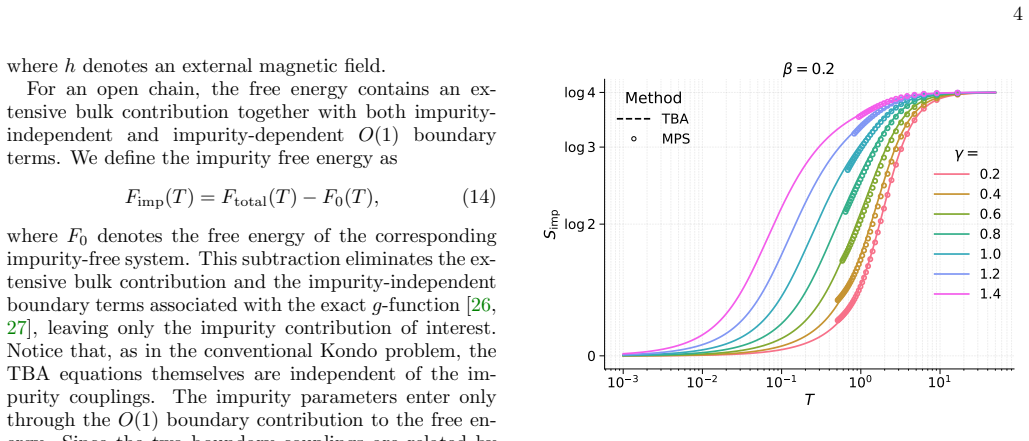
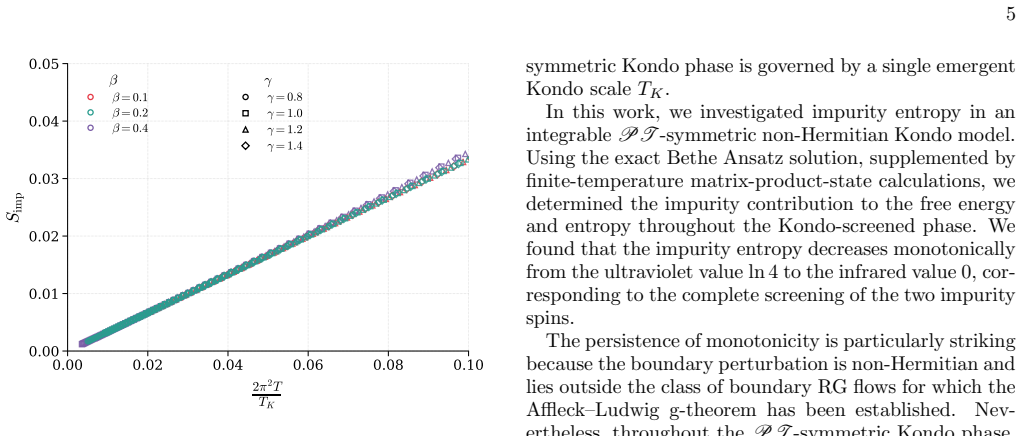
In the Kondo-screened regime, where the spectrum remains entirely real and the impurities are screened by many-body Kondo clouds, the impurity entropy decreases monotonically from ln 4 in the ultraviolet to 0 in the infrared. This monotonic flow persists despite the nonunitary nature of the boundary interaction.
What carries the argument
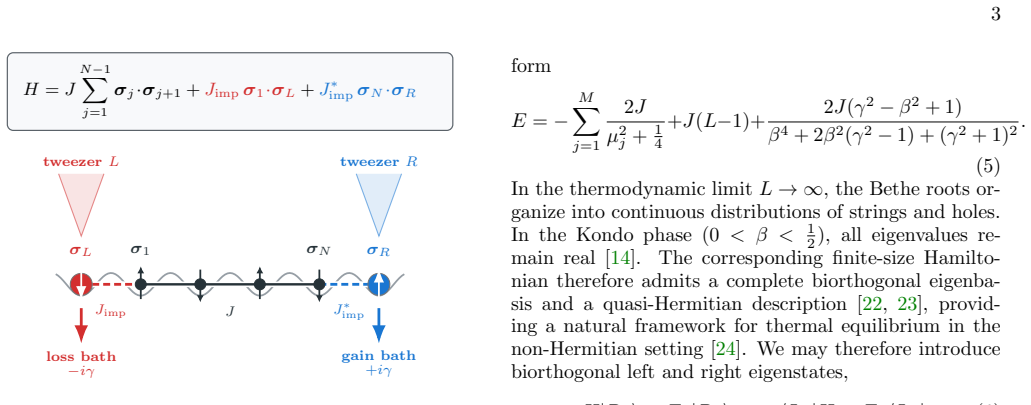
An integrable lattice realization of the PT-symmetric quantum impurity model solved by the Bethe Ansatz, which allows computation of the impurity contribution to the free energy and entropy.
If this is right
- The impurity entropy exhibits a monotonic decrease in the screened phase.
- This behavior extends beyond the standard assumptions of the g-theorem.
- The exact solution via Bethe Ansatz confirms the flow from ln 4 to 0.
- Finite-temperature matrix-product-state calculations benchmark the result.
- The model demonstrates stable Kondo screening with real spectrum in a non-unitary setting.
Where Pith is reading between the lines
- The result suggests that monotonic impurity entropy flow may apply more broadly to non-Hermitian systems with real spectra.
- Similar monotonic flows could be explored in other boundary critical systems that break hermiticity but preserve PT symmetry.
- Experimental setups in open quantum systems with balanced gain and loss might observe this entropy behavior.
Load-bearing premise
The spectrum remains entirely real and the impurities are screened by many-body Kondo clouds.
What would settle it
A calculation or measurement showing non-monotonic impurity entropy in the Kondo-screened regime at different energy scales would falsify the monotonic flow claim.
Figures

read the original abstract
Quantum impurity models provide a paradigmatic setting for studying Kondo screening, boundary criticality, and impurity entropies. While these phenomena are well understood in unitary systems, their fate in non-Hermitian many-body settings remains largely unexplored. We study a $\mathscr{PT}$-symmetric quantum impurity model consisting of a unitary $SU(2)_1$ Wess--Zumino--Witten bulk coupled to two impurity spins through complex-conjugate boundary Kondo interactions. Using an integrable lattice realization with $\mathscr{PT}$-symmetric boundary impurities, solved by the Bethe Ansatz and benchmarked against finite-temperature matrix-product-state calculations, we determine the impurity contribution to the free energy and entropy. In the Kondo-screened regime, where the spectrum remains entirely real and the impurities are screened by many-body Kondo clouds, we find that the impurity entropy decreases monotonically from $\ln 4$ in the ultraviolet to $0$ in the infrared. This monotonic flow persists despite the nonunitary nature of the boundary interaction, which places the system beyond the standard assumptions of the $g$-theorem.
Editorial analysis
A structured set of objections, weighed in public.
Referee Report
Summary. The manuscript studies a PT-symmetric quantum impurity model with an SU(2)_1 Wess-Zumino-Witten bulk coupled to two impurity spins via complex-conjugate boundary Kondo interactions. An integrable lattice realization is solved by the Bethe Ansatz and benchmarked against finite-temperature matrix-product-state calculations to extract the impurity contribution to the free energy and entropy. The central claim is that, in the Kondo-screened regime where the spectrum remains entirely real and impurities are screened by many-body Kondo clouds, the impurity entropy decreases monotonically from ln 4 in the ultraviolet to 0 in the infrared, persisting beyond the assumptions of the g-theorem.
Significance. If the real-spectrum Kondo-screened regime is rigorously established, the result would be significant for extending boundary criticality and impurity entropy concepts to non-Hermitian many-body systems. The combination of an exactly solvable integrable lattice model via Bethe Ansatz with MPS benchmarking is a strength, enabling direct thermodynamic computations without fitted parameters.
major comments (1)
- [Bethe Ansatz solution] The central claim is restricted to the Kondo-screened regime defined by an entirely real spectrum. The Bethe Ansatz solution provides no explicit analysis or demonstration that the Bethe equations admit only real eigenvalues throughout the coupling range where the impurity entropy is computed to flow to zero (as asserted in the abstract and the discussion of the screened regime). This assumption is load-bearing for the monotonic-flow result.
minor comments (2)
- The MPS benchmarking is described without reported error bars, convergence criteria, or quantitative discrepancy metrics relative to the Bethe Ansatz thermodynamics.
- The manuscript does not discuss the location or nature of PT-symmetry breaking transitions or exceptional points that might bound the real-spectrum regime.
Simulated Author's Rebuttal
We thank the referee for their careful reading, positive assessment of the work's significance, and constructive feedback. We address the single major comment below and will revise the manuscript to incorporate the requested clarification.
read point-by-point responses
-
Referee: [Bethe Ansatz solution] The central claim is restricted to the Kondo-screened regime defined by an entirely real spectrum. The Bethe Ansatz solution provides no explicit analysis or demonstration that the Bethe equations admit only real eigenvalues throughout the coupling range where the impurity entropy is computed to flow to zero (as asserted in the abstract and the discussion of the screened regime). This assumption is load-bearing for the monotonic-flow result.
Authors: We agree that an explicit demonstration of real eigenvalues from the Bethe equations strengthens the presentation. The Kondo-screened regime in the manuscript is identified by numerically solving the Bethe equations for the ground-state roots and low-lying excitations across the relevant coupling range; only real solutions are obtained in the window where the impurity entropy is shown to flow monotonically from ln 4 to 0. This is independently corroborated by the finite-temperature MPS data, which exhibit no complex-conjugate eigenvalue pairs in the same parameter regime. To address the referee's concern directly, we will add a short appendix (or subsection) that tabulates or plots the coupling values for which all Bethe roots remain real, together with a brief description of the numerical procedure used to confirm reality of the spectrum from the BA equations themselves. This revision will make the identification of the screened regime fully explicit and self-contained within the integrable analysis. revision: yes
Circularity Check
No circularity; derivation self-contained via Bethe Ansatz solution
full rationale
The paper obtains the monotonic entropy flow by solving an integrable PT-symmetric lattice model with Bethe Ansatz to compute the impurity free energy and entropy, then benchmarking against independent finite-temperature MPS numerics. The Kondo-screened regime is identified from the model's spectrum and screening properties within that solution; no step reduces the claimed monotonicity to a fitted parameter, self-defined quantity, or load-bearing self-citation whose content is itself unverified. The result is therefore independent of the target claim and does not match any enumerated circularity pattern.
Axiom & Free-Parameter Ledger
axioms (2)
- domain assumption The bulk is a unitary SU(2)_1 Wess-Zumino-Witten model
- domain assumption PT-symmetric boundary interactions produce an entirely real spectrum in the screened regime
Reference graph
Works this paper leans on
-
[1]
K. G. Wilson, The renormalization group: Critical phe- nomena and the kondo problem, Reviews of modern physics47, 773 (1975)
1975
-
[2]
Andrei, K
N. Andrei, K. Furuya, and J. Lowenstein, Solution of the kondo problem, Reviews of modern physics55, 331 (1983)
1983
-
[3]
Tsvelick and P
A. Tsvelick and P. Wiegmann, Exact results in the theory of magnetic alloys, Advances in Physics32, 453 (1983)
1983
-
[4]
Affleck, Conformal field theory approach to the kondo effect, arXiv preprint cond-mat/9512099 (1995)
I. Affleck, Conformal field theory approach to the kondo effect, arXiv preprint cond-mat/9512099 (1995)
Pith/arXiv arXiv 1995
-
[5]
A. Zhakenov, P. Kattel, and N. Andrei, Thermodynamics in a split hilbert space: Quantum impurity at the edge of the heisenberg chain, arXiv preprint arXiv:2508.19334 (2025)
arXiv 2025
-
[6]
Kattel, A
P. Kattel, A. Zhakenov, and N. Andrei, Thermodynamics in a split hilbert space: Quantum impurity at the edge 6 of a one-dimensional superconductor, Physical Review B 113, 195155 (2026)
2026
-
[7]
Y. Liu, H. Shimizu, D. Liu, and K. Kawabata, Extracting boundary conformal data from periodic non-hermitian critical chains (2026)
2026
-
[8]
M. Sinha, T. S. Tavares, H. Saleur, and A. Roy, Lattice topological defects in non-unitary conformal field theo- ries, arXiv preprint arXiv:2604.25999 (2026)
Pith/arXiv arXiv 2026
-
[9]
Maeda, N
R. Maeda, N. Nakamura, and T. Takayanagi, Holo- graphic dual of pt symmetric bcft (2026)
2026
-
[10]
M. Nakagawa, N. Kawakami, and M. Ueda, Non- hermitian kondo effect in ultracold alkaline-earth atoms, arXiv preprint arXiv:1806.04039 (2018)
Pith/arXiv arXiv 2018
-
[11]
Kattel, A
P. Kattel, A. Zhakenov, P. R. Pasnoori, P. Azaria, and N. Andrei, Dissipation driven phase transition in the non- hermitian kondo model, Physical Review B111, L201106 (2025)
2025
-
[12]
W.-Z. Yi, Y. Chen, J.-J. Pang, H. Chen, B. Wang, and R. Wang, Non-hermiticity induced universal anomalies in kondo conductance, Physical Review Letters136, 116502 (2026)
2026
-
[13]
W.-Z. Yi, Y. Chen, J.-J. Pang, H. Chen, B. Wang, and R. Wang, Interplay between non-fermi liquid and non- hermiticity: A multimethod study of non-hermitian mul- tichannel kondo model, Physical Review B113, 165110 (2026)
2026
-
[14]
Kattel, P
P. Kattel, P. R. Pasnoori, J. Pixley, and N. Andrei, Spin chain with non-hermitian pt-symmetric boundary couplings: Exact solution, dissipative kondo effect, and phase transitions on the edge, Physical Review B111, 224407 (2025)
2025
-
[15]
Witten, Non-abelian bosonization in two dimen- sions, Communications in Mathematical Physics92, 455 (1984)
E. Witten, Non-abelian bosonization in two dimen- sions, Communications in Mathematical Physics92, 455 (1984)
1984
-
[16]
J. Li, A. K. Harter, J. Liu, L. de Melo, Y. N. Joglekar, and L. Luo, Observation of parity-time symmetry breaking transitions in a dissipative floquet system of ultracold atoms, Nature communications10, 855 (2019)
2019
-
[17]
Peng, S ¸
B. Peng, S ¸. K.¨Ozdemir, F. Lei, F. Monifi, M. Gianfreda, G. L. Long, S. Fan, F. Nori, C. M. Bender, and L. Yang, Parity–time-symmetric whispering-gallery microcavities, Nature Physics10, 394 (2014)
2014
-
[18]
L. Feng, Z. J. Wong, R.-M. Ma, Y. Wang, and X. Zhang, Single-mode laser by parity-time symmetry breaking, Sci- ence346, 972 (2014)
2014
-
[19]
Hodaei, M.-A
H. Hodaei, M.-A. Miri, M. Heinrich, D. N. Christodoulides, and M. Khajavikhan, Parity-time– symmetric microring lasers, Science346, 975 (2014)
2014
-
[20]
Yamamoto, M
K. Yamamoto, M. Nakagawa, K. Adachi, K. Takasan, M. Ueda, and N. Kawakami, Theory of non-hermitian fermionic superfluidity with a complex-valued interac- tion, Physical review letters123, 123601 (2019)
2019
-
[21]
Miri and A
M.-A. Miri and A. Alu, Exceptional points in optics and photonics, Science363, eaar7709 (2019)
2019
-
[22]
A. Mostafazadeh, Pseudo-hermiticity versus pt- symmetry ii: A complete characterizatio n of non- hermitian hamiltonians with a real spectrum, arXiv preprint math-ph/0110016 (2001)
Pith/arXiv arXiv 2001
-
[23]
A. Mostafazadeh, Pseudo-hermiticity versus pt symme- try: The necessary condition for the reality of the spec- trum of a non-hermitian hamiltonian, Journal of Mathe- matical Physics43, 205 (2002)
2002
-
[24]
C. Lan, L. Ma, and H. Yang, Kubo-martin-schwinger con- ditions for non-hermitian systems (2026)
2026
-
[25]
C.-N. Yang, C. P. Yang,et al., Thermodynamics of a one-dimensional system of bosons with repulsive delta- function interaction, Journal of Mathematical Physics 10, 1115 (1969)
1969
-
[26]
Pozsgay, OnO(1) contributions to the free energy in bethe ansatz systems: the exact g-function, Journal of High Energy Physics2010, 90 (2010)
B. Pozsgay, OnO(1) contributions to the free energy in bethe ansatz systems: the exact g-function, Journal of High Energy Physics2010, 90 (2010)
2010
- [27]
-
[28]
A. C. Hewson,The Kondo problem to heavy fermions, 2 (Cambridge university press, 1997)
1997
-
[29]
Fishman, S
M. Fishman, S. White, and E. M. Stoudenmire, The iten- sor software library for tensor network calculations, Sci- Post Physics Codebases , 004 (2022)
2022
-
[30]
Fishman, S
M. Fishman, S. White, and E. M. Stoudenmire, Codebase release 0.3 for itensor, SciPost Physics Codebases , 004 (2022)
2022
-
[31]
O. A. Castro-Alvaredo, B. Doyon, and F. Ravanini, Ir- reversibility of the renormalization group flow in non- unitary quantum field theory, Journal of Physics A: Mathematical and Theoretical50, 424002 (2017)
2017
-
[32]
A. B. Zamolodchikov, Irreversibility of the flux of the renormalization group in a 2d field theory, JETP lett43, 730 (1986)
1986
-
[33]
ground-state degeneracy
I. Affleck and A. W. Ludwig, Universal noninteger “ground-state degeneracy”in critical quantum systems, Physical Review Letters67, 161 (1991)
1991
-
[34]
Friedan and A
D. Friedan and A. Konechny, Boundary entropy of one- dimensional quantum systems at low temperature, Phys- ical review letters93, 030402 (2004)
2004
-
[35]
Casini, I
H. Casini, I. S. Landea, and G. Torroba, The g-theorem and quantum information theory, Journal of High Energy Physics2016, 1 (2016)
2016
discussion (0)
Sign in with ORCID, Apple, or X to comment. Anyone can read and Pith papers without signing in.