AutoPRAC: Automating Attack Discovery for PRAC-Based Rowhammer Defenses using Model Checkers
Pith reviewed 2026-06-26 07:35 UTC · model grok-4.3
The pith
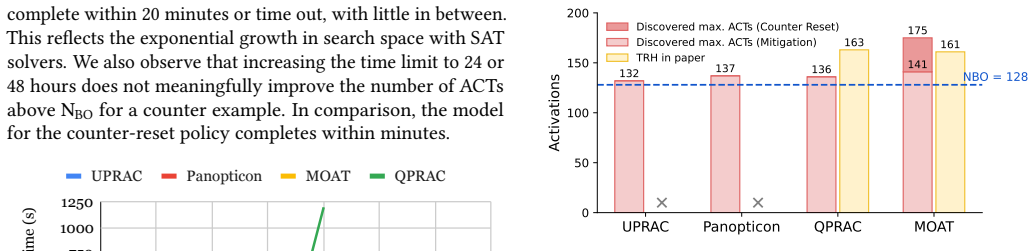
AutoPRAC uses model checkers on bounded state machines to find a flaw in MOAT that permits up to 34 undetected activations above the Rowhammer threshold.
A machine-rendered reading of the paper's core claim, the machinery that carries it, and where it could break.
Core claim
AutoPRAC models PRAC implementations as bounded state machines and checks security-critical safety properties against a worst-case oracle attacker. If a property is violated, the framework produces a concrete counterexample trace corresponding to a successful attack. Using AutoPRAC, a previously unreported flaw is uncovered in MOAT's counter-reset policy that allows up to 34 activations to go undetected above the Rowhammer threshold.
What carries the argument
Bounded state-machine model of a PRAC implementation checked by a model checker against a worst-case attacker oracle to detect violations of safety properties and generate counterexample attack traces.
If this is right
- PRAC designs can be checked for security properties before hardware implementation rather than after.
- Subtle flaws in counter-reset logic become detectable without relying on human-crafted attack patterns.
- Concrete attack traces can be produced automatically to demonstrate specific violations.
- Model checking serves as an early-stage design aid that flags issues in PRAC mitigations.
- Security evaluation of future PRAC variants can be performed systematically rather than manually.
Where Pith is reading between the lines
- The same modeling approach could apply to other per-row tracking mechanisms in emerging DRAM standards.
- Design teams could run AutoPRAC-style checks as part of routine verification flows to catch reset-policy errors early.
- The 34-activation gap points to a broader need for tighter coupling between activation thresholds and reset conditions in any counter-based defense.
- Automated trace generation may shorten the time between defense proposal and discovery of its edge-case weaknesses.
Load-bearing premise
The bounded state-machine model of the PRAC implementation and the worst-case attacker oracle accurately capture the behaviors that matter for real hardware security.
What would settle it
Running the concrete counterexample trace generated by AutoPRAC on actual DDR5 hardware implementing MOAT and observing that it fails to produce 34 undetected activations above the Rowhammer threshold.
Figures

read the original abstract
Per-Row Activation Counting (PRAC) in DDR5 is a specification to mitigate Rowhammer attacks by tracking activations per row and triggering mitigative refreshes when needed. However, the security of PRAC designs is currently evaluated using human-crafted attack patterns and we lack formal verification of their security properties, or automated techniques to detect implementation flaws. In this work, we present AutoPRAC, the first automated technique to test the security of PRAC-based defenses using model checkers. AutoPRAC models PRAC implementations as bounded state machines and checks security-critical safety properties against a worst-case oracle attacker. If a property is violated, the framework produces a concrete counterexample trace corresponding to a successful attack. Using AutoPRAC, we uncover a previously unreported flaw in MOAT, a state-of-the-art PRAC defense, in its counter-reset policy that allows up to 34 activations to go undetected above the Rowhammer threshold. Our results demonstrate that AutoPRAC can automatically discover subtle security flaws in Rowhammer mitigations and serves as an early-stage design aid for attack discovery on PRAC designs.
Editorial analysis
A structured set of objections, weighed in public.
Referee Report
Summary. The paper presents AutoPRAC, an automated framework that models PRAC-based Rowhammer defenses as bounded state machines and uses model checkers to verify security properties against a worst-case attacker oracle. If a property is violated, it produces a concrete counterexample trace. The central result is the discovery of a previously unreported flaw in MOAT's counter-reset policy that permits up to 34 activations above the Rowhammer threshold to go undetected.
Significance. If the models are faithful to the implementations, AutoPRAC supplies a systematic, automated method for finding subtle flaws in hardware mitigations that goes beyond manual attack construction. The production of falsifiable counterexample traces is a concrete strength that could aid early-stage PRAC design.
major comments (1)
- [Abstract and modeling description] Abstract and modeling section: The headline claim of a flaw allowing 34 undetected activations rests entirely on the accuracy of the bounded state-machine model of MOAT's counter-reset policy. No independent validation is reported (e.g., direct comparison to the JEDEC DDR5 PRAC specification, a vendor reference implementation, or cycle-accurate RTL simulation) confirming that the modeled reset transitions match actual hardware behavior.
Simulated Author's Rebuttal
We thank the referee for highlighting the need for explicit model validation. We address this concern directly below and will revise the manuscript accordingly.
read point-by-point responses
-
Referee: [Abstract and modeling description] Abstract and modeling section: The headline claim of a flaw allowing 34 undetected activations rests entirely on the accuracy of the bounded state-machine model of MOAT's counter-reset policy. No independent validation is reported (e.g., direct comparison to the JEDEC DDR5 PRAC specification, a vendor reference implementation, or cycle-accurate RTL simulation) confirming that the modeled reset transitions match actual hardware behavior.
Authors: Our MOAT model is constructed strictly from the counter-reset policy described in the original MOAT publication. The 34-activation counterexample is produced by the specific reset logic (periodic reset on a subset of rows without full activation tracking) as stated in that work. Because MOAT is a proposed algorithmic defense rather than a deployed RTL implementation, cycle-accurate simulation against vendor hardware is not feasible. We will add an appendix that (1) enumerates every state transition in our bounded model with a direct citation to the corresponding sentence in the MOAT paper and (2) cross-references the modeled behavior against the JEDEC DDR5 PRAC specification for the aspects that overlap. This mapping will allow independent verification of fidelity without requiring unavailable RTL. revision: yes
Circularity Check
No circularity; result is model-checker counterexample on independently constructed FSM
full rationale
The paper's central claim is the discovery of a counter-reset flaw in MOAT via AutoPRAC, which produces a concrete attack trace from an external model checker (NuSMV or similar) run on a bounded state-machine model of the PRAC implementation. No equations, fitted parameters, or self-citations appear as load-bearing steps in the derivation. The modeling step is an explicit construction of the FSM from the PRAC specification, and the output (the 34-activation trace) is not equivalent to any input by construction. The result is therefore self-contained against the model checker as an external oracle.
Axiom & Free-Parameter Ledger
axioms (1)
- domain assumption The bounded state-machine abstraction of PRAC logic and the worst-case attacker oracle faithfully represent relevant hardware behaviors for security analysis.
Reference graph
Works this paper leans on
-
[1]
(2024) JESD79-5C
JEDEC. (2024) JESD79-5C. https://www.jedec.org/document_search?search_api_ views_fulltext=jesd79-5c
2024
-
[2]
Flipping bits in memory without accessing them: an experimental study of dram disturbance errors,
Y. Kim, R. Daly, J. Kim, C. Fallin, J. H. Lee, D. Lee, C. Wilkerson, K. Lai, and O. Mutlu, “Flipping bits in memory without accessing them: an experimental study of dram disturbance errors, ” inProceeding of the 41st Annual International Symposium on Computer Architecuture, ser. ISCA ’14. IEEE Press, 2014, p. 361–372
2014
-
[3]
Panopticon: A complete in-dram rowhammer mitigation,
T. Bennett, S. Saroiu, A. Wolman, and L. Cojocar, “Panopticon: A complete in-dram rowhammer mitigation, ” inWorkshop on DRAM Security (DRAMSec), 2021
2021
-
[4]
Qprac: Towards secure and practical prac-based rowhammer mitigation using priority queues,
J. Woo, S. C. Lin, P. J. Nair, A. Jaleel, and G. Saileshwar, “Qprac: Towards secure and practical prac-based rowhammer mitigation using priority queues, ” in2025 IEEE International Symposium on High Performance Computer Architecture (HPCA), 2025, pp. 1021–1037
2025
-
[5]
Moat: Securely mitigating rowhammer with per-row activation counters,
M. Qureshi and S. Qazi, “Moat: Securely mitigating rowhammer with per-row activation counters, ” inProceedings of the 30th ACM International Conference on Architectural Support for Programming Languages and Operating Systems, Volume 1, ser. ASPLOS ’25. New York, NY, USA: Association for Computing Machinery, 2025, p. 698–714. [Online]. Available: https://d...
-
[6]
Un- derstanding the security benefits and overheads of emerging industry solutions to dram read disturbance,
O. Canpolat, A. G. Yağlıkçı, G. F. Oliveira, A. Olgun, O. Ergin, and O. Mutlu, “Un- derstanding the security benefits and overheads of emerging industry solutions to dram read disturbance, ” inWorkshop on DRAM Security (DRAMSec), 2024
2024
-
[7]
Chronus: Understanding and securing the cutting-edge industry solutions to dram read disturbance,
O. Canpolat, A. G. Yağlıkçı, G. F. Oliveira, A. Olgun, N. Bostanci, I. E. Yüksel, H. Luo, O. Ergin, and O. Mutlu, “Chronus: Understanding and securing the cutting-edge industry solutions to dram read disturbance, ”2025 IEEE International Symposium on High Performance Computer Architecture (HPCA), pp. 887–905, 2025. [Online]. Available: https://api.semanti...
2025
-
[8]
Mopac: Efficiently mitigating rowhammer with probabilistic activation counting,
S. Vittal, S. Qazi, P. Das, and M. Qureshi, “Mopac: Efficiently mitigating rowhammer with probabilistic activation counting, ” inProceedings of the 52nd Annual International Symposium on Computer Architecture, ser. ISCA ’25. New York, NY, USA: Association for Computing Machinery, 2025, p. 723–738. [Online]. Available: https://doi.org/10.1145/3695053.3730997
-
[9]
Counterpoint: One-hot counting for prac-based rowhammer mitigation,
S.-L. Lu, J. Woo, and P. J. Nair, “Counterpoint: One-hot counting for prac-based rowhammer mitigation, ”DRAMSec, 2025
2025
-
[10]
Per-row activation counting on real hardware: Demystifying performance overheads,
J. Kim, S. Baek, M. Wi, H. Nam, M. J. Kim, S. Lee, K. Sohn, and J. H. Ahn, “Per-row activation counting on real hardware: Demystifying performance overheads, ”IEEE Computer Architecture Letters, 2025
2025
-
[11]
CBMC: C bounded model checker,
Diffblue, “CBMC: C bounded model checker, ” https://github.com/diffblue/cbmc
-
[12]
Pensieve: Microarchitectural modeling for security evaluation,
Y. Yang, T. Bourgeat, S. Lau, and M. Yan, “Pensieve: Microarchitectural modeling for security evaluation, ” inProceedings of the 50th Annual International Symposium on Computer Architecture, ser. ISCA ’23. New York, NY, USA: Association for Computing Machinery, 2023. [Online]. Available: https: //doi.org/10.1145/3579371.3589094
-
[13]
Ramulator 2.0: A modern, modular, and extensible dram simulator,
H. Luo, Y. C. Tuğrul, F. N. Bostancı, A. Olgun, A. G. Yağlıkçı, and O. Mutlu, “Ramulator 2.0: A modern, modular, and extensible dram simulator, ”IEEE Computer Architecture Letters, vol. 23, no. 1, pp. 112–116, 2024
2024
-
[14]
CaDiCaL: Simplified long clause solver,
A. Biere, “CaDiCaL: Simplified long clause solver, ” https://github.com/arminbiere/ cadical. 6
-
[15]
G. J. Holzmann, “The model checker SPIN, ”IEEE Trans. Software Eng., vol. 23, no. 5, pp. 279–295, 1997. [Online]. Available: https://doi.org/10.1109/32.588521
-
[16]
Salt: Track-and-mitigate subarrays, not rows, for blast-radius-free rowhammer defense,
M. K. Qureshi, “Salt: Track-and-mitigate subarrays, not rows, for blast-radius-free rowhammer defense, ” in2026 IEEE International Symposium on High Performance Computer Architecture (HPCA), 2026, pp. 1–16
2026
-
[17]
Pvac: A rowhammer mitigation architecture exploiting per-victim-row counting,
J. Kim, S. Baek, H. Nam, M. Wi, N. S. Kim, and J. H. Ahn, “Pvac: A rowhammer mitigation architecture exploiting per-victim-row counting, ” 2026. [Online]. Available: https://arxiv.org/abs/2604.20576
Pith/arXiv arXiv 2026
-
[18]
Rowpress: Amplifying read disturbance in modern dram chips,
H. Luo, A. Olgun, A. G. Yağlıkçı, Y. C. Tuğrul, S. Rhyner, M. B. Cavlak, J. Lindegger, M. Sadrosadati, and O. Mutlu, “Rowpress: Amplifying read disturbance in modern dram chips, ” inProceedings of the 50th Annual International Symposium on Computer Architecture, ser. ISCA ’23. New York, NY, USA: Association for Computing Machinery, 2023. [Online]. Availab...
-
[19]
I. E. Yuksel, A. Olgun, N. Bostanci, H. Luo, A. G. Yaglikci, and O. Mutlu, “Columndisturb: Understanding column-based read disturbance in real dram chips and implications for future systems, ” inProceedings of the 58th IEEE/ACM International Symposium on Microarchitecture, ser. MICRO ’25. New York, NY, USA: Association for Computing Machinery, 2025, p. 97...
discussion (0)
Sign in with ORCID, Apple, or X to comment. Anyone can read and Pith papers without signing in.