REVIEW 3 major objections 6 minor 5 references
Neural Garment Dynamic Super-Resolution
T0 review · 3 major / 6 minor · reviewed 2026-08-11 · deepseek-v4-flash
Pith's one-line read A single lightweight network upscales low-resolution cloth simulation into detailed, wrinkled garments.
desk verdict Solid, well-written garment super-resolution method with released code; the generalization claims outrun the quantitative evidence, but it deserves a serious referee. read the letter →
The pith
A machine-rendered reading of the paper's core claim, the machinery that carries it, and where it could break.
The reading
What carries the argument
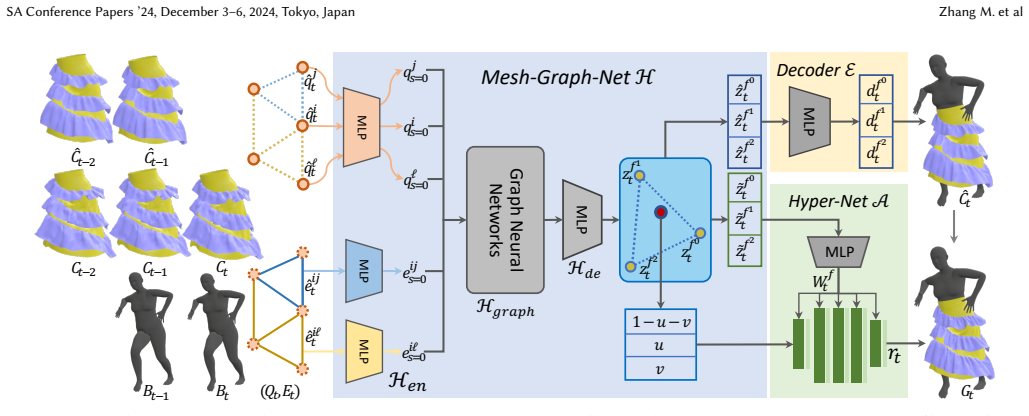
The central object is the per-triangle implicit wrinkle field built by a hyper-network: for each coarse mesh triangle, the hyper-network takes the graph-learned super-resolution features at the triangle's three vertices and outputs the weights of a small MLP, whose Gabor-wavelet ('WIRE') activation is chosen to represent high-frequency detail; that MLP maps barycentric coordinates to a wrinkle residual vector. The mesh-graph-net that supplies the features, and the decoder that corrects the coarse shape, are supporting mechanisms that make the field reflect dynamics and garment-body interaction.
What would settle it
Run the released network, without fine-tuning, on a low-resolution simulation of a garment made of a very different fabric (e.g., stiff denim) in an unseen motion, and compare the normal maps of the synthesized high-resolution geometry against a full high-resolution simulation; if the SSIM drops to the level of simple up-sampling from the coarse mesh, the learned mapping does not transfer across materials, which the paper's claims require it to do.
Extended reading notes
Core claim
GDSR reconstructs high-resolution garment geometry from low-resolution simulation by predicting two things at once: a corrected coarse garment shape and a per-triangle residual field that adds high-frequency wrinkles. The super-resolution features come from a mesh graph network operating on the coarse garment vertices, edges, and inter-layer edges, augmented with garment-body interaction vectors. A decoder maps part of these features to vertex displacements that fix the coarse shape, and a hyper-network maps the remaining features to the weights of a small implicit MLP per triangle; evaluating that MLP at barycentric coordinates yields wrinkle residuals that are added to the up-sampled corrected mesh. The architecture's key bet is that these local, topology-agnostic features and continuous fields let the same trained network handle garment types, body shapes, and motions it never saw, while the roll-out loop keeps details temporally coherent.
Load-bearing premise
The claim rests on the assumption that a mapping from low-resolution to high-resolution garment geometry can be learned from a small, homogeneous training set (two dance sequences, five outfits, one body shape, one silk fabric) and still transfers to unseen motions, body shapes, and garment types.
Editorial extensions
If this is right
- High-resolution garment animation could run on low-budget devices: simulate a coarse mesh and synthesize details with the 65MB network at about 0.115 s per frame (including coarse simulation), instead of running an expensive fine simulation.
- The continuous per-triangle field decouples output resolution from the network, so one trained model can produce geometry at any target mesh density.
- Roll-out prediction makes the network usable autoregressively; stretching and shearing energies stay within a small range over 1500 frames, suggesting long sequences do not drift.
- The generalization results imply that new garments can be added to a pipeline with only a low-resolution garment simulation and no retraining, as long as the coarse topology semantics match.
- Quantitatively, on an unseen motion the method beats the DDE and PhysGraph baselines on normal-map SSIM for three garment types, supporting the claim that it recovers high-frequency detail structure.
Reading between the lines
- If the learned detail function is truly topology-agnostic, the same recipe (graph features plus hyper-network implicit fields) could be applied to other deformable surfaces such as hair, skin, or soft tissue; the paper does not test this.
- A natural compression application follows implicitly: store only the low-resolution simulation and reconstruct high-resolution details at playback, cutting storage and transmission for character animation; this is not stated as a result.
- Because the paper trains on one fabric and lists fabric friction as a failure mode, a material-conditioned variant (e.g., conditioning the hyper-network on fabric parameters) would be a direct extension to test whether wrinkle residuals are material-agnostic.
- The quantitative claims rely on SSIM of normal maps over 300 frames on unseen motion; adding the same metric for unseen body shapes and garment types would directly probe the generalization claim's boundaries.
Editorial analysis
A structured set of objections, weighed in public.
Referee Report
Summary. This paper introduces GDSR, a learning-based method that takes low-resolution garment simulations and body motion as input and produces high-resolution garment geometry with fine wrinkle details. The architecture combines a mesh-graph-net that extracts super-resolution features from coarse garment dynamics and garment-body interactions, a decoder that corrects the coarse garment shape, and a hyper-net that constructs per-triangle implicit functions for wrinkle residuals. The method is trained on two dance sequences with five garment types and one fixed body shape, and the authors claim generalization to unseen motions, body shapes, and garment types, demonstrating results qualitatively and reporting SSIM comparisons on training garment types. The paper also reports a lightweight 65MB network, timing measurements, an explicit collision handling step, and releases code and data.
Significance. If the generalization claims are fully borne out, GDSR would be a practically valuable tool for low-budget high-resolution garment simulation: it is lightweight, fast (about 0.115s per frame including low-resolution simulation), and the released code/data would facilitate adoption. The method's architectural choices — graph-based feature extraction, explicit shape correction, and continuous per-triangle upsampling — are well motivated, and the qualitative results, especially for pleated and laced garments, are visually compelling. However, the current quantitative evidence covers only training garment types on an unseen motion, and the paper's own Section 6 acknowledges limitations such as single-material training and unresolved collisions. Consequently, the strongest claim in the abstract — robust generalization to unseen body shapes, motions, and garment types — is not yet supported by the reported experiments, which tempers the significance of the contribution at this stage.
major comments (3)
- [Section 5 and Appendix C, Table 3] The quantitative evaluation (SSIM on normal maps) is computed only for training garment types (A), (C), and (E), tested on an unseen motion sequence. No quantitative result is provided for the five unseen garment types (i)-(v) shown in Figure 6 or for the unseen body shapes in Figure 7, although the abstract and Section 1 explicitly claim generalization along these axes. Since the qualitative figures alone cannot distinguish genuine transfer from interpolation across similar training outfits, the central claim is not yet quantitatively established. The paper itself notes in Section 6 that it is trained on a single fabric material and that friction-dependent details are missed; these are honest limitations, but they make the absence of quantitative cross-garment evidence more conspicuous. I recommend reporting SSIM (or a geometric metric) on the unseen garments and body shapes, with error bars across frames or motion sequences, and ideally over multiple roll-out lengths.
- [Section 5 and Appendix B, Table 2] The training procedure uses history states derived from high-resolution ground truth (Section 5, first paragraph), while at inference the network consumes its own predictions in a roll-out. The only quantitative long-roll-out evaluation is stretching/shearing energy (Appendix B, Table 2), which measures deformation stability but not geometric or perceptual fidelity to the high-resolution reference. This gap matters because the self-feeding regime is exactly where accumulation errors would appear. I recommend adding a fidelity metric (SSIM or point-wise error) for roll-outs of increasing length (e.g., 1, 50, 100, 1000, and 1500 frames) and comparing against a one-step oracle that uses ground-truth history.
- [Section 5.1 and Table 3] The comparison with DDE and PhysGraph is also restricted to training garment types; no quantitative comparison is reported for unseen garments or body shapes. Given that the paper claims 'significant improvements over state-of-the-art alternatives' and the baselines are trained on the same or similar data, adding such comparisons on the unseen test garments would strengthen the central claim. This can be addressed together with the additional experiments suggested in Major Comment 1.
minor comments (6)
- [Section 3] The phrase 'referre to' appears in the descriptions of the Decoder E and Mesh-Hyper-Net A blocks; it should read 'refer to'.
- [Related Work] The citation 'Later et al. [2018]' should be 'Lahner et al. [2018]' (the DeepWrinkles paper).
- [Section 4.5] The equation defining L_c_def contains mismatched norm bars, e.g., '|| || w_u(Ĉ_t|| - || w_u(Ĉ*_t)|| ||_1'; please fix the parentheses and norm-bar pairing for readability.
- [Section 4.3] The notation '|f|' is used both for a triangle and for the number of adjacent triangles; consider using a symbol such as deg(v) or N(v) to avoid ambiguity.
- [Table 3 caption] The caption states that SSIM is reported for 'a t-shirt (A), a pleated short skirt (C), and a triple-lace long skirt (E)' but does not say these are training garment types; since the main text's generalization claim concerns unseen garments, the caption should explicitly clarify this point.
- [Section 5.2] The timing sentence 'including 0.083 seconds for low-resolution simulation in Marvelous Designer (MD)' could clarify that this 0.083s is the coarse simulation time and that the GDSR network itself accounts for 0.032s (as in Table 4), to avoid confusion about what the 0.115s total includes.
Circularity Check
No significant circularity: the GDSR result is a supervised super-resolution regression trained against external high-resolution physics simulation, with self-citations confined to baselines and related work.
full rationale
The central mapping in this paper is a supervised regression from low-resolution garment simulation and body motion to high-resolution garment geometry. The high-resolution ground truth is generated externally with Marvelous Designer at a 10mm particle distance, while low-resolution input is simulated at 30mm, and the network is trained with L1 losses on positions, normals, and deformation measures against these external references (Section 4.5, Appendix A). No equation defines the predicted wrinkle residual or coarse correction in terms of the target geometry: the residual r_k is decoded from learned super-resolution features through a per-triangle implicit function W_f, and the corrected coarse mesh is supervised by downsampled high-resolution ground truth. Roll-out prediction is an inference-time architectural choice, not a derivation that presupposes the claimed generalization. The self-citations (Zhang et al. 2021a, 2021b, 2022) appear as prior-work references, a baseline (DDE), and future-work pointers; they are not load-bearing for the core learning objective. External citations (e.g., VGG, MeshGraphNet message passing, Wire activation, Marvelous Designer simulation) provide the architectural and data support. The stated limitations in Section 6 (fabric friction, unresolved collisions) and the Appendix B stability metric (stretching and shearing energies rather than visual fidelity) are evidence gaps, not circular steps. The generalization claims to unseen body shapes and garment types are only qualitatively demonstrated, but insufficient evidence is a support limitation, not circularity. Therefore no circular step can be exhibited from the paper's own equations or citation chain.
Assumptions & free parameters
free parameters (5)
- sigma_b =
predefined constant (not specified)
- sigma_l =
predefined constant (not specified)
- gamma =
predefined constant (not specified)
- lambda_c and lambda_w (loss weights) =
initial 1.9 and 0.1, annealed to 1.0
- WIRE activation parameters =
omega0=5, alpha0=10
assumptions (5)
- domain assumption The UV parameterization correspondence between low- and high-resolution garment meshes remains fixed and valid across all motion sequences.
- domain assumption Garment-body interaction can be effectively captured by a signed distance field through ray casting with a predefined threshold.
- domain assumption A hyper-network can decode the parameters of an implicit function that represents high-frequency wrinkle residuals for each triangle.
- standard math The WIRE activation (complex Gabor wavelet) is suitable for reconstructing high-frequency features in this context.
- ad hoc to paper The small training set (two motions, five garments, one body shape, one fabric) is sufficient to learn a generalizable mapping.
Cite this review
Pith. "Pith review of Neural Garment Dynamic Super-Resolution." pith.science (2026). https://pith.science/paper/POGL2JWU
@misc{pith2026241206285,
  author       = {Pith},
  title        = {Pith review of: Neural Garment Dynamic Super-Resolution},
  year         = {2026},
  howpublished = {\url{https://pith.science/paper/POGL2JWU}},
  note         = {Machine review of arXiv:2412.06285}
}
read the original abstract
Achieving efficient, high-fidelity, high-resolution garment simulation is challenging due to its computational demands. Conversely, low-resolution garment simulation is more accessible and ideal for low-budget devices like smartphones. In this paper, we introduce a lightweight, learning-based method for garment dynamic super-resolution, designed to efficiently enhance high-resolution, high-frequency details in low-resolution garment simulations. Starting with low-resolution garment simulation and underlying body motion, we utilize a mesh-graph-net to compute super-resolution features based on coarse garment dynamics and garment-body interactions. These features are then used by a hyper-net to construct an implicit function of detailed wrinkle residuals for each coarse mesh triangle. Considering the influence of coarse garment shapes on detailed wrinkle performance, we correct the coarse garment shape and predict detailed wrinkle residuals using these implicit functions. Finally, we generate detailed high-resolution garment geometry by applying the detailed wrinkle residuals to the corrected coarse garment. Our method enables roll-out prediction by iteratively using its predictions as input for subsequent frames, producing fine-grained wrinkle details to enhance the low-resolution simulation. Despite training on a small dataset, our network robustly generalizes to different body shapes, motions, and garment types not present in the training data. We demonstrate significant improvements over state-of-the-art alternatives, particularly in enhancing the quality of high-frequency, fine-grained wrinkle details.
Figures


Figures from the paper (11 more)


Reference graph
Works this paper leans on
-
[2006]
In Computer graphics forum, Vol
Physically based deformable models in computer graphics. In Computer graphics forum, Vol. 25. Wiley Online Library, 809–836. Xiaoyu Pan, Jiaming Mai, Xinwei Jiang, Dongxue Tang, Jingxiang Li, Tianjia Shao, Kun Zhou, Xiaogang Jin, and Dinesh Manocha. 2022. Predicting Loose-Fitting Garment Deformations Using Bone-Driven Motion Networks. In ACM SIGGRAPH 2022...
work page 2013
-
[2010]
Towards Multi-Layered 3D Garments Animation
Animation wrinkling: augmenting coarse cloth simulations with realistic- looking wrinkles. ACM Transactions on Graphics (ToG) 29, 6 (2010), 1–8. Scott D Roth. 1982. Ray casting for modeling solids. Computer graphics and image processing 18, 2 (1982), 109–144. Mehdi SM Sajjadi, Raviteja Vemulapalli, and Matthew Brown. 2018. Frame-recurrent video super-reso...
work page Pith review arXiv 2010
-
[2012]
ACM Transactions on Graphics (TOG) 31, 4 (2012), 1–10
Drape: Dressing any person. ACM Transactions on Graphics (TOG) 31, 4 (2012), 1–10. Erhan Gundogdu, Victor Constantin, Amrollah Seifoddini, Minh Dang, Mathieu Salz- mann, and Pascal Fua. 2019. Garnet: A two-stream network for fast and accurate 3d cloth draping. In Proceedings of the IEEE/CVF International Conference on Computer Vision. 8739–8748. Fabian Ha...
arXiv 2012
-
[2014]
Sensitivity-optimized rigging for example-based real-time clothing synthesis. ACM Trans. Graph. 33, 4 (2014), 107–1. Jiayi Eris Zhang, Jérémie Dumas, Yun Fei, Alec Jacobson, Doug L James, and Danny M Kaufman. 2023. Progressive Shell Qasistatics for Unstructured Meshes. ACM Transactions on Graphics (TOG) 42, 6 (2023), 1–17. Meng Zhang, Duygu Ceylan, and Ni...
work page 2014
-
[2023]
In Computer Graphics Forum, Vol
Deep deformation detail synthesis for thin shell models. In Computer Graphics Forum, Vol. 42. Wiley Online Library, e14903. Lan Chen, Juntao Ye, and Xiaopeng Zhang. 2021c. Multi-feature super-resolution network for cloth wrinkle synthesis. Journal of Computer Science and Technology 36, 3 (2021), 478–493. Yinbo Chen, Sifei Liu, and Xiaolong Wang. 2021b. Le...
work page 2021
Reviewed August 11, 2026 · model on record in the stance chip above.
Discussion (0). Continue with ORCID to comment.