Opinion Polarization in LLM-Based Social Networks: Manipulation and Mitigation
Pith reviewed 2026-06-26 19:10 UTC · model grok-4.3
The pith
Even an adversary with a limited budget can considerably increase polarization in LLM-based social networks, and common mitigations do not restore baseline levels.
A machine-rendered reading of the paper's core claim, the machinery that carries it, and where it could break.
Core claim
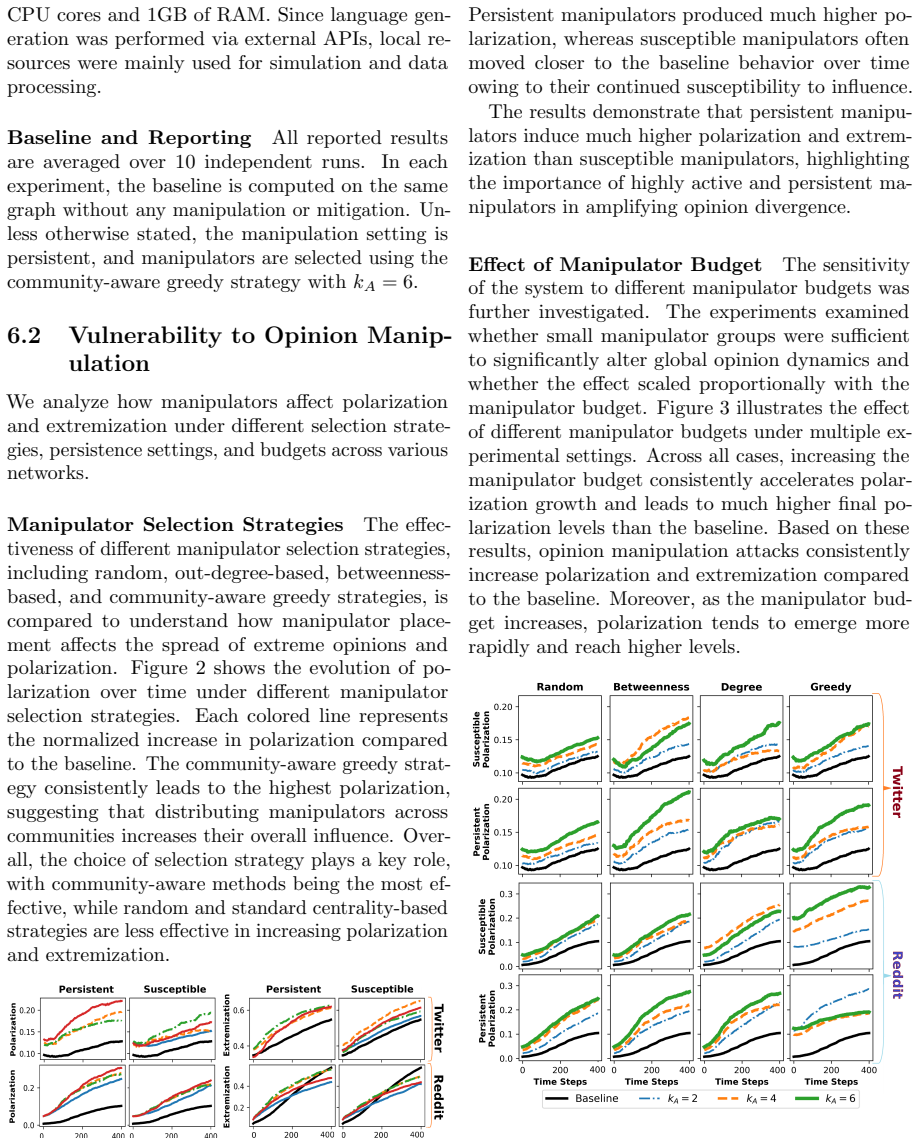
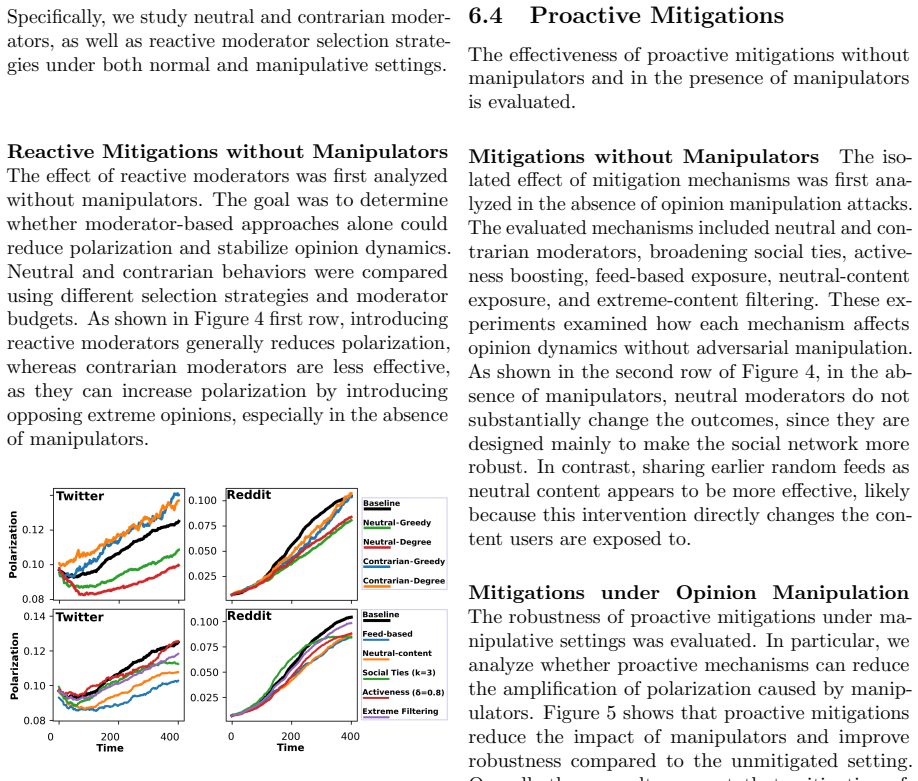
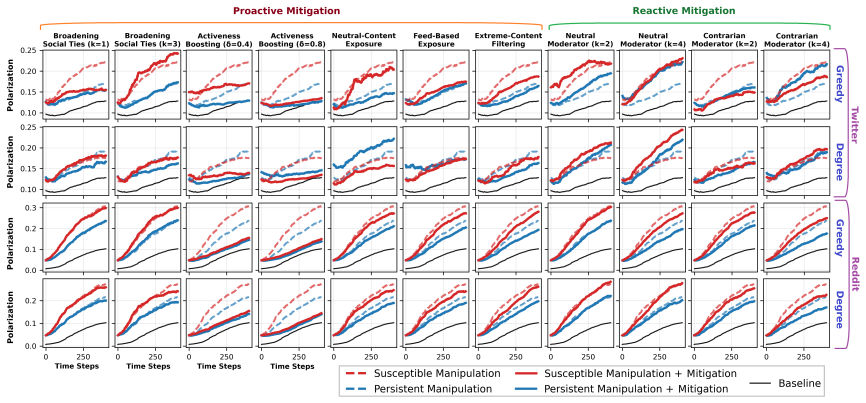
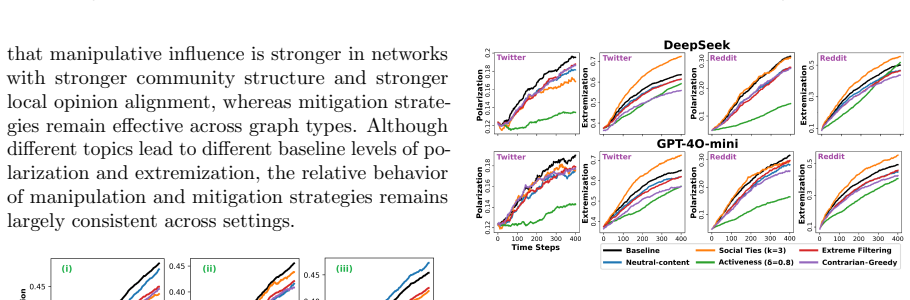
In a framework where LLM agents with diverse personas interact over a social network by exchanging natural language posts and updating their opinions accordingly, even an adversary with a limited manipulation budget can considerably increase polarization. Reactive mitigations, which assign specific users to actively counter manipulation, and proactive interventions, which increase resistance through general mechanisms, both reduce the impact of adversarial attacks but generally do not restore the network to its baseline polarization state.
What carries the argument
LLM agents with assigned diverse personas that exchange natural language posts and update opinions in a context-dependent manner.
Load-bearing premise
LLM agents with assigned personas produce opinion-update dynamics that are representative of real human social networks.
What would settle it
Running the same limited-budget manipulation experiment with actual human participants in a controlled network and finding no polarization increase would falsify the central claim.
Figures


read the original abstract
How vulnerable are online social networks to adversaries who seek to amplify opinion polarization by manipulating opinions, and how difficult is it to mitigate such manipulation? Existing studies have examined this question using mathematical models of opinion dynamics. While these models offer valuable theoretical insights, they rely on simplified assumptions about interactions, message content, and opinion updates, limiting the adversarial strategies they can capture and the applicability of their findings to real-world settings. Large language model (LLM)-based simulations provide a richer alternative: agents can be assigned diverse personas, communicate through natural language, and respond to persuasive or adversarial content in a context-dependent way. This enables the study of manipulation strategies that are difficult to represent using classical mathematical models. To the best of our knowledge, this study provides the first systematic analysis of polarization amplification and mitigation in an LLM-based simulated social network framework. In our framework, LLM agents with diverse personas interact over a social network by exchanging natural language posts and updating their opinions accordingly. We show that even an adversary with a limited manipulation budget can considerably increase polarization. We then study two classes of defense mechanisms: reactive mitigations, which assign specific users to actively counter manipulation, and proactive interventions, which increase resistance through general mechanisms not tied to particular users. Our results show that although these mechanisms reduce the impact of adversarial attacks, they generally do not restore the network to its baseline polarization state. These findings suggest that neither approach fully overcomes the vulnerability of the network, highlighting the potential risk of such attacks.
Editorial analysis
A structured set of objections, weighed in public.
Referee Report
Summary. The paper introduces an LLM-based simulation framework in which agents assigned diverse personas interact over a social network by exchanging natural-language posts and updating opinions in a context-dependent manner. It claims to provide the first systematic analysis of adversarial manipulation, showing that an adversary with a limited manipulation budget can considerably increase polarization, and that both reactive mitigations (assigning specific users to counter attacks) and proactive interventions (general resistance mechanisms) reduce the impact of attacks but generally fail to restore the network to its baseline polarization state.
Significance. If the LLM simulation dynamics prove representative, the framework enables study of richer adversarial strategies and natural-language persuasion effects that are difficult to encode in classical mathematical opinion-dynamics models. The explicit finding that neither reactive nor proactive defenses fully restore baseline polarization would be a useful contribution to understanding platform vulnerabilities. The work correctly highlights the limitations of simplified mathematical models and positions the LLM approach as a more flexible alternative.
major comments (2)
- [Abstract (framework description)] Abstract (framework description): No information is given on the specific LLMs used, the opinion-update rule, the polarization metric, the network topology, the manipulation budget definition, or statistical controls; therefore the data-to-claim link cannot be evaluated. This is load-bearing for the central claims that limited-budget adversaries considerably increase polarization and that mitigations reduce but do not restore baseline levels.
- [Abstract (framework description)] Abstract (framework description): The assumption that LLM agents with assigned personas exchanging natural-language posts produce opinion-update dynamics sufficiently representative of real human social networks is stated without any empirical anchoring—no comparison of simulated polarization trajectories, update rules, or mitigation effects to human-subject data, field studies, or established psychological models. This unvalidated modeling choice is load-bearing for conclusions about real-world manipulation vulnerability and mitigation effectiveness.
minor comments (1)
- [Abstract] The abstract would benefit from a concise statement of the number of agents, simulation duration, and number of independent runs to allow readers to gauge the scale of the reported effects.
Simulated Author's Rebuttal
We thank the referee for the constructive feedback. We address each major comment below and outline the revisions we will make.
read point-by-point responses
-
Referee: Abstract (framework description): No information is given on the specific LLMs used, the opinion-update rule, the polarization metric, the network topology, the manipulation budget definition, or statistical controls; therefore the data-to-claim link cannot be evaluated. This is load-bearing for the central claims that limited-budget adversaries considerably increase polarization and that mitigations reduce but do not restore baseline levels.
Authors: We agree that the abstract is high-level and omits these implementation details, which are described in the Methods section of the full manuscript. To address the concern, we will revise the abstract to include concise references to the LLMs employed, the opinion-update rule, the polarization metric, network topology, manipulation budget definition, and statistical controls. This will strengthen the data-to-claim connection while preserving the abstract's brevity. revision: yes
-
Referee: Abstract (framework description): The assumption that LLM agents with assigned personas exchanging natural-language posts produce opinion-update dynamics sufficiently representative of real human social networks is stated without any empirical anchoring—no comparison of simulated polarization trajectories, update rules, or mitigation effects to human-subject data, field studies, or established psychological models. This unvalidated modeling choice is load-bearing for conclusions about real-world manipulation vulnerability and mitigation effectiveness.
Authors: The referee correctly identifies that the manuscript provides no empirical anchoring to human data. Our work introduces an LLM-based simulation framework to explore richer dynamics than mathematical models permit; it is not presented as a validated model of human behavior. We will revise the abstract and add an explicit Limitations section to state the modeling assumptions, note the absence of direct human-subject validation, and discuss implications for interpreting real-world applicability. This will make the scope transparent. revision: yes
Circularity Check
No circularity: results are simulation outputs, not definitional reductions
full rationale
The paper presents a simulation framework in which LLM agents with personas exchange natural-language posts and update opinions; all central claims (adversary increases polarization; mitigations reduce but do not restore baseline) are stated as direct outcomes of running those simulations. No equations, fitted parameters, self-citations, or uniqueness theorems appear in the provided text that would reduce any result to an input by construction. The modeling assumption about LLM representativeness is an external validity concern, not a circularity in the derivation chain itself.
Axiom & Free-Parameter Ledger
axioms (1)
- domain assumption LLM agents with diverse personas exchanging natural language posts produce opinion dynamics representative enough of human networks to support claims about real-world manipulation risk.
invented entities (1)
-
LLM-based social network simulation framework
no independent evidence
Reference graph
Works this paper leans on
-
[1]
Polar- ization and social media: A systematic review and research agenda.Technological Forecasting and Social Change, 183:121942, 2022
Swapan Deep Arora, Guninder Pal Singh, Anir- ban Chakraborty, and Moutusy Maity. Polar- ization and social media: A systematic review and research agenda.Technological Forecasting and Social Change, 183:121942, 2022
2022
-
[2]
The spread of true and false news online.Sci- ence, 359(6380):1146–1151, 2018
Soroush Vosoughi, Deb Roy, and Sinan Aral. The spread of true and false news online.Sci- ence, 359(6380):1146–1151, 2018
2018
-
[3]
Discrimination through opti- mization: How facebook’s ad delivery can lead to biased outcomes.Proceedings of the Acm on Human-computer Interaction, 3(CSCW):1–30, 2019
Muhammad Ali, Piotr Sapiezynski, Miranda Bogen, Aleksandra Korolova, Alan Mislove, and Aaron Rieke. Discrimination through opti- mization: How facebook’s ad delivery can lead to biased outcomes.Proceedings of the Acm on Human-computer Interaction, 3(CSCW):1–30, 2019
2019
-
[4]
Joshua A Tucker, Andrew Guess, Pablo Barber´ a, Cristian Vaccari, Alexandra Siegel, Sergey Sanovich, Denis Stukal, and Brendan Nyhan. Social media, political polarization, and political disinformation: A review of the scientific literature.Political polarization, and political disinformation: a review of the scien- tific literature (March 19, 2018), 2018
2018
-
[5]
Emo- tion shapes the diffusion of moralized content in social networks.Proceedings of the National Academy of Sciences, 114(28):7313–7318, 2017
William J Brady, Julian A Wills, John T Jost, Joshua A Tucker, and Jay J Van Bavel. Emo- tion shapes the diffusion of moralized content in social networks.Proceedings of the National Academy of Sciences, 114(28):7313–7318, 2017
2017
-
[6]
Polarization in geometric opinion dynam- ics
Jason Gaitonde, Jon Kleinberg, and ´Eva Tar- dos. Polarization in geometric opinion dynam- ics. InProceedings of the 22nd ACM Confer- ence on Economics and Computation, pages 499–519, 2021
2021
-
[7]
An adversar- ial model of network disruption: Maximizing disagreement and polarization in social net- works.IEEE Transactions on Network Science and Engineering, 9(2):728–739, 2021
Mayee F Chen and Mikl´ os Z R´ acz. An adversar- ial model of network disruption: Maximizing disagreement and polarization in social net- works.IEEE Transactions on Network Science and Engineering, 9(2):728–739, 2021
2021
-
[8]
Towards consensus: Reducing polarization by perturb- ing social networks.IEEE Transactions on Network Science and Engineering, 10(6):3450– 3464, 2023
Miklos Z R´ acz and Daniel E Rigobon. Towards consensus: Reducing polarization by perturb- ing social networks.IEEE Transactions on Network Science and Engineering, 10(6):3450– 3464, 2023
2023
-
[9]
Majority opinion diffusion in social networks: An adversarial approach
Ahad N Zehmakan. Majority opinion diffusion in social networks: An adversarial approach. In Proceedings of the AAAI Conference on Artifi- cial Intelligence, volume 35, pages 5611–5619, 2021
2021
-
[10]
Why rumors spread fast in social networks, and how to stop it
Ahad N Zehmakan, Charlotte Out, and Saj- jad Hesamipour Khelejan. Why rumors spread fast in social networks, and how to stop it. InProceedings of the Thirty-Second Interna- tional Joint Conference on Artificial Intelli- gence, pages 234–242, 2023
2023
-
[11]
Simulating opinion dynamics with 11 networks of llm-based agents
Yun-Shiuan Chuang, Agam Goyal, Nikunj Har- lalka, Siddharth Suresh, Robert Hawkins, Si- jia Yang, Dhavan Shah, Junjie Hu, and Timo- thy Rogers. Simulating opinion dynamics with 11 networks of llm-based agents. InFindings of the association for computational linguistics: NAACL 2024, pages 3326–3346, 2024
2024
-
[12]
Maximilian Puelma Touzel, Sneheel Sarangi, Austin Welch, Gayatri Krishnakumar, Dan Zhao, Zachary Yang, Hao Yu, Ethan Kosak-Hine, Tom Gibbs, Andreea Musulan, et al. A simulation system towards solving societal-scale manipulation.arXiv preprint arXiv:2410.13915, 2024
-
[13]
Emergent coordinated behaviors in networked llm agents: Modeling the strategic dynamics of information operations
Gian Marco Orlando, Jinyi Ye, Valerio La Gatta, Mahdi Saeedi, Vincenzo Moscato, Emilio Ferrara, and Luca Luceri. Emergent coordinated behaviors in networked llm agents: Modeling the strategic dynamics of information operations. InProceedings of the ACM Web Conference 2026, pages 4805–4816, 2026
2026
-
[14]
Decoding echo chambers: Llm-powered simulations revealing polarization in social networks
Chenxi Wang, Zongfang Liu, Dequan Yang, and Xiuying Chen. Decoding echo chambers: Llm-powered simulations revealing polarization in social networks. InProceedings of the 31st In- ternational Conference on Computational Lin- guistics, pages 3913–3923, 2025
2025
-
[15]
Chenhao Gu, Ling Luo, Zainab Razia Zaidi, and Shanika Karunasekera. Large lan- guage model driven agents for simulating echo chamber formation.arXiv preprint arXiv:2502.18138, 2025
-
[16]
Jen-tse Huang, Jiaxu Zhou, Tailin Jin, Xuhui Zhou, Zixi Chen, Wenxuan Wang, Youliang Yuan, Michael R Lyu, and Maarten Sap. On the resilience of llm-based multi-agent collab- oration with faulty agents.arXiv preprint arXiv:2408.00989, 2024
-
[17]
Multiagent collabora- tion attack: Investigating adversarial attacks in large language model collaborations via de- bate
Alfonso Amayuelas, Xianjun Yang, Antonis An- toniades, Wenyue Hua, Liangming Pan, and William Yang Wang. Multiagent collabora- tion attack: Investigating adversarial attacks in large language model collaborations via de- bate. InFindings of the Association for Com- putational Linguistics: EMNLP 2024, pages 6929–6948, 2024
2024
-
[18]
When allies turn foes: Exploring group characteristics of llm- based multi-agent collaborative systems under adversarial attacks
Jiahao Zhang, Baoshuo Kan, Tao Gong, Fu Lee Wang, and Tianyong Hao. When allies turn foes: Exploring group characteristics of llm- based multi-agent collaborative systems under adversarial attacks. InFindings of the Associ- ation for Computational Linguistics: EMNLP 2025, pages 6275–6300, 2025
2025
-
[19]
Opinion dynamics: A comprehensive overview.arXiv preprint arXiv:2511.00401, 2025
Mohammad Shirzadi, Emilio Cruciani, and Ahad N Zehmakan. Opinion dynamics: A comprehensive overview.arXiv preprint arXiv:2511.00401, 2025
-
[20]
A survey on algorithmic interventions in opinion dynamics.arXiv preprint arXiv:2603.10756, 2026
Atsushi Miyauchi, Yuko Kuroki, Federico Ci- nus, Stefan Neumann, and Francesco Bonchi. A survey on algorithmic interventions in opinion dynamics.arXiv preprint arXiv:2603.10756, 2026
-
[21]
A sur- vey on opinion dynamics in social media net- works: Analysis, simulation, and control.IEEE Transactions on Computational Social Systems, 2025
Mohamed Zareer and Rastko R Selmic. A sur- vey on opinion dynamics in social media net- works: Analysis, simulation, and control.IEEE Transactions on Computational Social Systems, 2025
2025
-
[22]
The impact of external sources on the friedkin–johnsen model
Charlotte Out, Sijing Tu, Stefan Neumann, and Ahad N Zehmakan. The impact of external sources on the friedkin–johnsen model. InPro- ceedings of the 33rd ACM International Con- ference on Information and Knowledge Man- agement, pages 1815–1824, 2024
2024
-
[23]
Model- ing echo chambers and polarization dynamics in social networks.Physical Review Letters, 124(4):048301, 2020
Fabian Baumann, Philipp Lorenz-Spreen, Igor M Sokolov, and Michele Starnini. Model- ing echo chambers and polarization dynamics in social networks.Physical Review Letters, 124(4):048301, 2020
2020
-
[24]
How digital media drive af- fective polarization through partisan sorting
Petter T¨ ornberg. How digital media drive af- fective polarization through partisan sorting. Proceedings of the National Academy of Sci- ences, 119(42):e2207159119, 2022
2022
-
[25]
Do stubborn users always cause more polariza- tion and disagreement? a mathematical study
Mohammad Shirzadi and Ahad N Zehmakan. Do stubborn users always cause more polariza- tion and disagreement? a mathematical study. InProceedings of the Eighteenth ACM Inter- national Conference on Web Search and Data Mining, pages 309–317, 2025
2025
-
[26]
How mini- mizing conflicts could lead to polarization on social media: An agent-based model investiga- tion.PloS one, 17(1):e0263184, 2022
Michele Coscia and Luca Rossi. How mini- mizing conflicts could lead to polarization on social media: An agent-based model investiga- tion.PloS one, 17(1):e0263184, 2022
2022
-
[27]
A multi-agent system for fine-grained opinion dynamics analysis in online social networks
Huiyu Min, Jiuxin Cao, Jiawei Ge, and Bo Liu. A multi-agent system for fine-grained opinion dynamics analysis in online social networks. IEEE Transactions on Computational Social Systems, 11(1):815–828, 2022
2022
-
[28]
Yuhong Chen, Xiaobing Dai, Martin Buss, and Fangzhou Liu. Coevolution of opinion dynamics and recommendation system: Modeling analy- sis and reinforcement learning based manipu- lation.IEEE Transactions on Computational Social Systems, 2025
2025
-
[29]
Mengyi Zhang, Qingxing Dong, and Xiaozhen Wu. How misinformation diffuses on online social networks: Radical opinions, adaptive re- lationship, and algorithmic intervention.IEEE Transactions on Computational Social Systems, 12(5):2047–2061, 2024. 12
2047
-
[30]
Stratlearner: Learning a strat- egy for misinformation prevention in social net- works.Advances in Neural Information Pro- cessing Systems, 33:15546–15555, 2020
Guangmo Tong. Stratlearner: Learning a strat- egy for misinformation prevention in social net- works.Advances in Neural Information Pro- cessing Systems, 33:15546–15555, 2020
2020
-
[31]
Miti- gating opinion polarization in social networks using adversarial attacks.Scientific Reports, 15(1):9033, 2025
Michinori Ninomiya, Genki Ichinose, Katsumi Chiyomaru, and Kazuhiro Takemoto. Miti- gating opinion polarization in social networks using adversarial attacks.Scientific Reports, 15(1):9033, 2025
2025
-
[32]
Reducing polarization in social networks with adversarial opinion perturbations.Chaos, Soli- tons & Fractals, 201:117294, 2025
Lan Zhang, Lulu Gong, and Changwei Huang. Reducing polarization in social networks with adversarial opinion perturbations.Chaos, Soli- tons & Fractals, 201:117294, 2025
2025
-
[33]
Opinion dynamics in social net- works: The effect of centralized interaction tun- ing on emerging behaviors.IEEE Transactions on Computational Social Systems, 7(2):362–372, 2020
Paolo Bolzern, Patrizio Colaneri, and Giuseppe De Nicolao. Opinion dynamics in social net- works: The effect of centralized interaction tun- ing on emerging behaviors.IEEE Transactions on Computational Social Systems, 7(2):362–372, 2020
2020
-
[34]
Understanding large language model driven so- cial bots: A behavioral analysis and impact assessment.IEEE Transactions on Computa- tional Social Systems, 2025
Siyu Li, Jin Yang, Kui Zhao, and Dongqing Jia. Understanding large language model driven so- cial bots: A behavioral analysis and impact assessment.IEEE Transactions on Computa- tional Social Systems, 2025
2025
-
[35]
Erica Cau, Valentina Pansanella, Dino Pe- dreschi, and Giulio Rossetti. Language-driven opinion dynamics in agent-based simulations with llms.arXiv preprint arXiv:2502.19098, 2025
-
[36]
Ljubiˇ sa Boji´ c, Velibor Ili´ c, Veljko Prodanovi´ c, and Vuk Vukovi´ c. An agent-based simulation of politicized topics using large language models: Algorithmic personalization and polarization on social media.Chinese Political Science Re- view, pages 1–31, 2025
2025
-
[37]
Petter T¨ ornberg, Diliara Valeeva, Justus Uiter- mark, and Christopher Bail. Simulating social media using large language models to evalu- ate alternative news feed algorithms.arXiv preprint arXiv:2310.05984, 2023
-
[38]
Adversaries with limited information in the friedkin-johnsen model
Sijing Tu, Stefan Neumann, and Aristides Gio- nis. Adversaries with limited information in the friedkin-johnsen model. InProceedings of the 29th ACM SIGKDD Conference on Knowledge Discovery and Data Mining, pages 2201–2210, 2023
2023
-
[39]
Max- imizing opinion polarization using double deep q-learning on social networks.IEEE Access, 2025
Mohamed N Zareer and Rastko R Selmic. Max- imizing opinion polarization using double deep q-learning on social networks.IEEE Access, 2025
2025
-
[40]
Opinion dynamics with multiple adversaries
Akhil Jalan and Marios Papachristou. Opinion dynamics with multiple adversaries. InProceed- ings of the ACM Web Conference 2026, pages 7–18, 2026
2026
-
[41]
Botsim: Llm-powered malicious social botnet simulation
Boyu Qiao, Kun Li, Wei Zhou, Shilong Li, Qian- qian Lu, and Songlin Hu. Botsim: Llm-powered malicious social botnet simulation. InProceed- ings of the AAAI Conference on Artificial In- telligence, volume 39, pages 14377–14385, 2025
2025
-
[42]
How malicious ai swarms can threaten democracy.Science, 391(6783):354– 357, 2026
Daniel Thilo Schroeder, Meeyoung Cha, An- drea Baronchelli, Nick Bostrom, Nicholas A Christakis, David Garcia, Amit Goldenberg, Yara Kyrychenko, Kevin Leyton-Brown, Nina Lutz, et al. How malicious ai swarms can threaten democracy.Science, 391(6783):354– 357, 2026
2026
-
[43]
A set of measures of central- ity based on betweenness.Sociometry, pages 35–41, 1977
Linton C Freeman. A set of measures of central- ity based on betweenness.Sociometry, pages 35–41, 1977
1977
-
[44]
Fast unfolding of communities in large networks
Vincent D Blondel, Jean-Loup Guillaume, Re- naud Lambiotte, and Etienne Lefebvre. Fast unfolding of communities in large networks. Journal of Statistical Mechanics: Theory and Experiment, 2008(10):P10008, 2008
2008
-
[45]
Hyperbolic geometry of complex net- works.Physical Review E—Statistical, Non- linear, and Soft Matter Physics, 82(3):036106, 2010
Dmitri Krioukov, Fragkiskos Papadopoulos, Maksim Kitsak, Amin Vahdat, and Mari´ an Bogun´ a. Hyperbolic geometry of complex net- works.Physical Review E—Statistical, Non- linear, and Soft Matter Physics, 82(3):036106, 2010
2010
-
[46]
Understanding Filter Bubbles and Polarization in Social Networks
Uthsav Chitra and Christopher Musco. Under- standing filter bubbles and polarization in so- cial networks.arXiv preprint arXiv:1906.08772, 2019
work page internal anchor Pith review Pith/arXiv arXiv 1906
-
[47]
Opin- ion dynamics beyond social influence.Network Science, 12(4):339–365, 2024
Benedikt V Meylahn and Christa Searle. Opin- ion dynamics beyond social influence.Network Science, 12(4):339–365, 2024
2024
-
[48]
The origin of bursts and heavy tails in human dynamics.Nature, 435(7039):207–211, 2005
Albert-Laszlo Barabasi. The origin of bursts and heavy tails in human dynamics.Nature, 435(7039):207–211, 2005
2005
-
[49]
Openai api platform
OpenAI. Openai api platform. https:// platform.openai.com/, 2024. Accessed: 2026- 05-20
2024
-
[50]
DeepSeek LLM: Scaling Open-Source Language Models with Longtermism
Xiao Bi, Deli Chen, Guanting Chen, Shanhuang Chen, Damai Dai, Chengqi Deng, Honghui Ding, Kai Dong, Qiushi Du, Zhe Fu, et al. Deepseek llm: Scaling open-source language models with longtermism.arXiv preprint arXiv:2401.02954, 2024. 13 A Prompt Templates This appendix presents the prompt templates used in simulations. Two prompts are used: (i) a post- gene...
work page internal anchor Pith review Pith/arXiv arXiv 2024
discussion (0)
Sign in with ORCID, Apple, or X to comment. Anyone can read and Pith papers without signing in.