REVIEW 3 major objections 4 minor 7 references
DS@GT at Touch\'e: Large Language Models for Retrieval-Augmented Debate
T0 review · 3 major / 4 minor · reviewed 2026-08-06 · deepseek-v4-flash
Pith's one-line read Retrieval-augmented LLMs respond with relevant argumentative content but are systematically verbose, and LLM judges give repeatable, strict scores.
desk verdict A solid, transparent system-description working note for the Touché RAD task whose headline 'consistent in evaluation' claim overreaches its evidence. read the letter →
The pith
A machine-rendered reading of the paper's core claim, the machinery that carries it, and where it could break.
The reading
What carries the argument
The mechanism is a two-phase retrieval-augmented generation pipeline. In the response phase, a dense-embedding search service retrieves the top ten argument documents from a claims corpus, and a prompt pairs those documents with the full debate state before asking the model for a short utterance. In the evaluation phase, a second prompt asks the same or another model to score the latest utterance on quantity, quality, manner, and relation in a single structured JSON response, with one call producing all four measures and the result memoized to avoid repeated calls. The pipeline runs through the shared task's standard simulation interface, which supplies the request shapes for both speaking and scoring. This design carries the argument because the same retrieved context is what makes responses relevant, while the single-call structured evaluation is what makes the model's judgments repeatable.
What would settle it
Have independent human experts score the same debate utterances on the four dimensions and correlate their ratings with each model's scores; if the LLM rankings and strictness do not track the experts, then the paper's evaluation finding is an artifact of self-assessment rather than evidence about debate quality.
Extended reading notes
Core claim
The central finding is two-sided. On the generation side, giving an LLM retrieved arguments and the full debate transcript produces utterances that largely satisfy the relation and quantity standards of the task, yet the models habitually approach or exceed the stated 60-word ceiling, with Claude Opus 4 averaging 56.5 words per utterance and the tightest models still peaking near the limit. On the evaluation side, the same models, asked to score the latest utterance on four Gricean maxims in one structured call, are internally consistent but strict: every model rated the baseline's manner as acceptable while judging relation, quantity, and quality low, producing overall averages from 0.268 to 0.407. The paper interprets this as LLMs excelling at summarizing queried arguments while being verbose, and as LLM evaluation being repeatable even when its absolute judgments are pessimistic.
Load-bearing premise
The whole consistency-and-strictness finding rests on treating LLM self-scores as meaningful measures of debate quality even though they were never calibrated against human expert judgments, a limitation the paper itself acknowledges.
Editorial extensions
If this is right
- Retrieval augmentation is sufficient to make off-the-shelf LLMs competitive debaters on relevance, so debate systems do not need task-specific fine-tuning to stay on topic.
- A single structured evaluation call is enough to obtain repeatable scores on four debate-quality dimensions, which lowers the cost of evaluating large sets of debate turns.
- Because verbosity persists across providers despite explicit length instructions, response length must be controlled by decoding constraints or post-processing rather than by prompt wording alone.
- The uniformly low quantity and quality scores from self-evaluation indicate that the official baseline's weakness is visible to LLM judges, even if the absolute scale of that weakness remains unverified.
Reading between the lines
- Inference: the consistency the paper observes may live in the single shared evaluation prompt rather than in the models; re-running the evaluation with varied prompt phrasings would separate prompt stability from model stability.
- Inference: comparing the same six models' scores against expert human ratings on a shared utterance set would determine whether the strictness finding says something about the baseline system's actual quality or only about LLM calibration.
- Inference: the reported cost projections suggest that a cheap evaluation model could score hundreds of debates for about one dollar, making large-scale debate quality monitoring feasible for small teams.
Editorial analysis
A structured set of objections, weighed in public.
Referee Report
Summary. This CLEF 2025 working note describes the DS@GT participation in the Touché Retrieval-Augmented Debate (RAD) task. The authors deploy six LLMs from OpenAI, Anthropic, and Google as both debaters and evaluators. For response generation, the system retrieves the top-10 documents from the ClaimRev corpus and prompts an LLM to produce a counter-argument under a 60-word constraint. For evaluation, a single LLM call produces scores for quantity, quality, manner, and relation on a 0–1 scale. The internal validation reports word-count statistics over 18 utterances per model and LLM-based scores on the committee baseline debate, and the official Touché leaderboard results are reported for both sub-tasks. The paper's central claim is that LLMs perform well in debates when given related arguments, but are verbose in responses yet consistent in evaluation.
Significance. If fully supported, the paper would provide a useful, reproducible system description for retrieval-augmented debate with LLMs and an empirical data point on using LLMs as debate evaluators. The open-source code (https://github.com/dsgt-arc/touche-2025-rad), the official leaderboard results, and the transparent cost analysis are concrete contributions that make the paper a worthwhile notebook submission. However, the headline claims about evaluator consistency and overall debate performance are not yet established by the reported evidence. The paper's own discussion concedes that expert evaluation is required and that results must be grounded in human evaluation, which is exactly the missing calibration step. The verbosity observation is descriptive and supported by word counts, though it is partly an artifact of the prompt's own 60-word instruction.
major comments (3)
- [Section 4.1, Figure 2, Sections 5–6] The conclusion that LLM evaluators are "consistent in evaluation" is not supported. The evaluation prompt in Figure 2 imposes a strong shared scoring prior: a score of 1.0 "should be extremely rare" and "most responses should fall between 0 and 0.8." All six evaluators receive this identical prior, so the observed agreement on low scores and on Manner being the highest metric is plausibly an anchoring artifact of the rubric rather than an independent evaluative consistency. No inter-rater reliability statistic (e.g., ICC, Krippendorff's alpha) or repeated-measures agreement measure is reported. The paper itself admits in Section 5 that the task "requires an experimental setting with experts" and in Section 6 that results "have to be grounded in human evaluation." Without a prompt-ablation study or human-calibration step, the abstract's "consistent in evaluation" claim remains self-referential and over-stated.
- [Section 4.2, Table 4] The claim that "LLMs perform well in debates when given related arguments" is only partially supported by the official leaderboard. While GPT-4.1 achieves the highest average score (0.70) and Relation scores for all DS@GT runs are high (0.74–0.94), the Quality scores for all DS@GT runs are very low (0.02–0.31) compared with the baseline's 1.00, and four of the five non-GPT-4.1 runs (gemini-2.5-flash, claude-opus-4, gpt-4o, claude-sonnet-4) score at or below the baseline average (0.38–0.50 vs. 0.62). The "perform well" statement should be qualified to specific Gricean maxims (Relation, and in some cases Quantity) and specific models, or the paper should discuss these low Quality scores explicitly.
- [Section 4.1, Table 3] The sample sizes are too small and the dispersion too large for the population-level "consistent" conclusion. Generation statistics are based on only 18 utterances per model, and evaluation statistics on only 6 baseline messages repeated 4 times (2 topics × 3 messages). Table 3 reports standard deviations as large as 0.314 (Relation for Gemini Flash and Gemini Pro) on a 0–1 scale, which is nearly as large as the corresponding means (0.269 and 0.223 respectively). The statement that the models "all agree" on the low metrics is not justified without an agreement statistic. A test-retest reliability measure or an inter-evaluator agreement measure (e.g., ICC, Kendall's W) should be reported before claiming consistency.
minor comments (4)
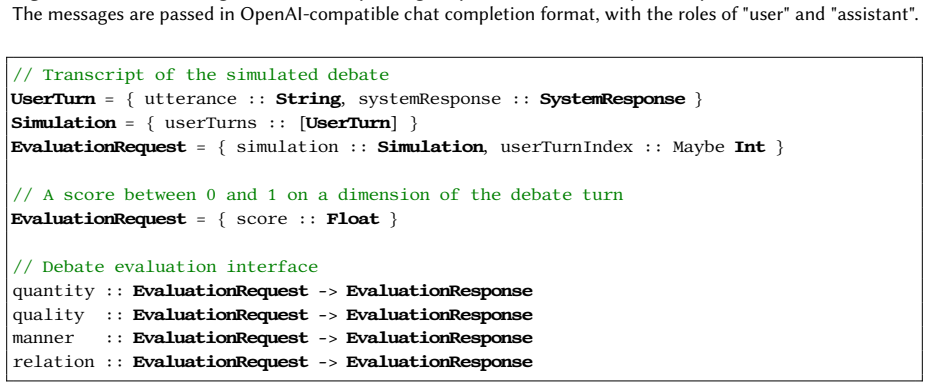
- [Figure 4] In the code listing, the second type declaration is also named "Evaluation Request" but should be "Evaluation Response" to match the described interface; as written, the request and response types share a name.
- [Section 4.1, Table 2] The text says Claude Opus 4 "peaking at the required maximum of 60 words" but Table 2 lists a maximum of 63 words, and Claude Sonnet 4's maximum is 61 words; the text should be corrected to acknowledge that these models exceeded the stated 60-word limit.
- [Section 4.1, Table 2] The word-count analysis for generation is based on only 18 utterances per model, yet the table reports means and standard deviations to four decimal places; the precision of the presented statistics should reflect the small sample size.
- [Keywords] The keyword list includes "CEUR-WS," which is not a topical keyword and appears to be a formatting artifact; it should be removed.
Circularity Check
No significant circularity: the paper's headline observations are direct measurements (word counts and repeated evaluation scores), and the official leaderboard provides external grounding for system performance.
full rationale
The abstract's two central observations are empirical summaries, not derivations that reduce to their inputs. Verbosity is measured directly from word counts in Table 2, which are outputs of the generation systems and are not fitted to any target conclusion. Evaluator consistency is measured in Section 4.1 by running the fixed baseline simulations four times per model and reporting standard deviations in Table 3; this is a test-retest reliability summary, and while the lack of human calibration limits the validity of the consistency claim (as the paper itself acknowledges in Sections 5 and 6), the claim is not forced by construction from a fitted parameter or by a self-referential equation. The Figure 2 prompt's instruction that most scores fall between 0 and 0.8 is a potential confound for the 'strictness' observation, but it does not make the observation tautological, since models still varied across metrics and runs. Official leaderboard results in Tables 4 and 5 provide committee-run, external benchmarks that independently support the response sub-task performance. There are no load-bearing self-citations or imported uniqueness theorems; references to Touché organizers, GenIRSim, and TIRA are infrastructural rather than argumentative. Accordingly, no circular step is exhibited.
Assumptions & free parameters
free parameters (1)
- retrieved document count (top-k) =
10
assumptions (3)
- domain assumption LLM evaluator scores are treated as valid measures of debate response quality without human calibration.
- domain assumption Six randomly selected topics with three turns per model are representative enough to support model comparisons.
- domain assumption The committee baseline retrieval system with Elasticsearch and Stella embeddings provides adequate evidence for the RAG component.
Cite this review
Pith. "Pith review of DS@GT at Touch\'e: Large Language Models for Retrieval-Augmented Debate." pith.science (2026). https://pith.science/paper/PUGGRLPD
@misc{pith2026250709090,
  author       = {Pith},
  title        = {Pith review of: DS@GT at Touch\'e: Large Language Models for Retrieval-Augmented Debate},
  year         = {2026},
  howpublished = {\url{https://pith.science/paper/PUGGRLPD}},
  note         = {Machine review of arXiv:2507.09090}
}
read the original abstract
Large Language Models (LLMs) demonstrate strong conversational abilities. In this Working Paper, we study them in the context of debating in two ways: their ability to perform in a structured debate along with a dataset of arguments to use and their ability to evaluate utterances throughout the debate. We deploy six leading publicly available models from three providers for the Retrieval-Augmented Debate and Evaluation. The evaluation is performed by measuring four key metrics: Quality, Quantity, Manner, and Relation. Throughout this task, we found that although LLMs perform well in debates when given related arguments, they tend to be verbose in responses yet consistent in evaluation. The accompanying source code for this paper is located at https://github.com/dsgt-arc/touche-2025-rad.
Figures


Figures from the paper (1 more)
Reference graph
Works this paper leans on
-
[1]
J. Kiesel, Ç. Çöltekin, M. Gohsen, S. Heineking, M. Heinrich, M. Fröbe, T. Hagen, M. Aliannejadi, T. Erjavec, M. Hagen, M. Kopp, N. Ljubešić, K. Meden, N. Mirzakhmedova, V. Morkevičius, H. Scells, I. Zelch, M. Potthast, B. Stein, Overview of Touché 2025: Argumentation Systems, in: J. C. de Albornoz, J. Gonzalo, L. Plaza, A. García Seco de Herrera, J. Moth...
work page 2025
-
[2]
A. Khan, J. Hughes, D. Valentine, L. Ruis, K. Sachan, A. Radhakrishnan, E. Grefenstette, S. R. Bowman, T. Rocktäschel, E. Perez, Debating with more persuasive llms leads to more truthful answers, 2024. URL: https://arxiv.org/abs/2402.06782. arXiv:2402.06782
arXiv 2024
-
[3]
L. Hagström, D. Saynova, T. Norlund, M. Johansson, R. Johansson, The effect of scaling, retrieval augmentation and form on the factual consistency of language models, 2023. URL: https://arxiv. org/abs/2311.01307. arXiv:2311.01307
arXiv 2023
-
[4]
X. Liu, P. Liu, H. He, An empirical analysis on large language models in debate evaluation, 2024. URL: https://arxiv.org/abs/2406.00050. arXiv:2406.00050
work page Pith review arXiv 2024
- [5]
- [6]
-
[7]
M. Fröbe, M. Wiegmann, N. Kolyada, B. Grahm, T. Elstner, F. Loebe, M. Hagen, B. Stein, M. Potthast, Continuous Integration for Reproducible Shared Tasks with TIRA.io, in: J. Kamps, L. Goeuriot, F. Crestani, M. Maistro, H. Joho, B. Davis, C. Gurrin, U. Kruschwitz, A. Caputo (Eds.), Advances in Information Retrieval. 45th European Conference on IR Research ...
work page 2023
Reviewed August 6, 2026 · model on record in the stance chip above.
Discussion (0). Sign in to comment.