REVIEW 3 major objections 5 minor 42 references
Repurposing RGB-based Foundation Model for Depth Estimation on Thermal Images Using Hierarchical Supervision
T0 review · 3 major / 5 minor · reviewed 2026-08-16 · deepseek-v4-flash
Pith's one-line read Hierarchical supervision from a frozen RGB foundation model improves depth estimation from thermal images, reducing the stereo baseline's RMSE from 5.068 to 3.548 on MS2 while matching the top RGB-distilled method on the cleaned split.
desk verdict Real but modest distillation gain for thermal depth; the verification module is misimplemented and likely does not do what the paper claims—referee-worthy but needs heavy revision. read the letter →
The pith
A machine-rendered reading of the paper's core claim, the machinery that carries it, and where it could break.
The reading
What carries the argument
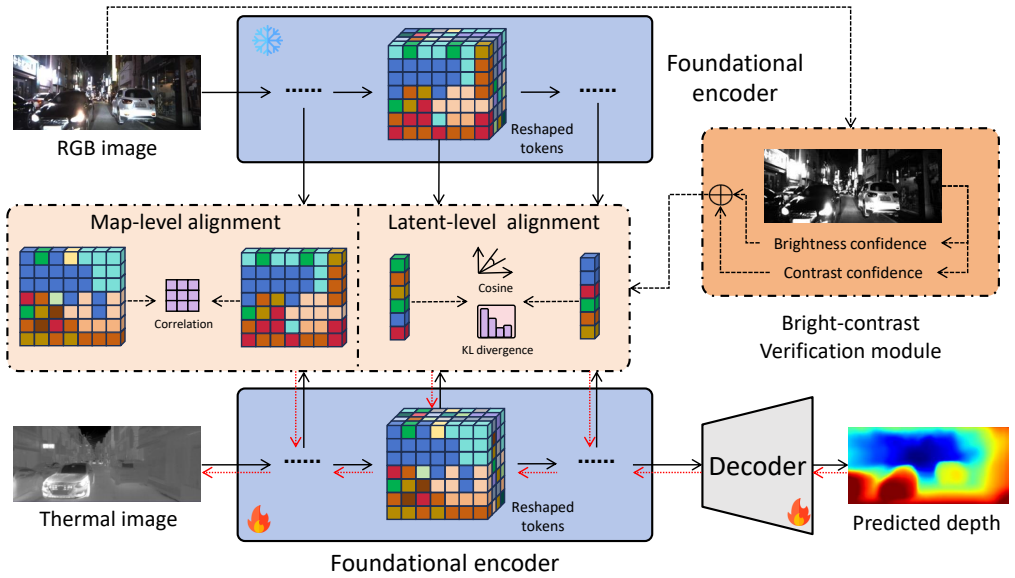
The load-bearing mechanism is a two-level alignment loss on a shared DINOv3 ViT-B/16 backbone: a map-level correlation loss compares per-channel self-correlation of thermal and RGB feature maps to transfer local structure, and a latent-level loss combining cosine similarity and KL divergence on max-pooled channel vectors transfers global semantic distributions. Around this sits a verification module that computes a brightness-contrast confidence $C_{\text{RGB}}$ from the RGB luminance map (average of normalized mean luminance and contrast) and scales the thermal features by $C_{\text{RGB}}$ before alignment, so low-quality RGB images contribute less. During inference the RGB branch, alignment, and verification are all discarded; only the thermal encoder-decoder runs.
What would settle it
Retrain RGB-HS with $C_{\text{RGB}}$ replaced by a constant or by random per-image weights; if the error stays within noise of the verified model, the verification module is not doing the claimed work. A sharper test is to compute a per-image measure of alignment quality (for example, agreement between the teacher's RGB features and a strong thermal-only depth estimate) and check whether $C_{\text{RGB}}$ predicts it better than chance; the paper reports only end-task validation numbers, not this correlation.
Extended reading notes
Core claim
The central claim is that the rich hierarchies inside an RGB foundation model can be transferred to a thermal encoder through a teacher-student scheme in which the RGB branch is frozen and the thermal branch is trained to match it at both map level and latent level. Concretely, with DINOv3 ViT-B/16 as the shared encoder, RGB-HS aligns reshaped patch tokens via a channel-wise correlation loss and aligns global pooled embeddings via cosine similarity plus KL divergence, then scales thermal features by a brightness-contrast confidence $C_{\text{RGB}}$ before computing these losses. On MS2 this yields the best thermal-only numbers in the main table (stereo AbsRel 0.105, RMSE 3.548), and on the cleaned MS2 split it reaches AbsRel 0.072 with RMSE 2.595, matching RGB-MDE's AbsRel while using fewer parameters and fewer FLOPs. The paper's diagnosis is that prior methods either ignored the RGB modality or ignored the intermediate tokens of the foundation model and treated all RGB supervision as equally reliable; RGB-HS addresses both omissions.
Load-bearing premise
The load-bearing premise is that the hand-designed brightness-contrast confidence $C_{\text{RGB}}$ tracks how much the RGB teacher's features should be trusted for alignment, and that scaling thermal features by it genuinely down-weights unreliable supervision.
Editorial extensions
If this is right
- RGB-HS in monocular mode (AbsRel 0.117, RMSE 3.806) beats the previous stereo baseline MSCRF (AbsRel 0.120, RMSE 5.068), so stereo input is not needed to benefit from RGB-supervised foundation priors.
- Adding verification after alignment improves stereo AbsRel from 0.114 to 0.105 and RMSE from 3.646 to 3.548, so quality-weighted alignment contributes beyond the losses alone.
- Using both alignment levels together beats either alone (AbsRel 0.114 vs 0.116 for each), indicating structural and semantic supervision are complementary.
- On the cleaned MS2 split, RGB-HS matches RGB-MDE's AbsRel (0.072) and RMSElog (0.100) while using a smaller model (249M vs 666M) and fewer FLOPs (0.23T vs 0.72T).
- Replacing the trained-from-scratch Swin-L encoder with a pre-trained DINOv3 ViT-B/16 gives most of the gain; the full RGB-HS reaches these numbers with an 86M encoder versus MSCRF's 197M.
Reading between the lines
- The brightness-contrast confidence is a hand-designed proxy; a learned confidence head or teacher-student feature-agreement score might replace it, and the ablation shows there is room to test whether a better signal widens the gap.
- Because the correlation loss is shift-invariant and the latent loss ignores spatial layout, a position-aware or attention-based alignment might recover fine boundaries better in rain, where AbsRel (0.124) still trails daytime performance (0.098).
- The method needs paired RGB-thermal training data but no correspondence at inference; adapting the alignment to unpaired or non-co-located RGB-thermal data would test whether the transfer is geometric or purely semantic.
- All conclusions rest on one benchmark; evaluating RGB-HS on additional thermal datasets or on near-infrared input would show whether the gain generalizes across sensors.
Signed reviews
Editorial analysis
A structured set of objections, weighed in public.
Referee Report
Summary. The paper proposes RGB-HS, a framework for thermal-image depth estimation built on the MSCRF baseline. It replaces the thermal encoder with a DINOv3 ViT-B/16 foundation model, adds a frozen parallel RGB teacher encoder of the same architecture, and aligns the two branches with a map-level correlation loss and latent-level cosine and KL losses. A verification module computes a brightness-contrast confidence score C_RGB per RGB image and scales the thermal features before computing alignment losses. Experiments on the MS2 dataset are reported for monocular and stereo depth estimation, including ablations over encoder scale, alignment losses, and verification, plus complexity comparisons.
Significance. If the results hold, RGB-HS would be a useful demonstration that frozen RGB foundation features can be transferred to thermal depth estimation using a simple training-time teacher, and the efficiency analysis is a strength: RGB-HS uses fewer parameters and FLOPs than MSCRF while improving RMSE (Tables VI and I). The paper also provides a thorough comparison to prior thermal depth methods on both standard and cleaned MS2 splits. However, the central mechanism is not currently established: the alignment ablation contradicts the text, and the verification operation's implementation does not match the claimed filtering behavior, so the empirical improvement is not yet attributable to the proposed hierarchical supervision. The reproducible experimental setup is a further strength, but missing error bars make the small reported gains hard to assess.
major comments (3)
- [Section IV-D, Table IV] The text states that adding either L_map or L_latent 'marginally improves' the baseline, but Table IV reports AbsRel 0.116 for each loss alone and 0.114 for both, versus 0.111 for the DINOv3 ViT-B/16 backbone without alignment. The alignment module therefore degrades AbsRel in every configuration shown, so the claim that the two alignment terms are complementary and improve performance is contradicted by the paper's own table. This is load-bearing because Table V attributes the final improvement to verification on top of these alignment terms; the authors must correct the text or provide corrected experiments, and report variance across multiple runs.
- [Section III-C, Eqs. (5), (6), (11), (12)] The verification module is described as 'weighting tokens from the RGB branch' and 'filtering unreliable RGB supervision', but the only implemented operation is F_THR <- C_RGB * F_THR, which scales the thermal student features. This is not equivalent to down-weighting the teacher: the cosine loss in Eq. (5) is invariant to this scaling, while in Eq. (6) scaling f_THR down flattens Softmax(f_THR/T) and increases KL(P_RGB || P_THR), so low-confidence images receive stronger, not weaker, distributional alignment pressure. Since Table V shows that verification is the sole component that improves AbsRel (0.114 to 0.105), the paper does not establish that the proposed quality-aware supervision causes the improvement; an alternative per-image reweighting explanation is not ruled out. The authors should validate C_RGB against an independent measure of RGB feature reliability, or redesign the mechanism so its effect matches the claimed filtering behavior.
- [Tables I and II] The key numerical claims rest on small performance differences without error bars or significance tests (e.g., AbsRel 0.105 vs 0.111 in Table I, and the tied 0.072 AbsRel with RGB-MDE in Table II). Given that the claimed improvement is the basis of the paper's central claim, the authors should report mean and standard deviation over multiple training runs or otherwise demonstrate that the differences are not within run-to-run noise.
minor comments (5)
- [Section IV-C] The text says 'reducing AbsRel and RMSE by 0.407 and 1.262' when comparing RGB-HS (Mono) with MSCRF (Stereo), but Table I shows an AbsRel reduction of 0.003 (0.120 to 0.117); the value 0.407 is the SqRel reduction. The sentence should refer to SqRel and RMSE, or the numbers should be corrected.
- [Section III-C] C_RGB is called a 'probabilistic indicator' of visual quality, but it is a hand-designed heuristic score and not a calibrated probability; the wording should be softened accordingly.
- [Abstract and Figure 2] There are several typographical issues: 'proposeRGB-HS' is missing a space, 'Bright-contrast' is awkward, and Table I contains the run-together entry '0.2070.8720.949' which should be separated.
- [Section IV-D, Table III] The statement that 'performance improves with larger ViT capacities' is only partially supported: ViT-L/16 has RMSE 3.939, worse than ViT-B/16's 3.826, so the relationship is non-monotonic and should be qualified or discussed.
- [Section III-B, Eq. (2)] The notation f_THR,c and f_RGB,c is undefined: it should be stated whether these are vectors, maps, or scalars, and which norm is applied to the Gram-matrix difference; currently the expression is ambiguous.
Circularity Check
No significant circularity: the central claims are evaluated on a held-out test split against external baselines, and no derivation step reduces by construction to its own inputs.
full rationale
The paper's claimed derivation chain is an empirical training and evaluation pipeline, not a closed-form derivation. The teacher-student alignment losses (Eqs. 2, 5, 6) are defined between RGB teacher features and thermal student features, and the verification confidence C_RGB (Eq. 11) is computed directly from RGB luminance and contrast, not from depth labels, depth predictions, or the alignment losses themselves. Final performance is reported on the held-out MS2 test split (training 26K, validation 4K, test 17.8K), and the loss coefficients (lambda_l=0.5, lambda_g1=1.0, lambda_g2=0.1) are explicitly stated to have been set on validation performance rather than on the reported test numbers, so this is ordinary hyperparameter tuning rather than a fitted input being renamed as a prediction. The main weaknesses are correctness and interpretation concerns, not circularity: Table IV shows L_map alone (0.116), L_latent alone (0.116), and their combination (0.114) all increase AbsRel relative to the 0.111 MSCRF-with-ViT-B/16 baseline, contradicting the text's claim that each alignment loss 'marginally improves' performance; and the verification step F_THR <- C_RGB*F_THR is a per-image scalar applied to student features, not a token-level weighting of the RGB branch as described, with the cosine loss being scale-invariant and the KL loss potentially behaving opposite to the claimed 'filtering'. These are substantive empirical and mechanistic issues that should be addressed in review, but they are not circularity. There is no load-bearing self-citation chain, no uniqueness theorem imported from the authors' prior work, and no result that is equivalent to its own input by construction. The honest finding is therefore no significant circularity, score 0.
Assumptions & free parameters
free parameters (5)
- lambda_l (map alignment weight) =
0.5
- lambda_g1 (latent cosine weight) =
1.0
- lambda_g2 (latent KL weight) =
0.1
- KL temperature T =
not reported
- encoder variant =
DINOv3 ViT-B/16
assumptions (5)
- domain assumption Pretrained DINOv3 features contain structural and semantic cues useful for thermal-image depth estimation.
- domain assumption Paired, spatially registered RGB and thermal images are available for training.
- ad hoc to paper Brightness and contrast of an RGB image are valid proxies for the reliability of its features for cross-modal alignment.
- domain assumption The MSCRF baseline and MS2 ground-truth LiDAR depth are accurate enough to support the reported metrics.
- standard math Standard vector calculus and probability identities for Gram matrices, cosine similarity, and KL divergence hold as used.
invented entities (1)
-
Brightness-contrast confidence C_RGB
Cite this review
Pith. "Pith review of Repurposing RGB-based Foundation Model for Depth Estimation on Thermal Images Using Hierarchical Supervision." pith.science (2026). https://pith.science/paper/PVORYNMZ
@misc{pith2026260811564,
  author       = {Pith},
  title        = {Pith review of: Repurposing RGB-based Foundation Model for Depth Estimation on Thermal Images Using Hierarchical Supervision},
  year         = {2026},
  howpublished = {\url{https://pith.science/paper/PVORYNMZ}},
  note         = {Machine review of arXiv:2608.11564}
}
read the original abstract
Depth estimation from thermal images is highly valuable for robotic applications in adverse conditions, such as nighttime and rainy weather. Recent studies have sought to transfer knowledge from RGB-based foundation models to thermal modalities, yet the rich hierarchical representations these models encode remain underutilized. To address this limitation, we propose RGB-HS, a novel framework for thermal-image depth estimation that leverages hierarchical supervision from an RGB-based foundation model. Specifically, we first replace the baseline thermal encoder with a foundational model and introduce a parallel RGB branch that also employs a foundational model as an encoder of the same architecture, taking RGB images as input. The alignment is then performed across multiple levels between the tokens of the two encoders, allowing the thermal student branch to capture both structural precision and semantic abstraction from the RGB teacher branch. Furthermore, we introduce verification to refine the alignment process by weighting tokens from the RGB branch based on RGB image quality. Extensive experiments on the popular benchmark demonstrate that RGB-HS achieves competitive performance and more effectively exploits the representational capacity of RGB-based foundation models for depth estimation on thermal images.
Figures


Reference graph
Works this paper leans on
-
[1]
Pseudo-lidar from visual depth estimation: Bridging the gap in 3d object detection for autonomous driving,
Y . Wang, W.-L. Chao, D. Garg, B. Hariharan, M. Campbell, and K. Q. Weinberger, “Pseudo-lidar from visual depth estimation: Bridging the gap in 3d object detection for autonomous driving,” inProceedings of the IEEE/CVF conference on computer vision and pattern recognition, 2019, pp. 8445–8453
2019
-
[2]
S. Chen, J. Hong, X. Liu, J. Li, T. Zhang, D. Wang, and Y . Guan, “A framework for 3d object detection and pose estimation in unstructured environment using single shot detector and refined linemod template matching,” in2019 24th IEEE International Conference on Emerging Technologies and Factory Automation (ETFA). IEEE, 2019, pp. 499– 504
work page 2019
-
[3]
Fastdepth: Fast monocular depth estimation on embedded systems,
D. Wofk, F. Ma, T.-J. Yang, S. Karaman, and V . Sze, “Fastdepth: Fast monocular depth estimation on embedded systems,” in2019 International Conference on Robotics and Automation (ICRA). IEEE, 2019, pp. 6101–6108
work page 2019
-
[4]
Real-time 3d object proposal gener- ation and classification using limited processing resources,
X. Li, J. Guivant, and S. Khan, “Real-time 3d object proposal gener- ation and classification using limited processing resources,”Robotics and Autonomous Systems, vol. 130, p. 103557, 2020
work page 2020
-
[5]
Multiseam tracking with a portable robotic welding system in unstructured environments,
S. Yu, Y . Guan, Z. Yang, C. Liu, J. Hu, J. Hong, H. Zhu, and T. Zhang, “Multiseam tracking with a portable robotic welding system in unstructured environments,”The International Journal of Advanced Manufacturing Technology, vol. 122, no. 3, pp. 2077–2094, 2022
work page 2022
-
[6]
Depth map prediction from a single image using a multi-scale deep network,
D. Eigen, C. Puhrsch, and R. Fergus, “Depth map prediction from a single image using a multi-scale deep network,”Advances in neural information processing systems, vol. 27, 2014
2014
-
[7]
Adabins: Depth estimation using adaptive bins,
S. F. Bhat, I. Alhashim, and P. Wonka, “Adabins: Depth estimation using adaptive bins,” inProceedings of the IEEE/CVF conference on computer vision and pattern recognition, 2021, pp. 4009–4018
2021
-
[8]
Depth anything: Unleashing the power of large-scale unlabeled data,
L. Yang, B. Kang, Z. Huang, X. Xu, J. Feng, and H. Zhao, “Depth anything: Unleashing the power of large-scale unlabeled data,” in Proceedings of the IEEE/CVF conference on computer vision and pattern recognition, 2024, pp. 10 371–10 381
2024
Show all 42 references
-
[9]
Deep depth estimation from thermal image,
U. Shin, J. Park, and I. S. Kweon, “Deep depth estimation from thermal image,” inProceedings of the IEEE/CVF Conference on Computer Vision and Pattern Recognition, 2023, pp. 1043–1053
2023
-
[10]
Segment anything,
A. Kirillov, E. Mintun, N. Ravi, H. Mao, C. Rolland, L. Gustafson, T. Xiao, S. Whitehead, A. C. Berg, W.-Y . Lo,et al., “Segment anything,” inProceedings of the IEEE/CVF international conference on computer vision, 2023, pp. 4015–4026
2023
-
[11]
Sim ´eoni, H
O. Sim ´eoni, H. V . V o, M. Seitzer, F. Baldassarre, M. Oquab, C. Jose, V . Khalidov, M. Szafraniec, S. Yi, M. Ramamonjisoa,et al., “Dinov3,” arXiv preprint arXiv:2508.10104, 2025
2025 arXiv
-
[12]
Enhancing features in long-tailed data using large vision model,
P. Han, C. Ye, J. Tong, C. Jiang, J. Hong, L. Fang, and X. Li, “Enhancing features in long-tailed data using large vision model,” in 2025 International Joint Conference on Neural Networks (IJCNN). IEEE, 2025, pp. 1–9
2025
-
[13]
Emerging properties in self-supervised vision trans- formers,
M. Caron, H. Touvron, I. Misra, H. J ´egou, J. Mairal, P. Bojanowski, and A. Joulin, “Emerging properties in self-supervised vision trans- formers,” inProceedings of the IEEE/CVF international conference on computer vision, 2021, pp. 9650–9660
2021
-
[14]
Dinov2: Learning robust visual features without supervision,
M. Oquab, T. Darcet, T. Moutakanni, H. V o, M. Szafraniec, V . Khali- dov, P. Fernandez, D. Haziza, F. Massa, A. El-Nouby,et al., “Dinov2: Learning robust visual features without supervision,”Transactions on Machine Learning Research, 2024
2024
-
[15]
General- izable thermal-based depth estimation via pre-trained visual foundation model,
R. Fan, W. Zhao, M. Lin, Q. Wang, Y .-J. Liu, and W. Wang, “General- izable thermal-based depth estimation via pre-trained visual foundation model,” in2024 IEEE International Conference on Robotics and Automation (ICRA). IEEE, 2024, pp. 14 614–14 621
2024
-
[16]
Monother-depth: Enhancing thermal depth estimation via confidence- aware distillation,
X. Zuo, N. Ranganathan, C. Lee, G. Gkioxari, and S.-J. Chung, “Monother-depth: Enhancing thermal depth estimation via confidence- aware distillation,”IEEE Robotics and Automation Letters, 2025
2025
-
[17]
Depth and surface normal estimation from monocular images using regression on deep features and hierarchical crfs,
B. Li, C. Shen, Y . Dai, A. Van Den Hengel, and M. He, “Depth and surface normal estimation from monocular images using regression on deep features and hierarchical crfs,” inProceedings of the IEEE conference on computer vision and pattern recognition, 2015, pp. 1119–1127
2015
-
[18]
Enforcing geometric con- straints of virtual normal for depth prediction,
W. Yin, Y . Liu, C. Shen, and Y . Yan, “Enforcing geometric con- straints of virtual normal for depth prediction,” inProceedings of the IEEE/CVF international conference on computer vision, 2019, pp. 5684–5693
2019
-
[19]
Gedepth: Ground embedding for monocular depth estimation,
X. Yang, Z. Ma, Z. Ji, and Z. Ren, “Gedepth: Ground embedding for monocular depth estimation,” inProceedings of the IEEE/CVF international conference on computer vision, 2023, pp. 12 719–12 727
2023
-
[20]
Nddepth: Normal- distance assisted monocular depth estimation,
S. Shao, Z. Pei, W. Chen, X. Wu, and Z. Li, “Nddepth: Normal- distance assisted monocular depth estimation,” inProceedings of the IEEE/CVF International Conference on Computer Vision, 2023, pp. 7931–7940
2023
-
[21]
Binsformer: Revisiting adaptive bins for monocular depth estimation,
Z. Li, X. Wang, X. Liu, and J. Jiang, “Binsformer: Revisiting adaptive bins for monocular depth estimation,”IEEE Transactions on Image Processing, vol. 33, pp. 3964–3976, 2024
2024
-
[22]
Structure- guided ranking loss for single image depth prediction,
K. Xian, J. Zhang, O. Wang, L. Mai, Z. Lin, and Z. Cao, “Structure- guided ranking loss for single image depth prediction,” inProceedings of the IEEE/CVF Conference on Computer Vision and Pattern Recog- nition, 2020, pp. 611–620
2020
-
[23]
Neural window fully- connected crfs for monocular depth estimation,
W. Yuan, X. Gu, Z. Dai, S. Zhu, and P. Tan, “Neural window fully- connected crfs for monocular depth estimation,” inProceedings of the IEEE/CVF conference on computer vision and pattern recognition, 2022, pp. 3916–3925
2022
-
[24]
Repurposing diffusion-based image generators for monocular depth estimation,
B. Ke, A. Obukhov, S. Huang, N. Metzger, R. C. Daudt, and K. Schindler, “Repurposing diffusion-based image generators for monocular depth estimation,” inProceedings of the IEEE/CVF con- ference on computer vision and pattern recognition, 2024, pp. 9492– 9502
2024
-
[25]
Depth anything v2,
L. Yang, B. Kang, Z. Huang, Z. Zhao, X. Xu, J. Feng, and H. Zhao, “Depth anything v2,”Advances in Neural Information Processing Systems, vol. 37, pp. 21 875–21 911, 2024
2024
-
[26]
High-resolution image synthesis with latent diffusion models,
R. Rombach, A. Blattmann, D. Lorenz, P. Esser, and B. Ommer, “High-resolution image synthesis with latent diffusion models,” in Proceedings of the IEEE/CVF conference on computer vision and pattern recognition, 2022, pp. 10 684–10 695
2022
-
[27]
Multispectral transfer network: Unsupervised depth estimation for all-day vision,
N. Kim, Y . Choi, S. Hwang, and I. S. Kweon, “Multispectral transfer network: Unsupervised depth estimation for all-day vision,” inPro- ceedings of the AAAI Conference on Artificial Intelligence, vol. 32, no. 1, 2018
2018
-
[28]
An alternative of lidar in nighttime: Unsupervised depth estimation based on single thermal image,
Y . Lu and G. Lu, “An alternative of lidar in nighttime: Unsupervised depth estimation based on single thermal image,” inProceedings of the IEEE/CVF Winter Conference on Applications of Computer Vision, 2021, pp. 3833–3843
2021
-
[29]
Self-supervised monocular depth estimation from thermal images via adversarial multi-spectral adaptation,
U. Shin, K. Park, B.-U. Lee, K. Lee, and I. S. Kweon, “Self-supervised monocular depth estimation from thermal images via adversarial multi-spectral adaptation,” inProceedings of the IEEE/CVF Winter Conference on Applications of Computer Vision, 2023, pp. 5798–5807
2023
-
[30]
Thermostereort: Thermal stereo matching in real time via knowledge distillation and attention-based refinement,
A. Hu, A. Li, X. Jin, and D. Zou, “Thermostereort: Thermal stereo matching in real time via knowledge distillation and attention-based refinement,” in2025 IEEE International Conference on Robotics and Automation (ICRA). IEEE, 2025, pp. 3766–3772
2025
-
[31]
Abm- drnet: Adaptive-weighted bi-directional modality difference reduction network for rgb-t semantic segmentation,
Q. Zhang, S. Zhao, Y . Luo, D. Zhang, N. Huang, and J. Han, “Abm- drnet: Adaptive-weighted bi-directional modality difference reduction network for rgb-t semantic segmentation,” inProceedings of the IEEE/CVF Conference on Computer Vision and Pattern Recognition, 2021, pp. 2633–2642
2021
-
[32]
Efficient rgb- t tracking via cross-modality distillation,
T. Zhang, H. Guo, Q. Jiao, Q. Zhang, and J. Han, “Efficient rgb- t tracking via cross-modality distillation,” inProceedings of the IEEE/CVF conference on computer vision and pattern recognition, 2023, pp. 5404–5413
2023
-
[33]
Efficient and accurate object detection with simultaneous classification and tracking under limited computing power,
X. Li and J. E. Guivant, “Efficient and accurate object detection with simultaneous classification and tracking under limited computing power,”IEEE Transactions on Intelligent Transportation Systems, vol. 24, no. 6, pp. 5740–5751, 2023
2023
-
[34]
D3t: Distinctive dual-domain teacher zigzagging across rgb-thermal gap for domain-adaptive object detection,
D. P. Do, T. Kim, J. Na, J. Kim, K. Lee, K. Cho, and W. Hwang, “D3t: Distinctive dual-domain teacher zigzagging across rgb-thermal gap for domain-adaptive object detection,” inProceedings of the IEEE/CVF Conference on Computer Vision and Pattern Recognition, 2024, pp. 23 313–23 322
2024
-
[35]
M-specgene: Generalized foundation model for rgbt multispectral vision,
K. Zhou, F. Yang, S. Wang, B. Wen, C. Zi, L. Chen, Q. Shen, and X. Cao, “M-specgene: Generalized foundation model for rgbt multispectral vision,” inProceedings of the IEEE/CVF International Conference on Computer Vision, 2025, pp. 7861–7872
2025
-
[36]
Swin transformer: Hierarchical vision transformer using shifted windows,
Z. Liu, Y . Lin, Y . Cao, H. Hu, Y . Wei, Z. Zhang, S. Lin, and B. Guo, “Swin transformer: Hierarchical vision transformer using shifted windows,” inProceedings of the IEEE/CVF international conference on computer vision, 2021, pp. 10 012–10 022
2021
-
[37]
Deep ordinal regression network for monocular depth estimation,
H. Fu, M. Gong, C. Wang, K. Batmanghelich, and D. Tao, “Deep ordinal regression network for monocular depth estimation,” inPro- ceedings of the IEEE conference on computer vision and pattern recognition, 2018, pp. 2002–2011
2018
-
[38]
From big to small: Multi-scale local planar guidance for monocular depth estimation,
J. H. Lee, M.-K. Han, D. W. Ko, and I. H. Suh, “From big to small: Multi-scale local planar guidance for monocular depth estimation,” arXiv preprint arXiv:1907.10326, 2019
1907 arXiv
-
[39]
Zoedepth: Zero-shot transfer by combining relative and metric depth,
S. F. Bhat, R. Birkl, D. Wofk, P. Wonka, and M. M ¨uller, “Zoedepth: Zero-shot transfer by combining relative and metric depth,”arXiv preprint arXiv:2302.12288, 2023
2023 arXiv
-
[40]
Decoupled weight decay regularization,
I. Loshchilov and F. Hutter, “Decoupled weight decay regularization,” inInternational Conference on Learning Representations, 2019
2019
-
[41]
Pytorch: An imperative style, high-performance deep learning library,
A. Paszke, S. Gross, F. Massa, A. Lerer, J. Bradbury, G. Chanan, T. Killeen, Z. Lin, N. Gimelshein, L. Antiga,et al., “Pytorch: An imperative style, high-performance deep learning library,”Advances in neural information processing systems, vol. 32, 2019
2019
-
[42]
Deep depth estimation from ther- mal image: Dataset, benchmark, and challenges,
U. Shin and J. Park, “Deep depth estimation from ther- mal image: Dataset, benchmark, and challenges,”arXiv preprint arXiv:2503.22060, 2025
2025 arXiv
Reviewed August 16, 2026 · model on record in the stance chip above.
Discussion (0). Continue with ORCID to comment.