Bridging Classification and Reconstruction: Cooperative Time Series Anomaly Detection
Pith reviewed 2026-06-29 22:18 UTC · model grok-4.3
The pith
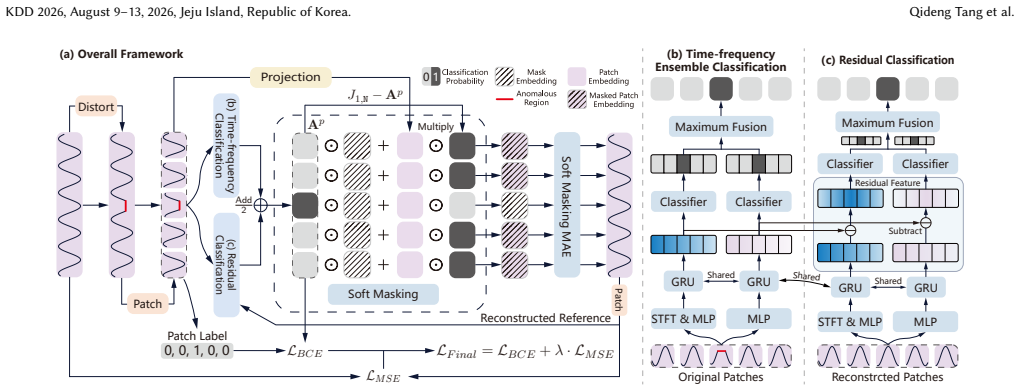
CoAD unifies classification and reconstruction so each module corrects the weaknesses of the other for time series anomaly detection.
A machine-rendered reading of the paper's core claim, the machinery that carries it, and where it could break.
Core claim
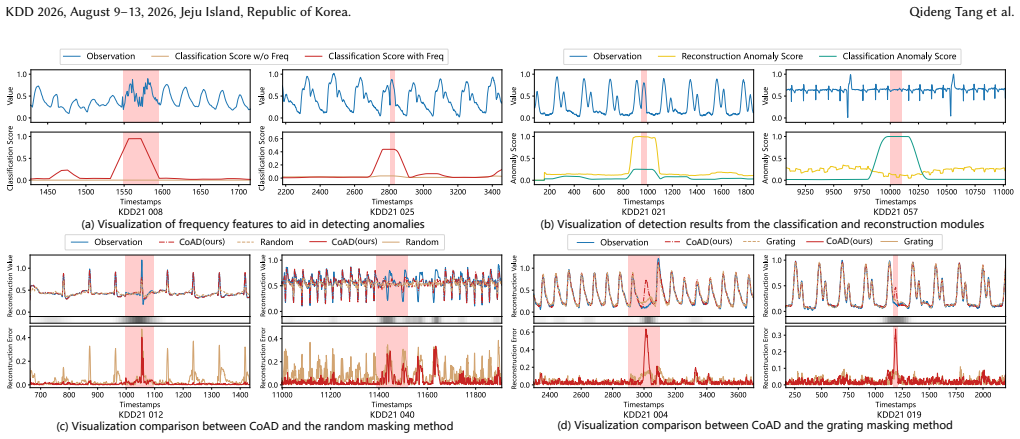
CoAD is a framework that unifies the outlier-exposure classification paradigm and the masked-autoencoder reconstruction paradigm through cooperative interaction: the classification module generates probability-informed soft masks for the reconstruction module, which in turn alleviates the generalization problem of the classification module, enabling effective detection of subtle and complex anomalies.
What carries the argument
The cooperative loop in which the classification module supplies probability-informed soft masks to steer the reconstruction module while reconstruction improves classification generalization.
If this is right
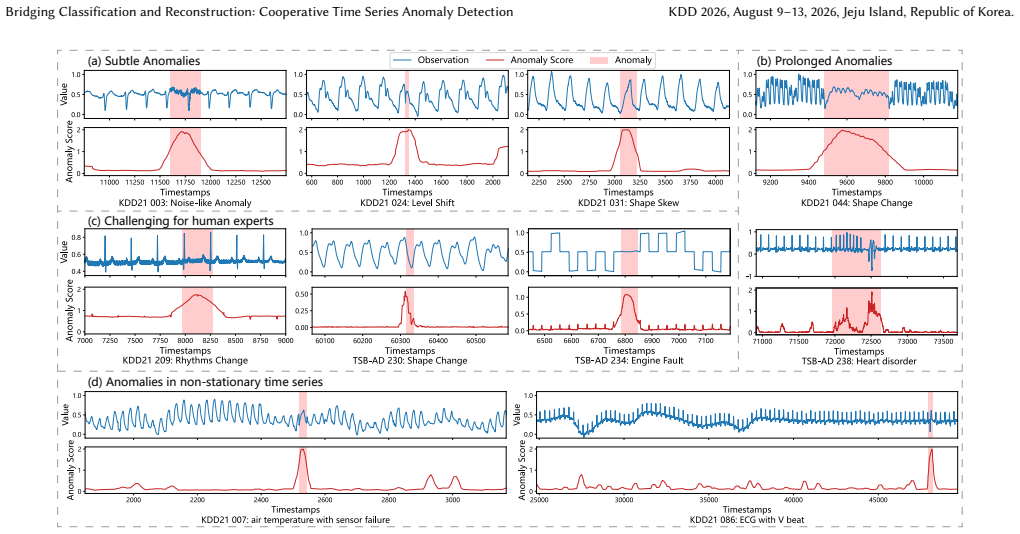
- CoAD detects subtle and prolonged anomalies that existing deep-learning methods miss.
- The design resolves improper classification granularity and the neglect of frequency information.
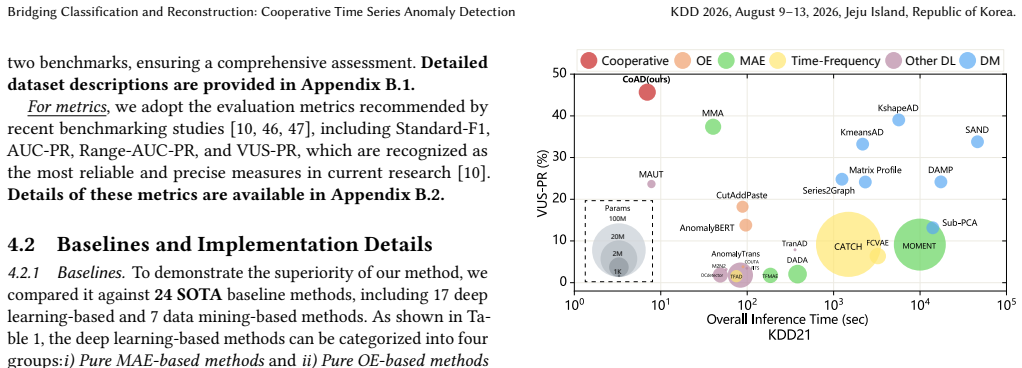
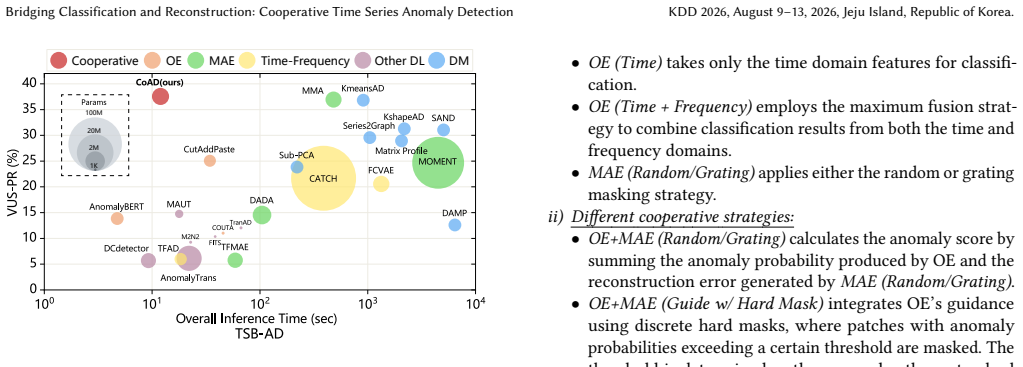
- CoAD runs substantially faster than current state-of-the-art methods while remaining lightweight.
- The same cooperative pattern yields higher accuracy on rigorous benchmark evaluations than either standalone paradigm.
Where Pith is reading between the lines
- Similar cooperative bridging of classification and reconstruction could be tested on non-time-series data such as images or sensor graphs.
- Real-time monitoring pipelines could adopt the reported speed advantage for continuous large-scale anomaly screening.
- The soft-mask cooperation might be generalized to other paired tasks where one module's output can regularize the other.
Load-bearing premise
The cooperative exchange of soft masks and reconstruction feedback will produce reliably better anomaly detection than either module achieves on its own.
What would settle it
On the same high-quality benchmark datasets and evaluation protocols used in the paper, CoAD would fail the central claim if its F1 or other detection scores did not exceed those of the strongest prior deep-learning and data-mining baselines.
Figures



read the original abstract
Time series anomaly detection (TSAD) has long been a hot research topic in data mining due to its various applications. Recent studies challenge the effectiveness of popular deep learning methods for TSAD, suggesting their failure in detecting subtle and prolonged anomalies. Outlier Exposure (OE) and Masked Autoencoder (MAE) emerge as two promising paradigms (classification and reconstruction) for solving the above problems. However, OE-based methods are constrained by poor generalization, while MAE-based methods are limited by masking misalignment issues. To address these limitations, this paper proposes a novel framework, CoAD, which unifies the two paradigms to leverage their complementary strengths while mitigating their respective weaknesses. In this framework, the classification module generates probability-informed soft masks for the reconstruction module, which in turn alleviates the generalization problem of the classification module. This cooperative design enables CoAD to effectively detect subtle and complex anomalies that are often overlooked by existing methods. Additionally, the classification module is carefully designed to resolve issues related to improper classification granularity and the neglect of frequency information. Extensive experiments on high-quality benchmark datasets, conducted under rigorous evaluation protocols, demonstrate that CoAD significantly outperforms both state-of-the-art deep learning and traditional data mining methods, highlighting the potential of deep learning in TSAD. Moreover, CoAD is lightweight and substantially faster than existing SOTA methods, demonstrating its practical value for large-scale, real-time applications.
Editorial analysis
A structured set of objections, weighed in public.
Referee Report
Summary. The manuscript proposes CoAD, a framework unifying outlier exposure (classification) and masked autoencoder (reconstruction) paradigms for time series anomaly detection. The classification module produces probability-informed soft masks to guide reconstruction, while reconstruction regularizes classification to mitigate generalization issues; additional design choices address classification granularity and frequency information. The central claim is that this bidirectional cooperation enables reliable detection of subtle and prolonged anomalies missed by prior methods, with extensive experiments on benchmark datasets under rigorous protocols showing significant outperformance over SOTA deep learning and traditional methods, plus practical advantages in speed and lightness.
Significance. If the cooperative soft-mask mechanism is shown to deliver gains beyond additive combination of the two modules, the work would usefully bridge two active TSAD paradigms and address documented weaknesses in generalization and masking alignment. Explicit credit is due for the stated commitment to rigorous evaluation protocols and for positioning the method as lightweight and faster than existing SOTA, which would strengthen its practical relevance if the performance claims hold.
major comments (2)
- [Experiments section] Experiments section: the reported gains are attributed to the bidirectional cooperative interaction, yet no ablation isolates the probability-informed soft masks against a non-cooperative (additive) combination of standalone OE and MAE modules or against standard random masking. Without such a control, it remains unclear whether the claimed synergy is load-bearing for the outperformance on subtle anomalies or whether the improvements could arise from the individual modules alone.
- [Method section] Method section: the description of how reconstruction regularizes the classification module (and vice versa) remains high-level without an explicit loss formulation or derivation showing that the soft masks are sufficiently accurate to avoid error amplification while differing enough from conventional masking to resolve misalignment. This leaves the central cooperative premise difficult to evaluate formally.
minor comments (2)
- [Abstract] The abstract asserts 'rigorous evaluation protocols' and 'high-quality benchmark datasets' but supplies no concrete protocol details, dataset names, or statistical significance tests; these should be summarized early for readers.
- [Method section] Notation for the soft-mask generation and the bidirectional loss terms should be introduced with explicit equations rather than prose descriptions to improve reproducibility.
Simulated Author's Rebuttal
We thank the referee for the constructive and detailed feedback. We address each major comment below.
read point-by-point responses
-
Referee: [Experiments section] Experiments section: the reported gains are attributed to the bidirectional cooperative interaction, yet no ablation isolates the probability-informed soft masks against a non-cooperative (additive) combination of standalone OE and MAE modules or against standard random masking. Without such a control, it remains unclear whether the claimed synergy is load-bearing for the outperformance on subtle anomalies or whether the improvements could arise from the individual modules alone.
Authors: We agree that the current experiments do not include ablations isolating the bidirectional cooperative mechanism from a simple additive combination of the OE and MAE modules or from standard random masking. Such controls would more rigorously demonstrate whether the synergy is necessary for gains on subtle and prolonged anomalies. We will add these ablation studies to the Experiments section in the revised manuscript. revision: yes
-
Referee: [Method section] Method section: the description of how reconstruction regularizes the classification module (and vice versa) remains high-level without an explicit loss formulation or derivation showing that the soft masks are sufficiently accurate to avoid error amplification while differing enough from conventional masking to resolve misalignment. This leaves the central cooperative premise difficult to evaluate formally.
Authors: We acknowledge that the Method section currently describes the mutual regularization at a high level without explicit loss equations or a formal derivation addressing error amplification and masking differences. In the revision we will expand the Method section to include the full loss formulations for both modules together with a derivation or analysis showing that the probability-informed soft masks avoid error amplification while differing sufficiently from random masking to resolve misalignment. revision: yes
Circularity Check
No derivation chain or equations present; framework is conceptual with empirical validation
full rationale
The provided abstract and description introduce CoAD as a cooperative unification of OE classification and MAE reconstruction modules, with claims about soft masks and generalization alleviation stated at a high level. No equations, parameter fittings, uniqueness theorems, or self-citations of load-bearing mathematical results appear. The central claims rest on experimental outperformance rather than any derivation that reduces to its own inputs by construction. This is self-contained against external benchmarks with no detectable circular steps.
Axiom & Free-Parameter Ledger
Reference graph
Works this paper leans on
-
[1]
Ane Blázquez-García, Angel Conde, Usue Mori, and Jose A. Lozano. 2022. A Review on Outlier/Anomaly Detection in Time Series Data.Comput. Surveys54, 3 (2022), 1–33. doi:10.1145/3444690
-
[2]
Siwon Kim, Kukjin Choi, Hyun-Soo Choi, Byunghan Lee, and Sungroh Yoon. 2022. Towards a Rigorous Evaluation of Time-Series Anomaly Detection.Proceedings of the AAAI Conference on Artificial Intelligence36, 7 (2022), 7194–7201. doi:10. 1609/aaai.v36i7.20680
2022
-
[3]
Manish Gupta, Jing Gao, Charu C. Aggarwal, and Jiawei Han. 2014. Outlier Detection for Temporal Data: A Survey.IEEE Transactions on Knowledge and Data Engineering26, 9 (2014), 2250–2267. doi:10.1109/TKDE.2013.184
-
[4]
Sebastian Schmidl, Phillip Wenig, and Thorsten Papenbrock. 2022. Anomaly Detection in Time Series: A Comprehensive Evaluation.Proceedings of the VLDB Endowment15, 9 (2022), 1779–1797. doi:10.14778/3538598.3538602
-
[5]
Gen Li and Jason J. Jung. 2023. Deep Learning for Anomaly Detection in Mul- tivariate Time Series: Approaches, Applications, and Challenges.Information Fusion91 (2023), 93–102. doi:10.1016/j.inffus.2022.10.008
-
[6]
Zahra Zamanzadeh Darban, Geoffrey I. Webb, Shirui Pan, Charu Aggarwal, and Mahsa Salehi. 2025. Deep Learning for Time Series Anomaly Detection: A Survey. Comput. Surveys57, 1 (2025), 1–42. doi:10.1145/3691338
-
[7]
Kukjin Choi, Jihun Yi, Changhwa Park, and Sungroh Yoon. 2021. Deep Learning for Anomaly Detection in Time-Series Data: Review, Analysis, and Guidelines. IEEE Access9 (2021), 120043–120065. doi:10.1109/ACCESS.2021.3107975
-
[8]
Kwei-Herng Lai, Daochen Zha, Yue Zhao, Guanchu Wang, Junjie Xu, and Xia Hu. 2021. Revisiting Time Series Outlier Detection: Definitions and Benchmarks. InThe 35th Conference on Neural Information Processing Systems Datasets and Benchmarks Track
2021
-
[9]
Ferdinand Rewicki, Joachim Denzler, and Julia Niebling. 2023. Is It Worth It? Comparing Six Deep and Classical Methods for Unsupervised Anomaly Detection in Time Series.Applied Sciences13, 3 (2023), 1778. doi:10.3390/app13031778
-
[10]
Qinghua Liu and John Paparrizos. 2024. The Elephant in the Room: Towards A Reliable Time-Series Anomaly Detection Benchmark. InThe 38th Conference on Neural Information Processing Systems Datasets and Benchmarks Track
2024
-
[11]
Saquib Sarfraz, Mei-Yen Chen, Lukas Layer, Kunyu Peng, and Marios Koulakis
M. Saquib Sarfraz, Mei-Yen Chen, Lukas Layer, Kunyu Peng, and Marios Koulakis
-
[12]
In Proceedings of the 41st International Conference on Machine Learning(Vienna, Austria)
Position: quo vadis, unsupervised time series anomaly detection?. In Proceedings of the 41st International Conference on Machine Learning(Vienna, Austria). Article 1771, 16 pages
-
[13]
Nesryne Mejri, Laura Lopez-Fuentes, Kankana Roy, Pavel Chernakov, Enjie Ghor- bel, and Djamila Aouada. 2024. Unsupervised Anomaly Detection in Time-Series: An Extensive Evaluation and Analysis of State-of-the-Art Methods.Expert Sys- tems with Applications256 (2024), 124922. doi:10.1016/j.eswa.2024.124922
-
[14]
Astha Garg, Wenyu Zhang, Jules Samaran, Ramasamy Savitha, and Chuan-Sheng Foo. 2022. An Evaluation of Anomaly Detection and Diagnosis in Multivariate Time Series.IEEE Transactions on Neural Networks and Learning Systems33, 6 (2022), 2508–2517. doi:10.1109/TNNLS.2021.3105827
-
[15]
Daesoo Lee, Sara Malacarne, and Erlend Aune. 2024. Explainable Time Series Anomaly Detection Using Masked Latent Generative Modeling.Pattern Recogni- tion156 (2024), 110826. doi:10.1016/j.patcog.2024.110826
-
[16]
Yuting Sun, Guansong Pang, Guanhua Ye, Tong Chen, Xia Hu, and Hongzhi Yin. 2024. Unraveling the ‘Anomaly’in time series anomaly detection: a self- supervised tri-domain solution. 981–994 pages
2024
-
[17]
Dan Hendrycks, Mantas Mazeika, and Thomas Dietterich. 2019. Deep Anomaly Detection with Outlier Exposure. InThe Seventh International Conference on Learning Representations
2019
-
[18]
Kaiming He, Xinlei Chen, Saining Xie, Yanghao Li, Piotr Dollar, and Ross Girshick
-
[19]
Masked Autoencoders Are Scalable Vision Learners. In2022 IEEE/CVF Conference on Computer Vision and Pattern Recognition. 15979–15988. doi:10. 1109/CVPR52688.2022.01553
-
[20]
Yungi Jeong, Eunseok Yang, Jung Hyun Ryu, Imseong Park, and Myungjoo Kang
-
[21]
InThe 11th International Conference on Learning Representations
AnomalyBERT: Self-Supervised Transformer for Time Series Anomaly Detection Using Data Degradation Scheme. InThe 11th International Conference on Learning Representations. KDD 2026, August 9–13, 2026, Jeju Island, Republic of Korea. Qideng Tang et al
2026
-
[22]
Rui Wang, Xudong Mou, Renyu Yang, Kai Gao, Pin Liu, Chongwei Liu, Tianyu Wo, and Xudong Liu. 2024. CutAddPaste: Time Series Anomaly Detection by Exploit- ing Abnormal Knowledge. InProceedings of the 30th ACM SIGKDD Conference on Knowledge Discovery and Data Mining. 3176–3187. doi:10.1145/3637528.3671739
-
[23]
Hongzuo Xu, Yijie Wang, Songlei Jian, Qing Liao, Yongjun Wang, and Guansong Pang. 2024. Calibrated One-Class Classification for Unsupervised Time Series Anomaly Detection.IEEE Transactions on Knowledge and Data Engineering(2024), 1–14. doi:10.1109/TKDE.2024.3393996
-
[24]
Qideng Tang, Chaofan Dai, Yahui Wu, and Haohao Zhou. 2025. MLP-Mixer based Masked Autoencoders are Effective, Explainable and Robust for Time Series Anomaly Detection. InProceedings of the VLDB Endowment, Vol. 18. VLDB Endowment, 798–811. doi:10.14778/3712221.3712243
-
[25]
Qichao Shentu, Beibu Li, Kai Zhao, Yang Shu, Zhongwen Rao, Lujia Pan, Bin Yang, and Chenjuan Guo. 2025. Towards a General Time Series Anomaly Detector with Adaptive Bottlenecks and Dual Adversarial Decoders. InThe Thirteenth International Conference on Learning Representations
2025
-
[26]
Mononito Goswami, Konrad Szafer, Arjun Choudhry, Yifu Cai, Shuo Li, and Artur Dubrawski. 2024. MOMENT: A Family of Open Time-series Foundation Models. In41st International Conference on Machine Learning
2024
-
[27]
Yuchen Fang, Jiandong Xie, Yan Zhao, Lu Chen, Yunjun Gao, and Kai Zheng
-
[28]
InIEEE 40th International Conference on Data Engineering
Temporal-Frequency Masked Autoencoders for Time Series Anomaly Detection. InIEEE 40th International Conference on Data Engineering. 1228–1241. doi:10.1109/ICDE60146.2024.00099
-
[29]
Yuhang Chen, Chaoyun Zhang, Minghua Ma, Yudong Liu, Ruomeng Ding, Bowen Li, Shilin He, Saravan Rajmohan, Qingwei Lin, and Dongmei Zhang
-
[30]
ImDiffusion: Imputed Diffusion Models for Multivariate Time Series Anomaly Detection.Proceedings of the VLDB Endowment17, 3 (2023), 359–372. doi:10.14778/3632093.3632101
-
[31]
Xincheng Yao, Chongyang Zhang, Ruoqi Li, Jun Sun, and Zhenyu Liu. 2023. One-for-All: Proposal Masked Cross-Class Anomaly Detection.Proceedings of the AAAI Conference on Artificial Intelligence37, 4 (2023), 4792–4800. doi:10.1609/ aaai.v37i4.25604
2023
-
[32]
Renjie Wu and Eamonn Keogh. 2021. Current Time Series Anomaly Detection Benchmarks Are Flawed and Are Creating the Illusion of Progress.IEEE Transac- tions on Knowledge and Data Engineering(2021), 1–1. doi:10.1109/TKDE.2021. 3112126
-
[33]
Eamonn Keogh. 2021. Irrational Exuberance: Why we should not believe 95% of papers on Time Series Anomaly Detection. https://kdd-milets.github.io/ milets2021/slides/Irrational%20Exuberance_Eammon_Keogh.pdf
2021
-
[34]
Renjie Wu and Eamonn Keogh. 2024. The Fundamental Problem in TSAD Re- search. https://lnkd.in/gP-H8w4i
2024
-
[35]
Takaaki Nakamura, Makoto Imamura, Ryan Mercer, and Eamonn Keogh. 2020. MERLIN: Parameter-Free Discovery of Arbitrary Length Anomalies in Massive Time Series Archives. In2020 IEEE International Conference on Data Mining. 1190–1195
2020
-
[36]
Yue Lu, Renjie Wu, Abdullah Mueen, Maria A. Zuluaga, and Eamonn Keogh. 2023. DAMP: Accurate Time Series Anomaly Detection on Trillions of Datapoints and Ultra-Fast Arriving Data Streams.Data Mining and Knowledge Discovery37, 2 (2023), 627–669. doi:10.1007/s10618-022-00911-7
-
[37]
Paul Boniol, John Paparrizos, Themis Palpanas, and Michael J. Franklin. 2021. SAND: Streaming Subsequence Anomaly Detection.Proceedings of the VLDB Endowment14, 10 (2021), 1717–1729. doi:10.14778/3467861.3467863
-
[38]
Yuqi Nie, Nam H Nguyen, Phanwadee Sinthong, and Jayant Kalagnanam. 2023. A Time Series is Worth 64 Words: Long-term Forecasting with Transformers. In The 11th International Conference on Learning Representations
2023
-
[39]
Xingjian Wu, Xiangfei Qiu, Zhengyu Li, Yihang Wang, Jilin Hu, Chenjuan Guo, Hui Xiong, and Bin Yang. 2025. CATCH: Channel-Aware multivariate Time Series Anomaly Detection via Frequency Patching. InThe 13th International Conference on Learning Representations
2025
-
[40]
Zexin Wang, Changhua Pei, Minghua Ma, Xin Wang, Zhihan Li, Dan Pei, Saravan Rajmohan, Dongmei Zhang, Qingwei Lin, Haiming Zhang, Jianhui Li, and Gao- gang Xie. 2024. Revisiting VAE for Unsupervised Time Series Anomaly Detection : A Frequency Perspective. InProceedings of the ACM on Web Conference 2024. 3096–3105. doi:10.1145/3589334.3645710
-
[41]
Chaoli Zhang, Tian Zhou, Qingsong Wen, and Liang Sun. 2022. TFAD: A De- composition Time Series Anomaly Detection Architecture with Time-Frequency Analysis. InProceedings of the 31st ACM International Conference on Information & Knowledge Management. 2497 –2507. doi:10.1145/3511808.3557470
-
[42]
Xincheng Yao, Zixin Chen, Chao Gao, Guangtao Zhai, and Chongyang Zhang
-
[43]
In Proceedings of the 38th International Conference on Neural Information Processing Systems(Vancouver, BC, Canada)(NIPS ’24)
ResAD: a simple framework for class generalizable anomaly detection. In Proceedings of the 38th International Conference on Neural Information Processing Systems(Vancouver, BC, Canada)(NIPS ’24). Curran Associates Inc., Red Hook, NY, USA, Article 3979, 25 pages
-
[44]
Xincheng Yao, Yan Luo, Zefeng Qian, and Chongyang Zhang. 2025. ADPretrain: Advancing Industrial Anomaly Detection via Anomaly Representation Pretrain- ing. InProceedings of the 39th International Conference on Neural Information Processing Systems. https://openreview.net/forum?id=mHfpziOtTW
2025
-
[45]
Shuxin Qin, Yongcan Luo, and Gaofeng Tao. 2023. Memory-Augmented U- Transformer For Multivariate Time Series Anomaly Detection. InICASSP 2023 - 2023 IEEE International Conference on Acoustics, Speech and Signal Processing. 1–5. doi:10.1109/ICASSP49357.2023.10096179
-
[46]
Ya Su, Youjian Zhao, Chenhao Niu, Rong Liu, Wei Sun, and Dan Pei. 2019. Robust Anomaly Detection for Multivariate Time Series through Stochastic Recurrent Neural Network.Proceedings of the 25th ACM SIGKDD International Conference on Knowledge Discovery & Data Mining(2019). doi:10.1145/3292500.3330672
-
[47]
Ahmed Abdulaal, Zhuanghua Liu, and Tomer Lancewicki. 2021. Practical Ap- proach to Asynchronous Multivariate Time Series Anomaly Detection and Lo- calization. InProceedings of the 27th ACM SIGKDD Conference on Knowledge Discovery & Data Mining. 2485–2494. doi:10.1145/3447548.3467174
-
[48]
Jonathan Goh, Sridhar Adepu, Khurum Nazir Junejo, and Aditya Mathur. 2017. A Dataset to Support Research in the Design of Secure Water Treatment Systems. InCritical Information Infrastructures Security. 88–99
2017
-
[49]
Kyle Hundman, Valentino Constantinou, Christopher Laporte, Ian Colwell, and Tom Soderstrom. 2018. Detecting Spacecraft Anomalies Using LSTMs and Nonparametric Dynamic Thresholding. InProceedings of the 24th ACM SIGKDD International Conference on Knowledge Discovery & Data Mining. 387–395. doi:10.1145/3219819.3219845
-
[50]
Subutai Ahmad, Alexander Lavin, Scott Purdy, and Zuha Agha. 2017. Unsuper- vised real-time anomaly detection for streaming data.Neurocomputing262 (2017), 134–147. doi:10.1016/j.neucom.2017.04.070
-
[51]
Alexis Huet, Jose Manuel Navarro, and Dario Rossi. 2022. Local Evaluation of Time Series Anomaly Detection Algorithms. InProceedings of the 28th ACM SIGKDD Conference on Knowledge Discovery and Data Mining. 635–645
2022
-
[52]
Tsay, Aaron Elmore, and Michael J
John Paparrizos, Paul Boniol, Themis Palpanas, Ruey S. Tsay, Aaron Elmore, and Michael J. Franklin. 2022. Volume under the Surface: A New Accuracy Evaluation Measure for Time-Series Anomaly Detection.Proceedings of the VLDB Endowment 15, 11 (2022), 2774–2787. doi:10.14778/3551793.3551830
-
[53]
Krishna, Marine Bruel, Qinghua Liu, Mingyi Huang, Themis Palpanas, Ruey S
Paul Boniol, Ashwin K. Krishna, Marine Bruel, Qinghua Liu, Mingyi Huang, Themis Palpanas, Ruey S. Tsay, Aaron Elmore, Michael J. Franklin, and John Paparrizos. 2025. VUS: effective and efficient accuracy measures for time-series anomaly detection.The VLDB Journal34, 3 (March 2025), 26 pages. doi:10.1007/ s00778-025-00907-x
2025
-
[54]
Shreshth Tuli, Giuliano Casale, and Nicholas R. Jennings. 2022. TranAD: Deep Transformer Networks for Anomaly Detection in Multivariate Time Series Data. Proceedings of the VLDB Endowment15, 6 (2022), 1201–1214. doi:10.14778/3514061. 3514067
-
[55]
Dongmin Kim, Sunghyun Park, and Jaegul Choo. 2024. When Model Meets New Normals: Test-Time Adaptation for Unsupervised Time-Series Anomaly Detection.Proceedings of the AAAI Conference on Artificial Intelligence38, 12 (2024), 13113–13121. doi:10.1609/aaai.v38i12.29210
-
[56]
Zhijian Xu, Ailing Zeng, and Qiang Xu. 2024. FITS: Modeling Time Series with $10k$ Parameters. InThe Twelfth International Conference on Learning Representations. https://openreview.net/forum?id=bWcnvZ3qMb
2024
-
[57]
Yiyuan Yang, Chaoli Zhang, Tian Zhou, Qingsong Wen, and Liang Sun. 2023. DCdetector: Dual Attention Contrastive Representation Learning for Time Series Anomaly Detection. InProceedings of the 29th ACM SIGKDD Confer- ence on Knowledge Discovery and Data Mining(Long Beach, CA, USA)(KDD ’23). Association for Computing Machinery, New York, NY, USA, 3033–3045....
-
[58]
Jiehui Xu, Haixu Wu, Jianmin Wang, and Mingsheng Long. 2022. Anomaly Transformer: Time Series Anomaly Detection with Association Discrepancy. In International Conference on Learning Representations. https://openreview.net/ forum?id=LzQQ89U1qm_
2022
-
[59]
Paul Boniol and Themis Palpanas. 2020. Series2Graph: : Graph-Based Subse- quence Anomaly Detection for Time Series.Proceedings of the VLDB Endowment 13, 12 (2020), 1821–1834. doi:10.14778/3407790.3407792
-
[60]
Takehisa Yairi, Yoshikiyo Kato, and Koichi Hori. 2001. Fault detection by mining association rules from house-keeping data. Inproceedings of the 6th International Symposium on Artificial Intelligence, Robotics and Automation in Space, Vol. 18. 21
2001
-
[61]
John Arevalo, Thamar Solorio, Manuel Montes-y Gómez, and Fabio A González
-
[62]
Gated multimodal units for information fusion.arXiv preprint arXiv:1702.01992(2017)
work page internal anchor Pith review Pith/arXiv arXiv 2017
-
[63]
Renjie Wu and Eamonn Keogh. 2024. Deep Learning Time Series Anomaly Detection Algorithms are Brutally Sensitive to Concept Drift. https://lnkd.in/ g7qWVTpS
2024
-
[64]
Zuluaga, and Eamonn Keogh
Yue Lu, Renjie Wu, Abdullah Mueen, Maria A. Zuluaga, and Eamonn Keogh
-
[65]
InProceedings of the 28th ACM SIGKDD Conference on Knowledge Discovery and Data Mining
Matrix Profile XXIV: Scaling Time Series Anomaly Detection to Trillions of Datapoints and Ultra-Fast Arriving Data Streams. InProceedings of the 28th ACM SIGKDD Conference on Knowledge Discovery and Data Mining. 1173–1182. doi:10.1145/3534678.3539271
-
[66]
Haotian Si, Jianhui Li, Changhua Pei, Hang Cui, Jingwen Yang, Yongqian Sun, Shenglin Zhang, Jingjing Li, Haiming Zhang, Jing Han, Dan Pei, and Gaogang Xie. 2024. TimeSeriesBench: An Industrial-Grade Benchmark for Time Series Anomaly Detection Models. InIEEE 35th International Symposium on Software Reliability Engineering. 61–72. doi:10.1109/ISSRE62328.202...
-
[67]
Jesse Davis and Mark Goadrich. 2006. The Relationship between Precision-Recall and ROC Curves. InProceedings of the 23rd International Conference on Machine Learning. 233–240. doi:10.1145/1143844.1143874
-
[68]
J. M. Lobo. 2010. AUC: a misleading measure of the performance of predictive distribution models.Global Ecology & Biogeography17, 2 (2010), 145–151
2010
-
[69]
Dongwen Li, Shenglin Zhang, Yongqian Sun, Yang Guo, Zeyu Che, Shiqi Chen, Zhenyu Zhong, Minghan Liang, Minyi Shao, Mingjie Li, Shuyang Liu, Yuzhi Zhang, and Dan Pei. 2023. An Empirical Analysis of Anomaly Detection Meth- ods for Multivariate Time Series. In2023 IEEE 34th International Symposium on Software Reliability Engineering. 57–68. doi:10.1109/ISSRE...
-
[70]
Junyoung Chung, Caglar Gulcehre, Kyung Hyun Cho, and Yoshua Bengio. 2014. Empirical Evaluation of Gated Recurrent Neural Networks on Sequence Modeling. arXiv preprint arXiv:1412.3555(2014)
work page internal anchor Pith review Pith/arXiv arXiv 2014
-
[71]
Tsay, Themis Palpanas, and Michael J
John Paparrizos, Yuhao Kang, Paul Boniol, Ruey S. Tsay, Themis Palpanas, and Michael J. Franklin. 2022. TSB-UAD: An End-to-End Benchmark Suite for Uni- variate Time-Series Anomaly DetectionTSB-UAD.Proceedings of the VLDB En- dowment15, 8 (2022), 1697–1711. doi:10.14778/3529337.3529354
-
[72]
Renjie Wu and Eamonn Keogh. 2021. Multi-dataset time series anomaly detec- tion competition. https://compete.hexagon-ml.com/practice/competition/39/ #evaluation
2021
-
[73]
Peiwang Tang and Weitai Zhang. 2025. Unlocking the Power of Patch: Patch- Based MLP for Long-Term Time Series Forecasting. InProceedings of the AAAI Conference on Artificial Intelligence, Vol. 39. 12640–12648. doi:10.1609/aaai.v39i12. 33378
-
[74]
Gomez, Łukasz Kaiser, and Illia Polosukhin
Ashish Vaswani, Noam Shazeer, Niki Parmar, Jakob Uszkoreit, Llion Jones, Aidan N. Gomez, Łukasz Kaiser, and Illia Polosukhin. 2017. Attention is all you need. InProceedings of the 31st International Conference on Neural Information Processing Systems(Long Beach, California, USA)(NIPS’17). Curran Associates Inc., Red Hook, NY, USA, 6000–6010
2017
-
[75]
Ailing Zeng, Muxi Chen, Lei Zhang, and Qiang Xu. 2023. Are Transformers Effective for Time Series Forecasting?Proceedings of the AAAI Conference on Artificial Intelligence37, 9 (Jun. 2023), 11121–11128. doi:10.1609/aaai.v37i9.26317
-
[76]
Peiwang Tang and Weitai Zhang. 2025. Unlocking the Power of Patch: Patch- Based MLP for Long-Term Time Series Forecasting.Proceedings of the AAAI Conference on Artificial Intelligence39, 12 (Apr. 2025), 12640–12648. doi:10.1609/ aaai.v39i12.33378
2025
-
[77]
Yaxuan Kong, Zepu Wang, Yuqi Nie, Tian Zhou, Stefan Zohren, Yuxuan Liang, Peng Sun, and Qingsong Wen. 2025. Unlocking the Power of LSTM for Long Term Time Series Forecasting.Proceedings of the AAAI Conference on Artificial Intelligence39, 11 (Apr. 2025), 11968–11976. doi:10.1609/aaai.v39i11.33303
-
[78]
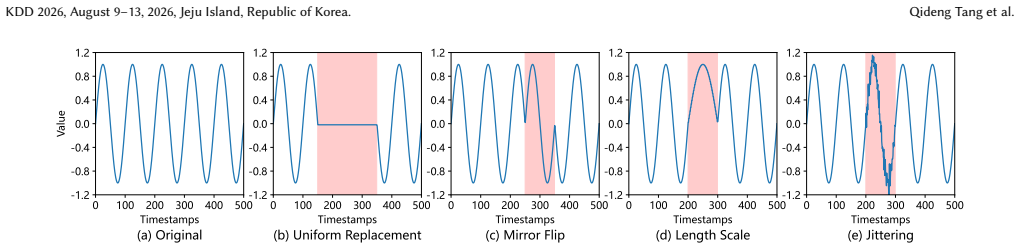
Shengsheng Lin, Weiwei Lin, Wentai Wu, Feiyu Zhao, Ruichao Mo, and Haotong Zhang. 2023. SegRNN: Segment Recurrent Neural Network for Long-Term Time Series Forecasting. arXiv:2308.11200 [cs.LG] https://arxiv.org/abs/2308.11200 A Simulated Anomalies We simulated anomalies by distorting a portion of the input time series windowX. In detail, we randomly selec...
discussion (0)
Sign in with ORCID, Apple, or X to comment. Anyone can read and Pith papers without signing in.