Photonic Violation of Wigner's Inequality
Pith reviewed 2026-06-30 05:54 UTC · model grok-4.3
The pith
A photonic setup produces data that violates Wigner's Inequality derived from set theory.
A machine-rendered reading of the paper's core claim, the machinery that carries it, and where it could break.
Core claim
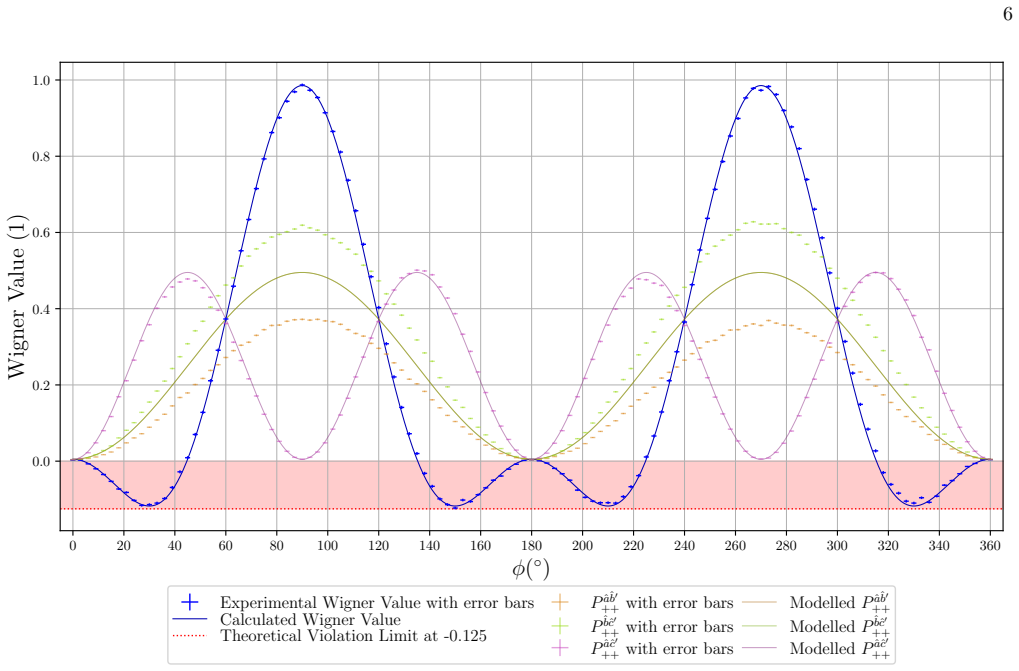
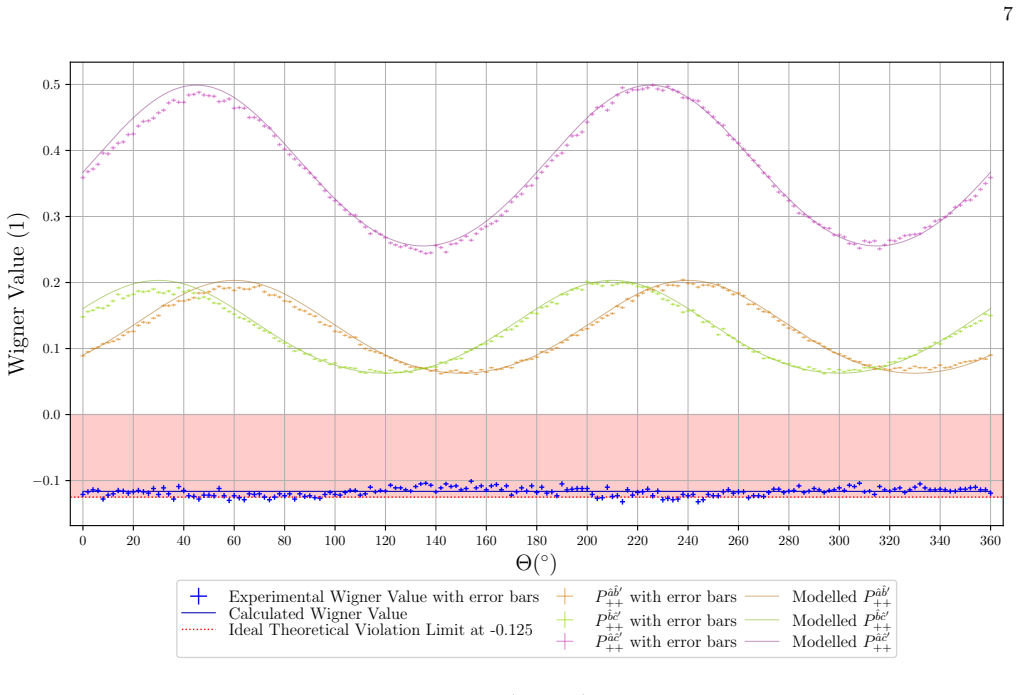
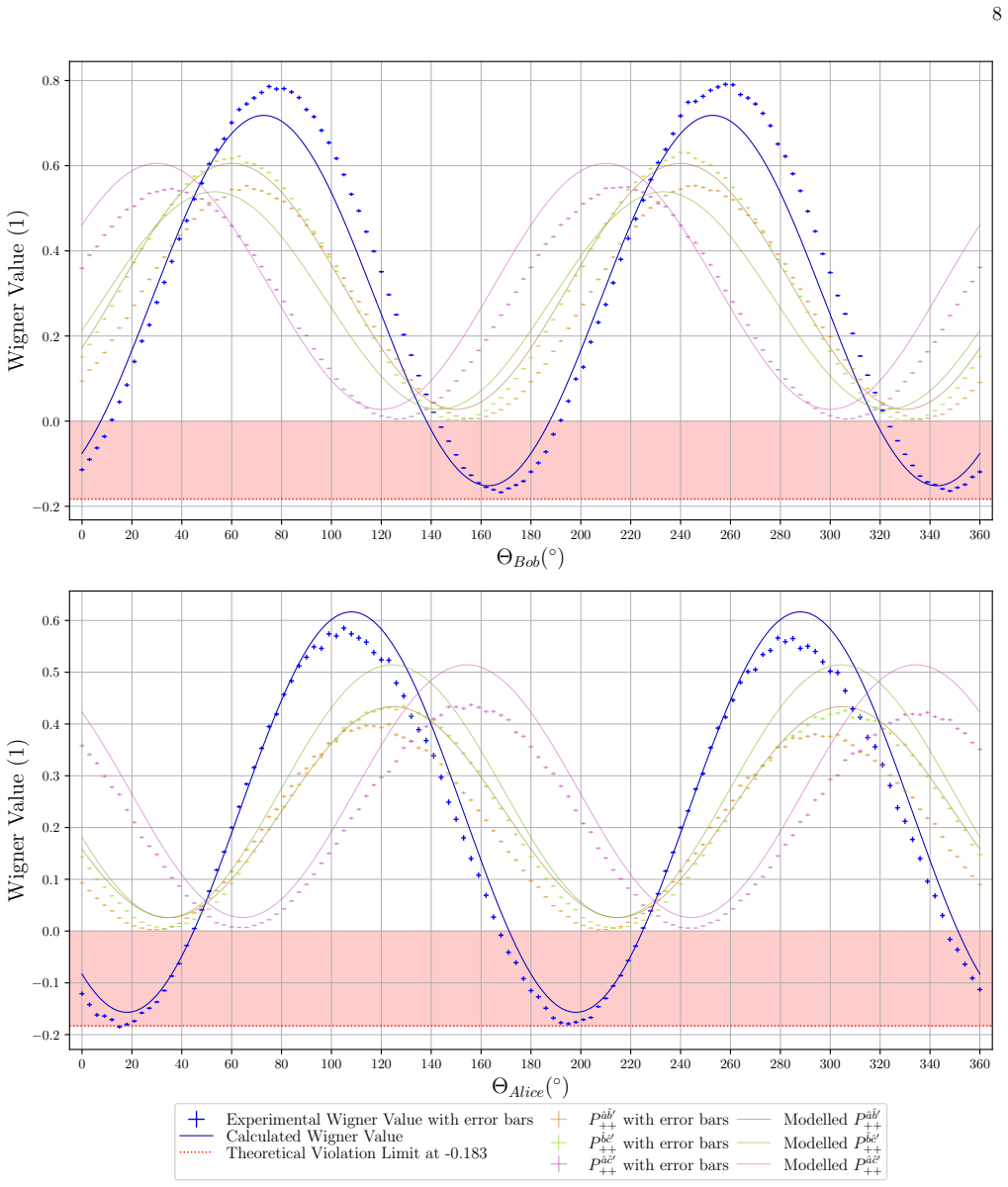
Wigner's Inequality is derived from set theory and then violated by photon-pair measurements in a quantum-optical apparatus; the supplied data exhibit correlations that lie outside the classical limit set by the inequality.
What carries the argument
Wigner's Inequality, a bound on the joint probability of three binary outcomes under the assumption that each property possesses a definite value independent of which other properties are measured.
If this is right
- Students obtain direct numerical evidence that quantum correlations exceed any classical bound obtainable from set theory.
- The same data set can be used to compute the degree of violation for different subsets of the measurement choices.
- The minimal-assumption derivation makes the conflict between the data and classical realism especially transparent.
Where Pith is reading between the lines
- Similar data releases could allow direct classroom tests of other inequalities that rest on comparable set-theoretic premises.
- The experiment isolates the minimal number of measurement settings needed to expose the conflict, which may simplify extensions to multi-particle cases.
Load-bearing premise
The photonic measurements satisfy every condition required by the set-theoretic derivation, with no undetected loopholes or residual classical variables.
What would settle it
Reprocessing the published raw data and finding that the observed joint probabilities remain inside the Wigner bound would falsify the violation claim.
Figures
read the original abstract
Teaching quantum mechanics is challenging, not least because the theory often conflicts with our classical worldview. Quantum correlations in particular are notoriously counter-intuitive. Their non-classical behavior is typically revealed through Bell-type inequalities. Among these, Wigner's Inequality constitutes a particularly accessible test, as it relies on minimal set-theoretic assumptions. In this pedagogical paper, we derive Wigner's Inequality, describe a quantum-optical setup to experimentally violate it, and provide access to the raw data, enabling students and instructors to perform their own analyses. Our measured data shows clear violations of Wigner's Inequality, directly illustrating the non-classical nature of quantum correlations. By connecting theory, experiment, and data analysis, this paper equips educators with a resource for engaging students in authentic scientific practice and developing a deeper understanding of quantum systems.
Editorial analysis
A structured set of objections, weighed in public.
Referee Report
Summary. The paper derives Wigner's Inequality from minimal set-theoretic assumptions on predetermined outcomes for three measurement settings, presents a photonic SPDC-based experimental setup to test it, and supplies raw coincidence data showing apparent violations, positioning the work as a pedagogical resource for illustrating non-classical correlations.
Significance. If the reported violations are robust under the exact conditions of the set-theoretic derivation (including fair sampling of the full ensemble), the combination of derivation, apparatus description, and open raw data would offer a concrete teaching aid for quantum foundations. The absence of free parameters in the inequality itself and the provision of raw data are positive features for reproducibility.
major comments (2)
- [Abstract, experimental description] Abstract and experimental section: the assertion that the measured data 'directly illustrates the non-classical nature of quantum correlations' is not supported without reported pair-detection efficiencies or a demonstration that the setup closes the detection loophole. Standard SPDC sources operate well below the ~83% threshold required for Wigner's Inequality; local realistic models remain compatible with the data under the fair-sampling assumption that the paper's set-theoretic derivation does not invoke.
- [Experimental methods] Experimental methods: no quantitative discussion appears of coincidence-window choices, accidental-subtraction procedures, or how undetected events are treated, all of which are load-bearing for whether the observed sample fairly represents the ensemble presupposed by the inequality.
minor comments (2)
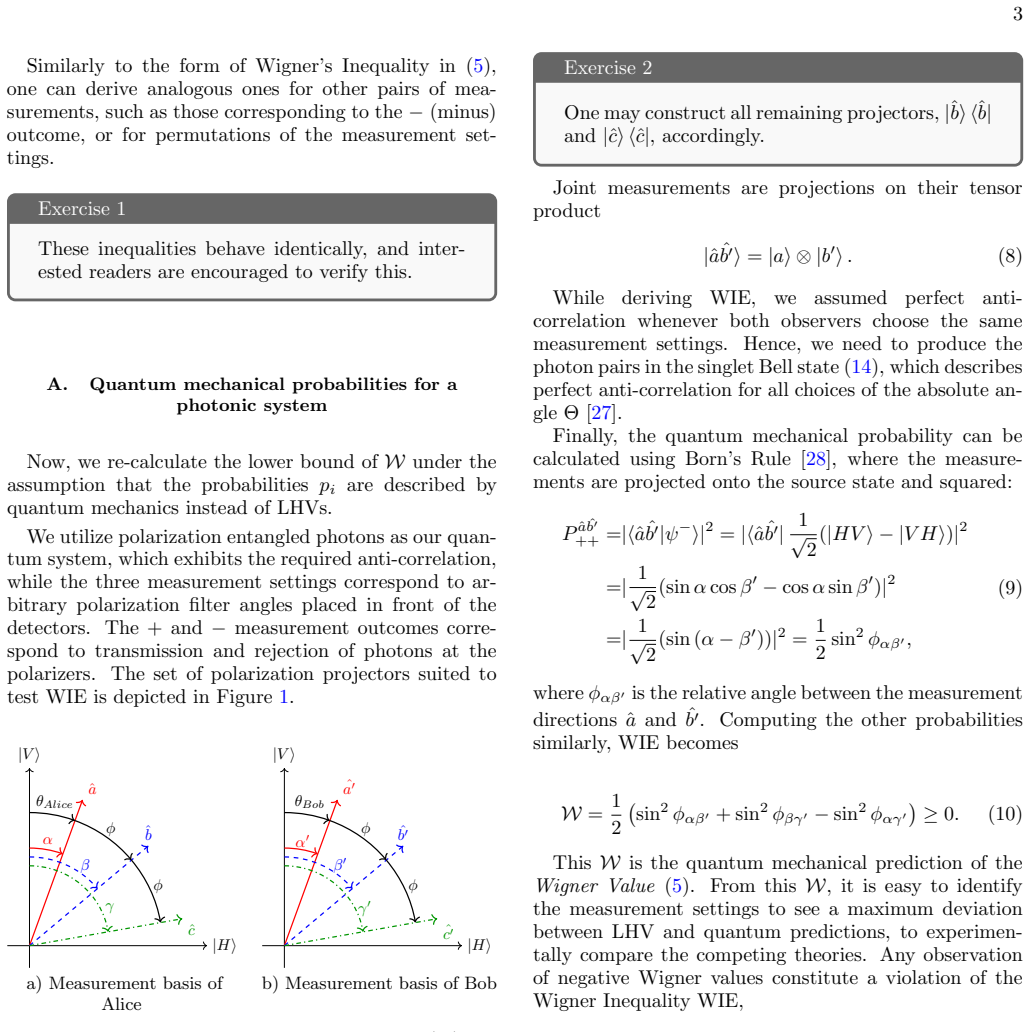
- [Theory section] Notation for the three measurement settings (A, B, C) should be introduced once with explicit reference to the corresponding polarization angles used in the apparatus.
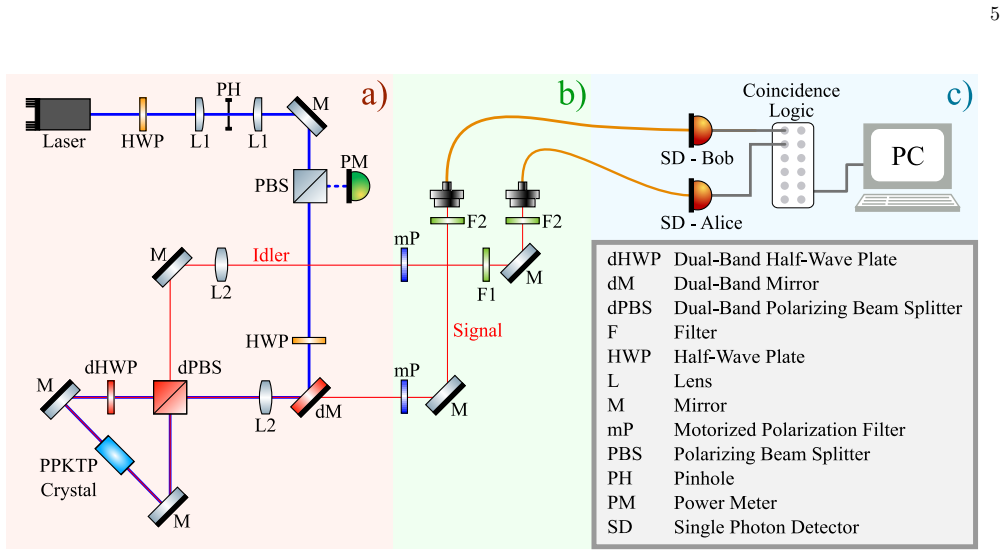
- [Figure 2] Figure captions for the setup diagram should state the source type, crystal, and filter wavelengths to allow readers to assess typical efficiencies.
Simulated Author's Rebuttal
We thank the referee for the constructive feedback, which helps clarify the scope and limitations of our pedagogical presentation. We agree that the manuscript's claims regarding the experimental results require refinement to accurately reflect the assumptions in the set-theoretic derivation versus the practical constraints of the SPDC setup. We address each major comment below and will make corresponding revisions.
read point-by-point responses
-
Referee: [Abstract, experimental description] Abstract and experimental section: the assertion that the measured data 'directly illustrates the non-classical nature of quantum correlations' is not supported without reported pair-detection efficiencies or a demonstration that the setup closes the detection loophole. Standard SPDC sources operate well below the ~83% threshold required for Wigner's Inequality; local realistic models remain compatible with the data under the fair-sampling assumption that the paper's set-theoretic derivation does not invoke.
Authors: We agree that the phrasing in the abstract and experimental section overstates the result. The derivation assumes predetermined outcomes for the full ensemble without invoking fair sampling, while the experiment relies on post-selection of detected pairs from an SPDC source whose efficiencies fall below the ~83% threshold. We will revise the abstract to state that the observed violations demonstrate non-classical correlations under the fair-sampling assumption, consistent with standard photonic tests, without claiming a loophole-free violation or direct illustration independent of that assumption. revision: yes
-
Referee: [Experimental methods] Experimental methods: no quantitative discussion appears of coincidence-window choices, accidental-subtraction procedures, or how undetected events are treated, all of which are load-bearing for whether the observed sample fairly represents the ensemble presupposed by the inequality.
Authors: We concur that these details are essential for evaluating whether the sampled data fairly represents the ensemble. The revised manuscript will add quantitative information on the chosen coincidence window, the accidental-coincidence subtraction method, and the treatment of undetected events, enabling readers to assess the validity of the fair-sampling assumption applied to the raw data. revision: yes
Circularity Check
No circularity: derivation from standard set theory, experiment reports independent data.
full rationale
The paper derives Wigner's Inequality from minimal set-theoretic assumptions on predetermined outcomes for three settings and fair sampling of the ensemble. No equations or claims reduce to author-defined parameters, self-citations, or ansatzes; the experimental section describes a conventional photonic setup and supplies raw measured counts for external analysis. The central claim of violation therefore rests on external mathematical premises and empirical observations rather than any self-referential construction.
Axiom & Free-Parameter Ledger
axioms (1)
- standard math Set-theoretic assumptions underlying Wigner's Inequality (locality and realism in the sense of definite pre-existing values)
Reference graph
Works this paper leans on
-
[1]
Einstein, B
A. Einstein, B. Podolsky, and N. Rosen, Phys. Rev.47, 777 (1935)
1935
-
[2]
J. S. Bell, Physics Physique Fizika1, 195 (1964)
1964
-
[3]
Bohr, Phys
N. Bohr, Phys. Rev.48, 696 (1935)
1935
-
[4]
E. P. Wigner, American Journal of Physics38, 1005 (1970), https://pubs.aip.org/aapt/ajp/article- abstract/38/8/1005/1043341/On-Hidden-Variables-and- Quantum-Mechanical?redirectedFrom=fulltext
1970
-
[5]
Aspect, P
A. Aspect, P. Grangier, and G. Roger, Physical Review Letters47, 460 (1981)
1981
-
[6]
Aspect, P
A. Aspect, P. Grangier, and G. Roger, Physical Review Letters49, 91 (1982)
1982
-
[7]
Aspect, J
A. Aspect, J. Dalibard, and G. Roger, Physical Review Letters49, 1804 (1982)
1982
-
[8]
S. J. Freedman and J. F. Clauser, Physical Review Let- ters28, 938 (1972)
1972
-
[9]
D. M. Greenberger, M. A. Horne, A. Shimony, and A. Zeilinger, American Journal of Physics58, 1131 (1990)
1990
-
[10]
Svetlichny, Phys
G. Svetlichny, Phys. Rev. D35, 3066 (1987)
1987
-
[11]
A. J. Leggett, Foundations of Physics33, 1469 (2003)
2003
-
[12]
Giustina, M
M. Giustina, M. A. M. Versteegh, S. Wengerowsky, J. Handsteiner, A. Hochrainer, K. Phelan, F. Steinlech- ner, J. Kofler, J.-A. Larsson, C. Abell´ an, W. Amaya, V. Pruneri, M. W. Mitchell, J. Beyer, T. Gerrits, A. E. Lita, L. K. Shalm, S. W. Nam, T. Scheidl, R. Ursin, B. Wittmann, and A. Zeilinger, Phys. Rev. Lett.115, 250401 (2015)
2015
-
[13]
Wiesner, SIGACT News15, 78–88 (1983)
S. Wiesner, SIGACT News15, 78–88 (1983)
1983
-
[14]
C. H. Bennett and G. Brassard, inProceedings of IEEE International Conference on Computers, Systems, and Signal Processing(IEEE, India, 1984) p. 175
1984
-
[15]
A. K. Ekert, Phys. Rev. Lett.67, 661 (1991)
1991
-
[16]
Liao, W.-Q
S.-K. Liao, W.-Q. Cai, J. Handsteiner, B. Liu, J. Yin, L. Zhang, D. Rauch, M. Fink, J.-G. Ren, W.-Y. Liu, Y. Li, Q. Shen, Y. Cao, F.-Z. Li, J.-F. Wang, Y.-M. Huang, L. Deng, T. Xi, L. Ma, T. Hu, L. Li, N.-L. Liu, F. Koidl, P. Wang, Y.-A. Chen, X.-B. Wang, M. Steindor- fer, G. Kirchner, C.-Y. Lu, R. Shu, R. Ursin, T. Scheidl, C.-Z. Peng, J.-Y. Wang, A. Zei...
2018
-
[17]
Pirandola, U
S. Pirandola, U. L. Andersen, L. Banchi, M. Berta, D. Bunandar, R. Colbeck, D. Englund, T. Gehring, C. Lupo, C. Ottaviani, J. L. Pereira, M. Razavi, J. Sham- sul Shaari, M. Tomamichel, V. C. Usenko, G. Vallone, P. Villoresi, and P. Wallden, Advances in Optics and Photonics12, 1012 (2020)
2020
-
[18]
Continuous-variable quantum communication
V. C. Usenko, A. Ac´ ın, R. All´ eaume, U. L. Andersen, E. Diamanti, T. Gehring, A. A. E. Hajomer, F. Kan- itschar, C. Pacher, S. Pirandola, and V. Pruneri, 10 “Continuous-variable quantum communication,” (2025), arXiv:2501.12801 [quant-ph]
work page internal anchor Pith review Pith/arXiv arXiv 2025
-
[19]
J. F. Clauser, M. A. Horne, A. Shimony, and R. A. Holt, Phys. Rev. Lett.23, 880 (1969)
1969
-
[20]
Popper,The Logic of Scientific Discovery, ISSR li- brary (Routledge, 2002)
K. Popper,The Logic of Scientific Discovery, ISSR li- brary (Routledge, 2002)
2002
-
[21]
Paterek, A
T. Paterek, A. Fedrizzi, S. Gr¨ oblacher, T. Jennewein, M. ˙Zukowski, M. Aspelmeyer, and A. Zeilinger, Phys. Rev. Lett.99, 210406 (2007)
2007
-
[22]
J. P. Lambare, Foundations of Physics52, 98 (2022)
2022
-
[23]
Castelletto, I
S. Castelletto, I. P. Degiovanni, and M. L. Rastello, Phys. Rev. A67, 044303 (2003)
2003
-
[24]
F. A. Bovino, A. M. Colla, G. Castagnoli, S. Castelletto, I. P. Degiovanni, and M. L. Rastello, Phys. Rev. A68, 034309 (2003)
2003
-
[25]
F. A. Bovino and I. P. Degiovanni, Phys. Rev. A77, 052110 (2008)
2008
-
[26]
Violation of a new Wigner inequality with high angular momenta
W. N. Plick, R. Fickler, R. Lapkiewicz, and S. Ramelow, “Violation of a new wigner inequality with high angular momenta,” (2015), arXiv:1304.2197 [quant-ph]
work page internal anchor Pith review Pith/arXiv arXiv 2015
-
[27]
M. A. Nielsen and I. L. Chuang,Quantum Computation and Quantum Information(Cambridge University Press, Cambridge, 2010)
2010
-
[28]
Born, Zeitschrift f¨ ur Physik37, 863 (1926)
M. Born, Zeitschrift f¨ ur Physik37, 863 (1926)
1926
-
[29]
D. J. Griffiths and D. F. Schroeter,Introduction to Quan- tum Mechanics, 3rd ed. (Cambridge University Press, 2018)
2018
-
[30]
Componentlibrary,
A. Franzen, “Componentlibrary,” (2009)
2009
-
[31]
Shi and A
B.-S. Shi and A. Tomita, Phys. Rev. A69, 013803 (2004)
2004
-
[32]
T. Kim, M. Fiorentino, and F. N. C. Wong, Phys. Rev. A73, 012316 (2006)
2006
-
[33]
Hentschel, H
M. Hentschel, H. H¨ ubel, A. Poppe, and A. Zeilinger, Opt. Express17, 23153 (2009)
2009
-
[34]
A. Anwar, C. Perumangatt, F. Steinlechner, T. Jen- newein, and A. Ling, Review of Scientific Instruments 92(2021), 10.1063/5.0023103
discussion (0)
Sign in with ORCID, Apple, or X to comment. Anyone can read and Pith papers without signing in.