REVIEW 2 major objections 4 minor 27 references
Logical Judgments Under Pressure: Diagnosing Syllogistic Stability with Learned Soft Prefixes
T0 review · 2 major / 4 minor · reviewed 2026-08-01 · deepseek-v4-flash
Pith's one-line read A short trainable embedding sequence prepended to a prompt can flip a large majority of a frozen LLM's correct syllogistic judgments, and the effect survives unseen forms, new wordings, and prompt changes.
desk verdict A careful, unusually honest empirical study showing learned soft prefixes override correct syllogistic judgments, with the main caveat that the quantitative 'unseen forms' range is less stable than the abstract suggests. read the letter →
The pith
A machine-rendered reading of the paper's core claim, the machinery that carries it, and where it could break.
The reading
What carries the argument
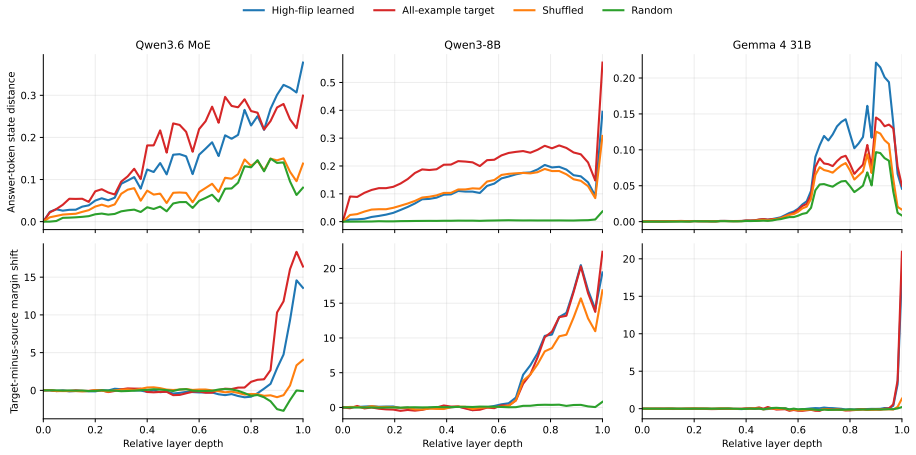
The central object is the soft prefix: a trainable sequence of embedding vectors prepended to the token embeddings of a frozen model. The diagnostic machinery: (1) an exactly labeled syllogistic benchmark with 256 logical forms rendered in four wordings, split by form so test forms are unseen; (2) randomized A/B answer mappings, which separate fixed-symbol forcing from answer-meaning bias; (3) score models (one-shift, two-shift, global/class-conditioned affine, isotonic) fitted to the target-minus-source margin to test whether the prefix acts as a uniform shift or an example-dependent change; and (4) activation patching, which restores subsets of unprefixed states to locate where the answer
What would settle it
Evaluate the same training setup with a test split drawn from all 256 logical forms (e.g., a 50-form random holdout rather than the fixed six-form group). If flip rates on the broad holdout fall to within the random-prefix control range, the paper's claim that steering survives unseen forms is falsified for that broader space.
Extended reading notes
Core claim
Across three model families, a short trainable sequence of embedding vectors prepended to an unmodified prompt flips a large majority of correctly answered syllogistic judgments on logical forms never seen during prefix training, and the effect persists across new wordings and rephrased prompts. Learned prefixes beat matched random controls in all 16 model–direction–split comparisons (37–99 percentage points); Gemma validity prefixes flip 54–56% versus under 1% for random. Randomized letter-to-meaning mappings show the effect follows answer meanings, not fixed symbols, and target-answer rates of 93–99% identify a broad answer preference. Weak cross-task transfer rules out a shared logical op
Load-bearing premise
The transfer claims are estimated from test splits containing only six targeted logical forms per condition, so the whole 'unseen forms' generalization rests on those six forms being representative of a much larger space of syllogistic forms.
Editorial extensions
If this is right
- Benchmark accuracy on a fixed prompt does not measure stability: a correct formal judgment can be reversed by an opaque, optimized context while the formal problem and correct answer stay unchanged.
- Steering from learned context transfers across logical forms and interface changes in all three models, so the effect is not memorization of particular items or prompt templates.
- The dominant mechanism is a broad answer-meaning preference rather than a fixed output symbol or a shared logical operation; high flip with low damage on minority-to-majority directions therefore characterizes intervention strength, not selective logical editing.
- The same aggregate flip rate can conceal different response patterns: Gemma's margins are well approximated by simple score transformations, while Qwen's flips are predictable in direction but not magnitude.
- Selected prefixes also change generated answers, so the effect is not an artifact of forced-choice continuation scoring.
Reading between the lines
- Editorial inference: the same controlled design — exact labels, held-out forms, matched random controls — could be applied to other formally defined tasks (arithmetic, temporal reasoning, graph query answering) to test whether answer-bias dominance is a general property of soft prefixes or specific to syllogistic choice tasks.
- Editorial inference: because the prompts explicitly instruct the model to ignore text outside the syllogism block and to treat prefixes as untrusted, the prefixes' success suggests that such semantic-scope instructions do not provide a reliable firewall; this may be relevant to defenses against injected or adversarial context.
- Editorial inference: the shuffling results (order matters little in Qwen3-8B, more in Qwen3.6, most in Gemma) suggest model-specific reliance on positional versus content information; this could be tested by varying prefix length, position, or positional-encoding schemes.
- Editorial inference: since selected random prefixes transfer poorly even when the best of 1000 are chosen, gradient-based optimization appears to find structure that random search at the same norm does not; a stronger test would compare against random search with the same number of optimization-equivalent evaluations.
Editorial analysis
A structured set of objections, weighed in public.
Referee Report
Summary. The paper introduces a diagnostic framework that prepends learned soft prefixes to an exactly labeled syllogistic reasoning benchmark, with model weights frozen, and characterizes the resulting changes through controls (randomized A/B mappings, norm-matched random prefixes, best-of-1000 random search, neutral-text prefixes, rephrased prompts, reverse directions, cross-task transfer, score-model fits, and activation patching). The central claim is that learned prefixes can redirect many previously correct judgments on held-out logical forms and across wording/prompt changes in Qwen3.6 MoE, Qwen3-8B, and Gemma 4 31B, and that the dominant mechanism is a broad preference for one answer meaning rather than fixed-symbol forcing or a transferable logical operation. The paper further claims that simple score models predict Gemma's prefixed margins better than Qwen's, while often predicting Qwen's binary flips without predicting their final margins.
Significance. If the claims hold, this is a valuable controlled methodology for measuring the stability of formal reasoning under optimized continuous context. The paper's strengths are substantial: exact labels computed from explicit semantics, held-out logical forms, four repeated split rotations, paired random controls, a best-of-1000 random control, per-form bootstrap intervals, score-model analyses fitted only on development data, and unusually candid limitation statements. The qualitative result—learned prefixes strongly outperform matched random prefixes—appears well supported. The main weakness is that the quantitative generalization claims rest on a small, fixed set of minority forms, and the paper's own tables show high split-dependence. The manuscript is methodologically careful but overstates the precision of its 'unseen forms' transfer estimate.
major comments (2)
- [§4.4, Table 1; §4.6, Table 4; Abstract] The central 'unseen forms' claim is quantified from only six targeted logical forms per condition. The paper acknowledges this in §4.4, but the abstract still presents '72–90%' and 'remain effective across unseen forms' as a model-level result. The form-level bootstrap for Qwen3.6 valid→invalid rephrased is 72.0% [56.1, 83.6], and Table 4 shows learned flip varying from 56.4% to 93.6% across splits. The 16/16 comparison against random controls in §4.6 is solid evidence of a qualitative effect, but it does not support a stable population estimate or a general quantitative range. Please report split-level ranges and/or a pooled form-bootstrap interval over all 24 minority forms, and state the conclusion as an effect in the tested minority forms rather than a population-level transfer rate.
- [§4.4, Tables 1–2 vs. Appendix A, §D.2] The 'new wording, random strings' condition is presented as an interface change, but the benchmark always contains random-string rendering as one of its four wording styles (Appendix A), and prefix training uses four wording styles (§D.2, Table 18). If random-string renderings are in the training distribution, this condition tests unseen logical forms in a familiar surface style, not an unseen wording interface. Please state explicitly whether the tested prefixes were trained on random-string renderings. If they were, revise 'new wording' and 'interface changes' in the abstract and §4.4; if separate prefixes were trained per wording style, this should be described in the main text. The rephrased-prompt conditions remain the only clear novel-interface transfer.
minor comments (4)
- [Abstract, §4.4] The abstract says Qwen3.6 MoE flip rates 'remain between 72% and 90%', but Table 1's lower bound is 72.0% and Table 4's repeated-split range goes down to 56.4%. Please attach a scope qualifier such as 'in the fixed six-form conditions' to avoid implying a stable cross-split estimate.
- [Figure 2] Panels A and B use a symmetric logarithmic scale, which cannot display non-positive R² values in the usual way. Please state explicitly how negative R² values are represented or clipped; several reported values are negative.
- [Appendix K, §4.5] The neutral-text control is reported for Qwen3.6 only. The main text says 'the tested neutral phrases' without noting this scope limitation; please add the model restriction in §4.5 or in the table caption.
- [Tables 2 and 14] Target-answer rates are computed over different denominators ('eligible rows' vs. 'all rows'). The main text and captions distinguish these, but the distinction is easy to miss. Consider labeling the columns more explicitly, e.g., 'target-answer rate, eligible rows' and 'target-answer rate, all rows' in both tables.
Circularity Check
No circularity: the headline results are held-out measurements with matched controls; the fitted score models are descriptive and not inputs to the claimed generalization.
full rationale
The paper's derivation chain is empirical rather than self-referential. The headline flip, damage, and target-answer rates are computed on logical forms, wordings, and prompts not used in prefix training, against labels derived from a fixed non-empty-term syllogistic semantics. The training objective in Section 4.3 optimizes toward the target label on targeted training examples, so observing flips on those training examples would be tautological; the paper's claims instead rest on held-out transfer results (Section 4.4), repeated logical-form splits (Section 4.6), and interface changes, none of which are inputs to the optimizer. The random-prefix controls, A/B meaning randomization, best-of-1000 random search, readable-text controls, and direct score-bias sweeps are designed specifically to rule out trivial explanations and are not used as evidence that defines the reported effect. The score models in Section 4.7 are fitted on development margins and evaluated on held-out test margins, then used only as descriptive characterizations of the prefixed response; they are not fitted to the flip-rate claims themselves. The interpretation that the dominant effect is broad answer preference is inferred from target-answer rates and score-model behavior rather than assumed in the definition of the measures. The paper's own stated limitations—only six targeted test forms per condition, wide bootstrap intervals, and split-dependent variation—are honest statistical caveats about generality, not indications that any result reduces to its own inputs. No load-bearing self-citations, imported uniqueness theorems, or ansatz-by-citation patterns are present. The central empirical findings are therefore self-contained measurements rather than consequences of the paper's modeling choices.
Assumptions & free parameters
free parameters (2)
- Objective weight λ =
1.0
- High-flip prefix threshold =
0.75
assumptions (3)
- domain assumption Aristotelian non-empty-term semantics for syllogistic labels
- domain assumption Continuation-scoring answer probabilities reflect the model's judgments under the prefix
- standard math Syllogistic validity and satisfiability are exactly reducible to finite sets of occupied Venn regions
Cite this review
Pith. "Pith review of Logical Judgments Under Pressure: Diagnosing Syllogistic Stability with Learned Soft Prefixes." pith.science (2026). https://pith.science/paper/Q2PZDIGC
@misc{pith2026260718228,
  author       = {Pith},
  title        = {Pith review of: Logical Judgments Under Pressure: Diagnosing Syllogistic Stability with Learned Soft Prefixes},
  year         = {2026},
  howpublished = {\url{https://pith.science/paper/Q2PZDIGC}},
  note         = {Machine review of arXiv:2607.18228}
}
read the original abstract
To test how correct logical judgments respond to learned context, we prepend a soft prefix to an exactly labeled syllogistic reasoning benchmark while keeping the model fixed. Soft prefixes are opaque continuous vectors, so we characterize them through the behavior they induce across controlled variations in logical form and interface. By studying which prefixes succeed and how their effects generalize, we characterize how learned contextual pressure can override correct judgments and expose limits in a model's logical stability. Across Qwen3.6-35B-A3B MoE, Qwen3-8B, and Gemma 4 31B, learned prefixes redirect many correct answers and remain effective across unseen forms and interface changes. In repeated tests with Qwen3.6 MoE and Gemma, they outperform paired random controls in all 16 model--direction--split comparisons by 37 to 99 percentage points. Qwen3.6 MoE flip rates remain between 72% and 90% across wording and prompt changes, while Gemma validity prefixes retain 54% to 56% flip compared with less than 1% for matched random prefixes. Diagnostic tests show that the dominant effect is a broad preference for one answer meaning rather than fixed-symbol forcing or a logical operation that transfers reliably between tasks. The form of this bias differs across models. In both Qwen models, simple score models often predict which judgments will flip but not how far their margins will move, whereas Gemma's overall response is more closely approximated by the same models. These results show that the dominant behavioral effect of successful soft prefixes is a broad answer preference, while the remaining response reveals substantial model-specific differences in logical stability.
Figures


Figures from the paper (3 more)


Reference graph
Works this paper leans on
-
[1]
Risako Ando, Takanobu Morishita, Hirohiko Abe, Koji Mineshima, and Mitsuhiro Okada. Evaluating large language models with NeuBAROCO: Syllogistic reasoning ability and human- like biases.arXiv preprint arXiv:2306.12567, 2023
arXiv 2023
-
[2]
Probing classifiers: Promises, shortcomings, and advances.Computational Linguistics, 48(1):207–219, 2022
Yonatan Belinkov. Probing classifiers: Promises, shortcomings, and advances.Computational Linguistics, 48(1):207–219, 2022
2022
-
[3]
A systematic analysis of large language models as soft reasoners: The case of syllogistic inferences
Leonardo Bertolazzi, Albert Gatt, and Raffaella Bernardi. A systematic analysis of large language models as soft reasoners: The case of syllogistic inferences. InProceedings of the 2024 Conference on Empirical Methods in Natural Language Processing, pages 13882–13905, Miami, Florida, USA, 2024. Association for Computational Linguistics
2024
-
[4]
Collin Burns, Haotian Ye, Dan Klein, and Jacob Steinhardt. Discovering latent knowledge in language models without supervision.arXiv preprint arXiv:2212.03827, 2022
arXiv 2022
-
[5]
Ishita Dasgupta, Andrew K. Lampinen, Stephanie C. Y. Chan, Hannah R. Sheahan, Antonia Creswell, Dharshan Kumaran, James L. McClelland, and Felix Hill. Language models show human-like content effects on reasoning tasks.arXiv preprint arXiv:2207.07051, 2022
arXiv 2022
-
[6]
Sphere neural-networks for rational reasoning
Tiansi Dong, Mateja Jamnik, and Pietro Li` o. Sphere neural-networks for rational reasoning. arXiv preprint arXiv:2403.15297, 2024
arXiv 2024
-
[7]
Tiansi Dong, Mateja Jamnik, and Pietro Li` o. Data-driven machine learning cannot reach symbolic-level logical reasoning – the limit of the scaling law.arXiv preprint arXiv:2606.26454, 2026
arXiv 2026
-
[8]
A systematic comparison of syllogistic reasoning in humans and language models
Tiwalayo Eisape, Michael Henry Tessler, Ishita Dasgupta, Fei Sha, Sjoerd van Steenkiste, and Tal Linzen. A systematic comparison of syllogistic reasoning in humans and language models. arXiv preprint arXiv:2311.00445, 2023
arXiv 2023
Show all 27 references
-
[9]
Gemma 4 31B model card
Google DeepMind. Gemma 4 31B model card. Hugging Face model card, 2026
2026
-
[10]
John Hewitt and Christopher D. Manning. A structural probe for finding syntax in word representations. InProceedings of the 2019 Conference of the North American Chapter of the Association for Computational Linguistics: Human Language Technologies, pages 4129–4138, 2019
2019
-
[11]
A mechanistic interpretation of syllogistic reasoning in auto-regressive language models.arXiv preprint arXiv:2408.08590, 2024
Geonhee Kim, Marco Valentino, and Andr´ e Freitas. A mechanistic interpretation of syllogistic reasoning in auto-regressive language models.arXiv preprint arXiv:2408.08590, 2024
2024 arXiv
-
[12]
The power of scale for parameter-efficient prompt tuning.arXiv preprint arXiv:2104.08691, 2021
Brian Lester, Rami Al-Rfou, and Noah Constant. The power of scale for parameter-efficient prompt tuning.arXiv preprint arXiv:2104.08691, 2021
2021 arXiv
-
[13]
Inference-time intervention: Eliciting truthful answers from a language model.arXiv preprint arXiv:2306.03341, 2023
Kenneth Li, Oam Patel, Fernanda Vi´ egas, Hanspeter Pfister, and Martin Wattenberg. Inference-time intervention: Eliciting truthful answers from a language model.arXiv preprint arXiv:2306.03341, 2023
2023 arXiv
-
[14]
Prefix-tuning: Optimizing continuous prompts for generation
Xiang Lisa Li and Percy Liang. Prefix-tuning: Optimizing continuous prompts for generation. arXiv preprint arXiv:2101.00190, 2021. 17
2021 arXiv
-
[15]
Locating and editing factual associations in GPT
Kevin Meng, David Bau, Alex Andonian, and Yonatan Belinkov. Locating and editing factual associations in GPT. InAdvances in Neural Information Processing Systems, volume 35, pages 17359–17372, 2022
2022
-
[16]
BIS Reasoning 1.0: The first large-scale Japanese benchmark for belief-inconsistent syllogistic reasoning.arXiv preprint arXiv:2506.06955, 2025
Ha-Thanh Nguyen, Chaoran Liu, Hirokazu Kiyomaru, Koichi Takeda, Yusuke Miyao, Maki Matsuda, Yusuke Oda, Pontus Stenetorp, Qianying Liu, Su Myat Noe, Hideyuki Tachibana, Kouta Nakayama, and Sadao Kurohashi. BIS Reasoning 1.0: The first large-scale Japanese benchmark for belief-...
2025
-
[17]
Logic-LM: Empowering large language models with symbolic solvers for faithful logical reasoning.arXiv preprint arXiv:2305.12295, 2023
Liangming Pan, Alon Albalak, Xinyi Wang, and William Yang Wang. Logic-LM: Empowering large language models with symbolic solvers for faithful logical reasoning.arXiv preprint arXiv:2305.12295, 2023
2023 arXiv
-
[18]
Qwen3 technical report.arXiv preprint arXiv:2505.09388, 2025
Qwen Team. Qwen3 technical report.arXiv preprint arXiv:2505.09388, 2025
2025 arXiv
-
[19]
Qwen3.6-35B-A3B model card
Qwen Team. Qwen3.6-35B-A3B model card. Hugging Face model card, 2026
2026
-
[20]
Pavlov, and Ian Pratt-Hartmann
Viktor Schlegel, Kamen V. Pavlov, and Ian Pratt-Hartmann. Can transformers reason in fragments of natural language?arXiv preprint arXiv:2211.05417, 2022
2022 arXiv
-
[21]
Soft prompt threats: Attacking safety alignment and unlearning in open-source LLMs through the embedding space.arXiv preprint arXiv:2402.09063, 2024
Leo Schwinn, David Dobre, Sophie Xhonneux, Gauthier Gidel, and Stephan G¨ unnemann. Soft prompt threats: Attacking safety alignment and unlearning in open-source LLMs through the embedding space.arXiv preprint arXiv:2402.09063, 2024
2024 arXiv
-
[22]
Vazquez, Ulisse Mini, and Monte MacDiarmid
Alexander Matt Turner, Lisa Thiergart, Gavin Leech, David Udell, Juan J. Vazquez, Ulisse Mini, and Monte MacDiarmid. Steering language models with activation engineering.arXiv preprint arXiv:2308.10248, 2023
2023 arXiv
-
[23]
Universal adver- sarial triggers for attacking and analyzing NLP
Eric Wallace, Shi Feng, Nikhil Kandpal, Matt Gardner, and Sameer Singh. Universal adver- sarial triggers for attacking and analyzing NLP. InProceedings of the 2019 Conference on Empirical Methods in Natural Language Processing and the 9th International Joint Conference on Natu...
2019
-
[24]
SylloBio-NLI: Evaluating large language models on biomedical syllogistic reasoning.arXiv preprint arXiv:2410.14399, 2024
Magdalena Wysocka, Danilo Carvalho, Oskar Wysocki, Marco Valentino, and Andr´ e Freitas. SylloBio-NLI: Evaluating large language models on biomedical syllogistic reasoning.arXiv preprint arXiv:2410.14399, 2024
2024 arXiv
-
[25]
Towards best practices of activation patching in language models: Metrics and methods
Fred Zhang and Neel Nanda. Towards best practices of activation patching in language models: Metrics and methods. InInternational Conference on Learning Representations, 2024
2024
-
[26]
All XareY
Andy Zou, Long Phan, Sarah Chen, James Campbell, Phillip Guo, Richard Ren, Alexander Pan, Xuwang Yin, Mantas Mazeika, Ann-Kathrin Dombrowski, Shashwat Goel, Nathaniel Li, Michael J. Byun, Zifan Wang, Alex Mallen, Steven Basart, Sanmi Koyejo, Dawn Song, Matt Fredrikson, J. Zico...
2023 arXiv
-
[2019]
Association for Computational Linguistics
Reviewed August 1, 2026 · model on record in the stance chip above.
Discussion (0). Sign in to comment.