Geometric Decoherence Time in Lindbladian Dynamics
Pith reviewed 2026-06-28 13:58 UTC · model grok-4.3
The pith
The geometric decoherence time is the first moment the exact relation between logarithmic negativity and Rényi-1/2 entropy breaks under Lindbladian evolution.
A machine-rendered reading of the paper's core claim, the machinery that carries it, and where it could break.
Core claim
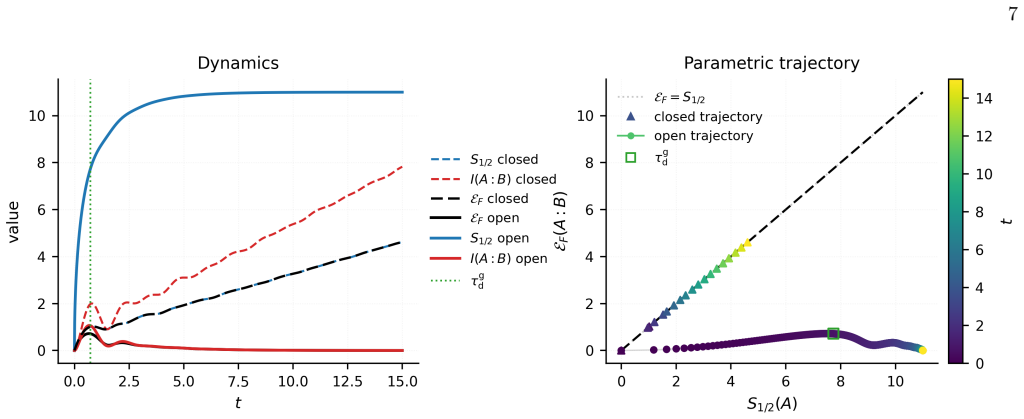
The geometric decoherence time is introduced as the earliest moment the monotone relation between logarithmic negativity and Rényi-1/2 entropy breaks down under open-system evolution, signaling entropy growth without accompanying entanglement growth. This criterion is established in both single-particle Gaussian dynamics and many-body Lindbladian evolution. Quantum mutual information provides a complementary long-time diagnostic whose asymptotic vanishing is equivalent to factorization of the steady state across the bipartition. In the Kitaev chain with balanced gain and loss a closed-form solution shows that the topological phase sustains longer coherence times than the trivial phase at ide
What carries the argument
The geometric decoherence time, defined as the earliest time at which the monotone relation between logarithmic negativity and Rényi-1/2 entropy breaks under Lindbladian evolution.
If this is right
- Quantum mutual information vanishes asymptotically if and only if the steady state factorizes across the bipartition.
- When a product steady state is approached exponentially in trace norm, negativity and mutual information share the same decay rate.
- Strong symmetries allow residual classical correlations to survive after entanglement has vanished, breaking the mutual-information tracking of negativity.
- In the Kitaev chain with balanced gain and loss the topological phase exhibits longer geometric decoherence times than the trivial phase at identical dissipation.
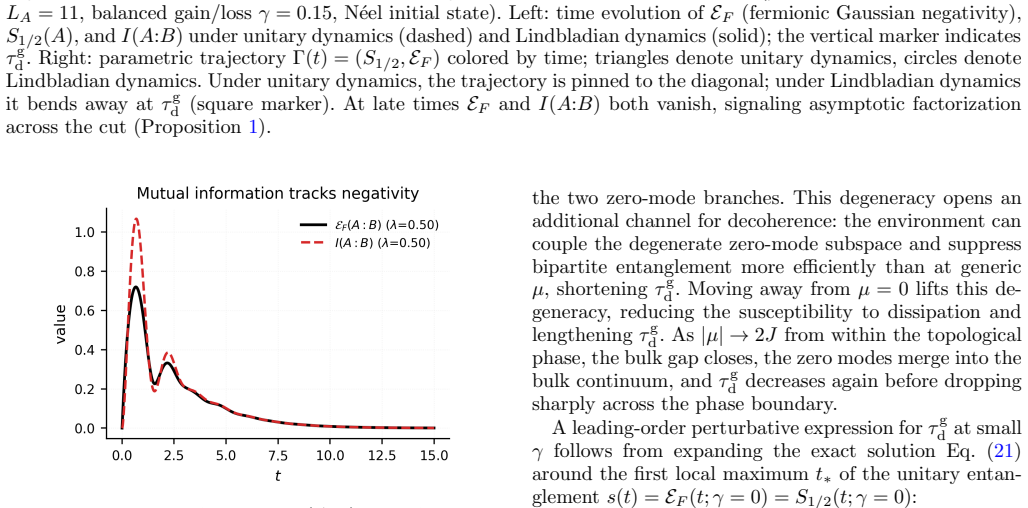
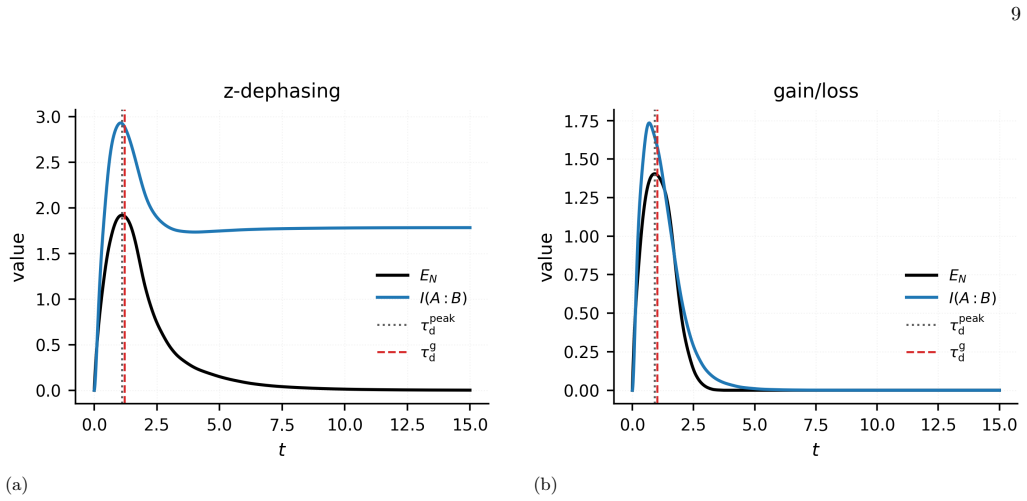
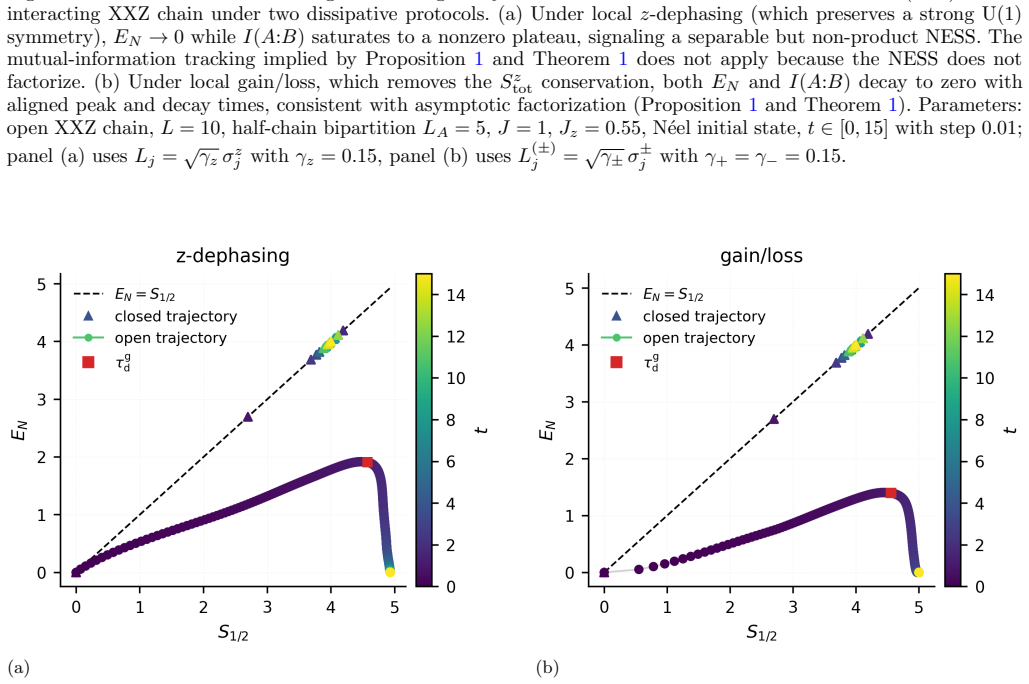
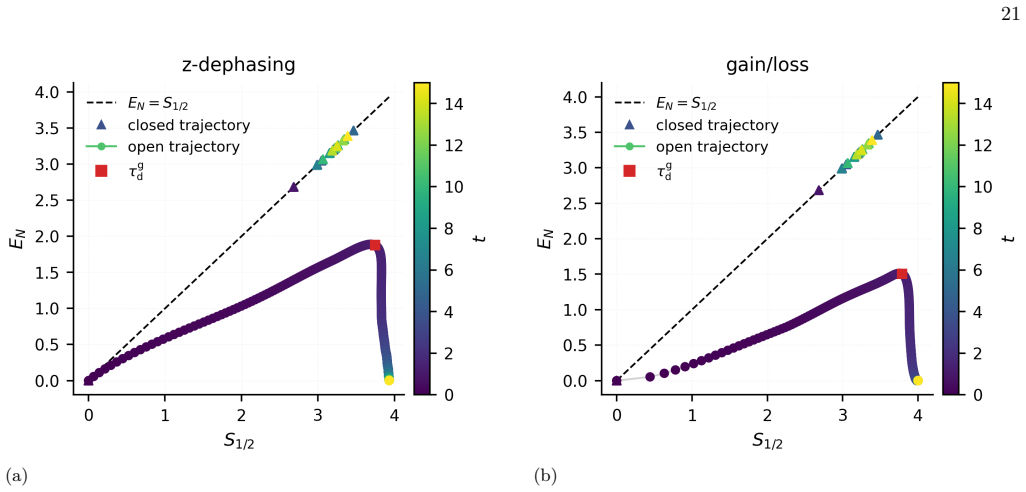
- Local Z-dephasing in the XXZ chain preserves residual classical correlations while gain and loss restore mutual-information tracking of negativity.
Where Pith is reading between the lines
- The geometric decoherence time could serve as a practical figure of merit for tuning dissipation strengths in engineered open quantum systems to prolong coherence.
- The concept may generalize to other entanglement monotones beyond logarithmic negativity, yielding alternative decoherence timescales.
- Experimental protocols that measure both negativity and Rényi entropy in real time could directly extract the geometric decoherence time in platforms with controllable Lindblad operators.
- The distinction between topological and trivial phases in coherence time suggests that topological protection may extend to open-system timescales in driven-dissipative settings.
Load-bearing premise
The assumption that the monotone relation between logarithmic negativity and Rényi-1/2 entropy holds exactly for all pure states and that its first breakdown under Lindbladian evolution is both well-defined and physically meaningful as the onset of decoherence.
What would settle it
Numerical integration of the Lindbladian for the Kitaev chain showing whether the computed geometric decoherence time is longer in the topological phase than in the trivial phase at the same dissipation strength, as predicted by the closed-form solution.
Figures



read the original abstract
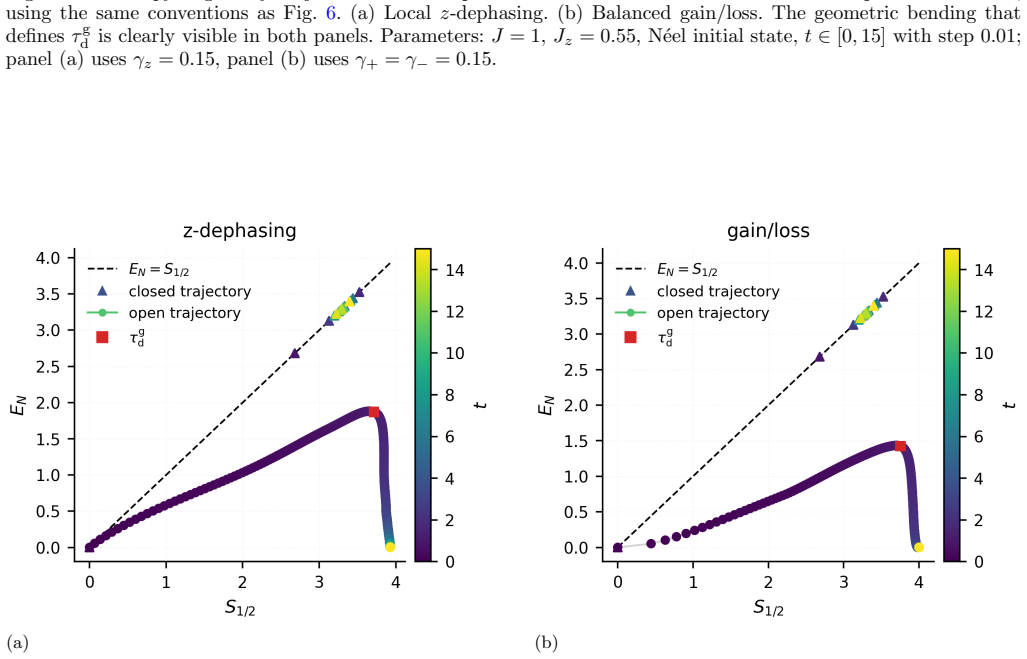
The onset of decoherence in open many-body systems lacks a dynamical timescale grounded in the loss of bipartite entanglement. Here, we introduce the $geometric$ $decoherence$ $time$, defined as the earliest moment the monotone relation between logarithmic negativity and R\'{e}nyi-$\tfrac{1}{2}$ entropy -- exactly equal across any bipartition for pure states -- breaks down under open-system evolution, signaling entropy growth without accompanying entanglement growth. We establish this criterion in both single-particle Gaussian dynamics and many-body Lindbladian evolution. We show that quantum mutual information provides a complementary long-time diagnostic: its asymptotic vanishing is equivalent to factorization of the steady state across the bipartition, a condition strictly stronger than separability, and whenever a product steady state is approached exponentially in trace norm, negativity and mutual information share the same decay rate. In the presence of a strong symmetry, this tracking can fail -- residual classical correlations can survive after entanglement has vanished. In the Kitaev chain with balanced gain and loss, we derive a closed-form solution and show that the topological phase sustains longer coherence times than the trivial phase at identical dissipation, with a local minimum at the chiral-symmetric point. In the interacting XXZ chain, exact many-body evolution shows that local $Z$-dephasing preserves residual classical correlations, whereas gain and loss restore the mutual-information tracking of negativity. Our results establish the geometric decoherence time as a dynamical scale tracking the onset of decoherence.
Editorial analysis
A structured set of objections, weighed in public.
Referee Report
Summary. The manuscript introduces the geometric decoherence time as the earliest moment at which the equality between logarithmic negativity E_N and Rényi-1/2 entropy S_{1/2} (which holds exactly for pure states across any bipartition) breaks down under Lindbladian evolution, interpreted as the onset of decoherence via entropy growth without entanglement growth. It derives closed-form expressions for single-particle Gaussian and many-body Kitaev-chain dynamics with balanced gain/loss, reports that the topological phase exhibits longer coherence times than the trivial phase at fixed dissipation (with a local minimum at the chiral-symmetric point), presents exact many-body numerics for the interacting XXZ chain under Z-dephasing versus gain/loss, and shows that quantum mutual information provides a complementary long-time diagnostic whose exponential decay tracks negativity when the steady state factorizes.
Significance. If the central definition is made rigorous, the geometric decoherence time supplies a new, entanglement-grounded dynamical scale for decoherence onset that can distinguish topological from trivial phases under identical dissipation. The closed-form Kitaev solution and the exact XXZ evolution constitute concrete, falsifiable results that strengthen the contribution.
major comments (1)
- [Abstract and Kitaev section] Abstract and § on Kitaev chain: the definition of geometric decoherence time as the 'earliest moment' the monotone relation E_N = S_{1/2} breaks down is not equipped with an explicit, threshold-independent detection rule. Both quantities are continuous in t, coincide at t=0, and generically separate for any t>0 under nonzero Lindblad operators; without a stated criterion (e.g., first nonzero derivative of |E_N(t)−S_{1/2}(t)| or |E_N−S_{1/2}| exceeding a fixed ε independent of numerical cutoff), the reported phase-dependent times rest on an incompletely specified procedure and are therefore not yet load-bearing for the central claim.
Simulated Author's Rebuttal
We thank the referee for the careful reading and for identifying the need for a more precise operational definition of the geometric decoherence time. We address the major comment below.
read point-by-point responses
-
Referee: [Abstract and Kitaev section] Abstract and § on Kitaev chain: the definition of geometric decoherence time as the 'earliest moment' the monotone relation E_N = S_{1/2} breaks down is not equipped with an explicit, threshold-independent detection rule. Both quantities are continuous in t, coincide at t=0, and generically separate for any t>0 under nonzero Lindblad operators; without a stated criterion (e.g., first nonzero derivative of |E_N(t)−S_{1/2}(t)| or |E_N−S_{1/2}| exceeding a fixed ε independent of numerical cutoff), the reported phase-dependent times rest on an incompletely specified procedure and are therefore not yet load-bearing for the central claim.
Authors: We agree that the original definition requires an explicit, reproducible detection rule to be fully rigorous. In the revised manuscript we will define the geometric decoherence time τ_g as the infimum of times t>0 at which |E_N(t)−S_{1/2}(t)| exceeds a fixed numerical threshold ε=10^{-10}, chosen once and for all to lie well above machine precision and independent of model parameters or numerical cutoff. This criterion will be stated in the abstract, the introductory section, and the Kitaev-chain section. For the closed-form Gaussian solutions of the Kitaev chain the analytic expressions for E_N(t) and S_{1/2}(t) permit direct evaluation of τ_g without ambiguity; the same threshold will be applied uniformly to the numerical XXZ data. We will also add a short robustness check confirming that the reported ordering of coherence times between topological and trivial phases is insensitive to modest variations of ε around the chosen value. revision: yes
Circularity Check
No circularity: definition relies on independently established pure-state equality without reduction to fits or self-citations
full rationale
The paper defines the geometric decoherence time directly from the breakdown of the known equality between logarithmic negativity and Rényi-1/2 entropy that holds exactly for pure states (due to the relation ||ρ^{T_A}||_1 = [Tr √ρ_A]^2). This equality is a standard fact independent of the present work. The subsequent analysis applies this criterion to explicit Lindbladian models (Gaussian dynamics, Kitaev chain with closed-form solution, XXZ chain) and derives results such as phase-dependent timescales and mutual-information tracking without any fitted parameters renamed as predictions, self-citation chains, or ansatzes smuggled from prior author work. No load-bearing step reduces by construction to the inputs; the derivation chain remains self-contained against external benchmarks.
Axiom & Free-Parameter Ledger
axioms (2)
- standard math Logarithmic negativity and Rényi-1/2 entropy are exactly equal (monotone) across any bipartition for pure states
- ad hoc to paper The first breakdown of this relation under Lindbladian evolution signals entropy growth without entanglement growth and therefore the onset of decoherence
invented entities (1)
-
geometric decoherence time
no independent evidence
Reference graph
Works this paper leans on
-
[1]
W. H. Zurek, Decoherence, einselection, and the quantum origins of the classical, Rev. Mod. Phys.75, 715 (2003)
2003
-
[2]
Schlosshauer, Decoherence, the measurement prob- lem, and interpretations of quantum mechanics, Rev
M. Schlosshauer, Decoherence, the measurement prob- lem, and interpretations of quantum mechanics, Rev. Mod. Phys.76, 1267 (2005)
2005
-
[3]
Breuer and F
H.-P. Breuer and F. Petruccione,The Theory of Open Quantum Systems(Oxford University Press, 2007)
2007
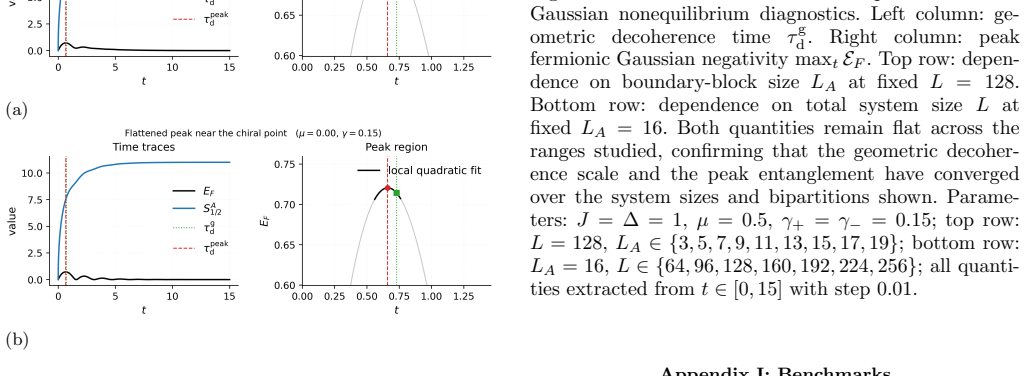
-
[4]
Rivas and S
´A. Rivas and S. F. Huelga,Open Quantum Systems: An Introduction(Springer, Berlin, 2012)
2012
-
[5]
H.-P. Breuer and F. Petruccione, Concepts and methods in the theory of open quantum systems, arXiv preprint (2003), arXiv:quant-ph/0302047
-
[6]
Amico, R
L. Amico, R. Fazio, A. Osterloh, and V. Vedral, Entan- glement in many-body systems, Rev. Mod. Phys.80, 517 (2008)
2008
-
[7]
Laflorencie, Quantum entanglement in condensed matter systems, Phys
N. Laflorencie, Quantum entanglement in condensed matter systems, Phys. Rep.646, 1 (2016)
2016
-
[8]
Calabrese and J
P. Calabrese and J. Cardy, Entanglement entropy and quantum field theory, J. Stat. Mech. , P06002 (2004)
2004
-
[9]
Calabrese and J
P. Calabrese and J. Cardy, Entanglement entropy and conformal field theory, J. Phys. A42, 504005 (2009)
2009
-
[10]
Calabrese and J
P. Calabrese and J. Cardy, Entanglement entropy and quantum field theory: A non-technical introduction, Int. J. Quantum Inf.4, 429 (2006)
2006
-
[11]
Alba and P
V. Alba and P. Calabrese, Entanglement and thermody- namics after a quantum quench in integrable systems, Proc. Natl. Acad. Sci. USA114, 7947 (2017)
2017
-
[12]
Alba and P
V. Alba and P. Calabrese, Entanglement dynamics after quantum quenches in generic integrable systems, SciPost Phys.4, 017 (2018)
2018
-
[13]
Peres, Separability criterion for density matrices, Phys
A. Peres, Separability criterion for density matrices, Phys. Rev. Lett.77, 1413 (1996)
1996
-
[14]
Vidal and R
G. Vidal and R. F. Werner, Computable measure of en- tanglement, Phys. Rev. A65, 032314 (2002)
2002
-
[15]
M. B. Plenio, Logarithmic negativity: A full entangle- ment monotone that is not convex, Phys. Rev. Lett.95, 090503 (2005)
2005
-
[16]
Calabrese, J
P. Calabrese, J. Cardy, and E. Tonni, Entanglement neg- ativity in quantum field theory, Phys. Rev. Lett.109, 130502 (2012)
2012
-
[17]
Eltschka and J
C. Eltschka and J. Siewert, Negativity as an estimator of entanglement dimension, Phys. Rev. Lett.111, 100503 (2013)
2013
-
[18]
Eltschka and J
C. Eltschka and J. Siewert, Quantifying entanglement re- sources, J. Phys. A47, 424005 (2014)
2014
-
[19]
Hillery, C
M. Hillery, C. Polvara, V. Oganesyan, and N. Ali, Two entanglement conditions and their connection to negativ- ity, Phys. Rev. A109, 022417 (2024)
2024
-
[20]
Coser, E
A. Coser, E. Tonni, and P. Calabrese, Entanglement neg- ativity after a global quantum quench, J. Stat. Mech. , P12017 (2014)
2014
-
[21]
N. E. Sherman, T. Devakul, M. B. Hastings, and R. R. P. Singh, Nonzero-temperature entanglement negativity of quantum spin models: Area law, linked cluster expan- sions, and sudden death, Phys. Rev. E93, 022128 (2016)
2016
-
[22]
T.-C. Lu, T. H. Hsieh, and T. Grover, Detecting topo- logical order at finite temperature using entanglement negativity, Phys. Rev. Lett.125, 116801 (2020)
2020
-
[23]
S. Sang, Y. Li, T. Zhou, X. Chen, T. H. Hsieh, and M. P. Fisher, Entanglement negativity at measurement- induced criticality, PRX Quantum2, 030313 (2021)
2021
-
[24]
Shapourian, K
H. Shapourian, K. Shiozaki, and S. Ryu, Partial time- reversal transformation and entanglement negativity in fermionic systems, Phys. Rev. B95, 165101 (2017)
2017
-
[25]
Shapourian and S
H. Shapourian and S. Ryu, Entanglement negativity of fermions: Monotonicity, separability criterion, and clas- sification of few-mode states, Phys. Rev. A99, 022310 (2019)
2019
-
[26]
Shapourian, P
H. Shapourian, P. Ruggiero, S. Ryu, and P. Calabrese, Twisted and untwisted negativity spectrum of free fermions, SciPost Phys.7, 037 (2019)
2019
-
[27]
H. Shapourian, S. Liu, J. Kudler-Flam, and A. Vish- wanath, Entanglement negativity spectrum of random mixed states: A diagrammatic approach, PRX Quantum 2, 030347 (2021), arXiv:2011.01277
-
[28]
Alba, Unbounded entanglement production via a dis- sipative impurity, SciPost Phys.12, 011 (2022)
V. Alba, Unbounded entanglement production via a dis- sipative impurity, SciPost Phys.12, 011 (2022)
2022
-
[29]
Alba and F
V. Alba and F. Carollo, Logarithmic negativity in out-of- equilibrium open free-fermion chains: An exactly solvable case, SciPost Phys.15, 124 (2023)
2023
-
[30]
Murciano, P
S. Murciano, P. Calabrese, and V. Alba, Symmetry- resolved entanglement in fermionic systems with dissi- pation, Journal of Statistical Mechanics: Theory and Ex- periment2023, 113102 (2023)
2023
-
[31]
Caceffo and V
F. Caceffo and V. Alba, Entanglement negativity in a fermionic chain with dissipative defects: exact results, Journal of Statistical Mechanics: Theory and Experiment 2023, 023102 (2023)
2023
-
[32]
Caceffo and V
F. Caceffo and V. Alba, Fate of entanglement in quadratic markovian dissipative systems, Phys. Rev. A 113, 042436 (2026)
2026
-
[33]
Prosen, Open xxz spin chain: Nonequilibrium steady state and a strict bound on ballistic transport, Phys
T. Prosen, Open xxz spin chain: Nonequilibrium steady state and a strict bound on ballistic transport, Phys. Rev. Lett.106, 217206 (2011)
2011
-
[34]
ˇZnidariˇ c, Exact solution for a diffusive nonequilibrium steady state of an open quantum chain, J
M. ˇZnidariˇ c, Exact solution for a diffusive nonequilibrium steady state of an open quantum chain, J. Stat. Mech. , L05002 (2010)
2010
-
[35]
K. Yamanaka and T. Sasamoto, Exact solution for the lindbladian dynamics for the open xx spin chain with boundary dissipation, SciPost Phys.14, 112 (2023), arXiv:2303.08559
-
[36]
Turkeshi and M
X. Turkeshi and M. Schir´ o, Diffusion and thermaliza- tion in a boundary-driven dephasing model, Phys. Rev. B104, 144301 (2021). 12
2021
-
[37]
Skinner, J
B. Skinner, J. Ruhman, and A. Nahum, Measurement- induced phase transitions in the dynamics of entangle- ment, Phys. Rev. X9, 031009 (2019)
2019
-
[38]
M. J. Gullans and D. A. Huse, Dynamical purifica- tion phase transition induced by quantum measurements, Phys. Rev. X10, 041020 (2020)
2020
-
[39]
S.-K. Jian, C. Liu, X. Chen, B. Swingle, and P. Zhang, Measurement-induced phase transition in the monitored sachdev-ye-kitaev model, Phys. Rev. Lett.127, 140601 (2021)
2021
-
[40]
Elben, R
A. Elben, R. Kueng, H.-Y. R. Huang, R. van Bij- nen, C. Kokail, M. Dalmonte, P. Calabrese, B. Kraus, J. Preskill, P. Zoller, and B. Vermersch, Mixed-State Entanglement from Local Randomized Measurements, Phys. Rev. Lett.125, 200501 (2020)
2020
- [41]
-
[42]
H. Jeng, S. Tserkis, J. Y. Haw, H. M. Chrzanowski, J. Janousek, T. C. Ralph, P. K. Lam, and S. M. Assad, Entanglement properties of a measurement-based entan- glement distillation experiment, Phys. Rev. A99, 042304 (2019), arXiv:1811.10822
work page internal anchor Pith review Pith/arXiv arXiv 2019
-
[43]
W. S. Bakr, J. I. Gillen, A. Peng, S. F¨ olling, and M. Greiner, A quantum gas microscope for detecting sin- gle atoms in a hubbard-regime optical lattice, Nature 462, 74 (2009)
2009
- [44]
-
[45]
Alba and P
V. Alba and P. Calabrese, Quantum information dynam- ics in multipartite integrable systems, EPL126, 60001 (2019)
2019
-
[46]
Bertini, K
B. Bertini, K. Klobas, and T.-C. Lu, Entanglement neg- ativity and mutual information after a quantum quench: Exact link from space-time duality, Phys. Rev. Lett.129, 140503 (2022)
2022
-
[47]
Caceffo and V
F. Caceffo and V. Alba, Negative tripartite mutual in- formation after quantum quenches in integrable systems, Phys. Rev. B108, 134434 (2023)
2023
-
[48]
M. A. Nielsen and I. L. Chuang,Quantum Computa- tion and Quantum Information: 10th Anniversary Edi- tion(Cambridge University Press, Cambridge, England, UK, 2010)
2010
-
[49]
Prosen, Third quantization: a general method to solve master equations for quadratic open Fermi systems, New J
T. Prosen, Third quantization: a general method to solve master equations for quadratic open Fermi systems, New J. Phys.10, 043026 (2008)
2008
-
[50]
Prosen, Spectral theorem for the Lindblad equation for quadratic open fermionic systems, J
T. Prosen, Spectral theorem for the Lindblad equation for quadratic open fermionic systems, J. Stat. Mech.: Theory Exp.2010(07), P07020
2010
- [51]
-
[52]
Fannes, A continuity property of the entropy density for spin lattice systems, Commun
M. Fannes, A continuity property of the entropy density for spin lattice systems, Commun. Math. Phys.31, 291 (1973)
1973
-
[53]
K. M. R. Audenaert, A sharp continuity estimate for the von Neumann entropy, J. Phys. A: Math. Theor.40, 8127 (2007)
2007
-
[54]
Buˇ ca and T
B. Buˇ ca and T. Prosen, A note on symmetry reductions of the Lindblad equation: transport in constrained open spin chains, New Journal of Physics14, 073007 (2012)
2012
-
[55]
V. V. Albert and L. Jiang, Symmetries and conserved quantities in lindblad master equations, Phys. Rev. A 89, 022118 (2014)
2014
-
[56]
A. Y. Kitaev, Unpaired Majorana fermions in quantum wires, Physics Uspekhi44, 131 (2001)
2001
-
[57]
Aydo˘ gan, A
K. Aydo˘ gan, A. W. Schlimgen, and K. Head-Marsden, Stabilizing steady-state properties of open quantum sys- tems with parameter engineering, Phys. Rev. Research 7, 023057 (2025)
2025
-
[58]
Y. Zhang, Y.-Q. Ge, and Y.-x. Liu, Simulation of Kitaev chain using one-dimensional chain of superconducting qubits and environmental effects on topological states, J. Appl. Phys.136, 10.1063/5.0224271 (2024)
-
[59]
M. S. Shustin, S. V. Aksenov, and I. S. Burmistrov, Dissipation-induced steady states in topological super- conductors: Mechanisms and design principles (2026), arXiv:2508.11242 [cond-mat.mes-hall]
work page internal anchor Pith review Pith/arXiv arXiv 2026
-
[60]
Lindblad Equation for the Inelastic Loss of Ultracold Atoms
E. Braaten, H.-W. Hammer, and G. P. Lepage, Lindblad equation for the inelastic loss of ultracold atoms, Phys. Rev. A95, 012708 (2017), arXiv:1607.08084
work page internal anchor Pith review Pith/arXiv arXiv 2017
-
[61]
Calabrese and J
P. Calabrese and J. Cardy, Evolution of entanglement en- tropy in one-dimensional systems, J. Stat. Mech.: Theory Exp.2005(04), P04010
2005
-
[62]
J. R. Johansson, P. D. Nation, and F. Nori, QuTiP: An open-source Python framework for the dynamics of open quantum systems, Comput. Phys. Commun.183, 1760 (2012). 13 Appendix A: The Pure-State IdentityE N =S 1/2 The identity Eq. (1) is well known and follows from the Schmidt decomposition; it is implicit in Ref. [14] and stated explicitly in the quantum ...
2012
-
[63]
Collecting all 2Loperators into the Nambu spinor Ψ = (c 1,
Equation of motion forC(t)and the balanced solution We consider a chain ofLsites with fermionic cre- ation and annihilation operators satisfying{c i, c† j}=δ ij and{c i, cj}= 0. Collecting all 2Loperators into the Nambu spinor Ψ = (c 1, . . . , cL, c† 1, . . . , c† L)T , the Hamil- tonian takes the formH= 1 2Ψ†HBdGΨ up to a constant, whereH BdG is the 2L×...
-
[64]
Its spectrum is read- ily obtained
Covariance-sector Liouvillian gap The homogeneous equation (F4) is governed by the linear super-operator Lcov(X) :=−i[H BdG, X]−2γX,(F7) whereX=C(t)− 1 2 12L is the traceless deviation from the infinite-temperature fixed point. Its spectrum is read- ily obtained. SinceH BdG is Hermitian, it admits an or- thonormal eigenbasis{ϕ n}with real eigenvaluesE n. ...
-
[65]
Perturbative decoherence time at smallγ We derive the leading-order shift ofτ g d away from the unitary maximumt ∗ whenγis small. Throughout,t ∗ is taken to be the first local maximum ofs(t) =E F (t;γ= 0) on (0,∞); if the unitary trajectory has multiple local maxima, the formula applies at each in turn, and the geometric decoherence time is the shift of t...
-
[66]
Balanced Gaussian dynamics versus exact many-body evolution For sufficiently small chains, the full Lindblad equation can be solved in the many-body Hilbert space, providing a direct comparison against the Gaussian correlation- matrix treatment. Figure 9 shows this comparison at the level of subsystem entropies: the time dependence ofS 1/2,S 2, andS vN ob...
-
[67]
(19) admits the closed-form solution (CMS) of Eq
Balanced versus imbalanced gain/loss Whenγ + =γ −, the correlation-matrix equation of mo- tion Eq. (19) admits the closed-form solution (CMS) of Eq. (21), and the time evolution is obtained spectrally after a single diagonalization of the BdG matrix. When γ+ ̸=γ −, the dynamics remains Gaussian but no analytic simplification of this form is available; one...
-
[68]
3 against both time-step resolution and bipartition choice
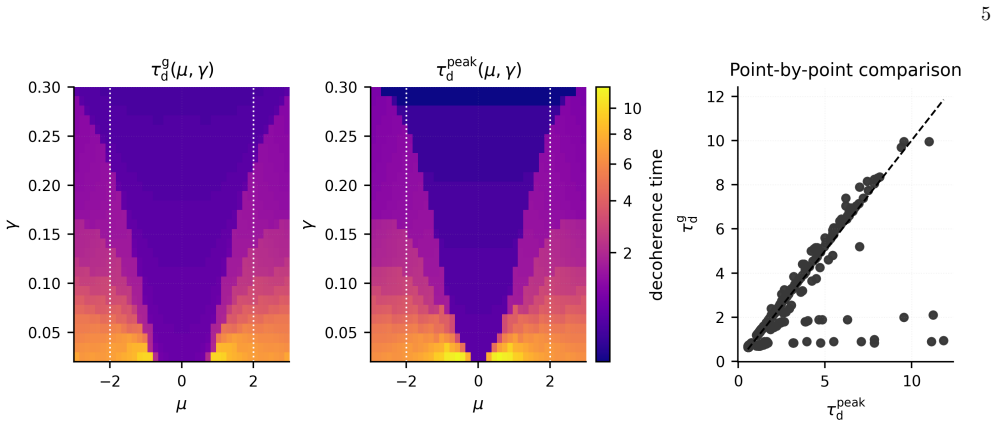
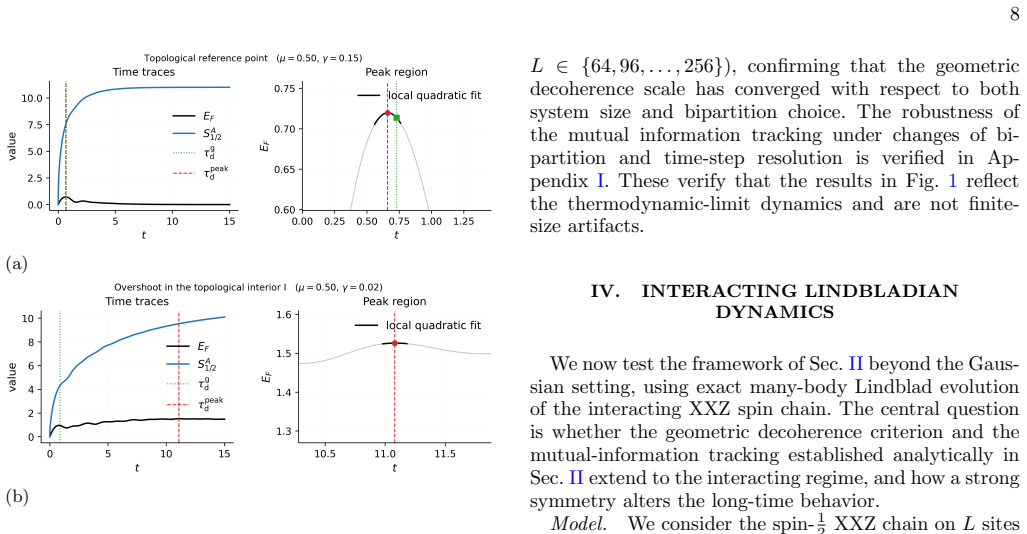
Convergence of the mutual-information tracking We verify the robustness of the tracking results shown in Fig. 3 against both time-step resolution and bipartition choice. For the baseline parametersL= 128,L A = 11, µ= 0.5,J= ∆ = 1, andγ + =γ − = 0.15, the geo- metric decoherence time isτ g d = 0.73 and the peak-based estimate isτ peak d = 0.66. The peak fe...
discussion (0)
Sign in with ORCID, Apple, or X to comment. Anyone can read and Pith papers without signing in.