REVIEW 2 major objections 4 minor 1 cited by
For every positive integer n, the perimeter of the sinusoidal spiral r^n = cos(nθ) is a fixed multiple of the area of the Lamé curve x^{2n}+y^{2n}=1, and the paper extends this to sectors, superellipses, and a central force law.
Reviewed by Pith at T0; open to challenge. T0 means a machine referee read the full paper against a public rubric. the ladder, T0–T4 →
T0 review · deepseek-v4-flash
2026-08-03 08:18 UTC pith:QGGYAQ5N
load-bearing objection Core identity and sector duality are correct and clean; the central-force law has a real but patchable gap for n>5, and the global Kepler correspondence is asserted more than proved. the 2 major comments →
Generalizations of the Squircle-Lemniscate Relation and Keplerian Dynamics
The pith
A machine-rendered reading of the paper's core claim, the machinery that carries it, and where it could break.
Core claim
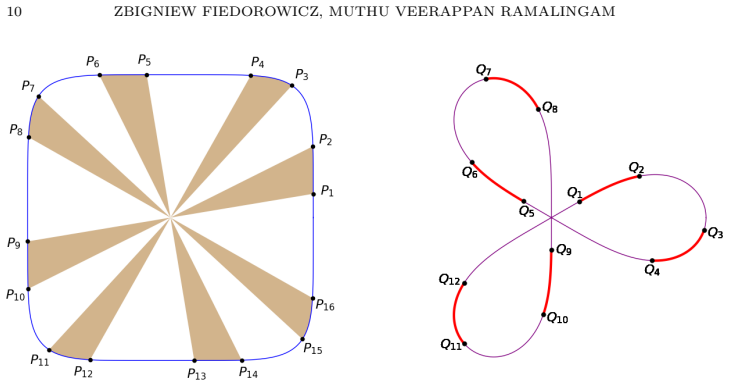
The central discovery is Theorem 1: for positive integer n, ∫₀¹ dr/√(1−r^{2n}) = 2^{1/n} ∫₀¹ (1−x^{2n})^{1/(2n)} dx. The left integral is the arc-length integral of the sinusoidal spiral r^n = cos(nθ); the right is the first-quadrant area of the Lamé curve x^{2n}+y^{2n}=1. Corollary 6 upgrades this to a sector-wise identity: the length of an arc of the spiral between two radii is 2^{1+1/n} times the area of the corresponding radial sector of the Lamé curve. The paper reads this as a kinematic equivalence: Keplerian motion on the Lamé curve at constant areal velocity maps to uniform motion on the spiral. It further derives a central force law for the Lamé curve and, in a separate construction
What carries the argument
The load-bearing tool is the integral identity of Theorem 1 and its parametrized proof. Writing the Lamé curve as x = cos^{1/n}(nt), y = sin^{1/n}(nt), the paper uses Green's theorem to convert the quadrature area into an arc-length integral of the sinusoidal spiral; the substitution r = sin^{1/n}(nu) collapses the computation. Theorem 5 contributes a larger substitution, r^n = 2v^n/(1+v^{2n}), which turns any radial arc-length integral into a sector-area integral and yields Corollary 6's sector-by-sector duality. The force law is derived through Binet's equation, the standard polar-coordinate orbit equation, with the simplification u+u'' = (2n−1)w^{2n−2}/u^{4n−1}, producing F(r) = −C r^{4n−
Load-bearing premise
For the central-force claim to hold for all n > 1, the angle term w = sinθ cosθ must be recoverable from the radius r alone along the Lamé curve; the paper verifies this only for n = 2, 3, 4, 5, so for larger n the force law may be multi-valued and not a true central force.
What would settle it
For n = 6, write the Lamé curve condition u^{12} = cos^{12}θ + sin^{12}θ and the relation w² = (1−cos4θ)/8; check whether the resulting equation has a unique real solution w² for every u along the orbit. If two different w² values give the same u, then the formula F(r) = −C r^{21} w^{10} is not a single-valued function of r, and the claim of a central force law for all n fails.
If this is right
- For every positive integer n, the original squircle–lemniscate relation carries over to Lamé curves and sinusoidal spirals: total Lamé area = 2^{1−1/n} ϖ_{2n}, where ϖ_{2n} is the full-leaf arc length of the spiral.
- The sector-wise identity gives an exact kinematic dictionary: a particle tracing the Lamé curve at constant areal velocity traces the sinusoidal spiral at constant speed over a full cycle.
- Keplerian motion on Lamé curves is generated by an explicit central force; for n = 2, 3, 4, 5 the force is written as a function of r alone, e.g., F(r) = Cr(1−r⁴) for n = 2 and F(r) = −C(1−r⁶)²/r³ for n = 3.
- The area formula extends to all superellipses (|x/a|^α + |y/b|^α = 1) for α > 0, giving A = 2^{1−2/α} ϖ_α ab.
- The new policle curves r⁴ = n sin²(nθ)/(1−cos^{2n}(nθ)) satisfy the direct arc/area duality l = 2a√n, so the squircle–lemniscate relation has a second, simpler generalization.
Where Pith is reading between the lines
- For n > 5, the proposed force law may fail to be a single-valued central force; a natural next step is to determine the largest n for which the polynomial relation between u^{2n} and w² is invertible, or to identify the branch structure that still makes the motion integrable.
- Because the identity holds for arbitrary positive real α, the same duality may extend to irrational exponents, where the curves are defined only piecewise; this suggests a continuum of non-integer spiral–Lamé pairs with no simple leaf geometry.
- The policle construction shows the squircle–lemniscate relation is not unique: many families of curves can be paired to sinusoidal spirals by the same substitution, so further polar equations r^m = f(θ) with a similar duality may exist.
- The kinematic correspondence could be tested numerically: simulate uniform motion on the spiral, pull it back to the Lamé curve via the sector map, and verify constant areal velocity, especially for large n where the central-force formula remains open.
Editorial analysis
A structured set of objections, weighed in public.
Referee Report
Summary. This paper generalizes the known squircle–lemniscate identity to arbitrary n. Theorem 1 establishes ∫_0^1 (1-r^{2n})^{-1/2} dr = 2^{1/n} ∫_0^1 (1-x^{2n})^{1/(2n)} dx, so the perimeter of the sinusoidal spiral r^n = cos(nθ) is a fixed multiple of the area of the Lamé curve x^{2n}+y^{2n}=1. Corollary 4 extends this to general superellipses and real exponents. Theorem 5 and Corollary 6 prove a sector-by-sector correspondence: the arc length of the spiral over a stated sector equals 2^{1+1/n} times the area of a corresponding radial sector of the Lamé curve. The paper then interprets this as a correspondence between Keplerian and uniform motion, derives a central-force formula (Theorem 8), and introduces 'policles' with their own sector/arc-length duality (Theorem 11).
Significance. The central integral identity and sector correspondence are correct, elegant, and proven by elementary substitutions and Green's theorem; they genuinely extend the n=2 result. The paper is self-contained, gives explicit beta-function checks, and the policle construction is a nice addition. The main advertised physical and force-law results are not fully established as written: the central force is not reduced to a function of r alone for n>5, and the global Kepler/uniform correspondence is asserted rather than constructed. These gaps are patchable, so the paper is worthy of publication after revision.
major comments (2)
- [Theorem 8 / Eq. (25), Remark 10] The theorem states a central force law F(r) = -C r^{4n-3} w^{2n-2}, w=sinθcosθ, for all n>1. As derived, this is a function of both r and θ; for a central force it must depend on r alone. Remark 10 shows elimination explicitly only for n=2,3,4,5. For n>5, the polynomial relation between u^{2n} and w^2 has degree ≥3 and no invertibility argument is supplied. This leaves the force-law claim unproved for general n. The gap is fixable: writing z=sin^2θ, P_n(z)=z^n+(1-z)^n has P'_n(z)=n(z^{n-1}-(1-z)^{n-1})<0 on z∈[0,1/2), so a unique inverse exists. The authors should add this argument or restrict the theorem.
- [Section 5, first paragraph] The passage 'By symmetry this correspondence extends to ... the entire Lamé curve and the entire sinusoidal spiral' is not a proof. Corollary 6 establishes a sector-area/arc-length equality in the first quadrant; extending this to a global correspondence between Keplerian and uniform motion requires a precise definition of the pairing and a verification of boundary identifications. The point-cycle pattern is illustrative but not a rigorous argument. Please provide a proof or state this as a conjectural interpretation.
minor comments (4)
- [Theorem 5 proof] The sentence 'Substituting (11), (12) and (13) into the integral on the left hand side of (10)' uses incorrect equation numbers; it should refer to (18), (19), (20) and (17).
- [Section 7, first sentence] 'Theorem 2 generalizes [3, Theorem 10]' should be 'Theorem 5 generalizes [3, Theorem 10]'.
- [Theorem 1 proof] The displayed Green's theorem computation has missing parentheses and an ambiguous factor: the line '= 1/2 1/n ∫ ...' is hard to follow and the factor 2^{1/n} appears inconsistently. Please rewrite for readability.
- [Theorem 8 proof] The symbol C is used for both the intermediate quantity s^{2n-4}+c^{2n-4} and the final constant C=(2n-1)mh^2. Rename the intermediate quantity to avoid confusion.
Circularity Check
No significant circularity: the integral and sector/arc identities are derived directly by calculus; the self-citations are motivational, not load-bearing.
full rationale
The paper's central results are self-contained derivations, not fits or renamed inputs. Theorem 1 is proved by a direct Green's theorem computation and an explicit change of variables, with Remark 2 giving an independent beta/gamma verification. Theorem 5 is a change-of-variables identity, and Corollary 6 follows from it by converting the Lamé curve to polar form and comparing the resulting integrals; Remark 7 then derives Theorem 1 as a special case. No parameter is fitted and no quantity is 'predicted' from a fitted input. The force-law derivation (Theorem 8) applies Binet's equation to the prescribed Lamé orbit; it does not assume the target formula. The acknowledged limitation in Remark 10—that explicit elimination of w = sinθ cosθ in favor of r alone is carried out only for n = 2,3,4,5—is a gap in fully exhibiting F as a function of r for n > 5, but it is a correctness gap, not circularity, because the derivation does not depend on that inversion being assumed. References to the authors' prior work [3] and to Siegel [13] provide motivation and historical context; the present proofs do not invoke [3] or [13] as premises for the identities. The policle result (Theorem 11) is likewise a direct integral substitution. Thus the manuscript is not circular; at most it contains minor non-load-bearing self-citation.
Axiom & Free-Parameter Ledger
axioms (5)
- standard math Standard calculus: polar arc-length formula, Green's theorem, and trigonometric substitutions are valid for the curves in question.
- domain assumption Binet's equation correctly describes orbits under a central force directed toward the origin.
- domain assumption The first-quadrant sector correspondence extends by symmetry to a global bijection between the entire Lamé curve and the entire sinusoidal spiral.
- domain assumption Policles, defined by r^4 = n sin^2(nθ)/(1−cos^{2n}(nθ)), are simple closed curves whose sectors have well-defined areas.
- domain assumption n is a positive integer for global geometric statements, while the integral identities hold for positive real n.
invented entities (1)
-
Policles
no independent evidence
read the original abstract
This paper establishes a generalized relationship between the arc length of sinusoidal spirals \(r^n=\cos(n\theta)\) and the area of generalized Lam\'e curves defined by \(x^{2n}+y^{2n}=1\). Building on our previous work connecting the lemniscate to the squircle, we prove an integral identity relating these two curves for any positive integer $n$, which we further generalize to arbitrary positive real exponents and general superellipses. We further extend this correspondence to a geometric relationship between radial sectors of the Lam\'e curve and arc lengths of the spiral, providing a physical interpretation where keplerian motion on the Lam\'e curve corresponds to uniform motion on the spiral. Additionally, we derive an explicit central force law for keplerian motion along the Lam\'e curve. Finally, we introduce policles--a new class of curves generalizing the squircle--and demonstrate a direct geometric mapping between their sectors and the arc lengths of sinusoidal spirals.
Figures



Forward citations
Cited by 1 Pith paper
-
Hypergeometric Series Representations for the Perimeter of Lam\'e Superellipses
The perimeter of a Lamé superellipse admits exact hypergeometric series representations for s>1 (conditionally convergent) and 0<s<1 (Abel-summable), with the rhombus at s=1 uniquely minimizing length.
Reference graph
Works this paper leans on
-
[1]
Artin,The Gamma Function, translated by M
E. Artin,The Gamma Function, translated by M. Butler (Holt, Rinehart and Winston, New York, 1964)
1964
-
[2]
J. B. Cooper, “On the relevance of the differential expressionsf 2 +f ′2,f+f ′′, andf f′′ −f ′2 for the geometrical and mechanical properties of curves”, arXiv preprint, arXiv:1102.1579./external-link-alt
-
[3]
An Elementary Proof of a Remarkable Relation Between the Squircle and Lemniscate
Z. Fiedorowicz, M.V. Ramalingam (2025). “An Elementary Proof of a Remarkable Relation Between the Squircle and Lemniscate”, arXiv preprint, arXiv:2411.19864./external-link-alt
Pith/arXiv arXiv 2025
-
[4]
Goldstein, C
H. Goldstein, C. Poole, and J. Safko. Classical Mechanics. Addison-Wesley, San Francisco, 3rd edition, 2001
2001
-
[5]
Google (2025, Dec.) Gemini Pro,/external-link-alt
2025
-
[6]
A Geometric Interpretation of an Infinite Product for the Lemniscate Constant
Levin, Aaron (2006). “A Geometric Interpretation of an Infinite Product for the Lemniscate Constant”. The American Mathematical Monthly. 113 (6): 510–520./external-link-alt
2006
-
[7]
A Wallis Product on Clovers
T. Hyde (2014), “A Wallis Product on Clovers”. The American Mathematical Monthly. 121 (3): 237-243./external-link-alt
2014
-
[8]
(1818).Examen des diff´ erentes m´ ethodes employ´ ees pour r´ esoudre les probl` emes de g´ eom´ etrie
Lam´ e, G. (1818).Examen des diff´ erentes m´ ethodes employ´ ees pour r´ esoudre les probl` emes de g´ eom´ etrie. Paris: Vve Courcier./external-link-alt
-
[9]
Dennis.A Catalog of Special Plane Curves
Lawrence, J. Dennis.A Catalog of Special Plane Curves. Dover Publications, New York, 1972. /external-link-alt
1972
-
[10]
London, 1720./external-link-alt
Maclaurin, Colin.Geometria Organica: Sive Descriptio Linearum Curvarum Universalis. London, 1720./external-link-alt
-
[11]
Encyclop´ edie des Formes Remarquables, Sinusoidal Spiral,/external-link-alt
-
[12]
(2022).Squigonometry: The Study of Imperfect Circles
Poodiack, Robert D.; Wood, William E. (2022).Squigonometry: The Study of Imperfect Circles. Springer. ISBN 978-3031137822
2022
-
[13]
Siegel, Carl Ludwig (1969).Topics in Complex Function Theory – Elliptic Functions and Uniformization Theory, Volume 1, Wiley
1969
-
[14]
N.(1978),A Course of Modern Analysis,Cambridge University
Whittaker E.T.; WatsonG. N.(1978),A Course of Modern Analysis,Cambridge University. Press, Cambridge. ISBN 0521-09189-6
1978
-
[15]
Wikipedia Contributors, Beta function, Wikipedia, The Free Encyclopedia, retrieved Decem- ber, 2025./external-link-alt
2025
-
[16]
Wikipedia Contributors, Binet equation, Wikipedia, The Free Encyclopedia, retrieved De- cember, 2025./external-link-alt
2025
-
[17]
Wikipedia Contributors, Gamma function, Wikipedia, The Free Encyclopedia, retrieved De- cember, 2025./external-link-alt
2025
-
[18]
Wikipedia Contributors, Sinusoidal spiral, Wikipedia, The Free Encyclopedia, retrieved De- cember, 2025./external-link-alt
2025
-
[19]
Wikipedia Contributors, Superellipse, Wikipedia, The Free Encyclopedia, retrieved Decem- ber, 2025./external-link-alt Department of Mathematics, The Ohio State University Columbus, Ohio 43235 -1174, USA Aranthangi, Tamil Nadu, India
2025
discussion (0)
Sign in with ORCID, Apple, or X to comment. Anyone can read and Pith papers without signing in.