Synthetic Network Packet Generation through Statistical Learning and Genetic Algorithms
Pith reviewed 2026-06-26 16:39 UTC · model grok-4.3
The pith
Constraint-enforcing statistical and genetic methods generate synthetic IoT packets that pass independent anomaly validators at 1.20% and 0.62% average rates.
A machine-rendered reading of the paper's core claim, the machinery that carries it, and where it could break.
Core claim
Both the statistical learning method and the genetic algorithm method produce synthetic packets that achieve PASS status under independently trained OCSVM and IF validators with a 30% anomaly rate threshold, attaining average anomaly rates of 1.20% and 0.62% respectively, while allowing amplification of underrepresented attack categories up to 200x.
What carries the argument
Dual anomaly-detection gating combined with feature-range clamping and independent validation embedded in the synthesis pipeline.
If this is right
- Both methods amplify the 5-sample ARP Spoofing category to 1000 validated packets.
- The statistical method reaches approximately 1091 packets per second throughput.
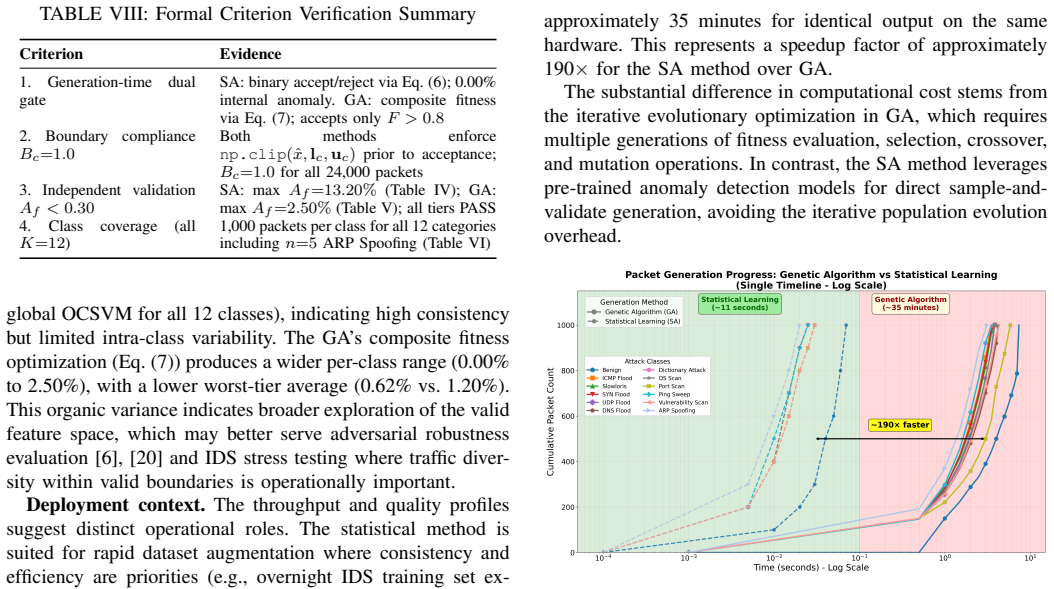
- The GA method maintains organic per-class variance between 0.00% and 2.50% at approximately 5.7 packets per second.
- The 190:1 throughput ratio supplies concrete selection criteria for rapid augmentation versus adversarial testing needs.
- Both methods succeed across all 12 attack categories despite extreme class imbalance.
Where Pith is reading between the lines
- These generators could allow IDS training sets to be balanced without additional collection of rare real-world attacks.
- Hybrid pipelines that use the statistical method for volume and the GA method for fidelity-critical subsets become feasible given their complementary profiles.
- The same constraint pipeline could be tested on non-IoT network traffic by retraining only the anomaly gates while keeping the validity clamps.
- Success would be confirmed by measuring whether IDS models trained on the synthetic data achieve higher detection rates on unseen real attacks than models trained on the original imbalanced set.
Load-bearing premise
The independently trained anomaly validators correctly identify packets that are physically invalid or distributionally unrealistic.
What would settle it
Run the generated packets through a fresh set of anomaly models trained on a completely held-out portion of real IoT traffic and check whether the anomaly rate stays below the 30% PASS threshold.
Figures

read the original abstract
Developing robust intrusion detection systems (IDS) for IoT environments requires large, labeled datasets capturing realistic traffic distributions across both benign and malicious activity. Existing public datasets suffer from fixed activity distributions and extreme class imbalance, while deep generative models (GANs, VAEs) provide no mechanism to enforce that synthetic packets remain within physically valid feature ranges. This paper proposes and compares two constraint-enforcing approaches for synthetic IoT network packet generation: (i) a statistical learning method combining PCA-based latent space sampling with dual One-Class SVM (OCSVM) and Isolation Forest (IF) boundary enforcement, and (ii) a genetic algorithm (GA) method that treats packet generation as a multi-objective optimization problem with explicit fitness criteria for anomaly model acceptance and distributional fidelity. Both methods embed hard validity constraints -- dual anomaly-detection gating, feature-range clamping, and independent validation -- directly into the synthesis pipeline. Evaluation on the complete ACI IoT 2023 dataset (1,231,411 packets, 12 attack categories, class imbalance up to 175,805:1) demonstrates that both methods achieve PASS status across all categories under independently trained validators with a 30% anomaly rate threshold: the statistical method attains 1.20% average anomaly rate with ~1,091 packets/s throughput, while the GA attains 0.62% average anomaly rate with organic per-class variance (0.00%-2.50%) at ~5.7 packets/s. Both methods successfully amplify the 5-sample ARP Spoofing category by 200x to 1,000 validated packets. The ~190:1 throughput ratio between methods, combined with their complementary quality profiles, provides evidence-based selection criteria for deployment contexts ranging from rapid dataset augmentation to adversarial robustness testing.
Editorial analysis
A structured set of objections, weighed in public.
Referee Report
Summary. The paper proposes two constraint-enforcing methods for synthetic IoT packet generation on the ACI IoT 2023 dataset: (i) a statistical pipeline using PCA latent sampling with dual OCSVM+IF boundary enforcement and feature clamping, and (ii) a GA treating generation as multi-objective optimization with anomaly acceptance and fidelity fitness terms. Both embed validity constraints and are evaluated for their ability to produce packets that pass independent OCSVM/IF validators at a 30% anomaly threshold, claiming average anomaly rates of 1.20% (statistical, ~1091 pkt/s) and 0.62% (GA, ~5.7 pkt/s) while amplifying the 5-sample ARP Spoofing class by 200x.
Significance. If the validation results hold, the work supplies concrete, deployable alternatives to GAN/VAE generators for imbalanced IDS datasets, with explicit throughput-quality trade-offs and demonstrated rare-class amplification. The ~190:1 speed difference and per-class variance data (0.00%-2.50%) offer practical selection criteria.
major comments (2)
- [Abstract] Abstract: the 30% anomaly-rate threshold used to declare PASS status is presented without derivation, sensitivity analysis, or description of training-split choices for the validators; post-hoc selection cannot be excluded from the reported text.
- [Abstract] Abstract and evaluation description: the statistical method already employs dual OCSVM+IF gating and the GA uses anomaly-model acceptance as a fitness term, yet the headline PASS rates (1.20% / 0.62%) are measured against separately trained but same-family validators; no ablation, calibration on known-invalid packets, or protocol-level constraint comparison is described to establish that the validators detect physically invalid outputs rather than model-family consistency.
minor comments (1)
- [Abstract] Abstract: average anomaly rates are reported without error bars, per-run variance, or confidence intervals.
Simulated Author's Rebuttal
We thank the referee for the constructive and detailed feedback. We address each major comment below, indicating where revisions will be made to improve clarity and rigor.
read point-by-point responses
-
Referee: [Abstract] Abstract: the 30% anomaly-rate threshold used to declare PASS status is presented without derivation, sensitivity analysis, or description of training-split choices for the validators; post-hoc selection cannot be excluded from the reported text.
Authors: We agree that the 30% threshold requires explicit justification. In the revised manuscript we will add a dedicated paragraph in the evaluation section deriving the threshold from the empirical distribution of anomaly scores on a held-out validation split of the original ACI IoT 2023 data, include sensitivity results for thresholds of 20%, 30%, and 40%, and specify the exact training/validation split ratios and random seeds used for the independent validators. revision: yes
-
Referee: [Abstract] Abstract and evaluation description: the statistical method already employs dual OCSVM+IF gating and the GA uses anomaly-model acceptance as a fitness term, yet the headline PASS rates (1.20% / 0.62%) are measured against separately trained but same-family validators; no ablation, calibration on known-invalid packets, or protocol-level constraint comparison is described to establish that the validators detect physically invalid outputs rather than model-family consistency.
Authors: This observation correctly identifies a potential circularity. While the validators are trained on independent data splits, the current text does not contain the requested ablation or calibration. In the revision we will add an ablation study that (i) injects known-invalid packets (feature-range violations and protocol-inconsistent combinations) into the validator training and test sets and (ii) reports protocol-level constraint violation rates on the generated packets, thereby demonstrating that the low anomaly rates reflect physical validity beyond model-family agreement. revision: yes
Circularity Check
No circularity detected in claimed results
full rationale
The paper measures success via anomaly rates on generated packets under separately trained OCSVM/IF validators (explicitly labeled 'independently trained' in the abstract) at a fixed 30% threshold, plus comparison to original dataset statistics; neither the statistical PCA+dual-gating pipeline nor the GA fitness function reduces the reported 1.20%/0.62% rates to a fitted parameter or self-defined quantity by construction. No equations equate validation output to generation inputs, no self-citation chain supports the central claim, and the throughput and amplification results are direct empirical counts. The derivation therefore remains self-contained against external benchmarks.
Axiom & Free-Parameter Ledger
free parameters (2)
- anomaly rate threshold
- PCA latent dimension
axioms (2)
- domain assumption Anomaly detectors (OCSVM, IF) trained on real packets can reliably flag physically invalid synthetic packets.
- domain assumption The ACI IoT 2023 dataset provides representative distributions for both benign and attack traffic.
Reference graph
Works this paper leans on
-
[1]
Machine learning based solutions for security of Internet of Things (IoT): A survey,
S. M. Tahsien, H. Karimipour, and P. Spachos, “Machine learning based solutions for security of Internet of Things (IoT): A survey,”J. Netw. Comput. Appl., vol. 161, p. 102630, 2020
2020
-
[2]
A survey of data mining and machine learning methods for cyber security intrusion detection,
A. L. Buczak and E. Guven, “A survey of data mining and machine learning methods for cyber security intrusion detection,”IEEE Commun. Surveys Tuts., vol. 18, no. 2, pp. 1153–1176, 2016
2016
-
[3]
ACI-IoT-2023: A robust dataset for Internet of Things network security analysis,
E. A. Nack, M. C. McKenzie, and N. D. Bastian, “ACI-IoT-2023: A robust dataset for Internet of Things network security analysis,” inProc. IEEE Military Commun. Conf. (MILCOM), 2024, pp. 1–6
2023
-
[4]
Towards the development of realistic botnet dataset in the Internet of Things for network forensic analytics: Bot-IoT dataset,
N. Koroniotis, N. Moustafa, E. Sitnikova, and B. Turnbull, “Towards the development of realistic botnet dataset in the Internet of Things for network forensic analytics: Bot-IoT dataset,”Future Gener. Comput. Syst., vol. 100, pp. 779–796, 2019
2019
-
[5]
A case study with CICIDS2017 on the robustness of machine learning against adversarial attacks in intrusion detection,
M. Catillo, A. Del Vecchio, A. Pecchia, and U. Villano, “A case study with CICIDS2017 on the robustness of machine learning against adversarial attacks in intrusion detection,” inProc. ACM, 2023
2023
-
[6]
Evaluating and improving adversarial robustness of machine learning- based network intrusion detectors,
D. Han, Z. Wang, Y . Zhong, W. Chen, J. Yang, S. Lu, X. Shi, and X. Yin, “Evaluating and improving adversarial robustness of machine learning- based network intrusion detectors,”IEEE J. Sel. Areas Commun., vol. 39, no. 8, pp. 2632–2647, 2021
2021
-
[7]
Evaluating model robustness to adversarial samples in network intrusion detection,
M. Schneider, D. Aspinall, and N. D. Bastian, “Evaluating model robustness to adversarial samples in network intrusion detection,” in Proc. IEEE Int. Conf. Big Data, 2021, pp. 3343–3352
2021
-
[8]
Adversarial attacks on visual objects using the fast gradient sign method,
S. M. A. Naqvi, M. Shabaz, M. A. Khan, and S. I. Hassan, “Adversarial attacks on visual objects using the fast gradient sign method,”J. Grid Comput., vol. 21, no. 4, p. 52, 2023
2023
-
[9]
Generate adversarial examples by adaptive moment iterative fast gradient sign method,
J. Zhang, W. Qian, R. Nie, J. Cao, and D. Xu, “Generate adversarial examples by adaptive moment iterative fast gradient sign method,”Appl. Intell., vol. 53, no. 1, pp. 1101–1114, 2023
2023
-
[10]
Universal adversarial attack via enhanced projected gradient descent,
Y . Deng and L. J. Karam, “Universal adversarial attack via enhanced projected gradient descent,” inProc. IEEE Int. Conf. Image Process. (ICIP), 2020, pp. 1241–1245
2020
-
[11]
Toward generating a new intrusion detection dataset and intrusion traffic characterization,
I. Sharafaldin, A. H. Lashkari, and A. A. Ghorbani, “Toward generating a new intrusion detection dataset and intrusion traffic characterization,” inProc. Int. Conf. Inf. Syst. Security Privacy (ICISSP), 2018, pp. 108– 116
2018
-
[12]
UNSW-NB15: A comprehensive data set for network intrusion detection systems,
N. Moustafa and J. Slay, “UNSW-NB15: A comprehensive data set for network intrusion detection systems,” inProc. Military Commun. Inf. Syst. Conf. (MilCIS), 2015, pp. 1–6
2015
-
[13]
Modeling tabular data using conditional GAN,
L. Xu, M. Skoularidou, A. Cuesta-Infante, and K. Veeramachaneni, “Modeling tabular data using conditional GAN,” inAdvances in Neural Information Processing Systems (NeurIPS), vol. 32, 2019
2019
-
[14]
Deep learning for cyber security intrusion detection: Approaches, datasets, and comparative study,
M. A. Ferrag, L. Maglaras, S. Moschoyiannis, and H. Janicke, “Deep learning for cyber security intrusion detection: Approaches, datasets, and comparative study,”J. Inf. Security Appl., vol. 50, p. 102419, 2020
2020
-
[15]
SMOTE: Synthetic minority over-sampling technique,
N. V . Chawla, K. W. Bowyer, L. O. Hall, and W. P. Kegelmeyer, “SMOTE: Synthetic minority over-sampling technique,”J. Artif. Intell. Res., vol. 16, pp. 321–357, 2002
2002
-
[16]
Adaptive network intrusion detection systems against performance degradation via model agnostic meta-learning,
G. Ekinci, A. Broggi, L. Fiondella, N. D. Bastian, and G. Kul, “Adaptive network intrusion detection systems against performance degradation via model agnostic meta-learning,” inProc. ACM, 2024
2024
-
[17]
Reliability evaluation of CNN-enabled systems in adversarial scenarios,
K. Da Mata, Z. Faddi, P. Silva, V . Nagaraju, S. Ghosh, G. Kul, and L. Fiondella, “Reliability evaluation of CNN-enabled systems in adversarial scenarios,” inProc. IEEE Int. Conf. Assured Autonomy (ICAA), 2024, pp. 87–90
2024
-
[18]
Robust network intrusion detection through explainable artificial intelligence (XAI),
P. Barnard, N. Marchetti, and L. A. DaSilva, “Robust network intrusion detection through explainable artificial intelligence (XAI),”IEEE Netw. Lett., vol. 4, no. 3, pp. 167–171, 2022
2022
-
[19]
varMax: Towards confidence-based zero-day attack recognition,
G. Baye, P. Silva, A. Broggi, N. D. Bastian, L. Fiondella, and G. Kul, “varMax: Towards confidence-based zero-day attack recognition,” in Proc. IEEE Military Commun. Conf. (MILCOM), 2024, pp. 863–868
2024
-
[20]
The limitations of deep learning in adversarial settings,
N. Papernot, P. McDaniel, S. Jha, M. Fredrikson, Z. B. Celik, and A. Swami, “The limitations of deep learning in adversarial settings,” inProc. IEEE European Symp. Security Privacy (EuroS&P), 2016, pp. 372–387
2016
-
[21]
Towards evaluating the robustness of neural networks,
N. Carlini and D. Wagner, “Towards evaluating the robustness of neural networks,” inProc. IEEE Symp. Security Privacy (SP), 2017, pp. 39–57
2017
-
[22]
Enhancing robustness against adversarial examples in network intrusion detection systems,
M. J. Hashemi and E. Keller, “Enhancing robustness against adversarial examples in network intrusion detection systems,” inProc. IEEE Conf. Netw. Function Virtualization Softw. Defined Netw. (NFV-SDN), 2020, pp. 37–43
2020
-
[23]
Is synthetic flow data from generative models ready for network intrusion detection systems?
J. Liu, Q. Gong, W. Jiang, P. Kumar, A. S. M. Tayeen, H. Cao, S. Misra, and J. Harikumar, “Is synthetic flow data from generative models ready for network intrusion detection systems?” inProc. IEEE Military Commun. Conf. (MILCOM), 2025, pp. 1–8
2025
-
[24]
Devel- oping realistic distributed denial of service (DDoS) attack dataset and taxonomy,
I. Sharafaldin, A. H. Lashkari, S. Hakak, and A. A. Ghorbani, “Devel- oping realistic distributed denial of service (DDoS) attack dataset and taxonomy,” inProc. Int. Carnahan Conf. Security Technol. (ICCST), 2019, pp. 1–8. Mayank Raj(Student Member, IEEE & COM- SOC) received the M.S. degree in Data Science (Thesis Track) with a concentration in cybersecur...
2019
-
[25]
Gokhan Kul on a Department of Defense-funded project (Co- operative Agreement No
His thesis, underResilience Engineering of ML-Enabled Open World Recognition for Network Intrusion Detection Systems, was conducted as a Graduate Research Assistant under Dr. Gokhan Kul on a Department of Defense-funded project (Co- operative Agreement No. W911NF-22-2-0160) in collaboration with the U.S. Military Academy at West Point. He has three years ...
2026
discussion (0)
Sign in with ORCID, Apple, or X to comment. Anyone can read and Pith papers without signing in.