REVIEW 2 major objections 3 minor 1 cited by
Lagrangian split tori in $S^2 \times S^2$ and billiards
T0 review · 2 major / 3 minor · reviewed 2026-08-09 · deepseek-v4-flash
Pith's one-line read Billiard paths classify product tori in $S^2 \times S^2$ up to Hamiltonian isotopy.
desk verdict Strong classification result with a real dependency on a to-appear theorem for the obstruction half; the billiard framing is new and the applications are clean. read the letter →
The pith
A machine-rendered reading of the paper's core claim, the machinery that carries it, and where it could break.
The reading
What carries the argument
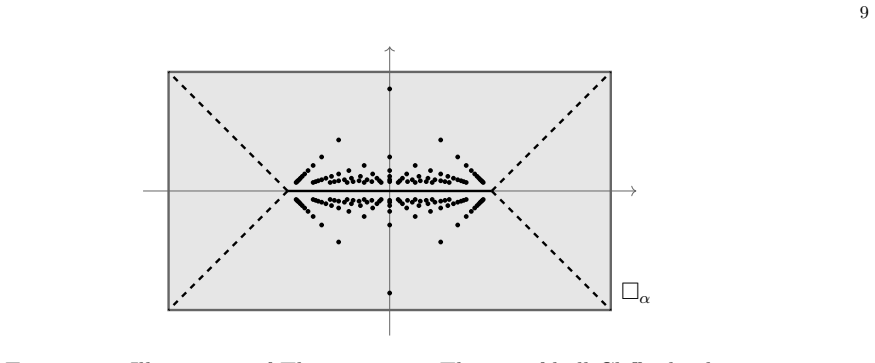
The billiard picture is the central organizing object: a split torus $T(x,y)$ is represented by a point in the moment rectangle $\square_\alpha$, and its equivalence class is read off from the trajectory of slope $\pi/4$ that bounces in the rectangle $\square_r$ for $r = \max\{|x|-1, |y|\}$, with corner collisions reflected back along the same line. On the construction side, symmetric probes—segments in the Delzant polytope that intersect the boundary integrally transversely and lift to Hamiltonian isotopies of toric fibres—turn each billiard bounce into an actual Hamiltonian equivalence. On the obstruction side, the paper uses the Chekanov invariants from [7] and the relative second-homology classes $D_i$ of the four obvious disks bounding the circles in the product, whose symplectic areas are the integral affine distances to the facets; preserving these areas under a Hamiltonian diffeomorphism produces the arithmetic condition.
What would settle it
Find an explicit Hamiltonian diffeomorphism of $X_\alpha$ sending $T(x,y)$ to $T(x',y')$ where $(\pm x', \pm y')$ is not an admissible bouncing point of the good billiard trajectory of $(x,y)$; the theorem forbids this, so a single such map would falsify it. Short of that, compute a Hamiltonian-isotopy invariant not derived from [7], such as displacement energy or a filtered Floer group, on two points satisfying $y' = y$ and $x = \pm x' + 2k_1 + 2k_2 y$ and check whether the invariant distinguishes them.
Extended reading notes
Core claim
The central result is Theorem 1.3: for split tori $T(x,y)$ and $T(x',y')$ in $X_\alpha$, Hamiltonian isotopy holds if and only if one of the points $(\pm x', \pm y')$ is an admissible bouncing point of the good billiard trajectory of $(x,y)$ in the rectangle $\square_{r(x,y)}$. In the region $Q \cup \Sigma$, Theorem 2.5 sharpens this to the arithmetic criterion $y' = y$ and $x = \pm x' + 2k_1 + 2k_2 y$ for some integers $k_1, k_2$. The equivalence is proved in both directions: consecutive bouncing points lie on symmetric probes at equal distance from the boundary, so each billiard bounce is realized by a Hamiltonian isotopy, while Chekanov-type invariants together with a relative-homology computation force any Hamiltonian diffeomorphism between the tori to satisfy the arithmetic condition.
Load-bearing premise
The 'only if' direction of the classification depends on the completeness of the Chekanov-type obstructions from [7], a source listed as to appear, and if those invariants fail to distinguish split tori in non-monotone $S^2 \times S^2$ (including the boundary segments $\Sigma$), the billiard criterion could identify tori that are not truly Hamiltonian isotopic.
Editorial extensions
If this is right
- Every split torus with $r(x,y)$ irrational has infinite Lagrangian packing number, because its good billiard trajectory has infinitely many admissible bouncing points.
- There exist split tori whose Hamiltonian orbit is neither $C^\infty$-closed nor locally path connected, giving dimension-four counterexamples to two conjectures about the space of Lagrangians.
- Ball-Chekanov tori in $X_\alpha$ are never exotic: every such torus is Hamiltonian isotopic to a split torus of the form $T(\alpha - a - 1, \alpha - a)$.
- The classification is independent of $\alpha > 0$, so equivalences between split tori persist across all non-monotone split symplectic forms on $S^2 \times S^2$.
- Theorem 1.3 confirms the symmetric-probe conjecture from [7] in the case of non-monotone $S^2 \times S^2$.
Reading between the lines
- The paper leaves implicit that the same billiard combinatorics should describe toric fibres of the even Hirzebruch surfaces, since those toric structures are related to $S^2 \times S^2$ by mutations; the authors note the mutation argument as beyond the present scope.
- The open monodromy cases (55) and (58), together with the cautionary example $T(0,1)$ in Section 3.5, suggest that corner-hitting billiard trajectories carry the remaining complexity; a modified billiard rule that tracks corner bounces explicitly may close the gap.
- The explicit counting function $b(x,y)$ from Proposition 5.3 gives a toric packing number that lower-bounds the true Lagrangian packing number, so comparing it with Floer-theoretic upper bounds in the rational cases could reveal where rigidity resumes.
Editorial analysis
A structured set of objections, weighed in public.
Referee Report
Summary. The paper classifies, up to Hamiltonian isotopy, the split Lagrangian tori T(x,y)=S^1_x × S^1_y in S^2 × S^2 equipped with the non-monotone split symplectic form ωα. The main result (Theorems 1.3 and 2.5) states that two split tori are Hamiltonian isotopic if and only if a certain billiard trajectory in a rectangle, defined by the base point, hits one of the obvious reflected points as an admissible bouncing point; this is refined to an arithmetic condition y′=y and x=±x′+2k1+2k2y. The construction direction is proved by symmetric probes and a folding/unfolding argument. The obstruction direction is proved using Chekanov invariants and a relative-homology result, [7, Theorem 4.7], from the first author's earlier work. The paper then derives several applications: infinite packing numbers, counterexamples to Chassé–Leclercq conjectures on the space of Lagrangians, a partial determination of the Hamiltonian monodromy group, and a characterization of which split tori are images of Clifford, Chekanov, or nonmonotone product tori under symplectic ball embeddings.
Significance. If the main theorem is fully justified, this is a substantial contribution: it gives the first complete classification of split tori in a non-monotone four-dimensional symplectic manifold, it connects the problem to an elegant and explicit billiard model, and it yields a number of immediate applications, including answering a question of Polterovich–Shelukhin on packing numbers and determining ball-Chekanov, ball-Clifford, and ball-nonmonotone split tori. The paper is also commendably honest: it explicitly states that the Hamiltonian monodromy group is not determined in cases (55) and (58) and gives a cautionary example in §3.5. The billiard constructions are self-contained and the arithmetic reductions are presented with machine-checkable precision. The main weakness is that the 'only if' direction of the central classification is not self-contained: it relies on an unpublished theorem from [7] whose hypotheses are not stated.
major comments (2)
- [§2.3, Lemma 2.7] The proof of the 'only if' direction of Theorem 2.5 uses [7, Theorem 4.7] to assert that a Hamiltonian diffeomorphism mapping T(x,y) to T(x′,y) sends the distinguished class D1 to D′1 (and, on Σ, controls the permutation of distinguished classes). This assertion is the load-bearing step that converts the area computation into the arithmetic relations (30)–(31). However, the theorem is not stated in the paper, its hypotheses are not given, and [7] is listed as 'to appear'. The first and second Chekanov invariants from Theorem 2.6 are not sufficient for this step: in Q they give y′=y and, for irrational y, a dense subgroup Γ(p)=Γ(q), which does not separate different x-values. The authors should either state [7, Theorem 4.7] with its precise hypotheses and verify those hypotheses for the non-monotone polytope □α, or provide a self-contained proof of the needed assertion. Without this, the 'only if' direction of the classification, and every application that relies on it, is conditional on an unverified external theorem.
- [§3.4, Theorem 3.5] The Hamiltonian monodromy group is not completely determined in cases (55) and (58), where only inclusions are proved; this is explicitly acknowledged in §1.2 and §3.5 and is a legitimate partial result. However, the cases that are determined also depend on Lemma 3.1, which in turn relies on Lemma 2.7 and hence on [7, Theorem 4.7]. The paper should state clearly that the monodromy classification for (x,y) ∈ Q inherits the same external dependence, so that the reader can separate the self-contained probe constructions from the conditional obstructions.
minor comments (3)
- [§2.2, Definition 2.3] In the definition of the folding map Fr, the reader is told only that (m,n) ∈ Z2 is chosen so that Fr(x,y) ∈ □r. It would be clearer to specify the admissible values of m and n for each (x,y), since the well-definedness of Fr at the preimages of the boundary is a subtle point that the current wording leaves implicit.
- [§5.2, Proposition 5.3] The counting argument for b(x,y) in the rational case y=p/q is compressed in the sentence about the segment [0,1/q] containing exactly one admissible bouncing point. A short derivation, or at least a reference to equation (48), would help the reader verify the boundary cases p′≡p+q mod 2 and p′≢p+q mod 2.
- [§2.1] In the discussion of symmetric probes, the paper states that for |k|>2 the probes of slope (k,−1) are redundant for the classification. Since this is used to justify restricting to the four slope types in (34), a one-sentence explanation of why these probes are redundant would be useful.
Circularity Check
No significant circularity: the billiard criterion is not defined in terms of the classification, the constructive half is self-contained, and the key 'only if' input from [7] is a general toric obstruction rather than a restatement of the target result.
full rationale
The paper's central equivalence Theorem 1.3, refined as Theorem 2.5, is not circular. The 'if' direction is fully constructive: Lemma 2.2 realizes each admissible billiard bounce by a sequence of symmetric probes, relying on the independent probe-isotopy statement of Theorem 2.1, and Lemma 2.4 establishes the arithmetic-to-billiard step via the folding map with no appeal to the uniqueness half. The 'only if' direction in Lemma 2.7 uses Chekanov invariants from [7, Theorem B] and the relative-homology constraint [7, Theorem 4.7]. Although [7] is by the first author and is listed as 'to appear', the cited theorem is a general statement about toric fibres and the map induced on relative homology by a Hamiltonian diffeomorphism; it is not a restatement of this paper's billiard classification, nor is it fitted to the data being predicted. The reduction of (2) implies (3) to [7, Theorem 4.7] is a provenance or completeness risk because the theorem is not stated or proved in detail here, but it is not a definitional equivalence and it is not a fitted parameter renamed as a prediction. The applications to monodromy, packing, and ball embeddings are consequences of the billiard criterion rather than inputs to it. There is therefore no circular step; any concern about the non-monotone applicability or external verification of [7] belongs to correctness risk, not to the circularity rubric.
Assumptions & free parameters
assumptions (6)
- domain assumption Every non-monotone split symplectic form on S^2 × S^2 is, up to scaling and swapping factors, of the form omega_alpha with alpha > 0 (Lalonde–McDuff [24]).
- domain assumption The group Symp(X_alpha) is connected (Abreu [1]); since X_alpha is simply connected, symplectomorphism classification equals Hamiltonian classification.
- domain assumption Chekanov invariants and relative-homology constraints from [7, Theorems B and 4.7] are valid Hamiltonian-isotopy invariants for toric fibres in compact toric manifolds, including non-monotone S^2 × S^2.
- domain assumption The space of symplectic ball embeddings into X_alpha is connected (McDuff [27]).
- standard math Gromov's nonsqueezing theorem gives Gromov width 2alpha and thus r < 2alpha for ball embeddings.
- domain assumption Displacement energies of split tori in X_alpha are as computed in [17] and [19] (e(T(0,0)) = infinity and e(T(x,0)) = 1 + alpha - |x|).
Cite this review
Pith. "Pith review of Lagrangian split tori in $S^2 \times S^2$ and billiards." pith.science (2026). https://pith.science/paper/QNMTXJLA
@misc{pith2026250203324,
  author       = {Pith},
  title        = {Pith review of: Lagrangian split tori in $S^2 \times S^2$ and billiards},
  year         = {2026},
  howpublished = {\url{https://pith.science/paper/QNMTXJLA}},
  note         = {Machine review of arXiv:2502.03324}
}
abstract
In this paper, we classify up to Hamiltonian isotopy Lagrangian tori that split as a product of circles in $S^2 \times S^2$, when the latter is equipped with a non-monotone split symplectic form. We show that this classification is equivalent to a problem of mathematical billiards in rectangles. We give many applications, among others: (1) answering a question on Lagrangian packing numbers raised by Polterovich--Shelukhin, (2) studying the topology of the space of Lagrangian tori, and (3) determining which split tori are images under symplectic ball embeddings of Chekanov or product tori in $\mathbb{R}^4$.
Figures


Figures from the paper (4 more)


Forward citations
Cited by 1 Pith paper
-
Nodal Tangles
Nodal tangles connect any two toric moment maps on a closed symplectic four-manifold, and give an exact displacement-energy formula for many toric fibres plus a recipe for Lagrangian torus knots.
Reference graph
Works this paper leans on
-
[7]
J. Brendel. Hamiltonian classification of toric fibres and symmetric probes. to appear in Algebraic Ge- ometry & Topology, 2023
work page 2023
-
[1]
M. Abreu. Topology of symplectomorphism groups of S2 × S2. Invent. Math., 131(1):1–23, 1998
work page 1998
- [2]
-
[3]
M. Augustynowicz, J. Smith, and J. Wornbard. Homological Lagrangian monodromy for some monotone tori. to appear in Quantum Topol, 2024
work page 2024
-
[4]
D. Auroux. Mirror symmetry and T -duality in the complement of an anticanonical divisor. J. G¨ okova Geom. Topol. GGT, 1:51–91, 2007
work page 2007
-
[5]
P. Biran. Symplectic packing in dimension 4. Geom. Funct. Anal., 7(3):420–437, 1997
work page 1997
-
[6]
J. Brendel. An introduction to the Chekanov torus. In Proceedings of the G¨ okova Geometry-Topology Conference 2021, pages 1–56. Int. Press, Somerville, MA, 2022
work page 2021
-
[8]
J. Brendel. Local exotic tori. to appear in Transactions of the AMS, 2024
work page 2024
Show all 36 references
-
[9]
Brendel, J
J. Brendel, J. Hauber, and J. Schmitz. Semi-Local Exotic Lagrangian Tori in Dimension Four. to appear in Annales de l’Institut Fourier, 2024
2024
-
[10]
Bro´ ci´ c and E
F. Bro´ ci´ c and E. Shelukhin. A counterexample to Lagrangian Poincar´ e recurrence. arXiv:2409.14225, 2024
2024 arXiv
-
[11]
Chass´ e and R
J.-P. Chass´ e and R. Leclercq. Weinstein exactness of nearby Lagrangians and the Lagrangian C 0 flux conjecture. arXiv:2410.04158, 2024
2024
-
[12]
Chekanov
Y. Chekanov. Lagrangian tori in a symplectic vector space and global symplectomorphisms. Math. Z., 223(4):547–559, 1996
1996
-
[13]
Chekanov and F
Y. Chekanov and F. Schlenk. Notes on monotone Lagrangian twist tori. Electron. Res. Announc. Math. Sci., 17:104–121, 2010
2010
-
[14]
Chekanov and F
Y. Chekanov and F. Schlenk. Lagrangian product tori in symplectic manifolds. Comment. Math. Helv., 91(3):445–475, 2016
2016
-
[15]
Dimitroglou Rizell, E
G. Dimitroglou Rizell, E. Goodman, and A. Ivrii. Lagrangian isotopy of tori in S2 × S2 and CP 2. Geom. Funct. Anal., 26(5):1297–1358, 2016
2016
-
[16]
Eliashberg and L
Y. Eliashberg and L. Polterovich. The problem of Lagrangian knots in four-manifolds. In Geometric topology (Athens, GA, 1993), volume 2 of AMS/IP Stud. Adv. Math., pages 313–327. Amer. Math. Soc., Providence, RI, 1997
1993
-
[17]
Entov and L
M. Entov and L. Polterovich. Quasi-states and symplectic intersections. Comment. Math. Helv. , 81(1):75–99, 2006
2006
-
[18]
Fukaya, Y.-G
K. Fukaya, Y.-G. Oh, H. Ohta, and K. Ono. Lagrangian Floer theory on compact toric manifolds. I. Duke Math. J., 151(1):23–174, 2010
2010
-
[19]
Fukaya, Y.-G
K. Fukaya, Y.-G. Oh, H. Ohta, and K. Ono. Displacement of polydisks and Lagrangian Floer theory. J. Symplectic Geom., 11(2):231–268, 2013
2013
-
[20]
V. L. Ginzburg and B. Z. G¨ urel. Hamiltonian pseudo-rotations of projective spaces. Invent. Math., 214(3):1081–1130, 2018
2018
-
[21]
M. Gromov. Pseudo holomorphic curves in symplectic manifolds. Invent. Math., 82(2):307–347, 1985
1985
-
[22]
S. Hu, F. Lalonde, and R. Leclercq. Homological Lagrangian monodromy. Geom. Topol., 15(3):1617– 1650, 2011
2011
-
[23]
Y. Karshon. Maximal tori in the symplectomorphism groups of Hirzebruch surfaces. Math. Res. Lett., 10(1):125–132, 2003
2003
-
[24]
Lalonde and D
F. Lalonde and D. McDuff. The classification of ruled symplectic 4-manifolds. Math. Res. Lett., 3(6):769– 778, 1996. 38 JO ´E BRENDEL AND JOONTAE KIM
1996
-
[25]
H. Lou. On Lagrangian Tori in S2 × S2. arXiv:2412.16356, 2024
2024 arXiv
-
[26]
C. Y. Mak and I. Smith. Non-displaceable Lagrangian links in four-manifolds. Geom. Funct. Anal., 31(2):438–481, 2021
2021
-
[27]
D. McDuff. From symplectic deformation to isotopy. In Topics in symplectic4-manifolds (Irvine, CA, 1996), First Int. Press Lect. Ser., I, pages 85–99. Int. Press, Cambridge, MA, 1998
1996
-
[28]
D. McDuff. Displacing Lagrangian toric fibers via probes. In Low-dimensional and symplectic topology, volume 82 of Proc. Sympos. Pure Math., pages 131–160. Amer. Math. Soc., Providence, RI, 2011
2011
-
[29]
McDuff and D
D. McDuff and D. Salamon. Introduction to symplectic topology. Oxford Graduate Texts in Mathematics. Oxford University Press, Oxford, third edition, 2017
2017
-
[30]
K. Ono. Some remarks on Lagrangian tori. J. Fixed Point Theory Appl., 17(1):221–237, 2015
2015
-
[31]
Polterovich and E
L. Polterovich and E. Shelukhin. Lagrangian configurations and Hamiltonian maps. Compos. Math., 159(12):2483–2520, 2023
2023
-
[32]
J. Schmitz. A counterexample to Lagrangian Poincar´ e recurrence in dimension four. arXiv:2410.24102, 2024
2024
-
[33]
Symington
M. Symington. Four dimensions from two in symplectic topology. In Topology and geometry of mani- folds (Athens, GA, 2001), volume 71 of Proc. Sympos. Pure Math., pages 153–208. Amer. Math. Soc., Providence, RI, 2003
2001
-
[34]
R. Vianna. Infinitely many monotone Lagrangian tori in del Pezzo surfaces. Selecta Math. (N.S.), 23(3):1955–1996, 2017
1955
-
[35]
Welschinger
J.-Y. Welschinger. Effective classes and Lagrangian tori in symplectic four-manifolds. J. Symplectic Geom., 5(1):9–18, 2007
2007
-
[36]
M.-L. Yau. Monodromy and isotopy of monotone Lagrangian tori. Math. Res. Lett., 16(3):531–541, 2009. D-MATH, ETH Z¨urich, R¨amistrasse 101, 8092 Z¨urich, Switzerland Email address: joe.brendel@math.ethz.ch Department of Mathematics and Center for Nano Materials, 35 Baekbeom-ro...
2009
Reviewed August 9, 2026 · model on record in the stance chip above.
Discussion (0). Continue with ORCID to comment.