FT-Pilot: Automated Fault-Tolerant RTL Rewriting via Vulnerability-Guided LLMs
Pith reviewed 2026-06-29 09:47 UTC · model grok-4.3
The pith
A GNN-guided LLM framework automatically rewrites RTL designs to add soft-error tolerance while preserving correctness and synthesizability.
A machine-rendered reading of the paper's core claim, the machinery that carries it, and where it could break.
Core claim
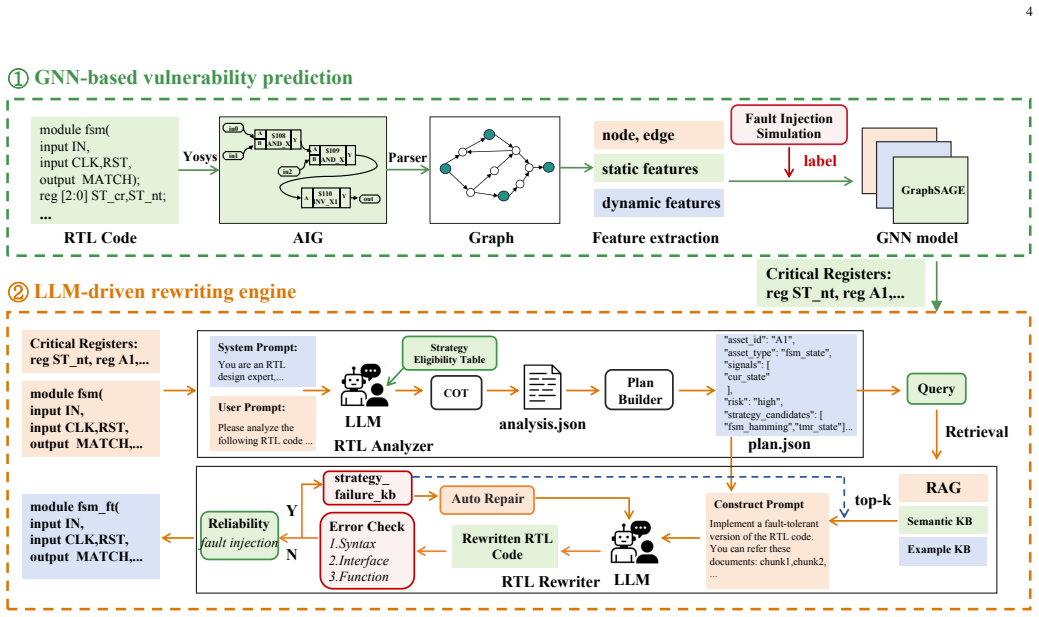
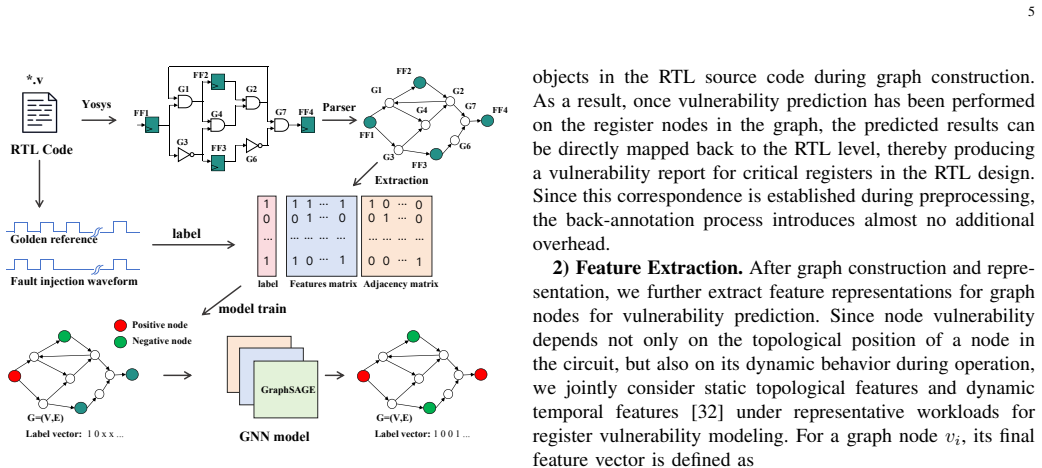
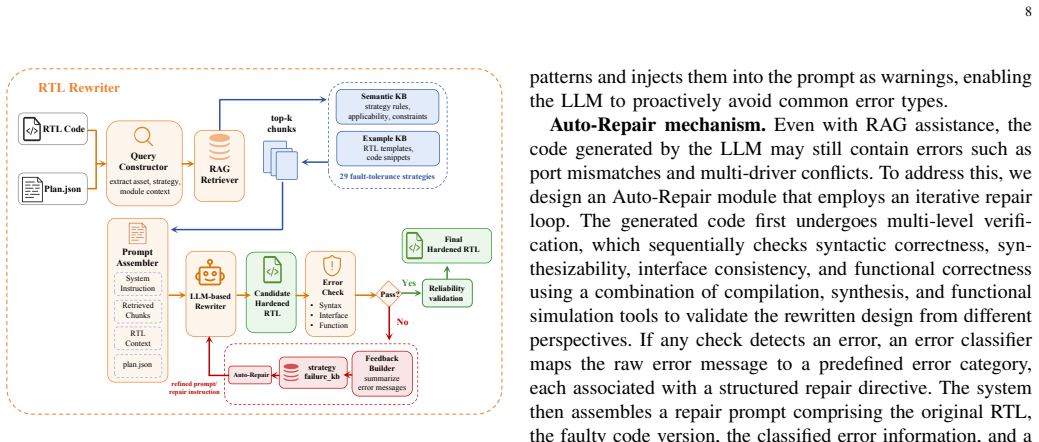
The framework first employs a GNN to identify critical vulnerable assets directly at the RTL level, and then introduces an LLM-driven rewriting engine composed of an analyzer and a rewriter, which performs RTL-level fault-tolerant code rewriting with the support of dual-knowledge-base retrieval-augmented generation and an automatic repair mechanism. Experimental results show that the proposed framework can automatically generate hardened RTL designs that are syntactically correct, functionally correct, and synthesizable across multiple benchmark circuits, while significantly reducing output error rates under soft-error scenarios.
What carries the argument
GNN-guided LLM rewriting engine that locates vulnerable RTL assets then performs analyzer-rewriter fault-tolerant code edits with retrieval-augmented generation and automatic repair.
If this is right
- Hardened RTL can be produced without running time-consuming fault-injection simulations.
- Selective changes keep area and power overhead lower than full-chip hardening.
- Generated designs remain correct and ready for downstream synthesis tools.
- The process supports early, automated reliability work before physical layout.
- The same pipeline works on multiple different benchmark circuits.
Where Pith is reading between the lines
- The approach could be tested on industrial-scale designs to check whether vulnerability prediction scales beyond the reported benchmarks.
- Similar GNN-LLM pairing might be applied to other transient reliability issues such as voltage droops or aging effects.
- Embedding the framework inside existing EDA flows could reduce the manual steps that still remain after code generation.
- Accuracy of the vulnerability model could be further improved by adding limited simulation feedback in a closed loop.
Load-bearing premise
The GNN can accurately pick the most important vulnerable assets straight from RTL code without any fault-injection runs, and the LLM can insert protection while keeping the original function and allowing synthesis.
What would settle it
Run the framework on a fresh benchmark circuit and observe that the output RTL either fails synthesis, changes the original functionality, or shows no measurable drop in soft-error rate during targeted testing.
Figures





read the original abstract
As integrated circuit technologies continue to scale toward advanced process nodes, the continual reduction in node capacitance and supply voltage has made digital systems increasingly vulnerable to soft errors. Although traditional full-chip hardening methods can improve reliability, they often incur unacceptable area and power overhead, making selective hardening a more practical engineering solution. However, existing approaches typically rely on time-consuming fault-injection simulation to determine hardening locations through vulnerability analysis, and still depend heavily on manual strategy selection and RTL modification during the hardening stage, making them ill-suited for efficient automated reliability optimization at early design stages. To address these challenges, this paper proposes FT-Pilot, a GNN-guided LLM framework for automatic RTL soft-error hardening. The framework first employs a GNN to identify critical vulnerable assets directly at the RTL level, and then introduces an LLM-driven rewriting engine composed of an analyzer and a rewriter, which performs RTL-level fault-tolerant code rewriting with the support of dual-knowledge-base retrieval-augmented generation and an automatic repair mechanism. Experimental results show that the proposed framework can automatically generate hardened RTL designs that are syntactically correct, functionally correct, and synthesizable across multiple benchmark circuits, while significantly reducing output error rates under soft-error scenarios. This work provides a practical automated path toward shift-left reliability optimization at the RTL level.
Editorial analysis
A structured set of objections, weighed in public.
Referee Report
Summary. The paper introduces FT-Pilot, a GNN-guided LLM framework for automatic RTL soft-error hardening. It employs a GNN to identify critical vulnerable assets at the RTL level without simulation, followed by an LLM-driven rewriting engine using dual-knowledge-base RAG and automatic repair to perform fault-tolerant code modifications. The abstract states that experiments demonstrate the generation of hardened RTL designs that are syntactically and functionally correct, synthesizable, and achieve significant reductions in output error rates under soft-error scenarios across multiple benchmark circuits.
Significance. If the experimental claims are substantiated with proper validation and quantitative data, this approach could offer a practical automated solution for selective hardening at early RTL design stages, potentially reducing the overhead of traditional methods and enabling shift-left reliability optimization in hardware design.
major comments (2)
- [Abstract] The central claim of experimental success, including 'significantly reducing output error rates under soft-error scenarios' across multiple benchmarks, is presented without any quantitative results, specific benchmark names, verification procedures for functional correctness, or comparisons to existing hardening methods or baselines. This omission makes the primary empirical contribution impossible to assess from the manuscript.
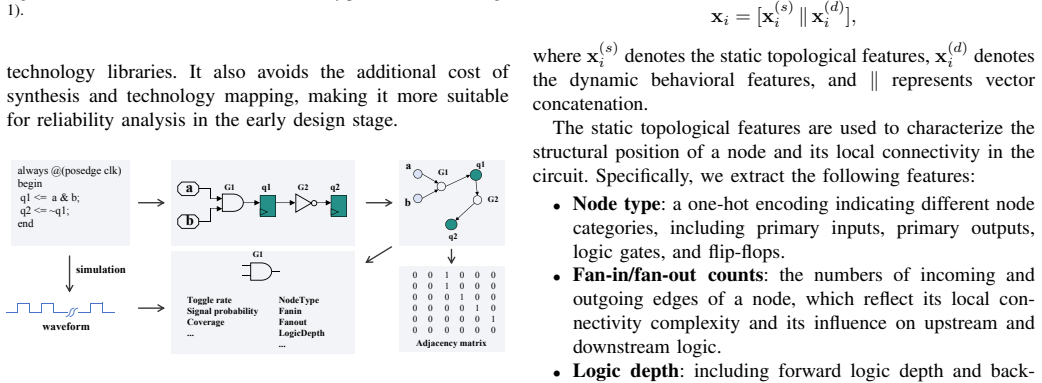
- [GNN Vulnerability Identification] The method description indicates that the GNN operates 'directly at the RTL level' to identify vulnerable assets, replacing standard fault-injection simulation. However, there is no mention of how the GNN is trained (e.g., what labels are used), no post-hoc correlation with actual soft-error sensitivities measured by bit-flip or SEU injection, and no validation metrics. This is a load-bearing assumption for the framework's ability to target meaningful locations for hardening.
minor comments (1)
- The abstract and description could benefit from clearer distinction between the analyzer and rewriter components in the LLM engine.
Simulated Author's Rebuttal
We thank the referee for the constructive feedback. The comments highlight opportunities to strengthen the presentation of empirical results and methodological details. We address each point below and will revise the manuscript accordingly.
read point-by-point responses
-
Referee: [Abstract] The central claim of experimental success, including 'significantly reducing output error rates under soft-error scenarios' across multiple benchmarks, is presented without any quantitative results, specific benchmark names, verification procedures for functional correctness, or comparisons to existing hardening methods or baselines. This omission makes the primary empirical contribution impossible to assess from the manuscript.
Authors: We agree the abstract would be strengthened by including key quantitative highlights. The full manuscript (Section 5) reports results on specific benchmarks (AES, FIR, and others), with functional correctness verified via simulation and synthesis, and error-rate reductions measured under fault-injection campaigns. We will revise the abstract to incorporate representative quantitative findings (e.g., average output error-rate reduction and benchmark count) while preserving its concise nature. revision: yes
-
Referee: [GNN Vulnerability Identification] The method description indicates that the GNN operates 'directly at the RTL level' to identify vulnerable assets, replacing standard fault-injection simulation. However, there is no mention of how the GNN is trained (e.g., what labels are used), no post-hoc correlation with actual soft-error sensitivities measured by bit-flip or SEU injection, and no validation metrics. This is a load-bearing assumption for the framework's ability to target meaningful locations for hardening.
Authors: The GNN training procedure, label generation from prior fault-injection data, and validation against SEU injection results are described in Section 3.2 of the manuscript, including correlation metrics. To address the concern, we will expand the high-level method overview to explicitly reference these elements and add a short validation summary or pointer to the relevant subsection. revision: yes
Circularity Check
No significant circularity detected in derivation chain
full rationale
The paper describes an engineering framework combining a GNN for RTL-level vulnerability identification with an LLM rewriting engine, supported by retrieval-augmented generation and repair mechanisms. No equations, fitted parameters, or self-referential definitions appear in the provided text. The central claims rest on experimental validation across benchmark circuits rather than any reduction of outputs to inputs by construction. No load-bearing self-citations, uniqueness theorems, or ansatzes imported from prior author work are invoked to force the methodology. The approach is presented as a novel combination of existing ML components applied to RTL hardening, making the derivation self-contained without circular steps.
Axiom & Free-Parameter Ledger
Reference graph
Works this paper leans on
-
[1]
Radiation-induced soft errors in advanced semiconductor technologies,
R. Baumann, “Radiation-induced soft errors in advanced semiconductor technologies,”IEEE Transactions on Device and Materials Reliability, vol. 5, no. 3, pp. 305–316, 2005. [2]ISO 26262: Road Vehicles—Functional Safety, International Organiza- tion for Standardization Std., 2018
2005
-
[2]
The use of triple-modular redundancy to improve computer reliability,
R. E. Lyons and W. Vanderkulk, “The use of triple-modular redundancy to improve computer reliability,”IBM Journal of Research and Devel- opment, vol. 6, no. 2, pp. 200–209, 1962
1962
-
[3]
Error detecting and error correcting codes,
R. W. Hamming, “Error detecting and error correcting codes,”The Bell system technical journal, vol. 29, no. 2, pp. 147–160, 1950
1950
-
[4]
A survey on fault injection techniques,
H. Ziade, R. A. Ayoubi, R. Velazcoet al., “A survey on fault injection techniques,”Int. Arab J. Inf. Technol., vol. 1, no. 2, pp. 171–186, 2004
2004
-
[5]
Soft-error-rate-analysis (sera) method- ology,
M. Zhang and N. R. Shanbhag, “Soft-error-rate-analysis (sera) method- ology,”IEEE Transactions on Computer-Aided Design of Integrated Circuits and Systems, vol. 25, no. 10, pp. 2140–2155, 2006
2006
-
[6]
Single event effects mitigation with tmrg tool,
S. Kulis, “Single event effects mitigation with tmrg tool,”Journal of Instrumentation, vol. 12, no. 01, p. C01082, 2017. [Online]. Available: http://stacks.iop.org/1748-0221/12/i=01/a=C01082
2017
-
[7]
Rtlcoder: Outperforming gpt-3.5 in design rtl generation with our open-source dataset and lightweight solution,
S. Liu, W. Fang, Y . Lu, Q. Zhang, H. Zhang, and Z. Xie, “Rtlcoder: Outperforming gpt-3.5 in design rtl generation with our open-source dataset and lightweight solution,” in2024 IEEE LLM Aided Design Workshop (LAD), 2024, pp. 1–5
2024
-
[8]
Rtlrewriter: Methodologies for large models aided rtl code optimization,
X. Yao, Y . Wang, X. Li, Y . Lian, R. Chen, L. Chen, M. Yuan, H. Xu, and B. Yu, “Rtlrewriter: Methodologies for large models aided rtl code optimization,” in2024 ACM/IEEE International Conference On Computer Aided Design (ICCAD), 2024, pp. 1–7
2024
-
[9]
Selective hardening: Toward cost-effective error tolerance,
I. Polian and J. P. Hayes, “Selective hardening: Toward cost-effective error tolerance,”IEEE Design & Test of Computers, vol. 28, no. 3, pp. 54–63, 2011
2011
-
[10]
Modeling gate-level abstraction hierarchy using graph convolu- tional neural networks to predict functional de-rating factors,
A. Balakrishnan, T. Lange, M. Glorieux, D. Alexandrescu, and M. Jeni- hhin, “Modeling gate-level abstraction hierarchy using graph convolu- tional neural networks to predict functional de-rating factors,” in2019 NASA/ESA Conference on Adaptive Hardware and Systems (AHS), 2019, pp. 72–78
2019
-
[11]
Toward critical flip- flop identification for soft-error tolerance with graph neural networks,
L. Lu, J. Chen, M. Ulbricht, and M. Krstic, “Toward critical flip- flop identification for soft-error tolerance with graph neural networks,” IEEE Transactions on Computer-Aided Design of Integrated Circuits and Systems, vol. 43, no. 4, pp. 1135–1148, 2024
2024
-
[12]
Machine learning method- ologies to predict the results of simulation-based fault injection,
L. Lu, J. Chen, M. Ulbricht, and M. Krstic, “Machine learning method- ologies to predict the results of simulation-based fault injection,”IEEE Transactions on Circuits and Systems I: Regular Papers, vol. 71, no. 5, pp. 1978–1991, 2024
1978
-
[13]
Machine learning to tackle the challenges of transient and soft errors in complex circuits,
T. Lange, A. Balakrishnan, M. Glorieux, D. Alexandrescu, and L. Ster- pone, “Machine learning to tackle the challenges of transient and soft errors in complex circuits,” in2019 IEEE 25th International Symposium on On-Line Testing and Robust System Design (IOLTS), 2019, pp. 7–14
2019
-
[14]
Yosys-a free verilog synthesis suite,
C. Wolf, J. Glaser, and J. Kepler, “Yosys-a free verilog synthesis suite,” inProceedings of the 21st Austrian Workshop on Microelectronics (Austrochip), vol. 97, 2013, pp. 1–6
2013
-
[15]
The soft error problem: An architectural perspective,
S. S. Mukherjee, J. Emer, and S. K. Reinhardt, “The soft error problem: An architectural perspective,” in11th International Symposium on High- Performance Computer Architecture. IEEE, 2005, pp. 243–247
2005
-
[16]
Algorithm-based fault tolerance for matrix operations,
K.-H. Huang and J. A. Abraham, “Algorithm-based fault tolerance for matrix operations,”IEEE Transactions on Computers, vol. C-33, no. 6, pp. 518–528, 1984
1984
-
[17]
Evaluating one-hot encoding finite state machines for seu reliability in sram-based fpgas,
M. Cassel and F. Lima, “Evaluating one-hot encoding finite state machines for seu reliability in sram-based fpgas,” in12th IEEE Inter- national On-Line Testing Symposium (IOLTS’06), 2006, pp. 6 pp.–
2006
-
[18]
Razor: a low-power pipeline based on circuit-level timing speculation,
D. Ernst, N. S. Kim, S. Das, S. Pant, R. Rao, T. Pham, C. Ziesler, D. Blaauw, T. Austin, K. Flautner, and T. Mudge, “Razor: a low-power pipeline based on circuit-level timing speculation,” inProceedings. 36th Annual IEEE/ACM International Symposium on Microarchitecture,
-
[19]
MICRO-36., 2003, pp. 7–18
2003
-
[20]
Bubble razor: Eliminating timing margins in an arm cortex-m3 processor in 45 nm cmos using architecturally independent error detection and correction,
M. Fojtik, D. Fick, Y . Kim, N. Pinckney, D. M. Harris, D. Blaauw, and D. Sylvester, “Bubble razor: Eliminating timing margins in an arm cortex-m3 processor in 45 nm cmos using architecturally independent error detection and correction,”IEEE Journal of Solid-State Circuits, vol. 48, no. 1, pp. 66–81, 2013
2013
-
[21]
Exploring a bayesian optimization framework compatible with digital standard flow for soft-error-tolerant circuit,
Y . Li, X. Zeng, Z. Gao, L. Lin, J. Tao, J. Han, X. Cheng, M. Tahoori, and X. Zeng, “Exploring a bayesian optimization framework compatible with digital standard flow for soft-error-tolerant circuit,” in2020 57th ACM/IEEE Design Automation Conference (DAC). IEEE, 2020, pp. 1–6
2020
-
[22]
ERASER: Efficient RTL fault simulation framework with trimmed execution redundancy,
J. Tang, J. Mu, S. Liu, Z. Liu, F. Gu, X. Zhang, L. Wang, S. Liang, J. Ye, H. Li, and X. Li, “ERASER: Efficient RTL fault simulation framework with trimmed execution redundancy,” inProc. Design, Automation & Test in Europe (DATE), 2025, pp. 1–7
2025
-
[23]
Graph learning-based fault criticality analysis for enhancing functional safety of e/e systems,
S. Das, S. Kundu, P. Madhusoodhanan, P. V . Pillai, R. Parekhji, A. Raha, S. Banerjee, S. Natarajan, and K. Basu, “Graph learning-based fault criticality analysis for enhancing functional safety of e/e systems,” in 2024 61st ACM/IEEE Design Automation Conference (DAC), 2024, pp. 1–6
2024
-
[24]
Autovcoder: A systematic framework for automated verilog code gen- eration using llms,
M. Gao, J. Zhao, Z. Lin, W. Ding, X. Hou, Y . Feng, C. Li, and M. Guo, “Autovcoder: A systematic framework for automated verilog code gen- eration using llms,” in2024 IEEE 42nd International Conference on Computer Design (ICCD), 2024, pp. 162–169
2024
-
[25]
Mage: A multi-agent engine for automated rtl code generation,
Y . Zhao, H. Zhang, H. Huang, Z. Yu, and J. Zhao, “Mage: A multi-agent engine for automated rtl code generation,” in2025 62nd ACM/IEEE Design Automation Conference (DAC), 2025, pp. 1–7
2025
-
[26]
Llm4gv: An llm-based flexible performance-aware framework for gemm verilog generation,
D. Zou, G. Zhang, K. Sun, Z. Wen, M. Wang, and Z. Wang, “Llm4gv: An llm-based flexible performance-aware framework for gemm verilog generation,” in2025 Design, Automation & Test in Europe Conference (DATE), 2025, pp. 1–2
2025
-
[27]
Are llms ready for practical adoption for assertion generation?
V . Pulavarthi, D. Nandal, S. Dan, and D. Pal, “Are llms ready for practical adoption for assertion generation?” in2025 Design, Automation & Test in Europe Conference (DATE), 2025, pp. 1–7
2025
-
[28]
Self-hwdebug: Automation of llm self- instructing for hardware security verification,
M. Akyash and H. M. Kamali, “Self-hwdebug: Automation of llm self- instructing for hardware security verification,” in2024 IEEE Computer Society Annual Symposium on VLSI (ISVLSI), 2024, pp. 391–396
2024
-
[29]
Hlspilot: Llm-based high-level synthesis,
C. Xiong, C. Liu, H. Li, and X. Li, “Hlspilot: Llm-based high-level synthesis,” in2024 ACM/IEEE International Conference On Computer Aided Design (ICCAD), 2024, pp. 1–9
2024
-
[30]
Chateda: A large language model powered autonomous agent for eda,
H. Wu, Z. He, X. Zhang, X. Yao, S. Zheng, H. Zheng, and B. Yu, “Chateda: A large language model powered autonomous agent for eda,” IEEE Transactions on Computer-Aided Design of Integrated Circuits and Systems, vol. 43, no. 10, pp. 3184–3197, 2024
2024
-
[31]
Retrieval- augmented generation for knowledge-intensive nlp tasks,
P. Lewis, E. Perez, A. Piktus, F. Petroni, V . Karpukhin, N. Goyal, H. K ¨uttler, M. Lewis, W.-t. Yih, T. Rockt ¨aschelet al., “Retrieval- augmented generation for knowledge-intensive nlp tasks,”Advances in neural information processing systems, vol. 33, pp. 9459–9474, 2020
2020
-
[32]
On the estimation of complex circuits functional failure rate by machine learning techniques,
T. Lange, A. Balakrishnan, M. Glorieux, D. Alexandrescu, and L. Ster- pone, “On the estimation of complex circuits functional failure rate by machine learning techniques,” in2019 49th Annual IEEE/IFIP Interna- tional Conference on Dependable Systems and Networks – Supplemental Volume (DSN-S), 2019, pp. 35–41
2019
-
[33]
VC Z01X functional safety simulator,
Synopsys Inc., “VC Z01X functional safety simulator,” https://www.synopsys.com/verification/simulation/vc-z01x.html, 2023
2023
-
[34]
Inductive representation learning on large graphs,
W. Hamilton, Z. Ying, and J. Leskovec, “Inductive representation learning on large graphs,”Advances in neural information processing systems, vol. 30, 2017
2017
-
[35]
Chain-of-thought prompting elicits reasoning in large language models,
J. Wei, X. Wang, D. Schuurmans, M. Bosma, F. Xia, E. Chi, Q. V . Le, D. Zhouet al., “Chain-of-thought prompting elicits reasoning in large language models,”Advances in neural information processing systems, vol. 35, pp. 24 824–24 837, 2022
2022
-
[36]
Rtllm: An open-source benchmark for design rtl generation with large language model,
Y . Lu, S. Liu, Q. Zhang, and Z. Xie, “Rtllm: An open-source benchmark for design rtl generation with large language model,” in2024 29th Asia and South Pacific Design Automation Conference (ASP-DAC). IEEE, 2024, pp. 722–727
2024
-
[37]
OpenCores—open source IP cores,
OpenCores, “OpenCores—open source IP cores,” https://opencores.org, 2023
2023
-
[38]
mriscvcore: A RISC-V processor core,
OnChipUIS, “mriscvcore: A RISC-V processor core,” https://github.com/onchipuis/mriscvcore, 2023
2023
-
[39]
Fast graph representation learning with Py- Torch Geometric,
M. Fey and J. E. Lenssen, “Fast graph representation learning with Py- Torch Geometric,” inProc. ICLR Workshop on Representation Learning on Graphs and Manifolds, 2019
2019
-
[40]
Evaluating Large Language Models Trained on Code
M. Chen, J. Tworek, H. Jun, Q. Yuan, H. P. D. O. Pinto, J. Kaplan, H. Edwards, Y . Burda, N. Joseph, G. Brockmanet al., “Evaluating large language models trained on code,”arXiv preprint arXiv:2107.03374, 2021
work page internal anchor Pith review Pith/arXiv arXiv 2021
-
[41]
Icarus verilog,
S. Williams, “Icarus verilog,” https://github.com/steveicarus/iverilog, 2002
2002
-
[42]
FreePDK: An open-source variation-aware design kit,
J. E. Stineet al., “FreePDK: An open-source variation-aware design kit,” inProc. IEEE Int. Conf. Microelectronic Systems Education (MSE), 2007, pp. 173–174
2007
discussion (0)
Sign in with ORCID, Apple, or X to comment. Anyone can read and Pith papers without signing in.