REVIEW 3 major objections 5 minor 2 cited by
Reason-Align-Respond: Aligning LLM Reasoning with Knowledge Graphs for KGQA
T0 review · 3 major / 5 minor · reviewed 2026-08-07 · deepseek-v4-flash
Pith's one-line read RAR claims that forcing LLM reasoning to pass through graph-valid paths, trained with expectation-maximization, yields state-of-the-art KGQA accuracy and eliminates hallucinated knowledge paths when answers are correct.
desk verdict Solid KGQA integration with strong reported gains, but the EM loop's causal contribution is not isolated by the experiments. read the letter →
The pith
A machine-rendered reading of the paper's core claim, the machinery that carries it, and where it could break.
The reading
What carries the argument
The load-bearing mechanism is the latent-variable factorization $p_\omega(a|z_r,z_p,q)\,p_\phi(z_p|G,z_r,q)\,p_\theta(z_r|q)$ summed over the unobserved reasoning chain $z_r$ and knowledge path $z_p$, optimized by expectation-maximization. In practice, the Reasoner and Aligner are fused into a single ReAligner that emits the chain and the path together, and the M-step fine-tunes it on chains that the current model scores as both graph-valid and answer-bearing. The second load-bearing piece is KG-constrained decoding, which restricts the Aligner's output tokens to those that can extend a triple already present in the knowledge graph, making hallucinated path steps impossible by construction during generation.
What would settle it
Run the Freebase-trained RAR zero-shot on a held-out knowledge graph whose relation labels share no string overlap with Freebase, comparing constrained versus unconstrained decoding; if removing the constraint does not lower accuracy, the claim that KG-constrained path validity drives the reported gains is falsified.
Extended reading notes
Core claim
RAR's central claim is that the alignment between a natural-language reasoning chain and a valid knowledge-graph path is what drives KGQA improvement, not merely the final answer selection. The paper formalizes the answer as an integral over two latent variables, the reasoning chain $z_r$ and the knowledge path $z_p$, under the factorization given in Equation (1), and optimizes the parameters of the Reasoner, Aligner, and Responser with an EM loop. In the E-step, candidate chains are scored by whether they lead to the correct answer through graph-valid triples; in the M-step, the Reasoner-Aligner is fine-tuned on the winners. At inference, KG-constrained decoding forbids tokens that cannot complete an existing graph triple, Knowledge Path Expansion generalizes one found triple into a query template that retrieves all instances, and LLM-driven Consolidation merges multiple sampled chains. The reported results, Hit@1 of 93.3% on WebQSP and 91.0% on CWQ with F1 of 87.7% and 84.8%, are presented as evidence that this grounded-reasoning loop outperforms both agent-exploration and path-generation baselines.
Load-bearing premise
The load-bearing premise is that a Reasoner-Aligner trained on Freebase-style chains can, without any adaptation or vocabulary mapping, emit valid and useful knowledge paths on entirely unseen knowledge graphs with different entities and relations.
Editorial extensions
If this is right
- Ablating KG-constrained decoding drops CWQ F1 from 84.8 to 48.9, so graph-valid decoding, not the backbone or the consolidation prompt, is the largest single contributor to the reported accuracy.
- With the constraint active, the paper measures zero hallucinated triples in knowledge paths on correctly answered questions, so users can inspect a trace that is guaranteed graph-factual.
- Because EM supplies supervision for latent chains, improving KGQA does not require human-annotated reasoning traces; a small cold-start set derived from SPARQL plus question-answer pairs is enough to begin the loop.
- Knowledge Path Expansion lets a single discovered relation template recover complete answer sets, which is what allows the method to reach high F1 rather than just Hit.
- At 4.38 seconds per CWQ question with an 8B backbone, the method keeps grounding overhead close to that of the previous constrained-decoding baseline (3.72 s) while improving Hit by 15.2 points.
Reading between the lines
- A controlled transfer test the paper does not report: apply the Freebase-trained RAR to a graph whose relation labels share no string overlap with Freebase, to separate alignment-driven transfer from the base LLM's parametric familiarity with ConceptNet-style relations.
- The same EM formulation is graph-agnostic, so the latent-chain/grounded-path scheme could be carried to other structured environments, such as SQL schemas or tool/API calls, wherever a natural-language plan must be executable against a formal object.
- Given that removing the Reasoner hurts precision but raises recall, one testable hypothesis is that the reasoning chain functions mainly as a search prior for the Aligner; a minimal variant with template-based chain prompts could show how much of the gain is due to the learned Reasoner itself.
Editorial analysis
A structured set of objections, weighed in public.
Referee Report
Summary. The paper introduces RAR (Reason-Align-Respond), a KGQA framework in which a Reasoner generates natural-language reasoning chains, an Aligner maps those chains to valid knowledge-graph paths, and a Responser produces final answers. The authors formalize the pipeline as a latent-variable model and propose an EM-style training loop that alternately selects high-quality (reasoning-chain, knowledge-path) pairs and fine-tunes the Reasoner/Aligner. At inference they add KG-constrained decoding, knowledge-path expansion, and GPT-4o-mini-based consolidation. Experiments on WebQSP and CWQ report state-of-the-art Hit@1/F1 scores (93.3/87.7 and 91.0/84.8), and the paper additionally reports ablations, human evaluation of reasoning chains, EM-iteration analyses, a CPU-efficiency comparison, and zero-shot results on CSQA and MedQA.
Significance. If the central attribution holds, RAR is a notable contribution: the reported F1 gains over the previous state of the art are large (13.6 and 23.1 points), the framework produces interpretable reasoning chains, and the human evaluation plus the KG-constrained decoding analysis point to a concrete mechanism for reducing hallucinations. The paper also includes useful analyses of EM iterations and beam size, and Table 3 shows competitive inference runtime. However, the empirical contribution is currently underdetermined: no ablation isolates the EM loop from cold-start supervision and test-time machinery, the appendix contradicts the main-text claim that all three modules are jointly fine-tuned, there are no error bars or significance tests, and no code or data are released. These issues prevent the paper from supporting its strongest mechanistic conclusions, though the benchmark numbers themselves may well be reproducible.
major comments (3)
- [§2.2, §3.3, App. A.3.4, App. C.3] The central claim that EM-trained alignment drives the gains is not tested by any ablation. In Table 2, removing LC, Reasoner, KD, or KPE always keeps the EM-trained ReAligner fixed; there is no control that starts from the same cold-start model and applies the same inference-time techniques while skipping the EM loop. Given that cold-start SFT already injects 2,000 GPT-4o-generated chains derived from gold SPARQL decompositions (§C.2), the improvements over GCR could come from that supervision or from the test-time components rather than from iterative EM refinement. I ask the authors to add a control: train ReAligner with cold-start SFT only, then evaluate with KD, KPE, and LC enabled, and compare against the full RAR pipeline across EM iterations. In addition, §2.2 states that all three modules are jointly fine-tuned and Eq. (6) includes a Q_Responser(w) term, but App. A.3.4 says the Responser optimization can be skipped and App. C.3 states the Responser is used without fine-tuning. This is an internal inconsistency in the training procedure, and it is load-bearing because the E-step posterior score S(z) = log p_w(a|q,z) + log p_psi(z|G,q) in Eq. (5)/Alg. 1 uses p_w; if p_w is never updated, the 'posterior' is not the model's actual posterior. Please clarify which version was used for the reported numbers and, if the Responser is not trained, adjust the EM derivation and add the requested no-EM control.
- [§3.4, Table 5] The zero-shot generalization claim is not supported by the described experimental setup. RAR is cold-started and EM-trained on Freebase-derived chains (§C.2), and Table 5 reports transfer to ConceptNet-based CSQA and a medical KG for MedQA. The paper does not describe any vocabulary-mapping, entity-linking, or retrieval adaptation for these graphs, whose entity and relation vocabularies differ from Freebase. Without such a mechanism, it is unclear how a ReAligner fine-tuned on Freebase relation names can emit valid knowledge paths on ConceptNet or a medical KG. Please either describe the adaptation used (including how the Aligner's KG-constrained decoding is instantiated on unseen KGs) or temper the claim to 'transfer on an unseen KG with suitable schema alignment.' As written, the zero-shot numbers in Table 5 are not reproducible from the paper.
- [§3.1, §3.2, Table 1] The state-of-the-art comparison lacks statistical uncertainty and reproducibility artifacts. Table 1 reports single-point results with no error bars, no multiple seeds, and no significance tests; on WebQSP the Hit gain over GCR is 1.1 points, which could be within run-to-run variation. The paper also does not provide code, trained checkpoints, or the generated EM training data, so the main results cannot be independently verified. Please report mean and variance over at least three seeds (or explain why the evaluation is deterministic), state hardware/software versions, and release code and data, at least in an anonymized supplement. The large F1 gains on CWQ are encouraging, but the current reporting makes the SOTA claim difficult to assess.
minor comments (5)
- [Table 1] The GPT-4o-mini row reports identical values (63.8 Hit, 40.5 F1) for both WebQSP and CWQ, which appears to be a copy/paste error and should be corrected.
- [§3.4, 'KG-constrained Decoding Effectiveness'] The statement that the method achieves 'zero hallucinations in Knowledge Paths when answers are correct' is not accompanied by a formal definition of hallucination rate, a table, or the number of samples; please add the measurement protocol and results.
- [App. B.1] There is an unresolved cross-reference 'Tab. ??' in the discussion of resource consumption; please fix it to point to Table 3 or remove it.
- [Figure 3] The axis labels and tick marks in Figure 3 appear corrupted with Unicode escape sequences in the submitted PDF; please replace with a readable vector figure.
- [App. C.2] The phrasing 'we generate a dataset of 2,000 high-quality Reasoning Chains with their corresponding Knowledge Paths for each question' is ambiguous: it should state whether 2,000 is the total number of exemplars or 2,000 per question.
Circularity Check
Core EM/KGQA derivation is self-contained; one local hallucination claim reduces to the definition of the method.
-
other
[Section 2.3 (KG-constrained Decoding) and Section 3.4 (KG-constrained Decoding Effectiveness)]
"KG-constrained Decoding aims to prevent hallucinated triples that do not exist in the KG. ... KG-constrained Decoding restricts the output tokens so that only tokens forming valid KG triples can be produced. ... Our method achieves zero hallucinations in Knowledge Paths when answers are correct, while without constraints, even correct answers show a 44% hallucination rate."
The reported effect is guaranteed by the method's definition. KG-constrained decoding is defined as restricting output tokens so that only valid KG triples can be produced, so any emitted Knowledge Path cannot contain triples absent from the KG. Claiming 'zero hallucinations in Knowledge Paths' under this constraint is therefore a restatement of the construction, not an empirical finding; the only empirical contrast is the unconstrained 44% hallucination rate. This local tautology does not affect the held-out WebQSP/CWQ benchmark results or the EM derivation.
full rationale
The paper's central derivation is not circular. The probabilistic model in Eqs. (1)-(6) is a standard latent-variable formulation: z_r and z_p are treated as latent, the E-step scores candidate chains by the posterior p_w,psi(z|G,q,a) proportional to p_w(a|q,z) p_psi(z|G,q), and the M-step is standard instruction-tuning on selected chains. Cold-start supervision comes from gold SPARQL queries (App. C.2), so initial latent labels are derived from an external source, not from the model's own predictions. Benchmark numbers in Table 1 are held-out results, and I found no load-bearing self-citation chain: the method's premises do not rest on the authors' prior work. The manuscript does contain an internal inconsistency—Section 2.2 says all three modules are jointly fine-tuned, while App. C.3 and App. A.3.4 state the Responser is not fine-tuned—and the absence of an ablation that removes the EM loop while keeping cold-start and test-time components means the SOTA gains are underdetermined as to causal attribution. Those are correctness and experimental-design concerns, not circularity. The only exhibited circular step is local: the zero-hallucination claim for KG-constrained decoding is true by construction rather than by measurement. Because the central derivation and benchmark claims are independent of that tautological evaluation, the overall circularity score is low.
Assumptions & free parameters
free parameters (3)
- Cold-start exemplar count =
2,000
- Beam size / top-K candidates =
10
- EM iteration count =
200 steps
assumptions (4)
- domain assumption The 2,000 cold-start exemplars, built by decomposing gold SPARQL queries and verbalizing retrieved triples with GPT-4o, are high-quality and representative enough to initialize the Reasoner and Aligner.
- ad hoc to paper The E-step posterior q(z) can be approximated by top-K selection using S(z) = log p_w(a|q,z) + log p_psi(z|G,q).
- domain assumption A single ReAligner trained on Freebase can generate valid knowledge paths on unseen knowledge graphs with different entity and relation vocabularies.
- domain assumption The answer is conditionally independent of the knowledge graph given the reasoning chain, knowledge path, and question.
Cite this review
Pith. "Pith review of Reason-Align-Respond: Aligning LLM Reasoning with Knowledge Graphs for KGQA." pith.science (2026). https://pith.science/paper/QXIQVANJ
@misc{pith2026250520971,
  author       = {Pith},
  title        = {Pith review of: Reason-Align-Respond: Aligning LLM Reasoning with Knowledge Graphs for KGQA},
  year         = {2026},
  howpublished = {\url{https://pith.science/paper/QXIQVANJ}},
  note         = {Machine review of arXiv:2505.20971}
}
read the original abstract
LLMs have demonstrated remarkable capabilities in complex reasoning tasks, yet they often suffer from hallucinations and lack reliable factual grounding. Meanwhile, knowledge graphs (KGs) provide structured factual knowledge but lack the flexible reasoning abilities of LLMs. In this paper, we present Reason-Align-Respond (RAR), a novel framework that systematically integrates LLM reasoning with knowledge graphs for KGQA. Our approach consists of three key components: a Reasoner that generates human-like reasoning chains, an Aligner that maps these chains to valid KG paths, and a Responser that synthesizes the final answer. We formulate this process as a probabilistic model and optimize it using the Expectation-Maximization algorithm, which iteratively refines the reasoning chains and knowledge paths. Extensive experiments on multiple benchmarks demonstrate the effectiveness of RAR, achieving state-of-the-art performance with Hit@1 scores of 93.3% and 91.0% on WebQSP and CWQ respectively. Human evaluation confirms that RAR generates high-quality, interpretable reasoning chains well-aligned with KG paths. Furthermore, RAR exhibits strong zero-shot generalization capabilities and maintains computational efficiency during inference.
Figures


Figures from the paper (7 more)




Forward citations
Cited by 2 Pith papers
-
TN-AutoRCA: Benchmark Construction and Agentic Framework for Self-Improving Alarm-Based Root Cause Analysis in Telecommunication Networks
A new 530-scenario benchmark for telecom alarm root cause analysis, plus an iterative agent that lifts F1 from 58.99% to 91.79% by repeatedly repairing its code against the benchmark.
-
Matching Game Preferences Through Dialogical Large Language Models: A Perspective
This perspective paper proposes the D-LLM framework, which couples the authors' GRAPHYP knowledge graphs with LLMs to personalize AI responses and make reasoning traceable, but no empirical validation is presented.
Reference graph
Works this paper leans on
-
[1]
Sample Candidate Graph-aware Reason- ing Chains.For each training example (G, q, a), sample K Graph-aware Reasoning Chains: zk ∼p ψ(z| G, q), k= 1, . . . , K. Letˆz={z 1, z2, . . . , zK}
-
[2]
Approximate the Objective for w.The term logE z∼pψ(z|G,q) pw(a|q, z) 13 is approximated by log 1 K KX k=1 pw(a|q, z k) . We then take gradients (w.r.t.w) and update w so that pw(a|q, z) is more likely to produce the correct a for the sampled Graph-aware Reasoning Chains
-
[3]
QueryAgent: A reliable and efficient reason- ing framework with environmental feedback based self-correction. InProceedings of the 62nd Annual Meeting of the Association for Computational Lin- guistics (Volume 1: Long Papers), pages 5014–5035, Bangkok, Thailand. Association for Computational Linguistics. Jinhao Jiang, Kun Zhou, Zican Dong, Keming Ye, Wayn...
work page 2023
-
[10]
Result.After updating w, Responser pw(a| q, z)is better aligned with whatever Graph- aware Reasoning Chainsp ψ currently emits. A.3.2 Step 2: EM-Style Update for ReAligner After w is updated, we refine the ReAligner pψ(z| G, q). In EM terms, we viewzas a latent variable: E-Step (Posterior Inference) • Compute / Re-rank Graph-aware Reason- ing Chains.Re-sa...
-
[11]
2.(E-Step):Using the updatedw, compute pw,ψ(z| G, q, a)∝pw(a|q, z)p ψ(z| G, q)
(Update w):For each sample (G, q, a), draw K Graph-aware Reasoning Chains from pψ, then updatewby maximizing log 1 K KX k=1 pw(a|q, z k) ! . 2.(E-Step):Using the updatedw, compute pw,ψ(z| G, q, a)∝pw(a|q, z)p ψ(z| G, q). Select high-quality Graph-aware Reasoning Chainsz I from the candidates
-
[12]
fine-tune pψ so that it is more likely to emitz I in the future
(M-Step):Update ψ by maximizing logp ψ(zI | G, q), i.e. fine-tune pψ so that it is more likely to emitz I in the future. This loop can be repeated until convergence or for a fixed number of epochs. A.3.4 Practical Variations
-
[13]
Top-K vs. Full Posterior.Instead of sum- ming/sampling over all subsets, it is simpler to pick the top- K Graph-aware Reasoning Chains byS(·)
-
[14]
Skipping Responser Optimization.To fur- ther improve efficiency, we can skip op- timizing Responser. LLMs often possess strong zero-shot summarization or question- answering capabilities, which means they can produce high-quality answers from given Graph-aware Reasoning Chains without ad- ditional training. As a result, we can treat an LLM as a pre-optimi...
work page 2024
Show all 16 references
-
[16]
Girl Tonight
without fine-tuning based on our prelimi- nary experiments (detailed analysis in App. A.3.4). For both Reasoner and Aligner, we conduct exten- sive experiments with various lightweight LLMs ranging from 0.5B to 8B parameters (Yang et al., 2024; Touvron et al., 2023; Meta, 2024...
2024
-
[1977]
Zixuan Dong, Baoyun Peng, Yufei Wang, Jia Fu, Xi- aodong Wang, Xin Zhou, Yongxue Shan, Kangchen Zhu, and Weiguo Chen
Maximum likelihood from incomplete data via the em algorithm.Journal of the royal statistical society: series B (methodological), 39(1):1–22. Zixuan Dong, Baoyun Peng, Yufei Wang, Jia Fu, Xi- aodong Wang, Xin Zhou, Yongxue Shan, Kangchen Zhu, and Weiguo Chen. 2025. Effiqa: Eff...
2025
-
[2016]
To ensure fair comparison, we adopt identical train and test splits as previous works (Jiang et al., 2022; Luo et al., 2024b)
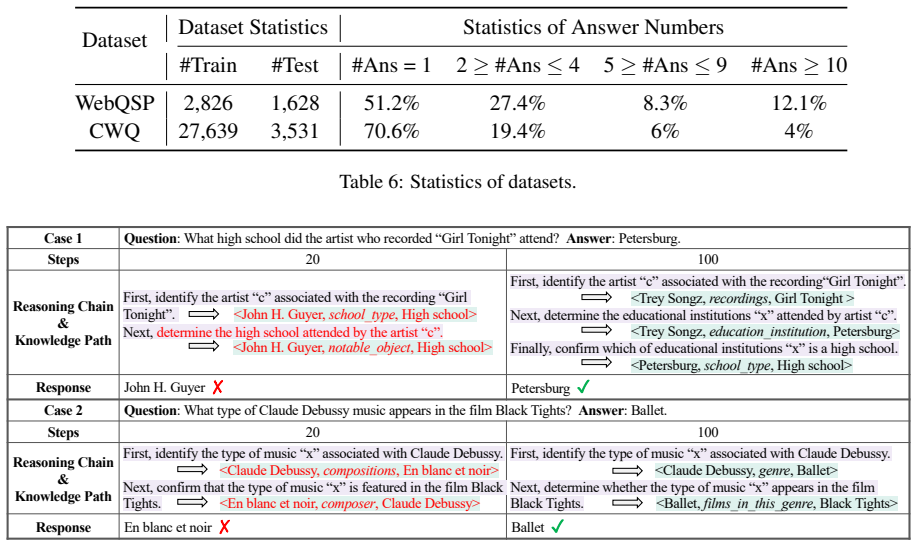
and Complex WebQuestions (CWQ) (Tal- mor and Berant, 2018). To ensure fair comparison, we adopt identical train and test splits as previous works (Jiang et al., 2022; Luo et al., 2024b). The detailed statistics of these datasets are presented in Tab. 6. Both WebQSP and CWQ are...
2024
-
[2018]
InProceedings of the 2018 Conference on Empirical Methods in Natural Language Processing, pages 4231–4242
Open domain question answering using early fusion of knowledge bases and text. InProceedings of the 2018 Conference on Empirical Methods in Natural Language Processing, pages 4231–4242. Jiashuo Sun, Chengjin Xu, Lumingyuan Tang, Saizhuo Wang, Chen Lin, Yeyun Gong, Lionel Ni, H...
2018 arXiv
-
[2022]
InThe Eleventh International Confer- ence on Learning Representations
Unikgqa: Unified retrieval and reasoning for solving multi-hop question answering over knowl- edge graph. InThe Eleventh International Confer- ence on Learning Representations. Di Jin, Eileen Pan, Nassim Oufattole, Wei-Hung Weng, Hanyi Fang, and Peter Szolovits. 2021. What dis...
2021 arXiv
-
[2023]
thought process
Tree of thoughts: Deliberate problem solving with large language models. InAdvances in Neural Information Processing Systems 36: Annual Confer- ence on Neural Information Processing Systems 2023, NeurIPS 2023, New Orleans, LA, USA, December 10 - 16, 2023. Wen-tau Yih, Matthew ...
2023 arXiv
-
[2024]
InProceedings of the 2024 Conference on Empir- ical Methods in Natural Language Processing, pages 7646–7663, Miami, Florida, USA
Middleware for LLMs: Tools are instrumen- tal for language agents in complex environments. InProceedings of the 2024 Conference on Empir- ical Methods in Natural Language Processing, pages 7646–7663, Miami, Florida, USA. Association for Computational Linguistics. Daya Guo, Dej...
2024 arXiv
-
[8219]
Robyn Speer, Joshua Chin, and Catherine Havasi
AAAI Press. Robyn Speer, Joshua Chin, and Catherine Havasi. 2017. Conceptnet 5.5: An open multilingual graph of gen- eral knowledge. InProceedings of the AAAI confer- ence on artificial intelligence, volume 31. Haitian Sun, Bhuwan Dhingra, Manzil Zaheer, Kathryn Mazaitis, Rusl...
2017
Reviewed August 7, 2026 · model on record in the stance chip above.
Discussion (0). Continue with ORCID to comment.