Extended Abstract: Canonical join complex and cubical coordinates for all framing lattices
Pith reviewed 2026-05-19 15:57 UTC · model grok-4.3
The pith
Bricks and brick cliques give a uniform combinatorial model for canonical join representations in every framing lattice.
A machine-rendered reading of the paper's core claim, the machinery that carries it, and where it could break.
Core claim
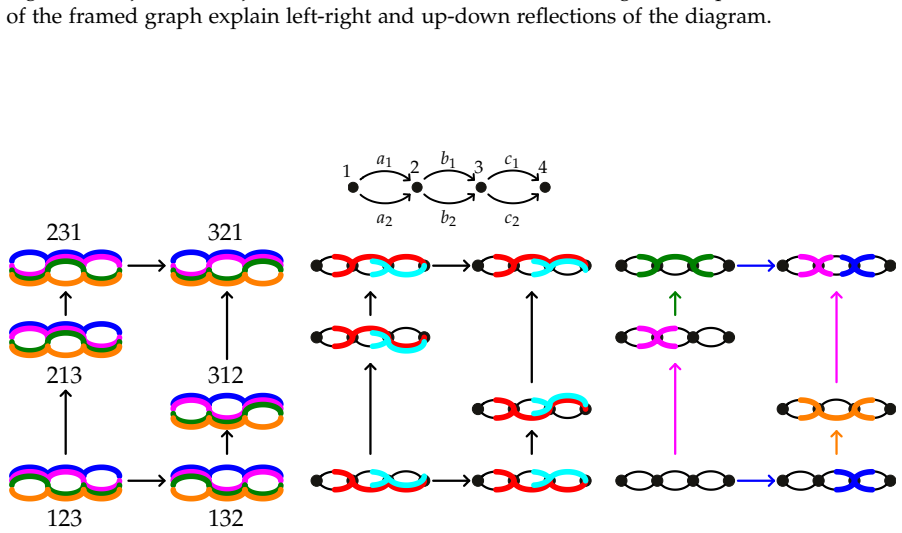
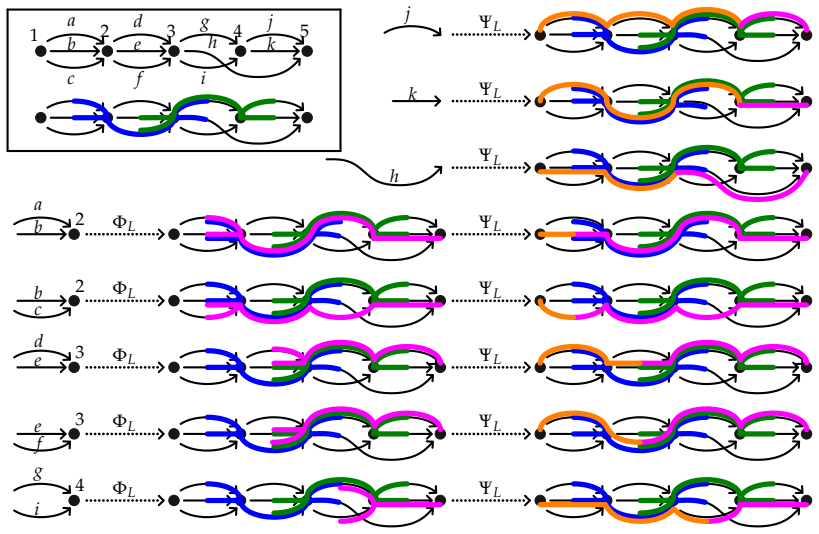
We define bricks and brick cliques as a combinatorial model for join-irreducible elements and canonical join representations in all framing lattices, generalizing noncrossing arc diagrams. Our model captures the natural bijection between join and meet canonical representations, as well as duality upon reflections of the framed graph. The proof is bijective, with an explicit reconstruction algorithm in two steps. Cornered cliques serve as an intermediate construction that yields cubical coordinates on a framing lattice.
What carries the argument
Bricks and brick cliques, which encode join-irreducible elements and canonical join representations while supporting a two-step bijective reconstruction.
If this is right
- Every framing lattice element admits an explicit description by its set of bricks.
- The two-step reconstruction algorithm computes the lattice element directly from any valid brick clique.
- Reflection of the framed graph interchanges canonical join and meet representations in a uniform way.
- Cubical coordinates obtained from cornered cliques give a direct comparison test between any two elements.
- The construction applies without extra restrictions to framing lattices not previously treated by arc diagrams.
Where Pith is reading between the lines
- Cubical coordinates may support new enumeration or sorting algorithms on these lattices.
- The brick model could be tested for compatibility with other known lattice constructions that generalize the Tamari or weak orders.
- If the reconstruction remains efficient, it might yield practical ways to compute meets and joins in large framing lattices.
Load-bearing premise
The newly defined bricks and brick cliques correctly capture the join-irreducible elements and canonical join representations for every framing lattice.
What would settle it
A single framing lattice in which some brick clique fails to reconstruct to the claimed lattice element via the two-step algorithm, or in which the claimed bijection between join and meet representations breaks.
Figures


read the original abstract
This document is an extended abstract for two articles in preparation. Recently, framing lattices were introduced to generalize many classical lattices such as the Tamari lattice and the weak order on the symmetric group. We define bricks and brick cliques as a combinatorial model for join-irreducible elements and canonical join representations in all framing lattices, generalizing noncrossing arc diagrams of (Reading, 2015) for the weak order on the symmetric group. Our model captures the natural bijection between join and meet canonical representations, as well as duality upon reflections of the framed graph. The proof is bijective, with an explicit reconstruction algorithm in two steps. A useful intermediate construction in our bijective proof is our new definition of cornered cliques. These enable us to define cubical coordinates on a framing lattice, generalizing bracket vectors for the Tamari lattice and providing an efficient comparison criterion.
Editorial analysis
A structured set of objections, weighed in public.
Referee Report
Summary. This extended abstract for two articles in preparation introduces bricks and brick cliques as a combinatorial model for join-irreducible elements and canonical join representations in all framing lattices, generalizing noncrossing arc diagrams. It claims a bijective proof via an explicit two-step reconstruction algorithm that also captures the natural bijection between join and meet representations as well as duality under reflections of the framed graph. An intermediate construction of cornered cliques is used to define cubical coordinates on framing lattices, generalizing bracket vectors for the Tamari lattice and providing an efficient comparison criterion.
Significance. If the claimed bijection and uniform correctness hold for arbitrary framing lattices, the work would supply a new combinatorial language applicable beyond classical cases such as the Tamari lattice and weak order on the symmetric group, potentially enabling systematic study of join-irreducibles, duality, and coordinate systems across a broader family of posets.
major comments (2)
- [Abstract] Abstract: the central assertion that bricks and brick cliques correctly identify join-irreducible elements and canonical join representations for every framing lattice (including those outside previously studied families) is stated without any explicit definition of a brick, any verification that the construction recovers the lattice order, or any outline of the two-step reconstruction algorithm.
- [Abstract] Abstract: the uniformity claim—that the model works without additional restrictions on the framed graph—is load-bearing for the generalization beyond noncrossing arc diagrams, yet no supporting argument, lemma, or check for novel framings is supplied in the text.
minor comments (2)
- The citation to Reading (2015) for noncrossing arc diagrams should be expanded to a full bibliographic entry.
- The abstract refers to 'two articles in preparation'; it would be helpful to indicate whether the full proofs and definitions will appear in those articles or whether additional detail is expected in a revised version of this document.
Simulated Author's Rebuttal
We thank the referee for their careful reading of our extended abstract and for highlighting points that clarify the scope of this short document. As this is an extended abstract for two full articles in preparation, space constraints limit the inclusion of complete definitions and proofs; we address each major comment below by indicating where the requested material appears in the forthcoming papers and what, if anything, can be added here.
read point-by-point responses
-
Referee: [Abstract] Abstract: the central assertion that bricks and brick cliques correctly identify join-irreducible elements and canonical join representations for every framing lattice (including those outside previously studied families) is stated without any explicit definition of a brick, any verification that the construction recovers the lattice order, or any outline of the two-step reconstruction algorithm.
Authors: We agree that the extended abstract does not contain the explicit definition of a brick or a detailed outline of the two-step reconstruction algorithm. These are supplied in the two articles in preparation: the first article defines bricks combinatorially as a generalization of noncrossing arcs and proves that brick cliques are in bijection with canonical join representations; the second article presents the explicit two-step reconstruction algorithm and verifies that it recovers the original lattice element, thereby confirming that the construction respects the lattice order. The extended abstract only summarizes the bijective strategy and key properties. We can add a one-paragraph high-level sketch of the reconstruction algorithm to a revised version of the extended abstract if the editor permits. revision: partial
-
Referee: [Abstract] Abstract: the uniformity claim—that the model works without additional restrictions on the framed graph—is load-bearing for the generalization beyond noncrossing arc diagrams, yet no supporting argument, lemma, or check for novel framings is supplied in the text.
Authors: The uniformity claim follows from the general definition of framing lattices on arbitrary framed graphs (as introduced in the foundational paper on framing lattices) and from the design of our bijective proof, which does not impose extra restrictions beyond those already present in the framed graph. The supporting lemmas establishing correctness for general framings, including explicit checks on framings outside the Tamari and weak-order cases, appear in the full articles. The extended abstract states the uniformity as a consequence of the bijective reconstruction and the reflection duality. We can insert a clarifying sentence in a revision stating that the proof applies to all framed graphs without further restrictions. revision: partial
Circularity Check
No circularity: new definitions with independent bijective proof
full rationale
The extended abstract introduces bricks and brick cliques via explicit new combinatorial definitions as a model for join-irreducibles and canonical joins in all framing lattices, generalizing Reading (2015) on specific cases. It asserts a bijective proof together with a two-step reconstruction algorithm and an intermediate cornered-clique construction for cubical coordinates. No equations, fitted parameters, or self-citations appear that would make any claimed result equivalent to its inputs by construction; the central claim rests on the (still-in-preparation) proof rather than on renaming or self-referential fitting. The derivation is therefore self-contained as a fresh combinatorial model.
Axiom & Free-Parameter Ledger
axioms (1)
- standard math Standard definitions and properties of join-irreducible elements and canonical join representations in lattices
invented entities (3)
-
bricks
no independent evidence
-
brick cliques
no independent evidence
-
cornered cliques
no independent evidence
Lean theorems connected to this paper
-
IndisputableMonolith/Foundation/ArithmeticFromLogic.leanLogicNat recovery of Peano structure unclear?
unclearRelation between the paper passage and the cited Recognition theorem.
We define bricks and brick cliques as a combinatorial model for join-irreducible elements and canonical join representations in all framing lattices, generalizing noncrossing arc diagrams of (Reading, 2015)
-
IndisputableMonolith/Foundation/BranchSelection.leanbranch_selection unclear?
unclearRelation between the paper passage and the cited Recognition theorem.
Through a (co)rank map on the left-cornered clique representations, we obtain cubical coordinates on the framing lattice which are analogues of bracket vectors for the Tamari lattice
What do these tags mean?
- matches
- The paper's claim is directly supported by a theorem in the formal canon.
- supports
- The theorem supports part of the paper's argument, but the paper may add assumptions or extra steps.
- extends
- The paper goes beyond the formal theorem; the theorem is a base layer rather than the whole result.
- uses
- The paper appears to rely on the theorem as machinery.
- contradicts
- The paper's claim conflicts with a theorem or certificate in the canon.
- unclear
- Pith found a possible connection, but the passage is too broad, indirect, or ambiguous to say the theorem truly supports the claim.
Reference graph
Works this paper leans on
-
[1]
The canonical complex of the weak order
[AP23] D. Albertin and V . Pilaud. “The canonical complex of the weak order”. Order 40(2) (2023), pp. 349–370. doi. [Bar19] E. Barnard. “The canonical join complex”. Electron. J. Combin. 26(1) (2019), Paper No. 1.24,
work page 2023
-
[2]
Framing lattices and flow poly- topes
doi. [BC24] M. von Bell and C. Ceballos. “Framing lattices and flow poly- topes”. Sém. Lothar. Combin. 91B (2024), Art. 98,
work page 2024
-
[3]
A unifying framework for the ν-Tamari lattice and principal order ideals in Young’s lattice
11 [Bel+23] M. von Bell, R. S. González D’León, F. A. Mayorga Cetina, and M. Yip. “A unifying framework for the ν-Tamari lattice and principal order ideals in Young’s lattice”. Combinatorica 43(3) (2023), pp. 479–504. doi. [Bel+24] M. von Bell, B. Braun, K. Bruegge, D. Hanely, Z. Peterson, K. Ser- hiyenko, and M. Yip. “Triangulations of flow polytopes, am...
work page 2023
-
[4]
Kostant partitions functions and flow polytopes
doi. [BV08] W. Baldoni and M. Vergne. “Kostant partitions functions and flow polytopes”. Transform. Groups 13(3-4) (2008), pp. 447–469. doi. [DKK12] V . I. Danilov, A. V . Karzanov, and G. A. Koshevoy. “Coherent fans in the space of flows in framed graphs”. 24th International Conference on Formal Power Series and Algebraic Combinatorics (FP- SAC 2012). Vo...
work page 2008
-
[5]
Toric matrix Schubert varieties and their polytopes
[EM16] L. Escobar and K. Mészáros. “Toric matrix Schubert varieties and their polytopes”. Proc. Amer. Math. Soc. 144(12) (2016), pp. 5081–
work page 2016
-
[6]
Realizing the s-permutahedron via flow poly- topes
doi. [GD+25] R. González D’León, A. Morales, E. Philippe, D. Tamayo Jiménez, and M. Yip. “Realizing the s-permutahedron via flow poly- topes”. Trans. Amer. Math. Soc. 378(11) (2025), pp. 7625–7666. doi. [HT72] S. Huang and D. Tamari. “Problems of associativity: A sim- ple proof for the lattice property of systems ordered by a semi- associative law”. J. Co...
work page 2025
discussion (0)
Sign in with ORCID, Apple, or X to comment. Anyone can read and Pith papers without signing in.