REVIEW 4 major objections 5 minor 1 cited by
BiasGuard: Guardrailing Fairness in Machine Learning Production Systems
T0 review · 4 major / 5 minor · reviewed 2026-08-10 · deepseek-v4-flash
Pith's one-line read Post-processing fairness tool cuts Equalized Odds 31% with only 0.09% accuracy cost.
desk verdict BiasGuard is a genuinely new combination - test-time augmentation with CTGAN for post-hoc fairness - with a promising empirical table, but the paper leaves the critical question of how the generators are trained relative to the test data unanswered, so the headline 31% EOD gain is not yet secure. read the letter →
The pith
A machine-rendered reading of the paper's core claim, the machinery that carries it, and where it could break.
The reading
What carries the argument
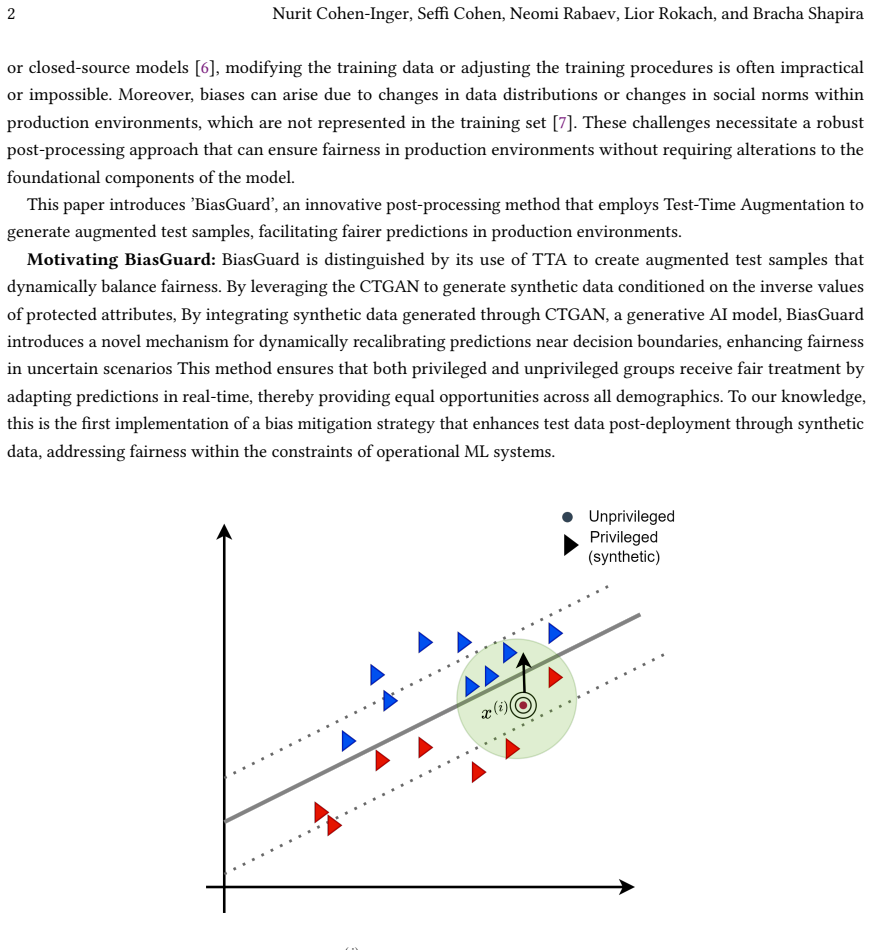
The machinery is a set of CTGAN generators, one per protected-attribute value, with CTGAN being a conditional generative adversarial network for tabular data. For each test instance, BiasGuard constructs an 'opposite' version by flipping only the protected attribute; if the classifier's rounded probabilities differ, it retrieves the $T$ nearest synthetic counterfactuals from the opposite group via nearest-neighbor search and feeds them through the black-box model. The final prediction uses the default aggregation $G(\hat{y}^{(i)}, \hat{Y}^{(i)}_{TTA}) = \tfrac{1}{2}\hat{y}^{(i)} + \tfrac{1}{2} \overline{\hat{Y}^{(i)}_{TTA}}$, so only predictions that would flip under the attribute swap get recalibrated. This targeted trigger is what keeps the number of flips low and the accuracy cost small.
What would settle it
Re-run the five experiments with CTGAN generators trained strictly on the training split, holding out the test fold for both the classifier and the generator, and compare Equalized Odds to the reported values; if the 31% average reduction shrinks or disappears under this clean split, the method's core claim is unsupported.
Extended reading notes
Core claim
The central discovery is that test-time augmentation with synthetic data generated conditional on inverted protected attributes can reduce Equalized Odds, a confusion-matrix fairness metric that measures true-positive-rate and false-positive-rate gaps between privileged and unprivileged groups, while barely moving accuracy. BiasGuard only intervenes on instances where flipping the protected attribute changes the model's discrete decision; on those instances it balances the original prediction with the average prediction over a small number of CTGAN-generated counterfactual samples. Across the LSAC law admissions, surgical outcome, Utrecht recruitment, Adult census income, and COMPAS recidivism datasets, the authors find that BiasGuard achieves an average Equalized Odds reduction of about 31% relative to the unmitigated baseline, with an average accuracy drop of 0.09%, and that it produces fewer prediction flips than Reject Option or Threshold Optimizer in four of five experiments.
Load-bearing premise
BiasGuard's fairness gains depend on CTGAN generators, trained once per protected-attribute value, producing synthetic samples that faithfully represent the opposite group's conditional distribution; the paper never specifies whether those generators were fit only on training data or whether the test fold was excluded, so if the synthetic samples leak test information the reported Equalized Odds improvements would not transfer to production.
Editorial extensions
If this is right
- Deployed black-box models can be made fairer at inference time without access to training data or model weights.
- Equalized Odds drops by about 31% on average across five datasets while accuracy degrades by only 0.09%.
- BiasGuard beats Reject Option and Threshold Optimizer on Equalized Odds in four of five experiments, and produces the fewest prediction flips in four of five.
- The number of augmentations (2, 4, 6, or 8) can be tuned to trade latency against fairness, and even the smallest setting still yields substantial Equalized Odds gains.
- Inference time increases roughly 11 to 31 times due to synthetic data generation, but the per-sample overhead remains sub-second.
Reading between the lines
- A testable implication is that BiasGuard's gains depend on how well CTGAN models the conditional distribution of the opposite group; the paper never specifies a train/test split for the generators, so a clean reproduction should check whether the synthetic samples leak test-fold information.
- The trigger condition, rounding the original and counterfactual predictions and comparing them, is essentially a counterfactual consistency check, which suggests the same aggregation idea could extend to other sensitive interventions such as recasting age or disability status.
- Because BiasGuard only adjusts instances where the protected attribute flips the decision, its effect is bounded by the model's own sensitivity to that attribute; models that already ignore the attribute would receive no augmentation and no fairness change.
- The reported 31% reduction is an average over datasets with very different baseline Equalized Odds values (from about 0.033 to 0.135), so the practical benefit is likely dataset-dependent and practitioners should tune the augmentation count per deployment.
Editorial analysis
A structured set of objections, weighed in public.
Referee Report
Summary. The paper proposes BiasGuard, a post-processing fairness method for production ML systems that uses Test-Time Augmentation (TTA) with Conditional GANs (CTGAN) to generate synthetic samples with the opposite protected attribute value, then aggregates the black-box classifier's predictions on the original and augmented samples. The authors report experiments on five tabular datasets (LAW, SURGICAL, RECRUIT, ADULT, COMPAS) claiming an average 31% reduction in Equalized Odds (EOD) with only a 0.09% accuracy drop relative to an unmitigated baseline, and better EOD than Threshold Optimizer and Reject Option post-processing in four of five datasets. The contribution is framed as a model-agnostic guardrail that requires no retraining and is suitable for deployed systems.
Significance. If the empirical claims hold, BiasGuard would be a practically relevant addition to the post-processing fairness toolbox: it operates on predictions only, is compatible with black-box models, and the reported fairness/accuracy trade-off is competitive with standard benchmarks. The paper also ships a public code repository and uses a simple, transparent aggregation rule. However, the central result currently rests on an underspecified evaluation protocol: the paper never states the train/test split or whether the per-protected-attribute CTGAN generators are fit on training folds only, which is the main load-bearing point for the 31% EOD claim. With that protocol gap closed and the statistical support strengthened, the contribution would be credible; as written, the evidence is suggestive rather than definitive.
major comments (4)
- [Section 4.3 and 4.4] The evaluation protocol is underspecified in a way that directly affects the headline claim. The paper states CTGAN hyperparameters (epochs, embedding_dim, generator/discriminator dims, learning rate) in Section 4.3, but never specifies the train/test split used for the Random Forest classifier or for fitting the per-PA CTGAN generators. The only mention of cross-validation is in Section 5.6, where 5-fold evaluation is attached to inference-time measurement, not to the CTGAN fit. If a CTGAN is fit on the full dataset or on the test fold, then the nearest-neighbor selection in Algorithm 1 (line 12) could draw synthetic samples that are near-duplicates of test instances, causing the reported EOD gain to be an artifact of test-set structure rather than a transferable production effect. Please specify the exact split, state that each per-PA CTGAN is trained on training folds only, and report the fold-level EOD and accuracy results.
- [Algorithm 1, line 12] The function NearestNeighbors(x, CTGAN_PA, T) is never defined in the manuscript or in the pseudocode. It is not clear how the T synthetic samples are sampled from the CTGAN and selected for each test instance—what distance metric is used, how continuous and categorical features are scaled, and how the generated candidates are conditioned on the opposite protected attribute value. Because the aggregation in line 15 depends entirely on this selection, the method as described is not reproducible, and the paper's claimed fairness improvements cannot be independently verified from the text alone. Please provide a precise definition of the nearest-neighbor selection procedure and, ideally, pseudocode.
- [Table 1 and Section 5.4] The statement in Section 5.4 that Threshold Optimizer and Reject Option worsened EOD on average (by 16% and 10%) is not supported by Table 1. For COMPAS, Threshold Optimizer achieves EOD=0.04415 versus the baseline's 0.13476, i.e., an improvement, and Reject Option also improves EOD on SURGICAL and COMPAS relative to baseline. Either the average is computed over the four datasets where both methods worsen (the text does not say this) or the computation is incorrect. This discrepancy undermines the comparative claim in Section 5.4 and the related Discussion paragraph, and should be corrected with a clear statement of the averaging procedure.
- [Table 1 and Section 5.1] No significance tests are reported, and the per-metric standard deviations in Table 1 are extremely small (e.g., 1e-5 for accuracy and EOD in LAW and ADULT), which is implausible unless the numbers are computed over a single fixed split or a very large number of repetitions. If the standard deviations come from a repeated sampling procedure, that procedure should be described. If they come from, say, bootstrap or fold variation, then the 31% average EOD reduction should be accompanied by a confidence interval or a paired test across folds. Without such support, the reader cannot distinguish the reported improvement from random variation, especially for ADULT where the DI standard deviations are approximately 0.7.
minor comments (5)
- [Section 2.1] The citation refers to "Canton et al." but the correct name is Caton et al. (reference [1]).
- [Table 1] The columns ΔFPR and ΔTPR are used but never defined in the table caption or in the metric definitions. Please define these quantities (presumably |FPR_privileged - FPR_unprivileged| and |TPR_privileged - TPR_unprivileged|) and explain their relation to the EOD formula in Eq. (3).
- [Section 4.4] The dataset name "LA W (SEX)" appears to have a typo; it should be "LAW (SEX)".
- [Algorithm 1] The notation x^(i)_opposite ← x^(i)^{¬PA} in line 6 is ambiguous. It would be clearer to state that the protected attribute value is replaced by the opposite value while all other features remain unchanged.
- [Section 3.3] The time complexity analysis assumes that all m test instances are augmented, but Algorithm 1 only augments the subset where the round(ŷ) comparison in line 11 detects a flip. The stated O(mT·L·D^2) is therefore an upper bound for the worst case; the expected cost in the reported experiments is lower. Please state this distinction explicitly to avoid confusion with Table 2.
Circularity Check
No significant circularity: the fairness claim is an external empirical evaluation, not a fitted or self-referential derivation.
full rationale
The paper's derivation chain does not reduce to its inputs. BiasGuard's aggregation weights, augmentation counts, and flip threshold are hand-set and evaluated over a grid rather than fitted to the EOD objective; the EOD metric is computed externally on standard benchmark datasets. The CTGAN and TTA components are adopted from external prior work (Xu et al. for CTGAN, and general TTA literature), and the method does not optimize any fairness metric during training or inference. The self-citations to the authors' earlier TTA papers and to their FairUS method appear only as background/related work and are not load-bearing for the central claim. The remaining concern—that the per-protected-attribute CTGAN generators may have been fit on data overlapping the evaluation fold—is a possible evaluation-protocol or leakage issue, but the manuscript does not state that the generators were fit on the test set, so there is no quoted textual reduction to exhibit. That concern is therefore outside the circularity framework and does not support a circularity finding.
Assumptions & free parameters
free parameters (4)
- T (number of augmentations) =
2, 4, 6, 8 per sensitivity analysis
- CTGAN hyperparameters (epochs, embedding_dim, generator/discriminator dims, learning rate) =
500; 32; (256,128,64,32); 5e-6
- Flip-detection threshold =
0.5 (rounding)
- Aggregation weight =
1/2 (original vs TTA average)
assumptions (3)
- domain assumption CTGAN trained on the original data can synthesize valid counterfactual samples for the opposite protected group.
- domain assumption The Random Forest probability outputs are comparable across the original and synthetic samples, so averaging probabilities is a meaningful aggregation.
- domain assumption The test set distribution matches the distribution the CTGAN was trained on.
Cite this review
Pith. "Pith review of BiasGuard: Guardrailing Fairness in Machine Learning Production Systems." pith.science (2026). https://pith.science/paper/R2TVVYGB
@misc{pith2026250104142,
  author       = {Pith},
  title        = {Pith review of: BiasGuard: Guardrailing Fairness in Machine Learning Production Systems},
  year         = {2026},
  howpublished = {\url{https://pith.science/paper/R2TVVYGB}},
  note         = {Machine review of arXiv:2501.04142}
}
read the original abstract
As machine learning (ML) systems increasingly impact critical sectors such as hiring, financial risk assessments, and criminal justice, the imperative to ensure fairness has intensified due to potential negative implications. While much ML fairness research has focused on enhancing training data and processes, addressing the outputs of already deployed systems has received less attention. This paper introduces 'BiasGuard', a novel approach designed to act as a fairness guardrail in production ML systems. BiasGuard leverages Test-Time Augmentation (TTA) powered by Conditional Generative Adversarial Network (CTGAN), a cutting-edge generative AI model, to synthesize data samples conditioned on inverted protected attribute values, thereby promoting equitable outcomes across diverse groups. This method aims to provide equal opportunities for both privileged and unprivileged groups while significantly enhancing the fairness metrics of deployed systems without the need for retraining. Our comprehensive experimental analysis across diverse datasets reveals that BiasGuard enhances fairness by 31% while only reducing accuracy by 0.09% compared to non-mitigated benchmarks. Additionally, BiasGuard outperforms existing post-processing methods in improving fairness, positioning it as an effective tool to safeguard against biases when retraining the model is impractical.
Figures


Forward citations
Cited by 1 Pith paper
-
FairTTTS: A Tree Test Time Simulation Method for Fairness-Aware Classification
FairTTTS is a Monte Carlo post-processing method that flips decision-tree branches at protected-attribute splits to improve fairness while keeping accuracy stable.
Reference graph
Works this paper leans on
- [1]
-
[2]
K. Holstein, J. Wortman Vaughan, H. Daumé III, M. Dudik, H. Wallach, Improving fairness in machine learning systems: What do industry practitioners need?, in: Proceedings of the 2019 CHI conference on human factors in computing systems, 2019, pp. 1–16
work page 2019
-
[3]
N. Mehrabi, F. Morstatter, N. Saxena, K. Lerman, A. Galstyan, A survey on bias and fairness in machine learning, ACM computing surveys (CSUR) 54 (6) (2021) 1–35
work page 2021
-
[4]
S. Barocas, M. Hardt, A. Narayanan, Fairness and machine learning: Limitations and opportunities, MIT Press, 2023
work page 2023
-
[5]
M. Hort, Z. Chen, J. M. Zhang, F. Sarro, M. Harman, Bia mitigation for machine learning classifiers: A comprehensive survey, arXiv preprint arXiv:2207.07068 (2022)
arXiv 2022
-
[6]
artificial intelligence as a service
K. Lewicki, M. S. A. Lee, J. Cobbe, J. Singh, Out of context: Investigating the bias and fairness concerns of “artificial intelligence as a service”, in: Proceedings of the 2023 CHI Conference on Human Factors in Computing Systems, 2023, pp. 1–17
work page 2023
-
[7]
B. Torpmann-Hagen, M. A. Riegler, P. Halvorsen, D. Johansen, A robust framework for distributional shift detection under sample-bias, IEEE Access (2024)
work page 2024
-
[8]
T. Calders, S. Verwer, Three naive bayes approaches for discrimination-free classification, Data mining and knowledge discovery 21 (2010) 277–292
work page 2010
Show all 38 references
-
[9]
Feldman, S
M. Feldman, S. A. Friedler, J. Moeller, C. Scheidegger, S. Venkatasubramanian, Certifying and removing disparate impact, in: proceedings of the 21th ACM SIGKDD international conference on knowledge discovery and data mining, 2015, pp. 259–268
2015
-
[10]
Hardt, E
M. Hardt, E. Price, N. Srebro, Equality of opportunity in supervised learning, Advances in neural information processing systems 29 (2016)
2016
-
[11]
R. Berk, H. Heidari, S. Jabbari, M. Kearns, A. Roth, Fairness in criminal justice risk assessments: The state of the art, Sociological Methods & Research 50 (1) (2021) 3–44
2021
-
[12]
Verma, J
S. Verma, J. Rubin, Fairness definitions explained, in: 2018 ieee/acm international workshop on software fairness (fairware), IEEE, 2018, pp. 1–7
2018
-
[13]
Corbett-Davies, J
S. Corbett-Davies, J. D. Gaebler, H. Nilforoshan, R. Shroff, S. Goel, The measure and mismeasure of fairness, The Journal of Machine Learning Research 24 (1) (2023) 14730–14846
2023
-
[14]
Calmon, D
F. Calmon, D. Wei, B. Vinzamuri, K. Natesan Ramamurthy, K. R. Varshney, Optimized pre-processing for discrimination prevention, Advances in neural information processing systems 30 (2017)
2017
-
[15]
K. Lum, J. Johndrow, A statistical framework for fair predictive algorithms, arXiv preprint arXiv:1610.08077 (2016)
2016 arXiv
-
[16]
Samadi, U
S. Samadi, U. Tantipongpipat, J. H. Morgenstern, M. Singh, S. Vempala, The price of fair pca: One extra dimension, Advances in neural information processing systems 31 (2018)
2018
-
[17]
Friedler, C
S. Friedler, C. Scheidegger, S. Venkatasubramanian, Certifying and removing disparate impact, arXiv preprint arXiv:1412.3756 (2014)
2014 arXiv
-
[18]
Cohen-Inger, G
N. Cohen-Inger, G. Rozenblatt, S. Cohen, L. Rokach, B. Shapira, Fairus - upsampling optimized method for boosting fairness, in: ECAI 2024, IOS Press, 2024, pp. 962–970, published under the CC BY-NC 4.0 License. doi:10.3233/FAIA240585
2024 doi
-
[19]
Abusitta, E
A. Abusitta, E. Aïmeur, O. A. Wahab, Generative adversarial networks for mitigating biases in machine learning systems, arXiv preprint arXiv:1905.09972 (2019)
2019 arXiv
-
[20]
Heidari, A
H. Heidari, A. Krause, Preventing disparate treatment in sequential decision making., in: IJCAI, 2018, pp. 2248–2254
2018
-
[21]
A. K. Menon, R. C. Williamson, The cost of fairness in binary classification, in: Conference on Fairness, Accountability and Transparency, PMLR, 2018, pp. 107–118
2018
-
[22]
Corbett-Davies, E
S. Corbett-Davies, E. Pierson, A. Feller, S. Goel, A. Huq, Algorithmic decision making and the cost of fairness, in: Proceedings of the 23rd acm sigkdd international conference on knowledge discovery and data mining, 2017, pp. 797–806
2017
-
[23]
Kobayashi, Y
K. Kobayashi, Y. Nakao, One-vs.-one mitigation of intersectional bias: A general method for extending fairness-aware binary classification, in: International Conference on Disruptive Technologies, Tech Ethics and Artificial Intelligence, Springer, 2021, pp. 43–54
2021
-
[24]
C. Ying, S. Thomas, Improving fairness in credit lending models using subgroup threshold optimization, arXiv preprint arXiv:2403.10652 (2024)
2024 arXiv
-
[25]
Cohen, D
S. Cohen, D. Presil, O. Katz, O. Arbili, S. Messica, L. Rokach, Enhancing social network hate detection using back translation and gpt-3 augmentations during training and test-time, Information Fusion 99 (2023) 101887
2023
-
[26]
Cohen, E
S. Cohen, E. Lior, M. Bocher, L. Rokach, Improving severity classification of hebrew pet-ct pathology reports using test-time augmentation, Journal of Biomedical Informatics 149 (2024) 104577
2024
-
[27]
Cohen, N
S. Cohen, N. Goldshlager, L. Rokach, B. Shapira, Boosting anomaly detection using unsupervised diverse test-time augmentation, Information Sciences 626 (2023) 821–836. Manuscript submitted to ACM BiasGuard: Guardrailing Fairness in Machine Learning Production Systems 15
2023
-
[28]
Cohen, N
S. Cohen, N. Goldshlager, B. Shapira, L. Rokach, Ttanad: Test-time augmentation for network anomaly detection, Entropy 25 (5) (2023) 820
2023
-
[29]
L. Xu, M. Skoularidou, A. Cuesta-Infante, K. Veeramachaneni, Modeling tabular data using conditional gan, Advances in Neural Information Processing Systems 32 (2019)
2019
-
[30]
Sikdar, F
S. Sikdar, F. Lemmerich, M. Strohmaier, Getfair: Generalized fairness tuning of classification models, in: 2022 ACM Conference on Fairness, Accountability, and Transparency, 2022, pp. 289–299
2022
-
[31]
Pedregosa, G
F. Pedregosa, G. Varoquaux, A. Gramfort, V. Michel, B. Thirion, O. Grisel, M. Blondel, P. Prettenhofer, R. Weiss, V. Dubourg, et al., Scikit-learn: Machine learning in python, the Journal of machine Learning research 12 (2011) 2825–2830
2011
-
[32]
Le Quy, A
T. Le Quy, A. Roy, V. Iosifidis, W. Zhang, E. Ntoutsi, A survey on datasets for fairness-aware machine learning, Wiley Interdisciplinary Reviews: Data Mining and Knowledge Discovery (2022) e1452
2022
-
[33]
L. F. Wightman, Lsac national longitudinal bar passage study. lsac research report series. (1998)
1998
-
[34]
Kohavi, et al., Scaling up the accuracy of naive-bayes classifiers: A decision-tree hybrid., in: Kdd, Vol
R. Kohavi, et al., Scaling up the accuracy of naive-bayes classifiers: A decision-tree hybrid., in: Kdd, Vol. 96, 1996, pp. 202–207
1996
-
[35]
Larson, S
J. Larson, S. Mattu, L. Kirchner, J. Angwin, How we analyzed the compas recidivism algorithm, ProPublica (5 2016) 9 (1) (2016) 3–3
2016
-
[36]
Angwin, J
J. Angwin, J. Larson, S. Mattu, L. Kirchner, Machine bias risk assessments in criminal sentencing, ProPublica, May 23 (2016)
2016
-
[37]
S. A. Friedler, C. Scheidegger, S. Venkatasubramanian, S. Choudhary, E. P. Hamilton, D. Roth, A comparative study of fairness-enhancing interventions in machine learning, in: Proceedings of the conference on fairness, accountability, and transparency, 2019, pp. 329–338
2019
-
[38]
Z. Chen, J. M. Zhang, F. Sarro, M. Harman, A comprehensive empirical study of bias mitigation methods for machine learning classifiers, ACM Transactions on Software Engineering and Methodology (2023). Manuscript submitted to ACM
2023
Reviewed August 10, 2026 · model on record in the stance chip above.
Discussion (0). Continue with ORCID to comment.