AR(1) processes driven by second-chaos white noise: Berry-Ess\'een bounds for quadratic variation and parameter estimation
Pith reviewed 2026-05-24 21:01 UTC · model grok-4.3
The pith
AR(1) processes with second-chaos white noise have quadratic variation converging to normal at a bounded total-variation rate, which supports mean-reversion estimation.
A machine-rendered reading of the paper's core claim, the machinery that carries it, and where it could break.
Core claim
For AR(1) processes driven by white noise in the second Wiener chaos, the normalized quadratic variation converges in total variation to the standard normal distribution at a rate that can be bounded from above using tools from the analysis on Wiener space; this bound is then applied to derive properties of the estimator for the mean-reversion coefficient.
What carries the argument
The quadratic variation of the AR(1) process, whose normalized version's distance to normality is bounded via Wiener space analysis.
If this is right
- The total variation distance between the law of the quadratic variation and the normal is upper bounded.
- This bound applies directly to the asymptotic analysis of the mean-reversion estimator.
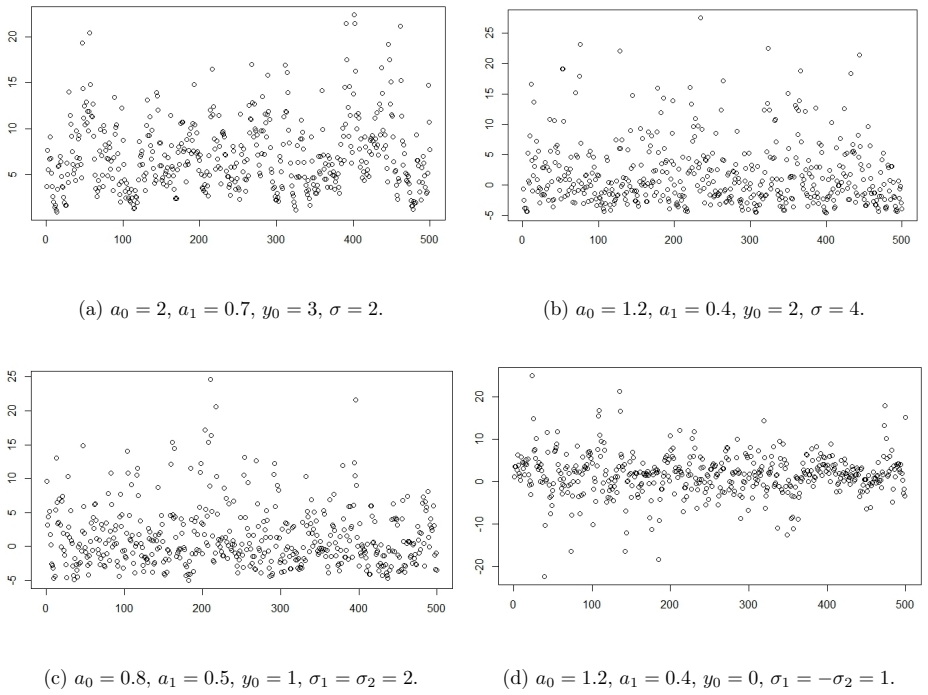
- Simulations confirm the theoretical convergence rates for the quadratic variation and the estimator.
- The results extend classical Berry-Esséen theorems to this class of processes with second-chaos driving noise.
Where Pith is reading between the lines
- If the bound holds, similar quantitative CLTs might apply to quadratic variations in other linear stochastic processes with chaos noise.
- The estimation procedure could be extended to test hypotheses about the mean-reversion parameter using the rate information.
- Connections to Malliavin calculus suggest potential for deriving bounds in related models like continuous-time Ornstein-Uhlenbeck processes.
Load-bearing premise
The driving noise is white noise belonging to the second Wiener chaos.
What would settle it
Numerical computation showing that the total-variation distance to the normal law for the quadratic variation does not decrease according to the derived upper bound as the sample size increases.
Figures


read the original abstract
In this paper, we study the asymptotic behavior of the quadratic variation for the class of AR(1) processes driven by white noise in the second Wiener chaos. Using tools from the analysis on Wiener space, we give an upper bound for the total-variation speed of convergence to the normal law, which we apply to study the estimation of the model's mean-reversion. Simulations are performed to illustrate the theoretical results.
Editorial analysis
A structured set of objections, weighed in public.
Referee Report
Summary. The paper studies the asymptotic behavior of the quadratic variation for AR(1) processes driven by white noise belonging to the second Wiener chaos. Using Malliavin calculus and Stein's method on Wiener space, it derives an upper bound on the total-variation distance to the normal law for the normalized quadratic variation. This bound is applied to obtain convergence rates for the estimator of the mean-reversion parameter, with numerical simulations provided to illustrate the results.
Significance. If the derivations are correct, the work extends Berry-Esseen-type results to a non-Gaussian setting via standard Wiener-space tools and directly links the bounds to statistical estimation rates. The explicit TV bound and its use for parameter estimation constitute a concrete contribution to the literature on limit theorems and inference for chaos-driven processes.
minor comments (2)
- [Abstract] Abstract: the claim of an 'upper bound' would benefit from a brief indication of its dependence on the model parameters (e.g., the AR coefficient or the chaos variance) to give readers an immediate sense of the result's sharpness.
- [Introduction] The manuscript would be strengthened by an explicit statement of the precise normalization used for the quadratic variation (e.g., centering and scaling constants) already in the introduction or statement of the main theorem.
Simulated Author's Rebuttal
We thank the referee for the careful reading, positive summary, and recommendation of minor revision. The report lists no specific major comments, so we have no individual points to address.
Circularity Check
No significant circularity
full rationale
The paper derives an explicit upper bound on total-variation distance to normality for the quadratic variation of an AR(1) process driven by second-chaos white noise, using standard Malliavin calculus and Stein-method tools on Wiener space; this bound is then applied to obtain convergence rates for the mean-reversion estimator. The model is defined directly by the noise class, the derivation chain relies on external, non-self-referential analytic machinery rather than any fitted parameter renamed as a prediction or any load-bearing self-citation, and no equation reduces by construction to its own inputs. The abstract and setup contain no self-definitional steps, uniqueness theorems imported from the authors' prior work, or ansatz smuggling.
Axiom & Free-Parameter Ledger
axioms (1)
- domain assumption The driving noise belongs to the second Wiener chaos and is white.
Reference graph
Works this paper leans on
-
[1]
Azmoodeh, E. and Morlanes, G. I. (2013). Drift parameter estimation for fractional Ornstein- Uhlenbeck process of the second kind.Statistics. DOI: 10.1080/02331888.2013.863888. 34
-
[2]
Azmoodeh, E. and Viitasaari, L. (2015). Parameter estimation based on discrete observations of fractional Ornstein-Uhlenbeck process of the second kind.Statist. Infer. Stoch. Proc.18, no. 3, 205-227
work page 2015
-
[3]
Balakrishna, N.andShiji, K.(2014).ExtremeValueAutoregressiveModelandItsApplications, Journal of Statistical Theory and Practice, 8 (3), 460–481
work page 2014
-
[4]
Barboza, L.A. and Viens, F. (2017). Parameter estimation of Gaussian stationary processes using the generalized method of moments.Electron. J. Statist.11 (1), 401-439
work page 2017
-
[5]
Belfadli, R., Es-Sebaiy, K. and Ouknine, Y. (2011). Parameter Estimation for Fractional Ornstein-Uhlenbeck Processes: Non-Ergodic Case.Frontiers in Science and Engineering (An International Journal Edited by Hassan II Academy of Science and Technology). 1, no. 1, 1-16
work page 2011
-
[6]
Biermé, H., Bonami, A., Nourdin, I. and Peccati, G. (2012). Optimal Berry-Esséen rates on the Wiener space: the barrier of third and fourth cumulants.ALEA 9, no. 2, 473-500
work page 2012
-
[7]
Brouste, A. and Iacus, S. M. (2012). Parameter estimation for the discretely observed fractional Ornstein-Uhlenbeck process and the Yuima R package.Comput. Stat.28, no. 4, 1529-1547
work page 2012
-
[8]
Cheridito, P., Kawaguchi, H. and Maejima, M. (2003). Fractional Ornstein-Uhlenbeck pro- cesses, Electr. J. Prob.8, 1-14
work page 2003
-
[9]
L.H.Y. Chen, L. Goldstein and Q.-M. Shao (2011).Normal Approximation by Stein’s Method. Berlin: Springer-Verlag
work page 2011
-
[10]
Cumberland, W.G. and Sykes, Z.M. (1982). Weak Convergence of an Autoregressive Process Used in Modeling Population Growth.Journal of Applied Probability, 19 (2) 450-455
work page 1982
-
[11]
Davydov, Y.A. and Martynova, G. V. (1987). Limit behavior of multiple stochastic integral. Statistics and control of random process.Preila, Nauka, Moscow, 55-57 (in Russian)
work page 1987
-
[12]
Dobrushin, R. L. and Major, P. (1979). Non-central limit theorems for nonlinear functionals of Gaussian fields.Z. Wahrsch. verw. Gebiete, 50, 27-52
work page 1979
-
[13]
Douissi, S., Es-Sebaiy, K., Viens, F. (2019). Berry-Esséen bounds for parameter estimation of general Gaussian processes.Latin American journal of probability and mathematical statistics, 16, 633-664
work page 2019
-
[14]
El Machkouri, M., Es-Sebaiy, K. and Ouknine, Y. (2015). Least squares estimator for non- ergodic OrnsteinUhlenbeck processes driven by Gaussian processes.Journal of the Korean Sta- tistical Society, DOI: 10.1016/j.jkss.2015.12.001 (In press)
-
[15]
El Onsy, B., Es-Sebaiy, K. and Tudor, C. (2014). Statistical analysis of the non-ergodic frac- tional Ornstein-Uhlenbeck process of the second kind.Preprint
work page 2014
-
[16]
El Onsy, B., Es-Sebaiy, K. and Viens, F. (2017). Parameter Estimation for Ornstein-Uhlenbeck driven by fractional Ornstein-Uhlenbeck processes.Stochastics, Vol. 89, No. 2, 431-468. 35
work page 2017
-
[17]
Ernst, Ph., Brown, L., Shepp, L., Wolpert, R. (2017). Stationary Gaussian Markov processes as limits of stationary autoregressive time series.Journal of Multivariate Analysis, 155, 180-186
work page 2017
-
[18]
Es-Sebaiy, K. and Viens, F. (2018). Optimal rates for parameter estimation of stationary Gaus- sian processes.Stochastic Processes and their Applications, in press, 49 pages, available online DOI: 10.1016/j.spa.2018.08.010
-
[19]
Régularité des trajectoires des fonctions alé atoires gaussiennes
Fernique, X. Régularité des trajectoires des fonctions alé atoires gaussiennes. InEcole d’Et´e de Probabilités de Saint-Flour IV-1974, Lecture Notes in Math.480, 1-96. Springer V., 1975
work page 1974
-
[20]
(1996).A unified View of linear AR(1) models, preprint
Grunwald, G.K., Hyndman, R.J., and Tedesco, L.M. (1996).A unified View of linear AR(1) models, preprint
work page 1996
-
[21]
On Non-Gaussian AR(1) Inflation Modeling
Hürlimann, W. (2012). “On Non-Gaussian AR(1) Inflation Modeling” Journal of Statistical and Econometric Methods,1 (1), 93-109
work page 2012
-
[22]
Hu, Y. and Nualart, D. (2010). Parameter estimation for fractional Ornstein-Uhlenbeck pro- cesses. Statist. Probab. Lett.80, 1030-1038
work page 2010
-
[23]
Hu, Y. and Song, J. (2013). Parameter estimation for fractional Ornstein-Uhlenbeck processes with discrete observations.F. Viens et al (eds), Malliavin Calculus and Stochastic Analysis: A Festschrift in Honor of David Nualart, 427-442, Springer
work page 2013
-
[24]
Kleptsyna, M. and Le Breton, A. (2002). Statistical analysis of the fractional Ornstein- Uhlen- beck type process.Statist. Infer. Stoch. Proc.5, 229-241
work page 2002
-
[25]
Kloeden, P. and Neuenkirch, A. (2007). The pathwise convergence of approximation schemes for stochastic differential equations.LMS J. Comp. Math.10, 235-253
work page 2007
-
[26]
Liptser, R. S. and Shiryaev, A. N. (2001).Statistics of Random Processes: II. Applications, Springer-Verlag, New York
work page 2001
-
[27]
Maddison, C.J., Tarlow, D., Minka, T. (2015). A* Sampling, Preprint, available online at https://arxiv.org/abs/1411.0030v2
work page internal anchor Pith review Pith/arXiv arXiv 2015
-
[28]
Nakajima, J., Kunihama, T., Omori, Y., and Frühwirth-Schnatter, S. (2012). Generalized extreme value distribution with time-dependence using the AR and MA models in state space form. Computational Statistics & Data Analysis, 56 (11), 3241-3259
work page 2012
-
[29]
A third-moment theorem and precise asymptotics for variations of stationary Gaussian sequences
Neufcourt, L. and Viens, F. (2014). A third-moment theorem and precise asymptotics for variations of stationary Gaussian sequences. In press in ALEA; preprint available at http://arxiv.org/abs/1603.00365
work page internal anchor Pith review Pith/arXiv arXiv 2014
-
[30]
Neuenkirch, A. and Tindel, S. (2014). A least square-type procedure for parameter estimation in stochastic differential equations with additive fractional noise.Statist. Infer. Stoch. Proc.17, no. 1, 99-120. 36
work page 2014
-
[31]
Nourdin, I. and Peccati, G. (2015). The optimal fourth moment theorem.Proc. Amer. Math. Soc.143, 3123-3133
work page 2015
-
[32]
Nourdin, I. and Peccati, G. (2012). Normal approximations with Malliavin calculus : from Stein’s method to universality.Cambridge Tracts in Mathematics 192. Cambridge University Press, Cambridge
work page 2012
-
[33]
Nourdin, I., Peccati, G., and Yang, X. (2018). Berry-Esseen bounds in the Breuer-Major CLT and Gebelein’s inequality. Preprint https://arxiv.org/abs/1812.08838
work page internal anchor Pith review Pith/arXiv arXiv 2018
-
[34]
Novikov, A.A. (1971). Sequential estimation of the parameters of diffusion type processes.Teor. Veroyatn. Primen., 16 (2), 394-396
work page 1971
-
[36]
Nualart, D. and Peccati, G. (2005). Central limit theorems for sequences of multiple stochastic integrals. Ann. Probab. 33, no. 1, 177-193
work page 2005
-
[37]
Total variation estimates in the Breuer-Major theorem
D. Nualart and H. Zhou (2018): Total variation estimates in the Breuer-Major theorem. Preprint arXiv:1807.09707
work page internal anchor Pith review Pith/arXiv arXiv 2018
-
[38]
Supremum concentration inequality and modulus of continuity for sub- nth chaos processes.J
Viens, F.; Vizcarra, A. Supremum concentration inequality and modulus of continuity for sub- nth chaos processes.J. Functional Analysis248 (1) (2007), 1-26
work page 2007
-
[39]
Nualart, D. (2006). The Malliavin calculus and related topics.Springer-Verlag, Berlin
work page 2006
-
[40]
Üstünel, A. S. (1995). An Introduction to Analysis on Wiener Space. Lecture Notes in Math
work page 1995
-
[41]
Nualart, D.andOrtiz-Latorre, S.(2008).Centrallimittheoremsformultiplestochasticintegrals and Malliavin calculus.Stochastic Process. Appl.118 614- 628
work page 2008
-
[42]
Nualart, D. and Peccati, G. (2005). Central limit theorems for sequences of multiple stochastic integrals. Ann. Probab.33 177-193
work page 2005
-
[43]
Peccati, G. and Tudor, C. A. (2004). Gaussian limits for vector-valued multiple stochastic inte- grals. In Séminaire de Probabilités XXXVIII. Lecture Notes in Math. 1857 247-262.Springer, Berlin
work page 2004
-
[44]
Schoenberg, I.J. (1951). On Polya frequency functions.Journal d’Analyse Mathématique, 1, 331-374
work page 1951
-
[45]
Shepp, L.A. (1969). Explicit solutions to some problems of optimal stopping.The Annals of Mathematical Statistics40, 993-1010
work page 1969
-
[46]
Shepp, L.A. and Shiryaev, A.N. (1993). The Russian option: reduced regret.The Annals of Applied Probability3, 631-640. 37
work page 1993
-
[47]
Shepp, L.A. and Vardi, Y. (1982) Maximum likelihood reconstruction for emission tomography. IEEE transactions on Medical Imaging, 1, 113-122
work page 1982
-
[48]
(2017).Time Series Analysis: Nonstationary and Noninvertible Distribution The- ory, volume 16
Tanaka, K. (2017).Time Series Analysis: Nonstationary and Noninvertible Distribution The- ory, volume 16. Wiley New York
work page 2017
-
[49]
Gwladys Toulemonde, Armelle Guillou, Philippe Naveau, Mathieu Vrac and Frederic Cheval- lier. (2010). Autoregressive models for maxima and their applications to CH4 and N2O. Envi- ronmetrics, 21 (2), 189-207
work page 2010
-
[50]
Tudor, C.A. (2008). Analysis of the Rosenblatt process.ESAIM: Probability and Statistics, 12, 230–257
work page 2008
-
[51]
Tudor, C. and Viens, F. (2007). Statistical aspects of the fractional stochastic calculus.Ann. Statist. 35, no. 3, 1183-1212
work page 2007
-
[52]
Viitasaari, L. Representation of Stationary and stationary increment processes via Langevin equation and self-similar processes. (2016).Statistics and Probability Letters, 115, 45-53
work page 2016
-
[53]
Voutilainen, M., Viitasaari, L., and Ilmonen, P. (2017). On model fitting and estimation of strictly stationary processes.Modern Stochastics : Theory and Applications. 4 (4), 381–406
work page 2017
-
[54]
Voutilainen, M., Viitasaari, L., and Ilmonen, P. (2019). Note on AR(1) characterization of sta- tionary processes and model fitting.Modern Stochastics : Theory and Applications, to appear, https://doi.org/10.15559/19-VMSTA132
-
[55]
Yuan Yan, Genton, M.C. (2018). Non-Gaussian autoregressive processes with Tukey g-and-h transformations. Environmetrics, e2503, https://doi.org/10.1002/env.2503 . 38
discussion (0)
Sign in with ORCID, Apple, or X to comment. Anyone can read and Pith papers without signing in.