REVIEW 3 major objections 4 minor 1 cited by
MemeBLIP2: A novel lightweight multimodal system to detect harmful memes
T0 review · 3 major / 4 minor · reviewed 2026-08-16 · deepseek-v4-flash
Pith's one-line read MemeBLIP2, a lightweight system that adapts BLIP-2's frozen encoders with projection and adapter layers, claims 77.5% accuracy and 79.0% macro F1 on the PrideMM harmful-meme benchmark, outperforming the CLIP-based MemeCLIP baseline on…
desk verdict The paper's reported results cannot be attributed to a single coherent architecture: it contradicts itself on the classifier, the ablation baseline, and whether it beats MemeCLIP. The BLIP-2 adaptation is plausible, but the draft is not internally consistent. read the letter →
The pith
A machine-rendered reading of the paper's core claim, the machinery that carries it, and where it could break.
The reading
What carries the argument
The engine of the system is a frozen BLIP-2 backbone (a vision-language model whose Q-Former text encoder grounds text in images through cross-attention) feeding two modality-specific linear projections that map visual and textual embeddings into a shared 1024-dimensional space. Two lightweight residual adapters, each a bottleneck with GELU and a learnable scale $\alpha$ initialized to 0.1, refine each modality, and the refined vectors are fused by element-wise multiplication before an MLP classifier applies layer normalization, GELU, dropout, and a final linear layer. The paper also names a 'Semantic-Aware Initialization' for the classifier as part of the design, though the mechanism is not defined in the text. The load-bearing idea is that because BLIP-2's visual and textual features are not inherently contrastively aligned, the projection layers act as the semantic bridge, and the ablation table supports this by showing near-random performance (AUROC 48.22%) when all projections are removed.
What would settle it
Rerun the exact Section 3.6 configuration (MLP classifier with layer norm, GELU, dropout, and Semantic-Aware Initialization) on the PrideMM 85/5/10 split with the paper's stated hyperparameters and three seeds; if the mean accuracy and macro F1 do not reproduce 77.5% and 79.0% within one standard deviation, or if swapping in the Section 4.2 cosine classifier changes the numbers by more than the reported error bars, the paper's attribution of its main result to the described architecture fails.
Extended reading notes
Core claim
On the paper's own terms, the central discovery is that a modular, parameter-efficient adapter over BLIP-2's frozen encoders outperforms a comparable CLIP-based system on the PrideMM hate-detection task. The authors report that MemeBLIP2, which projects BLIP-2's 1408-dimensional visual and 768-dimensional textual embeddings into a shared 1024-dimensional space, refines them with residual adapters, fuses them by element-wise multiplication, and classifies with an MLP head, achieves 77.5% accuracy and 79.0% macro F1, surpassing MemeCLIP by 3.1 and 6.0 percentage points respectively, with AUROC slightly lower (81.8% vs 83.4%). The claimed explanation is that BLIP-2's image-grounded text encoder provides finer cross-modal alignment, letting the model detect irony and culturally specific references that CLIP's contrastive global similarity misses.
Load-bearing premise
The reported 77.5% accuracy and 79.0% F1 are credited to the full architecture with the MLP classifier and Semantic-Aware Initialization, but the paper elsewhere describes a cosine classifier in the experimental setup and never defines the initialization; if Table 1 came from the cosine setup, the results do not support the method as described.
Editorial extensions
If this is right
- If the reported results reproduce, swapping the encoder backbone in a fixed modular pipeline is enough to lift hateful-meme detection accuracy on PrideMM from 74.4% to 77.5% and macro F1 from 73.0% to 79.0%.
- The design implies that harmful-meme classifiers can be updated to new cultural contexts by replacing the frozen backbone and retraining only the projection, adapter, and classifier layers, which is a small number of parameters.
- The ablation result that removing projection layers collapses AUROC to near random (48.22%) indicates the projections are doing the essential cross-modal alignment work when the frozen encoder's modalities are not pre-aligned.
- Because the approach does not require end-to-end fine-tuning of large encoders, it is compatible with deployment on 16 GB GPUs and, with further pruning and quantization, on edge devices, as the paper states as future work.
Reading between the lines
- A natural next test is whether the same adapter-plus-projection recipe transfers to other multimodal benchmarks, such as the original Hateful Memes Challenge, where CLIP-based systems previously set the bar; the paper does not run that comparison.
- The paper's internal conflict between the MLP classifier described in Section 3.6 and the cosine classifier named in Section 4.2 means the reported numbers can only be attributed to the method as written after checking which head actually produced Table 1; an independent re-run would settle this.
- Because the fusion is simple element-wise multiplication, one could test whether richer interaction mechanisms such as cross-attention or gated fusion would close the 1.6-point AUROC gap behind MemeCLIP while keeping the accuracy gain.
- The undefined 'Semantic-Aware Initialization' is a reproducibility gap; a plausible reading is that it initializes the final linear layer from the semantic label names or prototype embeddings, but the paper gives no formula, so the claim that it improves performance is not independently checkable.
Signed reviews
Editorial analysis
A structured set of objections, weighed in public.
Referee Report
Summary. The paper proposes MemeBLIP2, a lightweight multimodal system for harmful-meme detection on the PrideMM dataset. It takes frozen BLIP-2 vision and text embeddings, projects them into a shared space, refines them with residual adapters, fuses them by element-wise multiplication, and classifies the fused representation. The authors report 77.5% accuracy, 81.8% AUROC, and 79.0% macro F1 score, claiming improvements over the MemeCLIP baseline, and present an ablation study attributing most of the gain to the projection and adapter modules.
Significance. If the reported numbers are reproducible, the paper makes a modest but useful contribution: it shows that a BLIP-2 backbone with lightweight projection and adapter modules can be competitive with CLIP-based systems on a culturally specific meme benchmark, and the ablation isolates the contribution of each component. The paper explicitly promises three-seed mean ± standard deviation reporting and describes a modular architecture, which is the right experimental style for this type of study. However, the central empirical claim is currently not attributable to a single, unambiguously described system because of internal inconsistencies between the methodology, setup, main table, and analysis sections.
major comments (3)
- [Section 3.6 vs. Section 4.2] The classifier used for the main results is ambiguous. Section 3.6 states that an MLP-based classifier is the final design, while Section 4.2 states 'For classification, we use a cosine classifier with learnable bias terms.' Figure 1 and Section 3.6 also mention a 'Semantic-Aware Initialization' that is never defined. Because Table 1 is the basis for the claimed 3.1% accuracy and 6.0% F1 gains over MemeCLIP, the paper must state which classifier and which initialization produced the reported numbers. Without this, the result cannot be attributed to the described architecture.
- [Table 1 vs. Table 2] Table 1 reports MemeBLIP-2 as 77.5/81.8/79.0 with no error bars, despite Section 4.2 promising three-seed mean and standard deviation. Table 2 gives the 'All modules (baseline)' configuration as 76.90 ± 0.55 / 80.80 ± 0.96 / 78.39 ± 0.61. If the baseline in Table 2 is the same model as in Table 1, the tables are inconsistent; if it is not, the difference must be explained. The reader also cannot judge whether the 3.1% accuracy advantage over MemeCLIP is within seed noise.
- [Section 4.7] Section 4.7 states 'our model does not surpass MemeCLIP [4] in absolute performance,' which directly contradicts Section 4.4 and Table 1, where MemeBLIP-2 is said to outperform MemeCLIP by 3.1% accuracy and 6.0% F1. One of these statements is wrong. This is not a presentation nuance: it changes the paper's central claim from 'surpasses the state of the art' to 'offers an alternative architecture with comparable performance.'
minor comments (4)
- [Section 3.3] The adapter reduction factor r=1.5 is unusual; with c=1024 it gives a bottleneck of 682 dimensions, which is only a mild reduction. The authors should justify this choice or state whether it is a typo for r=4.
- [Section 4.1] The metrics are labeled 'Validation Accuracy, Validation AUROC, and Validation F1 Score,' but the main results are presumably on the test split; please use consistent terminology.
- [Section 4.3 vs. Table 1] The baselines are listed as 'GPT-4' in the text but 'GPT-4o' in Table 1; use one consistent name throughout.
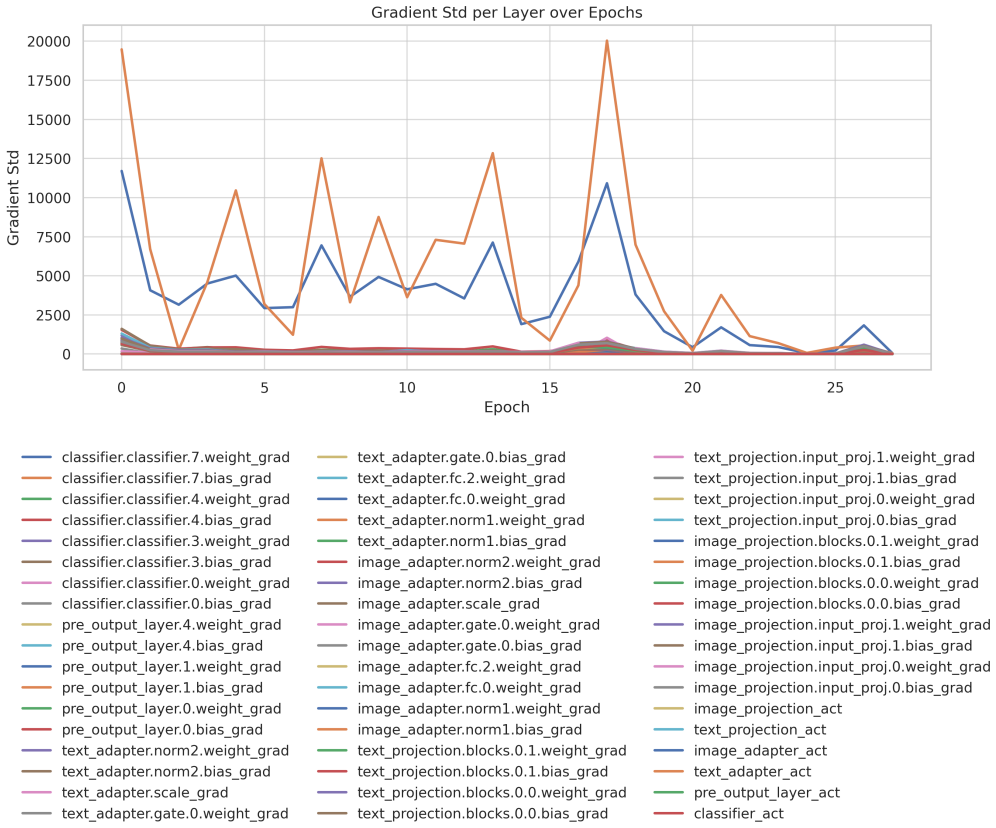
- [Section 4.5] The gradient diagnosis refers to 'classifier.7.weight' and 'classifier.7.bias,' but Section 3.6 does not number the classifier layers, so readers cannot map these parameter names to the architecture. Add a layer-index description.
Circularity Check
No circularity found; MemeBLIP2 is an empirical training-and-evaluation study whose headline numbers are not reduced from its inputs by construction.
full rationale
MemeBLIP2 is an empirical systems paper: it takes a frozen BLIP-2 backbone, trains lightweight projection, adapter, and classifier modules on PrideMM, and reports test metrics. There is no derivation chain in which an output quantity is defined in terms of the quantity being predicted. The classifier inconsistency (cosine in Section 4.2 vs. MLP in Section 3.6), the undefined Semantic-Aware Initialization, the mismatch between Table 1 and Table 2, and the Section 4.7 statement that the model does not surpass MemeCLIP in absolute performance are internal inconsistencies and reproducibility concerns, not cases where a prediction reduces to a fitted parameter by construction. No load-bearing claim is justified solely by self-citation; the cited prior work (PrideMM/MemeCLIP, BLIP-2, adapters) is external and is used as a benchmark or building block rather than as the proof of this paper's results. Model selection on validation AUROC followed by reporting on the test split is standard practice, not circular reasoning. Therefore the paper receives a circularity score of 0.
Assumptions & free parameters
free parameters (8)
- shared embedding dimension =
1024
- adapter reduction factor r =
1.5
- adapter residual scale alpha =
initialized to 0.1, learnable
- fusion ratio beta =
not specified
- dropout rates p and rho =
not specified
- number of projection layers L =
not specified
- MLP classifier width and depth =
not specified
- training hyperparameters =
lr 5e-5, wd 1e-4, batch 64, epochs 12
assumptions (5)
- domain assumption Pretrained BLIP-2 encoders, kept frozen, provide suitable representations for harmful meme detection.
- domain assumption The PrideMM dataset labels are reliable and the task is well-posed for binary classification.
- domain assumption The train/validation/test split protocol matches MemeCLIP, enabling fair comparison.
- ad hoc to paper The linear projection and adapter modules can align BLIP-2's independently encoded visual and textual features.
- ad hoc to paper Semantic-Aware Initialization improves MLP classifier performance.
Cite this review
Pith. "Pith review of MemeBLIP2: A novel lightweight multimodal system to detect harmful memes." pith.science (2026). https://pith.science/paper/R56APAC5
@misc{pith2026250421226,
  author       = {Pith},
  title        = {Pith review of: MemeBLIP2: A novel lightweight multimodal system to detect harmful memes},
  year         = {2026},
  howpublished = {\url{https://pith.science/paper/R56APAC5}},
  note         = {Machine review of arXiv:2504.21226}
}
read the original abstract
Memes often merge visuals with brief text to share humor or opinions, yet some memes contain harmful messages such as hate speech. In this paper, we introduces MemeBLIP2, a light weight multimodal system that detects harmful memes by combining image and text features effectively. We build on previous studies by adding modules that align image and text representations into a shared space and fuse them for better classification. Using BLIP-2 as the core vision-language model, our system is evaluated on the PrideMM datasets. The results show that MemeBLIP2 can capture subtle cues in both modalities, even in cases with ironic or culturally specific content, thereby improving the detection of harmful material.
Figures


Figures from the paper (1 more)

Forward citations
Cited by 1 Pith paper
-
Cloud-Based AI Systems: Leveraging Large Language Models for Intelligent Fault Detection and Autonomous Self-Healing
A generic LLM-based fault detection and self-healing framework is presented, with standard equations and unsupported claims of superior accuracy, recovery time, and stability.
Reference graph
Works this paper leans on
-
[4]
B., Shiwakoti, S., Chaudhary, M., & Wang, H
Shah, S. B., Shiwakoti, S., Chaudhary, M., & Wang, H. MemeCLIP: Leveraging CLIP Representations for Mul- timodal Meme Classification . Proceedings of the 2024 Conference on Empirical Methods in Natural Language Processing (EMNLP), 2024. https://arxiv.org/abs/2409. 14703
work page 2024
-
[1]
The Hate- ful Memes Challenge: Detecting Hate Speech in Mul- timodal Memes
Kiela, D., Firooz, H., Mohan, A., Goswami, V ., Singh, A., Ringshia, P., & Testuggine, D. The Hate- ful Memes Challenge: Detecting Hate Speech in Mul- timodal Memes. Advances in Neural Information Pro- cessing Systems (NeurIPS), 2020. https://arxiv.org/abs/ 2005.04790
arXiv 2020
-
[2]
S., Nakov, P., & Chakraborty, T
Pramanick, S., Sharma, S., Dimitrov, D., Akhtar, M. S., Nakov, P., & Chakraborty, T. MOMENTA: A Mul- timodal Framework for Detecting Harmful Memes and Their Targets. Proceedings of the 2021 Conference on Empirical Methods in Natural Language Processing (EMNLP), 2021. https://arxiv.org/abs/2109.05184
arXiv 2021
-
[3]
HateCLIPper: A CLIP- based Framework for Multimodal Hate Speech Detec- tion
Kumar, A., & Nandakumar, N. HateCLIPper: A CLIP- based Framework for Multimodal Hate Speech Detec- tion. Proceedings of the 2022 Conference on Empiri- cal Methods in Natural Language Processing (EMNLP),
work page 2022
-
[5]
Li, J., Li, D., Xiong, C., & Hoi, S. BLIP: Bootstrap- ping Language-Image Pre-training for Unified Vision- Language Understanding and Generation . Salesforce Research, 2022. https://arxiv.org/abs/2201.12086
arXiv 2022
-
[6]
Li, J., Li, D., Savarese, S., & Hoi, S.BLIP-2: Bootstrap- ping Language-Image Pre-training with Frozen Image Encoders and Large Language Models . Salesforce Re- search, 2023. https://arxiv.org/abs/2301.12597
arXiv 2023
-
[7]
Decoupled Weight De- cay Regularization
Loshchilov, I., & Hutter, F. Decoupled Weight De- cay Regularization. International Conference on Learn- ing Representations (ICLR), 2019. https://arxiv.org/abs/ 1711.05101
arXiv 2019
-
[8]
Parameter-Efficient Transfer Learning for NLP
Houlsby, N., Giurgiu, A., Jastrzebski, S., Morrone, B., de Laroussilhe, Q., Gesmundo, A., Attariyan, M., & Gelly, S. Parameter-Efficient Transfer Learning for NLP. Proceedings of the 36th International Conference on Machine Learning (ICML), 2019. https://arxiv.org/ abs/1902.00751
arXiv 2019
Show all 13 references
-
[9]
Gaussian Error Linear Units (GELUs)
Hendrycks, D., & Gimpel, K. Gaussian Error Linear Units (GELUs). 2016. https://arxiv.org/abs/1606.08415
2016 arXiv
-
[10]
N., Kaiser, L., & Polosukhin, I
Vaswani, A., Shazeer, N., Parmar, N., Uszkoreit, J., Jones, L., Gomez, A. N., Kaiser, L., & Polosukhin, I. Attention is All You Need . Advances in Neural In- formation Processing Systems (NeurIPS), 2017. https: //arxiv.org/abs/1706.03762
2017 arXiv
-
[11]
W., Hallacy, C., Ramesh, A., Goh, G., Agarwal, S., Sastry, G., Askell, A., Mishkin, P., Clark, J., Krueger, G., & Sutskever, I
Radford, A., Kim, J. W., Hallacy, C., Ramesh, A., Goh, G., Agarwal, S., Sastry, G., Askell, A., Mishkin, P., Clark, J., Krueger, G., & Sutskever, I. Learning Trans- ferable Visual Models From Natural Language Supervi- sion. Proceedings of the 38th International Conference on M...
2021 arXiv
-
[12]
SGDR: Stochastic Gradi- ent Descent with Warm Restarts
Loshchilov, I., & Hutter, F. SGDR: Stochastic Gradi- ent Descent with Warm Restarts . International Confer- ence on Learning Representations (ICLR), 2017. https: //arxiv.org/abs/1608.03983
2017 arXiv
-
[2022]
https://arxiv.org/abs/2210.05916
Reviewed August 16, 2026 · model on record in the stance chip above.
Discussion (0). Continue with ORCID to comment.