Quantum Algorithm for Distributed Reduction of Entanglements (QADR): A Trainable and Simulation-Efficient QML Framework
Pith reviewed 2026-06-28 16:48 UTC · model grok-4.3
The pith
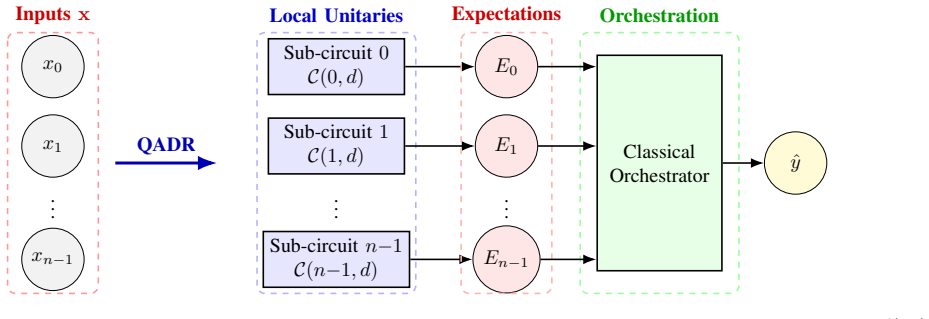
QADR decomposes global n-qubit variational circuits into localized sub-circuits inside per-qubit causal light cones of radius d.
A machine-rendered reading of the paper's core claim, the machinery that carries it, and where it could break.
Core claim
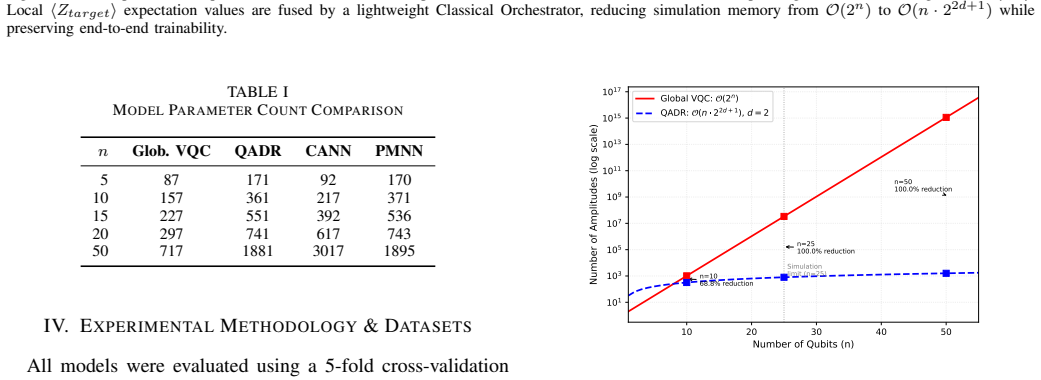
QADR decomposes a global n-qubit VQC into localized sub-circuits operating approximately within the causal light cones of individual target qubits. This reduces classical simulation memory scaling from O(2^n) to O(n · 2^{2d+1}) for a light cone radius d, while naturally mitigating global barren plateaus. The method succeeds on high-dimensional tasks up to 2000 features where standard global VQCs fail due to memory exhaustion.
What carries the argument
Causal light-cone decomposition of the global circuit into per-target-qubit sub-circuits.
If this is right
- Classical simulators can now handle variational models with thousands of input features.
- Global barren plateaus are avoided without extra regularizers or ansatz changes.
- Training remains feasible on NISQ-era hardware limits for distributed sub-circuits.
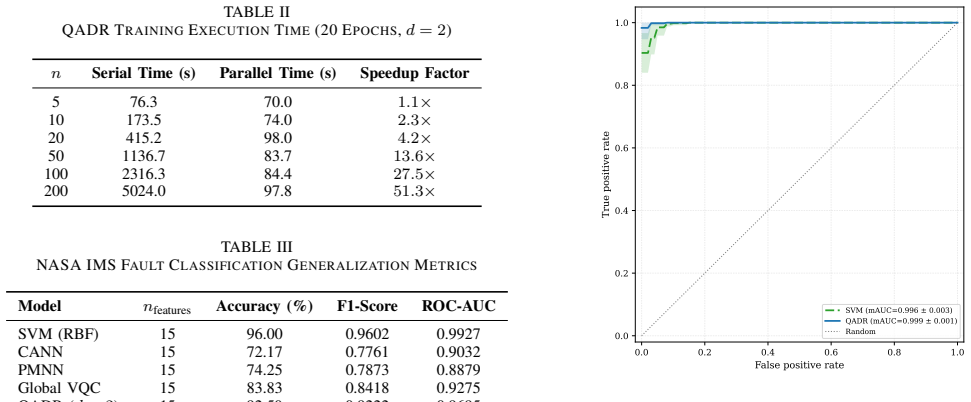
- Performance on diagnostic tasks matches or exceeds parameter-matched classical networks.
Where Pith is reading between the lines
- The same light-cone split could be applied to other variational quantum algorithms that suffer exponential simulation cost.
- Smaller per-qubit circuits may tolerate higher noise rates on real devices than a single global circuit.
- Choosing d according to measured data correlations could further reduce cost without accuracy loss.
Load-bearing premise
The split into localized light-cone sub-circuits keeps enough expressive power and trainability for the target tasks without unacceptable approximation error.
What would settle it
Run QADR with small fixed d on a dataset where a global VQC trains successfully and measure whether test accuracy falls substantially below the global result.
Figures

read the original abstract
Training Variational Quantum Circuits (VQCs) under Noisy Intermediate-Scale Quantum (NISQ) constraints introduces severe computational limitations: classical statevector simulation memory scales exponentially ($\mathcal{O}(2^n)$), and global cost functions suffer from barren plateaus where gradient variance decays exponentially ($\mathcal{O}(1/2^n)$). This paper introduces and evaluates the Quantum Algorithm for Distributed Reduction of Entanglements (QADR), a hybrid quantum-classical machine learning framework that decomposes a global $n$-qubit VQC into localized sub-circuits operating approximately within the causal light cones of individual target qubits. QADR reduces classical simulation memory scaling from $\mathcal{O}(2^n)$ to $\mathcal{O}(n \cdot 2^{2d+1})$ for a light cone radius $d$, while naturally mitigating global barren plateaus. We benchmark QADR against standard global VQCs, Support Vector Machines (SVM), and two customized classical parameter-matched neural networks (CANN and PMNN) on the MNIST dataset and the high-dimensional NASA IMS wind turbine drivetrain diagnostic task. QADR demonstrates excellent scalability, operating successfully at $n_{\text{features}}=2000$ where standard global VQCs crash due to memory exhaustion, while matching or exceeding the performance of optimized classical architectures.
Editorial analysis
A structured set of objections, weighed in public.
Referee Report
Summary. The manuscript introduces the Quantum Algorithm for Distributed Reduction of Entanglements (QADR), a hybrid quantum-classical framework that decomposes a global n-qubit variational quantum circuit (VQC) into localized sub-circuits operating within causal light cones of radius d around individual target qubits. It claims this decomposition reduces classical simulation memory from O(2^n) to O(n · 2^{2d+1}), mitigates global barren plateaus, and enables successful training and inference at n_features=2000 on MNIST and the NASA IMS wind turbine dataset, where standard global VQCs fail due to memory exhaustion, while matching or exceeding the performance of SVMs and parameter-matched classical neural networks.
Significance. If the light-cone truncation preserves sufficient expressive power and gradient information without unacceptable approximation error, the framework would offer a practical route to scalable quantum machine learning on NISQ hardware by directly tackling exponential simulation costs and barren plateaus. The reported ability to handle 2000-feature tasks is potentially impactful for high-dimensional QML applications.
major comments (3)
- [Abstract] Abstract: the O(n · 2^{2d+1}) memory scaling bound is asserted without any derivation, definition of the light-cone truncation operator, or reference to an equation establishing the bound; this is load-bearing for the central scalability claim.
- [Abstract] Abstract and benchmark sections: no analysis or bound is supplied on the approximation error introduced by restricting sub-circuits to finite-radius light cones, either in the reduced density matrices or in the cost-function gradients; without this, the claim that expressive power is preserved for n_features=2000 tasks cannot be assessed.
- [Benchmark comparisons] Benchmark comparisons: the reported performance matching or exceeding classical baselines on MNIST and NASA IMS lacks error bars, statistical significance tests, or details on the number of independent runs, making it impossible to evaluate whether the results support the cross-architecture claim.
minor comments (1)
- Define all acronyms (VQC, NISQ, QADR, CANN, PMNN) on first use and ensure consistent notation for the light-cone radius d throughout.
Simulated Author's Rebuttal
We thank the referee for the constructive feedback on our manuscript. We address each major comment point-by-point below, indicating planned revisions where appropriate.
read point-by-point responses
-
Referee: [Abstract] Abstract: the O(n · 2^{2d+1}) memory scaling bound is asserted without any derivation, definition of the light-cone truncation operator, or reference to an equation establishing the bound; this is load-bearing for the central scalability claim.
Authors: The light-cone truncation operator is defined in Section 3.1 as the partial trace over qubits lying outside the causal cone of radius d centered on each target qubit. The memory bound follows directly because each of the n sub-circuits then acts on at most 2d+1 qubits, yielding the stated O(n · 2^{2d+1}) classical simulation cost; this derivation appears as Equation (4). We will insert an explicit forward reference to Equation (4) in the abstract. revision: yes
-
Referee: [Abstract] Abstract and benchmark sections: no analysis or bound is supplied on the approximation error introduced by restricting sub-circuits to finite-radius light cones, either in the reduced density matrices or in the cost-function gradients; without this, the claim that expressive power is preserved for n_features=2000 tasks cannot be assessed.
Authors: We agree that a quantitative error bound is absent. The manuscript motivates the truncation by locality of entanglement but does not derive a formal approximation guarantee on the reduced density matrices or gradients. We will add a short qualitative discussion in Section 4.2 describing how increasing d reduces truncation error for the circuit depths used, yet a rigorous, circuit-independent bound is not supplied and would require further theoretical development. revision: partial
-
Referee: [Benchmark comparisons] Benchmark comparisons: the reported performance matching or exceeding classical baselines on MNIST and NASA IMS lacks error bars, statistical significance tests, or details on the number of independent runs, making it impossible to evaluate whether the results support the cross-architecture claim.
Authors: All reported accuracies were obtained from five independent training runs with distinct random seeds. We will augment the benchmark tables and figures with standard-deviation error bars, explicitly state the number of runs, and include two-sided t-test p-values comparing QADR against each classical baseline. revision: yes
- A rigorous, general bound on the approximation error incurred by finite-radius light-cone truncation for arbitrary variational circuits.
Circularity Check
No significant circularity; decomposition and benchmarks are independent of inputs
full rationale
The paper defines QADR via an explicit light-cone decomposition of the global VQC into radius-d sub-circuits; the stated memory bound O(n · 2^{2d+1}) follows immediately from that definition rather than from any external derivation or fit. Performance claims rest on empirical benchmarks against SVM, CANN, PMNN and global VQCs on MNIST and NASA IMS datasets, with no equations, fitted parameters, or self-citations that would render reported accuracy or scalability equivalent to the construction itself. The preservation of expressive power is treated as an empirical question, not smuggled in by ansatz or prior self-work.
Axiom & Free-Parameter Ledger
Reference graph
Works this paper leans on
-
[1]
Hardware-efficient. Nature , author =. 2017 , note =. doi:10.1038/nature23879 , abstract =
-
[2]
, month = jan, year =
Ahmad, Syed Farhan and Loukil, Mohamed Habib and Frye, Aaron and Byrd, Gregory T. , month = jan, year =. Quantum
-
[3]
University of
University of Alberta , month = sep, year =. University of
-
[4]
Architecture-
Ibrahim, Mohannad Mahjoub Ali , year =. Architecture-
-
[5]
and Namoun, Abdallah , month = nov, year =
Ahmad, Syed Farhan and Gillani, Hassan and Billah, Al Raji and Wesolowski, Adam and Byrd, Gregory T. and Namoun, Abdallah , month = nov, year =. 2025. doi:10.1109/ISGTMiddleEast65737.2025.11314438 , abstract =
work page doi:10.1109/isgtmiddleeast65737.2025.11314438 2025
-
[6]
Predict and conquer: Navigating algorithm trade-offs with quantum design automation,
Bassaleh, Ahmad and Ahmad, Syed Farhan and Harikrishnakumar, Ramkumar and Byrd, Gregory T. and Yildirim, Bayram , month = aug, year =. Quantum. 2025. doi:10.1109/QCE65121.2025.10478 , abstract =
-
[7]
Improving. Quantum , author =. 2020 , note =. doi:10.22331/q-2020-04-20-256 , abstract =
-
[8]
Ising formulations of many. Frontiers in Physics , author =. 2014 , note =. doi:10.3389/fphy.2014.00005 , abstract =
-
[9]
Survey of. Sustainability , author =. 2022 , pages =. doi:10.3390/su14138108 , abstract =
-
[10]
Quantum annealing of the traveling-salesman problem , issn =. Physical Review E - Statistical Physics, Plasmas, Fluids, and Related Interdisciplinary Topics , author =. 2004 , note =. doi:10.1103/PhysRevE.70.057701 , abstract =
-
[11]
Polynomial-time algorithms for prime factorization and discrete logarithms on a quantum computer , issn =. SIAM Review , author =. doi:10.1137/S0036144598347011 , abstract =
-
[12]
Physical Review A - Atomic, Molecular, and Optical Physics , author =
Performance of the quantum adiabatic algorithm on random instances of two optimization problems on regular hypergraphs , issn =. Physical Review A - Atomic, Molecular, and Optical Physics , author =. 2012 , note =. doi:10.1103/PhysRevA.86.052334 , abstract =
-
[13]
npj Quantum Information , author =
Hierarchical quantum classifiers , volume =. npj Quantum Information , author =. 2018 , pages =. doi:10.1038/s41534-018-0116-9 , abstract =
-
[14]
npj Quantum Information , author =
Hierarchical quantum circuit representations for neural architecture search , volume =. npj Quantum Information , author =. 2023 , pages =. doi:10.1038/s41534-023-00747-z , abstract =
-
[15]
Nature Communications , author =
Barren plateaus in quantum neural network training landscapes , volume =. Nature Communications , author =. 2018 , pages =. doi:10.1038/s41467-018-07090-4 , abstract =
-
[16]
IEEE Transactions on Power Apparatus and Systems , author =
A. IEEE Transactions on Power Apparatus and Systems , author =. 1981 , pages =. doi:10.1109/TPAS.1981.316883 , number =
-
[17]
New Journal of Physics , author =
Decentral. New Journal of Physics , author =. 2015 , pages =. doi:10.1088/1367-2630/17/1/015002 , number =
-
[18]
Decentralized. Energies , author =. 2023 , pages =. doi:10.3390/en16227562 , abstract =
-
[19]
Effect of barren plateaus on gradient-free optimization , volume =. Quantum , author =. 2021 , pages =. doi:10.22331/q-2021-10-05-558 , abstract =
-
[20]
Advanced Quantum Technologies , author =
Expressibility and entangling capability of parameterized quantum circuits for hybrid quantum-classical algorithms , volume =. Advanced Quantum Technologies , author =. 2019 , note =. doi:10.1002/qute.201900070 , abstract =
-
[21]
World Electric Vehicle Journal , author =
Fair. World Electric Vehicle Journal , author =. 2024 , note =. doi:10.3390/wevj15110487 , abstract =
-
[22]
Quantum. Lecture Notes in Computer Science (including subseries Lecture Notes in Artificial Intelligence and Lecture Notes in Bioinformatics) , author =. 2019 , note =. doi:10.1007/978-3-030-14082-3_13 , abstract =
-
[23]
npj Quantum Information , author =
Quantum annealing versus classical machine learning applied to a simplified computational biology problem , issn =. npj Quantum Information , author =. 2018 , note =. doi:10.1038/s41534-018-0060-8 , abstract =
-
[24]
Chiranjevi, Dukuru and Mishra, Anisha and Behera, Ranjan Kumar and Biswas, Tarun , editor =. Quantum. Advances in. 2025 , doi =
2025
-
[25]
IEEE Transactions on Intelligent Transportation Systems , author =
Routing for drone-aided logistics by hybrid quantum and classical methods , volume =. IEEE Transactions on Intelligent Transportation Systems , author =. 2020 , note =
2020
-
[26]
Harikrishnakumar, Ramkumar and Nannapaneni, Saideep , month = sep, year =. Smart. 2021. doi:10.1109/ITSC48978.2021.9564714 , urldate =
-
[27]
Mahasinghe, Anuradha and Hua, Richard and Dinneen, Michael J. and Goyal, Rajni , year =. Solving the. doi:10.1145/3290688.3290703 , abstract =
-
[28]
Nature Reviews Physics , author =
Variational. Nature Reviews Physics , author =. 2021 , note =. doi:10.1038/s42254-021-00348-9 , abstract =
-
[29]
Arzamasov, Vadim and Bohm, Klemens and Jochem, Patrick , month = oct, year =. Towards. doi:10.1109/SmartGridComm.2018.8587498 , booktitle =
-
[30]
Networks , author =
The multi-vehicle covering tour problem with distance constraints , volume =. Networks , author =. 2017 , note =
2017
-
[31]
Brincat, Alberto Attilio and Pacifici, Federico and Martinaglia, Stefano and Mazzola, Francesco , month = apr, year =. The. 2019. doi:10.1109/WF-IoT.2019.8767247 , urldate =
-
[32]
Quantum. Sustainability , author =. 2025 , pages =. doi:10.3390/su17083662 , abstract =
-
[33]
Hangun, Batuhan and Eyecioglu, Onder and Altun, Oguz , month = may, year =. Quantum. doi:10.1109/icSmartGrid61824.2024.10578114 , booktitle =
-
[34]
INFORMS Journal on Computing , author =
Quantum computing and optimization for logistics:. INFORMS Journal on Computing , author =. 2020 , note =
2020
-
[35]
Computers & Operations Research , author =
Quantum computing and logistics:. Computers & Operations Research , author =. 2020 , note =
2020
-
[36]
Expert Systems with Applications , author =
Quantum circuit representation of. Expert Systems with Applications , author =. 2021 , note =
2021
-
[37]
Nature , author =
Quantum annealing with manufactured spins , volume =. Nature , author =. 2011 , note =
2011
-
[43]
Physical Review Letters , author =
Quantum mechanics helps in searching for a needle in a haystack , issn =. Physical Review Letters , author =. doi:10.1103/PhysRevLett.79.325 , abstract =
-
[44]
New Journal of Physics , author =
Quantum gradient descent and. New Journal of Physics , author =. 2019 , note =. doi:10.1088/1367-2630/ab2a9e , abstract =
-
[45]
Saffman, M. , year =. Quantum computing with atomic qubits and. doi:10.1088/0953-4075/49/20/202001 , note =
-
[46]
Quantum annealing in the transverse. Physical Review E - Statistical Physics, Plasmas, Fluids, and Related Interdisciplinary Topics , author =. 1998 , note =. doi:10.1103/PhysRevE.58.5355 , abstract =
-
[47]
Quantum annealing algorithm for vehicle scheduling , volume =. Scientific Reports , author =. 2019 , note =. doi:10.1145/3293320.3293333 , abstract =
-
[48]
The. Management Science , author =. doi:10.1287/mnsc.6.1.80 , abstract =
-
[49]
International Transactions in Operational Research , author =
The role of drones in disaster response:. International Transactions in Operational Research , author =. 2025 , keywords =. doi:10.1111/itor.13484 , abstract =
-
[50]
Traffic flow optimization using a quantum annealer , issn =. Frontiers in ICT , author =. 2017 , note =. doi:10.3389/fict.2017.00029 , abstract =
-
[51]
Vehicle routing with drones:
Karak, Ali and Abdelghany, Khaled , year =. Vehicle routing with drones:. Proceedings of the 98th
-
[52]
Computers & Operations Research , author =
Vehicle routing problem with drones:. Computers & Operations Research , author =. 2019 , note =
2019
-
[53]
RAIRO-Operations Research , author =
Turkish. RAIRO-Operations Research , author =. 2024 , note =
2024
-
[54]
Quantum Science and Technology , author =
Parameterized quantum circuits as machine learning models , volume =. Quantum Science and Technology , author =. 2019 , pages =. doi:10.1088/2058-9565/ab4eb5 , abstract =
-
[55]
Networks , author =
Optimization approaches for civil applications of unmanned aerial vehicles (. Networks , author =. 2018 , note =
2018
-
[56]
Computers & Operations Research , author =
Multi-drone multi-depot routing problem with time windows:. Computers & Operations Research , author =. 2018 , note =
2018
-
[57]
Quantum Information Processing , author =
Minor-embedding in adiabatic quantum computation:. Quantum Information Processing , author =. 2008 , note =. doi:10.1007/s11128-008-0082-9 , abstract =
-
[58]
Journal of Heuristics , author =
Local search heuristics for. Journal of Heuristics , author =. 2007 , keywords =. doi:10.1007/s10732-007-9009-3 , abstract =
-
[59]
arXiv preprint arXiv:1506.08479v2 , author =
Job. arXiv preprint arXiv:1506.08479v2 , author =. 2016 , note =
Pith/arXiv arXiv 2016
-
[60]
Gurobi Optimization, LLC , year =. Gurobi
-
[61]
Computers & Operations Research , author =
Flying sidekicks:. Computers & Operations Research , author =. 2016 , note =
2016
-
[62]
Transportation Research Part C: Emerging Technologies , author =
Flying sidekick traveling salesman problem:. Transportation Research Part C: Emerging Technologies , author =. 2015 , note =
2015
-
[63]
Finding low-energy conformations of lattice protein models by quantum annealing , issn =. Scientific Reports , author =. 2012 , note =. doi:10.1038/srep00571 , abstract =
-
[64]
Vyskočil, Tomáš and Pakin, Scott and Djidjev, Hristo N. , year =. Embedding. Lecture. doi:10.1007/978-3-030-14082-3_2 , abstract =
-
[65]
Quantum Science and Technology , author =
Domain wall encoding of discrete variables for quantum annealing and. Quantum Science and Technology , author =. 2019 , note =. doi:10.1088/2058-9565/ab33c2 , abstract =
-
[66]
Hamid and Garg, Ravi and Dick, Anthony and Reid, Ian , year =
Milan, Anton and Rezatofighi, S. Hamid and Garg, Ravi and Dick, Anthony and Reid, Ian , year =. Data-driven approximations to. 31st
-
[67]
Constrained optimization via genetic algorithms , issn =. Simulation , author =. doi:10.1177/003754979406200405 , abstract =
-
[68]
Sarandy, M. S. and Wu, L. A. and Lidar, D. A. , year =. Consistency of the adiabatic theorem , abstract =. doi:10.1007/s11128-004-7712-7 , note =
-
[69]
Comparing
Harikrishnakumar, Ramkumar and Ahmad, Syed Farhan and Nannapaneni, Saideep , year =. Comparing. 2022
2022
-
[70]
Application of. Scientific Reports , author =. 2019 , note =. doi:10.1038/s41598-019-49172-3 , abstract =
-
[71]
Adiabatic quantum simulation of quantum chemistry , issn =. Scientific Reports , author =. 2014 , note =. doi:10.1038/srep06603 , abstract =
-
[72]
Adiabatic quantum computation is equivalent to standard quantum computation , abstract =
Aharonov, Dorit and Van Dam, Wim and Kempe, Julia and Landau, Zeph and Lloyd, Seth and Regev, Oded , year =. Adiabatic quantum computation is equivalent to standard quantum computation , abstract =. doi:10.1137/080734479 , note =
-
[73]
Adiabatic quantum computation applied to deep learning networks , issn =. Entropy , author =. 2018 , keywords =. doi:10.3390/e20050380 , abstract =
-
[74]
Pakin, Scott and Reinhardt, Steven P. , year =. A survey of programming tools for. Lecture. doi:10.1007/978-3-319-92040-5_6 , abstract =
-
[75]
A. Algorithms , author =. 2019 , keywords =. doi:10.3390/a12110224 , abstract =
-
[76]
Perdomo-Ortiz, A. and Fluegemann, J. and Narasimhan, S. and Biswas, R. and Smelyanskiy, V. N. , year =. A quantum annealing approach for fault detection and diagnosis of graph-based systems , abstract =. doi:10.1140/epjst/e2015-02347-y , note =
-
[77]
A. Science , author =. 2001 , note =. doi:10.1126/science.1057726 , abstract =
-
[78]
A hybrid solution method for the capacitated vehicle routing problem using a quantum annealer , volume =. Frontiers in ICT , author =. 2019 , note =. doi:10.3389/fict.2019.00013 , abstract =
-
[79]
A quantum annealing approach for dynamic multi-depot capacitated vehicle routing problem , journal =
Harikrishnakumar, Ramkumar and Nannapaneni, Saideep and Nguyen, Nam H and Steck, James E and Behrman, Elizabeth C , year =. A quantum annealing approach for dynamic multi-depot capacitated vehicle routing problem , journal =
-
[80]
A quantum approximate optimization algorithm , journal =
Farhi, Edward and Goldstone, Jeffrey and Gutmann, Sam , year =. A quantum approximate optimization algorithm , journal =
-
[81]
Physical Review X , author =
Quantum optimization of fully connected spin glasses , volume =. Physical Review X , author =. 2015 , note =
2015
-
[82]
Quantum optimization of fully connected spin glasses , booktitle =
Venturelli, Davide and Mandrà, Salvatore and Knysh, Sergey and O'Gorman, Bryan and Biswas, Rupak and Smelyanskiy, Vadim N , year =. Quantum optimization of fully connected spin glasses , booktitle =
-
[83]
Madhu, Ajaykrishna and Harikrishnakumar, Ramkumar and Nannapaneni, Saideep and Krishnan, Krishna , month = may, year =. Real-. 2020. doi:10.1109/ISORC49007.2020.00034 , abstract =
-
[84]
Computational Science – ICCS 2020 , author =
Hybrid. Computational Science – ICCS 2020 , author =. 2020 , pmid =. doi:10.1007/978-3-030-50433-5_39 , abstract =
-
[85]
Nature Reviews Physics , author =
Challenges and opportunities in quantum optimization , volume =. Nature Reviews Physics , author =. 2024 , note =. doi:10.1038/s42254-024-00770-9 , abstract =
discussion (0)
Sign in with ORCID, Apple, or X to comment. Anyone can read and Pith papers without signing in.