Flexible and Reliable Network Design for Emerging Transportation Services: Multi-stage Stochastic Programming Approach
Pith reviewed 2026-07-03 19:01 UTC · model grok-4.3
The pith
The FR-NDPs framework formulates network design as risk-averse multi-stage stochastic programs that integrate strategic investments with operational control and solve via SDDP under stated convergence conditions.
A machine-rendered reading of the paper's core claim, the machinery that carries it, and where it could break.
Core claim
FR-NDPs integrate strategic investment decisions with operational control as risk-averse multi-stage stochastic problems solvable by stochastic dual dynamic programming and establish sufficient conditions under which strategic and operational subproblems converge to the global optimum.
What carries the argument
The FR-NDPs framework, which decomposes the overall problem into strategic and operational subproblems solved by stochastic dual dynamic programming under the given convergence conditions.
If this is right
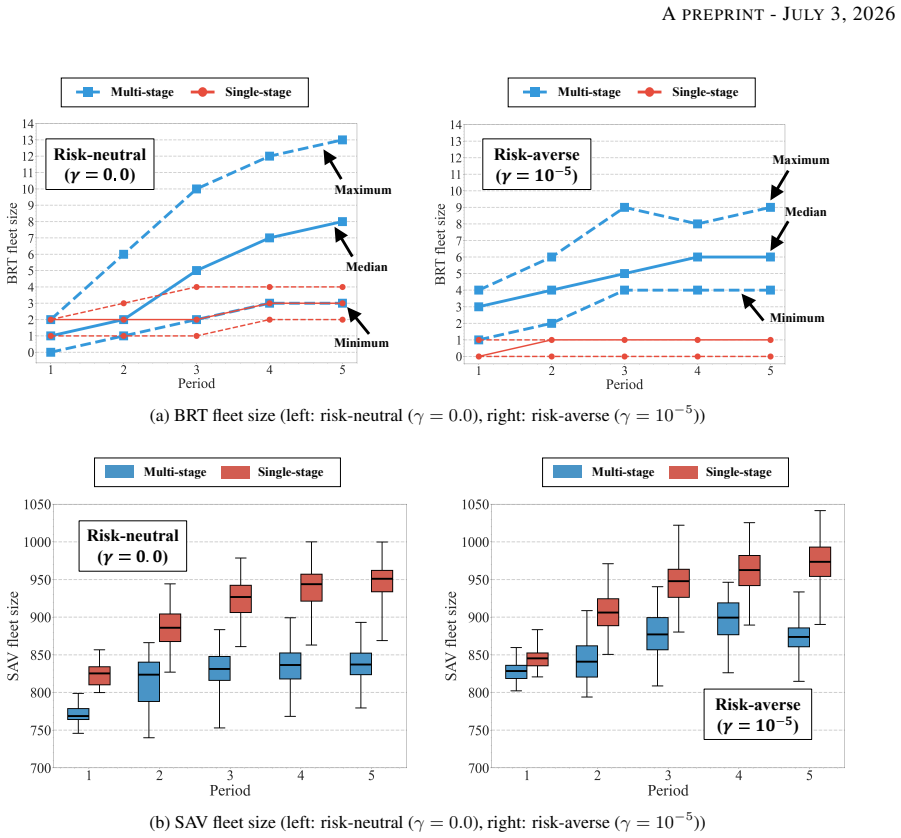
- Flexibility and reliability act complementarily to hedge against severe scenarios while limiting loss of expected performance.
- Flexibility in investment planning supports dynamic risk hedging, with risk-averse planners reducing early-stage investments to preserve future adaptability.
- Differences in operational flexibility between SAV and BRT systems are reflected in strategic decisions, with risk-averse planners tending to avoid investment in modes that offer lower operational flexibility.
Where Pith is reading between the lines
- The decomposition into strategic and operational layers may allow similar multi-stage stochastic models to be applied to other infrastructure systems that face staged decisions under uncertainty.
- The finding that operational flexibility shapes strategic choices implies that planners should quantify operational adaptability before committing to long-term mode-specific investments.
Load-bearing premise
Uncertainties such as demand and technology can be represented as multi-stage stochastic processes that permit decomposition into subproblems and application of SDDP with the stated convergence conditions.
What would settle it
Observing that the strategic and operational subproblems fail to converge to the global optimum on the SAV capacity-expansion or SAV-BRT instances despite satisfying the paper's sufficient conditions would falsify the convergence claim.
Figures







read the original abstract
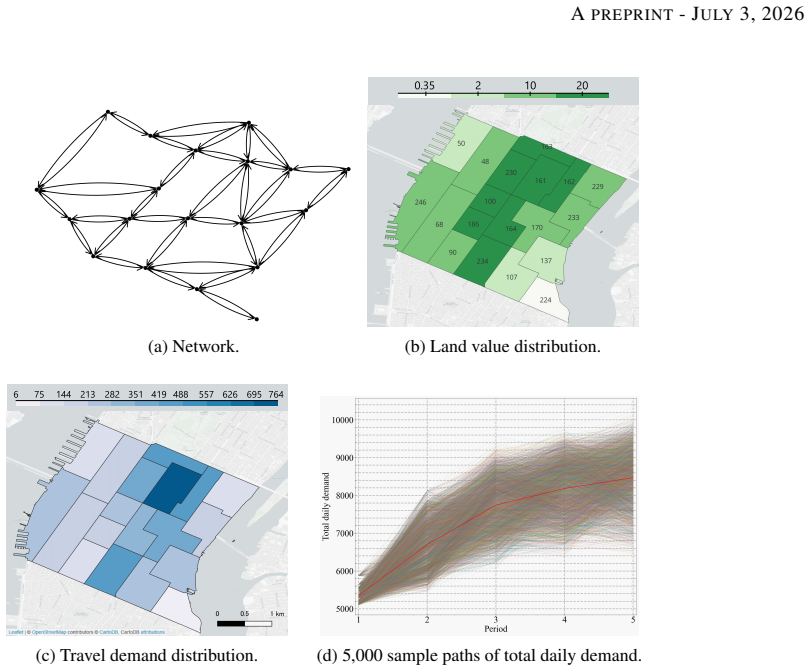
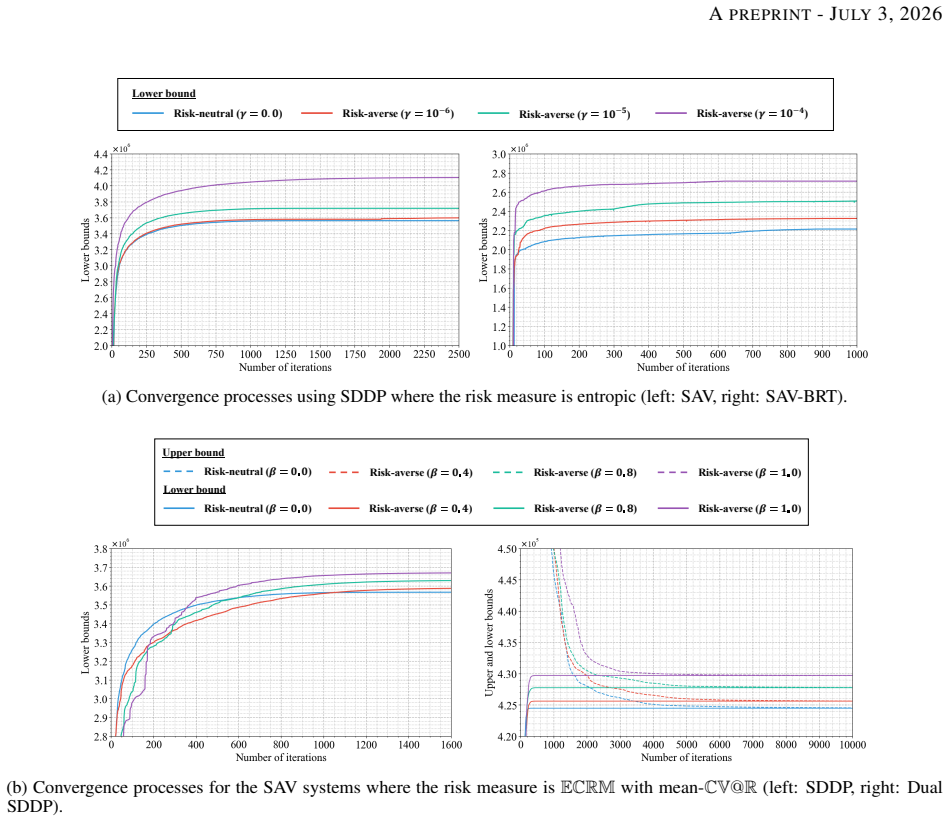
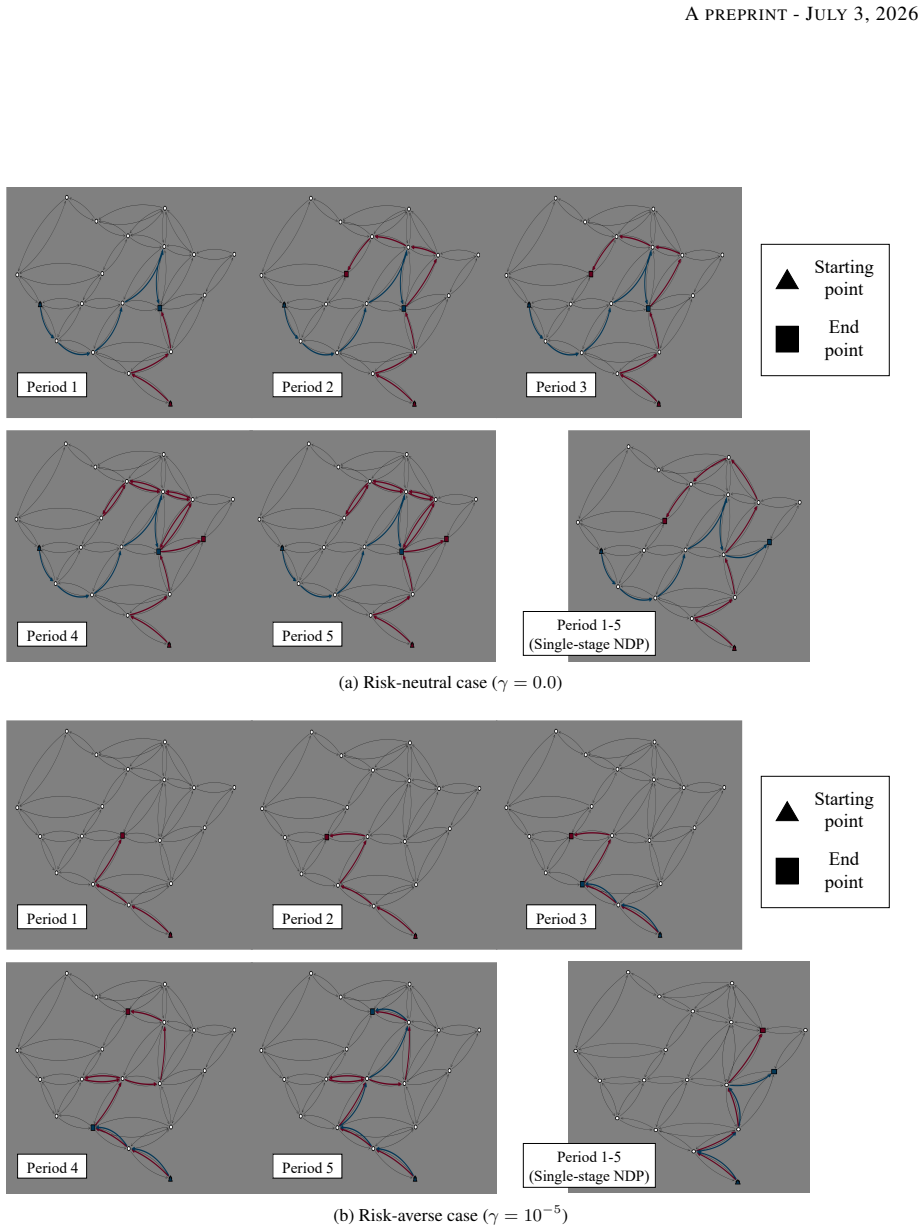
This paper proposes a general framework for flexible and reliable network design problems (FR-NDPs). The framework enables planners to change infrastructure investments in response to realized uncertainties, while ensuring desired levels of reliability. Motivated by emerging transportation services such as shared autonomous vehicle (SAV) systems, where historical data are scarce and technological developments uncertain, FR-NDPs integrate strategic investment decisions with operational control. We formulate the FR-NDPs as risk-averse multi-stage stochastic problems to be solvable by stochastic dual dynamic programming (SDDP) and establish sufficient conditions under which strategic and operational subproblems converge to the global optimum. We illustrate applications to SAV capacity expansion and integrated SAV-BRT (Bus Rapid Transit) route design, and numerical experiments on a Midtown Manhattan network highlight three key findings: (i) flexibility and reliability act complementarily to hedge against severe scenarios while mitigating the loss of expected performance; (ii) flexibility in investment planning allows dynamic risk hedging, with risk-averse planners reducing early-stage investments to preserve adaptability; and (iii) differences in operational flexibility between SAV and BRT systems are reflected in strategic decisions, with risk-averse planners tending to refrain investment in transport modes with lower operational flexibility.
Editorial analysis
A structured set of objections, weighed in public.
Referee Report
Summary. The paper proposes the FR-NDPs framework for flexible and reliable network design in transportation services (e.g., SAV systems), integrating strategic investments with operational control under uncertainty. It formulates the problems as risk-averse multi-stage stochastic programs solvable by SDDP, claims to establish sufficient conditions for convergence of strategic and operational subproblems to the global optimum, and presents numerical experiments on a Midtown Manhattan network for SAV capacity expansion and integrated SAV-BRT route design, highlighting three findings on complementarity of flexibility/reliability, dynamic risk hedging, and mode-specific investment differences.
Significance. If the convergence conditions are rigorously established and address standard SDDP requirements, the framework would offer a structured approach to risk-averse multi-stage planning with adaptive investments, which is relevant for emerging services with scarce data. The numerical findings on hedging behavior provide concrete insights, but their generality depends on the validity of the decomposition.
major comments (2)
- [Abstract] Abstract: The claim that 'sufficient conditions' ensure strategic and operational subproblems converge to the global optimum is load-bearing for the central contribution, yet the provided description does not specify how these conditions enforce convexity of recourse functions or stage-wise independence, both required by standard SDDP theory (e.g., Pereira and Pinto).
- [Abstract] Abstract (SAV-BRT route design application): The integrated route design likely introduces binary variables for route selection or capacity, rendering the operational recourse non-convex; without explicit relaxation, continuous approximation, or non-convex SDDP extension in the stated conditions, the global optimality guarantee does not hold.
minor comments (1)
- [Abstract] The abstract mentions 'three key findings' from numerical experiments but does not detail scenario generation, risk measure parameterization, or data exclusion rules, which would aid reproducibility.
Simulated Author's Rebuttal
We thank the referee for these constructive comments on the convergence claims and the SAV-BRT application. The points raise important issues about the level of detail in the abstract and the convexity requirements for SDDP. We respond to each comment below and will revise the manuscript to improve clarity.
read point-by-point responses
-
Referee: [Abstract] Abstract: The claim that 'sufficient conditions' ensure strategic and operational subproblems converge to the global optimum is load-bearing for the central contribution, yet the provided description does not specify how these conditions enforce convexity of recourse functions or stage-wise independence, both required by standard SDDP theory (e.g., Pereira and Pinto).
Authors: We agree that the abstract is too concise to detail the conditions. Section 3 of the manuscript establishes the sufficient conditions by requiring (i) convex recourse functions arising from linear operational subproblems and (ii) stage-wise independence enforced through the scenario-tree construction. These are the standard prerequisites referenced by Pereira and Pinto, augmented by our risk-averse formulation. To address the referee's concern, we will revise the abstract to include a brief clause stating that the conditions ensure convexity of the recourse functions and stage-wise independence. revision: yes
-
Referee: [Abstract] Abstract (SAV-BRT route design application): The integrated route design likely introduces binary variables for route selection or capacity, rendering the operational recourse non-convex; without explicit relaxation, continuous approximation, or non-convex SDDP extension in the stated conditions, the global optimality guarantee does not hold.
Authors: This observation is correct in principle: binary variables would violate the convexity assumption required for standard SDDP convergence. In the SAV-BRT formulation, route-selection decisions appear as binaries only at the strategic level; the operational recourse is formulated as a continuous linear program obtained by relaxing the binaries to the unit interval. The sufficient conditions stated in Section 3 therefore apply to this convex relaxation. We will revise the abstract and add an explicit statement in Section 4.2 clarifying the relaxation and confirming that the reported optimality guarantee holds for the relaxed problem. revision: yes
Circularity Check
No circularity: new formulation with stated convergence conditions
full rationale
The paper proposes FR-NDPs as a modeling framework formulated as risk-averse multi-stage stochastic programs solvable by SDDP, then states sufficient conditions for strategic/operational subproblems to converge to global optimum. This is an original formulation plus reference to standard SDDP theory (e.g., convexity and independence requirements), not a derivation that reduces by the paper's own equations or self-citations to its inputs. No fitted parameters renamed as predictions, no self-definitional loops, and no load-bearing self-citation chains appear. The approach is self-contained as a modeling contribution; any questions about applicability to non-convex cases (binary variables) concern correctness rather than circularity.
Axiom & Free-Parameter Ledger
free parameters (1)
- risk aversion parameter
axioms (1)
- domain assumption The transportation uncertainties admit a multi-stage representation allowing SDDP decomposition with global optimality under sufficient conditions.
invented entities (1)
-
FR-NDPs framework
no independent evidence
Reference graph
Works this paper leans on
-
[1]
SIAM Journal on Optimization , volume=
Exact augmented Lagrangian duality for mixed integer convex optimization , author=. SIAM Journal on Optimization , volume=. 2024 , publisher=
work page 2024
-
[2]
arXiv preprint arXiv:2409.19926 , year=
Mitigating optimistic bias in entropic risk estimation and optimization with an application to insurance , author=. arXiv preprint arXiv:2409.19926 , year=
-
[3]
Lefebvre, Henri and Schmidt, Martin , title =. 2024 , howpublished =
work page 2024
-
[4]
Mathematical Programming Studies , volume=
Lagrangean relaxation for integer programming , author=. Mathematical Programming Studies , volume=
-
[5]
Operations Research Letters , pages=
Geoffrion’s theorem beyond finiteness and rationality , author=. Operations Research Letters , pages=. 2026 , publisher=
work page 2026
-
[6]
Transportation Research Part A: General , volume=
Transportation network equilibrium, design and aggregation: key developments and research opportunities , author=. Transportation Research Part A: General , volume=. 1985 , publisher=
work page 1985
-
[7]
European Journal of Operational Research , volume=
A review of urban transportation network design problems , author=. European Journal of Operational Research , volume=. 2013 , publisher=
work page 2013
-
[8]
European Journal of Operational Research , volume=
Perspectives on modeling hub location problems , author=. European Journal of Operational Research , volume=. 2021 , publisher=
work page 2021
-
[9]
Transportation Research Part A: Policy and Practice , volume=
Revisiting transportation planning and decision making theory: The case of Denver International Airport , author=. Transportation Research Part A: Policy and Practice , volume=. 1997 , publisher=
work page 1997
-
[10]
Journal of the American Planning Association , volume=
How (in) accurate are demand forecasts in public works projects?: The case of transportation , author=. Journal of the American Planning Association , volume=. 2005 , publisher=
work page 2005
-
[11]
Annals of Operations Research , volume=
Incorporating convex risk measures into multistage stochastic programming algorithms , author=. Annals of Operations Research , volume=. 2025 , publisher=
work page 2025
-
[12]
European Journal of Operational Research , volume=
A unified framework for stochastic optimization , author=. European Journal of Operational Research , volume=. 2019 , publisher=
work page 2019
-
[13]
The policy graph decomposition of multistage stochastic programming problems , author=. Networks , volume=. 2020 , publisher=
work page 2020
-
[14]
Mathematics and Financial Economics , volume=
Representation results for law invariant time consistent functions , author=. Mathematics and Financial Economics , volume=. 2009 , publisher=
work page 2009
-
[15]
Journal of banking & finance , volume=
Conditional value-at-risk for general loss distributions , author=. Journal of banking & finance , volume=. 2002 , publisher=
work page 2002
-
[16]
Advanced financial modelling , volume=
Time consistency and information monotonicity of multiperiod acceptability functionals , author=. Advanced financial modelling , volume=. 2009 , publisher=
work page 2009
-
[17]
Computers & Operations Research , volume=
Risk-averse multistage stochastic programs with expected conditional risk measures , author=. Computers & Operations Research , volume=. 2024 , publisher=
work page 2024
-
[18]
European Journal of Operational Research , volume=
Risk aversion in multistage stochastic programming: A modeling and algorithmic perspective , author=. European Journal of Operational Research , volume=. 2016 , publisher=
work page 2016
-
[19]
Transportation Research Record , volume=
Reliable network design problem: case with uncertain demand and total travel time reliability , author=. Transportation Research Record , volume=. 2006 , publisher=
work page 2006
-
[20]
Transportation Research Part B: Methodological , volume=
Time-dependent transport network design under cost-recovery , author=. Transportation Research Part B: Methodological , volume=. 2009 , publisher=
work page 2009
-
[21]
Transportation Research Part A: Policy and Practice , volume=
Existence of self-financing and Pareto-improving congestion pricing: Impact of value of time distribution , author=. Transportation Research Part A: Policy and Practice , volume=. 2010 , publisher=
work page 2010
-
[22]
Transportation Research Part B: Methodological , volume=
Joint infrastructure planning and fleet management for one-way electric car sharing under time-varying uncertain demand , author=. Transportation Research Part B: Methodological , volume=. 2019 , publisher=
work page 2019
-
[23]
Transportation Research Part C: Emerging Technologies , volume=
Shared autonomous vehicle services: A comprehensive review , author=. Transportation Research Part C: Emerging Technologies , volume=. 2020 , publisher=
work page 2020
-
[24]
Transportation science , volume=
A linear programming model for the single destination system optimum dynamic traffic assignment problem , author=. Transportation science , volume=. 2000 , publisher=
work page 2000
-
[25]
Transportation Research Part A: Policy and Practice , volume=
Measuring capacity flexibility of a transportation system , author=. Transportation Research Part A: Policy and Practice , volume=. 2004 , publisher=
work page 2004
-
[26]
Transportation Research Part C: Emerging Technologies , volume=
Congestion-aware system optimal route choice for shared autonomous vehicles , author=. Transportation Research Part C: Emerging Technologies , volume=. 2017 , publisher=
work page 2017
-
[27]
Transportation Research Part C: Emerging Technologies , volume=
A time-dependent shared autonomous vehicle system design problem , author=. Transportation Research Part C: Emerging Technologies , volume=. 2021 , publisher=
work page 2021
-
[28]
IEEE Transactions on Intelligent Transportation Systems , volume=
Multi-objective linear optimization problem for strategic planning of shared autonomous vehicle operation and infrastructure design , author=. IEEE Transactions on Intelligent Transportation Systems , volume=. 2022 , publisher=
work page 2022
-
[29]
International Journal of Intelligent Transportation Systems Research , volume=
Integrated public transportation system with shared autonomous vehicles and fixed-route transits: Dynamic traffic assignment-based model with multi-objective optimization , author=. International Journal of Intelligent Transportation Systems Research , volume=. 2023 , publisher=
work page 2023
-
[30]
Sustainable cities and society , volume=
Exploring the impact of shared autonomous vehicles on urban parking demand: An agent-based simulation approach , author=. Sustainable cities and society , volume=. 2015 , publisher=
work page 2015
-
[31]
Transportation Research Part C: Emerging Technologies , volume=
A fractionally owned autonomous vehicle fleet sizing problem with time slot demand substitution effects , author=. Transportation Research Part C: Emerging Technologies , volume=. 2019 , publisher=
work page 2019
-
[32]
Transport network design problem under uncertainty: a review and new developments , author=. Transport Reviews , volume=. 2011 , publisher=
work page 2011
-
[33]
Road network reliability caused by daily fluctuation of traffic flow , author=. 1991 , booktitle=
work page 1991
-
[34]
Transportation Research Part B: Methodological , volume=
A topological network connectivity design problem based on spectral analysis , author=. Transportation Research Part B: Methodological , volume=. 2024 , publisher=
work page 2024
-
[35]
Stochastic dual dynamic programming and its variants: A review , author=. SIAM Review , volume=. 2025 , publisher=
work page 2025
-
[36]
International Journal of Production Research , volume=
Development of a reliable and flexible supply chain network design model: a genetic algorithm based approach , author=. International Journal of Production Research , volume=. 2021 , publisher=
work page 2021
-
[37]
Transportation Research Part B: Methodological , volume=
Multi-period transportation network design under demand uncertainty , author=. Transportation Research Part B: Methodological , volume=. 2009 , publisher=
work page 2009
-
[38]
Nature Sustainability , volume=
Impacts of transportation network companies on urban mobility , author=. Nature Sustainability , volume=. 2021 , publisher=
work page 2021
-
[39]
INFORMS Journal on Computing , year=
On the Value of Risk-Averse Multistage Stochastic Programming in Capacity Planning , author=. INFORMS Journal on Computing , year=
-
[40]
European Journal of Operational Research , year=
Capacity planning of renewable energy systems using stochastic dual dynamic programming , author=. European Journal of Operational Research , year=
-
[41]
arXiv preprint arXiv:2112.00874 , year=
Neural stochastic dual dynamic programming , author=. arXiv preprint arXiv:2112.00874 , year=
-
[42]
Mathematical Programming Computation , volume=
A Benders squared ( B^2 ) framework for infinite-horizon stochastic linear programs , author=. Mathematical Programming Computation , volume=. 2021 , publisher=
work page 2021
-
[43]
Transportation Research Part C: Emerging Technologies , volume=
From strategic to tactical carriers’ selection: A new SDDP algorithm to handle dynamic stochastic demand , author=. Transportation Research Part C: Emerging Technologies , volume=. 2025 , publisher=
work page 2025
-
[44]
arXiv preprint arXiv:2409.11611 , year=
Multi-stage stochastic linear programming for shared autonomous vehicle system operation and design with on-demand and pre-booked requests , author=. arXiv preprint arXiv:2409.11611 , year=
-
[45]
European Journal of Operational Research , volume=
A multi-stage stochastic optimization model of a pastoral dairy farm , author=. European Journal of Operational Research , volume=. 2019 , publisher=
work page 2019
-
[46]
Quantitative Finance , volume=
Large-scale financial planning via a partially observable stochastic dual dynamic programming framework , author=. Quantitative Finance , volume=. 2023 , publisher=
work page 2023
-
[47]
Mathematics of Operations Research , volume=
On the convergence of decomposition methods for multistage stochastic convex programs , author=. Mathematics of Operations Research , volume=. 2015 , publisher=
work page 2015
-
[48]
Mathematical Programming , volume=
Evaluating policies in risk-averse multi-stage stochastic programming , author=. Mathematical Programming , volume=. 2015 , publisher=
work page 2015
-
[49]
Operations Research Letters , volume=
Risk-averse stochastic optimal control: An efficiently computable statistical upper bound , author=. Operations Research Letters , volume=. 2023 , publisher=
work page 2023
-
[50]
Mathematical Programming , volume=
Stochastic dual dynamic programming for multistage stochastic mixed-integer nonlinear optimization , author=. Mathematical Programming , volume=. 2022 , publisher=
work page 2022
-
[51]
Operations Research Letters , volume=
On the convergence of stochastic dual dynamic programming and related methods , author=. Operations Research Letters , volume=. 2008 , publisher=
work page 2008
-
[52]
Decomposition and partitioning methods for multistage stochastic linear programs , author=. Operations Research , volume=. 1985 , publisher=
work page 1985
-
[53]
SIAM Journal on Optimization , volume=
Periodical multistage stochastic programs , author=. SIAM Journal on Optimization , volume=. 2020 , publisher=
work page 2020
-
[54]
Lectures on stochastic programming: modeling and theory , author=. 2009 , publisher=
work page 2009
-
[55]
European Journal of Operational Research , volume=
Duality and sensitivity analysis of multistage linear stochastic programs , author=. European Journal of Operational Research , volume=. 2023 , publisher=
work page 2023
-
[56]
Operations Research Letters , volume=
Dual SDDP for risk-averse multistage stochastic programs , author=. Operations Research Letters , volume=. 2023 , publisher=
work page 2023
-
[57]
Dual bounds for periodical stochastic programs , author=. Operations Research , volume=. 2023 , publisher=
work page 2023
-
[58]
Uncertainty in Facility Location Problems , pages=
On risk management of multistage multiscale FLP under uncertainty , author=. Uncertainty in Facility Location Problems , pages=. 2023 , publisher=
work page 2023
-
[59]
JuMP: A modeling language for mathematical optimization
Dunning, Iain and Huchette, Joey and Lubin, Miles , journal=. JuMP: A modeling language for mathematical optimization. 2017 , publisher=
work page 2017
-
[60]
SDDP.jl: a Julia package for stochastic dual dynamic programming
Dowson, Oscar and Kapelevich, Lea , journal=. SDDP.jl: a Julia package for stochastic dual dynamic programming. 2021 , publisher=
work page 2021
-
[61]
Operations Research Letters , volume=
On complexity of multistage stochastic programs , author=. Operations Research Letters , volume=. 2006 , publisher=
work page 2006
-
[62]
Mathematical Programming , volume=
Dynamic stochastic approximation for multi-stage stochastic optimization , author=. Mathematical Programming , volume=. 2021 , publisher=
work page 2021
-
[63]
Mathematical Programming , volume=
Complexity of stochastic dual dynamic programming , author=. Mathematical Programming , volume=. 2022 , publisher=
work page 2022
-
[64]
Transportation Research Part E: Logistics and Transportation Review , volume=
A sequential transit network design algorithm with optimal learning under correlated beliefs , author=. Transportation Research Part E: Logistics and Transportation Review , volume=. 2024 , publisher=
work page 2024
-
[65]
Computers & Operations Research , volume=
A deep real options policy for sequential service region design and timing , author=. Computers & Operations Research , volume=. 2024 , publisher=
work page 2024
-
[66]
European Journal of Operational Research , volume=
Facility location and supply chain management--A review , author=. European Journal of Operational Research , volume=. 2009 , publisher=
work page 2009
-
[67]
European Journal of Operational Research , volume=
Supply chain network design under uncertainty: A comprehensive review and future research directions , author=. European Journal of Operational Research , volume=. 2017 , publisher=
work page 2017
-
[68]
Journal of Global Optimization , volume=
A multi-stage stochastic integer programming approach for capacity expansion under uncertainty , author=. Journal of Global Optimization , volume=. 2003 , publisher=
work page 2003
-
[69]
arXiv preprint arXiv:2105.11005 , year=
On the value of multistage risk-averse stochastic facility location with or without prioritization , author=. arXiv preprint arXiv:2105.11005 , year=
-
[70]
Multistage stochastic programming for integrated network optimization in hurricane relief logistics and evacuation planning , author=. Networks , volume=. 2025 , publisher=
work page 2025
-
[71]
European Journal of Operational Research , volume=
Multistage stochastic programming with a random number of stages: Applications in hurricane disaster relief logistics planning , author=. European Journal of Operational Research , volume=. 2025 , publisher=
work page 2025
-
[72]
Stochastic dual dynamic programming solution of a short-term disaster management problem , author=. Uncertainty Management in Simulation-Optimization of Complex Systems: Algorithms and Applications , pages=. 2015 , publisher=
work page 2015
-
[73]
Transportation Research Record , volume=
Contextual bandit-based sequential transit route design under demand uncertainty , author=. Transportation Research Record , volume=. 2020 , publisher=
work page 2020
-
[74]
Journal of Computing in Civil Engineering , volume=
Sample average approximation technique for flexible network design problem , author=. Journal of Computing in Civil Engineering , volume=. 2011 , publisher=
work page 2011
-
[75]
Urban and Regional Transportation Modeling , pages=
Planning transport network improvements over time , author=. Urban and Regional Transportation Modeling , pages=. 2004 , publisher=
work page 2004
-
[76]
European Journal of Operational Research , volume=
Integration of selecting and scheduling urban road construction projects as a time-dependent discrete network design problem , author=. European Journal of Operational Research , volume=. 2015 , publisher=
work page 2015
-
[77]
Transportation Research Part C: Emerging Technologies , volume=
Optimal deployment of autonomous vehicle lanes with endogenous market penetration , author=. Transportation Research Part C: Emerging Technologies , volume=. 2016 , publisher=
work page 2016
-
[78]
Transportmetrica A: Transport Science , volume=
A simplified framework for sequencing of transportation projects considering user costs and benefits , author=. Transportmetrica A: Transport Science , volume=. 2018 , publisher=
work page 2018
-
[79]
Research in Transportation Economics , volume=
Multi-period transportation network investment decision making and policy implications using econometric framework , author=. Research in Transportation Economics , volume=. 2021 , publisher=
work page 2021
-
[80]
Transportation Research Part A: Policy and Practice , volume=
Time-dependent transport network improvement and tolling strategies , author=. Transportation Research Part A: Policy and Practice , volume=. 2008 , publisher=
work page 2008
discussion (0)
Sign in with ORCID, Apple, or X to comment. Anyone can read and Pith papers without signing in.