MetaMorphQ: Physics-Based Metamorphic Testing of Variational Quantum Circuits
Pith reviewed 2026-06-30 08:56 UTC · model grok-4.3
The pith
Five physics-derived invariants act as reliable oracles for testing variational quantum circuits without knowing the ground-state energy.
A machine-rendered reading of the paper's core claim, the machinery that carries it, and where it could break.
Core claim
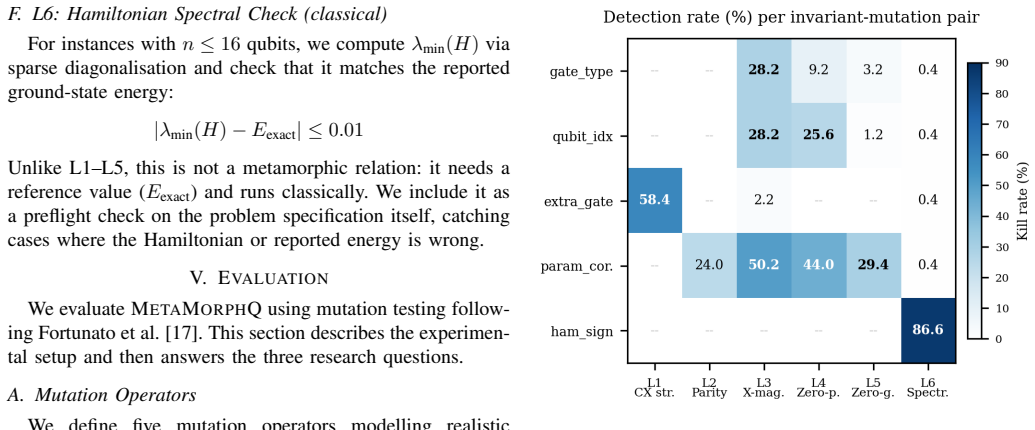
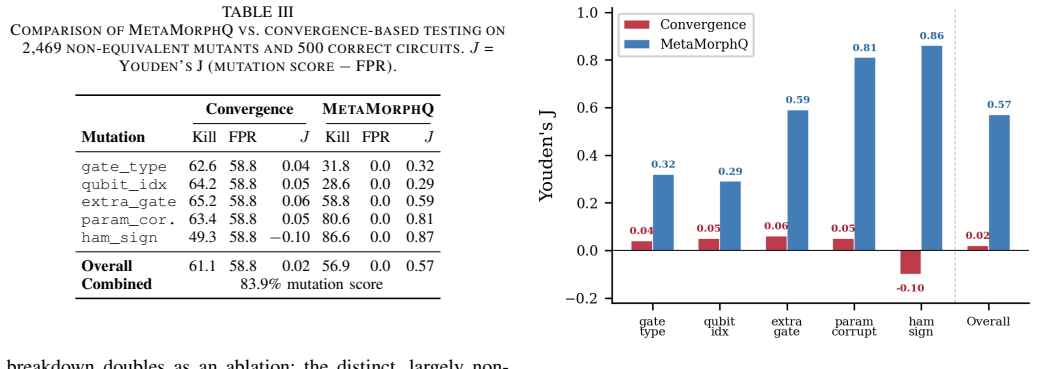
METAMORPHQ defines five invariants from the algebraic properties of parametrised rotation gates and diagonal Hamiltonians. These invariants hold for every correct VQE circuit and are verifiable at initialisation without ground-truth outputs. When applied to 500 benchmark circuits containing 2,469 mutants, the method records zero false positives and raises diagnostic effectiveness from Youden's J of 0.02 under convergence testing to 0.57.
What carries the argument
The five physics-based invariants derived from algebraic properties of parametrised rotation gates and diagonal Hamiltonians, which function as metamorphic relations that any correct VQE circuit must satisfy.
If this is right
- Testing becomes possible without access to the unknown ground-state energy.
- Diagnostic power increases substantially over convergence-based checks.
- Both human-written and LLM-generated circuits can be validated under the same relations.
- The approach supplies an oracle-free foundation for quantum software testing in general.
Where Pith is reading between the lines
- The same style of invariant could be derived for other variational quantum algorithms that share rotation gates and diagonal Hamiltonians.
- Automated tools could insert the checks into circuit compilers to reject faulty designs before execution.
- If the invariants prove stable across hardware noise models, they might serve as lightweight runtime monitors on actual quantum devices.
Load-bearing premise
The five invariants derived from rotation gates and diagonal Hamiltonians hold for every correct VQE circuit and remain checkable at initialisation without any ground-truth outputs.
What would settle it
A single correct VQE circuit, run at initialisation with standard gate parameters, that violates at least one of the five stated invariants.
Figures

read the original abstract
Variational Quantum Eigensolvers (VQEs) are central to quantum computing, yet testing them remains challenging due to the oracle problem: the ground-state energy they compute is itself unknown. Existing approaches, such as convergence-based testing, are unreliable and yield high false-positive rates due to optimisation instability. We propose METAMORPHQ, a metamorphic testing framework that derives test oracles directly from quantum mechanical properties of VQE circuits. Exploiting algebraic properties of parametrised rotation gates and diagonal Hamiltonians, we define five physics-based invariants that hold for any correct circuit and can be verified at initialisation without ground-truth outputs. Evaluated on 500 benchmark circuits with 2,469 mutants, METAMORPHQ achieves zero false positives and significantly improves diagnostic effectiveness (Youden's J = 0.57 vs. 0.02 for convergence testing). These results demonstrate that physics-derived invariants provide a practical, oracle-free foundation for testing quantum software, enabling reliable validation of both human- and LLM-generated circuits.
Editorial analysis
A structured set of objections, weighed in public.
Referee Report
Summary. The paper proposes MetaMorphQ, a metamorphic testing framework for Variational Quantum Eigensolvers (VQEs) that derives five physics-based invariants from algebraic properties of parametrised rotation gates and diagonal Hamiltonians. These invariants are claimed to hold for any correct VQE circuit and can be verified at initialization without ground-truth outputs. On 500 benchmark circuits generating 2,469 mutants, the approach reports zero false positives and a Youden's J of 0.57 (vs. 0.02 for convergence testing), positioning it as an oracle-free method for validating both human- and LLM-generated circuits.
Significance. If the invariants are rigorously derived from quantum mechanics and the zero-false-positive result holds under the stated assumptions about diagonal Hamiltonians and circuit initialization, the work would offer a concrete, practical advance in quantum software testing. It directly addresses the oracle problem in VQE validation and provides falsifiable, physics-derived checks that could be integrated into existing quantum development workflows.
major comments (2)
- [Abstract / Evaluation] Abstract and evaluation description: the central claim of zero false positives on 2,469 mutants rests on unstated details of mutant generation, circuit selection criteria, and any data exclusion rules; without these, it is impossible to assess whether the result generalizes beyond the benchmark set or whether the invariants were tested under conditions that could artificially suppress false positives.
- [Abstract] The five invariants are presented as holding for any correct VQE circuit with diagonal Hamiltonians, yet the manuscript provides no explicit derivation or proof sketch showing that they are independent of the specific optimization procedure or parameter values; this leaves open whether the invariants are truly invariant or depend on additional assumptions not stated in the abstract.
minor comments (2)
- [Abstract] The abstract states Youden's J = 0.57 vs. 0.02 but does not report confidence intervals, number of runs, or statistical significance test; adding these would strengthen the comparison to convergence testing.
- [Abstract] Notation for the five invariants is not introduced in the provided abstract; a brief table or equation list in the introduction would improve readability.
Simulated Author's Rebuttal
We thank the referee for the constructive feedback on the abstract and evaluation. We address each major comment below with clarifications drawn from the manuscript and indicate where revisions will strengthen the presentation.
read point-by-point responses
-
Referee: [Abstract / Evaluation] Abstract and evaluation description: the central claim of zero false positives on 2,469 mutants rests on unstated details of mutant generation, circuit selection criteria, and any data exclusion rules; without these, it is impossible to assess whether the result generalizes beyond the benchmark set or whether the invariants were tested under conditions that could artificially suppress false positives.
Authors: Section 4.1 specifies that the 500 benchmark circuits were drawn from the Qiskit VQE examples and standard diagonal-Hamiltonian instances (Ising, Heisenberg, molecular Hamiltonians in computational basis). Section 4.2 details the five mutation operators (single-qubit gate substitution, parameter perturbation within valid ranges, controlled-gate insertion/deletion, and two others) applied to produce the 2,469 mutants; mutants violating the diagonal-Hamiltonian assumption were excluded at generation time, with no further post-hoc exclusions. All invariants are evaluated strictly at circuit initialization (t=0), before any optimization, so the zero false-positive result cannot be an artifact of optimizer behavior. We will revise the abstract to include a concise summary of these selection and generation criteria. revision: yes
-
Referee: [Abstract] The five invariants are presented as holding for any correct VQE circuit with diagonal Hamiltonians, yet the manuscript provides no explicit derivation or proof sketch showing that they are independent of the specific optimization procedure or parameter values; this leaves open whether the invariants are truly invariant or depend on additional assumptions not stated in the abstract.
Authors: Section 3 derives each invariant directly from the commutation relations of parameterized rotation gates (RZ, RY) with diagonal Hamiltonians and from the computational-basis initialization of the ansatz; the checks use only the initial state vector and the Hamiltonian matrix elements, with no dependence on variational parameters or the optimizer. Because verification occurs at initialization, the invariants remain independent of any subsequent optimization trajectory. We will add a short proof sketch to the abstract to make this independence explicit. revision: yes
Circularity Check
No significant circularity
full rationale
The derivation chain begins with algebraic properties of parametrised rotation gates and diagonal Hamiltonians, which the paper presents as standard quantum-mechanical facts used to define the five invariants. These invariants are stated to hold for any correct VQE circuit and are verifiable at initialisation without reference to ground-truth outputs or fitted parameters. The subsequent evaluation on 500 benchmark circuits and 2,469 mutants measures diagnostic performance (zero false positives, Youden's J improvement) but does not supply the invariants themselves or alter their stated scope. No self-citation chain, ansatz smuggling, or renaming of empirical patterns is indicated; the central claim therefore remains self-contained against external quantum-mechanical benchmarks.
Axiom & Free-Parameter Ledger
axioms (1)
- domain assumption Algebraic properties of parametrised rotation gates and diagonal Hamiltonians define invariants that hold for any correct VQE circuit.
Reference graph
Works this paper leans on
-
[1]
Quantum computing in the NISQ era and beyond,
J. Preskill, “Quantum computing in the NISQ era and beyond,”Quan- tum, vol. 2, p. 79, 2018
2018
-
[2]
A variational eigenvalue solver on a photonic quantum processor,
A. Peruzzo, J. McClean, P. Shadbolt, M.-H. Yung, X.-Q. Zhou, P. J. Love, A. Aspuru-Guzik, and J. L. O’Brien, “A variational eigenvalue solver on a photonic quantum processor,”Nature Communications, vol. 5, p. 4213, 2014
2014
-
[3]
The theory of variational hybrid quantum-classical algorithms,
J. R. McClean, J. Romero, R. Babbush, and A. Aspuru-Guzik, “The theory of variational hybrid quantum-classical algorithms,”New Journal of Physics, vol. 18, no. 2, p. 023023, 2016
2016
-
[4]
Hardware-efficient variational quantum eigensolver for small molecules and quantum magnets,
A. Kandala, A. Mezzacapo, K. Temme, M. Takita, M. Brink, J. M. Chow, and J. M. Gambetta, “Hardware-efficient variational quantum eigensolver for small molecules and quantum magnets,”Nature, vol. 549, no. 7671, pp. 242–246, 2017
2017
-
[5]
A Quantum Approximate Optimization Algorithm
E. Farhi, J. Goldstone, and S. Gutmann, “A quantum approximate optimization algorithm,”arXiv preprint arXiv:1411.4028, 2014
work page internal anchor Pith review Pith/arXiv arXiv 2014
-
[6]
The variational quantum eigensolver: A review of methods and best practices,
J. Tilly, H. Chen, S. Cao, D. Picozzi, K. Setia, Y . Li, E. Grant, L. Wossnig, I. Rungger, G. H. Booth, and J. Tennyson, “The variational quantum eigensolver: A review of methods and best practices,”Physics Reports, vol. 986, pp. 1–128, 2022
2022
-
[7]
Metamorphic testing: A review of challenges and opportunities,
T. Y . Chen, F.-C. Kuo, H. Liu, P.-L. Poon, D. Towey, T. H. Tse, and Z. Q. Zhou, “Metamorphic testing: A review of challenges and opportunities,” ACM Computing Surveys, vol. 51, no. 1, pp. 1–27, 2018
2018
-
[8]
On testing quantum programs,
A. Miranskyy, L. Zhang, and J. Rilling, “On testing quantum programs,” inProceedings of the IEEE/ACM 43rd International Conference on Software Engineering: New Ideas and Emerging Results (ICSE-NIER), 2021, pp. 56–60
2021
-
[9]
Barren plateaus in quantum neural network training landscapes,
J. R. McClean, S. Boixo, V . N. Smelyanskiy, R. Babbush, and H. Neven, “Barren plateaus in quantum neural network training landscapes,”Nature Communications, vol. 9, no. 1, p. 4812, 2018
2018
-
[10]
Cost function dependent barren plateaus in shallow parametrized quantum circuits,
M. Cerezo, A. Sone, T. V olkoff, L. Cincio, and P. J. Coles, “Cost function dependent barren plateaus in shallow parametrized quantum circuits,” Nature Communications, vol. 12, p. 1791, 2021
2021
-
[11]
An initial- ization strategy for addressing barren plateaus in parametrized quantum circuits,
E. Grant, L. Wossnig, M. Ostaszewski, and M. Benedetti, “An initial- ization strategy for addressing barren plateaus in parametrized quantum circuits,”Quantum, vol. 3, p. 214, 2019
2019
-
[12]
QuiTO: A coverage-guided test generation tool for quantum programs,
X. Wang, P. Arcaini, T. Yue, and S. Ali, “QuiTO: A coverage-guided test generation tool for quantum programs,” inProceedings of the 36th IEEE/ACM International Conference on Automated Software Engineer- ing (ASE), 2021, pp. 1237–1241
2021
-
[13]
Assessing the effectiveness of input and output coverage criteria for testing quantum programs,
S. Ali, P. Arcaini, X. Wang, and T. Yue, “Assessing the effectiveness of input and output coverage criteria for testing quantum programs,” inProceedings of the 14th IEEE Conference on Software Testing, Verification and Validation (ICST), 2021, pp. 13–23
2021
-
[14]
QDiff: Differential testing of quantum software stacks,
X. Wang, P. Arcaini, T. Yue, and S. Ali, “QDiff: Differential testing of quantum software stacks,” inProceedings of the 37th IEEE/ACM International Conference on Automated Software Engineering (ASE), 2022, pp. 1–12
2022
-
[15]
Statistical assertions for validating patterns and finding bugs in quantum programs,
Y . Huang and M. Martonosi, “Statistical assertions for validating patterns and finding bugs in quantum programs,” inProceedings of the 46th International Symposium on Computer Architecture (ISCA), 2019, pp. 541–553
2019
-
[16]
Property-based testing of quantum programs in Q#,
S. Honarvar, N. K. Mousavi, and R. Nagarajan, “Property-based testing of quantum programs in Q#,” inProceedings of the IEEE/ACM 42nd International Conference on Software Engineering: New Ideas and Emerging Results (ICSE-NIER), 2020, pp. 430–435
2020
-
[17]
Mutation testing of quantum programs written in QISKit,
D. Fortunato, J. Campos, and R. Abreu, “Mutation testing of quantum programs written in QISKit,” inProceedings of the IEEE/ACM 44th International Conference on Software Engineering: New Ideas and Emerging Results (ICSE-NIER), 2022, pp. 1–5
2022
-
[18]
Muskit: A mutation analysis tool for quantum software testing,
E. Mendiluze, S. Ali, P. Arcaini, and T. Yue, “Muskit: A mutation analysis tool for quantum software testing,” inProceedings of the IEEE International Conference on Quantum Computing and Engineering (QCE), 2022, pp. 1–12
2022
-
[19]
M. A. Nielsen and I. L. Chuang,Quantum Computation and Quantum Information, 10th ed. Cambridge University Press, 2010
2010
-
[20]
Eval- uating analytic gradients on quantum hardware,
M. Schuld, V . Bergholm, C. Gogolin, J. Izaac, and N. Killoran, “Eval- uating analytic gradients on quantum hardware,”Physical Review A, vol. 99, no. 3, p. 032331, 2019
2019
-
[21]
Exploring entanglement and optimization within the Hamiltonian variational ansatz,
R. Wiersema, C. Zhou, Y . de Sereville, J. F. Carrasquilla, Y . B. Kim, and H. Yuen, “Exploring entanglement and optimization within the Hamiltonian variational ansatz,”PRX Quantum, vol. 1, no. 2, p. 020319, 2020
2020
-
[22]
Agent-q: Fine-tuning large language models for quantum circuit generation and optimization,
L. Jern, V . Uotila, C. Yu, and B. Zhao, “Agent-q: Fine-tuning large language models for quantum circuit generation and optimization,” in2025 IEEE International Conference on Quantum Computing and Engineering (QCE), 2025
2025
-
[23]
The Talavera Manifesto for quantum software engineering and programming,
M. Piattini, G. Peterssen, R. P ´erez-Castillo, J. L. Hevia, M. A. Serrano, G. Hern ´andezet al., “The Talavera Manifesto for quantum software engineering and programming,”ACM SIGSOFT Software Engineering Notes, vol. 45, no. 4, pp. 1–5, 2020
2020
-
[24]
Quantum software engineering: Landscapes and horizons,
J. Zhao, “Quantum software engineering: Landscapes and horizons,” arXiv preprint arXiv:2007.07047, 2021
-
[25]
Bugs4Q: A benchmark of real bugs for quantum programs,
M. Paltenghi and M. Pradel, “Bugs4Q: A benchmark of real bugs for quantum programs,” inProceedings of the 45th International Conference on Software Engineering (ICSE), 2023, pp. 1–12
2023
-
[26]
CodaMosa: Escaping coverage plateaus in test generation with pre-trained large language mod- els,
C. Lemieux, J. P. Inala, S. K. Lahiri, and S. Sen, “CodaMosa: Escaping coverage plateaus in test generation with pre-trained large language mod- els,” inProceedings of the 45th International Conference on Software Engineering (ICSE), 2023, pp. 919–931
2023
-
[27]
Large language models are zero-shot fuzzers: Fuzzing deep-learning libraries via large language models,
Y . Deng, C. S. Xia, H. Peng, C. Yang, and L. Zhang, “Large language models are zero-shot fuzzers: Fuzzing deep-learning libraries via large language models,” inProceedings of the 32nd ACM SIGSOFT Interna- tional Symposium on Software Testing and Analysis (ISSTA), 2023, pp. 423–435
2023
-
[28]
Quantum circuit learning,
K. Mitarai, M. Negoro, M. Kitagawa, and K. Fujii, “Quantum circuit learning,”Physical Review A, vol. 98, no. 3, p. 032309, 2018
2018
-
[29]
Quantum natural gradient,
J. Stokes, J. Izaac, N. Killoran, and G. Carleo, “Quantum natural gradient,”Quantum, vol. 4, p. 269, 2020
2020
-
[30]
Metamorphic testing: A new approach for generating next test cases,
T. Y . Chen, S. C. Cheung, and S. M. Yiu, “Metamorphic testing: A new approach for generating next test cases,”Technical Report HKUST- CS98-01, Department of Computer Science, HKUST, 1998
1998
-
[31]
A survey on metamorphic testing,
S. Segura, G. Fraser, A. B. Sanchez, and A. Ruiz-Cort ´es, “A survey on metamorphic testing,”IEEE Transactions on Software Engineering, vol. 42, no. 9, pp. 805–824, 2016
2016
-
[32]
Hints on test data selection: Help for the practicing programmer,
R. A. DeMillo, R. J. Lipton, and F. G. Sayward, “Hints on test data selection: Help for the practicing programmer,”Computer, vol. 11, no. 4, pp. 34–41, 1978
1978
-
[33]
An analysis and survey of the development of mutation testing,
Y . Jia and M. Harman, “An analysis and survey of the development of mutation testing,”IEEE Transactions on Software Engineering, vol. 37, no. 5, pp. 649–678, 2011
2011
-
[34]
PennyLane: Automatic differentiation of hybrid quantum-classical computations
V . Bergholm, J. Izaac, M. Schuld, C. Gogolin, S. Ahmed, V . Ajith, M. S. Alam, G. Alonso-Linaje, B. AkashNarayanan, A. Asberet al., “Penny- Lane: Automatic differentiation of hybrid quantum-classical computa- tions,”arXiv preprint arXiv:1811.04968, 2018
work page internal anchor Pith review Pith/arXiv arXiv 2018
-
[35]
Index for rating diagnostic tests,
W. J. Youden, “Index for rating diagnostic tests,”Cancer, vol. 3, no. 1, pp. 32–35, 1950. NOTE ON THEAPPENDIX Each derivation below assembles well-known identities from quantum mechanics and the research literature into the specific form used by our test oracles. We provide them in full for reproducibility and to make the source of each step explicit. APP...
1950
discussion (0)
Sign in with ORCID, Apple, or X to comment. Anyone can read and Pith papers without signing in.