Emergent Spin Supersolids in Frustrated Quantum Materials
Pith reviewed 2026-05-16 18:19 UTC · model grok-4.3
The pith
Spin supersolids emerge in frustrated quantum magnets with coexisting spin orders.
A machine-rendered reading of the paper's core claim, the machinery that carries it, and where it could break.
Core claim
In frustrated triangular-lattice quantum antiferromagnets, spin supersolids form where longitudinal spin order breaks lattice translational symmetry and transverse spin order breaks the spin U(1) symmetry. Extensive experimental investigations together with advanced numerical studies have revealed a coherent and internally consistent picture of these phases, deepening understanding of supersolidity in quantum magnetic materials.
What carries the argument
Spin supersolid, the phase with coexistence of longitudinal spin order breaking lattice translational symmetry and transverse spin order from spontaneous breaking of spin U(1) symmetry.
If this is right
- Giant magnetocaloric effect in candidate materials supports highly efficient demagnetization cooling.
- Dissipationless spin supercurrents could enable new spin transport and spintronic devices.
- Comparison of global phase diagrams, ground states, and excitations from minimal models with experiment strengthens the identification of the phases.
Where Pith is reading between the lines
- Similar supersolid behavior may appear in other frustrated geometries beyond triangular lattices.
- Direct transport measurements could confirm supercurrent properties in real materials.
- The functional properties might guide design of quantum materials for low-temperature applications.
Load-bearing premise
Observed thermodynamic and spectroscopic anomalies in candidate materials correspond directly to the spin supersolid phases predicted by the minimal frustrated antiferromagnet models.
What would settle it
Spectroscopic measurements that fail to detect the expected collective excitations or thermodynamic data that show phase boundaries mismatched with numerical results from the minimal models.
Figures


read the original abstract
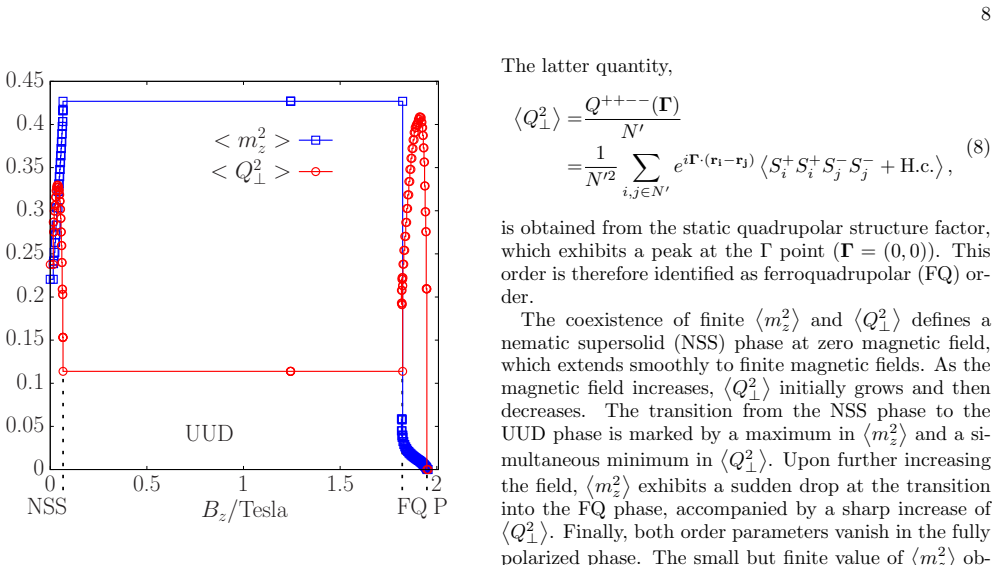
Recent years have witnessed the emergence of spin supersolids in frustrated quantum magnets, establishing a material-based platform for supersolidity beyond its original context in solid helium. A spin supersolid is characterized by the coexistence of longitudinal spin order that breaks lattice translational symmetry and transverse spin order associated with the spontaneous breaking of the spin U(1) symmetry. Extensive experimental investigations, together with advanced numerical studies, have now revealed a coherent and internally consistent picture of these phases, substantially deepening our understanding of supersolidity in quantum magnetic materials. Beyond their fundamental interest as exotic quantum states, potential applications in highly efficient demagnetization cooling have been supported by a giant magnetocaloric effect observed in candidate materials. Moreover, the possible dissipationless spin supercurrents could open promising perspectives for spin transport and spintronic applications. This review summarizes recent progress on emergent spin supersolids in frustrated triangular-lattice quantum antiferromagnets, surveys experimental evidence from thermodynamic and spectroscopic measurements, and compares these results with theoretical studies of minimal models addressing global phase diagrams, ground state properties, and collective excitations. In addition, this review discusses characteristic spin-transport phenomena and outlines future directions for exploring spin supersolids as functional quantum materials.
Editorial analysis
A structured set of objections, weighed in public.
Referee Report
Summary. This review summarizes recent progress on emergent spin supersolids in frustrated triangular-lattice quantum antiferromagnets. It characterizes spin supersolids by the coexistence of longitudinal spin order breaking translational symmetry and transverse order breaking U(1) symmetry, surveys experimental evidence from thermodynamic and spectroscopic measurements on candidate materials, compares these to theoretical studies of minimal models covering global phase diagrams, ground-state properties, and collective excitations, discusses spin-transport phenomena including possible dissipationless supercurrents, and outlines future directions with emphasis on applications such as magnetocaloric cooling.
Significance. If the compiled picture holds, the review is significant for consolidating independent experimental and numerical results into a coherent framework for supersolidity in quantum magnets. It highlights the convergence of data supporting these phases, the observation of giant magnetocaloric effects, and prospects for spintronic applications, thereby serving as a useful reference that deepens understanding without introducing new unverified claims.
minor comments (1)
- The abstract refers to 'candidate materials' without naming primary examples such as specific triangular-lattice compounds; adding one or two explicit names would improve immediate context for readers.
Simulated Author's Rebuttal
We thank the referee for their positive assessment of our review and the recommendation to accept the manuscript. The referee's summary accurately captures the scope, experimental and theoretical synthesis, and potential applications discussed in the work on emergent spin supersolids.
Circularity Check
No significant circularity in this review paper
full rationale
This is a review summarizing independent experimental and numerical literature on spin supersolids without introducing new derivations, equations, fitted parameters, or predictions. All claims reference external studies; no self-definitional reductions, fitted inputs renamed as predictions, or load-bearing self-citation chains exist within the paper itself. The central narrative relies on cited evidence rather than internal construction.
discussion (0)
Sign in with ORCID, Apple, or X to comment. Anyone can read and Pith papers without signing in.