Three-dimensional density and air-rock interface reconstruction with muography: Application to the TianQin tunnel
Pith reviewed 2026-06-28 08:03 UTC · model grok-4.3
The pith
An optimized Metropolis-Hastings algorithm reconstructs sharper three-dimensional density distributions from muon data without auxiliary measurements.
A machine-rendered reading of the paper's core claim, the machinery that carries it, and where it could break.
Core claim
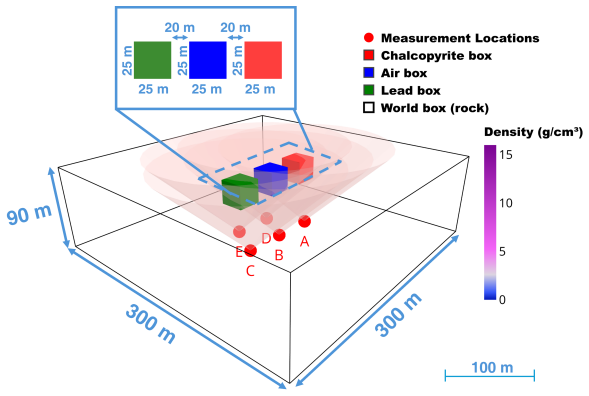
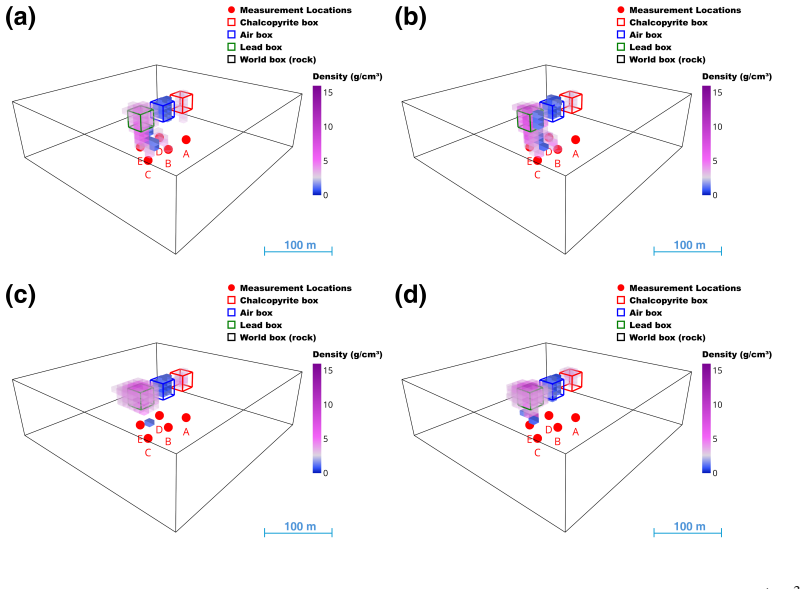
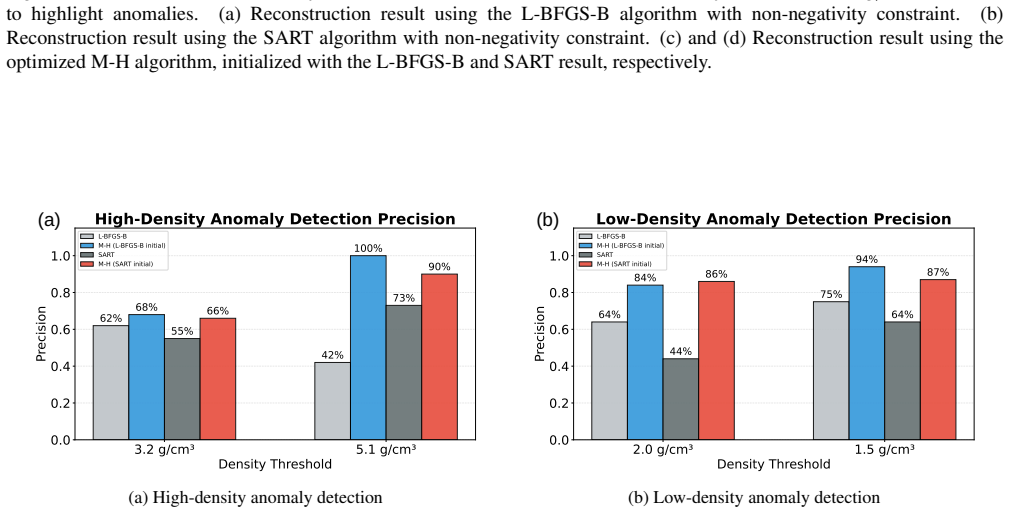
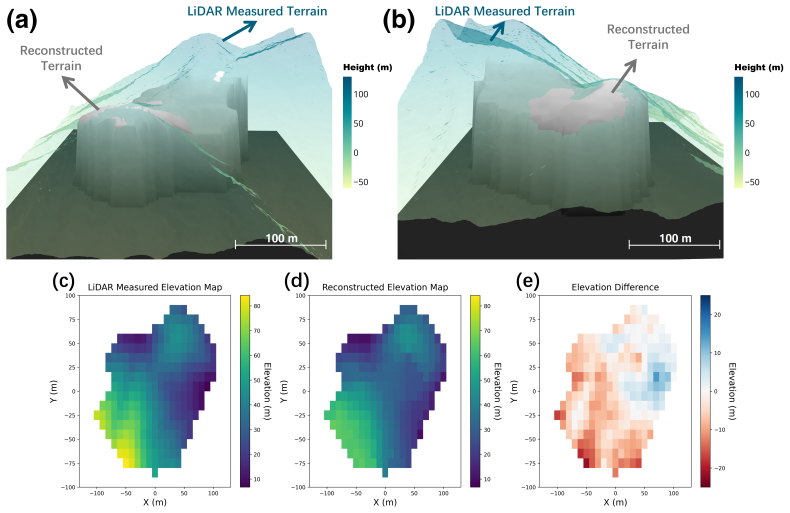
The optimized M-H algorithm mitigates smearing and retrieves sharper, more accurate density distributions without auxiliary data. In simulations, the optimized M-H algorithm improves high-density anomaly detection precision from 42% to 100% at threshold 5.1 g/cm³, with gains of 6% to 42% across other threshold and low-density scenarios. The IDW-reconstructed air-rock interface is validated against LiDAR measurements in the TianQin Tunnel experiment using the MuGrid-v2 detector.
What carries the argument
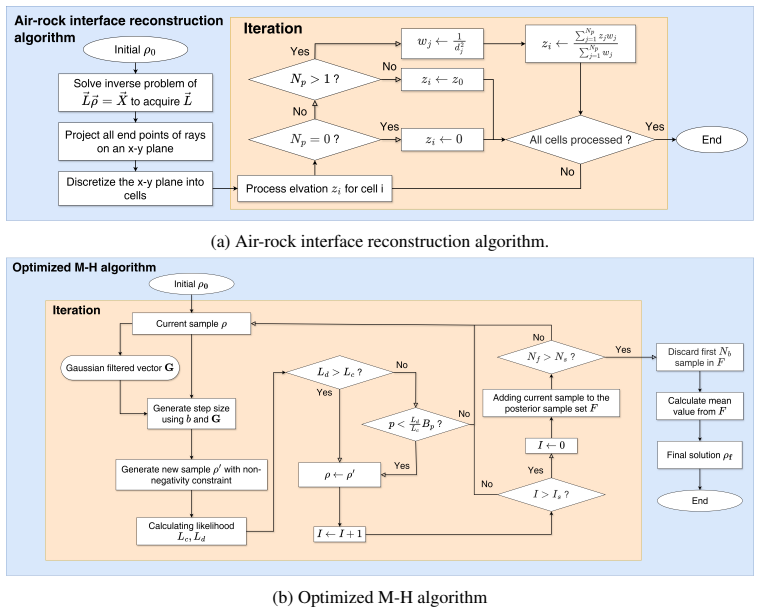
The optimized Metropolis-Hastings (M-H) algorithm for density inversion together with the inverse distance weighting (IDW) approach for air-rock interface reconstruction.
If this is right
- High-density anomalies are recovered at 100 percent precision at the 5.1 g/cm³ threshold in controlled simulations.
- Gains of 6 to 42 percent appear across other density thresholds and low-density cases.
- The IDW interface map matches LiDAR ground truth in the TianQin tunnel field test.
- Reconstructions are obtained from sparse muon data without requiring extra instruments.
Where Pith is reading between the lines
- The method could be tested on other underground sites where only muon detectors are available.
- Time-lapse applications might track density changes if repeated scans are feasible.
- Whether the same gains appear in scattering muography remains open because the paper focuses on transmission data.
Load-bearing premise
Performance gains measured in Monte Carlo simulations with known ground truth will translate to field data from the TianQin tunnel without additional calibration or auxiliary measurements.
What would settle it
Independent density measurements at the TianQin tunnel site that show no reduction in smearing artifacts or no gain in anomaly detection precision relative to standard inversion methods would falsify the central claim.
Figures
read the original abstract
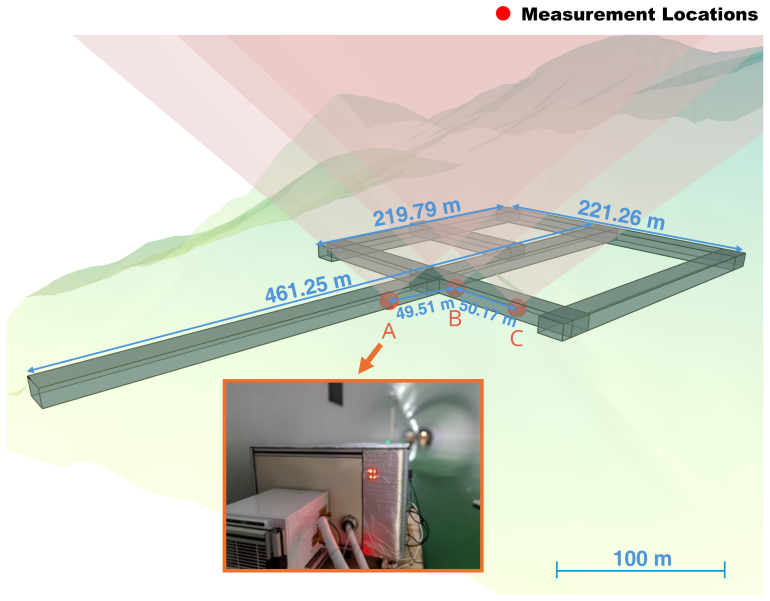
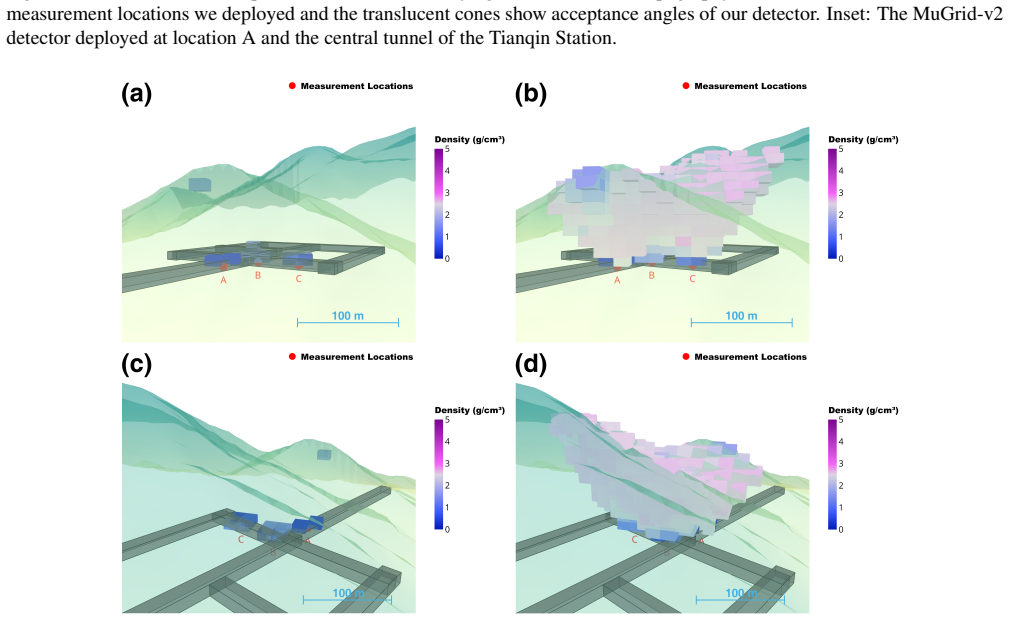
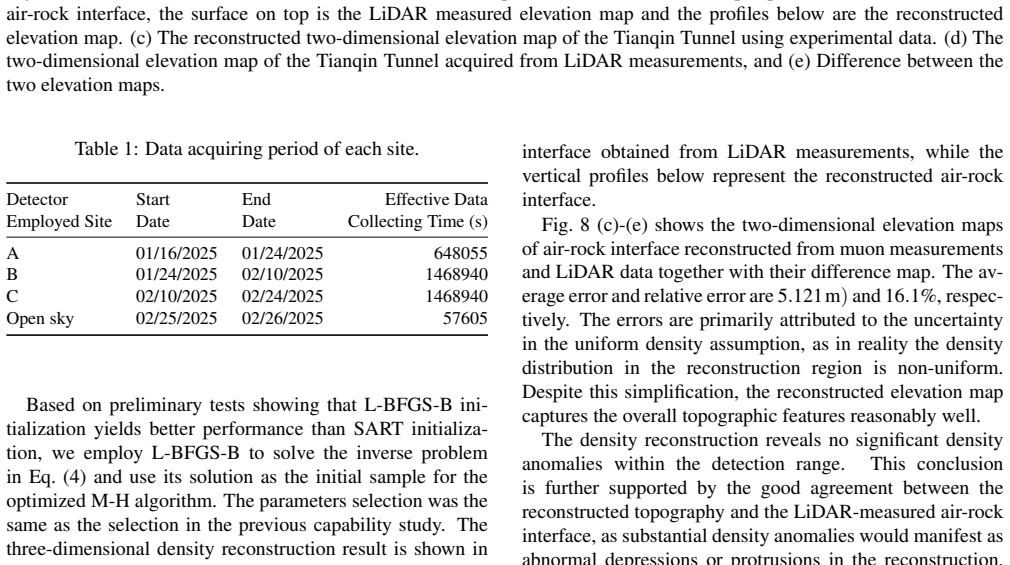
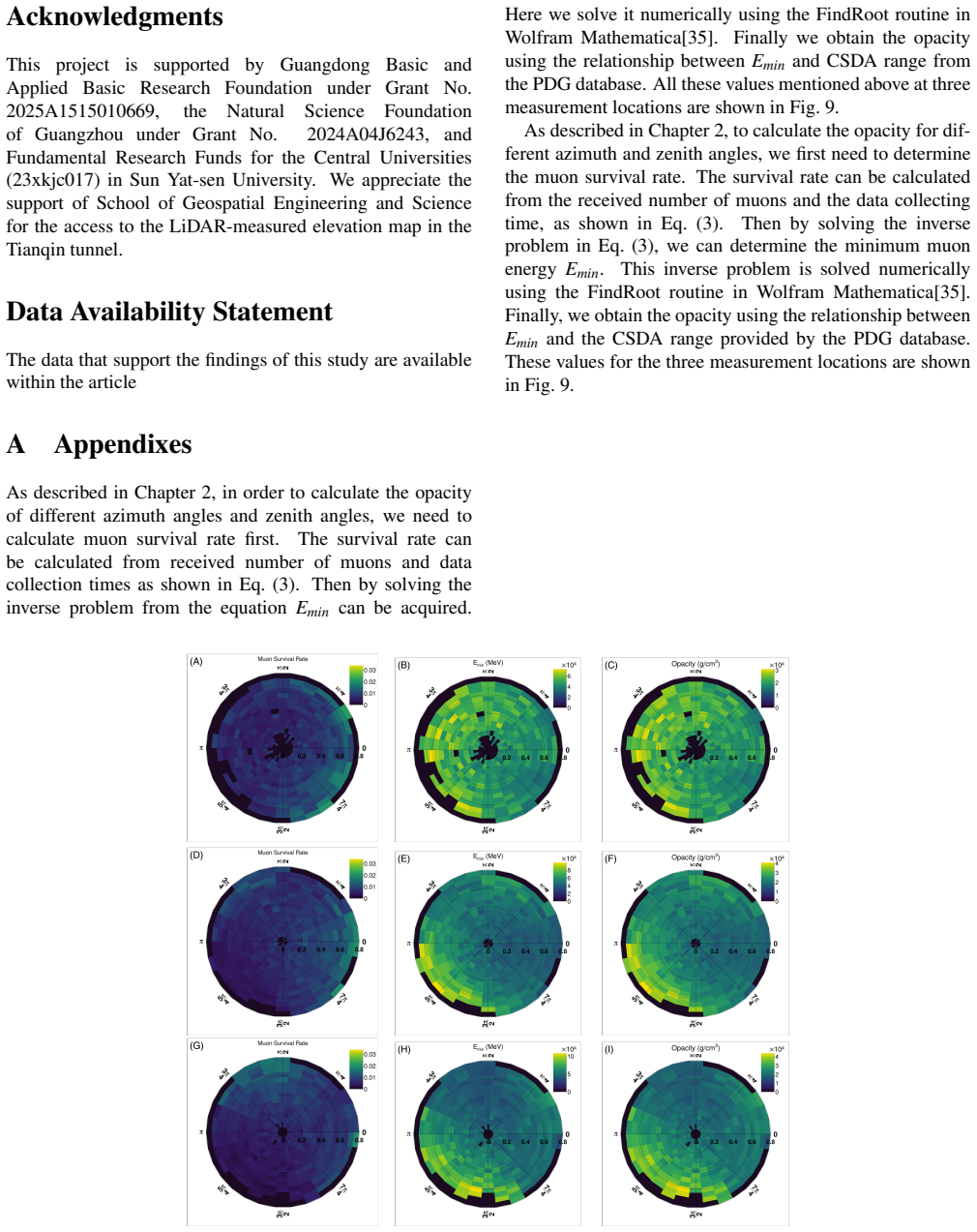
Muography is a non-invasive imaging technique that uses cosmic-ray muons, commonly divided into transmission (absorption) and scattering muography. For transmission muography, the inversion algorithm critically determines reconstruction quality. However, widely used schemes may produce smearing artifacts when measurement locations are limited and data are sparse. We develop an optimized Metropolis--Hastings (M--H) algorithm that mitigates smearing and retrieves sharper, more accurate density distributions without auxiliary data. Additionally, we implement an inverse distance weighting (IDW) approach to reconstruct the air--rock interface from muon measurements. The optimized M--H algorithm is applied in Monte Carlo simulations and applied to field data from the TianQin Tunnel experiment using the MuGrid-v2 detector. The IDW-reconstructed air--rock interface is validated against Light Detection and Ranging (LiDAR) measurements. In simulations, the optimized M--H algorithm improves high-density anomaly detection precision from $42\%$ to $100\%$ at threshold $5.1\,\mathrm{g/cm^3}$, with gains of $6\%$ to $42\%$ across other threshold and low-density scenarios, together with the TianQin Tunnel reconstructions, these results demonstrate the effectiveness of the proposed approach.
Editorial analysis
A structured set of objections, weighed in public.
Referee Report
Summary. The manuscript develops an optimized Metropolis-Hastings (M-H) algorithm for three-dimensional density reconstruction from muon transmission data to reduce smearing in sparse geometries, together with an inverse distance weighting (IDW) method for air-rock interface reconstruction. These are evaluated in Monte Carlo simulations that report precision gains for anomaly detection and are then applied to field data acquired with the MuGrid-v2 detector in the TianQin Tunnel; the IDW interface is compared to LiDAR while the combined results are presented as demonstrating effectiveness of the approach.
Significance. If the simulation-derived precision gains translate to field conditions, the optimized M-H method would offer a practical route to sharper density maps in muography without auxiliary measurements, which could benefit non-invasive geological imaging in tunnels and similar settings.
major comments (2)
- [Abstract] Abstract: the headline claim that the optimized M-H algorithm improves high-density anomaly detection precision from 42% to 100% at 5.1 g/cm³ (with gains of 6–42% in other cases) is quantified exclusively in Monte Carlo simulations that supply known ground truth; the manuscript provides no independent density reference (borehole logs, seismic tomography, or similar) for the TianQin field reconstructions, so the assertion that the method demonstrates effectiveness on real data rests on an untested transferability assumption that is load-bearing for the central claim.
- [Abstract] Abstract: the only external validation reported for the TianQin Tunnel data is the LiDAR comparison for the separate IDW air-rock interface reconstruction; no corresponding cross-check is described for the M-H density anomaly maps, leaving the field-data component of the effectiveness demonstration without direct empirical support.
Simulated Author's Rebuttal
We thank the referee for the constructive comments on the abstract claims. We agree that the quantitative precision gains are shown only in simulations with known ground truth and that the field application lacks an independent density reference. We will revise the abstract to separate these elements and avoid overstating the field-data validation.
read point-by-point responses
-
Referee: [Abstract] Abstract: the headline claim that the optimized M-H algorithm improves high-density anomaly detection precision from 42% to 100% at 5.1 g/cm³ (with gains of 6–42% in other cases) is quantified exclusively in Monte Carlo simulations that supply known ground truth; the manuscript provides no independent density reference (borehole logs, seismic tomography, or similar) for the TianQin field reconstructions, so the assertion that the method demonstrates effectiveness on real data rests on an untested transferability assumption that is load-bearing for the central claim.
Authors: We agree that the reported precision improvements (42% to 100% at 5.1 g/cm³ and 6–42% in other cases) are quantified exclusively via Monte Carlo simulations that provide known ground truth. The TianQin Tunnel section presents an application of the method to real data, with the IDW interface validated by LiDAR, but no independent density reference exists for the M-H reconstructions. We will revise the abstract to explicitly distinguish the simulation-based quantitative results from the field application and remove any implication of direct empirical validation for the density maps on real data. revision: yes
-
Referee: [Abstract] Abstract: the only external validation reported for the TianQin Tunnel data is the LiDAR comparison for the separate IDW air-rock interface reconstruction; no corresponding cross-check is described for the M-H density anomaly maps, leaving the field-data component of the effectiveness demonstration without direct empirical support.
Authors: We concur that the sole external validation for the TianQin data is the LiDAR comparison for the IDW air-rock interface. No independent cross-check (e.g., borehole logs or seismic data) is provided for the M-H density anomaly maps. The field component therefore demonstrates applicability rather than direct validation of the density results. We will revise the abstract wording to reflect this limitation and clarify the scope of the effectiveness claim. revision: yes
Circularity Check
No significant circularity; results rest on external benchmarks
full rationale
The paper reports precision gains exclusively from Monte Carlo simulations that supply independent known ground-truth densities, and validates the separate IDW interface reconstruction against external LiDAR measurements. No equations, fitted parameters, or self-citations are shown to reduce any reported result to a quantity defined by the same inputs. The derivation chain therefore remains self-contained against external benchmarks.
Axiom & Free-Parameter Ledger
free parameters (1)
- density threshold =
5.1 g/cm³
axioms (1)
- domain assumption Muon transmission depends primarily on integrated density along the path, allowing inversion to recover 3D density distributions.
Reference graph
Works this paper leans on
-
[1]
& Zhu, C
Byrd, R., Lu, P., Nocedal, J. & Zhu, C. A Limited Mem- ory Algorithm for Bound Constrained Optimization. SIAM Journal On Scientific Computing.16, 1190-1208 (1995)
1995
-
[2]
& Others 3D Muography for the Search of Hidden Cavities.Scientific Reports.9, 2974 (2019)
Cimmino, L., Baccani, G., Noli, P., Amato, L., Am- brosino, F. & Others 3D Muography for the Search of Hidden Cavities.Scientific Reports.9, 2974 (2019)
2019
-
[3]
& Others TOFPET2: A High-Performance ASIC for Time and Amplitude Measurements of SiPM Signals in Time-of-Flight Applications.Journal Of In- strumentation.11, C03042 (2016)
Francesco, A., Bugalho, R., Oliveira, L., Pacher, L., Rivetti, A. & Others TOFPET2: A High-Performance ASIC for Time and Amplitude Measurements of SiPM Signals in Time-of-Flight Applications.Journal Of In- strumentation.11, C03042 (2016)
2016
-
[4]
& Others 3D Cosmic Ray Muon Tomography from an Underground Tunnel.Pure Appl
Guardincerri, E. & Others 3D Cosmic Ray Muon Tomography from an Underground Tunnel.Pure Appl. Geophys..174, 2133-2141 (2017)
2017
-
[5]
& Others Experimental Detection of Upward Going Cosmic Particles and Consequences for Correction of Density Radiography of V olcanoes
Jourde, K., Gibert, D., Marteau, J., De Bremond d’Ars, J., Gardien, S. & Others Experimental Detection of Upward Going Cosmic Particles and Consequences for Correction of Density Radiography of V olcanoes. Geophysical Research Letters.40, 6334-6339 (2013)
2013
-
[6]
& Slaney, M
Kak, A. & Slaney, M. 7. Algebraic Reconstruction Algorithms.Principles Of Computerized Tomographic Imaging. pp. 275-296 (2001)
2001
-
[7]
& Wang, G
Kak, A., Slaney, M. & Wang, G. Principles of Com- puterized Tomographic Imaging.Medical Physics.29, 107-107 (2002)
2002
-
[8]
& Others Deep Investigation of Muography in Discovering Geological Structures in Mineral Exploration: A Case Study of Za- ozigou Gold Mine.Geophysical Journal International
Liu, G., Yao, K., Niu, F., Li, Z., Tian, H. & Others Deep Investigation of Muography in Discovering Geological Structures in Mineral Exploration: A Case Study of Za- ozigou Gold Mine.Geophysical Journal International. 237, 588-603 (2024)
2024
-
[9]
& Others High-Precision Muography in Archaeogeophysics: A Case Study on Xi’an Defensive Walls.Journal Of Applied Physics.133, 014901 (2023)
Liu, G., Luo, X., Tian, H., Yao, K., Niu, F. & Others High-Precision Muography in Archaeogeophysics: A Case Study on Xi’an Defensive Walls.Journal Of Applied Physics.133, 014901 (2023)
2023
-
[10]
& Others Progress of the TianQin Project
Luo, J., Bai, S., Bai, Y ., Cai, L., Dang, H. & Others Progress of the TianQin Project. (arXiv,2025)
2025
-
[11]
& Others The TianQin Project: Current Progress on Science and Technology.Progress Of Theoretical And Experimental Physics.2021, 05A107 (2021)
Mei, J., Bai, Y ., Bao, J., Barausse, E., Cai, L. & Others The TianQin Project: Current Progress on Science and Technology.Progress Of Theoretical And Experimental Physics.2021, 05A107 (2021)
2021
-
[12]
Algorithm 778: L-BFGS-B: Fortran Subroutines for Large-Scale Bound Constrained Optimization
Morales, J. & Nocedal, J. Remark on “Algorithm 778: L-BFGS-B: Fortran Subroutines for Large-Scale Bound Constrained Optimization”.ACM Trans. Math. Softw..38, 7:1-7:4 (2011)
2011
-
[13]
& Ishida, K
Nagamine, K., Iwasaki, M., Shimomura, K. & Ishida, K. Method of Probing Inner-Structure of Geophysical Substance with the Horizontal Cosmic-Ray Muons and Possible Application to V olcanic Eruption Prediction. Nuclear Instruments And Methods In Physics Research Section A: Accelerators, Spectrometers, Detectors And Associated Equipment.356, 585-595 (1995)
1995
-
[14]
& Hanafusa, H
Nakamura, Y . & Hanafusa, H. Inverse Kinematic Solu- tions With Singularity Robustness for Robot Manipu- lator Control.Journal Of Dynamic Systems, Measure- ment, And Control.108, 163-171 (1986)
1986
-
[15]
& Maekawa, T
Nishiyama, R., Miyamoto, S., Okubo, S., Oshima, H. & Maekawa, T. 3D Density Modeling with Gravity and Muon-Radiographic Observations in Showa-Shinzan Lava Dome, Usu, Japan.Pure And Applied Geophysics. 174, 1061-1070 (2017)
2017
-
[16]
& Others Bedrock Sculpting under an Active Alpine Glacier Revealed from Cosmic-Ray Muon Ra- diography.Scientific Reports.9, 6970 (2019)
Nishiyama, R., Ariga, A., Ariga, T., Lechmann, A., Mair, D. & Others Bedrock Sculpting under an Active Alpine Glacier Revealed from Cosmic-Ray Muon Ra- diography.Scientific Reports.9, 6970 (2019)
2019
-
[17]
& Others First Measurement of Ice-Bedrock Interface of Alpine Glaciers by Cosmic Muon Radio- graphy.Geophysical Research Letters.44, 6244-6251 (2017)
Nishiyama, R., Ariga, A., Ariga, T., Käser, S., Lech- mann, A. & Others First Measurement of Ice-Bedrock Interface of Alpine Glaciers by Cosmic Muon Radio- graphy.Geophysical Research Letters.44, 6244-6251 (2017)
2017
-
[18]
& Maekawa, T
Nishiyama, R., Tanaka, Y ., Okubo, S., Oshima, H., Tanaka, H. & Maekawa, T. Integrated Processing of Muon Radiography and Gravity Anomaly Data toward the Realization of High-resolution 3-D Density Struc- tural Analysis of V olcanoes: Case Study of Showa- Shinzan Lava Dome, Usu, Japan.Journal Of Geophys- ical Research: Solid Earth.119, 699-710 (2014)
2014
-
[19]
Review of Particle Physics.Chinese Physics C.38, 090001 (2014)
Olive, K. Review of Particle Physics.Chinese Physics C.38, 090001 (2014)
2014
-
[20]
& Zurlo, N
Pagano, D., Bonomi, G., Donzella, A., Zenoni, A., Zumerle, G. & Zurlo, N. EcoMug: An Efficient COs- mic MUon Generator for Cosmic-Ray Muon Appli- cations.Nuclear Instruments And Methods In Physics Research Section A: Accelerators, Spectrometers, De- tectors And Associated Equipment.1014pp. 165732 (2021)
2021
-
[21]
Cosmic Rays Measure Overburden of Tunnel
P, G. Cosmic Rays Measure Overburden of Tunnel. Commonwealth Engineer.455(1955)
1955
-
[22]
& Others 3D Imaging of a Nuclear Reactor Using Muography Measurements.Science Advances.9, eabq8431 (2023)
Procureur, S., Attié, D., Gallego, L., Gomez, H., Gonzales, P. & Others 3D Imaging of a Nuclear Reactor Using Muography Measurements.Science Advances.9, eabq8431 (2023)
2023
-
[23]
& Others Three-Dimensional Computational Axial Tomography Scan of a V olcano with Cosmic Ray Muon 12 Radiography.Journal Of Geophysical Research: Solid Earth.115(2010)
Tanaka, H., Taira, H., Uchida, T., Tanaka, M., Takeo, M. & Others Three-Dimensional Computational Axial Tomography Scan of a V olcano with Cosmic Ray Muon 12 Radiography.Journal Of Geophysical Research: Solid Earth.115(2010)
2010
-
[24]
& Others SciPy 1.0: Fundamental Algorithms for Scientific Computing in Python.Nature Methods.17, 261-272 (2020)
Virtanen, P., Gommers, R., Oliphant, T., Haberland, M., Reddy, T. & Others SciPy 1.0: Fundamental Algorithms for Scientific Computing in Python.Nature Methods.17, 261-272 (2020)
2020
-
[25]
Manipulator Inverse Kinematic Solutions Based on Vector Formulations and Damped Least- Squares Methods.Systems, Man And Cybernetics, IEEE Transactions On.16pp
Wampler, C. Manipulator Inverse Kinematic Solutions Based on Vector Formulations and Damped Least- Squares Methods.Systems, Man And Cybernetics, IEEE Transactions On.16pp. 93-101 (1986)
1986
-
[26]
& Others MuGrid-v2: A Novel Scintillator Detector for Multi- disciplinary Applications.Journal Of Applied Physics
Yu, T., Ning, Y ., Yuan, Y ., Zhao, S., Qi, S. & Others MuGrid-v2: A Novel Scintillator Detector for Multi- disciplinary Applications.Journal Of Applied Physics. 138, 024501 (2025)
2025
-
[27]
& Nocedal, J
Zhu, C., Byrd, R., Lu, P. & Nocedal, J. Algorithm 778: L-BFGS-B: Fortran Subroutines for Large-Scale Bound-Constrained Optimization.ACM Trans. Math. Softw..23, 550-560 (1997)
1997
-
[28]
& Teasdale, M
Borozdin, K., Hogan, G., Morris, C., Priedhorsky, W., Saunders, A., Schultz, L. & Teasdale, M. Radiographic Imaging with Cosmic-Ray Muons.Nature.422, 277- 277 (2003)
2003
-
[29]
& Others Muon Tomography in Geoscientific Research – A Guide to Best Practice.Earth-Science Reviews.222pp
Lechmann, A., Mair, D., Ariga, A., Ariga, T., Eredi- tato, A. & Others Muon Tomography in Geoscientific Research – A Guide to Best Practice.Earth-Science Reviews.222pp. 103842 (2021)
2021
-
[30]
& Coutant, O
Lesparre, N., Gibert, D., Marteau, J., Komorowski, J., Nicollin, F. & Coutant, O. Density Muon Radiography of La Soufrière of Guadeloupe V olcano: Compari- son with Geological, Electrical Resistivity and Gravity Data.Geophysical Journal International.190, 1008- 1019 (2012)
2012
-
[31]
& Gibert, D
Rosas-Carbajal, M., Jourde, K., Marteau, J., Deroussi, S., Komorowski, J. & Gibert, D. Three-Dimensional Density Structure of La Soufrière de Guadeloupe Lava Dome from Simultaneous Muon Radiographies and Gravity Data.Geophysical Research Letters.44, 6743- 6751 (2017)
2017
-
[32]
& Others Three-Dimensional Muon Imaging of Cavities inside the Temperino Mine (Italy).Scientific Reports.12, 22329 (2022)
Borselli, D., Beni, T., Bonechi, L., Bongi, M., Broc- chini, D. & Others Three-Dimensional Muon Imaging of Cavities inside the Temperino Mine (Italy).Scientific Reports.12, 22329 (2022)
2022
-
[33]
Zur theorie des durchgangs schneller kor- puskularstrahlen durch materie.Annalen Der Physik
Bethe, H. Zur theorie des durchgangs schneller kor- puskularstrahlen durch materie.Annalen Der Physik. 397, 325-400 (1930)
1930
-
[34]
(2025), http://pdg.lbl.gov/2025/AtomicNuclearProperties/index.html, Accessed: 2026-02-15
Particle Data Group PDG Live: Atomic and Nuclear Properties of Materials. (2025), http://pdg.lbl.gov/2025/AtomicNuclearProperties/index.html, Accessed: 2026-02-15
2025
-
[35]
Mathematica, Version 14.0
Wolfram Research, I. Mathematica, Version 14.0. (2024), https://www.wolfram.com/mathematica, Com- puter software
2024
-
[36]
& Others Review of Particle Physics
Group, P., Tanabashi, M., Hagiwara, K., Hikasa, K., Nakamura, K. & Others Review of Particle Physics. Physical Review D.98, 030001 (2018)
2018
-
[37]
& Others Geant4—a Simulation Toolkit
Agostinelli, S., Allison, J., Amako, K., Apostolakis, J., Araujo, H. & Others Geant4—a Simulation Toolkit. Nuclear Instruments And Methods In Physics Research Section A: Accelerators, Spectrometers, Detectors And Associated Equipment.506, 250-303 (2003) 13
2003
discussion (0)
Sign in with ORCID, Apple, or X to comment. Anyone can read and Pith papers without signing in.