REVIEW 4 major objections 7 minor 36 references
Fate of gapless edge states in two-dimensional topological insulators with Hatsugai-Kohmoto interaction
T0 review · 4 major / 7 minor · reviewed 2026-08-10 · deepseek-v4-flash
Pith's one-line read This paper argues that any finite Hatsugai-Kohmoto interaction opens a charge gap in the edge-state spectrum of both the Kane-Mele and spinful Haldane models on a zigzag ribbon, while the edge-localized character survives until edge and…
desk verdict A solid, honest ED-plus-effective-model study of H-K interacting ribbons whose central 'any finite U' claim outruns what the numerics and the effective model actually support. read the letter →
The pith
A machine-rendered reading of the paper's core claim, the machinery that carries it, and where it could break.
The reading
What carries the argument
The load-bearing object is the Hatsugai-Kohmoto interaction, an infinite-range two-particle interaction that conserves the center of mass: in the mixed $k_x$/site basis used here it couples only states with the same $k_x$ and generates correlated hopping across the width of the ribbon. Its non-local character produces a direct coupling between the two edge-localized modes whose strength falls off as a power law of the ribbon width, while ordinary edge-mode overlap decays exponentially. The argument is carried by an effective two-site model of the two edge modes, whose two-electron Hamiltonian matrices in Appendix B yield single-particle Green's-function poles that match the full ribbon spectra, including the different gap sizes and the survival of spin edge modes.
What would settle it
Compute the full ribbon spectrum, not the truncated two-edge effective model, for the spinful Haldane model at a fixed small $U=0.05$ for ribbons with widths $N=6,10,14,18$, and track the lowest charge excitation at $k_x=\pi$; if the gap extrapolates to zero with increasing width, or if a gapless crossing survives at any $k_x$, then the claim that any finite $U$ opens a charge gap is false.
Extended reading notes
Core claim
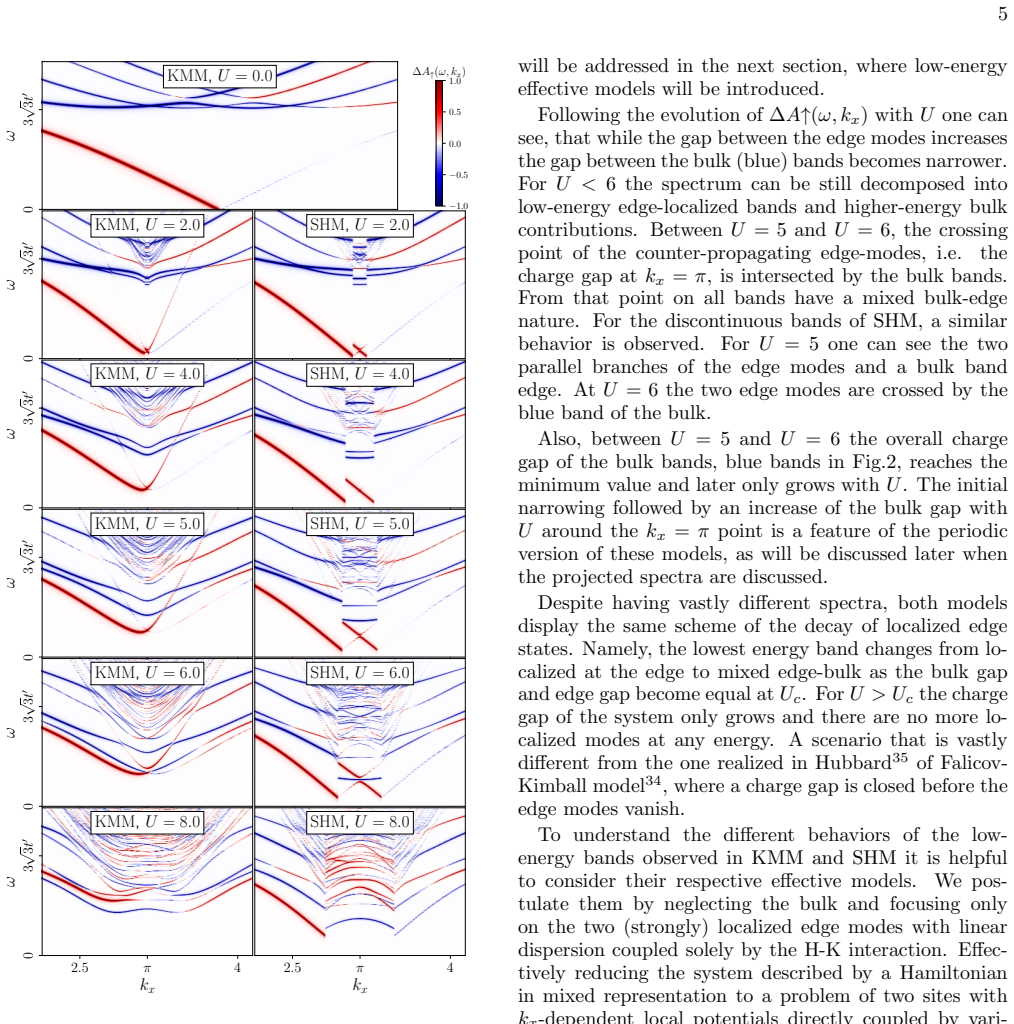
On a zigzag graphene nanoribbon with ten sites across ($t=1$, $t'=0.2$), exact diagonalization shows that in either model the Hatsugai-Kohmoto interaction immediately removes the Fermi-level crossing of the single-particle edge modes: even at $U=2$ the counter-propagating edge branches avoid crossing and a charge gap proportional to $U$ opens. The gapped edge modes remain edge-localized up to $U$ between 5 and 6, where bulk bands intersect them at $k_x=\pi$ and the low-energy modes become mixed edge-bulk objects; above that, no localized edge bands remain. An effective two-site model retaining only the two linearly dispersing edge modes and their Hatsugai-Kohmoto couplings reproduces the qualitative spectra and explains the model difference: the charge gap in the spinful Haldane model is narrower by a factor of $\sqrt{3}$, its gapped edge modes stay linear-massless, and its high-spin ground-state sector produces a flat, gapless spin-excitation branch for all $U$, whereas the Kane-Mele model develops parabolic-massive edge modes and gapless spin excitations only for weak $U$. In the periodic versions, the inter-sublattice spin-exchange terms of the full Hatsugai-Kohmoto interaction keep the $K/K'$ ground state of the Kane-Mele model non-degenerate for any $U$, so the spin-Chern number is never fully suppressed; the spinful Haldane Chern state instead ceases to exist above $U_c \approx 5.66$. Because the $U_c$ from the periodic models coincides with the onset of edge-bulk hybridization in the ribbon, the paper concludes that the bulk-boundary correspondence here manifests as hybridization at a topological transition without spectral-gap closing.
Load-bearing premise
The conclusion that a charge gap opens for arbitrarily small interaction assumes that the only important coupling between the two edges comes directly from the Hatsugai-Kohmoto interaction, and that tunneling through the bulk can be ignored at every ribbon width.
Editorial extensions
If this is right
- For both the Kane-Mele and spinful Haldane models on zigzag ribbons, any finite Hatsugai-Kohmoto strength $U$ opens a charge gap at the Fermi level, eliminating the gapless charged edge conductance of the non-interacting topological insulator.
- The edge-localized character of the low-energy modes persists up to $U_c \approx 5$-$6$ (for $t'=0.2$); beyond that the modes hybridize with bulk bands and no localized edge bands remain.
- Gapless spin edge excitations can coexist with the charge gap: in the spinful Haldane model they survive for every $U$, while in the Kane-Mele model they survive only for weak $U$ before becoming massive.
- In the periodic lattice, the full Hatsugai-Kohmoto interaction leaves the $K/K'$ ground state of the Kane-Mele model non-degenerate for any $U$, so the spin-Chern number is not completely destroyed, whereas the spinful Haldane Chern insulator loses its integer invariant above $U_c \approx 5.66$.
- The topological phase transition in the periodic models, which occurs without closing the spectral gap, corresponds in the ribbon to the onset of edge-bulk hybridization rather than to the disappearance of edge states.
Reading between the lines
- Because the Hatsugai-Kohmoto edge-edge coupling is a power law while edge-mode penetration is exponential, the charge gap in the effective model scales as $U/N$; this suggests that at a fixed small $U$ the gap closes in the thermodynamic limit, so the 'any finite $U$' claim would manifest as a finite-size effect in wide ribbons rather than as a gap in the infinite system.
- If the mechanism is generic to infinite-range, center-of-mass-conserving interactions, one would expect similar charge-gap opening in other topological boundary geometries and other Hatsugai-Kohmoto-type models, but the fate of the spin edge modes would depend on where the symmetry places the edge states, as the Kane-Mele versus spinful Haldane comparison shows.
- A testable extension would be to measure the single-particle spectral function of a finite topological ribbon with controlled long-range interactions: the predicted signature is an avoided crossing of the edge branches at $k_x=\pi$ whose splitting grows linearly with $U$, while spin-flip spectral weight stays pinned to zero energy in the broken-time-reversal model.
Editorial analysis
A structured set of objections, weighed in public.
Referee Report
Summary. This manuscript studies the fate of the gapless edge states of the Kane-Mele (KMM) and spinful Haldane (SHM) models on a zigzag graphene nanoribbon when the Hatsugai-Kohmoto (H-K) interaction, an infinite-range center-of-mass-conserving two-particle interaction, is added. Exact diagonalization for a 10-site-wide ribbon at half-filling shows a charge gap in the edge spectrum for U ≥ 2 in both models, with gapless local spin excitations surviving in certain regimes. To explain these spectra, the authors introduce two-site effective models (Sec. IV, Eqs. 12–14) that keep only the two edge-localized modes, solve the two-electron problem exactly in Appendix B, and obtain closed-form charge gaps of 7U/16 (KMM) and U/4 (SHM). They argue that any finite U opens a charge gap for any ribbon width, that the difference between the two models follows from the symmetry-distinct spin structure of their edge modes, and that the interaction-driven breakdown of the topological invariant in the periodic models (Uc ≈ 5.66 at t' = 0.2) coincides with the onset of edge-bulk hybridization in the ribbon. The abstract's headline claim is that any finite interaction strength U suffices to open a charge gap in either model, together with a proposed example of bulk-boundary correspondence without spectral gap closing.
Significance. If the central claims hold, the paper makes a substantive contribution: it identifies an interaction type that gapes the edge channels of two-dimensional topological insulators at infinitesimal coupling, and it shows that the sublattice-off-diagonal (spin-exchange) part of the H-K interaction, often dropped in previous work, plays a decisive role. The paper's genuine strengths are its parameter-free effective models, which reproduce the qualitative KMM-SHM differences (the narrower SHM gap, the parabolic versus linear massive dispersion, the √3 gap ratio) without any fitting; the exact closed-form two-electron solutions in Appendix B; and the clear ED spectra at several values of U for N = 10. The proposed link between the periodic-model degeneracy scale Uc and the ribbon hybridization onset is concrete and falsifiable. That said, the headline claim currently outruns the evidence: the numerics cover one width and U ≥ 2 only, and the width dependence of the gap is stated inconsistently in the text, as detailed below.
major comments (4)
- [Sec. IV / Appendix B / Abstract] The central claim of the abstract relies on a width-scaling statement that is internally inconsistent. The effective Hamiltonians (12)–(14) contain no ribbon width, and the closed-form gaps of Appendix B, 7U/16 for the KMM and U/4 for the SHM, are independent of the width N. Nevertheless, Sec. IV states that the effective-model analysis gives a charge gap ∝ U/N and uses this to argue that gapless edge modes are unstable for any finite width of the ribbon. If the gap scales as U/N, it vanishes at fixed U as N grows, and the abstract's assertion that any finite interaction strength U is sufficient to open a charge gap is at most a finite-size statement; if the N-independent effective-model gaps are the physical ones, then the width dependence is uncharacterized and the extrapolation to much larger systems (Sec. VIII) is unsupported. The manuscript must resolve which scaling it claims and provide supporting evidence, otherwise the headline result cannot be evaluated.
- [Sec. III–IV] The any-finite-U claim is an extrapolation from a single width and from U values that never approach the U → 0 limit. The ED spectra in Figs. 2 and 4 are for N = 10 sites across the ribbon and for U ≥ 2, and the U = 0 panel of Fig. 2 itself shows a weak inter-edge tunneling band that the authors attribute to the small ribbon width. The effective-model argument for an infinitesimal-U gap presumes that the two-state projection of Sec. IV spans the low-energy subspace as U → 0, but the matrix element of the full interaction (Eq. 7) between the two degenerate edge modes at kx = π is never computed, and the clear separation of energy scales between the edge and the bulk excitations invoked in Sec. IV is not established in the small-U regime. A first-order perturbation calculation or ED data below U = 2 for at least a second width is needed before the U → 0 behavior can be claimed.
- [Sec. IV] The neglect of bulk-mediated inter-edge tunneling is asserted, not demonstrated. Sec. IV justifies the two-mode projection by saying that the edge modes decay exponentially with ribbon width while the direct H-K inter-edge coupling has a power-law dependence, but the full H-K interaction in Eq. (7) couples all transverse coordinates y1...y4 with a prefactor U/(4N), so processes passing through bulk states can contribute to the effective inter-edge coupling at the same order in U. The issue is load-bearing because the contested 1/N suppression quoted in Sec. IV would plausibly arise precisely from bulk-mediated or normalization effects, so keeping one mechanism while dropping the other is inconsistent. Computing the projection of Eq. (7) onto the exact non-interacting edge wavefunctions, or running ED for at least two additional widths, would settle which scaling the full model actually follows.
- [Sec. V] The self-admitted failure of the effective model in the small-U regime weakens its use for the headline claim. Sec. V states that for the KMM the effective model proves to be insufficient to explain the gapless spin-excitations for U < 4 because it neglects the sublattice structure at each edge. This is the same weak-coupling regime in which the effective model is used to conclude that a charge gap opens for any finite U. If the two-edge-mode projection misses qualitative physics below U = 4, its prediction of the U → 0 charge gap requires additional justification; at minimum, this limitation should be disclosed wherever the any-finite-U claim is made.
minor comments (7)
- [Fig. 2 caption] The caption reads 'varying form the non-interacting (top)'; 'form' should be 'from'.
- [Sec. I] The word 'bulk-boundary correpsondece' is misspelled; it should read 'bulk-boundary correspondence'.
- [Sec. III] The 'former' and 'latter' of the two conditions for gapless edge modes appear to be reversed: the odd number of unit cells across ensures discrete translation invariance in y, while the wide-enough condition ensures that the overlap between edge modes is weak.
- [Sec. VI] For t' = 0.2, the statement that the SHM ground state jumps to the triple-degenerate subspace for U ≥ 12√3 t' gives a threshold of about 4.16, which is smaller than the quoted Uc ≈ 5.66 for the same model with full interaction; the relation between these two critical scales should be clarified.
- [Sec. II and Appendix A] The symbol N is used both for the number of sites across the ribbon (Sec. III gives 'N = 10 sites (5 two-site unit cells)') and for the number of unit cells in the H-K normalization used in Eq. (7) and Appendix A; please disambiguate the notation.
- [Sec. VII / Abstract] The abstract's claim of providing an example of the bulk-boundary correspondence is stronger than the acknowledged uncertainty in Sec. VII, where the authors state that it is not possible to confirm it with absolute certainty; the abstract should be aligned with this caveat.
- [Fig. 3 caption] The phrase 'the 3 k mode' is used without definition in the caption; please define this notation explicitly.
Circularity Check
No significant circularity: the gap-opening result is derived from the noninteracting edge modes plus the H-K interaction; self-citations are background only.
full rationale
The paper's central claim—that any finite U opens a charge gap in the edge spectrum—is an extrapolation from exact diagonalization (N=10, U≥2) and from an effective two-edge-mode model (Sec. IV, Eqs. 12–14). The effective interaction term Eq. (14) is obtained by projecting the H-K Hamiltonian (Eq. 7) onto the noninteracting edge modes; no parameter is fitted to the interacting ED data, and the two-electron spectra in Appendix B are solved directly from those Hamiltonians. The calculation is therefore self-contained: the gap is an output, not an input. Self-citations (Refs. 12, 26, 27, 34) are used as background or analogy (e.g., the H-K dimer's spin preference, periodic-model phenomenology) and are not the load-bearing step; the gap-opening conclusion does not reduce to any of these citations. The main weaknesses are evidentiary rather than circular: the effective model drops bulk-mediated inter-edge tunneling and has no width dependence, while the text also quotes a gap ∝ U/N that vanishes as N grows, and the ED does not probe U→0. These are uncontrolled-extrapolation/correctness concerns, not cases where the prediction is equivalent to its inputs by construction. No fitted parameter is renamed as a prediction and no self-citation chain forces the result.
Assumptions & free parameters
free parameters (2)
- t' (next-nearest-neighbor hopping) =
0.2 t
- Ribbon width N_y =
5 unit cells (10 sites across)
assumptions (4)
- domain assumption The mixed-basis form of the H-K interaction, Eq. (7), including the gauge phase f(y1,y2,y3,y4), is the correct representation on a zigzag ribbon.
- ad hoc to paper Only the two edge-localized modes matter for the low-energy gap; bulk modes and bulk-mediated inter-edge tunneling are negligible.
- domain assumption Ground-state degeneracy in the periodic model is a valid proxy for the integer topological invariant.
- ad hoc to paper A 10-site-wide ribbon is wide enough to represent the edge-state physics of wider ribbons.
Cite this review
Pith. "Pith review of Fate of gapless edge states in two-dimensional topological insulators with Hatsugai-Kohmoto interaction." pith.science (2026). https://pith.science/paper/RDG3ZHNZ
@misc{pith2026250104395,
  author       = {Pith},
  title        = {Pith review of: Fate of gapless edge states in two-dimensional topological insulators with Hatsugai-Kohmoto interaction},
  year         = {2026},
  howpublished = {\url{https://pith.science/paper/RDG3ZHNZ}},
  note         = {Machine review of arXiv:2501.04395}
}
abstract
Topologically protected edge states are the highlight feature of an interface between non-equivalent insulators. The robustness/sensitivity of these states to local single-particle perturbations is well understood, while their stability in the presence of various types of two-particle interactions remains unclear. To add to previous discussions of the Hubbard and unscreened Coulomb interactions, we address this problem from the point of view of infinite-range Hatsugai-Kohmoto interaction. Based on our numerical results for two models of Chern insulators, the Kane-Mele and spinful Haldane model, on a ribbon geometry with zig-zag edges, we argue that any finite interaction strength $U$ is sufficient to open a charge gap in the spectrum of either Chern insulator. We explain the differences between the two cases and present how their edge states phase out as the system enters the strongly correlated phase. We show that the closing of the many-body gap in periodic variants of these models can be connected to the onset of hybridization between the edge and bulk modes in finite geometries. Providing an example of the bulk-boundary correspondence in systems where there is a topological phase transition without closing of the spectral gap.
Figures


Figures from the paper (4 more)


Reference graph
Works this paper leans on
-
[1]
author author B. I. \ Halperin ,\ https://doi.org/10.1103/PhysRevB.25.2185 journal journal Phys. Rev. B \ volume 25 ,\ pages 2185 ( year 1982 ) NoStop
-
[2]
author author F. D. M. \ Haldane ,\ https://doi.org/10.1103/PhysRevLett.61.2015 journal journal Phys. Rev. Lett. \ volume 61 ,\ pages 2015 ( year 1988 ) NoStop
-
[3]
author author C. L. \ Kane \ and\ author E. J. \ Mele ,\ https://doi.org/10.1103/PhysRevLett.95.146802 journal journal Phys. Rev. Lett. \ volume 95 ,\ pages 146802 ( year 2005 a ) NoStop
-
[4]
author author R. A. \ Niyazov , author D. N. \ Aristov ,\ and\ author V. Y. \ Kachorovskii ,\ journal journal npj Computational Materials \ volume 6 ,\ https://doi.org/10.1038/s41524-020-00442-z 10.1038/s41524-020-00442-z ( year 2020 ) NoStop
-
[5]
author author M. R. \ Zirnbauer ,\ https://doi.org/10.1063/1.531675 journal journal Journal of Mathematical Physics \ volume 37 ,\ pages 4986 ( year 1996 ) ,\ https://arxiv.org/abs/https://pubs.aip.org/aip/jmp/article-pdf/37/10/4986/19056249/4986\_1\_online.pdf https://pubs.aip.org/aip/jmp/article-pdf/37/10/4986/19056249/4986\_1\_online.pdf NoStop
doi:10.1063/1.531675 1996
-
[6]
author author P. Heinzner , author A. Huckleberry ,\ and\ author M. Zirnbauer ,\ journal journal Communications in Mathematical Physics \ volume 257 ,\ https://doi.org/10.1007/s00220-005-1330-9 10.1007/s00220-005-1330-9 NoStop
-
[7]
author author Z. Wang \ and\ author S.-C. \ Zhang ,\ https://doi.org/10.1103/PhysRevX.2.031008 journal journal Phys. Rev. X \ volume 2 ,\ pages 031008 ( year 2012 ) NoStop
-
[8]
author author Z. Wang \ and\ author S.-C. \ Zhang ,\ https://doi.org/10.1103/PhysRevX.4.011006 journal journal Phys. Rev. X \ volume 4 ,\ pages 011006 ( year 2014 ) NoStop
Show all 36 references
-
[9]
Wang , author X.-L
author author Z. Wang , author X.-L. \ Qi ,\ and\ author S.-C. \ Zhang ,\ https://doi.org/10.1103/PhysRevLett.105.256803 journal journal Phys. Rev. Lett. \ volume 105 ,\ pages 256803 ( year 2010 ) NoStop
2010 doi
-
[10]
Blason \ and\ author M
author author A. Blason \ and\ author M. Fabrizio ,\ https://doi.org/10.1103/PhysRevB.108.125115 journal journal Phys. Rev. B \ volume 108 ,\ pages 125115 ( year 2023 ) NoStop
2023 doi
-
[11]
Wagner , author L
author author N. Wagner , author L. Crippa , author A. Amaricci , author P. Hansmann , author M. Klett , author E. J. \ König , author T. Schäfer , author D. D. \ Sante , author J. Cano , author A. J. \ Millis , author A. Georges ,\ and\ author G. Sangiovanni ,\ journal journa...
-
[12]
author author M. M. \ Wysoki n \' n ski \ and\ author W. Brzezicki ,\ https://doi.org/10.1103/PhysRevB.108.035121 journal journal Phys. Rev. B \ volume 108 ,\ pages 035121 ( year 2023 ) NoStop
2023 doi
-
[13]
Mai , author J
author author P. Mai , author J. Zhao , author T. A. \ Maier , author B. Bradlyn ,\ and\ author P. W. \ Phillips ,\ https://doi.org/10.1103/PhysRevB.110.075105 journal journal Phys. Rev. B \ volume 110 ,\ pages 075105 ( year 2024 ) NoStop
-
[14]
Xu \ and\ author J
author author C. Xu \ and\ author J. E. \ Moore ,\ https://doi.org/10.1103/PhysRevB.73.045322 journal journal Phys. Rev. B \ volume 73 ,\ pages 045322 ( year 2006 ) NoStop
2006 doi
-
[15]
author author J. C. Y. \ Teo \ and\ author C. L. \ Kane ,\ https://doi.org/10.1103/PhysRevB.79.235321 journal journal Phys. Rev. B \ volume 79 ,\ pages 235321 ( year 2009 ) NoStop
2009 doi
-
[16]
\ Chung , author D.-H
author author C.-H. \ Chung , author D.-H. \ Lee ,\ and\ author S.-P. \ Chao ,\ https://doi.org/10.1103/PhysRevB.90.035116 journal journal Phys. Rev. B \ volume 90 ,\ pages 035116 ( year 2014 ) NoStop
2014 doi
-
[17]
Zarea , author C
author author M. Zarea , author C. B\"usser ,\ and\ author N. Sandler ,\ https://doi.org/10.1103/PhysRevLett.101.196804 journal journal Phys. Rev. Lett. \ volume 101 ,\ pages 196804 ( year 2008 ) NoStop
2008 doi
-
[18]
author author E. W. \ Huang , author G. L. \ Nave ,\ and\ author P. W. \ Phillips ,\ https://doi.org/10.1038/s41567-022-01529-8 journal journal Nature Physics \ volume 18 ,\ pages 511 ( year 2022 ) NoStop
2022 doi
-
[19]
Zhong ,\ https://doi.org/10.1103/PhysRevB.106.155119 journal journal Phys
author author Y. Zhong ,\ https://doi.org/10.1103/PhysRevB.106.155119 journal journal Phys. Rev. B \ volume 106 ,\ pages 155119 ( year 2022 ) NoStop
2022 doi
-
[20]
Leeb \ and\ author J
author author V. Leeb \ and\ author J. Knolle ,\ https://doi.org/10.1103/PhysRevB.108.085106 journal journal Phys. Rev. B \ volume 108 ,\ pages 085106 ( year 2023 ) NoStop
2023 doi
-
[21]
Zhao , author W.-W
author author M. Zhao , author W.-W. \ Yang , author H.-G. \ Luo ,\ and\ author Y. Zhong ,\ https://doi.org/10.1088/1361-648X/acf69f journal journal Journal of Physics: Condensed Matter \ volume 35 ,\ pages 495603 ( year 2023 ) NoStop
-
[22]
author author P. W. \ Phillips , author L. Yeo ,\ and\ author E. W. \ Huang ,\ https://doi.org/10.1038/s41567-020-0988-4 journal journal Nature Physics \ volume 16 ,\ pages 1175 ( year 2020 ) NoStop
2020 doi
-
[23]
Guerci , author G
author author D. Guerci , author G. Sangiovanni , author A. J. \ Millis ,\ and\ author M. Fabrizio ,\ https://arxiv.org/abs/2407.00156 title Electrical transport in the hatsugai-kohmoto model ( year 2024 ),\ https://arxiv.org/abs/2407.00156 arXiv:2407.00156 [cond-mat.str-el] NoStop
2024 arXiv
-
[24]
Zhao , author W.-W
author author M. Zhao , author W.-W. \ Yang ,\ and\ author Y. Zhong ,\ https://arxiv.org/abs/2501.00388 title Topic review: Hatsugai-kohmoto models: Exactly solvable playground for mottness and non-fermi liquid ( year 2024 ),\ https://arxiv.org/abs/2501.00388 arXiv:2501.00388 ...
2024 arXiv
-
[25]
Mai , author J
author author P. Mai , author J. Zhao , author B. E. \ Feldman ,\ and\ author P. W. \ Phillips ,\ journal journal Nature Communications \ volume 14 ,\ https://doi.org/10.1038/s41467-023-41465-6 10.1038/s41467-023-41465-6 ( year 2023 ) NoStop
-
[26]
Jab onowski , author J
author author K. Jab onowski , author J. Skolimowski , author W. Brzezicki , author K. Byczuk ,\ and\ author M. M. \ Wysoki n \' n ski ,\ https://doi.org/10.1103/PhysRevB.108.195145 journal journal Phys. Rev. B \ volume 108 ,\ pages 195145 ( year 2023 ) NoStop
-
[27]
Skolimowski ,\ https://doi.org/10.1103/PhysRevB.109.165129 journal journal Phys
author author J. Skolimowski ,\ https://doi.org/10.1103/PhysRevB.109.165129 journal journal Phys. Rev. B \ volume 109 ,\ pages 165129 ( year 2024 ) NoStop
2024 doi
-
[28]
He , author S.-P
author author J. He , author S.-P. \ Kou , author Y. Liang ,\ and\ author S. Feng ,\ https://doi.org/10.1103/PhysRevB.83.205116 journal journal Phys. Rev. B \ volume 83 ,\ pages 205116 ( year 2011 ) NoStop
2011 doi
-
[29]
Maciejko \ and\ author A
author author J. Maciejko \ and\ author A. R\"uegg ,\ https://doi.org/10.1103/PhysRevB.88.241101 journal journal Phys. Rev. B \ volume 88 ,\ pages 241101 ( year 2013 ) NoStop
2013 doi
-
[30]
author author C. L. \ Kane \ and\ author E. J. \ Mele ,\ https://doi.org/10.1103/PhysRevLett.95.226801 journal journal Phys. Rev. Lett. \ volume 95 ,\ pages 226801 ( year 2005 b ) NoStop
2005 doi
-
[31]
\ Son , author M
author author Y.-W. \ Son , author M. L. \ Cohen ,\ and\ author S. G. \ Louie ,\ https://doi.org/10.1038/nature05180 journal journal Nature \ volume 444 ,\ pages 347 ( year 2006 ) NoStop
2006 doi
-
[32]
Hatsugai \ and\ author M
author author Y. Hatsugai \ and\ author M. Kohmoto ,\ https://doi.org/10.1143/JPSJ.61.2056 journal journal Journal of the Physical Society of Japan \ volume 61 ,\ pages 2056 ( year 1992 ) ,\ https://arxiv.org/abs/https://doi.org/10.1143/JPSJ.61.2056 https://doi.org/10.1143/JPS...
1992 doi
-
[33]
Rahmati , author M
author author F. Rahmati , author M. Amini , author M. Soltani ,\ and\ author M. Sadeghizadeh ,\ https://doi.org/10.1103/PhysRevB.107.205408 journal journal Phys. Rev. B \ volume 107 ,\ pages 205408 ( year 2023 ) NoStop
2023 doi
-
[34]
Skolimowski ,\ https://doi.org/10.1103/PhysRevB.106.054209 journal journal Phys
author author J. Skolimowski ,\ https://doi.org/10.1103/PhysRevB.106.054209 journal journal Phys. Rev. B \ volume 106 ,\ pages 054209 ( year 2022 ) NoStop
2022 doi
-
[35]
Amaricci , author A
author author A. Amaricci , author A. Valli , author G. Sangiovanni , author B. Trauzettel ,\ and\ author M. Capone ,\ https://doi.org/10.1103/PhysRevB.98.045133 journal journal Phys. Rev. B \ volume 98 ,\ pages 045133 ( year 2018 ) NoStop
-
[36]
Manning-Coe \ and\ author B
author author D. Manning-Coe \ and\ author B. Bradlyn ,\ https://doi.org/10.1103/PhysRevB.108.165136 journal journal Phys. Rev. B \ volume 108 ,\ pages 165136 ( year 2023 ) NoStop
2023 doi
Reviewed August 10, 2026 · model on record in the stance chip above.
Discussion (0). Continue with ORCID to comment.