Far-infrared observations of dust in Lyα emitters at z=2-6
Pith reviewed 2026-07-02 17:58 UTC · model grok-4.3
The pith
Non-zero Lyα escape fractions persist in massive and AGN-hosting dusty LAEs at z=2-6.
A machine-rendered reading of the paper's core claim, the machinery that carries it, and where it could break.
Core claim
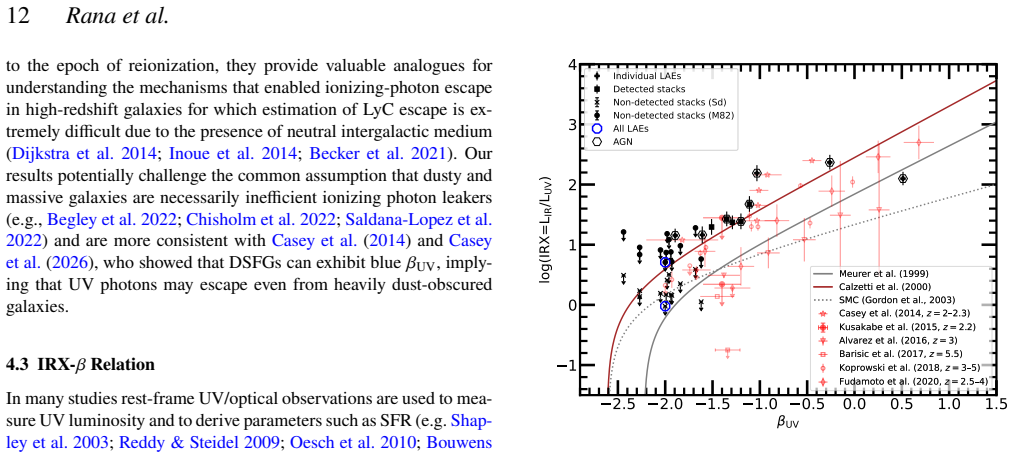
Far-infrared observations of the SC4K LAE sample show that individually detected AGN-hosting LAEs and stacks of massive systems have Lyα escape fractions of 1-7 percent while undetected stacks reach at least 10 percent, producing an overall average above 21 percent with significant scatter; the results imply a clumpy ISM dust geometry that permits escape even in dusty galaxies and yield higher IRX values than seen in typical star-forming galaxies at similar redshifts.
What carries the argument
Stacking analysis of far-infrared fluxes for individually undetected LAEs, combined with direct measurements of f_esc(Lyα) and IRX, to compare subsets divided by redshift, stellar mass, Lyα luminosity and AGN status.
If this is right
- Stellar mass and AGN activity increase dust visibility in LAEs at these redshifts.
- Escape fractions remain non-zero in the detected massive and AGN-hosting subsets.
- The full LAE population shows an average escape fraction exceeding 21 percent with large scatter.
- LAEs lie above the standard IRX-β_UV relation followed by typical star-forming galaxies.
- Deeper far-infrared observations are required to probe lower-mass systems.
Where Pith is reading between the lines
- Reionization calculations may need to include contributions from obscured but still leaking systems.
- Clumpy dust geometries could reconcile high escape fractions with the presence of substantial dust.
- The higher IRX values may indicate that LAE selection favors galaxies with particular dust-star geometries.
Load-bearing premise
The stacking analysis on individually undetected LAEs supplies an unbiased average representation of the population properties without significant contamination or selection effects from the SC4K sample definition.
What would settle it
Individual far-infrared detections or deeper non-detections for a large sample of massive non-AGN LAEs that yield escape fractions inconsistent with the 1-7 percent range found in the detected stacks.
Figures


read the original abstract
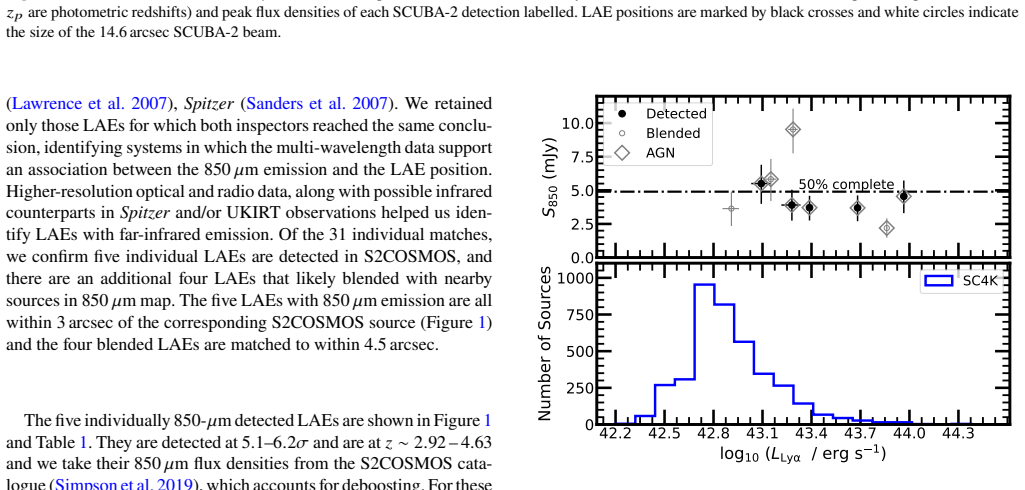
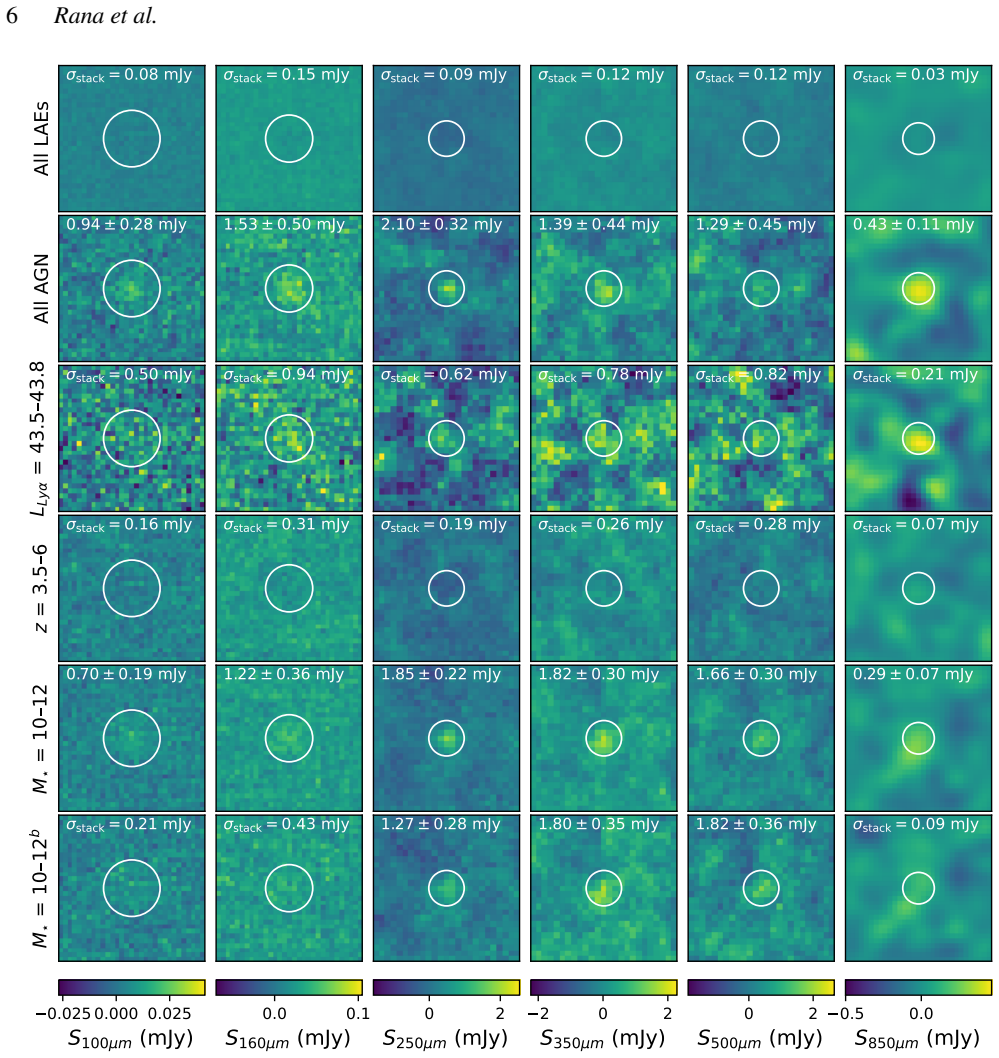
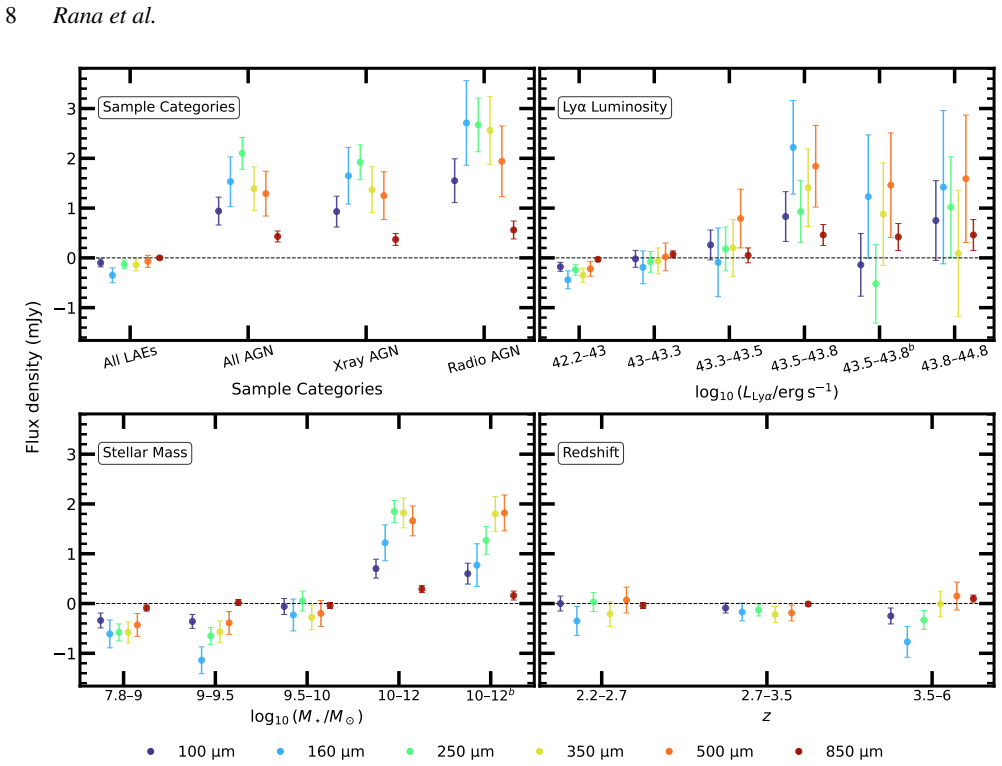
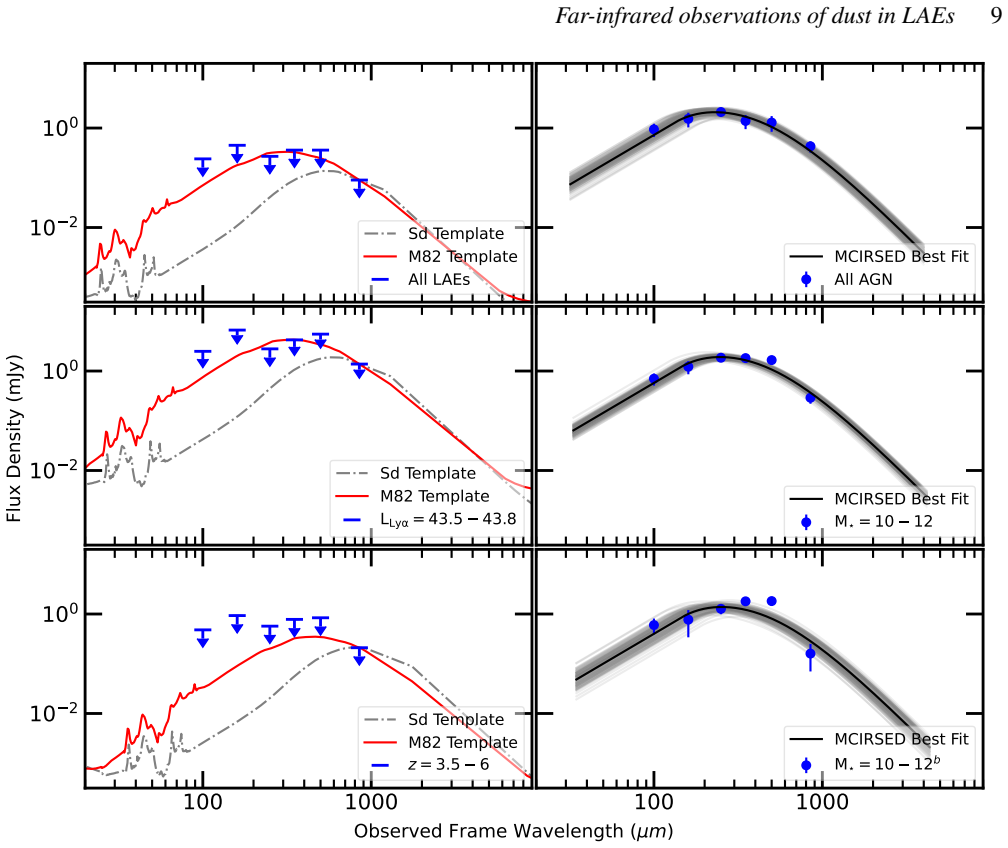
The bright Ly$\alpha$ line is regularly used to identify high-redshift star-forming galaxies known as Ly$\alpha$ emitters (LAEs). However, Ly$\alpha$ is affected by resonant scattering and dust absorption making interpretation of its brightness challenging without additional observations. We use SCUBA-2, PACS and SPIRE data to investigate the far-infrared emission, Ly$\alpha$ escape fraction ($f{esc}$(Ly$\alpha$)) and infrared excess (IRX=LIR/LUV) in $\sim$4000 LAEs at z=2.2-6 from SC4K. Five LAEs, all hosting AGN, are individually detected with fluxes $S_{850}$ = 3.7-5.5 mJy at 850$\mu\mathrm{m}$. Stacking is used to probe the average emission from all individually undetected LAEs, though the stacks are undetected at all wavelengths (e.g. $S_{850}$ < 0.09 mJy; 3$\sigma$). We group the sample into bins of redshift, stellar mass, Ly$\alpha$ luminosity and AGN status. Most subsets are undetected but LAEs containing AGN and that have high stellar masses ($M_{\star} = 10^{10} - 10^{12}\, M_{\odot}$; including and excluding AGN) are detected at most wavelengths, suggesting that stellar mass and AGN heating may be enhancing the dust visibility. Individually detected LAEs and detected stacks have $f{esc}$(Ly$\alpha$)=1-7%, while all undetected stacks $\geq$ 10%. All LAEs together average over > 21% and display significant scatter, suggesting a clumpy ISM dust distribution. Non-zero $f{esc}$(Ly$\alpha$) in massive and AGN-hosting LAEs suggests ionizing photons may escape even from dusty galaxies, challenging the idea that dusty galaxies are poor leakers. Examination of the IRX-$\beta_{UV}$ relation shows LAEs have higher IRX than typical star-forming galaxies at similar redshifts. However, our detections tend to favour more massive, AGN-hosting systems and deeper observations are therefore needed.
Editorial analysis
A structured set of objections, weighed in public.
Referee Report
Summary. The manuscript reports far-infrared observations with SCUBA-2, PACS and SPIRE of ~4000 LAEs at z=2.2-6 selected from SC4K. Five AGN-hosting LAEs are individually detected at 850 μm (S_850=3.7-5.5 mJy); stacking of the remaining undetected sources yields non-detections in most subsets but detections in high-mass (M⋆=10^{10}-10^{12} M⊙) and AGN-hosting bins. Derived f_esc(Lyα) values are 1-7% for the detected sources/stacks and ≥10% for undetected stacks, with an overall sample average >21%; IRX is elevated relative to typical star-forming galaxies at similar redshifts. The work concludes that non-zero escape fractions in massive/AGN LAEs imply ionizing photons can escape even from dusty systems, challenging the view that dusty galaxies are poor leakers, and attributes the scatter to a clumpy ISM.
Significance. If the stacking results prove robust against selection and confusion effects, the large sample and binning by mass, redshift, luminosity and AGN status would provide valuable observational constraints on dust attenuation and Lyα escape at high redshift. The direct FIR detections in the AGN and high-mass subsets, together with the reported IRX elevation, offer a concrete test of escape mechanisms in dusty environments.
major comments (3)
- [Stacking analysis] Stacking analysis (as described following the individual detections): the procedure does not detail weighting scheme, error propagation, or quantitative assessment of contamination from the large FIR beam sizes (SCUBA-2 850 μm, PACS/SPIRE), which directly affects the reliability of the detected stacks in the M⋆=10^{10}-10^{12} M⊙ bins that underpin the non-zero f_esc(Lyα) claim for dusty systems.
- [f_esc derivation] f_esc(Lyα) values (1-7% for detected LAEs and stacks; overall average >21%): the conversion from stacked FIR fluxes to L_IR and then to escape fraction is not specified, including any assumptions about dust temperature or geometry, making it impossible to evaluate whether the reported non-zero values in the massive/AGN subsets are robust against the SC4K Lyα selection bias.
- [Sample and subset analysis] Sample definition and subset results: the potential bias introduced by the SC4K Lyα selection (which favors systems with some escape) on the high-mass and AGN stacks is not quantified, yet these subsets are load-bearing for the central claim that ionizing photons escape from dusty galaxies.
minor comments (2)
- [Abstract] Abstract contains LaTeX formatting artifacts (f{esc}(Lyα) instead of f_esc(Lyα)) and an imprecise statement of the overall average escape fraction without indicating how it is computed from the subset values.
- [Abstract] The statement that 'deeper observations are therefore needed' is appropriate but would benefit from a brief discussion of the current sensitivity limits relative to the reported stack upper limits (e.g., S_850 < 0.09 mJy).
Simulated Author's Rebuttal
We thank the referee for the thorough and constructive review. We address each major comment point-by-point below, agreeing to revisions that clarify methods and strengthen the analysis where appropriate.
read point-by-point responses
-
Referee: [Stacking analysis] Stacking analysis (as described following the individual detections): the procedure does not detail weighting scheme, error propagation, or quantitative assessment of contamination from the large FIR beam sizes (SCUBA-2 850 μm, PACS/SPIRE), which directly affects the reliability of the detected stacks in the M⋆=10^{10}-10^{12} M⊙ bins that underpin the non-zero f_esc(Lyα) claim for dusty systems.
Authors: We agree that the stacking procedure requires more explicit documentation to ensure reproducibility and to evaluate beam confusion effects. In the revised manuscript we will add a dedicated methods subsection specifying the inverse-variance weighting scheme, bootstrap-based error propagation, and quantitative contamination assessment via source-injection simulations matched to the SCUBA-2, PACS and SPIRE beam sizes. These additions will directly support the robustness of the high-mass and AGN stack detections. revision: yes
-
Referee: [f_esc derivation] f_esc(Lyα) values (1-7% for detected LAEs and stacks; overall average >21%): the conversion from stacked FIR fluxes to L_IR and then to escape fraction is not specified, including any assumptions about dust temperature or geometry, making it impossible to evaluate whether the reported non-zero values in the massive/AGN subsets are robust against the SC4K Lyα selection bias.
Authors: We acknowledge that the conversion steps from stacked fluxes to L_IR and f_esc(Lyα) were insufficiently detailed. The revised text will explicitly describe the modified-blackbody SED fitting (dust temperatures 35–45 K), bolometric corrections, the adopted f_esc formula, and geometry assumptions, together with sensitivity tests to temperature and a note on how the SC4K selection enters the calculation. This will permit direct evaluation of the non-zero escape fractions in the massive/AGN subsets. revision: yes
-
Referee: [Sample and subset analysis] Sample definition and subset results: the potential bias introduced by the SC4K Lyα selection (which favors systems with some escape) on the high-mass and AGN stacks is not quantified, yet these subsets are load-bearing for the central claim that ionizing photons escape from dusty galaxies.
Authors: The referee correctly notes that the Lyα selection bias must be addressed. While a complete statistical de-biasing would require modeling beyond the present data, we will add a focused discussion paragraph that quantifies the bias using literature comparisons of LAE versus continuum-selected fractions at comparable masses and redshifts, and that discusses its implications for the escape-fraction results in the high-mass and AGN subsets. revision: partial
Circularity Check
Purely observational study; no derivations or fitted models present
full rationale
The paper performs direct flux measurements, stacking of undetected sources, and reports of f_esc(Lyα) and IRX from SCUBA-2/PACS/SPIRE data on the SC4K LAE sample. These are empirical results from survey observations with no equations, parameter fits, or model derivations that could reduce to the inputs by construction. No self-citations are load-bearing for any claimed result. This matches the default expectation for an observational astronomy paper with no theoretical chain.
Axiom & Free-Parameter Ledger
Reference graph
Works this paper leans on
-
[1]
The Constant Average Relationship between Dust-obscured Star Formation and Stellar Mass from z = 0 to z = 2.5. , keywords =. doi:10.3847/1538-4357/aa94ce , archivePrefix =. 1710.06872 , primaryClass =
work page internal anchor Pith review Pith/arXiv arXiv doi:10.3847/1538-4357/aa94ce
-
[2]
Confirming a population of hot-dust dominated, star-forming, ultraluminous galaxies at high redshift. , keywords =. doi:10.1111/j.1365-2966.2009.15291.x , archivePrefix =. 0906.5346 , primaryClass =
-
[3]
The Hubble Deep Field-North SCUBA Super-map - IV. Characterizing submillimetre galaxies using deep Spitzer imaging. , keywords =. doi:10.1111/j.1365-2966.2006.10575.x , archivePrefix =. astro-ph/0605573 , primaryClass =
-
[4]
A Redshift Survey of the Submillimeter Galaxy Population
A Redshift Survey of the Submillimeter Galaxy Population. , keywords =. doi:10.1086/428082 , archivePrefix =. astro-ph/0412573 , primaryClass =
work page internal anchor Pith review Pith/arXiv arXiv doi:10.1086/428082
-
[5]
On the dust temperatures of high-redshift galaxies. , keywords =. doi:10.1093/mnras/stz2134 , archivePrefix =. 1902.10727 , primaryClass =
-
[6]
The ALMA REBELS Survey: cosmic dust temperature evolution out to z 7. , keywords =. doi:10.1093/mnras/stac302 , archivePrefix =. 2202.01227 , primaryClass =
-
[7]
ALMA characterizes the dust temperature of z 5.5 star-forming galaxies. , keywords =. doi:10.1093/mnras/staa2545 , archivePrefix =. 2005.07716 , primaryClass =
-
[8]
The Evolving Interstellar Medium of Star-forming Galaxies since z = 2 as Probed by Their Infrared Spectral Energy Distributions. , keywords =. doi:10.1088/0004-637X/760/1/6 , archivePrefix =. 1210.1035 , primaryClass =
work page internal anchor Pith review Pith/arXiv arXiv doi:10.1088/0004-637x/760/1/6
-
[9]
The pointing system of the Herschel space observatory. Description, Calibration, Performance and improvements. Experimental Astronomy , keywords =. doi:10.1007/s10686-014-9396-z , archivePrefix =. 1405.3186 , primaryClass =
work page internal anchor Pith review Pith/arXiv arXiv doi:10.1007/s10686-014-9396-z
-
[10]
Dust in the Average Galaxy: Attenuation, Emission, and Opacity from 0<z<7
Dust in the Average Galaxy: Attenuation, Emission, and Opacity from 0<z<7. arXiv e-prints , keywords =. doi:10.48550/arXiv.2606.17270 , archivePrefix =. 2606.17270 , primaryClass =
work page internal anchor Pith review Pith/arXiv arXiv doi:10.48550/arxiv.2606.17270
-
[11]
Are Dusty Galaxies Blue? Insights on UV Attenuation from Dust-Selected Galaxies
Are Dusty Galaxies Blue? Insights on UV Attenuation from Dust-selected Galaxies. , keywords =. doi:10.1088/0004-637X/796/2/95 , archivePrefix =. 1410.0702 , primaryClass =
work page internal anchor Pith review Pith/arXiv arXiv doi:10.1088/0004-637x/796/2/95
-
[12]
Unveiling the ISM properties of low-z Lyman-continuum emitters
The Low-Redshift Lyman Continuum Survey. Unveiling the ISM properties of low-z Lyman-continuum emitters. , keywords =. doi:10.1051/0004-6361/202141864 , archivePrefix =. 2201.11800 , primaryClass =
-
[13]
The far-ultraviolet continuum slope as a Lyman Continuum escape estimator at high redshift. , keywords =. doi:10.1093/mnras/stac2874 , archivePrefix =. 2207.05771 , primaryClass =
-
[14]
The VANDELS survey: a measurement of the average Lyman-continuum escape fraction of star-forming galaxies at z = 3.5. , keywords =. doi:10.1093/mnras/stac1067 , archivePrefix =. 2202.04088 , primaryClass =
-
[15]
The mean free path of ionizing photons at 5 < z < 6: evidence for rapid evolution near reionization. , keywords =. doi:10.1093/mnras/stab2696 , archivePrefix =. 2103.16610 , primaryClass =
-
[16]
An updated analytic model for the attenuation by the intergalactic medium
An updated analytic model for attenuation by the intergalactic medium. , keywords =. doi:10.1093/mnras/stu936 , archivePrefix =. 1402.0677 , primaryClass =
work page internal anchor Pith review Pith/arXiv arXiv doi:10.1093/mnras/stu936
-
[17]
Evolution in the escape fraction of ionizing photons and the decline in strong Ly emission from z > 6 galaxies. , keywords =. doi:10.1093/mnras/stu531 , archivePrefix =. 1401.7676 , primaryClass =
work page internal anchor Pith review Pith/arXiv arXiv doi:10.1093/mnras/stu531
-
[18]
Connecting the escape fraction of Lyman-alpha and Lyman-continuum photons in star-forming galaxies at z ≃ 4-5. , keywords =. doi:10.1093/mnras/stad3417 , archivePrefix =. 2306.03916 , primaryClass =
-
[19]
The origin of the escape of Lyman and ionizing photons in Lyman continuum emitters. , keywords =. doi:10.1051/0004-6361/202038096 , archivePrefix =. 2005.07215 , primaryClass =
-
[20]
Using Lyman-alpha to detect galaxies that leak Lyman continuum
Using Lyman- to detect galaxies that leak Lyman continuum. , keywords =. doi:10.1051/0004-6361/201423978 , archivePrefix =. 1404.2958 , primaryClass =
work page internal anchor Pith review Pith/arXiv arXiv doi:10.1051/0004-6361/201423978
-
[21]
The Herschel view of the dominant mode of galaxy growth from z=4 to the present day
The Herschel view of the dominant mode of galaxy growth from z = 4 to the present day. , keywords =. doi:10.1051/0004-6361/201425017 , archivePrefix =. 1409.5433 , primaryClass =
work page internal anchor Pith review Pith/arXiv arXiv doi:10.1051/0004-6361/201425017
-
[22]
Multi-Wavelength SEDs of Herschel Selected Galaxies in the COSMOS Field
Multi-wavelength SEDs of Herschel-selected Galaxies in the COSMOS Field. , keywords =. doi:10.1088/0004-637X/778/2/131 , archivePrefix =. 1310.0474 , primaryClass =
work page internal anchor Pith review Pith/arXiv arXiv doi:10.1088/0004-637x/778/2/131
-
[23]
, archivePrefix = "arXiv", eprint =
The Star Formation Mass Sequence Out to z = 2.5. , keywords =. doi:10.1088/2041-8205/754/2/L29 , archivePrefix =. 1205.0547 , primaryClass =
work page internal anchor Pith review Pith/arXiv arXiv doi:10.1088/2041-8205/754/2/l29 2041
-
[24]
A Simple Model for the Absorption of Starlight by Dust in Galaxies. , keywords =. doi:10.1086/309250 , archivePrefix =. astro-ph/0003128 , primaryClass =
work page internal anchor Pith review Pith/arXiv arXiv doi:10.1086/309250
-
[25]
Bo\"otes-HiZELS: an optical to near-infrared survey of emission-line galaxies at $\bf z=0.4-4.7$
Bo \"o tes-HiZELS: an optical to near-infrared survey of emission-line galaxies at z = 0.4-4.7. , keywords =. doi:10.1093/mnras/stx1569 , archivePrefix =. 1702.04721 , primaryClass =
work page internal anchor Pith review Pith/arXiv arXiv doi:10.1093/mnras/stx1569
-
[26]
The CALYMHA survey: Lya luminosity function and global escape fraction of Lya photons at z=2.23
The CALYMHA survey: Ly luminosity function and global escape fraction of Ly photons at z = 2.23. , keywords =. doi:10.1093/mnras/stw3090 , archivePrefix =. 1609.05897 , primaryClass =
work page internal anchor Pith review Pith/arXiv arXiv doi:10.1093/mnras/stw3090
-
[27]
Subaru Prime Focus Camera -- Suprime-Cam --
Subaru Prime Focus Camera -- Suprime-Cam. , keywords =. doi:10.1093/pasj/54.6.833 , archivePrefix =. astro-ph/0211006 , primaryClass =
work page internal anchor Pith review Pith/arXiv arXiv doi:10.1093/pasj/54.6.833
-
[28]
COSMOS Photometric Redshifts with 30-bands for 2-deg2
Cosmos Photometric Redshifts with 30-Bands for 2-deg ^ 2. , keywords =. doi:10.1088/0004-637X/690/2/1236 , archivePrefix =. 0809.2101 , primaryClass =
work page internal anchor Pith review Pith/arXiv arXiv doi:10.1088/0004-637x/690/2/1236
-
[29]
The evolution of the dust temperatures of galaxies in the SFR-M _ * plane up to z 2. , keywords =. doi:10.1051/0004-6361/201322217 , archivePrefix =. 1311.2956 , primaryClass =
work page internal anchor Pith review Pith/arXiv arXiv doi:10.1051/0004-6361/201322217
-
[30]
Towards universal hybrid star formation rate estimators
Towards universal hybrid star formation rate estimators. , keywords =. doi:10.1051/0004-6361/201527759 , archivePrefix =. 1603.09340 , primaryClass =
work page internal anchor Pith review Pith/arXiv arXiv doi:10.1051/0004-6361/201527759
-
[31]
The UV to FIR spectral energy distribution of star-forming galaxies in the redshift desert
The ultraviolet to far-infrared spectral energy distribution of star-forming galaxies in the redshift desert. , keywords =. doi:10.1093/mnras/stt2468 , archivePrefix =. 1307.0971 , primaryClass =
work page internal anchor Pith review Pith/arXiv arXiv doi:10.1093/mnras/stt2468
-
[32]
On Star Formation Rates and Star Formation Histories of Galaxies out to z ~ 3
On Star Formation Rates and Star Formation Histories of Galaxies Out to z -0.5ex 3. , keywords =. doi:10.1088/0004-637X/738/1/106 , archivePrefix =. 1106.5502 , primaryClass =
work page internal anchor Pith review Pith/arXiv arXiv doi:10.1088/0004-637x/738/1/106
-
[33]
Escape of about five per cent of Lyman-alpha photons from high-redshift star-forming galaxies
Escape of about five per cent of Lyman- photons from high-redshift star-forming galaxies. , keywords =. doi:10.1038/nature08881 , archivePrefix =. 1002.4876 , primaryClass =
work page internal anchor Pith review Pith/arXiv arXiv doi:10.1038/nature08881
-
[34]
, year = 1967, month = mar, volume =
Are Young Galaxies Visible?. , year = 1967, month = mar, volume =. doi:10.1086/149079 , adsurl =
-
[35]
The Evolution of the Galaxy Rest-frame Ultraviolet Luminosity Function over the First Two Billion Years. , keywords =. doi:10.1088/0004-637X/810/1/71 , archivePrefix =. 1410.5439 , primaryClass =
work page internal anchor Pith review Pith/arXiv arXiv doi:10.1088/0004-637x/810/1/71
-
[36]
UV Luminosity Functions at redshifts z~4 to z~10: 10000 Galaxies from HST Legacy Fields
UV Luminosity Functions at Redshifts z 4 to z 10: 10,000 Galaxies from HST Legacy Fields. , keywords =. doi:10.1088/0004-637X/803/1/34 , archivePrefix =. 1403.4295 , primaryClass =
work page internal anchor Pith review Pith/arXiv arXiv doi:10.1088/0004-637x/803/1/34
-
[37]
The Evolution of the Ultraviolet Luminosity Function from z -0.5ex 0.75 to z -0.5ex 2.5 Using HST ERS WFC3/UVIS Observations. , keywords =. doi:10.1088/2041-8205/725/2/L150 , archivePrefix =. 1005.1661 , primaryClass =
work page internal anchor Pith review Pith/arXiv arXiv doi:10.1088/2041-8205/725/2/l150 2041
-
[38]
A Steep Faint-End Slope of the UV Luminosity Function at z -0.5ex 2-3: Implications for the Global Stellar Mass Density and Star Formation in Low-Mass Halos. , keywords =. doi:10.1088/0004-637X/692/1/778 , archivePrefix =. 0810.2788 , primaryClass =
work page internal anchor Pith review Pith/arXiv arXiv doi:10.1088/0004-637x/692/1/778
-
[39]
Rest-Frame Ultraviolet Spectra of z~3 Lyman Break Galaxies
Rest-Frame Ultraviolet Spectra of z -0.5ex 3 Lyman Break Galaxies. , keywords =. doi:10.1086/373922 , archivePrefix =. astro-ph/0301230 , primaryClass =
work page internal anchor Pith review Pith/arXiv arXiv doi:10.1086/373922
-
[40]
Tidal dwarf galaxies in the nearby Universe: Tidal dwarf galaxies in the nearby Universe , volume=
Lyman emitters in cosmological simulations - I. Lyman escape fraction and statistical properties at z= 3.1. , keywords =. doi:10.1111/j.1365-2966.2011.19549.x , archivePrefix =. 1102.1509 , primaryClass =
-
[41]
Physical properties and evolutionary state of the Lyman alpha emitting starburst galaxy IRAS 08339+6517. , keywords =. doi:10.1051/0004-6361/201323069 , archivePrefix =. 1403.7687 , primaryClass =
work page internal anchor Pith review Pith/arXiv arXiv doi:10.1051/0004-6361/201323069
-
[42]
Lyman alpha emission in high-redshift galaxies
Ly emission in high-redshift galaxies. , keywords =. doi:10.1051/0004-6361:20065825 , archivePrefix =. astro-ph/0702414 , primaryClass =
work page internal anchor Pith review Pith/arXiv arXiv doi:10.1051/0004-6361:20065825
-
[43]
A Comprehensive Study of Ly$\alpha$ Emission in the High-redshift Galaxy Population
A Comprehensive Study of Ly Emission in the High-redshift Galaxy Population. , keywords =. doi:10.3847/1538-4357/aa7552 , archivePrefix =. 1706.01886 , primaryClass =
work page internal anchor Pith review Pith/arXiv arXiv doi:10.3847/1538-4357/aa7552
-
[44]
The effect of the high-pass filter data reduction technique on the Herschel PACS Photometer PSF and noise. arXiv e-prints , keywords =. doi:10.48550/arXiv.1211.4257 , archivePrefix =. 1211.4257 , primaryClass =
work page internal anchor Pith review Pith/arXiv arXiv doi:10.48550/arxiv.1211.4257
-
[45]
The Herschel-PACS photometer calibration: Point-source flux calibration for scan maps
The Herschel-PACS photometer calibration. Point-source flux calibration for scan maps. Experimental Astronomy , keywords =. doi:10.1007/s10686-013-9352-3 , archivePrefix =. 1309.6099 , primaryClass =
work page internal anchor Pith review Pith/arXiv arXiv doi:10.1007/s10686-013-9352-3
-
[46]
Interferometric imaging of the high-redshift radio galaxy, 4C60.07: an SMA, Spitzer and VLA study reveals a binary AGN/starburst. , keywords =. doi:10.1111/j.1365-2966.2008.13811.x , archivePrefix =. 0808.2188 , primaryClass =
-
[47]
A Far-infrared Characterization of 24 m Selected Galaxies at 0 < z < 2.5 using Stacking at 70 m and 160 m in the COSMOS Field. , keywords =. doi:10.1088/0004-637X/717/1/175 , archivePrefix =. 1005.3852 , primaryClass =
work page internal anchor Pith review Pith/arXiv arXiv doi:10.1088/0004-637x/717/1/175
-
[48]
The LABOCA survey of the Extended Chandra Deep Field-South - radio and mid-infrared counterparts to submillimetre galaxies. , keywords =. doi:10.1111/j.1365-2966.2010.18132.x , archivePrefix =. 1012.0305 , primaryClass =
-
[49]
The UKIRT Infrared Deep Sky Survey (UKIDSS). , keywords =. doi:10.1111/j.1365-2966.2007.12040.x , archivePrefix =. astro-ph/0604426 , primaryClass =
-
[50]
The Spitzer Legacy Survey of the HST-ACS 2 sq. deg. COSMOS Field: survey strategy and first analysis
S-COSMOS: The Spitzer Legacy Survey of the Hubble Space Telescope ACS 2 deg ^ 2 COSMOS Field I: Survey Strategy and First Analysis. , keywords =. doi:10.1086/517885 , archivePrefix =. astro-ph/0701318 , primaryClass =
work page internal anchor Pith review Pith/arXiv arXiv doi:10.1086/517885
-
[51]
The Subaru COSMOS 20: Subaru Optical Imaging of the HST COSMOS Field with 20 Filters
The Subaru COSMOS 20: Subaru optical imaging of the HST COSMOS field with 20 filters*. , keywords =. doi:10.1093/pasj/psv106 , archivePrefix =. 1510.00550 , primaryClass =
work page internal anchor Pith review Pith/arXiv arXiv doi:10.1093/pasj/psv106
-
[52]
COSMOS : Hubble Space Telescope Observations
COSMOS: Hubble Space Telescope Observations. , keywords =. doi:10.1086/516580 , archivePrefix =. astro-ph/0612306 , primaryClass =
work page internal anchor Pith review Pith/arXiv arXiv doi:10.1086/516580
-
[53]
The Early Data Release of the Dark Energy Spectroscopic Instrument. , keywords =. doi:10.3847/1538-3881/ad3217 , archivePrefix =. 2306.06308 , primaryClass =
-
[54]
The DEIMOS 10k spectroscopic survey catalog of the COSMOS field
The DEIMOS 10K Spectroscopic Survey Catalog of the COSMOS Field. , keywords =. doi:10.3847/1538-4357/aabacf , archivePrefix =. 1803.09251 , primaryClass =
work page internal anchor Pith review Pith/arXiv arXiv doi:10.3847/1538-4357/aabacf
-
[55]
Characterizing Dust Attenuation in Local Star Forming Galaxies: UV and Optical Reddening
Characterizing Dust Attenuation in Local Star-forming Galaxies: UV and Optical Reddening. , keywords =. doi:10.3847/0004-637X/818/1/13 , archivePrefix =. 1601.00208 , primaryClass =
work page internal anchor Pith review Pith/arXiv arXiv doi:10.3847/0004-637x/818/1/13
-
[56]
The infrared-radio correlation of spheroid- and disc-dominated star-forming galaxies to z 1.5 in the COSMOS field. , keywords =. doi:10.1093/mnras/stx3234 , archivePrefix =. 1710.07655 , primaryClass =
work page internal anchor Pith review Pith/arXiv arXiv doi:10.1093/mnras/stx3234
-
[57]
The VLA-COSMOS 3 GHz Large Project: The infrared-radio correlation of star-forming galaxies and AGN to z 6. , keywords =. doi:10.1051/0004-6361/201629430 , archivePrefix =. 1703.09723 , primaryClass =
work page internal anchor Pith review Pith/arXiv arXiv doi:10.1051/0004-6361/201629430
-
[58]
Evolution of the far-infrared-radio correlation and infrared spectral energy distributions of massive galaxies over z= 0-2. , keywords =. doi:10.1111/j.1365-2966.2010.17517.x , archivePrefix =. 1005.3155 , primaryClass =
-
[59]
Multiwavelength analysis of the Lyman- emitting galaxy Haro 2: relation between the diffuse Lyman- and soft X-ray emissions. , keywords =. doi:10.1051/0004-6361/201219318 , archivePrefix =. 1207.7303 , primaryClass =
work page internal anchor Pith review Pith/arXiv arXiv doi:10.1051/0004-6361/201219318
-
[60]
A multi-wavelength study of z = 3.15 Lyman-alpha emitters in the GOODS South Field
A multi-wavelength study of z = 3.15 Lyman- emitters in the GOODS South Field. , keywords =. doi:10.1051/0004-6361:20066949 , archivePrefix =. 0706.1070 , primaryClass =
work page internal anchor Pith review Pith/arXiv arXiv doi:10.1051/0004-6361:20066949
-
[61]
Spitzer Constraints on the z=6.56 Galaxy Lensed by Abell 370
Spitzer Constraints on the z = 6.56 Galaxy Lensed by Abell 370. , keywords =. doi:10.1086/499205 , archivePrefix =. astro-ph/0510827 , primaryClass =
work page internal anchor Pith review Pith/arXiv arXiv doi:10.1086/499205
-
[62]
Physical Processes in Gaseous Nebulae. III. The Balmer Decrement. , year = 1938, month = jul, volume =. doi:10.1086/143959 , adsurl =
-
[63]
A simple model to interpret the ultraviolet, optical and infrared emission from galaxies. , keywords =. doi:10.1111/j.1365-2966.2008.13535.x , archivePrefix =. 0806.1020 , primaryClass =
-
[64]
Cold streams in early massive hot haloes as the main mode of galaxy formation
Cold streams in early massive hot haloes as the main mode of galaxy formation. , keywords =. doi:10.1038/nature07648 , archivePrefix =. 0808.0553 , primaryClass =
work page internal anchor Pith review Pith/arXiv arXiv doi:10.1038/nature07648
-
[65]
Predicting dust extinction from the stellar mass of a galaxy. , keywords =. doi:10.1111/j.1365-2966.2010.17321.x , archivePrefix =. 1007.1145 , primaryClass =
-
[66]
SILVERRUSH. V. Census of Ly , [O III] 5007, H , and [C II] 158 m Line Emission with 1000 LAEs at z = 4.9-7.0 Revealed with Subaru/HSC. , keywords =. doi:10.3847/1538-4357/aabd80 , archivePrefix =. 1711.03735 , primaryClass =
work page internal anchor Pith review Pith/arXiv arXiv doi:10.3847/1538-4357/aabd80
-
[67]
Infared Observations of Nebular Emission Lines from Galaxies at z = 3
Infrared Observations of Nebular Emission Lines from Galaxies at Z -0.5ex = 3. , keywords =. doi:10.1086/306431 , archivePrefix =. astro-ph/9806219 , primaryClass =
work page internal anchor Pith review Pith/arXiv arXiv doi:10.1086/306431
-
[68]
Dissecting the IRX- dust attenuation relation: exploring the physical origin of observed variations in galaxies. , keywords =. doi:10.1093/mnras/stx2202 , archivePrefix =. 1706.06587 , primaryClass =
work page internal anchor Pith review Pith/arXiv arXiv doi:10.1093/mnras/stx2202
-
[69]
The MOSDEF Survey: Measurements of Balmer Decrements and the Dust Attenuation Curve at Redshifts z -0.5ex 1.4-2.6. , keywords =. doi:10.1088/0004-637X/806/2/259 , archivePrefix =. 1504.02782 , primaryClass =
work page internal anchor Pith review Pith/arXiv arXiv doi:10.1088/0004-637x/806/2/259
-
[70]
, year = 1955, month = jan, volume =
The Luminosity Function and Stellar Evolution. , year = 1955, month = jan, volume =. doi:10.1086/145971 , adsurl =
-
[71]
Reexamination of the Infrared Excess-Ultraviolet Slope Relation of Local Galaxies
Reexamination of the Infrared Excess-Ultraviolet Slope Relation of Local Galaxies. , keywords =. doi:10.1088/0004-637X/755/2/144 , archivePrefix =. 1206.3905 , primaryClass =
work page internal anchor Pith review Pith/arXiv arXiv doi:10.1088/0004-637x/755/2/144
-
[72]
Lyman-alpha spectral properties of five newly discovered Lyman continuum emitters
Lyman- spectral properties of five newly discovered Lyman continuum emitters. , keywords =. doi:10.1051/0004-6361/201629264 , archivePrefix =. 1609.03477 , primaryClass =
work page internal anchor Pith review Pith/arXiv arXiv doi:10.1051/0004-6361/201629264
-
[73]
Neutral gas in Lyman-alpha emitting galaxies Haro 11 and ESO 338-IG04 measured through sodium absorption. , keywords =. doi:10.1051/0004-6361/201220702 , archivePrefix =. 1303.2011 , primaryClass =
work page internal anchor Pith review Pith/arXiv arXiv doi:10.1051/0004-6361/201220702 2011
-
[74]
HST study of Lyman-alpha emission in star-forming galaxies: the effect of neutral gas flows
HST study of Lyman-alpha emission in star-forming galaxies: the effect of neutral gas flows. , keywords =. doi:10.48550/arXiv.astro-ph/9802253 , archivePrefix =. astro-ph/9802253 , primaryClass =
work page internal anchor Pith review Pith/arXiv arXiv doi:10.48550/arxiv.astro-ph/9802253
-
[75]
Spectroscopic Properties of the z=4.5 Lyman-alpha Emitters
Spectroscopic Properties of the z -0.5ex 4.5 Ly Emitters. , keywords =. doi:10.1086/425572 , archivePrefix =. astro-ph/0409090 , primaryClass =
work page internal anchor Pith review Pith/arXiv arXiv doi:10.1086/425572
-
[76]
A Luminous Lyman-alpha Emitting Galaxy at Redshift z=6.535: Discovery and Spectroscopic Confirmation
A Luminous Ly -emitting Galaxy at Redshift z = 6.535: Discovery and Spectroscopic Confirmation. , keywords =. doi:10.1086/422094 , archivePrefix =. astro-ph/0403161 , primaryClass =
work page internal anchor Pith review Pith/arXiv arXiv doi:10.1086/422094
-
[77]
Monthly Notices of the Royal Astronomical Society , volume =
A remarkably high fraction of strong Ly emitters amongst luminous redshift 6.0 < z < 6.5 Lyman-break galaxies in the UKIDSS Ultra-Deep Survey. , keywords =. doi:10.1111/j.1365-2966.2012.20720.x , archivePrefix =. 1110.1722 , primaryClass =
-
[78]
A Spectroscopic Survey of Ly Emitters and Ly Luminosity Function at Redshifts 3.7 and 4.8. , keywords =. doi:10.3847/1538-4357/ad0231 , archivePrefix =. 2310.07285 , primaryClass =
-
[79]
Witnessing the onset of reionization through Lyman- emission at redshift 13. , keywords =. doi:10.1038/s41586-025-08779-5 , archivePrefix =. 2408.16608 , primaryClass =
-
[80]
The Ly luminosity function at z = 5.7 - 6.6 and the steep drop of the faint end: implications for reionization. , keywords =. doi:10.1093/mnras/stw2076 , archivePrefix =. 1606.07435 , primaryClass =
work page internal anchor Pith review Pith/arXiv arXiv doi:10.1093/mnras/stw2076
discussion (0)
Sign in with ORCID, Apple, or X to comment. Anyone can read and Pith papers without signing in.