REVIEW 3 major objections 2 minor 1 cited by
Multimodal Ambivalence/Hesitancy Recognition in Videos for Personalized Digital Health Interventions
T0 review · 3 major / 2 minor · reviewed 2026-07-12 · grok-4.5
Pith's one-line read Standard deep learning and LLM pipelines fall short on video ambivalence and hesitancy recognition, so digital health personalization still needs better multimodal fusion.
desk verdict The abstract for 2604.11730 is a limited-result multimodal A/H application paper; the supplied full text is a different paper (NAM single-cell clustering), so we cannot verify the claimed BAH results. read the letter →
The pith
A machine-rendered reading of the paper's core claim, the machinery that carries it, and where it could break.
The reading
What carries the argument
Three evaluation setups on the BAH video dataset—supervised multimodal learning, unsupervised domain adaptation for personalization, and zero-shot LLM inference—used as a diagnostic of whether standard deep multimodal pipelines can detect A/H as affective inconsistency.
What would settle it
A multimodal model that explicitly models within- and across-modality affective conflict (spatio-temporal fusion designed for inconsistency) and achieves substantially higher A/H recognition accuracy on BAH, or an annotation audit showing that limited scores are driven by label noise rather than model failure.
Extended reading notes
Core claim
On the BAH video dataset for ambivalence/hesitancy recognition, deep learning under supervised learning, unsupervised domain adaptation for personalization, and zero-shot LLM inference all yield limited performance. Accurate automatic A/H recognition therefore requires multimodal models specifically adapted to capture affective conflicts within and across modalities through better spatio-temporal and fusion design.
Load-bearing premise
That A/H appears consistently enough as machine-detectable inconsistency in language, face, voice, and body channels of the BAH videos for ordinary multimodal deep learning and LLM pipelines to be a fair test of feasibility.
Editorial analysis
A structured set of objections, weighed in public.
Referee Report
Summary. The submission under review is titled and abstract-identified as a cs.CV paper on multimodal ambivalence/hesitancy (A/H) recognition in videos for digital health personalization (arXiv:2604.11730). It claims that supervised deep learning, unsupervised domain adaptation for personalization, and zero-shot LLM inference on the BAH video dataset all yield limited performance, and concludes that more adapted spatio-temporal and multimodal fusion is required to exploit affective conflicts within and across modalities. The body supplied with the review package is instead a complete, unrelated manuscript: Nested Atoms Model (NAM) for two-layered Bayesian nonparametric clustering of nested single-cell and genotype data (arXiv:2604.11731, stat.ME). No methods, architectures, metrics, tables, figures, ablations, or BAH results for the A/H paper are present.
Significance. If the abstract claims of 2604.11730 were substantiated, automatic A/H recognition would be a useful building block for scalable, personalized digital health interventions. That significance cannot be assessed from the materials provided: the only available text for the claimed paper is the abstract, while the full manuscript is a different work. The NAM manuscript that was supplied is a technically substantial contribution in Bayesian nonparametrics and single-cell analysis, but it is not the paper under review and does not speak to multimodal A/H recognition.
major comments (3)
- Manuscript identity mismatch: the review package title/abstract (arXiv:2604.11730, Multimodal A/H Recognition, cs.CV) does not match the full text (Nested Atoms Model / OneK1K clustering, arXiv:2604.11731, stat.ME). No experimental section, model definitions, BAH dataset protocol, metrics, baselines, or fusion ablations for A/H recognition are available. The central claim of limited performance under supervised / UDA / LLM zero-shot setups therefore cannot be verified, reproduced, or stress-tested.
- Abstract-only diagnosis for 2604.11730: the inference that limited performance implies a need for better spatio-temporal and multimodal fusion is load-bearing but uncheckable. Without label protocol, inter-annotator agreement, clip construction, modality-wise baselines, and error analysis, it is equally plausible that construct validity, annotation noise, or data scale—not fusion architecture—drive the reported failure. That alternative cannot be ruled out from the abstract alone.
- If the authors intended the NAM manuscript (2604.11731) to be reviewed instead, the submission metadata and abstract must be corrected; the current package is not a coherent review object for either paper as labeled.
minor comments (2)
- The abstract of 2604.11730 is clear on motivation and the three learning setups, but without the body there is nothing further to comment on for presentation of that paper.
- For the supplied NAM text (if relevant to a corrected submission): several figure/table references and the GitHub URL appear redacted or garbled in the source (e.g., blacked-out repository link in §1.3); that would need fixing before any review of NAM.
Circularity Check
No circular derivation: the A/H abstract reports empirical limited performance; the cached full text is a different paper (NAM) and supplies no A/H equations or self-reducing predictions.
full rationale
The titled paper (arXiv:2604.11730) is available only as an abstract: it states that supervised learning, unsupervised domain adaptation, and zero-shot LLM inference on the BAH dataset yield limited A/H recognition performance and therefore that better spatio-temporal and multimodal fusion is needed. That is an empirical report plus an interpretive recommendation, not a derivation chain in which a claimed prediction or first-principles result reduces to its own inputs by construction. There are no equations, fitted parameters re-labeled as predictions, uniqueness theorems, or load-bearing self-citations in the abstract. The CACHEABLE full manuscript is instead Nested Atoms Model (arXiv:2604.11731, stat.ME)—a Bayesian nonparametric clustering paper with simulations and OneK1K analysis—so BAH methods, metrics, and fusion claims cannot be checked for equation-level circularity. Under the hard rules (quote-and-exhibit only; no manufactured circularity; honest non-finding when warranted), score is 0 with no circular steps. Mild residual risk that “limited performance implies need for better fusion” partly restates the modeling premise is interpretive, not a self-definitional or fitted-input circularity.
Assumptions & free parameters
assumptions (3)
- domain assumption Ambivalence/hesitancy manifests as affective inconsistency within or across language, facial, vocal, and body modalities and is the primary reason people delay, avoid, or abandon health interventions.
- domain assumption The BAH video dataset is a valid and sufficient benchmark for evaluating automatic multimodal A/H recognition and personalization via unsupervised domain adaptation.
- ad hoc to paper Limited performance of current deep multimodal models and LLM zero-shot inference implies that better spatio-temporal and multimodal fusion methods are required.
invented entities (1)
-
Automatic multimodal A/H recognition pipeline for digital health personalization (supervised / UDA / LLM zero-shot)
Cite this review
Pith. "Pith review of Multimodal Ambivalence/Hesitancy Recognition in Videos for Personalized Digital Health Interventions." pith.science (2026). https://pith.science/paper/RFF3HE2C
@misc{pith2026260411730,
  author       = {Pith},
  title        = {Pith review of: Multimodal Ambivalence/Hesitancy Recognition in Videos for Personalized Digital Health Interventions},
  year         = {2026},
  howpublished = {\url{https://pith.science/paper/RFF3HE2C}},
  note         = {Machine review of arXiv:2604.11730}
}
read the original abstract
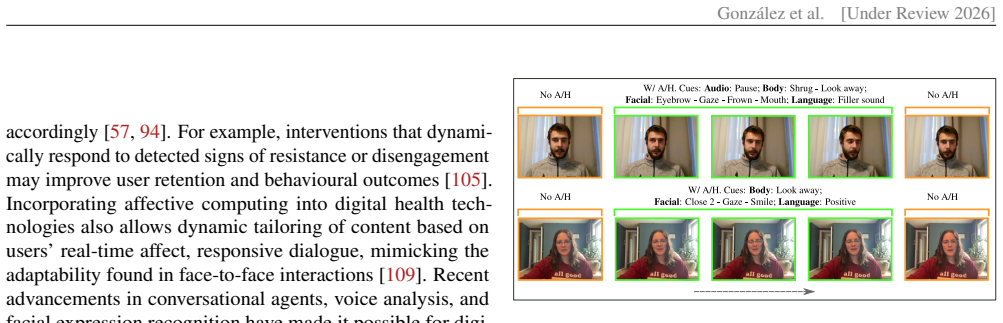
Using behavioural science, health interventions focus on behaviour change by providing a framework to help patients acquire and maintain healthy habits that improve medical outcomes. In-person interventions are costly and difficult to scale, especially in resource-limited regions. Digital health interventions offer a cost-effective approach, potentially supporting independent living and self-management. Automating such interventions, especially through machine learning, has recently gained considerable attention. Ambivalence and hesitancy (A/H) play a primary role for individuals to delay, avoid, or abandon health interventions. A/H are subtle and conflicting emotions that place a person in a state between positive and negative evaluations of a behaviour, or between acceptance and refusal to engage in it. They manifest as affective inconsistency across modalities or within a modality, such as language, facial, vocal expressions, and body language. While experts can be trained to recognize A/H, integrating them into digital health interventions is costly and less effective. Automatic A/H recognition is therefore critical for the personalization and cost-effectiveness of digital health interventions. Here, we explore the application of deep learning models for A/H recognition in videos, a multi-modal task by nature. In particular, this paper covers three learning setups: supervised learning, unsupervised domain adaptation for personalization, and zero-shot inference via large language models (LLMs). Our experiments are conducted on the unique and recently published BAH video dataset for A/H recognition. Our results show limited performance, suggesting that more adapted multi-modal models are required for accurate A/H recognition. Better methods for modeling spatio-temporal and multimodal fusion are necessary to leverage conflicts within/across modalities.
Figures


Forward citations
Cited by 1 Pith paper
-
SVF-CR: Synchronized Visual-Facial Cross-Refinement for Multimodal Ambivalence and Hesitancy Recognition
Synchronized visual-facial cross-refinement plus late pairwise fusion of text and audio reaches 0.7156 public macro-F1 on BAH ambivalence/hesitancy recognition.
Reference graph
Works this paper leans on
-
[1]
Ascolani, F., Lijoi, A., Rebaudo, G., and Zanella, G. (2022). Clustering Consistency with Dirichlet Process Mixtures.Biometrika, 110(2):551–558. Azzalini, A. (2013).The Skew-Normal and Related Families. Institute of Mathematical Statistics Mono- graphs. Cambridge University Press. 31 Balocchi, C., George, E. I., and Jensen, S. T. (2022). Clustering areal ...
arXiv 2022
-
[2]
Bishop, C. M. (2006).Pattern Recognition and Machine Learning, volume 4 ofInformation Science and Statistics. Springer, New York. Blei, D. M. and Jordan, M. I. (2006). Variational Inference for Dirichlet Process Mixtures.Bayesian Analysis, 1(1):121 –
2006
-
[3]
B., Lijoi, A., Pr¨ unster, I., and Rodr´ ıguez, A
Camerlenghi, F., Dunson, D. B., Lijoi, A., Pr¨ unster, I., and Rodr´ ıguez, A. (2019). Latent Nested Nonpara- metric Priors (with Discussion).Bayesian Analysis, 14(4):1303 –
2019
-
[4]
Chakrabarti, A., Ni, Y., Pati, D., and Mallick, B. (2025). Global-local Dirichlet processes for clustering grouped data in the presence of group-specific idiosyncratic variables. In Singh, A., Fazel, M., Hsu, D., Lacoste-Julien, S., Berkenkamp, F., Maharaj, T., Wagstaff, K., and Zhu, J., editors,Proceedings of the 42nd International Conference on Machine ...
2025
-
[5]
32 Denti, F., Camerlenghi, F., Guindani, M., and Mira, A. (2023). A Common Atoms Model for the Bayesian Nonparametric Analysis of Nested Data.Journal of the American Statistical Association, 118(541):405–
2023
-
[6]
and D’Angelo, L
Denti, F. and D’Angelo, L. (2025). The Generalized Nested Common Atoms Model.Econometrics and Statistics. Ferguson, T. S. (1973). A Bayesian Analysis of Some Nonparametric Problems.The Annals of Statistics, 1(2):209–230. Graziani, R., Guindani, M., and Thall, P. F. (2015). Bayesian Nonparametric Estimation of Targeted Agent Effects on Biomarker Change to ...
2025
-
[7]
Lijoi, A., Pr¨ unster, I., and Rebaudo, G. (2023). Flexible Clustering via Hidden Hierarchical Dirichlet Priors. Scandinavian Journal of Statistics, 50(1):213–234. Lun, A. T. L., McCarthy, D. J., and Marioni, J. C. (2016). A Step-by-Step Workflow for Low-Level Analysis of Single-Cell RNA-seq Data with Bioconductor.F1000Res, 5:2122. Mathys, H., Boix, C. A....
2023
-
[8]
Miller, J
Curran Associates, Inc. Miller, J. W. and Harrison, M. T. (2014). Inconsistency of Pitman-Yor Process Mixtures for the Number of Components.Journal of Machine Learning Research, 15(1):3333–3370. Petrie, R. J. and Deans, J. P. (2002). Colocalization of the B cell Receptor and CD20 Followed by Activation- Dependent Dissociation in Distinct Lipid Rafts.The J...
2014
Show all 13 references
-
[9]
B., and Gelfand, A
Rodr´ ıguez, A., Dunson, D. B., and Gelfand, A. E. (2008). The Nested Dirichlet Process.Journal of the American Statistical Association, 103(483):1131–1154. Scrucca, L., Fraley, C., Murphy, T. B., and Raftery, A. E. (2023).Model-Based Clustering, Classification, and Density Es...
2008
-
[10]
Nested Atoms Model with Applica- tion to Clustering Big Population-Scale Single-Cell Data
Teh, Y. W., Jordan, M. I., Beal, M. J., and Blei, D. M. (2006). Hierarchical Dirichlet Processes.Journal of the American Statistical Association, 101(476):1566–1581. Wei, R., Zhang, L., Hu, W., Wu, J., and Zhang, W. (2022). CSTA Plays a Role in Osteoclast Formation and Bone Re...
2006 arXiv
-
[11]
Finally, the proof follows from some algebra. 39 B. Graphical Representation of the NAM Mixture Model In this section, we present the graphical model representation of the NAM mixture model (Figure S1). � �� �� �� � �� ��� ���� �� � ���� � �� � � � � Figure S1: Graphical repre...
2024
-
[12]
� � � log� � �� ��� �� � � �� � � � �� =�log�(� � � � �� � ) + 1 2 � (�� � ���1) �� ��� ������ � � � 1 2 � �� ��� �� � �(� � �� � � � � ) � + 1 2 � �� ��� � �log � �� � 2� � +� ����� � � ��� � �� � �� � � �� �(� � � �� � �)� � � � (� � � �� � �) � � � where�(�) is the trace op...
2006
-
[13]
embeddings of the gene expression data for the individual numbered 131, with cells colored according to the estimated OCs alongside the annotated cell-type labels by OneK1K (Yazar et al., 2022). (a) (b) Figure S11: UMAP embeddings of the gene expression data for the individual...
2022
Reviewed July 12, 2026 · model on record in the stance chip above.
Discussion (0). Continue with ORCID to comment.