REVIEW 3 major objections 4 minor 5 cited by
System-1.5 Reasoning: Traversal in Language and Latent Spaces with Dynamic Shortcuts
T0 review · 3 major / 4 minor · reviewed 2026-08-07 · deepseek-v4-flash
Pith's one-line read System-1.5 Reasoning matches chain-of-thought accuracy while cutting inference cost by more than 20x, by routing each reasoning step through a dynamic shortcut in latent space.
desk verdict A promising combination of depth and step shortcuts for latent reasoning, but the printed training objective appears to invert the early-exit weighting and the main experiments are under-specified. read the letter →
The pith
A machine-rendered reading of the paper's core claim, the machinery that carries it, and where it could break.
The reading
What carries the argument
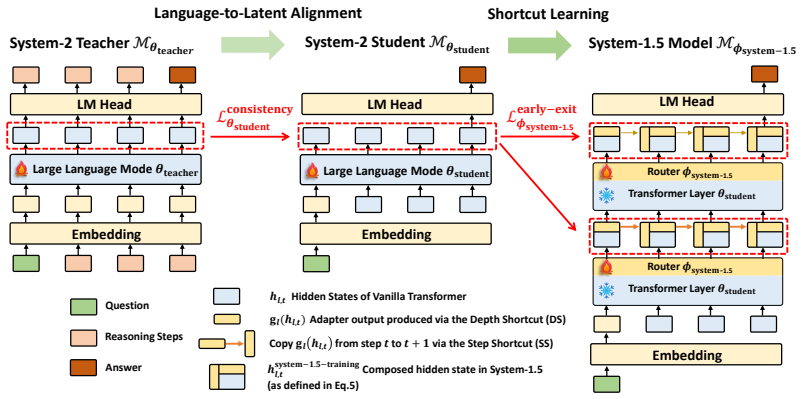
The load-bearing mechanism is the router-adapter module inserted into every transformer layer, combined with two dynamic shortcuts. The depth shortcut (DS) computes a weighted combination of a lightweight adapter branch output $g_{l-1}(h_{l-1,t})$ and the vanilla transformer layer output $f_l(h_{l-1,t})$, with the mixing weight $w = R_l(h_{l-1,t})$ from a sigmoid router; at inference, a threshold $\lambda_{\text{depth}}$ decides whether the token exits early. The step shortcut (SS) mixes the previous step's hidden state at the same layer, $g_l(h_{l,t-1})$, with the vanilla path, allowing the model to skip decoding steps horizontally. The two are trained with an early-exit loss $L_{\text{early-exit}} = \sum_{l,t} e_{l,t}\;\mathrm{MSE}(h^{\text{student}}_{l,t}, h^{\text{system-1.5}}_{l,t})$, where the weights $e_{l,t}$ are computed from binary criticality labels $c_t$ via Eq. 11, making non-critical steps exit at shallow layers and critical steps continue deep. The criticality labels themselves come from an atom-of-thought decomposition of the CoT into a DAG of subquestions, which is the source of the supervision that teaches the routers where computation is wasted.
What would settle it
Train System-1.5 Reasoning twice on GSM8K: once with the true atom-of-thought criticality labels and once with the labels permuted randomly among steps, keeping all other settings identical. If the random-label model lands on the same accuracy-speedup Pareto curve as the original, the criticality supervision is not load-bearing and some other property of the training is producing the result; if it degrades, the labels are doing the work.
Extended reading notes
Core claim
The central claim is that a two-stage self-distillation can compress explicit chain-of-thought into continuous latent thought, then compress full-depth latent reasoning into adaptive shortcut paths without losing accuracy. In the first stage, a student model is trained so its final-layer hidden states match those of a CoT-trained teacher on the reasoning steps, with only the final answer decoded in language; in the second stage, the transformer is frozen and only the router-adapter modules are trained, using an early-exit loss whose per-layer weights are set by binary criticality labels. Those labels come from decomposing the CoT into a directed acyclic graph of self-contained subquestions: derived nodes that require logical integration are labeled critical and routed deeper, while independent nodes are labeled non-critical and exited early. The depth shortcut lets non-critical tokens leave through an adapter branch, and the step shortcut copies the early-exited hidden state to the next decoding step, so the model reasons both vertically through layers and horizontally across steps. On the paper's own reported numbers, this preserves CoT-level accuracy — 46.66% versus 46.94% on GSM8K, 38.28% versus 38.32% on GSM-HARD, and 48.61% versus 47.62% on StrategyQA — while achieving 20.27x, 12.45x, and 55.65x wall-clock speedups respectively.
Load-bearing premise
The method assumes that the automatically produced criticality labels — each reasoning step marked critical or non-critical from a DAG decomposition of the chain of thought — correctly reflect how much computation that step truly needs, and that every token in the step inherits the step's label; if the labels are noisy, the router is trained to exit at the wrong layers and the reported accuracy-speedup trade-off degrades.
Editorial extensions
If this is right
- Reasoning tokens and reasoning work are decoupled: the same answer can be produced in roughly two latent steps instead of a 26-step CoT, because the latent trajectory carries the reasoning.
- Inference cost becomes a tunable budget rather than a fixed output length; $\lambda_{\text{depth}}$ and $\lambda_{\text{step}}$ define a Pareto frontier that can be adjusted at test time without retraining.
- Latent reasoning generalizes out of distribution: GSM-HARD accuracy (38.28%) nearly matches CoT (38.32%) despite training only on GSM8K.
- Direct language-to-latent distillation outperforms curriculum-based distillation (iCoT-style) as preparation for shortcut learning, and freezing transformer parameters during shortcut learning beats joint or full-parameter fine-tuning.
- On text-rich commonsense reasoning, pure latent reasoning can exceed CoT accuracy, suggesting that hidden-state reasoning integrates supporting evidence differently.
Reading between the lines
- If the criticality signal is the real driver, the same router-adapter scheme could be applied at inference time without ground-truth CoT, by estimating step criticality from the model's own hidden-state dynamics such as prediction confidence or attention entropy; the paper does not test this, but it is a direct consequence of the mechanism.
- The reported 20x speedup is wall-clock time on small backbones (1B parameters and below); on larger models the per-step FLOPs reduction (1.76x–2.12x) is the more architecture-intrinsic quantity, and the actual end-to-end gain will depend on memory bandwidth and batch size.
- The step shortcut effectively decouples thinking time from token positions, which raises the question of whether the fixed step constant could itself be made adaptive — a model that stops thinking when its latent state stabilizes could save further compute.
- The same two-dimensional shortcut idea could transfer to multimodal reasoning, where critical perceptual steps could be routed to deep fusion layers while trivial ones exit early; the paper only considers text.
Editorial analysis
A structured set of objections, weighed in public.
Referee Report
Summary. The paper proposes System-1.5 Reasoning, a two-stage distillation framework for latent-space chain-of-thought reasoning with dynamic shortcuts. Stage 1 aligns a student LLM's last-layer hidden states with a CoT fine-tuned teacher's reasoning-step hidden states, teaching the student to reason in latent space. Stage 2 freezes the Transformer and trains router-adapter modules that (claimedly) make non-critical tokens exit early along model depth and copy hidden states across decoding steps. The authors evaluate on GSM8K, GSM-HARD, and StrategyQA, reporting accuracy comparable to CoT fine-tuning while achieving large inference speedups, and they provide a test-time scaling analysis over the depth threshold and step count.
Significance. If the claims hold, the paper contributes a useful mechanism for adaptive allocation of compute in latent-space reasoning, combining early-exit style depth control with step-level hidden-state reuse. The two-stage distillation idea is sensible, and the comparison against six efficient-reasoning baselines is a strength. The test-time scaling grid in Figure 4 is a valuable falsifiable prediction that shows performance varies smoothly with the two control parameters. However, the central mechanism depends on the correctness of the early-exit loss in Eq. (11), which appears to have the opposite of the intended depth pressure. The criticality labels that guide routing are not validated. The reported accuracy and token-reduction numbers also contain internal contradictions. These issues make the empirical claims, as presently written, unreliable.
major comments (3)
- [§2.2, Eq. (11)] The early-exit weight e_{l,t} is defined with reversed depth pressure relative to the stated objective. For a non-critical token (c_t=0), Eq. (11) gives e_{l,t} = (Σ_{i=1}^l i)/(Σ_{j=1}^L j), which increases from near zero at l=1 to one at l=L. For a critical token (c_t=1), e_{l,t} decreases from near one at l=1 to zero at l=L. In the loss of Eq. (10), a high weight enforces consistency with the full-depth hidden state at that layer. Thus the printed loss trains non-critical tokens to match deep-layer hidden states and leaves critical tokens unconstrained at depth, which is the opposite of the sentence in Section 2.2 that the loss 'encourages non-critical steps to exit at shallower layers while allowing critical steps to proceed deeper.' If implemented as written, the router is trained against the claimed early-exit behavior. Please correct the formula (or the surrounding text), and clarify whether the reported results used the corrected weighting.
- [§2.2 and §3 (datasets paragraph)] The criticality labels c_t, produced by atom-of-thought DAG decomposition, are the only supervisory signal that distinguishes critical from non-critical steps. The paper gives no human agreement, no ablation, no sensitivity analysis, and no qualitative examples of the label quality. If these labels are noisy or the token-level mapping from step-level labels is inappropriate, Eq. (10) trains the routers toward incorrect exits, and the claimed accuracy–speedup tradeoff could degrade. Please provide at least an inter-annotator agreement or a label-ablation study (e.g., random labels, all-critical, all-non-critical) to demonstrate that the learned routing depends on the label signal.
- [§3.1 and Table 1] Several reported numbers are internally inconsistent. The abstract states a 92.31% average token reduction, while the introduction states 91.0%. In the text, 'System-1.5 Reasoning achieves 46.94% and 38.32% accuracy respectively, closely matching CoT fine-tuning results of 46.67% and 38.28%,' but Table 1 shows CoT at 46.94% on GSM8K and 38.32% on GSM-HARD, and System-1.5 at 46.66% and 38.28%. Likewise, Table 1 lists CoT StrategyQA accuracy as 47.62%, while the text says CoT is 47.36%. The table also does not report the operating points λ_depth and λ_step used for the main results, nor does it give confidence intervals or multiple seeds. Because the central claim is 'comparable accuracy and 20× speedup,' these inconsistencies and omissions prevent verification of the headline numbers. Please reconcile the values and specify the experimental operating point.
minor comments (4)
- [§2.1, Eq. (5)] Equations (1) and (4) use routers conditioned on different inputs (h_{l-1,t} and h_{l,t-1}), but Eq. (5) merges both shortcut terms under a single weight w. Please clarify whether a single router output is shared or whether the two terms use the two distinct router outputs.
- [Table 1] The table caption and the text state that System-1.5 is implemented with GPT-2 124M and LLaMA 3.2 1B backbones, but the table does not indicate which backbone produced each column. Please mark the backbone, or report the two variants separately.
- [Figure 4] The horizontal axis is labeled 'step' and the vertical axis 'depth,' while the caption refers to λ_depth and λ_step. Please make the axis labels consistent with the parameter names and explain the units.
- [§5 (Conclusion)] The phrase 'based two forms' should read 'based on two forms.'
Circularity Check
No significant circularity: the accuracy and speedup results are empirical measurements, and the few self-citations are not load-bearing; Eq. 11 is a non-circular technical inconsistency.
full rationale
System-1.5 Reasoning is a distillation-plus-routing method, and I find no step in its derivation chain that reduces to its own inputs by construction. The teacher-forced hidden-state distillation (Eqs. 6, 9, 10) explains why accuracy can approach the CoT teacher, but the paper reports this as an empirical result measured on GSM8K/GSM-HARD/StrategyQA, not as a quantity derived from the fitted early-exit weights, so it is not a fitted-input-called-prediction. The self-citations (e.g., Wang & Liu 2024; Wang et al. 2025) appear only in background citations of agent and NLP work and do not carry the central derivation; no uniqueness theorem or ansatz is imported from the authors' prior work. The AoT criticality labels are an unvalidated supervision signal, which is a robustness/correctness concern but not circular: the router is trained on the labels and the efficiency claim is subsequently measured. I do note a serious non-circular technical issue: Eq. 11 as printed appears to invert the stated early-exit objective. With e_{l,t} = (1-c_t) * (sum_i i / sum_j j) + c_t * (1 - sum_i i / sum_j j), the non-critical weight grows with depth while the critical weight shrinks with depth, so the loss literally written would reward late exits for non-critical tokens and early exits for critical tokens. Because the claimed 20x speedup depends on the opposite behavior, the paper should correct Eq. 11 or clarify the implementation; however, this is an internal inconsistency in the stated loss, not a circular derivation. Overall circularity is therefore minimal.
Assumptions & free parameters
free parameters (4)
- lambda_depth =
not reported
- lambda_step =
2 for GSM8K and StrategyQA, 4 for GSM-HARD (from # Steps column)
- alpha =
not reported
- beta =
not reported
assumptions (5)
- domain assumption Hidden-state distillation from a CoT teacher transfers reasoning ability into latent space.
- domain assumption Intermediate hidden states of the System-2 student are valid targets for early-exit consistency.
- domain assumption Criticality labels from atom-of-thought DAG decomposition correctly identify which steps require deep reasoning.
- domain assumption Copying hidden states across decoding steps preserves the information needed for subsequent reasoning.
- domain assumption The router's hard threshold at inference matches the soft weighted training behavior.
invented entities (2)
-
Router-adapter module (depth shortcut)
-
Step shortcut mechanism
Cite this review
Pith. "Pith review of System-1.5 Reasoning: Traversal in Language and Latent Spaces with Dynamic Shortcuts." pith.science (2026). https://pith.science/paper/RFGFZQMG
@misc{pith2026250518962,
  author       = {Pith},
  title        = {Pith review of: System-1.5 Reasoning: Traversal in Language and Latent Spaces with Dynamic Shortcuts},
  year         = {2026},
  howpublished = {\url{https://pith.science/paper/RFGFZQMG}},
  note         = {Machine review of arXiv:2505.18962}
}
read the original abstract
Chain-of-thought (CoT) reasoning enables large language models (LLMs) to move beyond fast System-1 responses and engage in deliberative System-2 reasoning. However, this comes at the cost of significant inefficiency due to verbose intermediate output. Recent latent-space reasoning methods improve efficiency by operating on hidden states without decoding into language, yet they treat all steps uniformly, failing to distinguish critical deductions from auxiliary steps and resulting in suboptimal use of computational resources. In this paper, we propose System-1.5 Reasoning, an adaptive reasoning framework that dynamically allocates computation across reasoning steps through shortcut paths in latent space. Specifically, System-1.5 Reasoning introduces two types of dynamic shortcuts. The model depth shortcut (DS) adaptively reasons along the vertical depth by early exiting non-critical tokens through lightweight adapter branches, while allowing critical tokens to continue through deeper Transformer layers. The step shortcut (SS) reuses hidden states across the decoding steps to skip trivial steps and reason horizontally in latent space. Training System-1.5 Reasoning involves a two-stage self-distillation process: first distilling natural language CoT into latent-space continuous thought, and then distilling full-path System-2 latent reasoning into adaptive shortcut paths (System-1.5 Reasoning). Experiments on reasoning tasks demonstrate the superior performance of our method. For example, on GSM8K, System-1.5 Reasoning achieves reasoning performance comparable to traditional CoT fine-tuning methods while accelerating inference by over 20x and reducing token generation by 92.31% on average.
Figures


Figures from the paper (1 more)

Forward citations
Cited by 5 Pith papers
-
Efficient Reasoning on the Edge
LoRA adapters, budget-forced GRPO, dynamic switching, parallel verification and FPTQuant enable practical chain-of-thought reasoning on quantized Qwen2.5-7B for edge devices.
-
The Latent Space: Foundation, Evolution, Mechanism, Ability, and Outlook
A large survey organizes latent-space work in language-based models by foundation, evolution, four mechanisms, seven abilities, and open challenges.
-
A Survey on Latent Reasoning
A survey that organizes latent reasoning methods into vertical recurrence, horizontal recurrence, and infinite-depth diffusion, arguing that silent reasoning can beat explicit chain-of-thought.
-
Toward Efficient Agents: Memory, Tool learning, and Planning
A survey that organizes efficiency techniques for LLM agents into memory, tool learning, and planning, and consolidates benchmarks and metrics for measuring cost-performance trade-offs.
-
Towards Concise and Adaptive Thinking in Large Reasoning Models: A Survey
A comprehensive review that categorizes methods for shortening and adaptively triggering chain-of-thought reasoning in large language models.
Reference graph
Works this paper leans on
-
[1]
Phi-4-reasoning technical report
Marah Abdin, Sahaj Agarwal, Ahmed Awadallah, Vidhisha Balachandran, Harkirat Behl, Lingjiao Chen, Gustavo de Rosa, Suriya Gunasekar, Mojan Javaheripi, Neel Joshi, et al. Phi-4-reasoning technical report. arXiv preprint arXiv:2504.21318,
-
[4]
Towards reasoning era: A survey of long chain-of- thought for reasoning large language models
Qiguang Chen, Libo Qin, Jinhao Liu, Dengyun Peng, Jiannan Guan, Peng Wang, Mengkang Hu, Yuhang Zhou, Te Gao, and Wanxiang Che. Towards reasoning era: A survey of long chain-of- thought for reasoning large language models. arXiv preprint arXiv:2503.09567,
-
[5]
Do not think that much for 2+ 3=? on the overthinking of o1-like llms
Xingyu Chen, Jiahao Xu, Tian Liang, Zhiwei He, Jianhui Pang, Dian Yu, Linfeng Song, Qiuzhi Liu, Mengfei Zhou, Zhuosheng Zhang, et al. Do not think that much for 2+ 3=? on the overthinking of o1-like llms. arXiv preprint arXiv:2412.21187,
-
[7]
Training verifiers to solve math word problems
Karl Cobbe, Vineet Kosaraju, Mohammad Bavarian, Mark Chen, Heewoo Jun, Lukasz Kaiser, Matthias Plappert, Jerry Tworek, Jacob Hilton, Reiichiro Nakano, et al. Training verifiers to solve math word problems. arXiv preprint arXiv:2110.14168,
-
[9]
Implicit chain of thought reasoning via knowledge distillation
10 Yuntian Deng, Kiran Prasad, Roland Fernandez, Paul Smolensky, Vishrav Chaudhary, and Stuart Shieber. Implicit chain of thought reasoning via knowledge distillation. arXiv preprint arXiv: 2311.01460,
-
[10]
From explicit cot to implicit cot: Learning to internalize cot step by step
Yuntian Deng, Yejin Choi, and Stuart Shieber. From explicit cot to implicit cot: Learning to internalize cot step by step. arXiv preprint arXiv:2405.14838,
-
[12]
Maha Elbayad, Jiatao Gu, Edouard Grave, and Michael Auli. Depth-adaptive transformer. arXiv preprint arXiv:1910.10073,
arXiv 1910
-
[13]
doi: 10.18653/v1/ 2024.acl-long.681
Association for Computational Linguistics. doi: 10.18653/v1/ 2024.acl-long.681. URL https://aclanthology.org/2024.acl-long.681/. Yichao Fu, Junda Chen, Siqi Zhu, Zheyu Fu, Zhongdongming Dai, Aurick Qiao, and Hao Zhang. Efficiently serving llm reasoning programs with certaindex. arXiv preprint arXiv:2412.20993,
arXiv 2024
Show all 53 references
-
[14]
URL https://aclanthology.org/2021.tacl-1.21/
doi: 10.1162/tacl_a_00370. URL https://aclanthology.org/2021.tacl-1.21/. Sachin Goyal, Ziwei Ji, Ankit Singh Rawat, Aditya Krishna Menon, Sanjiv Kumar, and Vaishnavh Nagarajan. Think before you speak: Training language models with pause tokens. arXiv preprint arXiv:2310.02226,
2021 arXiv
-
[15]
The llama 3 herd of models
Aaron Grattafiori, Abhimanyu Dubey, Abhinav Jauhri, Abhinav Pandey, Abhishek Kadian, Ahmad Al-Dahle, Aiesha Letman, Akhil Mathur, Alan Schelten, Alex Vaughan, et al. The llama 3 herd of models. arXiv preprint arXiv:2407.21783,
-
[16]
Deepseek-r1: Incentivizing reasoning capability in llms via reinforcement learning
Daya Guo, Dejian Yang, Haowei Zhang, Junxiao Song, Ruoyu Zhang, Runxin Xu, Qihao Zhu, Shirong Ma, Peiyi Wang, Xiao Bi, et al. Deepseek-r1: Incentivizing reasoning capability in llms via reinforcement learning. arXiv preprint arXiv:2501.12948,
-
[17]
Training large language models to reason in a continuous latent space
Shibo Hao, Sainbayar Sukhbaatar, DiJia Su, Xian Li, Zhiting Hu, Jason Weston, and Yuandong Tian. Training large language models to reason in a continuous latent space. arXiv preprint arXiv:2412.06769,
-
[18]
Measuring mathematical problem solving with the math dataset
Dan Hendrycks, Collin Burns, Saurav Kadavath, Akul Arora, Steven Basart, Eric Tang, Dawn Song, and Jacob Steinhardt. Measuring mathematical problem solving with the math dataset. arXiv preprint arXiv:2103.03874,
-
[19]
Metagpt: Meta programming for multi-agent collaborative framework
Sirui Hong, Xiawu Zheng, Jonathan Chen, Yuheng Cheng, Jinlin Wang, Ceyao Zhang, Zili Wang, Steven Ka Shing Yau, Zijuan Lin, Liyang Zhou, et al. Metagpt: Meta programming for multi-agent collaborative framework. arXiv preprint arXiv:2308.00352,
-
[20]
Gpt-4o system card
11 Aaron Hurst, Adam Lerer, Adam P Goucher, Adam Perelman, Aditya Ramesh, Aidan Clark, AJ Os- trow, Akila Welihinda, Alan Hayes, Alec Radford, et al. Gpt-4o system card. arXiv preprint arXiv:2410.21276,
-
[21]
Openai o1 system card
Aaron Jaech, Adam Kalai, Adam Lerer, Adam Richardson, Ahmed El-Kishky, Aiden Low, Alec Helyar, Aleksander Madry, Alex Beutel, Alex Carney, et al. Openai o1 system card. arXiv preprint arXiv:2412.16720,
-
[22]
Livecodebench: Holistic and contamination free evaluation of large language models for code
Naman Jain, King Han, Alex Gu, Wen-Ding Li, Fanjia Yan, Tianjun Zhang, Sida Wang, Armando Solar-Lezama, Koushik Sen, and Ion Stoica. Livecodebench: Holistic and contamination free evaluation of large language models for code. arXiv preprint arXiv:2403.07974,
-
[23]
Mixtral of experts
Albert Q Jiang, Alexandre Sablayrolles, Antoine Roux, Arthur Mensch, Blanche Savary, Chris Bamford, Devendra Singh Chaplot, Diego de las Casas, Emma Bou Hanna, Florian Bressand, et al. Mixtral of experts. arXiv preprint arXiv:2401.04088,
-
[24]
Swe-bench: Can language models resolve real-world github issues? arXiv preprint arXiv:2310.06770,
Carlos E Jimenez, John Yang, Alexander Wettig, Shunyu Yao, Kexin Pei, Ofir Press, and Karthik Narasimhan. Swe-bench: Can language models resolve real-world github issues? arXiv preprint arXiv:2310.06770,
-
[25]
How well do llms compress their own chain-of-thought? a token complexity approach
Ayeong Lee, Ethan Che, and Tianyi Peng. How well do llms compress their own chain-of-thought? a token complexity approach. arXiv preprint arXiv:2503.01141,
-
[26]
CascadeBERT: Ac- celerating inference of pre-trained language models via calibrated complete models cascade
Lei Li, Yankai Lin, Deli Chen, Shuhuai Ren, Peng Li, Jie Zhou, and Xu Sun. CascadeBERT: Ac- celerating inference of pre-trained language models via calibrated complete models cascade. In Marie-Francine Moens, Xuanjing Huang, Lucia Specia, and Scott Wen-tau Yih (eds.), Findings...
2021
-
[27]
doi: 10.18653/v1/2021
Association for Computational Linguistics. doi: 10.18653/v1/2021. findings-emnlp.43. URL https://aclanthology.org/2021.findings-emnlp.43/. Peiji Li, Kai Lv, Yunfan Shao, Yichuan Ma, Linyang Li, Xiaoqing Zheng, Xipeng Qiu, and Qipeng Guo. Fastmcts: A simple sampling strategy fo...
2021 arXiv
-
[29]
Can language models learn to skip steps? arXiv preprint arXiv:2411.01855,
Tengxiao Liu, Qipeng Guo, Xiangkun Hu, Cheng Jiayang, Yue Zhang, Xipeng Qiu, and Zheng Zhang. Can language models learn to skip steps? arXiv preprint arXiv:2411.01855,
-
[30]
O1-pruner: Length-harmonizing fine-tuning for o1-like reasoning pruning
Haotian Luo, Li Shen, Haiying He, Yibo Wang, Shiwei Liu, Wei Li, Naiqiang Tan, Xiaochun Cao, and Dacheng Tao. O1-pruner: Length-harmonizing fine-tuning for o1-like reasoning pruning. arXiv preprint arXiv:2501.12570, 2025a. 12 Yijia Luo, Yulin Song, Xingyao Zhang, Jiaheng Liu, ...
-
[31]
Niklas Muennighoff, Zitong Yang, Weijia Shi, Xiang Lisa Li, Li Fei-Fei, Hannaneh Hajishirzi, Luke Zettlemoyer, Percy Liang, Emmanuel Candès, and Tatsunori Hashimoto
URL https://ai.meta.com/blog/llama-4-multimodal-intelligence/ . Niklas Muennighoff, Zitong Yang, Weijia Shi, Xiang Lisa Li, Li Fei-Fei, Hannaneh Hajishirzi, Luke Zettlemoyer, Percy Liang, Emmanuel Candès, and Tatsunori Hashimoto. s1: Simple test-time scaling. arXiv preprint ar...
-
[32]
Let’s think dot by dot: Hidden computation in transformer language models
Jacob Pfau, William Merrill, and Samuel R Bowman. Let’s think dot by dot: Hidden computation in transformer language models. arXiv preprint arXiv:2404.15758,
-
[33]
Ui-tars: Pioneering automated gui interaction with native agents
Yujia Qin, Yining Ye, Junjie Fang, Haoming Wang, Shihao Liang, Shizuo Tian, Junda Zhang, Jiahao Li, Yunxin Li, Shijue Huang, et al. Ui-tars: Pioneering automated gui interaction with native agents. arXiv preprint arXiv:2501.12326,
-
[34]
A survey of efficient reasoning for large reasoning models: Language, multimodality, and beyond
Xiaoye Qu, Yafu Li, Zhaochen Su, Weigao Sun, Jianhao Yan, Dongrui Liu, Ganqu Cui, Daizong Liu, Shuxian Liang, Junxian He, et al. A survey of efficient reasoning for large reasoning models: Language, multimodality, and beyond. arXiv preprint arXiv:2503.21614,
-
[36]
System-1
Swarnadeep Saha, Archiki Prasad, Justin Chih-Yao Chen, Peter Hase, Elias Stengel-Eskin, and Mohit Bansal. System-1. x: Learning to balance fast and slow planning with language models. arXiv preprint arXiv:2407.14414,
-
[37]
Codi: Compressing chain-of-thought into continuous space via self-distillation
Zhenyi Shen, Hanqi Yan, Linhai Zhang, Zhanghao Hu, Yali Du, and Yulan He. Codi: Compressing chain-of-thought into continuous space via self-distillation. arXiv preprint arXiv:2502.21074,
-
[38]
Scaling llm test-time compute optimally can be more effective than scaling model parameters
Charlie Snell, Jaehoon Lee, Kelvin Xu, and Aviral Kumar. Scaling llm test-time compute optimally can be more effective than scaling model parameters. arXiv preprint arXiv:2408.03314,
-
[39]
Prmbench: A fine-grained and challenging benchmark for process-level reward models
Mingyang Song, Zhaochen Su, Xiaoye Qu, Jiawei Zhou, and Yu Cheng. Prmbench: A fine-grained and challenging benchmark for process-level reward models. arXiv preprint arXiv:2501.03124,
-
[40]
Token assorted: Mixing latent and text tokens for improved language model reasoning
DiJia Su, Hanlin Zhu, Yingchen Xu, Jiantao Jiao, Yuandong Tian, and Qinqing Zheng. Token assorted: Mixing latent and text tokens for improved language model reasoning. arXiv preprint arXiv:2502.03275,
-
[41]
Visual agents as fast and slow thinkers.arXiv preprint arXiv:2408.08862, 2024a
Guangyan Sun, Mingyu Jin, Zhenting Wang, Cheng-Long Wang, Siqi Ma, Qifan Wang, Tong Geng, Ying Nian Wu, Yongfeng Zhang, and Dongfang Liu. Visual agents as fast and slow thinkers.arXiv preprint arXiv:2408.08862, 2024a. 13 Hanshi Sun, Momin Haider, Ruiqi Zhang, Huitao Yang, Jiah...
-
[42]
Kimi Team, Angang Du, Bofei Gao, Bowei Xing, Changjiu Jiang, Cheng Chen, Cheng Li, Chenjun Xiao, Chenzhuang Du, Chonghua Liao, et al. Kimi k1. 5: Scaling reinforcement learning with llms. arXiv preprint arXiv:2501.12599,
-
[43]
Octo: An open-source generalist robot policy
Octo Model Team, Dibya Ghosh, Homer Walke, Karl Pertsch, Kevin Black, Oier Mees, Sudeep Dasari, Joey Hejna, Tobias Kreiman, Charles Xu, et al. Octo: An open-source generalist robot policy. arXiv preprint arXiv:2405.12213,
-
[44]
Fengwei Teng, Zhaoyang Yu, Quan Shi, Jiayi Zhang, Chenglin Wu, and Yuyu Luo
URL https://qwenlm.github.io/blog/qwq-32b/. Fengwei Teng, Zhaoyang Yu, Quan Shi, Jiayi Zhang, Chenglin Wu, and Yuyu Luo. Atom of thoughts for markov llm test-time scaling. arXiv preprint arXiv:2502.12018,
-
[45]
Llama 2: Open foundation and fine-tuned chat models
Hugo Touvron, Louis Martin, Kevin Stone, Peter Albert, Amjad Almahairi, Yasmine Babaei, Nikolay Bashlykov, Soumya Batra, Prajjwal Bhargava, Shruti Bhosale, et al. Llama 2: Open foundation and fine-tuned chat models. arXiv preprint arXiv:2307.09288,
-
[46]
Accelerating llama infer- ence by enabling intermediate layer decoding via instruction tuning with lite
Neeraj Varshney, Agneet Chatterjee, Mihir Parmar, and Chitta Baral. Accelerating llama infer- ence by enabling intermediate layer decoding via instruction tuning with lite. arXiv preprint arXiv:2310.18581,
-
[47]
V oyager: An open-ended embodied agent with large language models
Guanzhi Wang, Yuqi Xie, Yunfan Jiang, Ajay Mandlekar, Chaowei Xiao, Yuke Zhu, Linxi Fan, and Anima Anandkumar. V oyager: An open-ended embodied agent with large language models. arXiv preprint arXiv:2305.16291,
-
[48]
Oscar: Operating system control via state-aware reasoning and re-planning
Xiaoqiang Wang and Bang Liu. Oscar: Operating system control via state-aware reasoning and re-planning. arXiv preprint arXiv:2410.18963,
-
[49]
FAC 2E: Better understanding large language model capabilities by dissociating language and cognition
Xiaoqiang Wang, Lingfei Wu, Tengfei Ma, and Bang Liu. FAC 2E: Better understanding large language model capabilities by dissociating language and cognition. In Yaser Al-Onaizan, Mohit Bansal, and Yun-Nung Chen (eds.),Proceedings of the 2024 Conference on Empirical Methods in N...
2024
-
[50]
doi: 10.18653/v1/2024.emnlp-main.734
Association for Computational Linguistics. doi: 10.18653/v1/2024.emnlp-main.734. URL https: //aclanthology.org/2024.emnlp-main.734/. Xiaoqiang Wang, Suyuchen Wang, Yun Zhu, and Bang Liu. R3mem: Bridging memory retention and retrieval via reversible compression. arXiv preprint ...
2024 arXiv
-
[51]
Seeing beyond words: Matvqa for challenging visual-scientific reasoning in materials science
Sifan Wu, Huan Zhang, Yizhan Li, Farshid Effaty, Amirreza Ataei, and Bang Liu. Seeing beyond words: Matvqa for challenging visual-scientific reasoning in materials science. arXiv preprint arXiv:2505.18319,
-
[53]
arXiv preprint arXiv:2407.06023,
-
[54]
What, how, where, and how well? a survey on test-time scaling in large language models
Qiyuan Zhang, Fuyuan Lyu, Zexu Sun, Lei Wang, Weixu Zhang, Zhihan Guo, Yufei Wang, Irwin King, Xue Liu, and Chen Ma. What, how, where, and how well? a survey on test-time scaling in large language models. arXiv preprint arXiv:2503.24235,
-
[2019]
Mixture-of-depths: Dynamically allocating compute in transformer-based language models
David Raposo, Sam Ritter, Blake Richards, Timothy Lillicrap, Peter Conway Humphreys, and Adam Santoro. Mixture-of-depths: Dynamically allocating compute in transformer-based language models. arXiv preprint arXiv:2404.02258,
-
[2020]
doi: 10.18653/v1/ 2020.acl-main.204
Association for Computational Linguistics. doi: 10.18653/v1/ 2020.acl-main.204. URL https://aclanthology.org/2020.acl-main.204/. Silei Xu, Wenhao Xie, Lingxiao Zhao, and Pengcheng He. Chain of draft: Thinking faster by writing less. arXiv preprint arXiv:2502.18600, 2025a. 14 Y...
2020 arXiv
-
[2021]
Skipdecode: Autoregressive skip decoding with batching and caching for efficient llm inference
Luciano Del Corro, Allie Del Giorno, Sahaj Agarwal, Bin Yu, Ahmed Awadallah, and Subhabrata Mukherjee. Skipdecode: Autoregressive skip decoding with batching and caching for efficient llm inference. arXiv preprint arXiv:2307.02628,
-
[2022]
Advances and challenges in foundation agents: From brain-inspired intelligence to evolutionary, collaborative, and safe systems
Bang Liu, Xinfeng Li, Jiayi Zhang, Jinlin Wang, Tanjin He, Sirui Hong, Hongzhang Liu, Shaokun Zhang, Kaitao Song, Kunlun Zhu, et al. Advances and challenges in foundation agents: From brain-inspired intelligence to evolutionary, collaborative, and safe systems. arXiv preprint ...
-
[2023]
doi: 10.18653/v1/2023.emnlp-main.309
Association for Computational Linguistics. doi: 10.18653/v1/2023.emnlp-main.309. URL https://aclanthology.org/2023. emnlp-main.309/. Anthony Brohan, Noah Brown, Justice Carbajal, Yevgen Chebotar, Xi Chen, Krzysztof Choromanski, Tianli Ding, Danny Driess, Avinava Dubey, Chelsea...
2023 arXiv
-
[2024]
Compressed chain of thought: Efficient reasoning through dense representations
Jeffrey Cheng and Benjamin Van Durme. Compressed chain of thought: Efficient reasoning through dense representations. arXiv preprint arXiv:2412.13171,
-
[2025]
CoLT5: Faster long-range transformers with conditional computation
Joshua Ainslie, Tao Lei, Michiel de Jong, Santiago Ontanon, Siddhartha Brahma, Yury Zemlyanskiy, David Uthus, Mandy Guo, James Lee-Thorp, Yi Tay, Yun-Hsuan Sung, and Sumit Sanghai. CoLT5: Faster long-range transformers with conditional computation. In Houda Bouamor, Juan Pino,...
2023
Reviewed August 7, 2026 · model on record in the stance chip above.
Discussion (0). Sign in to comment.