Introduction to Stochastic Differential Equations for Generative Machine Learning: A Variational Perspective
Pith reviewed 2026-07-01 06:24 UTC · model grok-4.3
The pith
Diffusion models, score matching, and flow matching are all specific parameterizations of one general variational framework for stochastic differential equation generative models.
A machine-rendered reading of the paper's core claim, the machinery that carries it, and where it could break.
Core claim
The paper establishes that diffusion models, score matching, and flow matching may be viewed as specific parameterizations of the most general variational approach to generative modeling with stochastic differential equations, with the evidence lower bound serving as the shared objective derived via the Fokker-Planck equation.
What carries the argument
The evidence lower bound (ELBO) on the log-likelihood, obtained by integrating the Fokker-Planck equation over the time evolution of the marginal distribution.
If this is right
- Each existing generative method corresponds to a distinct way of choosing the variational parameters or dynamics inside the same ELBO objective.
- New generative procedures can be obtained by selecting previously unused parameterizations of the same variational bound.
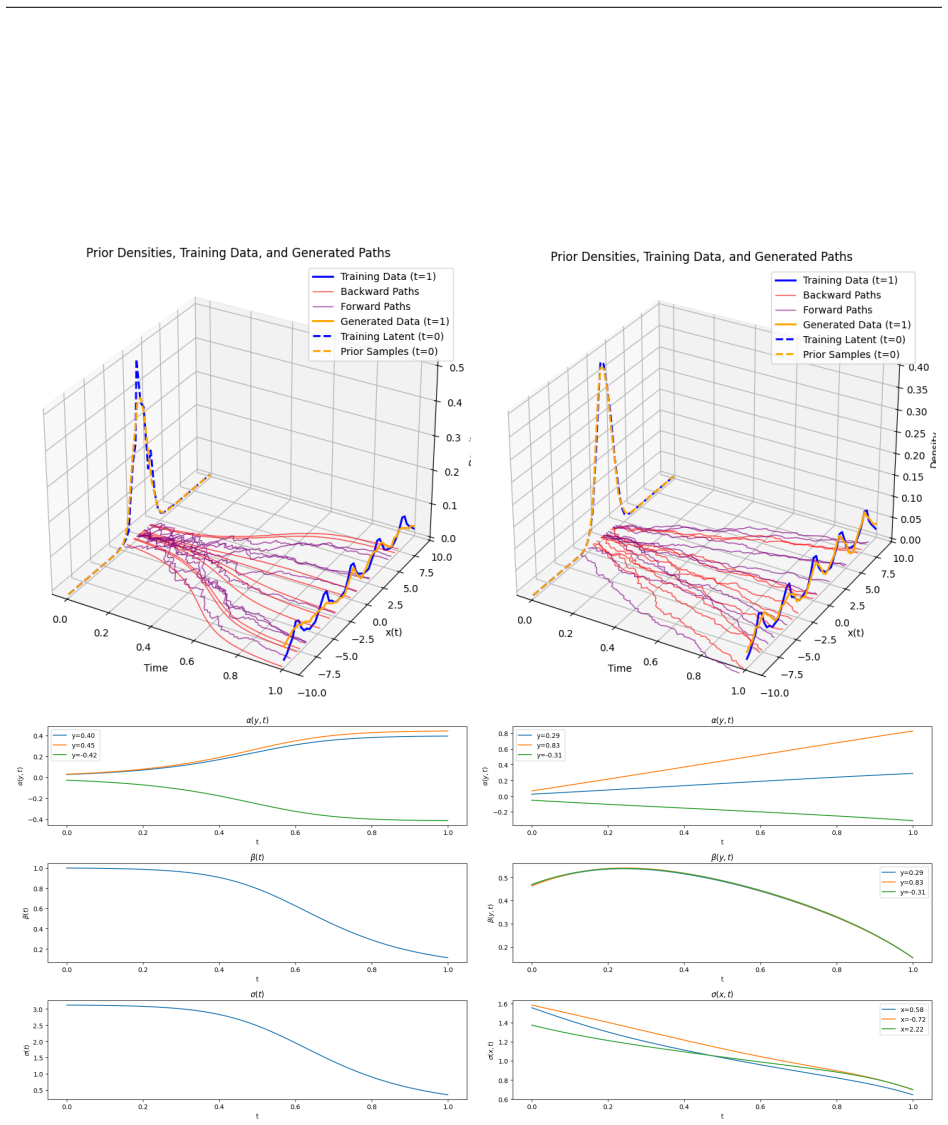
- The one-dimensional density modeling example provides a direct, low-dimensional test bed for comparing how different parameterizations affect performance.
- The Fokker-Planck derivation supplies the common probabilistic foundation that links the continuous-time dynamics across all listed methods.
Where Pith is reading between the lines
- Hybrid models could be constructed by mixing parameterization choices from diffusion, score, and flow matching inside one optimization.
- The framework suggests a systematic search over possible parameterizations rather than treating each named method as a separate research direction.
- Extending the same ELBO derivation to discrete or structured data might reveal whether the unification holds beyond continuous density estimation.
Load-bearing premise
The Fokker-Planck equation governs the temporal evolution of the marginal distribution of the stochastic variables in the generative modeling setup.
What would settle it
A derivation that expresses score matching or flow matching in a form that cannot be recovered as any parameterization of the ELBO derived from the Fokker-Planck equation.
Figures

read the original abstract
The use of ordinary and stochastic differential equations has led to substantial progress in generative machine learning with applications to, for example, image, video and biomolecule generation. This paper provides a self-contained and informal introduction to the differential equations, the probabilistic framework for using them in generative modeling and the Fokker--Planck equation that governs the temporal evolution of the marginal distribution of the stochastic variables of the differential equations. The variational lower bound on the log-likelihood (the evidence lower bound, ELBO) is derived and used as a general starting point for a discussion of diffusion models, score matching, and flow matching. All of these approaches may be viewed as specific parameterizations of the most general variational approach. A one-dimensional density modeling problem is used as a simple example to compare different parameterizations.
Editorial analysis
A structured set of objections, weighed in public.
Referee Report
Summary. The manuscript provides a self-contained informal introduction to stochastic differential equations (SDEs) and their use in generative machine learning. It presents the probabilistic framework, derives the Fokker-Planck equation governing the evolution of marginal distributions, and obtains the evidence lower bound (ELBO) as a variational starting point. Diffusion models, score matching, and flow matching are positioned as specific parameterizations of this general variational approach, with a one-dimensional density modeling example used for illustration.
Significance. If the exposition is accurate, the paper offers a pedagogical unification of several generative modeling techniques under the ELBO variational framework. The derivations rely on standard results (ELBO and Fokker-Planck), the 1D example is explicitly illustrative, and no free parameters or self-referential claims are introduced. This framing may aid clarity for newcomers, though the work contains no novel theoretical results or empirical contributions.
minor comments (2)
- The abstract states that the 1D example is used 'to compare different parameterizations,' but without a dedicated section or equation reference in the provided framing, it is unclear how the comparison is quantified (e.g., via explicit ELBO terms or sampling metrics).
- The manuscript describes itself as 'informal'; adding a brief note on the level of rigor (e.g., which steps invoke Itô calculus without proof) would help readers decide whether to consult primary references such as Øksendal.
Simulated Author's Rebuttal
We thank the referee for the careful reading and positive recommendation to accept the manuscript. The report accurately characterizes the paper as a self-contained informal introduction with no novel theoretical or empirical contributions.
Circularity Check
No significant circularity
full rationale
The paper is an expository introduction that derives the ELBO via standard variational inference and invokes the Fokker-Planck equation (the forward Kolmogorov equation for Itô SDEs) in its conventional form to relate marginal densities. It then frames diffusion models, score matching, and flow matching as parameterizations of this general variational setup. All load-bearing steps rely on external, well-established mathematical results rather than self-referential definitions, fitted inputs renamed as predictions, or self-citation chains. The one-dimensional example is illustrative only and introduces no circular reduction.
Axiom & Free-Parameter Ledger
axioms (2)
- standard math Standard properties of stochastic differential equations and the Fokker-Planck equation hold for the marginal distributions.
- domain assumption The evidence lower bound is a valid starting point for parameterizing generative models via variational inference.
Reference graph
Works this paper leans on
-
[1]
Stochastic Interpolants: A Unifying Framework for Flows and Diffusions
Michael S Albergo, Nicholas M Boffi, and Eric Vanden-Eijnden. Stochastic interpolants: A unifying frame- work for flows and diffusions.arXiv preprint arXiv:2303.08797,
work page internal anchor Pith review Pith/arXiv arXiv
-
[2]
Grigory Bartosh, Dmitry Vetrov, and Christian A Naesseth. Neural flow diffusion models: Learnable forward process for improved diffusion modelling.arXiv preprint arXiv:2404.12940,
-
[3]
Grigory Bartosh, Dmitry Vetrov, and Christian A Naesseth. Sde matching: Scalable and simulation-free training of latent stochastic differential equations.arXiv preprint arXiv:2502.02472,
-
[4]
Damiano Brigo. The general mixture-diffusion SDE and its relationship with an uncertain-volatility option model with volatility-asset decorrelation.arXiv preprint arXiv:0812.4052,
work page internal anchor Pith review Pith/arXiv arXiv
-
[5]
FFJORD: Free-form Continuous Dynamics for Scalable Reversible Generative Models
Will Grathwohl, Ricky TQ Chen, Jesse Bettencourt, Ilya Sutskever, and David Duvenaud. Ffjord: Free-form continuous dynamics for scalable reversible generative models.arXiv preprint arXiv:1810.01367,
work page internal anchor Pith review Pith/arXiv arXiv
-
[6]
Denoising Diffusion Probabilistic Models
Jonathan Ho, Ajay Jain, and Pieter Abbeel. Denoising diffusion probabilistic models.arXiv preprint arXiv:2006.11239,
work page internal anchor Pith review Pith/arXiv arXiv 2006
-
[7]
Jonathan Ho, Tim Salimans, Alexey Gritsenko, William Chan, Mohammad Norouzi, and David J Fleet. Video diffusion models.arXiv:2204.03458,
work page internal anchor Pith review Pith/arXiv arXiv
-
[8]
Chin-WeiHuang, JaeHyunLim, andAaronCourville
URLhttps://arxiv.org/abs/2203.17003. Chin-WeiHuang, JaeHyunLim, andAaronCourville. Avariationalperspectiveondiffusion-basedgenerative models and score matching,
-
[9]
Variational diffusion models.arXiv preprint arXiv:2107.00630, 2,
Diederik P Kingma, Tim Salimans, Ben Poole, and Jonathan Ho. Variational diffusion models.arXiv preprint arXiv:2107.00630, 2,
-
[10]
Flow Matching for Generative Modeling
Yaron Lipman, Ricky TQ Chen, Heli Ben-Hamu, Maximilian Nickel, and Matt Le. Flow matching for generative modeling.arXiv preprint arXiv:2210.02747,
work page internal anchor Pith review Pith/arXiv arXiv
-
[11]
Flow Straight and Fast: Learning to Generate and Transfer Data with Rectified Flow
Xingchao Liu, Chengyue Gong, and Qiang Liu. Flow straight and fast: Learning to generate and transfer data with rectified flow.arXiv preprint arXiv:2209.03003,
work page internal anchor Pith review Pith/arXiv arXiv
-
[12]
Diffenc: Variational diffusion with a learned encoder.arXiv preprint arXiv:2310.19789,
Beatrix MG Nielsen, Anders Christensen, Andrea Dittadi, and Ole Winther. Diffenc: Variational diffusion with a learned encoder.arXiv preprint arXiv:2310.19789,
-
[13]
Non-denoising forward-time diffusions
Stefano Peluchetti. Non-denoising forward-time diffusions.arXiv preprint arXiv:2312.14589,
-
[14]
doi: 10.1007/978-3-642-61544-3_4
ISBN 978-3-642-61544-3. doi: 10.1007/978-3-642-61544-3_4. URLhttps://doi.org/10.1007/ 978-3-642-61544-3_4. Simo Särkkä and Arno Solin.Applied stochastic differential equations, volume
-
[15]
Denoising Diffusion Implicit Models
Jiaming Song, Chenlin Meng, and Stefano Ermon. Denoising diffusion implicit models.arXiv preprint arXiv:2010.02502, 2020a. Yang Song and Stefano Ermon. Generative modeling by estimating gradients of the data distribution.arXiv preprint arXiv:1907.05600,
work page internal anchor Pith review Pith/arXiv arXiv 2010
-
[16]
Score-Based Generative Modeling through Stochastic Differential Equations
Yang Song, Jascha Sohl-Dickstein, Diederik P Kingma, Abhishek Kumar, Stefano Ermon, and Ben Poole. Score-based generative modeling through stochastic differential equations.arXiv preprint arXiv:2011.13456, 2020b. Yang Song, Conor Durkan, Iain Murray, and Stefano Ermon. Maximum likelihood training of score-based diffusion models.Advances in Neural Informat...
work page internal anchor Pith review Pith/arXiv arXiv 2011
-
[17]
Yang Song, Prafulla Dhariwal, Mark Chen, and Ilya Sutskever. Consistency models.arXiv preprint arXiv:2303.01469,
work page internal anchor Pith review Pith/arXiv arXiv
-
[18]
Alexander Tong, Nikolay Malkin, Kilian Fatras, Lazar Atanackovic, Yanlei Zhang, Guillaume Huguet, Guy Wolf, and Yoshua Bengio. Simulation-free Schrödinger bridges via score and flow matching.arXiv preprint arXiv:2307.03672, 2023a. Alexander Tong, Nikolay Malkin, Guillaume Huguet, Yanlei Zhang, Jarrid Rector-Brooks, Kilian Fatras, Guy Wolf, and Yoshua Beng...
-
[19]
21 A The Kramers–Moyal expansion and the Fokker–Planck equation In this appendix we show (i) a general Taylor series expansion expression for the partial time derivative of the marginal density that (ii) for the SDE will only consist of the first and second order term. The Fokker– Planck equation holds for any continuous-time stochastic process as long as...
1996
-
[20]
transition kernel
provide a tool to deal with jumps in the process, but this is beyond the scope of this paper. A.1 Kramers–Moyal The Fokker–Planck equation is a special case of a more general equation, the Kramers–Moyal expansion, that describes the evolution of the densitypt(x)over time in any stochastic process. In this section, we will derive the Kramers–Moyal expansio...
1967
-
[21]
This fundamental result is a consequence of the Liouville equation being a continuity equation for a conserved quantity, the probability, see for example Villani et al. (2009). Over time the probability density can change but the continuity equation ensures that the total probability is conserved. The Fokker–Planck equation generalizes probability conserv...
2009
-
[22]
marginalized
employ a different discretization that has the same continuous-time limit—see, for example, Song et al. (2020b, Appendix E) for a discussion. 29 where we have left the prior distributions unspecified for now. We plug in these distributions into the ELBO Equation (110). The KL divergence is the expectation with respect toq(X|y)of the following log-likeliho...
2021
discussion (0)
Sign in with ORCID, Apple, or X to comment. Anyone can read and Pith papers without signing in.