REVIEW 3 major objections 5 minor 106 references
Growing the Intermediate-mass Black Hole in Omega Centauri
T0 review · 3 major / 5 minor · reviewed 2026-08-06 · deepseek-v4-flash
Pith's one-line read This paper claims that Omega Centauri's central black hole grew from a small seed to roughly 50,000 solar masses by swallowing stellar-mass black holes, and that the resulting cluster models match the observed surface brightness, velocity…
desk verdict Solid simulation study with a genuinely new loss-cone treatment; the IMBH growth result is plausible but rides on an admittedly rough BH capture prescription that deserves more scrutiny. read the letter →
The pith
A machine-rendered reading of the paper's core claim, the machinery that carries it, and where it could break.
The reading
What carries the argument
The central object is the loss cone: the set of orbits whose pericenter distance falls within the tidal or Schwarzschild radius of the central black hole. The paper's key addition is an orbit-resolved random walk, in which each object's velocity vector is diffused over the number of orbits it completes within a Monte Carlo timestep, so that stars and black holes can enter the loss cone on orbital timescales. Binaries that enter the loss cone are integrated as three-body encounters with the black hole, which produces the fast ejected companions and the tightly bound stars that later become tidal disruption events. Compact objects whose gravitational-wave inspiral time is short are assumed to merge with the black hole, using the standard Peters equations for the inspiral timescale.
What would settle it
High-resolution observations of the inner 0.2 arcseconds of $\Omega$ Centauri that find no population of tightly bound fast stars produced by binary disruptions, together with a fully stellar-mass explanation of the central velocity dispersion rise, would contradict the paper's central growth scenario.
Extended reading notes
Core claim
Starting with a Monte Carlo model of a dense, massive stellar system with initial conditions meant to represent $\Omega$ Centauri, and placing a seed black hole of either 500 or 5,000 solar masses at the center, the paper finds that both seeds grow to 47,000 and 51,000 solar masses respectively by the present day. The overwhelming majority of the accreted mass comes from mergers with stellar-mass black holes, with tidal disruption of stars contributing only about 143 solar masses on average. The models also reproduce the cluster's surface brightness and proper-motion velocity dispersion profiles, including the central rise interpreted as evidence for an intermediate-mass black hole, and they naturally generate fast-moving stars through binary disruptions. On this basis, the authors conclude that $\Omega$ Centauri is consistent with hosting an intermediate-mass black hole that grew from a collision-runaway seed through dynamical captures of black holes.
Load-bearing premise
The models assume that only 2 percent of the cluster's stars were born in binary systems, and the fast-moving stars plus about half of the tidal disruption events come from those binaries, so a different binary fraction could change the predicted rates by an order of magnitude.
Editorial extensions
If this is right
- Intermediate-mass black hole seeds of only hundreds to thousands of solar masses can grow to tens of thousands of solar masses in dense stellar systems, so present-day IMBHs in globular clusters need not have been born massive.
- The predicted IMBH-BH merger rate of roughly $4\times10^{-8}$ to $8\times10^{-8}$ yr$^{-1}$ implies that Omega Centauri-like clusters could contribute events detectable by future space-based gravitational-wave observatories.
- The modeled tidal disruption event rate of about $5\times10^{-8}$ yr$^{-1}$ per cluster translates to a per-galaxy rate between $5\times10^{-8}$ and $10^{-6}$ yr$^{-1}$, suggesting that some observed TDEs may be off-nuclear and originate in stripped cluster nuclei.
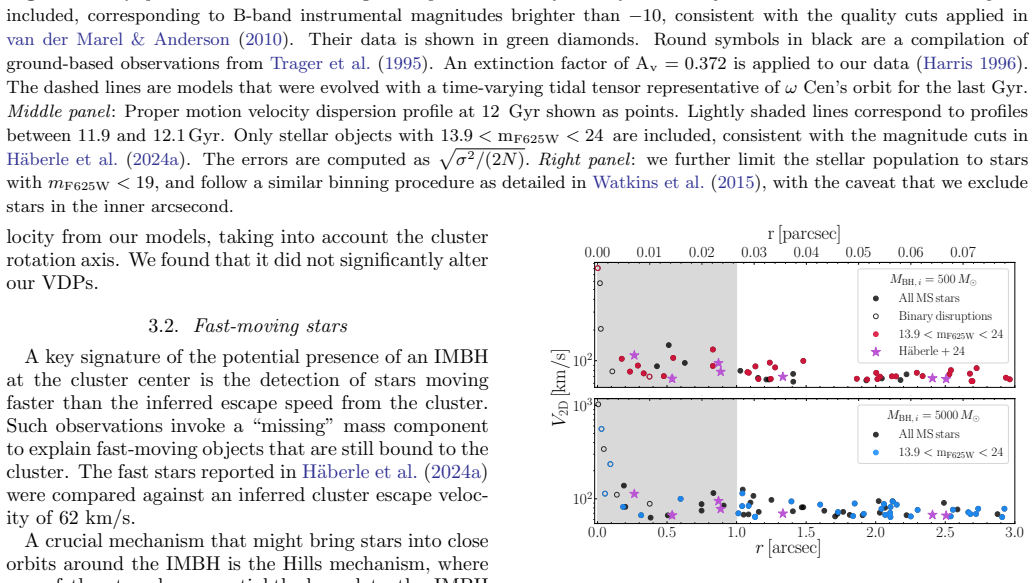
- The fast-moving stars produced by binary disruptions are concentrated within the innermost 0.2 arcseconds, making them a directly testable prediction for high-resolution observations of Omega Centauri.
- The models with a bottom-heavy initial mass function prevent the seed from growing too large, hinting that the IMBH may itself be the product of a runaway collision of massive stars.
Reading between the lines
- If the assumed 2 percent initial binary fraction is too low, the same mechanism could raise the tidal disruption event rate by an order of magnitude, making off-nuclear TDEs from dense clusters more common than the paper's baseline estimate.
- The growth channel described here suggests that other massive globular clusters and stripped dwarf nuclei with similar densities could host intermediate-mass black holes grown by the same process, potentially raising the black hole occupation fraction in low-mass stellar systems.
- The paper's treatment of inspiral assumes Keplerian orbits and does not self-consistently compute gravitational-wave orbital evolution, so the true balance between direct plunges and long inspirals could shift the predicted IMRI rates; resolving this would sharpen the LISA predictions.
- A direct test would be to search for the predicted tightly bound fast stars in the innermost arcsecond of Omega Centauri with JWST; detecting them would strongly support the binary-disruption origin of the fast-star population.
Editorial analysis
A structured set of objections, weighed in public.
Referee Report
Summary. The paper presents Monte Carlo cluster models of Omega Centauri with a central intermediate-mass black hole (IMBH) seed, using the CMC code with new prescriptions for loss-cone dynamics, binary disruptions, tidal disruption events (TDEs), and gravitational-wave inspirals of compact objects. Two best-fit models, starting with seeds of 500 and 5000 M_sun, grow to approximately 47,000 and 51,000 M_sun after 12 Gyr while reproducing the observed surface brightness and proper-motion velocity dispersion profiles (Section 3). The models produce fast-moving stars in the core, a present-day IMBH-BH capture rate of roughly (4-8)e-8 per year, and TDE rates around 5e-8 per year. The authors acknowledge in Section 4.2 that the BH capture rates are rough estimates and in Section 5 that the neglect of an IMBH-BH binary could reduce growth; Appendix A.2 validates the TDE loss-cone treatment against N-body simulations but does not validate the BH capture channel.
Significance. If the growth calculation is robust, the paper would provide a concrete and observationally motivated scenario in which low-mass IMBH seeds, consistent with runaway stellar collisions, grow to tens of thousands of solar masses through mergers with stellar-mass BHs in an Omega Cen-like cluster. This would connect the fast-star evidence of Haberle et al. (2024a) to a specific formation channel and would yield predictions for LISA-band IMRIs and off-nuclear TDE rates. The paper builds on public, well-tested codes (CMC, COSMIC, Fewbody), makes careful comparison to observational selection cuts, and provides a useful N-body benchmark for the TDE rate in Appendix A.2 as well as agreement with theoretical cusp slopes in Appendix A.3. However, the headline growth result depends on a BH capture prescription that the manuscript itself labels as rough and that lacks direct validation, and the fast-star comparison is presented more favorably in the abstract than the overproduction shown in Figure 2.
major comments (3)
- [§4.2, §5, Appendix A.2] The claim that the 500-5000 M_sun seeds grow to 47,000-51,000 M_sun rests on a BH capture prescription that the manuscript itself labels as giving only rough estimates and that lacks validation for the BH channel. The growth requires roughly 1,500 captured BHs with mean mass 31 M_sun, yet the capture rate is computed with isolated Keplerian inspiral times from Peters (1964) without resolving GW-driven orbital evolution, and Section 5 acknowledges that an IMBH-stellar-BH binary, which could dynamically eject BHs and reduce growth (Leigh et al. 2014), is neglected. The Appendix A.2 benchmark against Baumgardt et al. (2004) validates only TDE rates in a single-mass, stellar-evolution-free cluster; it does not test BH captures. Since a factor-of-two change in the net capture rate would move the final mass from roughly 50,000 M_sun down to about 25,000-30,000 M_sun and make the outcome seed-dependent, please add a validation or a quantitative bracketing of the unmodeled processes and adjust the abstract if the resulting uncertainty is wide.
- [§3.2 and abstract] The models overproduce fast-moving main-sequence stars compared to the seven HST detections (Figure 2), and the manuscript argues that selection effects (e.g., extremely tight orbits and measurement quality) remove the excess, but it does not model those effects. As written, the abstract's statement that the models produce 'a population of fast stars similar to those observed' overstates the agreement. The paper should either apply a mock-observation selection function to the simulated stars and show that the detected count is reproduced, or explicitly present the simulated fast-star population as an upper limit rather than as a matched population.
- [§2.1 and §3] The agreement with the surface brightness and velocity dispersion profiles is demonstrated only for two best-fit models selected from a grid of 35 runs, and the text reports that only bottom-heavy IMFs prevent excessive growth. Because the observed profiles were used to select the initial conditions, the match is not an independent test of the IMBH-growth scenario. Please report how the final IMBH mass, BH capture rate, and TDE rate vary across the explored parameter ranges (at least the IMF slope, virial radius, and binary fraction), so that the sensitivity of the headline numbers to the model-selection step is visible and the claim that the two seeds converge to a common final mass is supported.
minor comments (5)
- [§2, Eq. (2)] The product 'vR' in the loss-cone angle expression is notationally ambiguous; please define it explicitly as the product of the speed |v| and radius R to avoid confusion with a radial velocity component.
- [§4.1 and Figure 4] The text refers to dN/dβ ∝ β^-2, while the figure y-axis is labeled 'Density'; please clarify whether the plotted distribution is dN/dβ and make the axis label consistent with the text.
- [Figure 2] The left and right panels have different legend entries; the text says that empty circles denote stars produced by binary disruptions, but the right panel's legend omits this symbol, making it difficult to interpret the magnitude-selected comparison.
- [§2] Please verify the reference to 'Equations 5.4 and 5.5 from Peters (1964)'; the standard Peters equations for da/dt and de/dt are numbered differently, and a correct citation would improve reproducibility.
- [§1 and §4] The inferred allowed IMBH mass range from Haberle et al. (2024a) is quoted as 8,200-50,000 M_sun, yet the 5000 M_sun seed model reaches 51,000 M_sun; please comment explicitly on whether this is a hard upper limit or a bound with observational uncertainty.
Circularity Check
No core circularity; the profile match is partly a best-fit selection, but the IMBH growth and rates are emergent outputs.
-
other
[Section 2.1 (Initial Conditions) and Section 3.1 (Surface Brightness and Velocity Dispersion Profiles)]
"Out of a grid of 35 runs, we present our best-fit models with an initial number of N=1.1 × 10^7 particles, IMBH seeds of 500 M⊙ and 5000 M⊙ ... The models reproduce the observed data quite closely, only predicting a slightly brighter inner core."
The observed surface brightness and velocity dispersion profiles are presented as reproduced, but the models were specifically selected as the best fit to those same observations from a 35-run grid. The agreement is therefore a consequence of model selection rather than an independent prediction. This is a minor, framing-level circularity: the headline growth to ~47,000–51,000 M⊙ and the merger/TDE rates are not fitted to the fast-star or TDE observations; they emerge from the seed masses, IMF, and loss-cone/BH-capture prescriptions. The quoted BH-capture caveats and the neglected IMBH-BH binary channel weaken robustness but do not make the result equivalent to its inputs.
full rationale
The core derivation is not circular. The IMBH seed mass starts at 500 or 5000 M⊙ and grows to ~47,000–51,000 M⊙ through an explicitly prescribed BH-inspiral/TDE accretion treatment; these final masses and the quoted rates are simulation outputs, not fit parameters. The loss-cone treatment is benchmarked in Appendix A.2 against external direct N-body models (Baumgardt et al. 2004; Umbreit et al. 2012), which provides independent support for the TDE-disruption part of the calculation. Self-citations to CMC (Rodriguez et al. 2022) and to seed-formation runaway-collision papers (González Prieto et al. 2024; Sharma & Rodriguez 2025) are present, but they are not load-bearing for the central growth result: the growth is integrated dynamically in the code rather than imported as an assumption. The paper's own caveats—Keplerian inspiral approximations, unresolved GW orbital evolution, and neglect of an IMBH-BH binary that could eject BHs (Leigh et al. 2014)—are robustness concerns, not circularity, because they affect the accuracy of the emergent rates rather than defining those rates as inputs. The only mild circularity is the validation framing: the models are 'best-fit' to the very SBP/VDP profiles shown as agreement, so that comparison should be read as calibration, not as an independent prediction.
Assumptions & free parameters
free parameters (8)
- Initial IMBH seed mass =
500 Msun and 5000 Msun
- Initial number of particles N =
1.1e7
- Virial radius =
5 pc
- IMF slope alpha_3 (bottom-heavy) =
2.5
- Elson profile gamma =
3
- Initial binary fraction =
0.02
- TDE accretion fraction =
0.5
- Adaptive random walk parameter c_safe =
0.2
assumptions (6)
- domain assumption Cluster is spherically symmetric with a single epoch of star formation (CMC limitation).
- domain assumption IMBH is fixed point particle at cluster center.
- domain assumption Orbits for GW inspiral are Keplerian and not self-consistently evolved.
- domain assumption Tidal disruption radius formula assumes non-spinning BH and non-rotating star.
- domain assumption Loss cone random walk reproduces two-body relaxation (validated against N-body).
- ad hoc to paper Elson profile with gamma=3 approximates Omega Cen's initial density distribution.
Cite this review
Pith. "Pith review of Growing the Intermediate-mass Black Hole in Omega Centauri." pith.science (2026). https://pith.science/paper/RHANT5Q2
@misc{pith2026250706316,
  author       = {Pith},
  title        = {Pith review of: Growing the Intermediate-mass Black Hole in Omega Centauri},
  year         = {2026},
  howpublished = {\url{https://pith.science/paper/RHANT5Q2}},
  note         = {Machine review of arXiv:2507.06316}
}
abstract
The recent detection of fast-moving stars in the core of Omega Centauri ($\omega$ Cen), the most massive globular cluster (GC) in the Milky Way, has provided strong evidence for the presence of an intermediate-mass black hole (IMBH). As $\omega$ Cen, is likely the accreted nucleus of a dwarf galaxy, this IMBH also represents a unique opportunity to study BH seeding mechanisms and their potential role in the formation of supermassive BHs. We present Monte Carlo $N$-body models of $\omega$ Cen with detailed treatments for the loss cone dynamics involving stars, binaries, and compact objects. Starting with BH seeds of $500-5000 \, M_{\odot}$ (consistent with runaway collisions of massive stars), our cluster models grow IMBHs with masses of $\sim50{,}000 \, M_{\odot}$ after 12 Gyr, while successfully reproducing the present-day surface brightness and velocity dispersion profiles of $\omega$ Cen. We find a population of fast stars similar to those observed in the core of $\omega$ Cen, with the fastest stars originating from binaries that were tidally disrupted by the IMBH. The IMBH growth is primarily driven by mergers with $30-40 \, M_{\odot}$ BHs, suggesting a present-day IMBH-BH merger rate of $\sim(4-8)\times10^{-8}~\rm{yr}^{-1}$ in $\omega$ Cen-like GCs. Our models also predict a similar rate of tidal disruption events ($\sim5\times10^{-8}~\rm{yr}^{-1}$) which, depending on the frequency of $\omega$ Cen-like GCs per galaxy, may represent anywhere from $0.1\%$ to $10\%$ of the observed TDE rate.
Figures


Figures from the paper (7 more)


Reference graph
Works this paper leans on
-
[1]
, " * write output.state after.block = add.period write newline
ENTRY address archivePrefix author booktitle chapter doi edition editor eprint howpublished institution journal key month number organization pages publisher school series title misctitle type volume year version url label extra.label sort.label short.list INTEGERS output.state before.all mid.sentence after.sentence after.block FUNCTION init.state.consts ...
-
[2]
write newline
" write newline "" before.all 'output.state := FUNCTION format.url url empty "" new.block "" url * "" * if FUNCTION format.eprint eprint empty "" archivePrefix empty "" archivePrefix "arXiv" = new.block " " eprint * " " * new.block " " eprint * " " * if if if FUNCTION format.doi doi empty "" " " doi * " " * if FUNCTION format.pid doi empty eprint empty ur...
-
[3]
m-*hՐ=M8DeB,߽Xsؐ&I kLE- )ȚՄ\ ;0<H P` L* B )4OK4jZm k ?L0S * ) Y Dd g 7 AE J) PE` -Q7ZIdV߮Y E V h E` BmHe dg_0 R@ ˤ,U6 8DS#k IG BiH@7=z\轏. (.V ѓ f&Je`Ƭ
thebibliography [1] 20pt to REFERENCES 6pt =0pt -12pt 10pt plus 3pt =0pt =0pt =1pt plus 1pt =0pt =0pt -12pt =13pt plus 1pt =20pt =13pt plus 1pt \@M =10000 =-1.0em =0pt =0pt 0pt =0pt =1.0em @enumiv\@empty 10000 10000 `\.\@m \@noitemerr \@latex@warning Empty `thebibliography' environment \@ifnextchar \@reference \@latexerr Missing key on reference command E...
2021
-
[4]
Abt , H. A. 1983, , 21, 343, 10.1146/annurev.aa.21.090183.002015
arXiv 1983
-
[5]
2017, , 55, 17, 10.1146/annurev-astro-091916-055306
Alexander , T. 2017, , 55, 17, 10.1146/annurev-astro-091916-055306
-
[6]
2009, , 697, 1861, 10.1088/0004-637X/697/2/1861
Alexander , T., & Hopman , C. 2009, , 697, 1861, 10.1088/0004-637X/697/2/1861
-
[7]
Anderson , J., & van der Marel , R. P. 2010, , 710, 1032, 10.1088/0004-637X/710/2/1032
-
[8]
Bahcall , J. N., & Wolf , R. A. 1976, , 209, 214, 10.1086/154711
doi:10.1086/154711 1976
Show all 106 references
- [9]
-
[10]
2016, , 820, 129, 10.3847/0004-637X/820/2/129
Bar-Or , B., & Alexander , T. 2016, , 820, 129, 10.3847/0004-637X/820/2/129
2016 doi
-
[11]
2017, , 464, 2174, 10.1093/mnras/stw2488
Baumgardt , H. 2017, , 464, 2174, 10.1093/mnras/stw2488
2017 doi
-
[12]
2019 a , , 482, 5138, 10.1093/mnras/sty2997
Baumgardt , H., Hilker , M., Sollima , A., & Bellini , A. 2019 a , , 482, 5138, 10.1093/mnras/sty2997
2019 doi
-
[13]
2004, The Astrophysical Journal, 613, 1133, 10.1086/423298
Baumgardt, H., Makino, J., & Ebisuzaki, T. 2004, The Astrophysical Journal, 613, 1133, 10.1086/423298
2004 doi
-
[14]
M., et al
Baumgardt , H., He , C., Sweet , S. M., et al. 2019 b , , 488, 5340, 10.1093/mnras/stz2060
2019 doi
-
[15]
Bekki , K., & Freeman , K. C. 2003, , 346, L11, 10.1046/j.1365-2966.2003.07275.x
2003
-
[16]
P., del Pino , A., et al
Bianchini , P., van der Marel , R. P., del Pino , A., et al. 2018, , 481, 2125, 10.1093/mnras/sty2365
2018 doi
-
[17]
2018, , 479, 2789, 10.1093/mnras/sty1601
Boubert , D., Guillochon , J., Hawkins , K., et al. 2018, , 479, 2789, 10.1093/mnras/sty1601
2018 doi
-
[18]
2020, , 898, 71, 10.3847/1538-4357/ab9d85
Breivik , K., Coughlin , S., Zevin , M., et al. 2020, , 898, 71, 10.3847/1538-4357/ab9d85
2020 doi
-
[19]
2020, , 890, 73, 10.3847/1538-4357/ab6989
Bricman , K., & Gomboc , A. 2020, , 890, 73, 10.3847/1538-4357/ab6989
2020 doi
-
[20]
R., Geller , M
Brown , W. R., Geller , M. J., Kenyon , S. J., & Kurtz , M. J. 2005, , 622, L33, 10.1086/429378
2005 doi
-
[21]
Chang , J. N. Y., Dai , L., Pfister , H., Kar Chowdhury , R., & Natarajan , P. 2025, , 980, L22, 10.3847/2041-8213/adace7
2025 doi
-
[22]
C., Dotter , A., et al
Clontz , C., Seth , A. C., Dotter , A., et al. 2024, , 977, 14, 10.3847/1538-4357/ad8621
2024 doi
-
[23]
N., Mapelli , M., Pasquato , M., et al
Di Carlo , U. N., Mapelli , M., Pasquato , M., et al. 2021, , 507, 5132, 10.1093/mnras/stab2390
2021 doi
-
[24]
I., Girard , T
Dinescu , D. I., Girard , T. M., & van Altena , W. F. 1999, , 117, 1792, 10.1086/300807
1999 doi
-
[25]
L., Brandt , W
Donley , J. L., Brandt , W. N., Eracleous , M., & Boller , T. 2002, , 124, 1308, 10.1086/342280
2002 doi
-
[26]
Elson , R. A. W., Fall , S. M., & Freeman , K. C. 1987, , 323, 54, 10.1086/165807
1987 doi
-
[27]
R., Bellazzini , M., & Pancino , E
Ferraro , F. R., Bellazzini , M., & Pancino , E. 2002, , 573, L95, 10.1086/342087
2002 doi
- [28]
-
[29]
M., Cheung , P., Portegies Zwart , S
Fregeau , J. M., Cheung , P., Portegies Zwart , S. F., & Rasio , F. A. 2004, , 352, 1, 10.1111/j.1365-2966.2004.07914.x
2004
- [30]
-
[31]
2006, , 649, 91, 10.1086/506193
Freitag , M., Amaro-Seoane , P., & Kalogera , V. 2006, , 649, 91, 10.1086/506193
2006 doi
-
[32]
2001, , 375, 711, 10.1051/0004-6361:20010706
Freitag , M., & Benz , W. 2001, , 375, 711, 10.1051/0004-6361:20010706
2001 doi
-
[33]
M., Rhee , J., Ostheimer , J
Frinchaboy , P. M., Rhee , J., Ostheimer , J. C., et al. 2002, in Astronomical Society of the Pacific Conference Series, Vol. 265, Omega Centauri, A Unique Window into Astrophysics, ed. F. van Leeuwen , J. D. Hughes , & G. Piotto , 143, 10.48550/arXiv.astro-ph/0112169
- [35]
-
[36]
2006, , 368, 221, 10.1111/j.1365-2966.2006.10091.x
Ginsburg , I., & Loeb , A. 2006, , 368, 221, 10.1111/j.1365-2966.2006.10091.x
2006
-
[37]
2021, , 908, L29, 10.3847/2041-8213/abdf5b
Gonz \'a lez , E., Kremer , K., Chatterjee , S., et al. 2021, , 908, L29, 10.3847/2041-8213/abdf5b
2021 doi
-
[38]
C., Fragione , G., Kremer , K., & Rasio , F
Gonz \'a lez Prieto , E., Weatherford , N. C., Fragione , G., Kremer , K., & Rasio , F. A. 2024, , 969, 29, 10.3847/1538-4357/ad43d6
2024 doi
-
[39]
Greene , J. E. 2012, Nature Communications, 3, 1304, 10.1038/ncomms2314
2012 doi
-
[40]
A., Freitag , M., & Rasio , F
G \"u rkan , M. A., Freitag , M., & Rasio , F. A. 2004, , 604, 632, 10.1086/381968
2004 doi
-
[41]
2024 a , , 631, 285, 10.1038/s41586-024-07511-z
H \"a berle , M., Neumayer , N., Seth , A., et al. 2024 a , , 631, 285, 10.1038/s41586-024-07511-z
2024 doi
-
[42]
2024 b , , 970, 192, 10.3847/1538-4357/ad47f5
H \"a berle , M., Neumayer , N., Bellini , A., et al. 2024 b , , 970, 192, 10.3847/1538-4357/ad47f5
2024 doi
-
[43]
2025, , 983, 95, 10.3847/1538-4357/adbe67
H \"a berle , M., Neumayer , N., Clontz , C., et al. 2025, , 983, 95, 10.3847/1538-4357/adbe67
2025 doi
-
[44]
H., Stone , N
Hannah , C. H., Stone , N. C., Seth , A. C., & van Velzen , S. 2025, , 988, 29, 10.3847/1538-4357/addd1b
2025 doi
-
[45]
Harris , W. E. 1996, , 112, 1487, 10.1086/118116
1996 doi
-
[46]
Heggie , D. C. 1975, , 173, 729, 10.1093/mnras/173.3.729
1975 doi
- [47]
-
[48]
Hills , J. G. 1988, , 331, 687, 10.1038/331687a0
1988 doi
-
[49]
2005, , 629, 362, 10.1086/431475
Hopman , C., & Alexander , T. 2005, , 629, 362, 10.1086/431475
2005 doi
- [50]
-
[51]
2024, , 527, 1865, 10.1093/mnras/stad3269
Huang , H.-T., & Lu , W. 2024, , 527, 1865, 10.1093/mnras/stad3269
2024 doi
-
[52]
2004, , 616, L107, 10.1086/426505
Ideta , M., & Makino , J. 2004, , 616, L107, 10.1086/426505
2004 doi
-
[53]
1983, , 202, 995, 10.1093/mnras/202.4.995
Jaffe , W. 1983, , 202, 995, 10.1093/mnras/202.4.995
1983 doi
-
[54]
2012, , 538, A19, 10.1051/0004-6361/201116923
Jalali , B., Baumgardt , H., Kissler-Patig , M., et al. 2012, , 538, A19, 10.1051/0004-6361/201116923
2012 doi
-
[55]
I., & Pilachowski , C
Johnson , C. I., & Pilachowski , C. A. 2010, , 722, 1373, 10.1088/0004-637X/722/2/1373
2010 doi
-
[56]
J., Rasio , F
Joshi , K. J., Rasio , F. A., & Portegies Zwart , S. 2000, , 540, 969, 10.1086/309350
2000 doi
-
[57]
2025, , 980, 150, 10.3847/1538-4357/ada8a8
Kaur , K., Rom , B., & Sari , R. 2025, , 980, 150, 10.3847/1538-4357/ada8a8
2025 doi
-
[58]
2012, , 85, 024037, 10.1103/PhysRevD.85.024037
Kesden , M. 2012, , 85, 024037, 10.1103/PhysRevD.85.024037
2012 doi
-
[59]
E., Boubert , D., Li , T
Koposov , S. E., Boubert , D., Li , T. S., et al. 2020, , 491, 2465, 10.1093/mnras/stz3081
2020 doi
-
[60]
2001, , 322, 231, 10.1046/j.1365-8711.2001.04022.x
Kroupa , P. 2001, , 322, 231, 10.1046/j.1365-8711.2001.04022.x
2001
-
[61]
Kruijssen , J. M. D., & Cooper , A. P. 2012, , 420, 340, 10.1111/j.1365-2966.2011.20037.x
2012
-
[62]
2019, , 882, L25, 10.3847/2041-8213/ab379a
Law-Smith , J., Guillochon , J., & Ramirez-Ruiz , E. 2019, , 882, L25, 10.3847/2041-8213/ab379a
2019 doi
- [63]
-
[64]
Leigh , N. W. C., L \"u tzgendorf , N., Geller , A. M., et al. 2014, , 444, 29, 10.1093/mnras/stu1437
2014 doi
- [65]
-
[66]
2024, , 977, L2, 10.3847/2041-8213/ad9384
Limberg , G. 2024, , 977, L2, 10.3847/2041-8213/ad9384
2024 doi
-
[67]
2012, , 757, 134, 10.1088/0004-637X/757/2/134
MacLeod , M., Guillochon , J., & Ramirez-Ruiz , E. 2012, , 757, 134, 10.1088/0004-637X/757/2/134
2012 doi
-
[68]
1999, , 309, 447, 10.1046/j.1365-8711.1999.02853.x
Magorrian , J., & Tremaine , S. 1999, , 309, 447, 10.1046/j.1365-8711.1999.02853.x
1999
-
[69]
2025, , 694, A272, 10.1051/0004-6361/202452306
Mancieri , D., Broggi , L., Bonetti , M., & Sesana , A. 2025, , 694, A272, 10.1051/0004-6361/202452306
2025 doi
-
[70]
E., & van der Marel , R
McLaughlin , D. E., & van der Marel , R. P. 2005, , 161, 304, 10.1086/497429
2005 doi
-
[71]
2019, , 872, 151, 10.3847/1538-4357/ab010f
Mockler , B., Guillochon , J., & Ramirez-Ruiz , E. 2019, , 872, 151, 10.3847/1538-4357/ab010f
2019 doi
-
[72]
2024, , 527, 2452, 10.1093/mnras/stad3001
Mummery , A., van Velzen , S., Nathan , E., et al. 2024, , 527, 2452, 10.1093/mnras/stad3001
2024 doi
-
[73]
S., Neumayer , N., H \"a berle , M., et al
Nitschai , M. S., Neumayer , N., H \"a berle , M., et al. 2024, , 970, 152, 10.3847/1538-4357/ad5289
2024 doi
-
[74]
E., Freeman , K
Norris , J. E., Freeman , K. C., Mayor , M., & Seitzer , P. 1997, , 487, L187, 10.1086/310895
1997 doi
-
[75]
R., Bellazzini , M., Piotto , G., & Zoccali , M
Pancino , E., Ferraro , F. R., Bellazzini , M., Piotto , G., & Zoccali , M. 2000, , 534, L83, 10.1086/312658
2000 doi
-
[76]
Peters, P. C. 1964, Phys. Rev., 136, B1224, 10.1103/PhysRev.136.B1224
1964 doi
-
[77]
L., & Colpi , M
Pfister , H., Volonteri , M., Dai , J. L., & Colpi , M. 2020, , 497, 2276, 10.1093/mnras/staa1962
2020 doi
-
[78]
Price-Whelan, A. M. 2017, The Journal of Open Source Software, 2, 10.21105/joss.00388
2017 doi
-
[79]
Qunbar , I., & Stone , N. C. 2024, , 133, 141401, 10.1103/PhysRevLett.133.141401
2024 doi
-
[80]
Rees , M. J. 1988, , 333, 523, 10.1038/333523a0
1988 doi
- [81]
-
[82]
L., Hafen , Z., Grudi \'c , M
Rodriguez , C. L., Hafen , Z., Grudi \'c , M. Y., et al. 2023, , 521, 124, 10.1093/mnras/stad578
2023 doi
-
[83]
L., Weatherford, N
Rodriguez, C. L., Weatherford, N. C., Coughlin, S. C., et al. 2022, , 258, 22, 10.3847/1538-4365/ac2edf
2022 doi
-
[84]
2024, , 977, 7, 10.3847/1538-4357/ad8b1d
Rom , B., Linial , I., Kaur , K., & Sari , R. 2024, , 977, 7, 10.3847/1538-4357/ad8b1d
2024 doi
- [85]
-
[86]
Rosswog , S., Ramirez-Ruiz , E., & Hix , W. R. 2009, , 695, 404, 10.1088/0004-637X/695/1/404
2009 doi
-
[87]
2017, , 95, 083001, 10.1103/PhysRevD.95.083001
Servin , J., & Kesden , M. 2017, , 95, 083001, 10.1103/PhysRevD.95.083001
2017 doi
-
[88]
Sharma , K., & Rodriguez , C. L. 2025, , 983, 162, 10.3847/1538-4357/adbbdf
2025 doi
-
[89]
2013, , 435, 1809, 10.1093/mnras/stt1270
Stone , N., Sari , R., & Loeb , A. 2013, , 435, 1809, 10.1093/mnras/stt1270
2013 doi
-
[90]
C., K \"u pper , A
Stone , N. C., K \"u pper , A. H. W., & Ostriker , J. P. 2017, , 467, 4180, 10.1093/mnras/stx097
2017 doi
- [91]
-
[92]
E., & Quataert , E
Strubbe , L. E., & Quataert , E. 2009, , 400, 2070, 10.1111/j.1365-2966.2009.15599.x
2009
-
[93]
L., Madau , P., Bortolas , E., et al
Tang , V. L., Madau , P., Bortolas , E., et al. 2024, , 963, 146, 10.3847/1538-4357/ad1dd9
2024 doi
-
[94]
C., King , I
Trager , S. C., King , I. R., & Djorgovski , S. 1995, , 109, 218, 10.1086/117268
1995 doi
-
[95]
I., & Korchagin , V
Tsuchiya , T., Dinescu , D. I., & Korchagin , V. I. 2003, , 589, L29, 10.1086/375805
2003 doi
-
[96]
M., Chatterjee , S., & Rasio , F
Umbreit , S., Fregeau , J. M., Chatterjee , S., & Rasio , F. A. 2012, , 750, 31, 10.1088/0004-637X/750/1/31
2012 doi
-
[97]
P., & Anderson , J
van der Marel , R. P., & Anderson , J. 2010, , 710, 1063, 10.1088/0004-637X/710/2/1063
2010 doi
-
[98]
S., Reijns , R
van Leeuwen , F., Le Poole , R. S., Reijns , R. A., Freeman , K. C., & de Zeeuw , P. T. 2000, , 360, 472
2000
-
[99]
E., Stone , N
van Velzen , S., Anderson , G. E., Stone , N. C., et al. 2016, Science, 351, 62, 10.1126/science.aad1182
2016 doi
-
[100]
2021, , 505, 5978, 10.1093/mnras/stab1475
Vasiliev , E., & Baumgardt , H. 2021, , 505, 5978, 10.1093/mnras/stab1475
2021 doi
-
[101]
T., Seth , A
Voggel , K. T., Seth , A. C., Baumgardt , H., et al. 2019, , 871, 159, 10.3847/1538-4357/aaf735
2019 doi
-
[102]
2010, , 18, 279, 10.1007/s00159-010-0029-x
Volonteri , M. 2010, , 18, 279, 10.1007/s00159-010-0029-x
2010 doi
-
[103]
2004, , 600, 149, 10.1086/379767
Wang , J., & Merritt , D. 2004, , 600, 149, 10.1086/379767
2004 doi
-
[104]
L., van der Marel , R
Watkins , L. L., van der Marel , R. P., Bellini , A., & Anderson , J. 2015, , 803, 29, 10.1088/0004-637X/803/1/29
2015 doi
-
[105]
2024, , 535, 781, 10.1093/mnras/stae2333
Wragg , F., Kamann , S., Saracino , S., et al. 2024, , 535, 781, 10.1093/mnras/stae2333
2024 doi
-
[106]
2023, , 955, L6, 10.3847/2041-8213/acf216
Yao , Y., Ravi , V., Gezari , S., et al. 2023, , 955, L6, 10.3847/2041-8213/acf216
2023 doi
-
[107]
2019, , 482, 4713, 10.1093/mnras/sty1508
Zocchi , A., Gieles , M., & H \'e nault-Brunet , V. 2019, , 482, 4713, 10.1093/mnras/sty1508
2019 doi
Reviewed August 6, 2026 · model on record in the stance chip above.
Discussion (0). Continue with ORCID to comment.