REVIEW 3 major objections 6 minor 1 cited by
Comprehensive Examination of Unrolled Networks for Solving Linear Inverse Problems
T0 review · 3 major / 6 minor · reviewed 2026-08-10 · deepseek-v4-flash
Pith's one-line read A memory-based unrolled network that reuses every past gradient and is trained with an unweighted sum of intermediate reconstruction errors achieves the best reconstruction quality among the tested unrolled designs.
desk verdict Useful broad ablation and a clean generalization (DeMUN), but no seed variance undercuts the 'uniformly' claims; accept for peer review, then revise. read the letter →
The pith
A machine-rendered reading of the paper's core claim, the machinery that carries it, and where it could break.
The reading
What carries the argument
The machine that carries the argument is the Deep Memory Unrolled Network (DeMUN) update $$\tilde{x}_i = \alpha_i x_i + \sum_{j=0}^{i} \beta_i^j A^\top(y - A x_j),$$ followed by a learned projection $x_{i+1} = P_C(\tilde{x}_i)$ or the residual variant $x_{i+1} = \tilde{x}_i + P_C(\tilde{x}_i)$. The coefficients $\alpha_i, \beta_i^j$ are learned, so the data chooses how much of each past gradient to keep; the update reduces to standard gradient descent when only the current gradient survives and to momentum- or message-passing-style updates under other coefficient patterns. The second piece is the unweighted intermediate loss $\ell_{i,1} = \sum_{i=1}^{T} \|x_i - x^*\|_2^2$, which supervises every unrolled estimate instead of only the final one. Together they make the training landscape smoother and let extra unrolled steps keep improving the estimate, which underlies the headline performance claims.
What would settle it
Take a structured measurement operator from a real imaging modality, for example radial or Cartesian-sampled MRI with realistic receiver noise, and train the recommended configuration (DeMUN, unweighted intermediate loss, residual connections) against a standard unrolled baseline such as projected gradient descent with last-layer loss. If the recommended configuration fails to match or beat that baseline in reconstruction quality on held-out images, the paper's central recommendation would be shown not to transfer.
Extended reading notes
Core claim
The central discovery is that the choice of algorithm to unroll can be eliminated: DeMUN lets training learn the memory coefficients, and with an unweighted intermediate loss and residual connections it consistently outperforms unrolled projected gradient descent, momentum acceleration, and approximate message passing. With the last-layer loss, extra unrolled steps give almost no gain; with the intermediate loss, performance improves with more steps and plateaus rather than degrading. The paper also finds that weighting early layers slightly less (omega=0.95, 0.85) does not hurt, but weighting them much less (omega <= 0.5) or using skip-layer supervision degrades performance, and that increasing the number of projector layers from 5 to 15 is inconsequential while dropping to 3 hurts. These results hold for both Gaussian and DCT matrices, under additive noise, and across image resolutions from 32 by 32 to 80 by 80.
Load-bearing premise
The recipe was measured on Gaussian and DCT measurement operators acting on grayscale natural-image crops up to 80 by 80, and the paper's recommendations assume these findings transfer to other linear inverse problems, such as MRI or CT, where the forward operator is structured, the noise enters differently, and the image statistics differ.
Editorial extensions
If this is right
- Training with the unweighted intermediate loss turns extra unrolled steps from a liability into a monotone, plateauing improvement, so a practitioner can pick a large step count without fear of overfitting.
- The algorithm-choice decision disappears: because DeMUN contains projected gradient descent, momentum, and message-passing-style updates as special cases, the learned coefficients select the effective update, and the paper finds DeMUN matches or beats those baselines.
- The loss-weighting choice is forgiving: any omega in [0.75, 1] performs about as well as the unweighted intermediate loss, so users do not need to tune the exponential weighting precisely.
- Projector capacity is not a sensitive dial: 5 to 15 convolutional layers give nearly identical PSNR, including under noise and DCT operators, so small projectors can be used to save computation.
- Robustness checks show the same design choices work for DCT matrices, additive Gaussian noise, and resolutions from 32 to 80, and reconstruction degrades more slowly than the input SNR.
Reading between the lines
- The same recipe could be stress-tested on structured medical operators such as radial or Cartesian-sampled MRI and fan-beam CT; if it holds there, the paper's recipe becomes a default starting point for new imaging systems.
- The slower-than-input-SNR degradation suggests the trained network behaves partly as a denoiser; a testable extension is to compare DeMUN's reconstruction error against state-evolution predictions of approximate message passing in the large-system limit.
- The interaction between DeMUN's many parameters and the last-layer loss, where DeMUN sometimes loses to projected gradient descent, hints that intermediate supervision rescues high-capacity unrolled networks from poor local minima; one could test this by visualizing loss-landscape curvature or varying parameter count.
Editorial analysis
A structured set of objections, weighed in public.
Referee Report
Summary. The paper studies design choices for unrolled networks solving linear inverse problems y = Ax + w. It introduces DeMUN, an unrolled architecture whose linear step is a learned combination of the current iterate and all past gradient terms A^T(y - Ax_j), implemented as trainable 1x1 convolutions; this generalizes PGD, Nesterov, and AMP in a single framework. The core empirical contribution is an extensive ablation across loss functions (last-layer, weighted intermediate, and skip-L intermediate losses), residual connections, the number of unrolled steps T ∈ {5, 15, 30}, DnCNN projector depth L ∈ {3, 5, 10, 15}, sampling rates {0.1, 0.2, 0.3, 0.4}n, Gaussian and DCT measurement matrices, additive Gaussian noise levels, and image resolutions from 32x32 to 80x80. Based on test PSNR on 2500 ImageNet validation crops, the authors propose four hypotheses and recommend DeMUN trained with the unweighted intermediate loss ℓ_{i,1} and residual connections.
Significance. If the empirical ordering is reproducible, the paper would give practitioners a useful shortcut: they could avoid sweeping over optimization algorithms, loss functions, and projector depths when designing unrolled networks. DeMUN is a clean and simple generalization, the ablation grid is broad, the DCT and noise robustness checks go beyond many ablation studies, and the code is publicly linked. The main limitations are statistical and interpretive: all comparisons come from single training runs, several gaps are tiny (0.01–0.2 dB), the word 'uniformly' is used without error bars, and Hypothesis 4 is internally contradicted by the paper's own DCT results. With repeated-training statistics and refined claims, this would be a valuable reference for the field.
major comments (3)
- [Sec. 4.3–4.4, Tables 4–6] The central claims that intermediate loss and residual connections 'uniformly' or 'consistently' improve performance are based on single training runs. Many reported differences are smaller than typical Adam run-to-run variation: for example, Table 5 (T=15, m=0.1n) shows PGD without residual at 26.42 dB and with residual at 26.43 dB, and Table 4 (m=0.1n) shows DeMUN at 26.09 vs 26.29 dB. No seeds, repeated runs, or confidence intervals are reported, so the pairwise ordering is not quantified. Because Hypotheses 1 and 2 use universal language, please report multi-seed means with standard deviations (or at least the number of seeds and observed range) and, where gaps are below roughly 0.1 dB, state that the difference is not statistically meaningful. This is load-bearing: reversal of even a few small-gap comparisons would weaken the 'uniformly' claims.
- [Sec. 4.6 and 5.3, Tables 10–12 and 18–20] Hypothesis 4 is not robust as stated. The hypothesis says that increasing L from 3 to 5 yields a 'noticeable improvement,' but Table 10 shows L=3 outperforming L=5 at m=0.1n (26.33 vs 26.29 dB) and Table 11 shows the same at m=0.4n (34.49 vs 34.43 dB). Moreover, in Section 5.3 the authors acknowledge that for DCT matrices 'in most cases... the performance gain from increasing L from 3 to 5 is also marginal,' which directly contradicts the unqualified claim in Hypothesis 4. Please either weaken the hypothesis (for example, 'L=3 can be slightly worse or comparable to L=5; L=5 is a safe default') or provide statistical evidence for a genuine improvement from L=3 to 5.
- [Sec. 4.3, Hypothesis 1 and Tables 1–3] The paper states that 'Among all algorithms that we have unrolled... DeMUN achieves the highest PSNR values when trained with the intermediate loss,' and the tables support that restricted claim. However, the broad wording of Hypothesis 1 and the abstract-level summary can be read as claiming DeMUN superiority regardless of loss. Under the last-layer loss, Tables 1–3 show PGD and Nesterov sometimes beating DeMUN (for example, Table 2, m=0.2n: PGD 27.71 vs DeMUN 27.23; Table 2, m=0.1n: PGD 24.72 vs DeMUN 24.42). The footnote acknowledges this, but the main text should make the restriction explicit in the hypothesis statement and in Section 6. Please rephrase to say that DeMUN superiority is demonstrated for the intermediate-loss configuration and not claimed in general.
minor comments (6)
- [Sec. 5.1] In the first bullet of Section 5.1, 'Tabel 13' should be 'Table 13'.
- [Sec. 2.1] The heading 'Loss F unction' contains an erroneous space; it should read 'Loss Function'.
- [Sec. 5.2] The additive noise is written as 'ω ∼ N(0, σ²I)', but ω already denotes the loss-weight parameter in Eq. (4); using a different symbol such as w would avoid confusion.
- [Sec. 5.4] The question 'Do we need more or fewer projections as we increase the number of projections?' should likely read 'as we increase the image resolution'.
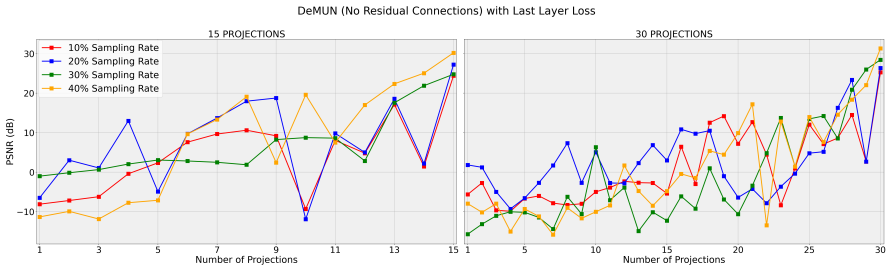
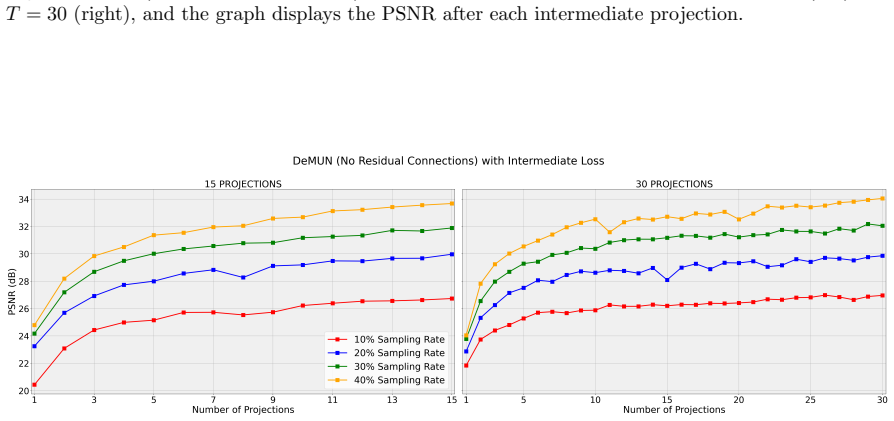
- [Figures 4–13] The intermediate-PSNR figures would be easier to read with labeled axes (projection index vs PSNR) and a legend; currently some figures are visually similar and rely only on the caption.
- [Sec. 2.3] In the phrase 'theDeep Memory Unrolled Network' a space is missing after 'the'.
Circularity Check
No significant circularity: the paper's claims are empirical ablation findings tested on held-out configurations, with no fitted parameter or self-citation doubling as a prediction.
full rationale
The paper makes no claimed prediction or first-principles derivation that reduces to its own inputs. Its contributions are (i) a parametric architecture, DeMUN, whose update rule is defined in Eq. (6), with unit step-size PGD as the stated initialization (Appendix A.2.2), and (ii) four hypotheses that are explicitly described as summaries of simulations and then examined on additional measurement matrices, noise levels, and image resolutions. Trained network weights are fitted objects, but the paper does not rename a fitted parameter as a prediction: the reported PSNRs are direct evaluations on held-out test images, and the recommendations are empirical generalizations from those evaluations. Self-citations such as [5,6,8,9,42] concern background compressed-sensing and message-passing algorithms and are not load-bearing for the hypotheses. The paper's own limitations, including Section 4.6's admission that conclusions had not yet been validated beyond Gaussian matrices and the later DCT, noise, and resolution experiments, are scope limitations rather than circular steps. The lack of seed variance and error bars around single-run PSNR comparisons is a statistical robustness concern, not a circularity: it does not make any stated result equivalent to its inputs by construction. No equation in the paper is identical by definition to a claimed output, and no external result is imported through self-citation to force a design choice. Hence no circular step is identified.
Assumptions & free parameters
free parameters (2)
- Memory coefficients α_i and β_i^j (DeMUN weights) =
learned via ADAM during training
- DnCNN projector weights =
learned via ADAM
assumptions (3)
- domain assumption The measurement process is well modeled by y = Ax + w with A known or known with small error.
- domain assumption Natural images can be approximately projected onto a plausible image set by a DnCNN trained on ImageNet-derived grayscale crops.
- domain assumption ADAM training for 300 epochs with validation-based early stopping yields fair and comparable results across architectures.
Cite this review
Pith. "Pith review of Comprehensive Examination of Unrolled Networks for Solving Linear Inverse Problems." pith.science (2026). https://pith.science/paper/RHHBIVRE
@misc{pith2026250104608,
  author       = {Pith},
  title        = {Pith review of: Comprehensive Examination of Unrolled Networks for Solving Linear Inverse Problems},
  year         = {2026},
  howpublished = {\url{https://pith.science/paper/RHHBIVRE}},
  note         = {Machine review of arXiv:2501.04608}
}
read the original abstract
Unrolled networks have become prevalent in various computer vision and imaging tasks. Although they have demonstrated remarkable efficacy in solving specific computer vision and computational imaging tasks, their adaptation to other applications presents considerable challenges. This is primarily due to the multitude of design decisions that practitioners working on new applications must navigate, each potentially affecting the network's overall performance. These decisions include selecting the optimization algorithm, defining the loss function, and determining the number of convolutional layers, among others. Compounding the issue, evaluating each design choice requires time-consuming simulations to train, fine-tune the neural network, and optimize for its performance. As a result, the process of exploring multiple options and identifying the optimal configuration becomes time-consuming and computationally demanding. The main objectives of this paper are (1) to unify some ideas and methodologies used in unrolled networks to reduce the number of design choices a user has to make, and (2) to report a comprehensive ablation study to discuss the impact of each of the choices involved in designing unrolled networks and present practical recommendations based on our findings. We anticipate that this study will help scientists and engineers design unrolled networks for their applications and diagnose problems within their networks efficiently.
Figures


Figures from the paper (10 more)



Forward citations
Cited by 1 Pith paper
-
How to warm-start your unfolding network
Warm-starting an unfolding network via continuation and training with log-cosh is claimed to improve compressed sensing, but the supporting comparison is confounded by metric mismatch and test-set leakage.
Reference graph
Works this paper leans on
-
[1]
D.L. Donoho. Compressed sensing. IEEE Transactions on Information Theory , 52(4):1289–1306, April 2006. ISSN 0018-9448. doi: 10.1109/TIT.2006.871582. URL http://ieeexplore.ieee. org/document/1614066/
arXiv 2006
-
[2]
Michael Lustig, David Donoho, and John M. Pauly. Sparse MRI: The application of compressed sensing for rapid MR imaging. Magnetic Resonance in Medicine , 58(6):1182–1195, December
-
[3]
E.J. Candes and M.B. Wakin. An Introduction To Compressive Sampling. IEEE Signal Processing Magazine, 25(2):21–30, March 2008. ISSN 1053-5888. doi: 10.1109/MSP.2007.914731. URL http://ieeexplore.ieee.org/document/4472240/
arXiv 2008
-
[4]
Compressive sensing [lecture notes]
Richard G Baraniuk. Compressive sensing [lecture notes]. IEEE signal processing magazine , 24 (4):118–121, 2007
work page 2007
-
[5]
Donoho, Arian Maleki, and Andrea Montanari
David L. Donoho, Arian Maleki, and Andrea Montanari. Message-passing algorithms for com- pressed sensing. Proceedings of the National Academy of Sciences, 106(45):18914–18919, November
-
[6]
Metzler, Arian Maleki, and Richard G
Christopher A. Metzler, Arian Maleki, and Richard G. Baraniuk. From denoising to compressed sensing. IEEE Transactions on Information Theory , 62:5117–5144, 2016
work page 2016
-
[7]
Singanallur V. Venkatakrishnan, Charles A. Bouman, and Brendt Wohlberg. Plug-and-Play priors for model based reconstruction. In 2013 IEEE Global Conference on Signal and Information Processing, pages 945–948, Austin, TX, USA, December 2013. IEEE. ISBN 978-1-4799-0248-4. doi: 10.1109/GlobalSIP.2013.6737048. URL http://ieeexplore.ieee.org/document/6737048/
arXiv 2013
-
[8]
From compression to compressed sensing
Shirin Jalali and Arian Maleki. From compression to compressed sensing. Applied and Computa- tional Harmonic Analysis , 40(2):352–385, 2016
work page 2016
Show all 60 references
-
[9]
An efficient algorithm for compression-based compressed sensing
Sajjad Beygi, Shirin Jalali, Arian Maleki, and Urbashi Mitra. An efficient algorithm for compression-based compressed sensing. Information and Inference: A Journal of the IMA , 8 (2):343–375, 2019
2019
-
[10]
The Little Engine that Could: Regu- larization by Denoising (RED), September 2017
Yaniv Romano, Michael Elad, and Peyman Milanfar. The Little Engine that Could: Regu- larization by Denoising (RED), September 2017. URL http://arxiv.org/abs/1611.02862. arXiv:1611.02862 [cs]
2017 arXiv
-
[11]
Deep ADMM-Net for Compres- sive Sensing MRI
Yan Yang, Jian Sun, Huibin Li, and Zongben Xu. Deep ADMM-Net for Compres- sive Sensing MRI. In D. Lee, M. Sugiyama, U. Luxburg, I. Guyon, and R. Gar- nett, editors, Advances in Neural Information Processing Systems , volume 29. Curran Asso- ciates, Inc., 2016. URL https://proc...
2016
-
[12]
Baraniuk
Ali Mousavi and Richard G. Baraniuk. Learning to invert: Signal recovery via Deep Convolutional Networks. In 2017 IEEE International Conference on Acoustics, Speech and Signal Processing (ICASSP), pages 2272–2276, New Orleans, LA, March 2017. IEEE. ISBN 978-1-5090-4117-6. doi:...
2017
-
[13]
Rick Chang, Chun-Liang Li, Barnabas Poczos, B.V.K
J.H. Rick Chang, Chun-Liang Li, Barnabas Poczos, B.V.K. Vijaya Kumar, and Aswin C. Sankara- narayanan. One Network to Solve Them All — Solving Linear Inverse Problems Using Deep Projection Models. In 2017 IEEE International Conference on Computer Vision (ICCV) , pages 5889–589...
2017
-
[14]
Baraniuk
Ali Mousavi, Gautam Dasarathy, and Richard G. Baraniuk. DeepCodec: Adaptive Sensing and Recovery via Deep Convolutional Neural Networks, July 2017. URL http://arxiv.org/abs/ 1707.03386. arXiv:1707.03386 [stat]. 22
2017 arXiv
-
[15]
Metzler, Ali Mousavi, and Richard G
Christopher A. Metzler, Ali Mousavi, and Richard G. Baraniuk. Learned D-AMP: Principled Neural Network based Compressive Image Recovery, November 2017. URL http://arxiv.org/ abs/1704.06625. arXiv:1704.06625 [cs, stat]
2017 arXiv
-
[16]
McCann, Kyong Hwan Jin, and Michael Unser
Michael T. McCann, Kyong Hwan Jin, and Michael Unser. Convolutional Neural Networks for Inverse Problems in Imaging: A Review. IEEE Signal Processing Magazine, 34(6):85–95, Novem- ber 2017. ISSN 1053-5888. doi: 10.1109/MSP.2017.2739299. URL http://ieeexplore.ieee. org/document...
2017
-
[17]
ISTA-Net: Interpretable Optimization-Inspired Deep Net- work for Image Compressive Sensing, June 2018
Jian Zhang and Bernard Ghanem. ISTA-Net: Interpretable Optimization-Inspired Deep Net- work for Image Compressive Sensing, June 2018. URL http://arxiv.org/abs/1706.07929. arXiv:1706.07929 [cs]
2018 arXiv
-
[18]
Unrolled Optimization with Deep Priors, December 2018
Steven Diamond, Vincent Sitzmann, Felix Heide, and Gordon Wetzstein. Unrolled Optimization with Deep Priors, December 2018. URL http://arxiv.org/abs/1705.08041. arXiv:1705.08041 [cs]
2018 arXiv
-
[19]
Hajnal, Anthony N
Jo Schlemper, Jose Caballero, Joseph V. Hajnal, Anthony N. Price, and Daniel Rueckert. A Deep Cascade of Convolutional Neural Networks for Dynamic MR Image Reconstruction. IEEE Transactions on Medical Imaging , 37(2):491–503, February 2018. ISSN 0278-0062, 1558-254X. doi: 10.1...
2018
-
[20]
Neumann Networks for Inverse Problems in Imaging, June 2019
Davis Gilton, Greg Ongie, and Rebecca Willett. Neumann Networks for Inverse Problems in Imaging, June 2019. URL http://arxiv.org/abs/1901.03707. arXiv:1901.03707 [cs]
2019 arXiv
-
[21]
Aggarwal, Merry P
Hemant K. Aggarwal, Merry P. Mani, and Mathews Jacob. MoDL: Model-Based Deep Learn- ing Architecture for Inverse Problems. IEEE Transactions on Medical Imaging , 38(2):394– 405, February 2019. ISSN 0278-0062, 1558-254X. doi: 10.1109/TMI.2018.2865356. URL https://ieeexplore.iee...
2019
-
[22]
Metzler, Richard G
Gregory Ongie, Ajil Jalal, Christopher A. Metzler, Richard G. Baraniuk, Alexandros G. Dimakis, and Rebecca Willett. Deep Learning Techniques for Inverse Problems in Imaging. IEEE Journal on Selected Areas in Information Theory , 1(1):39–56, May 2020. ISSN 2641-8770. doi: 10.11...
2020
-
[23]
Dave Van Veen, Ajil Jalal, Mahdi Soltanolkotabi, Eric Price, Sriram Vishwanath, and Alexan- dros G. Dimakis. Compressed Sensing with Deep Image Prior and Learned Regularization, Octo- ber 2020. URL http://arxiv.org/abs/1806.06438. arXiv:1806.06438 [stat]
2020 arXiv
-
[24]
Deep Equilibrium Architectures for Inverse Problems in Imaging
Davis Gilton, Gregory Ongie, and Rebecca Willett. Deep Equilibrium Architectures for Inverse Problems in Imaging. IEEE Transactions on Computational Imaging , 7:1123–1133, 2021. ISSN 2333-9403, 2334-0118, 2573-0436. doi: 10.1109/TCI.2021.3118944. URL https://ieeexplore. ieee.o...
2021
-
[25]
Model Adaptation for Inverse Problems in Imaging
Davis Gilton, Gregory Ongie, and Rebecca Willett. Model Adaptation for Inverse Problems in Imaging. IEEE Transactions on Computational Imaging , 7:661–674, 2021. ISSN 2333-9403, 2334-0118, 2573-0436. doi: 10.1109/TCI.2021.3094714. URL https://ieeexplore.ieee.org/ document/9477112/
2021
-
[26]
Stochastic solutions for linear inverse problems using the prior implicit in a denoiser
Zahra Kadkhodaie and Eero Simoncelli. Stochastic solutions for linear inverse problems using the prior implicit in a denoiser. In M. Ranzato, A. Beygelzimer, Y. Dauphin, P.S. Liang, and J. Wortman Vaughan, editors, Advances in Neural Information Processing Systems , volume 34,...
2021
-
[27]
Shastri, Rizwan Ahmad, Christopher A
Saurav K. Shastri, Rizwan Ahmad, Christopher A. Metzler, and Philip Schniter. Denoising Generalized Expectation-Consistent Approximation for MR Image Recovery. IEEE Journal on Selected Areas in Information Theory , 3(3):528–542, September 2022. ISSN 2641-8770. doi: 10.1109/JSA...
2022
-
[28]
Beyond First-Order Tweedie: Solving Inverse Problems using Latent Diffusion, De- cember 2023
Litu Rout, Yujia Chen, Abhishek Kumar, Constantine Caramanis, Sanjay Shakkottai, and Wen- Sheng Chu. Beyond First-Order Tweedie: Solving Inverse Problems using Latent Diffusion, De- cember 2023. URL http://arxiv.org/abs/2312.00852. arXiv:2312.00852 [cs]
2023 arXiv
-
[29]
Physics-Inspired Compressive Sensing: Beyond deep unrolling
Jian Zhang, Bin Chen, Ruiqin Xiong, and Yongbing Zhang. Physics-Inspired Compressive Sensing: Beyond deep unrolling. IEEE Signal Processing Magazine , 40(1):58–72, January 2023. ISSN 1053-5888, 1558-0792. doi: 10.1109/MSP.2022.3208394. URL https://ieeexplore.ieee.org/ document...
2023
-
[30]
Plug-and- play methods for integrating physical and learned models in computational imaging: Theory, algorithms, and applications
Ulugbek S Kamilov, Charles A Bouman, Gregery T Buzzard, and Brendt Wohlberg. Plug-and- play methods for integrating physical and learned models in computational imaging: Theory, algorithms, and applications. IEEE Signal Processing Magazine , 40(1):85–97, 2023
2023
-
[31]
Block coordinate plug-and-play methods for blind inverse problems
Weijie Gan, Yuyang Hu, Jiaming Liu, Hongyu An, Ulugbek Kamilov, et al. Block coordinate plug-and-play methods for blind inverse problems. Advances in Neural Information Processing Systems, 36, 2024
2024
-
[32]
Ptychodv: Vision transformer-based deep unrolling network for ptychographic image reconstruction
Weijie Gan, Qiuchen Zhai, Michael Thompson McCann, Cristina Garcia Cardona, Ulugbek S Kamilov, and Brendt Wohlberg. Ptychodv: Vision transformer-based deep unrolling network for ptychographic image reconstruction. IEEE Open Journal of Signal Processing , 2024
2024
-
[33]
Yuyang Hu, Albert Peng, Weijie Gan, Peyman Milanfar, Mauricio Delbracio, and Ulugbek S. Kamilov. Stochastic Deep Restoration Priors for Imaging Inverse Problems, October 2024. URL http://arxiv.org/abs/2410.02057. arXiv:2410.02057 [eess]
2024 arXiv
-
[34]
Decomposed Diffusion Sampler for Acceler- ating Large-Scale Inverse Problems, February 2024
Hyungjin Chung, Suhyeon Lee, and Jong Chul Ye. Decomposed Diffusion Sampler for Acceler- ating Large-Scale Inverse Problems, February 2024. URL http://arxiv.org/abs/2303.05754. arXiv:2303.05754 [cs]
2024 arXiv
-
[35]
Practical Compact Deep Compressed Sensing, November 2024
Bin Chen and Jian Zhang. Practical Compact Deep Compressed Sensing, November 2024. URL http://arxiv.org/abs/2411.13081. arXiv:2411.13081 [cs]
2024 arXiv
-
[36]
Self-Supervised Scalable Deep Compressed Sensing, August 2024
Bin Chen, Xuanyu Zhang, Shuai Liu, Yongbing Zhang, and Jian Zhang. Self-Supervised Scalable Deep Compressed Sensing, August 2024. URL http://arxiv.org/abs/2308.13777. arXiv:2308.13777 [eess]
2024 arXiv
-
[37]
MRI recovery with self- calibrated denoisers without fully-sampled data
Muhammad Shafique, Sizhuo Liu, Philip Schniter, and Rizwan Ahmad. MRI recovery with self- calibrated denoisers without fully-sampled data. Magnetic Resonance Materials in Physics, Bi- ology and Medicine , October 2024. ISSN 1352-8661. doi: 10.1007/s10334-024-01207-1. URL https...
2024 doi
-
[38]
Kamilov, and Brendt Wohlberg
Weijie Gan, Qiuchen Zhai, Michael Thompson McCann, Cristina Garcia Cardona, Ulugbek S. Kamilov, and Brendt Wohlberg. PtychoDV: Vision Transformer-Based Deep Unrolling Network for Ptychographic Image Reconstruction, March 2024. URLhttp://arxiv.org/abs/2310.07504. arXiv:2310.075...
2024
-
[39]
ReconNet: Non-Iterative Reconstruction of Images from Compressively Sensed Measurements
Kuldeep Kulkarni, Suhas Lohit, Pavan Turaga, Ronan Kerviche, and Amit Ashok. ReconNet: Non-Iterative Reconstruction of Images from Compressively Sensed Measurements. In 2016 IEEE Conference on Computer Vision and Pattern Recognition (CVPR) , pages 449–458, Las Vegas, NV, USA, ...
2016
-
[40]
Learning fast approximations of sparse coding
Karol Gregor and Yann LeCun. Learning fast approximations of sparse coding. In Proceedings of the 27th International Conference on International Conference on Machine Learning , ICML’10, page 399–406, Madison, WI, USA, 2010. Omnipress. ISBN 9781605589077
2010
-
[41]
Vishal Monga, Yuelong Li, and Yonina C. Eldar. Algorithm Unrolling: Interpretable, Efficient Deep Learning for Signal and Image Processing, August 2020. URL http://arxiv.org/abs/ 1912.10557. arXiv:1912.10557 [eess]
2020 arXiv
-
[42]
Compression-based compressed sensing
Farideh E Rezagah, Shirin Jalali, Elza Erkip, and H Vincent Poor. Compression-based compressed sensing. IEEE Transactions on Information Theory , 63(10):6735–6752, 2017. 24
2017
-
[43]
Neural Proximal Gradient Descent for Compressive Imaging, June
Morteza Mardani, Qingyun Sun, Shreyas Vasawanala, Vardan Papyan, Hatef Monajemi, John Pauly, and David Donoho. Neural Proximal Gradient Descent for Compressive Imaging, June
-
[44]
Yuelong Li, Or Bar-Shira, Vishal Monga, and Yonina C. Eldar. Deep Algorithm Unrolling for Biomedical Imaging, August 2021. URL http://arxiv.org/abs/2108.06637. arXiv:2108.06637 [cs]
2021 arXiv
-
[45]
A Fast Iterative Shrinkage-Thresholding Algorithm for Linear In- verse Problems
Amir Beck and Marc Teboulle. A Fast Iterative Shrinkage-Thresholding Algorithm for Linear In- verse Problems. SIAM Journal on Imaging Sciences , 2(1):183–202, 2009. doi: 10.1137/080716542. URL https://doi.org/10.1137/080716542. eprint: https://doi.org/10.1137/080716542
2009 doi
-
[46]
GSISTA-Net: generalized structure ISTA networks for image compressed sensing based on optimized unrolling algorithm
Chunyan Zeng, Yan Yu, Zhifeng Wang, Shiyan Xia, Hao Cui, and Xiangkui Wan. GSISTA-Net: generalized structure ISTA networks for image compressed sensing based on optimized unrolling algorithm. Multimedia Tools and Applications , March 2024. ISSN 1573-7721. doi: 10.1007/ s11042-...
2024 doi
-
[47]
AMP-Net: Denoising-Based Deep Unfolding for Compressive Image Sensing
Zhonghao Zhang, Yipeng Liu, Jiani Liu, Fei Wen, and Ce Zhu. AMP-Net: Denoising-Based Deep Unfolding for Compressive Image Sensing. IEEE Transactions on Image Processing , 30: 1487–1500, 2021. ISSN 1057-7149, 1941-0042. doi: 10.1109/TIP.2020.3044472. URL https: //ieeexplore.iee...
2021
-
[48]
Convolutional Neural Networks With Intermediate Loss for 3D Super-Resolution of CT and MRI Scans
Mariana-Iuliana Georgescu, Radu Tudor Ionescu, and Nicolae Verga. Convolutional Neural Networks With Intermediate Loss for 3D Super-Resolution of CT and MRI Scans. IEEE Access, 8:49112–49124, 2020. ISSN 2169-3536. doi: 10.1109/ACCESS.2020.2980266. URL https://ieeexplore.ieee.o...
2020
-
[49]
Deep Generalized Unfolding Networks for Image Restoration
Chong Mou, Qian Wang, and Jian Zhang. Deep Generalized Unfolding Networks for Image Restoration. In 2022 IEEE/CVF Conference on Computer Vision and Pattern Recognition (CVPR), pages 17378–17389, New Orleans, LA, USA, June 2022. IEEE. ISBN 978-1-66546- 946-3. doi: 10.1109/CVPR5...
2022
-
[50]
Rethinking the inception architecture for computer vision
Christian Szegedy, Vincent Vanhoucke, Sergey Ioffe, Jon Shlens, and Zbigniew Wojna. Rethinking the inception architecture for computer vision. In Proceedings of the IEEE conference on computer vision and pattern recognition, pages 2818–2826, 2016
2016
-
[51]
Beyond a Gaussian Denoiser: Residual Learning of Deep CNN for Image Denoising
Kai Zhang, Wangmeng Zuo, Yunjin Chen, Deyu Meng, and Lei Zhang. Beyond a Gaussian Denoiser: Residual Learning of Deep CNN for Image Denoising. IEEE Transactions on Image Processing, 26(7):3142–3155, July 2017. ISSN 1057-7149, 1941-0042. doi: 10.1109/TIP.2017. 2662206. URL http...
2017
-
[52]
Deep Residual Learning for Image Recognition, December 2015
Kaiming He, Xiangyu Zhang, Shaoqing Ren, and Jian Sun. Deep Residual Learning for Image Recognition, December 2015. URL http://arxiv.org/abs/1512.03385. arXiv:1512.03385 [cs]
2015 arXiv
-
[53]
Identity Mappings in Deep Residual Networks, July 2016
Kaiming He, Xiangyu Zhang, Shaoqing Ren, and Jian Sun. Identity Mappings in Deep Residual Networks, July 2016. URL http://arxiv.org/abs/1603.05027. arXiv:1603.05027 [cs]
2016 arXiv
-
[54]
Convolu- tional neural networks: an overview and application in radiology
Rikiya Yamashita, Mizuho Nishio, Richard Kinh Gian Do, and Kaori Togashi. Convolu- tional neural networks: an overview and application in radiology. Insights into Imaging , 9 (4):611–629, August 2018. ISSN 1869-4101. doi: 10.1007/s13244-018-0639-9. URL https: //insightsimaging...
2018 doi
-
[58]
Sub- sequently, we normalize A according to A′ = A/∥A∥∞,2 to obtain our sampling matrix
We calculate the maximum ℓ2 row norm of the matrix: ∥A∥∞,2 = max1≤i≤m qPn j=1 a2 ij. Sub- sequently, we normalize A according to A′ = A/∥A∥∞,2 to obtain our sampling matrix
-
[59]
For each loss reducer i, we initialize the first two terms αi, βi i to 1 and set all other weights to 0
-
[60]
All other network projector weights {P t C}t are initialized randomly [12, 17, 47]. For instance in PyTorch, convolutional weights are initialized by sampling from Uniform( − √ k, − √ k), where k = groups Cin · Q1 i=0 kernelsize i Here, groups specifies independent channel gro...
2012
-
[2007]
doi: 10.1002/mrm.21391
ISSN 0740-3194, 1522-2594. doi: 10.1002/mrm.21391. URL https://onlinelibrary. wiley.com/doi/10.1002/mrm.21391
-
[2009]
doi: 10.1073/pnas.0909892106
ISSN 0027-8424, 1091-6490. doi: 10.1073/pnas.0909892106. URL https://pnas.org/doi/ full/10.1073/pnas.0909892106
- [2018]
Reviewed August 10, 2026 · model on record in the stance chip above.
Discussion (0). Continue with ORCID to comment.