An Exponential Sample-Complexity Advantage for Coherent Quantum Inference
Pith reviewed 2026-05-21 04:07 UTC · model grok-4.3
The pith
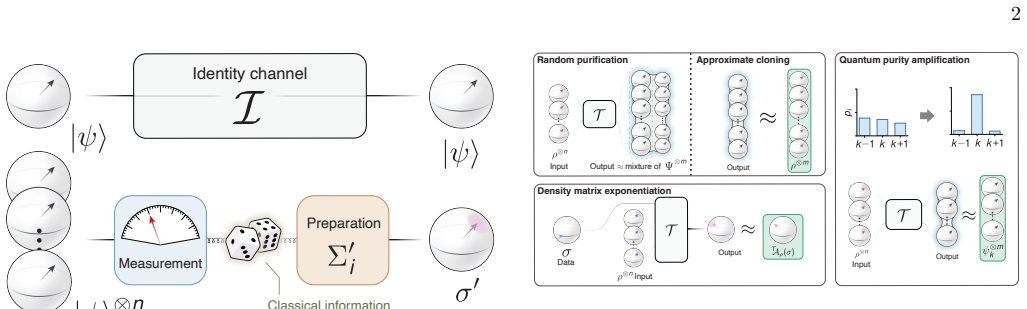
Coherent quantum processing achieves error ε with O(1/ε) copies while any incoherent protocol requires Ω(d/ε) copies for d-dimensional inputs in tasks like quantum purity amplification.
A machine-rendered reading of the paper's core claim, the machinery that carries it, and where it could break.
Core claim
For QPA with principal eigenstate targets and d-dimensional inputs, coherent processing achieves error ε using O(1/ε) copies, versus the Ω(d/ε) copies required by any incoherent protocol. Together, these sharp coherent-incoherent separations seed a theory of coherent quantum inference, with an entanglement-breaking limit identifying the optimal incoherent counterpart of each coherent protocol.
What carries the argument
The separation between coherent processing that preserves quantum outputs and measurement-mediated (entanglement-breaking) protocols that convert inputs to classical data before further manipulation.
Load-bearing premise
Incoherent protocols are precisely those that measure the input states before any further processing.
What would settle it
An explicit construction of a measurement-mediated protocol that achieves error ε for principal-eigenstate QPA using o(d/ε) copies would refute the claimed lower bound.
Figures

read the original abstract
Standard quantum inference converts quantum data into classical outputs. We study an alternative inference setting in which the desired output is quantum, preserving coherence. Such settings include quantum purity amplification (QPA), mixed-state approximate purification or cloning, and density matrix exponentiation. We show that such protocols can achieve exponentially lower sample complexity than incoherent, measurement-mediated protocols. For QPA with principal eigenstate targets and $d$-dimensional inputs, coherent processing achieves error $\varepsilon$ using $O(1/\varepsilon)$ copies, versus the $\Omega(d/\varepsilon)$ copies required by any incoherent protocol. Together, these sharp coherent-incoherent separations seed a theory of coherent quantum inference, with an entanglement-breaking limit identifying the optimal incoherent counterpart of each coherent protocol.
Editorial analysis
A structured set of objections, weighed in public.
Referee Report
Summary. The manuscript introduces coherent quantum inference protocols whose outputs are quantum states that preserve coherence, contrasting with standard inference that yields classical outputs. For quantum purity amplification (QPA) targeting principal eigenstates of d-dimensional inputs, it claims coherent processing achieves error ε with O(1/ε) copies while any incoherent measurement-mediated protocol requires Ω(d/ε) copies, yielding an exponential separation. The work identifies the entanglement-breaking limit as the optimal incoherent counterpart and positions these results as seeding a theory of coherent quantum inference applicable to tasks including mixed-state purification and density matrix exponentiation.
Significance. If the claimed separations hold, the work would establish a new paradigm quantifying coherence advantages in quantum inference tasks. The sharp asymptotic bounds derived from quantum information principles, rather than data fitting, and the explicit identification of the entanglement-breaking limit as a benchmark are notable strengths that could influence quantum state preparation and learning protocols.
major comments (1)
- [Abstract] Abstract: The central separation rests on the Ω(d/ε) lower bound for incoherent protocols, which the abstract ties to 'measurement-mediated protocols' and the 'entanglement-breaking limit'. The manuscript must explicitly prove that this bound applies to the full entanglement-breaking class and that no intermediate quantum operations (e.g., local unitaries or non-entanglement-breaking channels followed by measurement) can improve upon it while remaining incoherent; otherwise the claimed exponential advantage is not load-bearing.
minor comments (1)
- [Protocol Constructions] The manuscript should include explicit circuit diagrams or pseudocode for the coherent QPA protocol achieving O(1/ε) scaling to aid verification.
Simulated Author's Rebuttal
We thank the referee for their careful reading and constructive feedback. The major comment highlights the need for a more explicit proof that the Ω(d/ε) lower bound applies to the full entanglement-breaking class and that intermediate operations cannot improve performance while remaining incoherent. We address this point directly below and will revise the manuscript accordingly to strengthen the rigor of the claimed separation.
read point-by-point responses
-
Referee: [Abstract] Abstract: The central separation rests on the Ω(d/ε) lower bound for incoherent protocols, which the abstract ties to 'measurement-mediated protocols' and the 'entanglement-breaking limit'. The manuscript must explicitly prove that this bound applies to the full entanglement-breaking class and that no intermediate quantum operations (e.g., local unitaries or non-entanglement-breaking channels followed by measurement) can improve upon it while remaining incoherent; otherwise the claimed exponential advantage is not load-bearing.
Authors: We agree that the abstract and main text would benefit from a more explicit treatment of this point to ensure the exponential separation is fully load-bearing. In the revised manuscript we will add a dedicated lemma (placed in the preliminaries section) that formally extends our existing information-theoretic lower-bound argument to arbitrary entanglement-breaking channels, proving that Ω(d/ε) samples are required for any protocol in this class. We will further show that allowing local unitaries or non-EB channels prior to measurement cannot reduce the sample complexity below this bound while the overall protocol remains incoherent: any such intermediate operation can be absorbed into an equivalent entanglement-breaking map without increasing the number of copies needed for the target error ε. This revision clarifies the definition of incoherence and confirms that the EB limit is indeed the optimal benchmark, without changing the core results or the O(1/ε) coherent upper bound. revision: yes
Circularity Check
No significant circularity; bounds derived from standard quantum channel properties
full rationale
The paper's central separation for QPA follows from comparing coherent protocols (achieving O(1/ε) copies) against the class of measurement-mediated protocols whose optimal performance is identified with the entanglement-breaking limit, yielding the Ω(d/ε) lower bound. This comparison is grounded in established quantum information results on channel classes rather than any self-referential definition, fitted parameter, or self-citation chain that reduces the claimed advantage to its own inputs. The derivation remains self-contained against external benchmarks in quantum channel theory, with no load-bearing step that collapses by construction to a prior result from the same authors or an ansatz smuggled via citation.
Axiom & Free-Parameter Ledger
axioms (1)
- standard math Standard quantum mechanics: quantum states are density operators, operations are completely positive trace-preserving maps, and coherence is preserved under unitary evolution and partial traces.
Lean theorems connected to this paper
-
IndisputableMonolith/Foundation/RealityFromDistinction.leanreality_from_one_distinction unclear?
unclearRelation between the paper passage and the cited Recognition theorem.
coherent processing achieves error ε using O(1/ε) copies, versus the Ω(d/ε) copies required by any incoherent protocol... entanglement-breaking limit identifying the optimal incoherent counterpart
-
IndisputableMonolith/Cost/FunctionalEquation.leanwashburn_uniqueness_aczel unclear?
unclearRelation between the paper passage and the cited Recognition theorem.
Schur sampling... overhang-removal rule... covariant POVM
What do these tags mean?
- matches
- The paper's claim is directly supported by a theorem in the formal canon.
- supports
- The theorem supports part of the paper's argument, but the paper may add assumptions or extra steps.
- extends
- The paper goes beyond the formal theorem; the theorem is a base layer rather than the whole result.
- uses
- The paper appears to rely on the theorem as machinery.
- contradicts
- The paper's claim conflicts with a theorem or certificate in the canon.
- unclear
- Pith found a possible connection, but the passage is too broad, indirect, or ambiguous to say the theorem truly supports the claim.
Reference graph
Works this paper leans on
-
[1]
author author D. Kretschmann , author D. Schlingemann ,\ and\ author R. F. \ Werner ,\ https://doi.org/10.1109/TIT.2008.917696 journal journal IEEE Transactions on Information Theory \ volume 54 ,\ pages 1708 ( year 2008 ) ,\ https://arxiv.org/abs/quant-ph/0605009 arXiv:quant-ph/0605009 [quant-ph] NoStop
-
[2]
author author M. Horodecki , author P. W. \ Shor ,\ and\ author M. B. \ Ruskai ,\ @noop journal journal Reviews in Mathematical Physics \ volume 15 ,\ pages 629 ( year 2003 ) NoStop
work page 2003
-
[3]
Efficient classical simulation of slightly entangled quantum computations
author author G. Vidal ,\ https://doi.org/10.1103/PhysRevLett.91.147902 journal journal Phys. Rev. Lett. \ volume 91 ,\ pages 147902 ( year 2003 ) ,\ https://arxiv.org/abs/quant-ph/0301063 arXiv:quant-ph/0301063 [quant-ph] NoStop
work page internal anchor Pith review Pith/arXiv arXiv doi:10.1103/physrevlett.91.147902 2003
-
[4]
Proceedings of the 51st Annual ACM SIGACT Symposium on Theory of Computing , pages =
author author A. Gily \'e n , author Y. Su , author G. H. \ Low ,\ and\ author N. Wiebe ,\ in\ https://doi.org/10.1145/3313276.3316366 booktitle Proceedings of the 51st Annual ACM SIGACT Symposium on Theory of Computing (STOC) \ ( publisher ACM ,\ year 2019 )\ pp.\ pages 193--204 ,\ https://arxiv.org/abs/1806.01838 arXiv:1806.01838 [quant-ph] NoStop
-
[5]
author author J. M. \ Martyn , author Z. M. \ Rossi , author A. K. \ Tan ,\ and\ author I. L. \ Chuang ,\ https://doi.org/10.1103/PRXQuantum.2.040203 journal journal PRX Quantum \ volume 2 ,\ pages 040203 ( year 2021 ) ,\ https://arxiv.org/abs/2105.02859 arXiv:2105.02859 [quant-ph] NoStop
- [6]
-
[7]
author author A. N. \ Soklakov \ and\ author R. Schack ,\ @noop journal journal Physical Review A—Atomic, Molecular, and Optical Physics \ volume 73 ,\ pages 012307 ( year 2006 ) NoStop
work page 2006
-
[8]
author author E. Tang , author J. Wright ,\ and\ author M. Zhandry ,\ https://arxiv.org/abs/2510.07622 title Conjugate queries can help ( year 2025 ),\ https://arxiv.org/abs/2510.07622 arXiv:2510.07622 [quant-ph] NoStop
work page internal anchor Pith review Pith/arXiv arXiv 2025
-
[9]
Unspeakable quantum information
author author A. Peres \ and\ author P. F. \ Scudo ,\ @noop journal journal arXiv preprint quant-ph/0201017 \ ( year 2002 ) NoStop
work page internal anchor Pith review Pith/arXiv arXiv 2002
-
[10]
author author J. Haah , author A. W. \ Harrow , author Z. Ji , author X. Wu ,\ and\ author N. Yu ,\ in\ @noop booktitle Proceedings of the forty-eighth annual ACM symposium on Theory of Computing \ ( year 2016 )\ pp.\ pages 913--925 NoStop
work page 2016
-
[11]
Graph Isomorphism in Quasipolynomial Time [Extended Ab- stract]
author author R. O’Donnell \ and\ author J. Wright ,\ in\ https://doi.org/10.1145/2897518.2897544 booktitle Proceedings of the forty-eighth annual ACM symposium on Theory of Computing ,\ series and number STOC ’16 \ ( publisher ACM ,\ year 2016 )\ p.\ pages 899–912 NoStop
-
[12]
author author O. E. \ Barndorff-Nielsen , author R. D. \ Gill ,\ and\ author P. E. \ Jupp ,\ @noop journal journal Journal of the Royal Statistical Society Series B: Statistical Methodology \ volume 65 ,\ pages 775 ( year 2003 ) NoStop
work page 2003
-
[13]
author author S. W. P. \ Kim , author C. von Keyserlingk ,\ and\ author A. Lamacraft ,\ https://arxiv.org/abs/2504.08888 title Measurement-induced phase transitions in quantum inference problems and quantum hidden markov models ( year 2025 ),\ https://arxiv.org/abs/2504.08888 arXiv:2504.08888 [cond-mat.stat-mech] NoStop
-
[14]
author author S. Arunachalam \ and\ author R. De Wolf ,\ @noop journal journal ACM Sigact News \ volume 48 ,\ pages 41 ( year 2017 ) NoStop
work page 2017
-
[15]
author author A. Anshu , author S. Arunachalam , author T. Kuwahara ,\ and\ author M. Soleimanifar ,\ @noop journal journal Nature Physics \ volume 17 ,\ pages 931 ( year 2021 ) NoStop
work page 2021
-
[16]
author author H.-Y. \ Huang , author R. Kueng ,\ and\ author J. Preskill ,\ https://doi.org/10.1038/s41567-020-0932-7 journal journal Nature Physics \ volume 16 ,\ pages 1050 ( year 2020 ) ,\ https://arxiv.org/abs/2002.08953 arXiv:2002.08953 [quant-ph] NoStop
-
[17]
author author A. W. \ Harrow ,\ @noop journal journal arXiv preprint arXiv:1308.6595 \ ( year 2013 ) NoStop
work page internal anchor Pith review Pith/arXiv arXiv 2013
-
[18]
author author S. Kazi \ and\ author I. Marvian ,\ @noop journal journal arXiv preprint arXiv:2510.08493 \ ( year 2025 ) NoStop
-
[19]
author author Z. Li , author H. Fu , author T. Isogawa ,\ and\ author I. Chuang ,\ https://arxiv.org/abs/2409.18167 title Optimal quantum purity amplification ( year 2024 ),\ https://arxiv.org/abs/2409.18167 arXiv:2409.18167 [quant-ph] NoStop
-
[20]
author author S. Lloyd , author M. Mohseni ,\ and\ author P. Rebentrost ,\ @noop journal journal Nature physics \ volume 10 ,\ pages 631 ( year 2014 ) NoStop
work page 2014
-
[21]
author author D. Grier , author D. Leung , author Z. Li , author H. Pashayan ,\ and\ author L. Schaeffer ,\ @noop journal journal arXiv preprint arXiv:2503.22644 \ ( year 2025 ) NoStop
-
[22]
Mixed state tomog- raphy reduces to pure state tomography.arXiv preprint arXiv:2511.15806, 2025
author author A. Pelecanos , author J. Spilecki , author E. Tang ,\ and\ author J. Wright ,\ https://arxiv.org/abs/2511.15806 title Mixed state tomography reduces to pure state tomography ( year 2025 ),\ https://arxiv.org/abs/2511.15806 arXiv:2511.15806 [quant-ph] NoStop
-
[23]
author author M. Walter \ and\ author F. Witteveen ,\ https://arxiv.org/abs/2512.15690 title A random purification channel for arbitrary symmetries with applications to fermions and bosons ( year 2025 ),\ https://arxiv.org/abs/2512.15690 arXiv:2512.15690 [quant-ph] NoStop
-
[24]
Random purification channel made simple.Preprint arXiv:2511.23451, 2025
author author F. Girardi , author F. A. \ Mele ,\ and\ author L. Lami ,\ https://arxiv.org/abs/2511.23451 title Random purification channel made simple ( year 2026 ),\ https://arxiv.org/abs/2511.23451 arXiv:2511.23451 [quant-ph] NoStop
-
[25]
author author R. F. \ Werner ,\ @noop journal journal Physical Review A \ volume 58 ,\ pages 1827 ( year 1998 ) NoStop
work page 1998
-
[26]
Optimal Cloning of Pure States, Judging Single Clones
author author M. Keyl \ and\ author R. F. \ Werner ,\ https://arxiv.org/abs/quant-ph/9807010 journal journal Journal of Mathematical Physics \ volume 40 ,\ pages 3283 ( year 1999 ) ,\ https://arxiv.org/abs/quant-ph/9807010 arXiv:quant-ph/9807010 NoStop
work page internal anchor Pith review Pith/arXiv arXiv 1999
-
[27]
author author V. Scarani , author S. Iblisdir , author N. Gisin ,\ and\ author A. Ac \' n ,\ @noop journal journal Reviews of Modern Physics \ volume 77 ,\ pages 1225 ( year 2005 ) NoStop
work page 2005
-
[28]
Is global asymptotic cloning state estimation?
author author Y. Yang \ and\ author G. Chiribella ,\ @noop journal journal arXiv preprint arXiv:1306.6427 \ ( year 2013 ) NoStop
work page internal anchor Pith review Pith/arXiv arXiv 2013
-
[29]
author author Z. Li , author E. Theil , author A. W. \ Harrow ,\ and\ author I. Chuang ( year 2026 ),\ note manuscript submitted NoStop
work page 2026
-
[30]
author author B. Go , author H. Kwon , author S. Park , author D. Patel ,\ and\ author M. M. \ Wilde ,\ @noop journal journal Quantum Science and Technology \ volume 10 ,\ pages 045058 ( year 2025 ) NoStop
work page 2025
-
[31]
author author J. O. \ Berger ,\ @noop title Statistical Decision Theory and Bayesian Analysis \ ( publisher Springer ,\ year 1985 ) NoStop
work page 1985
-
[32]
author author E. L. \ Lehmann \ and\ author G. Casella ,\ @noop title Theory of Point Estimation ,\ edition 2nd \ ed.\ ( publisher Springer ,\ year 1998 ) NoStop
work page 1998
-
[33]
author author J. Bae \ and\ author A. Ac \'i n ,\ @noop journal journal Physical Review Letters \ volume 97 ,\ pages 030402 ( year 2006 ) NoStop
work page 2006
-
[34]
author author A. Bisio , author G. Chiribella , author G. M. \ D'Ariano , author S. Facchini ,\ and\ author P. Perinotti ,\ @noop journal journal Physical Review A---Atomic, Molecular, and Optical Physics \ volume 81 ,\ pages 032324 ( year 2010 ) NoStop
work page 2010
-
[35]
author author M. Christandl , author R. König , author G. Mitchison ,\ and\ author R. Renner ,\ https://doi.org/10.1007/s00220-007-0189-3 journal journal Communications in Mathematical Physics \ volume 273 ,\ pages 473–498 ( year 2007 ) NoStop
-
[36]
author author M. Keyl \ and\ author R. F. \ Werner ,\ @noop journal journal Journal of Mathematical Physics \ volume 40 ,\ pages 3283 ( year 1999 ) NoStop
work page 1999
-
[37]
author author Y. Hu , author E. Cervero-Mart \' n , author E. Theil , author L. Man c inska ,\ and\ author M. Tomamichel ,\ @noop journal journal arXiv preprint arXiv:2410.16220 \ ( year 2024 ) NoStop
work page internal anchor Pith review arXiv 2024
discussion (0)
Sign in with ORCID, Apple, or X to comment. Anyone can read and Pith papers without signing in.