Granulation signatures as seen by Kepler short-cadence data. II. A hierarchical route to inferring stellar radii from granulation
Pith reviewed 2026-07-01 16:47 UTC · model grok-4.3
The pith
A Bayesian hierarchical model infers stellar radii from granulation amplitude and frequency in photometric time series at roughly 10 percent precision.
A machine-rendered reading of the paper's core claim, the machinery that carries it, and where it could break.
Core claim
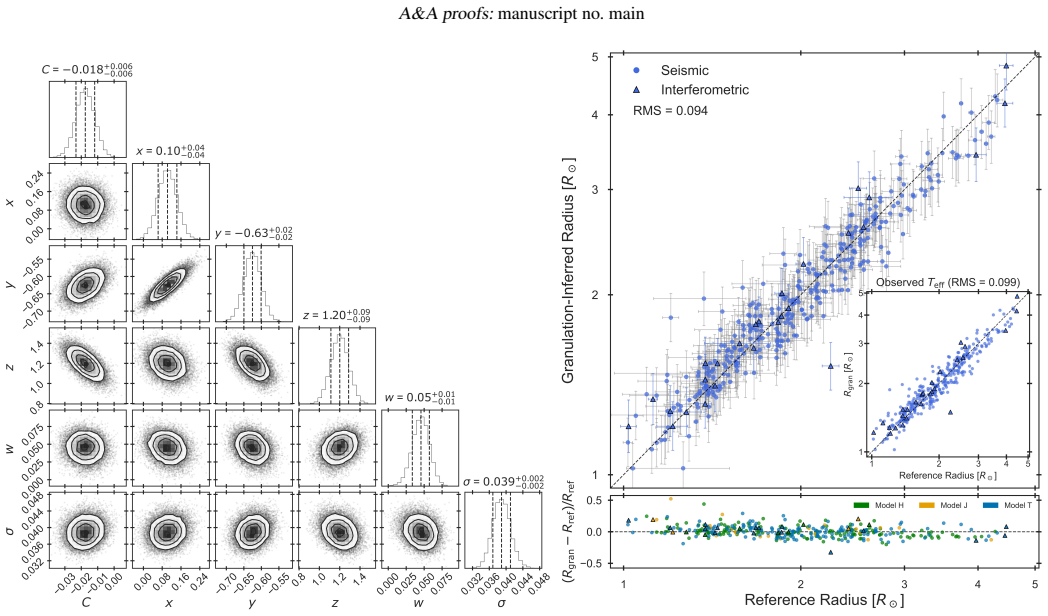
Granulation-radius regression relations derived within a Bayesian hierarchical model from three background models recover reference radii within 1 sigma in approximately 73 percent of cases on an independent 367-star sample and deliver a typical precision of 10 percent, showing that granulation observables encode predictive information on stellar radii at a level comparable to several established techniques.
What carries the argument
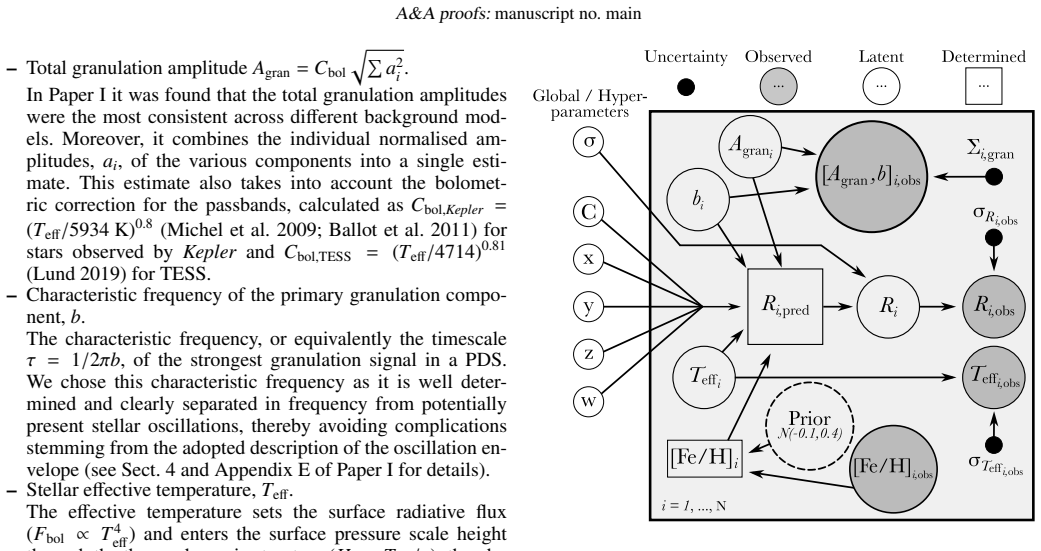
Bayesian hierarchical regression model that relates stellar radius to total granulation amplitude, primary characteristic frequency, effective temperature and surface metallicity, with marginal posteriors from three granulation background models combined by Bayesian evidence weighting.
If this is right
- Stellar radii can be inferred for any star with long-duration photometry that exhibits measurable granulation, without requiring detected oscillations or direct interferometry.
- The same relations apply directly to photometric data from Kepler, TESS and the upcoming PLATO mission.
- The inference remains valid across the diverse stellar populations represented in the heterogeneous training and test samples.
- The 10 percent precision level matches the performance of several established radius-determination techniques.
Where Pith is reading between the lines
- Radius estimates could become available for stars in open clusters or at distances where oscillation detection or interferometry is impractical.
- The framework could be extended to other fundamental parameters such as mass or surface gravity if additional regression relations are derived from the same granulation observables.
- Application to ensemble photometry of large stellar populations might reveal population-level trends in radius that are currently accessible only through more resource-intensive methods.
Load-bearing premise
The granulation-radius regression relations fitted on the 363-star training sample remain valid without significant bias when applied to new stars.
What would settle it
A large sample of stars where granulation-inferred radii show a systematic offset exceeding 10 percent relative to independent seismic or interferometric radii would falsify the claim of unbiased inference at the stated precision.
Figures



read the original abstract
Stellar granulation arises from near-surface convection and is imprinted in stellar photometric time series, yet links between granulation observables and fundamental stellar properties remain underexploited. We aim to establish a statistically robust framework for inferring stellar radii directly from granulation signals in long-duration space-based photometry, aided by atmospheric parameters. We construct a Bayesian hierarchical model to connect stellar radius and granulation, relating radius through regression to the total granulation amplitude, primary characteristic frequency of the granulation, stellar effective temperature, and surface metallicity. The derivation is performed separately for three granulation models, propagating the marginal posteriors of the granulation parameters to account for intrinsic dispersion of the derived relations. Each background model yields a unique radius posterior, subsequently combined using Bayesian evidences as weights, producing posteriors that best represent the given star. The granulation-radius relations were derived from a heterogeneous sample of 363 stars, combining seismic and interferometric targets from multiple sources. Application to an independent sample of 367 stars recovers the reference radii within $1\sigma$ in ${\approx}73\%$ of cases. The distribution of residuals is consistent with a well-calibrated and unbiased inference. Across applications, the granulation-inferred radii achieve a precision of ${\approx}10\%$. The agreement with seismic and interferometric benchmarks demonstrates that granulation carries predictive information on stellar radii at a level comparable to several established techniques. Using granulation as a structural diagnostic enables the inference of stellar radii from granulation signals across diverse stellar populations; directly applicable to data from Kepler, TESS, and the upcoming ESA PLATO mission.
Editorial analysis
A structured set of objections, weighed in public.
Referee Report
Summary. The manuscript develops a Bayesian hierarchical framework to infer stellar radii from granulation signals in Kepler short-cadence photometry. It fits regression relations between radius and granulation amplitude, characteristic frequency, Teff, and [Fe/H] separately for three background models on a heterogeneous 363-star training sample, then applies evidence-weighted posteriors to an independent 367-star test sample, reporting ~73% recovery within 1σ and ~10% precision.
Significance. If the relations generalize, this provides a new photometric route to stellar radii with precision comparable to seismic and interferometric methods, directly applicable to Kepler, TESS, and PLATO data. The propagation of granulation-parameter posteriors across three models with evidence weighting and the independent test-set validation are methodological strengths.
major comments (2)
- [Training sample description] Training-sample section: the regression relations are fitted to a heterogeneous 363-star set combining seismic and interferometric reference radii from multiple sources; no explicit homogenization or offset correction between reference methods is described, so any systematics could be absorbed into the fitted coefficients (free parameters listed in the axiom ledger), undermining the claim that the test-set performance demonstrates genuine granulation predictive power rather than shared selection effects.
- [Application to independent sample] Test-sample results: the abstract states ~73% recovery within 1σ with unbiased residuals, but without reported checks for trends in residuals versus reference method, stellar type, or other covariates, it is unclear whether the evidence-weighted combination fully mitigates reference-radius heterogeneity when applied to the 367-star test set.
minor comments (2)
- Clarify how the primary granulation frequency is defined and extracted consistently across the three background models.
- Specify the priors placed on the regression coefficients in the hierarchical model and how reference-radius uncertainties are incorporated into the likelihood.
Simulated Author's Rebuttal
We thank the referee for the constructive review. We respond point-by-point to the major comments below.
read point-by-point responses
-
Referee: Training-sample section: the regression relations are fitted to a heterogeneous 363-star set combining seismic and interferometric reference radii from multiple sources; no explicit homogenization or offset correction between reference methods is described, so any systematics could be absorbed into the fitted coefficients (free parameters listed in the axiom ledger), undermining the claim that the test-set performance demonstrates genuine granulation predictive power rather than shared selection effects.
Authors: We acknowledge the training sample combines reference radii from multiple literature sources without explicit homogenization or offset corrections, as noted in the manuscript. The independent test set, selected from comparable populations, yields performance consistent with the training results, indicating the relations capture predictive information beyond shared selection. We will add a dedicated paragraph in the revised Section 3 discussing potential reference-method systematics and their possible absorption into coefficients as a limitation. revision: partial
-
Referee: Test-sample results: the abstract states ~73% recovery within 1σ with unbiased residuals, but without reported checks for trends in residuals versus reference method, stellar type, or other covariates, it is unclear whether the evidence-weighted combination fully mitigates reference-radius heterogeneity when applied to the 367-star test set.
Authors: We agree that explicit residual-trend checks versus reference method and stellar covariates would strengthen the validation. Although the manuscript reports the overall residual distribution as unbiased, we will include additional analysis (e.g., residual plots stratified by reference method and spectral type) in the revised manuscript to confirm the evidence-weighted posteriors mitigate heterogeneity. revision: yes
Circularity Check
Empirical regression on training set validated on independent test set; no reduction to inputs by construction
full rationale
The paper constructs a Bayesian hierarchical regression model relating stellar radius to granulation parameters (amplitude, frequency), Teff and [Fe/H], fitted on a 363-star heterogeneous training sample and applied to a separate 367-star test sample. It reports that ~73% of test radii are recovered within 1σ with unbiased residuals. This is standard empirical calibration and cross-validation; the paper makes no first-principles derivation claim and does not rename a fitted mapping as an independent prediction. No self-citations, uniqueness theorems, or ansatzes are invoked in the provided text that would create load-bearing circularity. The test-set agreement supplies external grounding, so the derivation chain is self-contained.
Axiom & Free-Parameter Ledger
free parameters (1)
- regression coefficients relating radius to granulation amplitude, frequency, Teff and metallicity
axioms (1)
- domain assumption The three chosen granulation background models adequately capture the dominant power-spectrum features for the sample stars.
Reference graph
Works this paper leans on
-
[1]
Diagnosing Suboptimal Cotangent Disintegrations in Hamiltonian Monte Carlo
Adibekyan, V ., Sousa, S. G., & Santos, N. C. 2018, in Astrophysics and Space Science Proceedings, V ol. 49, Asteroseismology and Exoplanets: Listening to the Stars and Searching for New Worlds, ed. T. L. Campante, N. C. Santos, & M. J. P. F. G. Monteiro, 225 Aguirre Børsen-Koch, V ., Rørsted, J. L., Justesen, A. B., et al. 2022, MNRAS, 509, 4344 Baglin, ...
work page internal anchor Pith review Pith/arXiv arXiv 2018
-
[2]
are listed in Table A.1. Table D.4 of Lund et al. (2025) provides the stars in their catalogue with interferometric measurements. Using this table, we selected the 50 stars displaying 200< ν max <3000µHz and, as they are bright, adopted the Hipparcos parallaxes. From the respective interferometric sources given in the table, we re- trieved the limb-darken...
work page 2025
-
[3]
The summary statistics are given as the median and 16/84 percentiles of the posteriors.Right panel:The granulation-inferred stellar radii plotted against the asteroseismic radii for each star. In the main panel we use the inferredT efffor the prediction, while the insert shows the results obtained when using the observedT eff. The obtained fractional root...
work page 2016
discussion (0)
Sign in with ORCID, Apple, or X to comment. Anyone can read and Pith papers without signing in.