REVIEW 3 major objections 3 minor 65 references
The Traditional Approximation of Rotation including the centrifugal acceleration for slightly deformed stars
T0 review · 3 major / 3 minor · reviewed 2026-08-14 · deepseek-v4-flash
Pith's one-line read The authors extend the Traditional Approximation of Rotation to include centrifugal deformation, deriving a generalized Laplace tidal equation and asymptotic periods for low-frequency gravito-inertial waves in slightly flattened rotating…
desk verdict Useful formal extension of TAR to centrifugal deformation, but the non-orthogonal coordinate treatment may have missed first-order metric terms; needs a check before the period formula is used. read the letter →
The pith
A machine-rendered reading of the paper's core claim, the machinery that carries it, and where it could break.
The reading
What carries the argument
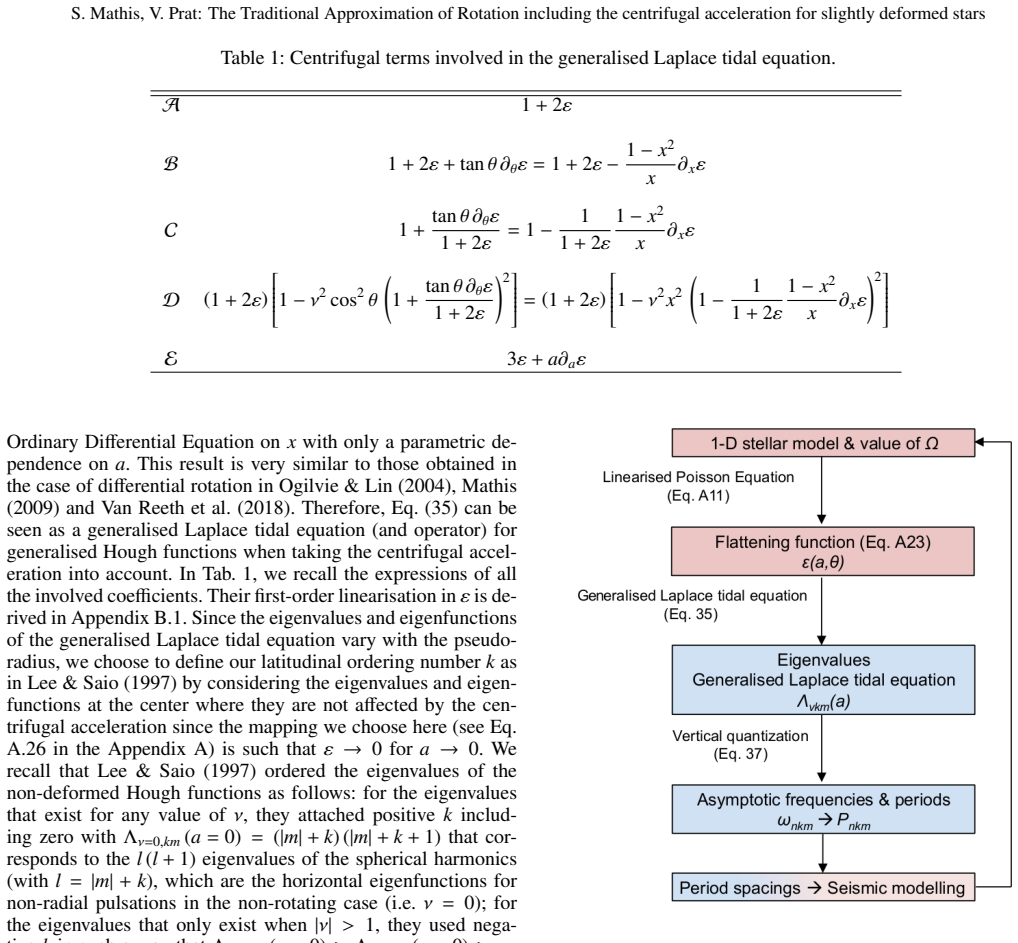
The central object is the generalized Laplace tidal equation, a second-order linear ordinary differential equation in the latitudinal variable $x=\cos\theta$ for the JWKB amplitude $w_{\nu km}(a,x)$ of the normalized pressure fluctuation, with coefficients that depend on the pseudo-radius $a$ through the centrifugal deformation $\varepsilon(a,\theta)$. The load-bearing mechanism is the TAR hierarchy—$2\Omega\ll N$ and almost horizontal wave motions—which lets the horizontal momentum equations be inverted to give the displacement components in terms of the pressure fluctuation. Inserting those expressions into the anelastic continuity equation and using a JWKB vertical dependence produces the eigenvalue equation $\mathcal{L}_{\nu m}[w_{\nu km}]=-\Lambda_{\nu km}(a)w_{\nu km}$, which reduces to the classical Laplace tidal equation with Hough functions when $\varepsilon\to0$. The $a$-dependent eigenvalues and eigenfunctions are what carry the new physics, since they feed directly into the dispersion relation and the asymptotic period formula.
What would settle it
Compute low-frequency gravito-inertial mode frequencies and period spacings with a full two-dimensional oscillation code for a uniformly rotating stellar model at $\Omega/\Omega_K\approx0.2$ and $0.4$, and compare them with the prediction of the period formula $P_{nkm}=2\pi^2(n+1/2)/\int \Lambda_{\nu km}^{1/2} N/a\, da$. If the deviations grow systematically with rotation rate, or if the predicted avoided-crossing pattern in the eigenvalues as a function of pseudo-radius is not reproduced, the generalized TAR framework fails to capture the centrifugal effects it claims to include.
Extended reading notes
Core claim
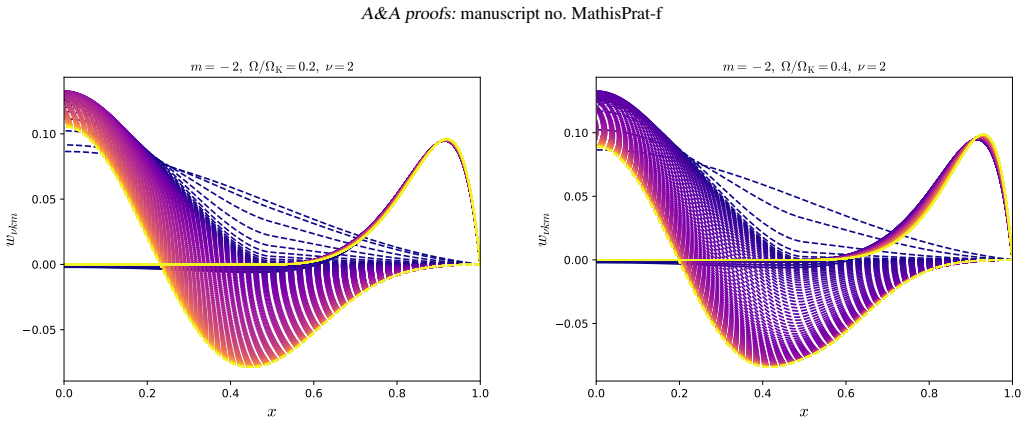
The central claim is that the TAR can be extended from spherical to slightly deformed, uniformly rotating stars by keeping the same frequency and amplitude hierarchies while working in spheroidal coordinates. For low-frequency gravito-inertial waves, the Cowling, anelastic, and JWKB approximations reduce the problem to a generalized Laplace tidal equation for the horizontal eigenfunction $w_{\nu km}(a,x)$ in $x=\cos\theta$, whose eigenvalue $\Lambda_{\nu km}(a)$ varies with the pseudo-radius $a$ through the deformation function $\varepsilon(a,\theta)$. This eigenvalue enters the dispersion relation $k_{V;\nu km}^2 = N^2 \Lambda_{\nu km}/(\omega^2 a^2)$ and, through the vertical quantization condition, the asymptotic period $P_{nkm}=2\pi^2(n+1/2)/\int_{a_{t1}}^{a_{t2}}\Lambda_{\nu km}^{1/2} N/a\, da$. The authors argue these formulas extend the standard TAR period-spacing diagnostics to stars rotating up to roughly $40\%$ of the Keplerian breakup rate, and their numerical solutions show that both gravity-like and Rossby-like branches change with pseudo-radius and undergo avoided crossings.
Load-bearing premise
The whole derivation rests on the assumption that the TAR's ordering of terms—buoyancy overwhelming the radial Coriolis force, and wave motions staying almost horizontal—remains valid inside a centrifugally deformed star, so the same terms can be dropped from the momentum equations even though the geometry is now spheroidal.
Editorial extensions
If this is right
- Asteroseismic period spacings can now be computed analytically for slightly deformed stars, replacing costly two-dimensional mode computations in the regime $\Omega\lesssim0.4\Omega_K$.
- Because $\Lambda_{\nu km}(a)$ varies with pseudo-radius, mode identification must account for the radial variation of the horizontal eigenfunctions rather than using a single spherical Hough function.
- Avoided crossings between gravity-like and Rossby-like branches as a function of $a$ alter the ordering of modes, which will affect how observed frequencies are assigned to quantum numbers.
- The same formalism provides the wave polarisation relations needed to compute angular-momentum transport and tidal dissipation by gravito-inertial waves in deformed stars and planets.
- The critical colatitude $\theta_c$ bounding sub-inertial wave propagation is shifted by deformation, broadening the equatorial propagation belt near the surface.
Reading between the lines
- A natural next step, not taken in the paper, is to combine the centrifugal deformation with the differential-rotation generalization of the TAR; the method appears to extend directly because the $a$-dependence of the coefficients is analogous to the radius-dependence in the differential-rotation case.
- The predicted $a$-dependence of the eigenvalues could make avoided crossings observable as characteristic deviations in period-spacing patterns of rapidly rotating $\gamma$ Doradus stars, offering a seismic probe of the deformation gradient itself rather than just of rotation.
- The first-order perturbation theory developed in Appendix B could be used to estimate tidal dissipation in deformed planets such as Saturn, an application the paper mentions but does not develop.
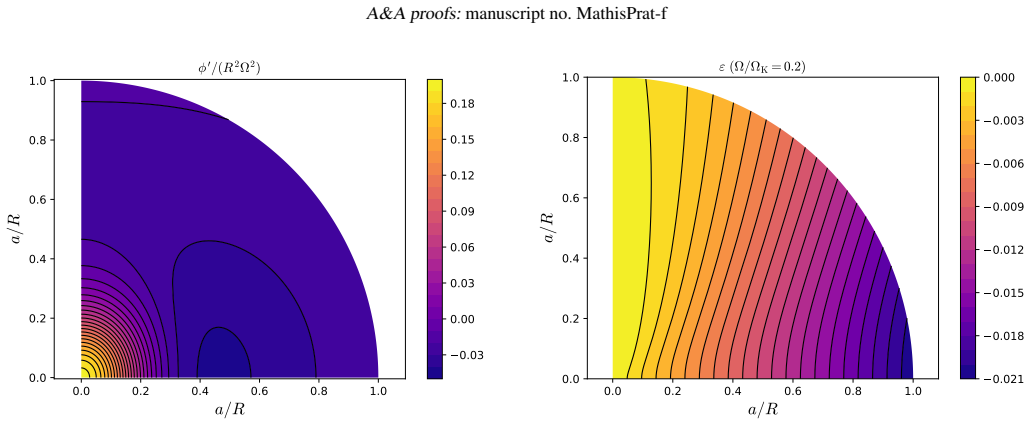
- Although $\varepsilon$ is only a few percent at $\Omega/\Omega_K=0.2$, the numerical results suggest the effects on eigenfunctions are amplified near turning points, which would be worth testing against direct simulations.
Signed reviews
Editorial analysis
A structured set of objections, weighed in public.
Referee Report
Summary. The paper generalizes the Traditional Approximation of Rotation (TAR) to uniformly rotating, slightly deformed stars by including the centrifugal acceleration. The authors work in a spheroidal coordinate system r = a[1 + ε(a, θ)], derive the linearized adiabatic wave equations under the Cowling, anelastic, and JWKB approximations, and obtain a generalized Laplace tidal equation (Eq. 35) whose eigenvalues Λνkm(a) depend on the pseudo-radius. From this they derive asymptotic frequencies and periods (Eqs. 38-39). They then compute ε from a perturbative hydrostatic model, solve the generalized Laplace tidal equation numerically for a 1.5 Msun ZAMS model, and show how eigenvalues, eigenfunctions, and avoided crossings vary with pseudo-radius and rotation rate.
Significance. If correct, the result is significant: it would provide an inexpensive analytical tool for computing low-frequency gravito-inertial mode frequencies and period spacings in moderately rotating deformed stars, complementing heavy 2D oscillation codes and extending the widely used spherical TAR. The paper has real strengths: the eigenvalue problem is derived, not fitted; ε is computed independently from hydrostatic balance and the perturbed gravitational potential, so there are no free parameters adjusted to the target seismology; and the formulation reduces to the classical spherical TAR when ε = 0. The numerical exploration of eigenvalue avoided crossings as a function of pseudo-radius is also a useful first step. However, the central derivation rests on assumptions that are asserted rather than demonstrated, and the non-orthogonality of the coordinate basis raises a serious correctness question for the main equations.
major comments (3)
- [Section 2, Eqs. (2)-(4) and Section 4, Eq. (35)] The basis defined in Eq. (2) is not orthogonal: e_a · e_θ = (1 + ε + a∂aε)∂θε is first order in ε, so the metric has a nonzero off-diagonal component g_{aθ}. Nevertheless, the operator ∇0 in Eq. (4) and all subsequent equations treat (a, θ) as orthogonal spherical coordinates; no g^{aθ} terms, Christoffel symbols, or mixed scale-factor derivatives appear. At first order in ε the true θ-component of ∇W' acquires a term proportional to ∂θε ∂_a W' that is absent from Eqs. (15)-(16), and the a-component acquires a corresponding term proportional to ∂θε ∂_θ W'. These omitted terms are of the same order as the centrifugal terms that are deliberately retained. Moreover, in the JWKB ansatz (31), ∂_a W' ~ i k_{V;νkm} W' can be large, so the omission is not automatically a small correction. The text does not show that the Lee-Baraffe formalism eliminates these off-diagonal metric contributions. The authors should either display the missing metric terms and prove their cancellation order by order in ε, or redo the derivation with the full covariant operators. This is load-bearing because Eq. (35) and the period formula (39) inherit any first-order error in ε.
- [Section 3, Eqs. (13)-(16)] The TAR hierarchy is carried over unchanged from the spherical case: the paper assumes 2Ω ≪ N and ξa ≪ ξθ, ξφ, and on this basis neglects the radial Coriolis term in Eq. (13), the coupling term (ξa/ξθ)∂θε in Eq. (15), and the horizontal projection of the rotation vector. No quantitative check of this hierarchy is given for the spheroidal geometry. In the numerical application (Sect. 6, Fig. 3), ε reaches about 2% at Ω/Ω_K = 0.2 and about 10% at Ω/Ω_K = 0.4 near the surface, where the ε-dependent factors A, B, and C (Eqs. 17-23) modify the horizontal equations. The paper's conclusion defers a comparison with 2D oscillation codes, but a scale analysis of the discarded terms as a function of a and θ — in particular whether ε-dependent geometrical terms can partially compensate the suppressed radial Coriolis term — would be needed to justify the neglect before the generalized Laplace equation is considered established.
- [Appendix A, Eqs. (A.25)-(A.26); Section 5, Eq. (39)] The pseudo-radius mapping r = a + (r_s/R - 1) a^2/R is chosen by hand as 'the simplest mapping' satisfying the center and surface conditions. Since the generalized Laplace eigenvalues Λνkm(a), the integral I in Eq. (40), and the predicted periods in Eq. (39) all depend on the pseudo-radial coordinate, any dependence of the final physical predictions on this ad hoc mapping would directly affect the seismic diagnosis. The paper does not demonstrate that Pnkm is invariant under changes of the pseudo-radius mapping at first order in ε, nor does it quantify the sensitivity. The authors should show the invariance, or estimate the resulting uncertainty; otherwise the mapping choice is an unquantified source of error in the central period formula.
minor comments (3)
- [Abstract and Introduction] There are several typographical errors: 'expended' should be 'expanded', 'Navier-Stockes' should be 'Navier-Stokes', 'writte' should be 'written', 'gravific' appears inconsistently, and 'chermical' should be 'chemical'.
- [Section 6] The numerical solution of the generalized Laplace tidal equation is described as using a Chebyshev implementation, but no convergence criteria, grid resolution, or validation against the known spherical case are reported beyond visual agreement with Lee & Saio (1997). A brief numerical validation statement would strengthen the reported avoided crossings and eigenvalue variations.
- [Appendix B.1 and Section 6] The first-order perturbative formulas in Appendix B.1 are presented but the numerical results in Section 6 appear to use a direct solution of Eq. (35). Please state explicitly which method produced Figs. 4-9, and whether the first-order expressions were used for any of the displayed results.
Circularity Check
No significant circularity: the generalised Laplace tidal equation and period formula are derived from stated physical assumptions, with the deformation function ε as an independently computed input.
full rationale
The paper's central claim, the generalized Laplace tidal equation (Eq. 35) and asymptotic periods (Eqs. 38-39), is not circular. Eq. (35) is obtained algebraically from the linearised momentum, continuity, and energy equations under the explicitly stated TAR, anelastic, and JWKB assumptions (Eqs. 13-20, 29-35). The only external input is the deformation field ε(a,θ), computed in Appendix A from hydrostatic balance and the perturbed Poisson equation (Eqs. A.17 and A.26); this computation does not use the wave eigenvalues or periods. The eigenvalues Λνkm(a) are the solutions of the resulting Sturm-Liouville problem, not fitted quantities, and the periods follow from the JWKB quantisation condition (Eq. 37). Citations to Mathis (2009), Ogilvie & Lin (2004), and Van Reeth et al. (2018) provide the analogous differential-rotation method and JWKB technique, but the ε-dependent coefficients and their numerical eigenvalue spectra are derived in this paper. The paper itself states that comparison with 2D oscillation codes remains future work; that is a validation gap and potential correctness concern, as is the potential non-orthogonality issue for the mapping r=a[1+ε(a,θ)], but neither makes the derivation equivalent to its inputs by construction. No circularity is found.
Assumptions & free parameters
assumptions (8)
- domain assumption TAR hierarchy: 2Ω << N and ξa << ξθ, ξφ, allowing neglect of radial Coriolis term and horizontal rotation-vector components.
- domain assumption Uniform rotation.
- domain assumption Cowling approximation: wave-induced gravitational potential perturbation neglected.
- domain assumption Adiabatic oscillations.
- domain assumption Anelastic and JWKB approximations for low-frequency GIWs.
- domain assumption Small centrifugal deformation: ε = O((Ω/Ω_K)^2), linearized hydrostatic balance.
- ad hoc to paper Pseudo-radius mapping r = a + (r_s/R - 1) a^2/R.
- domain assumption Truncation of the deformation expansion to l=0,2.
Cite this review
Pith. "Pith review of The Traditional Approximation of Rotation including the centrifugal acceleration for slightly deformed stars." pith.science (2026). https://pith.science/paper/RNWSA7CK
@misc{pith2026190806521,
  author       = {Pith},
  title        = {Pith review of: The Traditional Approximation of Rotation including the centrifugal acceleration for slightly deformed stars},
  year         = {2026},
  howpublished = {\url{https://pith.science/paper/RNWSA7CK}},
  note         = {Machine review of arXiv:1908.06521}
}
read the original abstract
The Traditional Approximation of Rotation (TAR) is a treatment of the dynamical equations of rotating stably stratified fluids where the action of the Coriolis acceleration along the direction of the entropy (and chemicals) stratification is neglected while assuming that the fluid motions are mostly horizontal because of their inhibition in the vertical direction by the buoyancy force. This leads to neglect the horizontal projection of the rotation vector in the equations for the dynamics of gravito-inertial waves (GIWs) that become separable as in the non-rotating case while they are not in the case with the full Coriolis acceleration. This approximation has been broadly applied in stellar (and planetary) astrophysics to study low-frequency GIWs. TAR is built on the assumptions that the star is spherical (i.e. its centrifugal deformation is neglected) and uniformly rotating while an adiabatic treatment of the dynamics of the waves is adopted. However, it has been recently generalised with including the effects of a differential rotation. We aim to do a new generalisation that takes into account the centrifugal acceleration in the case of moderately uniformly rotating deformed stars. As in the case of a differentially rotating spherical star, the problem becomes 2D but can be treated analytically if assuming the Cowling, anelastic and JWKB approximations, which are relevant for low-frequency GIWs. It allows us to derive a generalised Laplace tidal equation for the horizontal eigenfunctions and asymptotic wave periods that can be used to probe the structure and dynamics of rotating deformed stars thanks to asteroseismology. A first numerical exploration of its eigenvalues and horizontal eigenfunctions shows their variation as a function of the pseudo-radius for different rotation rates and frequencies and the development of avoided crossings.
Figures

Figures from the paper (5 more)




Reference graph
Works this paper leans on
-
[1]
, " * write output.state after.block = add.period write newline
ENTRY address archiveprefix author booktitle chapter edition editor howpublished institution eprint journal key month note number organization pages publisher school series title type volume year label extra.label sort.label short.list INTEGERS output.state before.all mid.sentence after.sentence after.block FUNCTION init.state.consts #0 'before.all := #1 ...
-
[2]
write newline
" write newline "" before.all 'output.state := FUNCTION n.dashify 't := "" t empty not t #1 #1 substring "-" = t #1 #2 substring "--" = not "--" * t #2 global.max substring 't := t #1 #1 substring "-" = "-" * t #2 global.max substring 't := while if t #1 #1 substring * t #2 global.max substring 't := if while FUNCTION word.in bbl.in " " * FUNCTION format....
-
[3]
Aerts , C., Christensen-Dalsgaard , J., & Kurtz , D. W. 2010, Asteroseismology
2010
-
[4]
2018 a , arXiv e-prints [ [arXiv] 1809.07779 ]
Aerts , C., Mathis , S., & Rogers , T. 2018 a , arXiv e-prints [ [arXiv] 1809.07779 ]
arXiv 2018
-
[5]
Aerts , C., Molenberghs , G., Michielsen , M., et al. 2018 b , , 237, 15
work page 2018
- [6]
-
[7]
Alvan , L., Strugarek , A., Brun , A. S., Mathis , S., & Garcia , R. A. 2015, , 581, A112
work page 2015
-
[8]
Ballot , J., Ligni \`e res , F., Reese , D. R., & Rieutord , M. 2010, , 518, A30
work page 2010
Show all 65 references
-
[9]
1978, , 70, 597
Berthomieu , G., Gonczi , G., Graff , P., Provost , J., & Rocca , A. 1978, , 70, 597
1978
-
[10]
2013, , 429, 2500
Bouabid , M.-P., Dupret , M.-A., Salmon , S., et al. 2013, , 429, 2500
2013
-
[11]
Braviner , H. J. & Ogilvie , G. I. 2014, , 441, 2321
2014
-
[12]
Braviner , H. J. & Ogilvie , G. I. 2015, , 447, 1141
2015
-
[13]
1933, , 93, 390
Chandrasekhar , S. 1933, , 93, 390
1933
-
[14]
Christophe , S., Ballot , J., Ouazzani , R.-M., Antoci , V., & Salmon , S. J. A. J. 2018, , 618, A47
2018
-
[15]
1986, Quantum Mechanics, Volume 2 , 626
Cohen-Tannoudji , C., Diu , B., & Laloe , F. 1986, Quantum Mechanics, Volume 2 , 626
1986
-
[16]
Cowling , T. G. 1941, , 101, 367
1941
-
[17]
1999, Journal of Fluid Mechanics, 398, 271
Dintrans , B., Rieutord , M., & Valdettaro , L. 1999, Journal of Fluid Mechanics, 398, 271
1999
-
[18]
o man , N. & Fr \
Fr \"o man , N. & Fr \"o man , P. O. 2005, Physical Problems Solved by the Phase-Integral Method , 228
2005
-
[19]
2016, , 458, 3867
Fuller , J., Luan , J., & Quataert , E. 2016, , 458, 3867
2016
-
[20]
& Shrira , V
Gerkema , T. & Shrira , V. I. 2005, Journal of Fluid Mechanics, 529, 195
2005
-
[21]
Gerkema , T., Zimmerman , J. T. F., Maas , L. R. M., & van Haren , H. 2008, Reviews of Geophysics, 46, RG2004
2008
-
[22]
Hough , S. S. 1898, Philosophical Transactions of the Royal Society of London Series A, 191, 139
-
[23]
W., Saio , H., Takata , M., et al
Kurtz , D. W., Saio , H., Takata , M., et al. 2014, , 444, 102
2014
-
[24]
1993, The Astrophysical Journal, 405, 359
Lee , U. 1993, The Astrophysical Journal, 405, 359
1993
-
[25]
& Baraffe , I
Lee , U. & Baraffe , I. 1995, Astronomy & Astrophysics, 301, 419
1995
-
[26]
2014, , 443, 1515
Lee , U., Neiner , C., & Mathis , S. 2014, , 443, 1515
2014
-
[27]
& Saio , H
Lee , U. & Saio , H. 1987, , 224, 513
1987
-
[28]
& Saio , H
Lee , U. & Saio , H. 1989, , 237, 875
1989
-
[29]
& Saio , H
Lee , U. & Saio , H. 1993, , 261, 415
1993
-
[30]
& Saio , H
Lee , U. & Saio , H. 1997, , 491, 839
1997
-
[31]
R., Murphy , S
Li , G., Bedding , T. R., Murphy , S. J., et al. 2019, , 482, 1757
2019
-
[32]
Longuet-Higgins , M. S. 1968, Philosophical Transactions of the Royal Society of London Series A, 262, 511
1968
-
[33]
2009, , 506, 811
Mathis , S. 2009, , 506, 811
2009
-
[34]
2008, , 251, 101
Mathis , S., Talon , S., Pantillon , F.-P., & Zahn , J.-P. 2008, , 251, 101
2008
-
[35]
& Zahn , J.-P
Mathis , S. & Zahn , J.-P. 2004, , 425, 229
2004
-
[36]
J., Fossati , L., Bedding , T
Murphy , S. J., Fossati , L., Bedding , T. R., et al. 2016, , 459, 1201
2016
-
[37]
Ogilvie , G. I. & Lin , D. N. C. 2004, , 610, 477
2004
-
[38]
Ogilvie , G. I. & Lin , D. N. C. 2007, , 661, 1180
2007
-
[39]
Ouazzani , R.-M., Dupret , M.-A., & Reese , D. R. 2012, , 547, A75
2012
-
[40]
M., Marques , J
Ouazzani , R. M., Marques , J. P., Goupil , M. J., et al. 2019, , 626, A121
2019
-
[41]
Ouazzani , R.-M., Salmon , S. J. A. J., Antoci , V., et al. 2017, , 465, 2294
2017
-
[42]
B., et al
Paxton , B., Schwab , J., Bauer , E. B., et al. 2018, , 234, 34
2018
-
[43]
G., Aerts , C., P \'a pics , P
Pedersen , M. G., Aerts , C., P \'a pics , P. I., & Rogers , T. M. 2018, , 614, A128
2018
-
[44]
2016, , 587, A110
Prat , V., Ligni \`e res , F., & Ballot , J. 2016, , 587, A110
2016
-
[45]
2018, , 615, A106
Prat , V., Mathis , S., Augustson , K., et al. 2018, , 615, A106
2018
-
[46]
2017, , 598, A105
Prat , V., Mathis , S., Ligni \`e res , F., Ballot , J., & Culpin , P.-M. 2017, , 598, A105
2017
-
[47]
2006, , 455, 621
Reese , D., Ligni \`e res , F., & Rieutord , M. 2006, , 455, 621
2006
-
[48]
Roxburgh , I. W. 2006, , 454, 883
2006
-
[49]
1981, The Astrophysical Journal, 244, 299
Saio , H. 1981, The Astrophysical Journal, 244, 299
1981
-
[50]
W., Takata , M., et al
Saio , H., Kurtz , D. W., Takata , M., et al. 2015, , 447, 3264
2015
-
[51]
& Denis , J
Smeyers , P. & Denis , J. 1971, Astronomy & Astrophysics, 14, 311
1971
-
[52]
Sweet , P. A. 1950, , 110, 548
1950
-
[53]
1978, Theory of rotating stars
Tassoul , J.-L. 1978, Theory of rotating stars
1978
-
[54]
1980, , 43, 469
Tassoul , M. 1980, , 43, 469
1980
-
[55]
Townsend , R. H. D. 2003, , 340, 1020
2003
-
[56]
Van Reeth , T., Mombarg , J. S. G., Mathis , S., et al. 2018, , 618, A24
2018
-
[57]
2016, , 593, A120
Van Reeth , T., Tkachenko , A., & Aerts , C. 2016, , 593, A120
2016
-
[58]
2015 a , , 574, A17
Van Reeth , T., Tkachenko , A., Aerts , C., et al. 2015 a , , 574, A17
2015
-
[59]
2015 b , , 218, 27
Van Reeth , T., Tkachenko , A., Aerts , C., et al. 2015 b , , 218, 27
2015
-
[60]
P., & Akmaev , R
Wang , H., Boyd , J. P., & Akmaev , R. A. 2016, Geoscientific Model Development, 9, 1477
2016
-
[61]
Zahn , J. P. 1966, Annales d'Astrophysique, 29, 313
1966
-
[62]
1992, , 265, 115
Zahn , J.-P. 1992, , 265, 115
1992
-
[63]
@esa (Ref
\@ifclassloaded agu2001 natbib The agu2001 class already includes natbib coding, so you should not add it explicitly Type <Return> for now, but then later remove the command natbib from the document \@ifclassloaded aguplus natbib The aguplus class already includes natbib codin...
-
[64]
@stdbsttrue NAT@ctr \@lbibitem[ NAT@ctr ] \@lbibitem[#1]#2 \@extra@b@citeb \@ifundefined br@#2\@extra@b@citeb \@namedef br@#2 \@nameuse br@#2\@extra@b@citeb \@ifundefined b@#2\@extra@b@citeb @num @parse #2 [ @natanchorstart #2\@extra@b@citeb \@biblabel @num @natanchorend] @ifc...
-
[65]
@open @close @open @close and [1] URL: #1 \@ifundefined chapter * \@mkboth \@ifundefined NAT@sectionbib * \@mkboth * \@mkboth\@gobbletwo \@ifclassloaded amsart * \@ifclassloaded amsbook * \@ifundefined bib@heading @heading NAT@ctr thebibliography [1] @ \@biblabel NAT@ctr \@bib...
Reviewed August 14, 2026 · model on record in the stance chip above.
Discussion (0). Continue with ORCID to comment.